Part 1
My name is Alyssa Monroe. I’m twenty-five, and the first time my brother ruined me in public, I was seven years old and wearing a paper crown from Burger King.
He told our cousins I’d wet my pants at school. I hadn’t. I was holding a cardboard cup of orange soda with both hands, the ice clinking against the sides, when everyone at the table looked at me and laughed anyway. My mother laughed too. Not hard, not with her whole chest. Just enough to let me know which side she was on.
At twenty-five, I should’ve known better than to think Italy would be different.
Naples hit me first through smell. Hot oil. Salt. Diesel. Dough frying somewhere nearby. Not the soft, chilled floral air I’d pictured around a wedding hotel in Florence. Not white roses and champagne and candle wax. This air had teeth. It curled into my silk dress and made me feel overdressed, misplaced, ridiculous.
The taxi driver had already pulled away by the time I noticed the hotel awning wasn’t the one from the Pinterest board I’d spent three months helping my brother’s fiancée put together. No gold crest. No marble lions. No staff in cream uniforms. Just a sun-faded sign, a chipped planter with a dead fern in it, and a teenage bellboy smoking beside the entrance with his tie hanging loose.
I stood on the curb with my suitcase handle digging into my palm.
“Scusi,” I said to the girl at the front desk a minute later, trying not to sound panicked. “I’m here for the Hawthorne-Vale wedding party?”
She blinked. “No wedding here.”
My stomach went cold so fast it almost felt clean.
I pulled up the itinerary email, the one my brother had forwarded with a careless “You’re a lifesaver, Lyss, handle this?” tone that had followed me my whole life. The confirmation was there. Hotel Santa Lucia. Naples. Check-in for Friday. Wedding weekend.
Except the wedding website still said Florence. The venue still said Villa Bellarosa, Florence Hills. Welcome dinner, Florence. Ceremony, Florence. Brunch, Florence.
I checked the train times with shaking fingers. Two hours and fifty-eight minutes if I caught one in forty minutes. Longer with luggage. Longer in heels. Longer in humiliation.
I called my brother first.
He didn’t answer.
I called again.
Straight to voicemail.
Then my phone lit up with a text.
LOL, didn’t want to invite you.
I stared at the screen so long the words stopped looking like language.
Another message popped up before I could breathe.
Thought you’d figure it out eventually. Relax. It’s funny.
Funny.
My throat closed. Around me, the hotel lobby hummed with cheap air-conditioning and the clatter of someone dragging a mop bucket over tile. A television mounted in the corner showed a soccer recap with the volume too loud. Somewhere outside, a scooter barked past in a burst of engine noise. Everything felt too sharp, too bright, too ordinary for what had just happened.
I called my mother.
She answered on the second ring, as if she’d been waiting.
“Mom.”
“Alyssa, I’m busy.”
“I’m in Naples.”
A pause. Not confusion. Not alarm. A pause shaped exactly like guilt.
“So?” she said.
“The wedding is in Florence.”
Another pause, smaller this time, like she was deciding how much cruelty to use. “Then why are you in Naples?”
My hand tightened around my phone. “Because that’s the hotel confirmation Ethan sent me.”
“Hm.” I could picture her making that face she always made when something ugly had happened and she intended to survive it by acting bored. “Well, maybe check more carefully next time.”
“Mom, he texted me that he did it on purpose.”
Now her voice changed. It went flat and hard. “Stop faking confusion. It’s your fault for making everything into drama.”
I looked around the lobby, at the cracked tile near the front desk, at the potted palm shedding brown ribbons onto the floor, at my pale silk dress reflected in the glass door like I was some ghost who’d wandered into the wrong life.
“My fault,” I said.
“Yes,” she snapped. “Honestly, Alyssa, the attention-seeking never ends with you.”
Then she hung up.
I wish I could tell you I cried right there, dramatic and broken in the lobby of that mediocre hotel while strangers pretended not to look. But I didn’t. I did something worse.
I checked in.
I smiled at the receptionist. I handed over my passport. I let her tag my suitcase. I thanked her when she gave me the key card and explained breakfast hours in careful English. I rode the elevator to the fourth floor with an elderly couple who smelled like sunscreen and peppermints, and when the doors opened, I walked down a narrow hall with framed prints of lemons and coastlines, and I went into my room and stood there in silence.
The room wasn’t terrible. That almost made it crueler.
A narrow bed. A little balcony with a rusting metal chair. A white bathroom with a flickering vanity light. A bowl of wrapped candies at the desk. My garment bag laid across the bed like a body.
I sat beside it and stared at the wall until my phone buzzed again.
This time it was my brother, Ethan.
You’ll get over it.
Then:
Can you at least not ruin the vibe by posting?
I laughed. It came out ugly. Small and cracked.
You know what kills me? Not that he did it. Not even that he enjoyed it. It was that my first instinct, even then, was to inventory my mistakes. Had I said something wrong in the last few weeks? Had I been too involved in the planning? Not involved enough? Did Camille—his fiancée—hate me? Had my mother finally gotten tired of pretending she could stand me in photos?
I sat there and replayed everything that had brought me to Italy.
The deposits.
The florist.
The midnight calls.
The way Ethan always said, “You’re better at this stuff than I am,” as if incompetence were a crown people should admire on him.
The way Mom called me “reliable” in that tone that meant useful, not loved.
It had started six months earlier with a coffee-stained legal pad and Ethan crying at my kitchen table because his venue budget had exploded and Camille was threatening to cancel the wedding if they couldn’t save face.
“Alyssa,” he’d said, eyes red, voice raw, “I’m asking because you’re the only one I trust.”
Trust. Another word that had only ever meant I would pay.
By sunset in Naples, I had taken off my heels, washed my face, and booked a flight home for Monday. I told myself I’d take the weekend, breathe, eat something decent, see the water maybe. Pretend this wasn’t annihilation.
But annihilation has a way of following you into small rooms.
At dusk, the city turned gold outside my balcony. Church bells rang somewhere far off, then closer. A woman shouted up from the street. Plates clinked below in a restaurant I couldn’t see. The air carried sea salt and hot sugar.
I stood there with my hands wrapped around the railing and realized something that should have occurred to me years earlier.
My family didn’t just overlook me.
They arranged me.
Like lighting. Like cutlery. Like emergency funds.
Useful when needed. Invisible when not.
That was the moment the hurt began hardening into something cleaner. Something with edges.
Because when I booked my ticket home, I didn’t just pack clothes.
I packed intention.
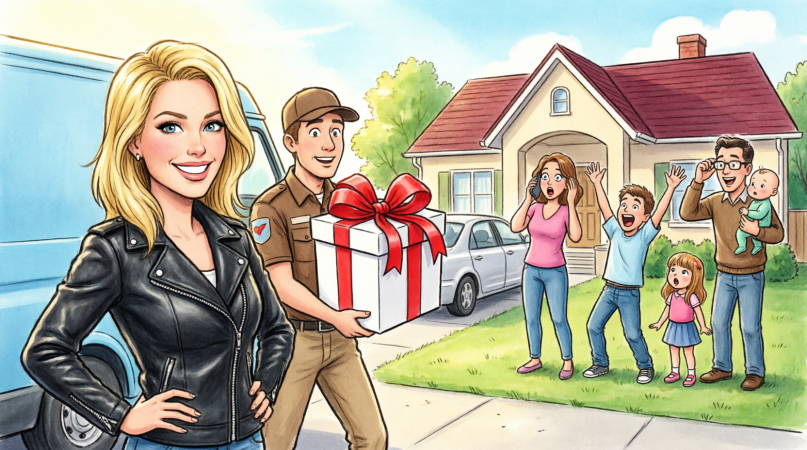
And before a courier rang my mother’s doorbell with something too large and too deliberate to ignore, I needed to understand exactly how deep the rot went.
My phone buzzed one more time before I went inside. It was a photo from Florence—white roses, candlelight, my brother in black tie, grinning under the fairy lights I had paid for.
And in the back corner of the shot, half-cut off by the frame, I saw Camille looking straight into the camera with an expression I couldn’t quite read.
Not joy. Not surprise.
Something closer to fear.
So who exactly had been laughing when they sent me away?
Part 2
If you’d met my brother Ethan at a party, you probably would’ve liked him.
He had that easy, expensive kind of charm men get praised for even when they didn’t earn it. Tall without working for it. Funny when the target wasn’t you. The kind of face strangers trusted. He could spill red wine on someone’s rug, apologize with a crooked smile, and somehow leave with a bigger tip jar and three new phone numbers.
I spent most of my life being the cleanup crew after his weather passed through.
The thing about golden children is they’re rarely golden alone. Somebody has to polish them. Somebody has to explain away the dents. In our house, that was my mother, Diane, with her pressed cardigans and her careful voice and her endless ability to translate Ethan’s cruelty into personality.
“He’s spirited.”
“He doesn’t mean it.”
“You know how he is.”
Those were her favorite hymns.
My father had been softer, or maybe just quieter. He died when I was fifteen, a Tuesday in November that smelled like wet leaves and burnt coffee from the church basement where people brought casseroles we didn’t need. After that, the house got sharper. Ethan became “the man of the family,” which was funny, considering he couldn’t load a dishwasher without acting like he deserved a medal. Mom became more devout about him. More invested. More protective. Like grief had taken one of her pillars and she’d decided to build the next one entirely out of her son.
I became the spare set of hands.
By nineteen, I was the one comparing utility bills, scheduling the plumber, making sure Ethan mailed his insurance forms on time, reminding Mom about prescription refills, scanning school documents, balancing calendars, wrapping gifts, smoothing conflict, translating everyone’s chaos into something survivable.
“Family means loyalty,” Mom used to say while handing me another task.
She never meant me. She meant my obedience.
When Ethan got engaged to Camille Hawthorne, the family acted like royalty had announced a state marriage.
Camille came from money that didn’t have to explain itself. Old house money. Vacation-house money. “Summering” somewhere money. Her parents lived in Connecticut in a home with gravel that crunched in a refined way under tires. The first time I met them, her mother kissed my cheek and called me “the organized sister,” which should’ve been a compliment but somehow landed like a job title.
Camille herself was beautiful in a careful way. Blonde hair that always looked accidentally perfect. Teeth that had definitely cost something. She wore silk like it was a neutral. She was also, at first, very good at making me feel chosen.
“Alyssa, you’re the only sane person in this circus.”
“Alyssa, can you look at these florist bids?”
“Alyssa, I swear I’d drown without you.”
It’s embarrassing now, how easily I confused being useful with being loved.
I remember one night in February, rain streaking my apartment windows while I sat cross-legged on the floor with my laptop open and three vendor spreadsheets spread around me. Camille was on FaceTime from a white kitchen so immaculate it looked staged.
“Okay,” I said, “if we cut the champagne tower and switch the welcome bags to local pastries instead of custom monogrammed boxes, you can save almost six thousand.”
She leaned closer to the screen. “You’re a genius.”
“No,” I said, smiling despite myself. “I’m just not emotionally attached to tiny jars of imported honey.”
She laughed. Then her face changed, softened. “I mean it, Alyssa. Ethan’s lucky to have you.”
The stupidest part is that I believed her.
Three weeks later, Ethan showed up at my apartment looking like a man fleeing a fire. His hair was damp from the snow, his jaw shadowed with stubble, coat half-zipped. He paced between my couch and kitchen counter while I made him coffee.
“The villa wants another deposit by Friday,” he said. “Camille’s dad backed out of covering the difference because of some stock thing or tax thing or whatever. She’s freaking out. Her mom says if the venue changes, people will talk.”
“People always talk,” I said.
“You know what I mean.” He dragged both hands down his face. “I can’t have this blow up.”
I should’ve said that weddings aren’t emergencies.
I should’ve said adults adjust.
Instead I asked, “How much?”
He told me.
I remember the sound my refrigerator made right then, that low old hum, and the smell of the coffee between us, dark and slightly burnt because I’d left it on the hot plate too long. I remember staring at him and hearing my own heartbeat like a fist inside my ears.
“That’s insane.”
“I know.” His voice cracked. “I know, Alyssa. I’m just asking for a bridge. A temporary thing. We’ll repay you after the wedding. Camille’s trust disbursement comes in August. Mom said maybe you’d understand.”
Mom said maybe you’d understand.
Of course she had.
“How much have you already put down?” I asked.
He named numbers like they were weather. Venue. Catering hold. Musicians. Lighting. Floral minimum. Photography retainer. Travel concierge. By the time he was done, my stomach hurt.
“You booked all this without having the money?”
He sat on my couch and looked at me with the same face he used when we were kids and he wanted me to take the blame for something broken. “I thought I would. And then things shifted.”
Things shifted. Not he lied. Not he gambled on appearances. Not he signed contracts he couldn’t cover. Things shifted.
“I don’t have that kind of money lying around,” I said.
That was only half true.
I had savings. Good savings. Money from four years of work in event strategy, from freelancing weekends, from saying no to vacations, no to nicer apartments, no to the impulsive little luxuries people my age were supposed to enjoy. I had money because I liked safety. Because after growing up in a house where care was conditional, I found comfort in numbers that stayed where I put them.
He looked at the bookshelf behind me instead of at my face. “I know. I know what I’m asking.”
That, more than anything, did it. The act. The shame-colored voice. The pretense that he understood sacrifice because he had learned to mimic its silhouette.
“Why can’t Mom help?”
He laughed once, bitter. “Mom has eight thousand in a money market and three hundred thousand opinions. She says this is the kind of thing siblings do.”
That night I didn’t sleep. I ran budgets until dawn. I opened and closed my banking apps. I walked barefoot over the cold wood floor of my apartment while rain ticked at the windows.
At 4:12 a.m., I made a spreadsheet called WEDDING BRIDGE.
At 8:03 a.m., I sent Ethan a text: I can cover some of it. Under conditions.
He showed up with pastries and a hug I didn’t want.
The conditions got blurrier over time. Of course they did. A little more here. An advance there. One vendor card charged to “keep things moving.” Then another. Then the florist lost imported ranunculus in a shipping issue and needed replacement funds. Then the rehearsal dinner menu had to change because Camille’s mother suddenly decided burrata was “too provincial.” Then a planner quit and somehow I became the planner without the title.
Months passed like that. My kitchen table became a command center. Swatches, contracts, ribbon samples, invoices, seating charts, customs forms, currency conversions. Midnight phone calls. Early morning emails. Camille crying over linens. Ethan panicking over guest optics. Mom forwarding me articles about Italian tipping etiquette like I was an intern.
I told myself it would mean something in the end.
Maybe not gratitude exactly. Maybe not transformation. But something.
Maybe one sincere look across a candlelit room. One toast. One acknowledgment that I wasn’t just an ATM with good instincts.
Then came the first clue that something was wrong.
It was small. So small I almost missed it.
I was on a group video call in late May, finalizing transportation from the Florence hotels to the villa. Camille was distracted, twisting her engagement ring. Ethan kept muting himself to answer another phone. Mom was in frame only from the shoulders up, as if hiding in a booth.
I said, “I’ll be landing Friday morning, so send me the updated car assignment and I’ll meet everyone at the welcome dinner.”
There was a beat of silence.
Camille looked at Ethan.
Ethan looked at Mom.
And Mom smiled too quickly and said, “We’ll handle you separately.”
You separately.
At the time, it sounded like logistics.
By the time I understood what it really meant, I was standing alone in Naples with sea salt on my skin and a dead fern outside my hotel.
But that wasn’t the only clue I’d ignored.
Two nights after I got home from Italy, I opened my inbox and found an old attachment I didn’t remember saving.
It was a seating chart draft from three weeks before the wedding.
My name wasn’t on it.
So how long had they planned for me not to be there?
Part 3
The first morning after I got back from Italy, I woke up with salt still in my hair.
Not literally. I had showered in Naples, showered again at JFK, showered the minute I got into my apartment. But some smells stay in your nerves. The city had followed me home—fried dough, damp stone, exhaust, bitterness. I made coffee and stood in my kitchen in an oversized T-shirt while the machine hissed and dripped, and for one disorienting second I forgot what had happened.
Then I saw the garment bag slumped over the chair.
The pale silk dress inside it had never been worn for what it was meant for. It was still tagged under one sleeve. Soft, expensive, the exact shade of diluted champagne. Camille had helped me pick it. “Elegant but not attention-seeking,” she’d said, laughing like we were girlfriends.
I left the coffee untouched and unzipped the bag.
There are few things sadder than formalwear that never got its occasion.
The fabric slid cool over my fingertips. The room was quiet except for the refrigerator’s hum and the distant scrape of a garbage truck outside. I pressed the dress against my face, smelled cedar from my closet and the faint ghost of the perfume I’d sprayed on in that hotel bathroom in Naples, and something hot and ugly rose in my chest.
Not grief. Not exactly.
Waste.
I folded the dress back up so carefully it felt like violence.
Then I sat down with my laptop and started pulling records.
I’m not proud of how calm I was. That calm scared me a little. But rage had always made me clumsy, and my family knew how to survive clumsy emotion. They thrived on it. If I cried, I was dramatic. If I yelled, I was unstable. If I explained, I was overthinking. They had trained me out of open fury the way people train dogs out of barking indoors.
So I did what they’d trained me to do best.
I organized.
Bank statements. Wire confirmations. Credit card charges. Vendor contracts. Screenshots of texts. Every payment tied to the wedding got pulled into one folder on my desktop. I named it FLORENCE.
By noon, I had six subfolders and a spreadsheet with tabs.
Venue.
Floral.
Lighting.
Wardrobe support.
Guest logistics.
Emergency bridge transfers.
The total at the bottom stared back at me in crisp black numbers.
$77,042.16
I sat with that number until it lost meaning and became shape. Seventy-seven thousand dollars. More money than my father left me when he died. More than a down payment in the county where I lived. More than Ethan had probably ever saved in one place in his life.
I thought of the photos already circulating online.
Florence lit up my brother’s smile in every one of them. White roses. Golden chandeliers. Candlelight kissing the rims of crystal glasses. Camille in ivory silk and lace, radiant in the gown I had partly covered when the boutique “unexpectedly” increased her alteration fees. Ethan in a tux, hand at the small of her back like he’d built the evening himself.
People were tagging me.
Where are you???
Thought you’d be maid of honor lol
Alyssa did you do all this? It’s gorgeous
I didn’t answer any of them.
Instead, I clicked through image after image and watched myself disappear in real time.
The welcome dinner was at the terrace restaurant where I had negotiated the per-head rate after the original quote came back absurd. The string quartet on the lawn? My contact. The custom stationery? Paid after Ethan swore he’d hit a limit. The late-night gelato cart everyone was posting with little heart emojis? My idea, my vendor, my invoice.
Ghost sponsor. That was the phrase that came into my mind.
I was haunting a wedding I funded and wasn’t allowed to attend.
Around three in the afternoon, my friend Noelle came over with Thai takeout and the expression people wear when they know enough not to say “Are you okay?”
Noelle and I had met in college in the least cinematic way possible—fighting over the last open outlet in the library during finals week. She had copper-colored curls, a laugh that came out in bursts like she was surprising herself, and a moral compass so functional it made other people seem underfurnished.
She set the food on my counter, took one look at my face, and said, “Tell me everything, but if you try to defend them, I’m leaving.”
So I told her. Naples. The text. My mother’s voice. The photos. The seating chart draft without my name. The money.
When I got to the total, she put her fork down very carefully. “You gave your brother seventy-seven thousand dollars?”
“Technically forty-eight in direct transfers and the rest in covered vendor costs.”
“Alyssa.”
“I know.”
“No, I don’t think you do.”
The basil and fish sauce smell from the takeout filled the kitchen. Outside, a siren passed, then faded. Noelle leaned back against my counter and studied me with narrowed eyes.
“Did Camille know?”
That was the question I had been dodging all day.
“I don’t know.”
“You think she didn’t?”
I thought of her face in that wedding photo. The way she’d looked at the camera from the back corner of the frame, not joyous, not smug. Tense. Watching.
“I think,” I said slowly, “she knew something.”
Noelle tapped a fingernail against her takeout container. “Then find out.”
“How?”
“You have all this.” She gestured toward my laptop, the folders, the printouts, the digital fortress of proof. “Start with the trail.”
I nodded, but shame crawled through me anyway. Because the trail didn’t just lead to them. It led to me. To every moment I had accepted crumbs and called it closeness. To every time I had stepped in because being needed felt adjacent to being cherished.
After Noelle left, I went back through my messages with Camille.
At first, they were normal wedding chaos. Dress photos. Venue questions. Guest count drama. Her mother objecting to local olive oil favors because they were “too farmstand.” Ethan vanishing during critical decisions. Me solving everything.
Then, around mid-June, the tone changed.
She stopped asking for anything directly.
Instead, she sent odd little check-ins.
You booked your travel, right?
What hotel did Ethan send?
You’re arriving Friday, not Thursday?
Did he forward the transport memo?
At the time, I read those as anxious bride energy. Now I saw the seams.
She hadn’t been making conversation.
She had been checking what version of the lie I had.
My chest went tight.
I clicked one message from twelve days before the wedding.
Just making sure you got the final itinerary from Ethan because there were “updates” lol.
There were quotation marks around updates.
I hadn’t noticed that before.
I went colder with every scroll.
Another message, a week later:
You should text me when you land. Just in case.
Just in case what?
At 11:47 p.m., after three hours of rereading, one detail surfaced like a hand from dark water. In the metadata of the seating chart draft, the file creator wasn’t Camille.
It was Diane Monroe.
My mother had made the chart where I didn’t exist.
I was still staring at that when an email notification slid across the corner of my screen. New message. No subject line. From an address I didn’t know.
I opened it.
The body contained only one sentence.
She told us you weren’t coming because you were “unstable.”
Attached was a screenshot from a bridesmaids’ group chat.
And there, in my mother’s words, was the first real crack in the story I’d been told.
Part 4
The screenshot looked fake for the first ten seconds.
Maybe that was my brain protecting itself. Maybe it was just how bizarre it felt to see my mother’s cruelty laid out in a font so casual, in a bubble so soft-colored, as if malice were just another group text housekeeping note.
The screenshot came from a chat called Bellarosa Girls. Eight participants. Little profile pictures in a row. And there, above a string of lipstick emojis and menu chatter, was my mother’s message.
Alyssa won’t be joining us after all. She’s having one of her episodes and thought it would be best not to come. Let’s all be gracious and not make it a thing this weekend.
Episodes.
I read it three times. Then again.
I had no episodes. I’d had one panic attack in college after a seventeen-hour work-study shift and an organic chemistry exam, and somehow that single event had lived in family mythology ever since as proof that I was fragile, dramatic, unstable when pressured. Ethan had once called me “our little collapse artist” at Thanksgiving and everyone laughed except my father, who was already sick then and too tired to start a war over one more insult.
My mother had weaponized that history and used it to explain my absence.
Not lost.
Not misdirected.
Not pranked.
Unstable.
I wrote back to the unknown sender before I could overthink it.
Who is this?
The reply came two minutes later.
Lena. One of Camille’s cousins. We met at the shower, you helped me fix the place card printer.
I remembered her vaguely. Short dark hair, silver rings, a warm laugh, the kind of person who noticed equipment before aesthetics. She had spent fifteen minutes on the floor with me in a country club ballroom trying to clear a jammed printer while Camille’s aunt complained nearby about peonies.
Why are you sending this? I typed.
Because it was messed up. And because Camille looked like she was going to throw up when your mom said it out loud Friday.
I stared at that message so hard my vision pulsed.
Out loud.
So the lie had been rehearsed in person too.
My fingers moved faster now.
Did Camille know I was sent to Naples?
The typing dots appeared. Disappeared. Reappeared.
Not at first, Lena wrote. I don’t think so. But she definitely knew by the rehearsal dinner. I heard her and Ethan fighting behind the kitchen doors. She said, “This is psychotic.” He said, “It’s done now.”
The room around me narrowed. The edges of my desk, the lamp, the coffee mug with yesterday’s brown ring inside it—all of it seemed suddenly overlit, like truth had turned up the wattage.
Camille hadn’t started it.
But she had stayed.
There it was. The first real red herring of the whole mess clearing out of the water. I had spent two days wondering if my brother’s bride had engineered the prank because she wanted me erased from her fairy-tale weekend. Maybe she still wanted me gone. Maybe she enjoyed the result. But this, at least, suggested the rot had started where it usually did—with Ethan’s need to feel powerful and my mother’s appetite for letting him.
I called Lena.
She answered in a whisper. “Hi.”
“Are you somewhere you can talk?”
A door shut on her end. Then a rush of air. “Now I am.”
I sat at my desk with one hand gripping my own knee hard enough to hurt. “Tell me everything.”
And she did.
Not elegantly. Not like someone delivering a witness statement. More like a person emptying her pockets of something she hadn’t wanted to carry. She told me she’d heard my mother at the rehearsal dinner explaining my absence to Camille’s side of the family with a smile tight as a seam. She told me Ethan had laughed when one of his college friends asked whether I’d “bailed again.” She told me that during hair and makeup the morning of the wedding, Camille had gone quiet after checking her phone and asked twice whether anyone had spoken to me directly.
“She showed Ethan something on her screen,” Lena said. “I couldn’t see what. But he grabbed her wrist and took the phone. Not hard enough to leave a mark or anything. Just… controlling.”
The word landed with a sound in my body, like a lock engaging.
“Did anyone try to call me?” I asked.
“I don’t know. Camille disappeared for about twenty minutes before the ceremony. When she came back, her mascara had been redone.”
I looked down at my own hands. My nails were bitten ragged from Naples. I hadn’t even noticed.
“Why didn’t you tell me sooner?”
“I only got your email from the shower RSVP chain, and honestly?” Lena exhaled. “Your family scared me.”
That almost made me laugh. Of course they did. People like my mother and brother always look polished from a distance. You don’t see the teeth until you get close.
After I hung up, I went back through my call log from the wedding weekend.
No missed calls from Camille.
No voicemails.
One unknown number on Saturday morning at 9:14 a.m., the exact time hair and makeup would’ve been in full swing in Florence. I’d ignored it because I was standing in line for a coffee and sfogliatella in Naples, wearing sunglasses to hide the fact that I’d been crying in public.
I dialed the number.
It rang four times.
Then a woman answered, cautious. “Hello?”
“This is Alyssa Monroe. You called me Saturday morning.”
Silence. Then a soft, sharp intake of breath.
“Alyssa,” Camille said.
Her voice was lower than I expected. Hoarse, maybe from disuse, maybe from stress, maybe from the kind of crying you do with your mouth closed so no one hears.
“You called,” I said.
“I did.”
“Why?”
A long pause. I could hear something faint on her end—ice in a glass, maybe, and the muffled sound of a television in another room.
“Because by then I knew.”
Those four words should have felt like relief. Instead they hurt.
“And?”
“And I was in a white dress with eight people touching my face,” she said, with a bitterness that sounded new on her. “And your brother was telling me not to create a scene.”
I stood up so fast my chair rolled back and hit the wall.
“You let me stay there.”
“Yes.” No defense in her voice. No spin. Just yes. “I did.”
There is something infuriating about an honest answer from a coward. It leaves you nowhere to aim but the truth.
“Why?”
“Because I thought if I could get through the ceremony, I could make him fix it after.”
“Fix it after?” I repeated. “Camille, I was in the wrong city in another country.”
“I know.”
“No, I don’t think you do.”
She inhaled slowly. “I’m not asking you to absolve me.”
Good, I thought. Because I wouldn’t.
“What do you want, then?”
“I want you to know I didn’t set it up.”
That should not have mattered as much as it did. But it mattered. Not enough to save her. Not enough to soften anything. Just enough to redraw the edges of the battlefield.
“Did my mother know before the trip?” I asked.
“Yes.”
The word came fast this time. Immediate. Certain.
“And the seating chart?”
“She did that too.”
I closed my eyes.
Outside, somewhere below my apartment window, someone was arguing over a parking space. A horn blared once, twice. The ordinary world kept going.
“Why are you telling me this now?”
Another pause.
Then Camille said, very quietly, “Because something happened after the wedding, and I think you need to see it before they decide what story to tell next.”
A second later, my phone buzzed with an incoming video file.
I downloaded it with numb fingers.
The thumbnail showed my mother in the bridal suite, leaning close to Camille, smiling the way she did when she was about to say something poisonous and call it practical.
What exactly had she said when she thought no one else was listening?
Part 5
The video was twenty-three seconds long.
That was all it took.
I watched it once without sound because my hand was shaking too hard to hit the volume. Then I watched it again, louder this time, my laptop speakers tinny and cruel in my quiet apartment.
The camera angle was bad, probably a phone half-hidden in a makeup bag or propped against a curling iron case. The room looked soft and expensive in that wedding-suite way—cream curtains, gilt mirror, bottles and brushes spread across a white table, a garment bag hanging open in the background with lace peeking through. My mother stood near the vanity in her pale blue dress, pearls at her throat, lipstick perfect.
Camille was seated in front of the mirror in a silk robe, one earring on, one hand flat against the table.
My mother leaned in and said, in the tender voice she used when she wanted her cruelty mistaken for wisdom, “Let this be a lesson, sweetheart. Women like Alyssa confuse usefulness with belonging.”
I felt my face go hot all over.
Camille in the video didn’t answer.
My mother continued, dabbing at an invisible speck on the robe sleeve like she was fixing lint on a doll. “You can’t invite that kind of need into a marriage. They always want a seat that was never theirs.”
Then the video cut.
I sat there in the blue-white light of my screen with my hands lying useless in my lap.
Not because I was shocked. I wish I could say that. Shock would imply novelty. But there was nothing in her words that was new. Only condensed. Refined. Stripped of the softer packaging she usually wrapped around it.
Women like Alyssa.
Not my daughter.
Not your sister.
A category. A cautionary tale. A type.
I called Camille back.
She answered immediately, like she’d been standing over the phone waiting.
“Who took that?” I asked.
“My makeup artist,” she said. “By accident at first. She was filming a product setup for her socials, then realized what she caught and sent it to me after.”
“And you just had this?”
“I got it Monday. I’ve watched it maybe fifty times.”
There was shame in her voice now. Real shame. Not the decorative kind.
“You should’ve sent it sooner.”
“I know.”
I stood and walked to my kitchen because standing still suddenly felt impossible. The floor was cool under my bare feet. My coffee mug was still full from that morning, cold now, a slick rainbow sheen floating on top.
“What do you want me to do with this?” I asked.
“Whatever you want.”
I let out a laugh that had no humor in it. “That’s convenient.”
“It’s not convenient. My life is on fire.”
I almost said good. Instead I bit the inside of my cheek until I tasted metal.
“What happened after the wedding?”
A cabinet door closed on her end. Then glass against stone. She was pacing too, I realized. Somewhere in some pristine rental or hotel suite, still in the wreckage of her dream life.
“We got back from Italy and I asked Ethan again why he did it. Really asked. Not in front of people. Not where he could joke his way out. He said you’d been acting entitled and needed to be taken down a notch before the wedding because you were making everything about yourself.”
My fingers tightened around the edge of the counter.
She kept going, voice smaller now. “I told him it was cruel. He said cruel would’ve been letting you show up in Florence and not letting you in.”
For a second, I forgot how to breathe.
There it was—that casual family style of violence, polished into wit.
“Then what?” I asked.
“Then I told him I was reconsidering things.”
Things. Marriage, presumably. Vows. Future. Shared address. The whole expensive illusion.
“And?”
“And your mother told me I was being emotional and that men do stupid things under stress.”
Of course she had.
The old liturgy. He’s spirited. He doesn’t mean it. You know how he is.
I moved back to my desk and opened the video again. Paused it on my mother’s face. There was something obscene about how calm she looked. As if erasing me were just another line item to manage before guests arrived.
“I’m not helping you save your marriage,” I said.
“I know.”
“I’m not helping you leave it either.”
“I know that too.”
“So why call me?”
This time, when Camille answered, her voice cracked.
“Because I think your family has been using you for years and I was willing to look away while it benefited me, and now I can’t live with that version of myself.”
I leaned back in my chair. The silence after that felt different. Less strategic. More exhausted.
There are apologies that try to climb into your lap and be comforted. Hers didn’t. Hers just sat there on the floor between us, bleeding.
It still wasn’t enough.
But it was something.
After we hung up, I made a list.
I didn’t do it for drama. I did it because details calm me when emotion threatens to turn to mush. Lists give shape to things. Lists tell you what is inside the pain.
At the top, I wrote: WHAT I KNOW.
- Ethan intentionally sent me to Naples.
- My mother knew in advance.
- My mother told guests I was unstable.
- I was excluded from the seating chart weeks earlier.
- Camille learned before the ceremony and did not stop the wedding.
- Camille has evidence of my mother speaking about me with contempt.
- I have full financial records totaling $77,042.16.
Then I made a second list.
WHAT THEY FEAR.
That one came easier than it should have.
Proof.
Public embarrassment.
Money.
Loss of control over the story.
Being seen clearly.
By midnight, I knew what I wanted wasn’t an argument. Not tears. Not one of those nauseating family reconciliations where the person most hurt is expected to praise everyone else for “trying.”
I wanted weight.
Something undeniable.
Something that would enter my mother’s carefully arranged house and sit there like judgment.
I started researching custom art fabricators at 12:38 a.m.
Not because I planned to send a threat. I didn’t. Violence was beneath the point. What I wanted was symbolic, exact, and impossible to laugh off. A thing she’d have to stand in front of and see, really see, in her own polished living room.
At 1:12 a.m., I found a studio in Brooklyn that built archival display installations for galleries and private collections.
At 1:40 a.m., I filled out the inquiry form.
At 8:17 a.m., they called me back.
The owner’s name was Ruben. He had a low radio voice and the patient tone of someone used to wealthy clients asking whether plexiglass can make shame look elegant.
“What you’re describing,” he said after I explained, “is basically a freestanding shadow-box monument.”
“Yes.”
“With reflective backing?”
“Yes.”
“So when someone looks at the contents, they also see themselves.”
I closed my eyes. “Exactly.”
We talked dimensions. Four feet tall. Polished walnut frame. Museum glass. Archival mounts. Ribbon-bound document stacks suspended at staggered depths so the receipts, invoices, wire confirmations, and contract pages would seem to float. At the bottom, a brass plaque.
He asked, gently, “What do you want engraved?”
I knew immediately.
For the Wedding I Wasn’t Allowed to Attend.
No name. No curse. No rant. Just fact sharpened to a point.
By the time I clicked confirm on the invoice, something inside me had gone still in a way that felt almost holy.
Because for once, I was not reacting.
I was composing.
Two days later, the fabricator emailed photos from the studio floor. The piece was beautiful in a way that made me laugh out loud in my apartment. Pain arranged with taste. Sacrifice under glass. A mirror made out of debt and exclusion.
I forwarded the delivery instructions myself.
To my mother’s home address.
Signature required.
Morning delivery.
At work, I answered client emails and nodded through meetings while my leg shook under the desk. At night I refreshed the shipping tracker like it contained a heartbeat.
Out for delivery.
Expected between 9:00 a.m. and 11:00 a.m.
I was brushing my teeth the morning it arrived when my phone started vibrating against the bathroom counter.
Mom.
I let it ring.
Then it rang again.
And again.
When I finally answered, I heard something I had never once heard from her in twenty-five years.
Fear.
But what exactly had she opened before she called me crying?
Part 6
“Can I please pay you back?”
That was the first thing my mother said.
No hello. No Alyssa. No “there’s a package here I don’t understand.” Just a plea, thin and shaking, like the box in her living room had reached inside her and squeezed.
I sat on the edge of my bed, toothbrush still in my hand, mint burning my tongue.
“Pay me back for what?”
I knew it was cruel. I asked anyway.
A wet inhale crackled through the phone. “Don’t do this.”
Interesting, that phrase. Don’t do this. As if I had created the moment rather than simply arranging evidence of what they had done.
“What did the plaque say?” I asked.
Silence.
Then, in a whisper so frayed it barely sounded like her, “Alyssa.”
“What did it say, Mom?”
When she answered, it was in the voice people use reading gravestones. “For the wedding I wasn’t allowed to attend.”
I rinsed my mouth and spit, listening to her breathe.
“Did you open it?”
“Yes.”
“Did you look?”
Another silence, longer now. I could picture her in the front room of the house I grew up in, the room nobody was allowed to carry food into because she liked the rugs too much. I could see the installation standing there, four feet of polished walnut and merciless glass, the brass plaque catching morning light, the receipts floating in neat vertical layers while her own reflection hovered ghostlike behind them.
“Yes,” she said. “I looked.”
Good, I thought.
“What do you want from me?” she asked.
The old question, but emptied now. No authority left in it. No accusation. Just the sick uncertainty of a person realizing money leaves tracks, and daughters keep records.
I walked into the kitchen and opened the blinds. Morning light spilled over the counter in pale bars. Across the street, my neighbor was watering a basil plant in boxer shorts and tube socks, blissfully unaware that my family was finally choking on the architecture of their own choices.
“What I want,” I said slowly, “is for you to understand what it feels like to be invisible until someone needs your money.”
She made a sound then. Not quite a sob. More like something giving way under pressure.
“You know I didn’t mean—”
“Don’t,” I said.
Her breath caught.
“Don’t tell me you didn’t mean it. You knew. You lied about me. You built the seating chart without my name on it. You called me unstable to people I’d never even met. And when I called you from Naples, you told me it was my fault.”
“I was trying to keep the weekend together.”
There she was. The woman I knew. Even frightened, she reached for management before remorse.
“At my expense.”
“It was already done.”
“You helped do it.”
The line went quiet.
Then, so softly I almost missed it, she said, “Yes.”
I leaned against the counter. The tile was cool through my pajama sleeve. I hadn’t realized until then how badly I needed that word.
Not because it fixed anything. It didn’t. But truth, once spoken aloud, changes the shape of the room.
“I can transfer money today,” she said quickly, as if confession had bought her momentum. “I’ll liquidate what I need. Ethan will help. We’ll fix this.”
I laughed once. “No.”
“No?”
“I don’t want it fixed.”
“What does that even mean?”
“It means I want it remembered.”
The words landed between us with a strange, almost elegant finality. I heard her swallow.
“Alyssa, please. Don’t punish me forever over one mistake.”
One mistake.
My hand tightened around the phone. “This didn’t start in Italy.”
She knew exactly what I meant. We both did. The years. The tiny humiliations. The ways she trained me to shrink so Ethan could shine brighter. The dinner-table interruptions. The way every achievement of mine became useful only insofar as it could support him. The birthdays rearranged around his schedule. The favors. The “be the bigger person.” The “you know he needs more grace than you do.”
I heard her sit down hard, likely at the dining table under the chandelier she dusted every Christmas with monastic devotion.
“I did the best I could,” she said.
“No,” I answered. “You did what was easiest for you.”
That one hit. I could tell.
Her next breath broke at the edges. “What do I tell people about this… thing in my house?”
The answer came to me with such simplicity it almost felt kind.
“The truth.”
She started crying then. Not delicately. Not performatively. The real ugly crying of someone whose self-image has just been mugged.
I let her cry.
That was the part I’m not supposed to admit, because women are expected to be softened by maternal tears no matter how late they arrive. But I had spent years being trained to rush in and soothe her whenever her choices scraped against consequences. I wasn’t doing that anymore.
After a while, she managed, “Your brother is coming over.”
“Good.”
“He’s terrified.”
For the first time that morning, I smiled.
As if summoned by the thought of him, my phone buzzed with a text while she was still on the line.
ETHAN:
What the hell did you send Mom?
I almost appreciated the phrasing. Not what was it. Not why. What the hell did you send.
“Tell him to look carefully,” I said, and hung up.
He called within thirty seconds.
I let it go to voicemail.
Then he texted.
This is insane.
Another.
You’re being vindictive.
Another.
Take it back.
I made coffee before replying. I measured grounds. Waited for the water to heat. Watched steam rise. The domesticity of it pleased me. There is something satisfying about answering chaos while doing ordinary things with clean hands.
When I finally wrote back, I kept it simple.
Did you like the plaque?
He called again, and again, and then, as ever, moved from outrage to negotiation the minute outrage failed to restore control.
I’m serious, Alyssa. Mom is hysterical.
Tell me what you want.
I’ll pay you back.
Please don’t drag other people into this.
Other people. An interesting category, considering he had dragged an entire wedding’s worth of people into a lie about me.
By noon, family friends had begun texting.
Not many at first. Just enough to signal movement.
Is everything okay with your mother?
She sounded upset.
Saw Ethan’s car at the house this morning.
Apparently the installation was too large to tuck discreetly in a hallway until guests left. Ruben had promised me “impossible to miss,” and he had delivered. I pictured Ethan arriving in loafers and panic, standing in the front room in front of forty-eight direct transfers, floral invoices, catering addendums, emergency wire confirmations, all mirrored back at him alongside his own face.
Around one, Noelle came by with iced coffees and sat on my couch while I read her Ethan’s texts.
“He called you vindictive?” she said. “That’s adorable.”
“Mm.”
“You know he’s not upset about the money, right?”
“I know.”
“He’s upset because proof is aesthetic now.”
That made me laugh for real.
By two-thirty, my mother had tried to call four more times.
By three, Ethan sent a new message.
Please don’t ruin us. I’ll pay you back. Just tell me what to do.
I stared at that one a long time.
There it was again—that family habit of treating accountability like weather damage. Ruin as something that happened to them, not something they caused. Still, buried inside his panic was the shape of a useful instinct.
Just tell me what to do.
For once, he was asking.
I set my cup down and typed three words.
Tell the truth publicly.
He did not answer for seven full minutes.
Then:
No.
I looked at the message, at the bright hard certainty of it, and felt something settle deeper inside me.
Good.
Let him choose.
Because either he would step into the truth himself, or I would decide what happened next.
At 4:07 p.m., my doorbell rang.
No package. No visitor I knew.
Just a messenger envelope from a law office in Hartford addressed to Ethan and Camille—misdelivered to me because my apartment had once been used as Ethan’s mailing address when he “needed something stable for paperwork.”
Inside was a postnup consultation packet.
Why on earth were they already discussing the terms of a marriage that had barely survived its first week?
Part 7
The postnup packet smelled faintly like toner and somebody else’s cologne.
That detail lodged in my brain first, absurdly. Not the law office letterhead. Not the fact that my brother had gotten married in a cathedral of white roses and fairy lights only days earlier and was already receiving legal paperwork about asset division. Just the smell. Dry paper, machine heat, male aftershave. The scent of something handled by people who billed in six-minute increments.
I sat at my kitchen table and read every page.
The packet itself was generic—questionnaires, disclosure checklists, language about separate property, anticipated inheritances, reimbursement rights. But clipped to the front was a handwritten note on thick cream paper from someone at the firm.
Ethan, attached is the preliminary framework based on your call with Ms. Hawthorne’s office. We strongly recommend full disclosure of outstanding informal debts prior to execution.
Outstanding informal debts.
I laughed so hard I had to cover my mouth.
There I was. An informal debt.
Not a sister. Not a lender. Not a human being who had been exiled to the wrong city in a silk dress for the amusement of her own family.
An informal debt.
I took photos of every page and tucked the originals back into the envelope. Then I texted Ethan.
Check your mail more carefully.
A second later, three dots appeared.
What does that mean?
I sent him one photo: the note with outstanding informal debts underlined.
The call came instantly.
This time I answered.
“You opened my mail?”
“It came to my apartment. Again. Because apparently I’m still your administrative assistant in the eyes of the federal government.”
“Jesus Christ, Alyssa—”
“No,” I said. “Don’t say my name like I’m the disaster here.”
I heard him exhale through his teeth. He was somewhere with echo—garage, maybe, or stairwell. Hiding. Ethan never had important conversations in open spaces if he thought he might look bad in front of other people.
“Give it back.”
“Come get it.”
“Alyssa.”
“What?”
“You’re enjoying this.”
I looked at the envelope on my table. At his expensive, panicked life leaking paper.
“No,” I said, and it surprised me how true it was. “I’m understanding it.”
Silence.
Then, flatter: “Camille’s parents are involved now.”
Of course they were.
Wealthy families never simply felt things. They retained them.
“Is that supposed to scare me?”
“It should.”
I leaned back in my chair. “Ethan, I was sent alone to the wrong city in a foreign country in a dress your wife picked out for a wedding I paid for. You’re going to have to do better than rich in-laws and a stationery budget.”
He swore under his breath.
“Mom says you want a public apology.”
“I want the truth.”
“That will explode everything.”
“That sounds like a you problem.”
I could hear, in the distance behind him, a car door slam. Then a woman’s voice, indistinct but sharp. Camille, maybe. Or her mother.
“Alyssa,” he said, lowering his voice. “Listen to me. I’ll transfer half tonight.”
“No.”
“All of it.”
“No.”
“What then?”
It should have felt triumphant, him asking that. Instead it felt sad, almost boring. Because Ethan had always believed every problem had a price if you threw enough confidence at it. He still thought this was a transaction. Money out, silence in.
“You tell people what you did,” I said. “Without minimizing it. Without blaming stress. Without blaming me. And then you pay me back.”
His laugh came out jagged. “That’s extortion.”
“No,” I said. “That’s consequence.”
He hung up.
I half expected him to disappear for a while after that, to regroup with my mother and come back with a joint statement full of family-sanitized nonsense. Miscommunication. Hurt feelings. Regrettable misunderstanding. But by evening the pressure had shifted in ways I hadn’t predicted.
Camille called.
I let it ring twice before answering. Not as a tactic. Just because hearing her name on my screen made something in my stomach pull tight.
“He got the mail, didn’t he?” she asked.
“Not yet.”
“He thinks you’re going to send it to my father.”
“Am I supposed to reassure you?”
“No.” She sounded tired enough to fold in half. “I just wanted to tell you I’m leaving our apartment tonight.”
The room around me slowed.
“You’re what?”
“I’m going to my cousin’s place in Brooklyn.”
I rubbed my temple. “You live in Connecticut.”
“Not tonight.”
There was movement on her end—drawer opening, zipper, hangers maybe. Packing.
“What happened?” I asked.
She gave a short laugh. “He called the postnup a routine precaution. I asked him if informing his new wife about seventy-seven thousand dollars he owed his sister was also routine. He said I was weaponizing your feelings.”
Of course he did.
“And your mother?” I asked.
“She told me not to overreact and that you’ve always been vindictive when embarrassed.”
I closed my eyes. Somewhere outside, a siren rose and fell.
“So what now?” I asked.
“I don’t know,” Camille said. “I know I married someone I don’t trust. I know your mother is worse than I wanted to see. And I know if I stay in that apartment tonight, I’m going to become the kind of woman who starts calling cruelty ‘complicated.’”
That landed harder than I expected.
Because that was the choice, wasn’t it? Not just hers. Mine too, for years. Stay long enough and you start renaming things to survive them. Manipulation becomes stress. Exploitation becomes family duty. Humiliation becomes a joke that maybe you’re too sensitive to get.
“Don’t use me as your moral awakening,” I said quietly.
“I’m trying not to.”
Good answer.
After we hung up, I drove the envelope to Ethan’s building myself. Not upstairs. Not hand-delivered. I left it with the doorman in a manila outer sleeve and wrote only UNIT 12B on the front.
Then I sat in my car across the street for ten minutes with the engine off.
The lobby glowed honey-yellow through the glass. Residents drifted in and out carrying gym bags, flowers, grocery sacks. A little girl in sparkly sneakers pressed both hands to the revolving door and laughed when it moved too fast. Life going on. People entering homes where they were either loved or not, and most of them probably knowing which.
At 8:14 p.m., Ethan posted.
Not the full confession. Not yet.
Just a vague story on social media: Taking time offline. Family matter. Please respect privacy.
Privacy. Another favorite word of people who mistake secrecy for dignity.
The comments came fast anyway.
Everything okay?
Bro u just got married??
Sending love
At 9:03, Mom left me a voicemail.
Her voice was quieter now, almost emptied out. “He won’t listen to me,” she said. “Camille left. Her parents are furious. Ethan keeps saying you’re trying to destroy his life.” A pause. Then, smaller: “Are you?”
I listened to it twice.
Then I deleted it without answering.
Because by then I already knew the truth.
I wasn’t destroying his life.
I was removing the lies that decorated it.
At 11:26 p.m., Ethan sent a final text for the night.
You win. Just tell me how.
I looked at the screen, then at the dark window over my sink where my reflection hovered faintly over the city lights.
For the first time in my life, he was the one waiting on my terms.
So what would happen if I told him the exact price of being seen clearly?
Part 8
I didn’t answer Ethan that night.
Not because I was playing games. Because I wanted my answer clean.
Click Here to continuous Read Full Ending Story :After I paid $77,000 for my brother’s wedding, he sent me to the wrong city in Italy “as a joke.” I landed in Naples while they were celebrating in Florence. The next morning, he texted: “LOL, I just didn’t want you there.” My mother added, “This is your fault.” I didn’t argue. I smiled… and sent her a gift—four feet tall, delivered by courier. She called me in tears: “Can I please pay you back?”__PART2 (ENDING)