When I asked about the Hawaii summer vacation I had spent $22,000 funding for the entire family, my parents replied: “We already went last week. Only for family.” A month later, they asked me: “The rent is overdue! Did you send the money yet?” I answered: “Only for family, remember?”
I paid twenty-two thousand dollars for a family trip to Hawaii—and was cut out of it through a text message.
Not before booking. Not during the planning stage. Not even after some explosive argument that would have at least made the cruelty feel honest. I mean I covered the flights, the beachside rental, the airport transfers, the luau package my mother insisted was “non-negotiable,” and the upgraded ocean-view rooms because my father said, If we’re doing this as a family, let’s do it right.
Then, two weeks before I was supposed to fly out and meet them in Maui after a work conference in Seattle, I called my mother to ask if they needed me to bring anything for the kids.
There was a pause.
Then she said, far too casually, “Oh. We already went last week.”
I thought I must have misheard.
“What?”
“We already took the trip,” she said. “It worked better for everyone.”
I was standing in my office in Denver with a pen in one hand and a contract draft open on my laptop, staring through the glass wall at a city that suddenly blurred.
“You already went,” I repeated.
“Yes.”
“With the booking I paid for.”
Another pause. Then came the line that still twists my stomach when I remember it.
“Well,” my father said when he took the phone, “it was only for family.”
Only for family.
I don’t think I spoke for a full three seconds.
My name is Rachel Mercer. I was thirty-seven, single, on partner track at a commercial real estate firm, and apparently not family enough for the vacation I had funded. My younger brother, Caleb, went with his wife and their two kids. My older sister, Lindsey, went with her husband and teenage daughter. My parents posted sunset photos, smiling beach dinners, and one especially painful picture of all of them in matching white linen at the luau I paid for.
I didn’t know any of that yet.
Not until after the call.
At first, there was just the sentence. Only for family.
Then the full meaning hit all at once.
They had used my money to take the trip without me.
I leaned against my desk and asked, very quietly, “What does that mean?”
My father gave the dry sigh he used whenever he thought I was overreacting to something he had already decided. “Rachel, you’re always working. It would have been awkward with your schedule. The kids wanted just immediate family.”
Immediate family.
Meaning my siblings, their spouses, their children, and my parents.
Meaning the daughter who paid still didn’t count.
My mother cut in with that false-soft tone she always used when the truth looked bad in daylight. “Don’t make this bigger than it is.”
That was the exact moment something inside me went cold.
Not broken.
Cold.
Because this wasn’t confusion. It wasn’t an oversight. They had planned it. Coordinated it. Packed for it. Boarded planes with my card covering the reservations, and not one of them—not one—felt obligated to tell me before posting photos from a balcony I paid for.
So I smiled.
They couldn’t see it, but I smiled anyway.
“I understand,” I said.
And that was the last easy sentence I gave them.
A month later, when my mother called in a panic asking if I had sent the rent money yet, I answered with the only words they had left me.
“Only for family, remember?”
And then, finally, they understood what exclusion costs when the useful daughter stops paying for it…
Part 2
The rent money wasn’t a random request.
That was what made the whole situation almost elegant.
For the past eighteen months, I had been quietly covering part of my parents’ rent on the townhouse they moved into after selling the family home. Officially, they had “downsized for freedom.” In reality, my father had overestimated the sale, underestimated the cost of maintaining the lifestyle he believed he deserved, and quietly begun depending on me to close the gap between their income and their pride.
It started as “just a few months.”
Then it became routine.
I automated two thousand dollars on the first of every month into my mother’s account because she cried the first time she asked and said, “You know your father hates needing help.” What she meant was: you know he’d rather take your money quietly than ask your brother for anything openly.
Caleb never contributed because “the kids are expensive.”
Lindsey never contributed because “teenagers have needs.”
I contributed because I was unmarried, earned well, and had spent my entire adult life being cast as the child with enough margin to absorb everyone else’s deficits.
The Hawaii trip should have broken that pattern sooner than it did.
But family systems are messy things. Even after that call, even after the photos surfaced and I sat in my Denver apartment scrolling through beach dinners, snorkeling shots, and captions about “perfect family time,” part of me still wanted to believe they would eventually realize what they had done. That maybe shame would show up on its own if I gave it enough silence.
It didn’t.
A month passed.
Then, on the first of the next month, I didn’t send the transfer.
At 9:08 a.m., my mother called.
Not to apologize. Not to ask how I was. Not to revisit Hawaii.
Straight to the money.
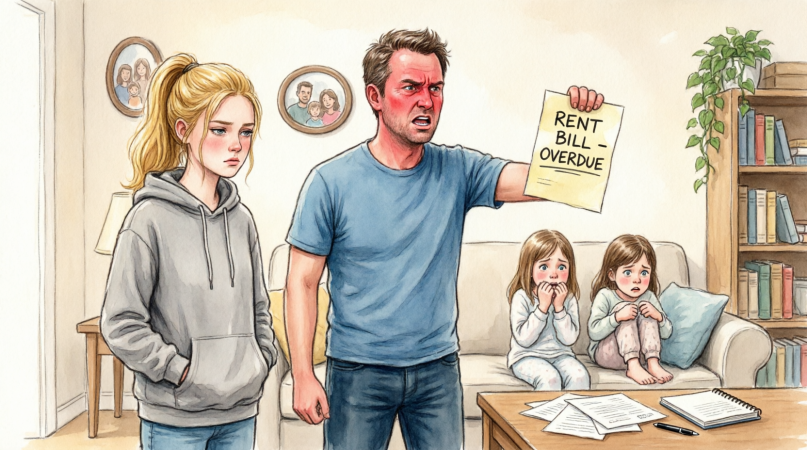
“Rachel, the rent is overdue,” she said. “Did you send the payment yet?”
I was in my kitchen pouring coffee, phone tucked between my shoulder and ear, sunlight cutting through the blinds in thin white lines.
“No,” I said.
A pause. Then, sharper: “Why not?”
There are moments when a line you’ve only thought once arrives fully formed, exact and complete. This was one of them.
“Only for family,” I said. “Remember?”
Silence.
Then my mother inhaled like I’d slapped her. “Oh, don’t start that again.” Again.
As if being excluded from a vacation I paid for was just a petty mood I was dragging out for attention. I set the coffee pot down and leaned against the counter. “You told me the trip was only for family. I’m honoring that category.”
My father got on the line almost immediately, which told me he had been listening the whole time.
“This is childish,” he snapped.
“No,” I said. “It’s accurate.”
That made him angrier.
He launched into the familiar script. I was being dramatic. I was punishing everyone over a misunderstanding. The kids wanted a simple trip. My work schedule was complicated. It wasn’t personal. Money shouldn’t be weaponized inside families.
That last one almost made me laugh.
Money shouldn’t be weaponized. From the people who used my money to create a family memory and then told me I didn’t qualify for it.
“I paid twenty-two thousand dollars for that trip,” I said. “And you told me I wasn’t family.”
“We never said you weren’t family,” my mother cut in.
I closed my eyes and repeated her exact words. “Only for family.” Nothing came back for two full seconds. Because she knew.
She knew there was no softer version left to hide behind. Then my father made the mistake that ended whatever patience I had left. “You have no idea what pressure we’re under.”
I opened my eyes and looked around my clean, quiet kitchen—the one I paid for, the one I kept stable, the one no one in my family ever entered unless they needed something from me.
“No,” I said. “I just know exactly when you remember I exist.” And then I hung up.
That afternoon, Caleb texted me.
Mom says you’re blowing up over Hawaii. Seriously? I replied with one line: You mean the trip I financed and wasn’t allowed to attend? He never answered.
Lindsey called once and tried to play peacemaker, which in our family usually meant asking the hurt person to be more convenient for everyone else. She said Mom was stressed, Dad was humiliated, and could I please not make rent “the hill I die on.”
No. Because it wasn’t about rent anymore. It was about visibility.
And after years of paying quietly, I had finally decided that if I was going to be treated like an outsider, I would stop funding the illusion that I belonged. That was when the real panic started.
Part 3
By the third day, my parents stopped sounding offended and started sounding afraid.
That shift always reveals more truth than the anger that comes before it.
My father called from his own number instead of letting my mother handle the requests. He sounded tired, which meant the landlord had probably called twice and whatever small reserves they pretended to have were already gone.
“We need to be practical,” he said.
I almost smiled.
Practical was my role in the family. Not loved. Not celebrated. Not included. Practical. The daughter who could always be relied on to do the math after everyone else made decisions based on ego, favoritism, or convenience.
“You should have tried practical before Maui,” I said.
He exhaled sharply. “This is about one trip?”
“No,” I replied. “It’s about the fact that all of you sat in rooms and cars and airports for days knowing you were taking a vacation I paid for, and not one of you had the decency to tell me.”
That landed harder than anything else I’d said.
Because it was so simple.
No drama. No therapy language. Just the plain ugliness of a coordinated exclusion.
My mother started crying in the background. Real crying this time, maybe. Or maybe just more desperate. With her, the difference had never helped much.
Then came the line I had been waiting for.
“We thought you’d understand.”
There it was.
The entire family contract in six words.
We thought you’d understand.
Understand being left out.
Understand paying anyway.
Understand that your siblings mattered more because they had spouses, children, and louder needs.
Understand that being useful was your love language because they had trained you into it.
“No,” I said. “You thought I’d absorb it.”
That was the closest anyone came to silence as confession.
The next week unfolded in small, predictable ways. My mother sent long texts about how family shouldn’t “keep score.” My father called me selfish once and regretted it immediately when I said, “You only say that when I stop being convenient.” Caleb’s wife messaged me saying the kids loved the trip and didn’t know anything about adult issues, which was true and irrelevant. Lindsey eventually admitted she assumed I had chosen not to come and then went quiet when I asked why she never once thought to confirm that with me.
No one had a good answer.
Of course they didn’t.
The honest answer would have been too embarrassing: because somewhere in their minds, I was no longer a person who needed to be considered before decisions were made. I was infrastructure. A funding source with opinions best ignored until billing day.
I didn’t resume the rent payments that month.
Or the next.
They figured it out, because people always do when they have to. My father sold antique furniture he had always called untouchable. My mother stopped buying expensive skincare from the neighbor’s daughter. Caleb suddenly found five hundred dollars a month he claimed he “didn’t realize” he could spare. Lindsey started covering the utilities. The world didn’t end. What ended was the illusion that only I had the capacity to sacrifice.
That mattered more to me than the money.
Because for years, my family had built itself around the idea that my flexibility was permanent and therefore morally available. Once I removed it, everyone else discovered they were far less helpless than they liked to pretend.
Months later, my mother invited me to Thanksgiving with a strange new softness in her voice.
I went.
Not because everything was healed. It wasn’t. Not even close. But I wanted to see whether the room felt different.
It did.
No one mentioned Hawaii. No one asked me to pay for anything. My father thanked me when I brought wine, which had never happened before in my entire adult life. Caleb’s wife asked about my work and actually listened. Lindsey looked guilty enough to almost be useful.
And when my mother started to say, “We didn’t mean—” I held up one hand and she stopped.
That was new too.
I never got a real apology.
Families like mine rarely give clean ones. They offer changed behavior, awkwardness, small acts of caution, and the occasional careful sentence where entitlement used to sit.
It’s not justice.
But it is evidence.
And sometimes, that has to be enough. Especially when the real victory was never making them feel bad.
It was making them finally feel the cost.
Because when they told me Hawaii was “only for family,” they thought they were excluding me from a vacation.
What they actually did was end the subsidy.
Part 4: The Architecture of Absence
The silence after Thanksgiving did not feel like victory. It felt like standing in a room after a heavy piece of furniture has finally been moved. The floorboards were exposed. The dust patterns had shifted. The air moved differently.
I went back to my apartment in Denver that night, placed my keys on the counter, and listened to the refrigerator hum. For the first time in years, my phone did not vibrate with a request disguised as a question. No “Could you look at this contract for Caleb?” No “Dad’s car needs a new transmission, can you just cover half?” No “Mom’s feeling overwhelmed, maybe you could send something for groceries?”
Just the hum. Just the quiet. Just me.
I had spent my entire adult life mistaking urgency for importance. When you are the reliable one, the calm one, the one with the steady job and the clear credit and the emotional bandwidth to absorb other people’s panic, you learn to equate being needed with being loved. It is a slow conditioning. You stop noticing the weight until your posture changes. You stop questioning the imbalance because the imbalance funds your sense of purpose.
Hawaii had not been a betrayal. It had been a diagnosis.
And the rent stoppage had been the treatment.
The weeks that followed were not dramatic. There were no slammed doors, no tearful confrontations on doorsteps, no cinematic family meetings where everyone finally understood their roles. Real change is rarely loud. It is administrative. It is logistical. It is the quiet recalibration of people who suddenly realize the floor will no longer cushion their falls.
My mother’s texts grew shorter. They used to arrive in paragraphs, layered with justification, guilt, and half-truths. Now they were two lines: a grocery list, a doctor’s appointment reminder, a photo of a bird feeder my father had hung. She stopped asking for anything she could not justify with a concrete reason. When she did ask, she prefaced it with “I know this is a lot,” which was a sentence I had never heard in my life.
My father called less. When he did, he talked about weather, local politics, the neighbor’s dog. He never mentioned money. He never mentioned Hawaii. He never mentioned the unspoken ledger that had governed our relationship for fifteen years. I let him talk. I listened. I did not fill the silence with solutions. That was the hardest part: learning to leave a problem unsolved when the problem was never mine to fix.
Caleb reached out in December. Not for money. For advice. His youngest had been recommended for a gifted program at school, but the assessment required a fee his insurance didn’t cover. He called me on a Tuesday evening, voice tight, pacing through what I could only imagine was a kitchen with a sink full of dishes.
“I don’t know what to do,” he said. “They say it’s a sliding scale, but the bottom tier is still more than we can swing this month.”
Old instinct flared. The muscle memory of being the solution. My fingers actually twitched toward my banking app before I caught myself. I set the phone down. I picked it up again.
“Have you asked the school if they can defer it?” I said. “Or spread it over two terms? Sometimes they’ll work with you if you’re upfront about the timeline.”
He was quiet for a moment. “Yeah. I guess I could.”
“Call them tomorrow,” I said. “Ask for the coordinator, not the front desk. They usually have more flexibility.”
“Thanks, Rach.”
Another pause. Then, softer: “How have you been?”
I almost laughed. Not at him. At the strangeness of the question. It was the first time in my adult life my brother had asked me that without it being a preamble to a request.
“I’m good,” I said. “Really good.”
“Yeah?”
“Yeah. Work’s busy. I’m up for partner next spring. I’ve been going to therapy. I bought a plant that hasn’t died yet.”
He chuckled. “A real milestone.”
“Don’t mock it. It’s a fiddle-leaf fig. It’s practically a toddler.”
He laughed again. Genuinely. And for the first time, I realized I wasn’t angry at him. I was grieving the version of us that had never been allowed to exist. The version where he called to ask how I was, not because he needed something, but because he wanted to know. The version where we were siblings, not utility and user.
We talked for twenty more minutes. About his kids. About his wife’s new job. About the weird noise his washing machine was making. I did not offer to pay for a repairman. I did not solve it. I just listened. And when we hung up, I sat on my couch and cried. Not from sadness. From relief. The kind of relief that comes when you finally stop carrying a weight you were never meant to carry, and your spine remembers what it feels like to stand straight.
That was the architecture of absence. Not emptiness. Space. Room to breathe. Room to be. Room to exist without being monetized.
But families are ecosystems. When you remove one species, the others adapt. And adaptation is rarely graceful.
By February, the strain showed. Not in demands. In exhaustion. My mother’s voice on our occasional calls had lost its performative brightness. It sounded tired. Not dramatically tired. Just human tired. The kind that comes from realizing you cannot outsource your survival forever. My father sold his classic watch. He didn’t tell me. I found out when Lindsey mentioned it offhand, then immediately backtracked, as if she’d revealed a state secret. I said nothing. I felt nothing. That was the point. I was no longer the audience for their sacrifices. I was just a daughter who happened to live three states away.
Then came the night my father called from a hospital waiting room.
Not a crisis. Not a heart attack. Just a fall. A misstep on icy stairs, a cracked collarbone, a night in observation. My mother’s voice shook when she handed him the phone. She didn’t ask for money. She asked if I could look up the specialist he’d been referred to. I did. I emailed him the information. I did not offer to pay. I did not offer to fly out. I offered what I could give without giving myself away.
He thanked me. He sounded older. Not frail. Just aged by the realization that his body was no longer invincible, and his safety net was no longer bottomless.
“I’m sorry we didn’t include you,” he said suddenly.
I didn’t speak. I let the sentence hang.
“In Maui,” he added. “We… we handled it badly.”
“Yes,” I said.
He didn’t defend it. He didn’t explain it. He just let the word sit there. It was the closest he would ever come to an apology. And it was enough. Not because it healed anything. Because it proved he could still feel shame. And shame, however delayed, is a sign of a conscience that hasn’t fully atrophied.
We hung up. I poured a glass of water. I sat by the window and watched the snow fall on Denver in slow, quiet sheets. I thought about the twenty-two thousand dollars. I thought about the balcony. The luau. The matching linen. The way they had looked into the camera and smiled while my name never crossed their lips. I used to think the cruelty was in the exclusion. I was wrong. The cruelty was in the assumption that I would pay for my own absence and call it love.
I didn’t call them the next day. I didn’t send a card. I didn’t check in. I let the silence do its work. I let them learn what it felt like to be responsible for themselves.
And I let myself learn what it felt like to be responsible for me.
Part 5: The Ledger
People talk about boundaries like they are walls. They are not. Walls keep things out. Boundaries define what you will carry, and what you will set down.
The hardest part of setting them down is not the physical act. It is the psychological withdrawal. Your nervous system has been trained to equate usefulness with safety. When you stop being useful, your brain interprets it as abandonment. It sends out false alarms. It whispers that you are being cruel. That you are being cold. That you are breaking a covenant you never actually agreed to, but were born into.
I spent March untangling that wiring.
Therapy helped. Not with magic words. With repetition. With the slow, unglamorous work of noticing my own patterns. I wrote lists. I tracked my reactions. I learned to separate obligation from choice. I learned that “family” is not a moral exemption from basic reciprocity. It is a relationship. And relationships require mutual recognition to survive.
By April, I was promoted to partner. The firm threw a dinner. I wore a black dress I had bought for myself. I drank wine I had chosen. I laughed at jokes I actually found funny. When the managing partner toasted me, he said something about my “relentless clarity.” I smiled. I didn’t tell him that clarity had been forged in the quiet aftermath of betrayal. Some victories are too private to share.
That same week, Lindsey flew to Denver.
She didn’t call ahead. She just showed up at my building with a suitcase and a nervous smile. I let her in. I made tea. I did not pretend I was thrilled. I did not pretend I was angry. I just existed. She sat on my sofa, looked around, and said, “You’ve really made this place yours.”
“It’s mine,” I said.
She nodded. “I forgot what that looked like.”
We sat in silence for a while. Then she said, “I came to talk. Not to fix anything. Just to talk.”
“Okay.”
She told me about her marriage. How her husband had lost his job. How they were drowning in student loans. How she had been carrying the emotional weight of their household for years, smiling through it, performing stability while quietly unraveling. She told me about the teenager I barely knew, who had started cutting herself, who had finally been diagnosed with severe anxiety, who was now in treatment. She told me about the nights she cried in her car because she couldn’t ask her parents for help without triggering my father’s pride, and couldn’t ask Caleb without triggering my brother’s defensiveness, and couldn’t ask me because she knew what I would think.
“I know you think I took it for granted,” she said. “The money. The silence. The way we let you carry everything. I did. But it wasn’t because I didn’t care. It was because I didn’t know how to carry it myself. And when you stopped… I had to.”
I listened. I did not interrupt. I did not offer solutions. I just let her speak until she ran out of words.
When she finished, she looked at me. “Do you hate me?”
“No,” I said. “I pity the version of us that thought this was sustainable.”
She flinched. Then nodded. “Yeah. That’s fair.”
We talked for three hours. Not about money. Not about Hawaii. About childhood. About the unspoken roles we had been assigned. The reliable one. The charming one. The golden child. The quiet one. How we had all been shaped by a family system that valued function over feeling, utility over intimacy, performance over presence. How we had mistaken love for logistics. How we had confused sacrifice with devotion.
“I didn’t know you were drowning,” she said finally.
“I didn’t either,” I replied. “Because I never let myself look down.”
She left the next morning. I walked her to her rental car. She hugged me. It was stiff at first. Then it softened. I didn’t cry. She didn’t cry. We just held each other like two people who had finally stopped pretending they were fine.
That afternoon, I drove to the old neighborhood. The house we had grown up in had been sold years ago. It belonged to a young couple now. They had painted the shutters blue. They had a trampoline in the yard. I sat in my car across the street and watched a little girl chase a dog through the grass. I felt nothing nostalgic. I felt something else. Something quieter. Recognition.
The house had never been the container of my family. It had just been the stage. The real family was the pattern of behavior we had repeated inside it. The way my father’s voice carried through the hallway when he was frustrated. The way my mother’s hands moved when she was anxious. The way Caleb would retreat to his room and Lindsey would smooth things over with humor. The way I would stay up late, making sure everything was balanced, making sure no one noticed the cracks, making sure the machinery kept running.
I had not been loved for who I was. I had been valued for what I could stabilize.
And that was the tragedy. Not that they didn’t love me. But that they had never learned how to love me without needing something from me.
I started the car. I drove back to my apartment. I watered my plant. I opened my laptop. I worked. I lived. I existed.
And slowly, without fanfare, the ledger began to close.
Not because they paid me back. Because I stopped keeping score.
There is a profound difference between forgiveness and forgetting. Forgiveness is not erasure. It is the deliberate choice to stop letting the past dictate your present. I forgave them not because they deserved it. Because I deserved peace. And peace requires you to stop feeding ghosts.
In May, my mother called. She didn’t ask for money. She asked if I wanted to come to her book club dinner. She said it was casual. She said no pressure. She said they’d be at a place I’d probably like.
I said yes.
I went. I sat at a long table with strangers and semi-strangers. I drank wine. I ate bread. I listened to my mother talk about a novel she had read, her voice lighter than I had heard it in years. She did not look at me like I owed her something. She looked at me like I was a person she wanted to know.
I let her.
I did not fix her. I did not fund her. I did not carry her. I just sat with her. And for the first time, it felt enough.
Part 6: The Weight of the Name
Summer arrived in Denver with a dry heat that baked the pavement and turned the mountains into sharp, clear silhouettes. I took a week off. I didn’t travel. I didn’t plan anything extravagant. I slept. I walked. I read. I sat on my balcony and watched the city breathe.
I thought about Hawaii often. Not with bitterness. With clarity. The twenty-two thousand dollars had not bought me a vacation. It had bought me a mirror. And in that mirror, I had finally seen myself clearly: not as the reliable daughter, not as the financial shock absorber, not as the invisible infrastructure. Just as Rachel. A woman who deserved to be seen before she was used. A woman who deserved to be invited before she was invoiced. A woman who deserved to be family, not a funding source.
My parents’ sixtieth anniversary fell in August. They had planned a small dinner at a restaurant near their townhouse. Lindsey handled the logistics. Caleb handled the drinks. I handled my own boundaries.
I arrived on time. I brought a bottle of olive oil and a handwritten card. I did not bring a check. I did not bring guilt. I brought presence.
The dinner was quiet. Not tense. Just measured. My father wore a pressed shirt. My mother wore a dress she had probably bought specifically for the occasion. They looked older. Not diminished. Just real. The kind of real that comes when you stop performing for an audience that has finally stopped clapping.
We talked about the weather. About a documentary my father had watched. About my plant, which had finally survived a full season. About Caleb’s son, who had made the honor roll. About Lindsey’s daughter, who was doing better in therapy. About work. About nothing. About everything.
No one mentioned money. No one mentioned Hawaii. No one mentioned the years I had carried the weight of their convenience.
And yet, it was all there. In the careful way my mother poured my water. In the way my father asked for my opinion on a neighborhood zoning issue. In the way Caleb toasted me without hesitation. In the way Lindsey caught my eye across the table and gave a small, almost imperceptible nod.
It was not a grand reconciliation. It was a quiet recalibration. The kind that happens when people finally realize that love cannot be outsourced, and belonging cannot be purchased.
After dessert, I stood. “I should head out.”
My mother looked up. “Stay longer?”
“I will,” I said. “Just not tonight.”
She nodded. She didn’t push. She didn’t guilt. She just said, “Drive safe.”
I walked to my car. I sat inside for a moment. I watched the restaurant lights glow through the glass. I thought about the word family. How it had been used as a weapon. How it had been used as a currency. How it had been used to justify my own erasure. And how, finally, I was learning to redefine it.
Family is not a debt. It is not a ledger. It is not a hierarchy of need. It is a choice. A daily, deliberate, imperfect choice to show up for each other without keeping score. To offer without expecting return. To love without conditions. To see each other as people, not utilities.
I had spent my life paying for a seat at a table where I was never truly welcome. I had finally realized that the table was not the point. The point was whether I would respect myself enough to build my own.
I started the car. I drove home. I parked. I went inside. I watered my plant. I sat by the window. I watched the city lights blink on, one by one, in the quiet dark.
My phone buzzed. A text from my mother: Thank you for coming. We missed you.
I read it. I smiled. I typed back: I missed you too.
I did not send money. I did not offer to fix anything. I just told the truth. And for the first time, it was enough.
The subsidy was over. The relationship was not. It was different. Lighter. Real. And sometimes, that is the only victory you need.
Because when they told me Hawaii was “only for family,” they thought they were excluding me from a vacation.
What they actually did was end the subsidy.
And what I actually did was begin.

