I Acted Poor And Naive At Dinner With My Boyfriend’s Rich Parents. His mother slid me a $1,500 “etiquette” envelope, sat his glamorous ex right beside him, and smirked while they mocked my rough “laborer” hands and “cute” science job. Then they bragged about a mysterious $2,000,000 donor saving their beloved foundation. I just opened my phone, pulled up the donation under my name… and with one tap, turned their perfect dinner into a financial earthquake.
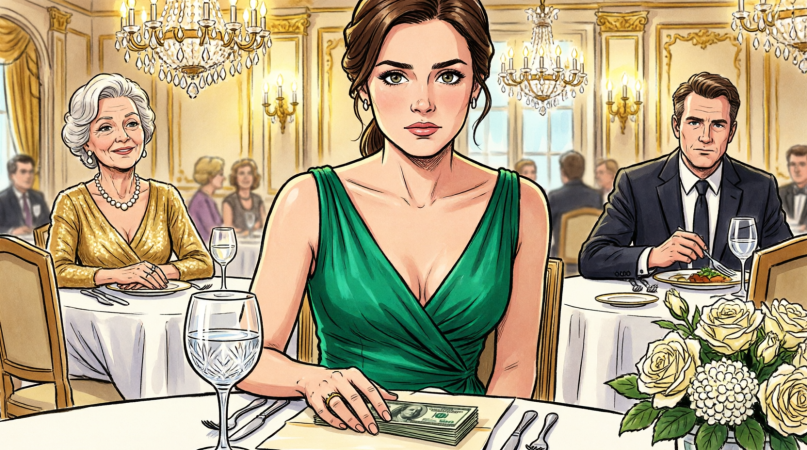
The envelope made the softest sound when it slid across the table, like someone exhaling through their teeth.
It came to a stop beside my water glass, slightly crooked, an intruder in the almost aggressive symmetry of the dinner setting. Everything else in the Langford dining room had been arranged with such military precision that the envelope looked almost rebellious. The monogrammed napkins had been folded into perfect ivory fans. The cutlery lay in clean silver lines at either side of bone-white china. The crystal glasses stood in a glittering half-circle around each plate, waiting for wine, water, judgment. Even the flowers in the center of the table seemed disciplined, white roses clipped short and packed tightly into a low silver bowl as if beauty itself had been instructed not to take up too much space.
And then there was the envelope.
Off-white linen. Thin. Expensive in that quiet way rich people prefer when they are pretending not to notice the price of things. It leaned at a lazy angle, almost touching the stem of my water glass, as if it had not received the room’s instructions about posture.
I stared at it.
Then I looked up at Patricia Langford.
My boyfriend’s mother sat at the head of the table beneath the chandelier, smiling at me. But there was nothing kind in that smile. It had sharp edges. It was the kind of smile a predator might show right before deciding whether you were worth the effort of chewing. Patricia wore a cream silk blouse, pearl earrings, and a gold bracelet slim enough to whisper old money rather than shout it. Her silver-blond hair had been blown into a smooth helmet of softness. Her makeup was flawless, her posture perfect, her eyes bright with the quiet pleasure of a woman about to humiliate someone and call it generosity.
“Go ahead, dear,” she said.
Her voice was rich and honeyed, practiced from years of charity galas, board meetings, and dinner tables where cruelty came wrapped in etiquette. She lifted her wine glass, then set it down without drinking. “Open it. Consider it…”
She tilted her head, pretending to search for a word that had clearly been rehearsed before I arrived.
“An investment in your future.”
My fingers tightened around the napkin in my lap.
“My future?” I repeated.
Across from me, Evan Langford studied his plate with an intensity that would have impressed any of his graduate students. The sea bass in front of him was perfectly seared, pale and delicate, resting in a pool of lemon beurre blanc. He was cutting it into small anatomical sections, as if he were performing a dissection rather than eating dinner. Each scrape of his knife against the porcelain clicked in my ears like a metronome of cowardice.
He did not look at me.
That was the first thing I understood clearly.
Not the money. Not the envelope. Not Patricia’s smile. Evan’s silence.
We had been together for two years. Two years of coffee shops and lectures, of walking through Chicago snow with his scarf wrapped around both our necks, of late-night calls after he finished grading and I stumbled out of the lab too tired to remember where I had parked. Two years of him calling me brilliant in that vague, indulgent way people sometimes do when they do not intend to ask follow-up questions. Two years of Sunday mornings when he read the New York Review of Books while I pretended to be asleep because I liked the sound of him turning pages.
And now, while his mother pushed an envelope across a formal dinner table, Evan did not even raise his head.
I forced my hand to move.
The envelope felt almost weightless when I picked it up, as if it might float out of my fingers if I loosened my grip. I slid my thumb under the flap and opened it.
Inside were fifteen crisp, newly printed one-hundred-dollar bills.
They had been fanned neatly, too neatly, as though a bank teller with a private love of symmetry had arranged them especially for this performance. I stared at Benjamin Franklin’s face again and again until the meaning sorted itself into a number.
“Fifteen hundred dollars,” I said before I could stop myself.
Patricia’s smile widened.
“Oh, you’re quick,” she said, as if I had just counted to ten without using my fingers.
Richard Langford, Evan’s father, gave a small laugh from the other end of the table. He had the dry, papery chuckle of a man who considered most things amusing only when they happened to someone else. Richard wore a navy suit and a burgundy tie, his white hair combed back from a high forehead, his face long and aristocratic in the New England way, though we were in a lakefront mansion outside Chicago and not a nineteenth-century portrait gallery.
“Is this…” I stopped, the question already tasting foolish in my mouth. “Is this a gift?”
I knew it was not.
The whole table knew it was not.
But I wanted her to say it. I needed the quiet part dragged into the light and placed beside the silverware.
Patricia laughed delicately. The sound matched the chandelier overhead and the crystal at our places, tinkling and cold.
“Heavens, no. Don’t be silly. It’s an etiquette stipend.”
My throat tightened.
Richard lifted his wine glass, the faintest smirk touching his mouth.
Patricia’s eyes glittered. “Richard and I call it the Grace Improvement Fund.”
The words landed on the table like something damp.
For a moment I thought I had misheard her. That some part of my brain, unable to process the fact that a grown woman had said that to another grown woman over dinner, had rearranged the sentence into something worse than the original. But then Richard smiled, Evan’s knife scraped his plate again, and I knew I had heard every syllable.
The Grace Improvement Fund.
My name had been turned into a project title.
Patricia leaned forward, lowering her voice into a fake conspiratorial register that was clearly designed for everyone in the room to hear. “Evan’s tenure review is coming up, darling. It’s such an important time for him, and you know how academics can be… particular.”
Her gaze traveled over me.
My dress. My hair. My earrings. The tiny silver studs I had worn because they were simple and because I liked them, not because they sparkled. She let her eyes rest on my hands, then on the soft cotton of my dark green dress, faded slightly from washing.
“That rural look you’ve got going on is charming in a sort of farm-to-table way,” she said. “But it simply won’t do for the faculty dinner. We need you polished. Refined. Fixed. Before you embarrass him.”
Silence followed.
Not ordinary silence.
The kind that thickens until it has weight. The kind where you can hear a clock ticking two rooms away, the faint hum of the refrigerator in the kitchen, the breath of a server standing very still near the sideboard. The kind of silence that waits to see what shape you are going to take after someone has tried to fold you.
I looked down at the money again.
Fifteen hundred dollars.
For the version of me Patricia believed in, it was supposed to be a lot. Enough to pay rent for the apartment Evan thought I was barely holding onto. Enough for a new dress, maybe shoes, a haircut, a facial, whatever she imagined women from beneath her social altitude needed in order to pass briefly among the better-lit people.
Enough to make me grateful.
Enough to buy compliance.
My fingers curled around the bills. The paper felt crisp and obscene.
I looked at Evan.
Say something, I thought.
Anything.
Tell her this is insane. Tell her I am not a project. Tell her you are embarrassed by her, not me. Tell her she owes me an apology. Tell her my dress has pockets and that alone makes it superior to half the things in this room.
He kept cutting his fish.
The knife clicked against the plate.
It was not only the lack of words. It was the way his shoulders stayed relaxed, the way his face remained arranged in mild discomfort rather than outrage. He acted as though this were not a violation but an awkward family habit, something to be endured like his father’s opinions on modern art or Patricia’s insistence that dessert wines were misunderstood.
He did not even shift in his chair.
The space between us cracked.
Not shattered. Not yet.
Cracked.
I took a slow breath, tasting lemon, butter, and humiliation. It coated my tongue, thicker than the sauce on Evan’s fish. I had the surreal feeling of time stretching, as if a rubber band had been pulled so far it no longer remembered what rest felt like.
I had not worn the dress to provoke them.
That was the absurd part.
It was a simple dark green dress I loved, soft cotton, worn in at the seams, with a waist that did not punish me for sitting and pockets that actually worked. In my real life, I did not dress for crystal and chandeliers. I dressed for centrifuges, whiteboards, code reviews, investor calls that stretched past midnight, and the freezing air of walk-in freezers where sample trays sat under lights cold enough to make your bones complain. I dressed for the lab.
In my real life, I lived in Wicker Park.
If you have never lived there, or even walked through it in the rain, you might not understand why I loved it. Wicker Park smelled like espresso, spray paint, wet brick, ambition, and someone’s late-night noodles from an upstairs apartment. It was old brick buildings covered in murals, potholes pretending to be small lakes after the first thaw, bikes chained to everything vertical, record stores that looked like they had survived three economic cycles through sheer stubbornness, coffee shops full of people writing screenplays, manifestos, grant applications, breakup texts, and business plans.
Nobody in Wicker Park cared whether your earrings were real diamonds or whether your shoes came from a boutique with a silent French name. You could walk down the street in paint-splattered jeans, a tuxedo jacket, a tutu, or all three at once, and the most anyone would do was ask where you got your coffee.
That was where I met Evan.
He had been sitting in the corner of my favorite coffee shop, the one with mismatched chairs and chalkboard menus that never seemed to match what they actually had. He sat beneath a shelf full of old board games and forgotten books, hunched over a stack of essays like the fate of the world depended on semicolons. His dark hair fell over his forehead. He wore a tweed jacket without irony, or at least with such practiced irony that it had become sincere. There was a red pen in his hand and an expression on his face that said civilization itself was under threat from undergraduate grammar.
I remember that day clearly because I was trying very hard not to cry in public.
My hair was in a messy bun, still damp from the shower. I wore an oversized hoodie with a faded logo from my undergrad lab and jeans that had seen better years. My laptop was open in front of me, and three empty coffee cups formed a small defensive wall between me and the world.
On the screen was an email from a lawyer representing the venture arm of a pharmaceutical company whose name could move stock prices if whispered in the wrong hallway.
It was not a rejection, not technically.
It was a counter-offer. A negotiation. Careful language about valuation, milestones, licensing rights, retention packages, and the kind of clauses that looked boring until they determined whether forty-five people kept their jobs. But to anyone glancing over my shoulder, it looked like just another professional disappointment. The first visible line read, We regret that we cannot accept the proposed terms as drafted.
I was halfway through typing a response that began with Thank you for your thoughtful comments and contained, under the surface, the legal equivalent of go to hell, when Evan slid into the seat across from me without asking.
“Rough day?” he asked, nodding toward my screen.
I blinked, caught.
“Something like that.”
His eyes flicked to the email before I angled the laptop slightly away. His brows knit together in instant sympathy.
“Grant rejections are brutal,” he said knowingly. “You in grad school?”
I could have corrected him.
Postdoc, technically, once.
Founder.
CEO.
Principal investigator.
Woman currently negotiating a licensing deal that could change not only my rent but the entire trajectory of a therapeutic platform for hereditary disease.
Instead, something in me hesitated.
I looked at his face. Kind, interested, self-assured. A man used to explaining things, yes, but not cruelly. At least not then.
“Yeah,” I said. “Something like that.”
He smiled.
That was the first version of the smile I would come to know so well. Warm. A little smug. Not in a mean way, at first. More like he had seen this before and knew how to handle it. He leaned back, red pen still in hand.
“I remember those days,” he said. “Constantly chasing funding. Existential crisis every other Tuesday. I’m Evan, by the way. I teach history at the university.”
Of course he did.
Not a university. The university.
He said it as if specificity would be gauche.
He launched into a story about a fellowship he had lost in his final year of graduate school, and then another he had won, and how he had survived on instant ramen, cheap beer, and what he called “moral superiority.” I listened, watching the way his hands moved when he spoke, the confidence in his voice, the ease with which he placed himself inside intellectual history. He had a way of making failure sound curated, like hardship in his life had been an aesthetic choice rather than a cliff.
Back then, it was charming.
Back then, I mistook his certainty for safety.
He asked about my work, and I gave him the surface. Biology. Genomics. A lab downtown. Long hours. He nodded in the way people nod when they have heard just enough to categorize you. Struggling scientist. Overcaffeinated. Probably underpaid. A little intense. Harmless.
Maybe I let him believe it because I was tired.
Maybe because the last two men who had seen more had not known how to survive the view.
The first was named Daniel. He had been funny, bright, and broke in the romantic way only men in their late twenties with guitars can be broke. He loved that I was smart until he saw numbers attached to it. The first time he glimpsed part of a term sheet on my kitchen counter, he said, “Wow, that’s actually a lot of money,” in a tone that turned the air between us strange. Three months later, every conversation had become an investment pitch. His music. His friend’s app. His brother’s podcast. His cousin’s “wellness beverage concept.” My success became a gravity well, pulling every half-formed dream in a ten-mile radius into its orbit.
The second was quieter. Peter. An architect. Thoughtful, careful, wounded in ways he did not admit. He did not ask for money. He did something worse. He measured himself against me in silence until resentment grew mold on everything. A joke about “your fancy biotech money.” A shrug when I paid for dinner. A colder voice when I called from a hotel after a pitch meeting in Boston. When my company’s valuation crossed a number that made reporters start emailing, he stopped answering my calls and later told a mutual friend he “couldn’t be with someone whose life made him feel like an accessory.”
After that, I learned.
I stopped bringing the golden parts of my life to the front door. I dressed myself in invisibility. Messy bun. Old sneakers. Habitually cheap coffee. A car I loved because it ran and asked nothing of me. An apartment with exposed brick and a radiator that clanged like a ghost dragging pipes through the walls.
I let people see the struggling scientist, the woman one grant rejection away from disaster, the girl who bought thrifted furniture and ate cereal over the sink.
It became my filter.
My test.
If someone could like me like that, maybe they could be trusted with the rest.
Evan passed that test, or so I thought.
In the beginning, he was sweet with the version of me he believed in. He paid for dinner with the gentle pride of a man giving someone access to a world she was not used to. He explained the difference between Baroque and Rococo while I hid a smile behind my wineglass, because I had taken art history as an undergrad and knew perfectly well. He bought me used books with inscriptions from strangers. He read passages aloud from historians he admired, then looked at me like he was waiting for applause and affection in equal measure.
“You know,” he would say, “one of the things about being from an old family is that you really understand the weight of history.”
I would sip my house red and nod, thinking of payroll, burn rate, clinical trial timelines, regulatory hurdles, and the weight of forty-five employees’ health insurance. But those were not the things he asked about.
When I mentioned my lab, my team, the insane hours we were keeping trying to get our platform ready for the next stage, he would smile indulgently.
“You’re really passionate about your science experiments,” he once said. “I love that about you.”
Science experiments.
It should have been a red flag bright enough to stop traffic.
Instead, I filed it away as one of his academic blind spots. Historians could be vain, I told myself. Scientists could be too. Everyone was allowed imprecision when speaking across a field. He did not mean harm. He liked me. He listened, in his way. He made soup when I had the flu. He learned that I hated cilantro and loved burned toast. He called me “my brilliant mess” once, and instead of objecting to the possessive, I curled into it because I was tired and wanted to be cherished without being understood.
Eighteen months before Patricia Langford slid that envelope across the table, my startup was acquired by a pharmaceutical giant with glass towers in three countries and a logo so familiar that even people who hated Big Pharma recognized it.
The deal was exhausting.
People imagine acquisitions as champagne, signatures, and sudden wealth. They do not imagine three in the morning calls with lawyers arguing over phrase placement in retention agreements. They do not imagine sitting on the floor of your office eating stale granola bars while trying to decide whether a clause will protect your team or quietly gut everything you built. They do not imagine telling a boardroom full of men in better suits that no, your platform will not be turned into a patent farm while the actual research dies in a windowless department.
I fought.
For my team. For the science. For the families whose genetic histories were not abstract to us. For the children born with futures already narrowed by disease markers they had not chosen. For the idea that money should accelerate work, not consume it.
There were days I thought I had ruined everything by refusing to be agreeable.
Then the ink dried.
I kept the lab. My team stayed. The platform moved forward under conditions I could live with. And stock, options, and equity turned into numbers in my bank account that felt almost fictional.
Numbers so large my accountant, a dry woman named Miriam who wore black turtlenecks and trusted no one, looked at me over her glasses and said, “You are in a very good position, Grace,” in the same tone she might use to say the building was on fire but the exits were clearly marked.
My monthly dividends alone equaled what Evan made in two years.
He never knew.
Not because I wanted to trick him. Not because I enjoyed hiding. At first, I told myself I was waiting for the right time. After the tenure review. After the next conference. After I understood whether we were moving toward marriage or simply moving through habit. But underneath all that was fear.
I wanted someone to see me before seeing what I controlled.
I wanted to be loved before I was valued.
I wanted someone to look at my rough edges, my cheap coffee, my late-night panic, my ugly cry over failed assays, and still say, yes, her. That one.
I thought Evan was that person.
I thought his fascination with history meant he understood complexity. I thought his talk about revolutions meant he admired people who broke systems, not just people who inherited comfortable positions within them. I thought his tenderness toward my supposed struggle was empathy.
Sitting at the Langford dinner table under a chandelier that reflected cold light onto fifteen hundred dollars in cash, I finally understood the truth.
He had not loved me.
He had loved the way he felt standing next to me.
He had loved being taller by comparison.
He had loved the role of benevolent intellectual, the professor with the old family name lifting up the scrappy girl from the lab. He had loved my lack, or rather the lack he imagined. It made him generous. It made him stable. It made him important.
I was not his partner.
I was his charity case.
And to his family, I was lower than that.
A stain.
A risk.
A woman to be corrected before faculty dinners and tenure committees and donors mistook Evan’s romantic choices for evidence of poor judgment.
Patricia was still watching me, waiting.
She expected me to fold the bills neatly back into the envelope and murmur, Thank you, Mrs. Langford, that’s so generous. She expected embarrassment, perhaps a tear restrained with noble effort. She expected me to be grateful for the chance to be sanded down into someone more suitable.
She thought she was looking at a desperate girl who would do anything to belong.
She had no idea that I could have purchased the house we were sitting in, along with the three surrounding properties, in cash and barely noticed.
The armor had worked almost too well.
It had protected me from opportunists. It had also convinced people like the Langfords that they stood on a higher floor when, in reality, their house was built on sand.
I slid the envelope back to where it had been, beside my water glass. I did not push it away. I did not pull it closer. I let it sit there like a landmine.
“Thank you,” I said evenly. “I’ll think about it.”
Patricia’s eyes narrowed almost imperceptibly.
She had not gotten the reaction she wanted.
She smoothed her napkin over her lap, each movement precise and controlled.
“Do, dear. Image is everything in circles like ours.” Her smile sharpened. “Of course, your background is part of your charm. We don’t want to erase that. Just… polish.”
Across the table, Evan finally glanced at me for less than a second.
His expression was pleading and embarrassed, silently asking what his mouth would not.
Don’t make this a thing.
Please.
Just go along with it.
I was still deciding what, exactly, I was going to do with the envelope when the main event arrived.
She appeared in the dining room like a stage cue perfectly timed, floating into view with the effortless grace of someone who had never had to worry about bumping into chairs because space rearranged itself around her.
“Vanessa!” Patricia exclaimed.
Her voice lifted an octave, suddenly bright and girlish. “You made it!”
My spine went rigid.
I had heard the name in passing.
Vanessa Moreau. An ex-girlfriend. Someone from “a different chapter” in Evan’s life. A mention here, a hesitation there. Daughter of a Swiss diplomat. Art galleries. Summers in Geneva. A woman who appeared in anecdotes the way expensive perfume appears in a room, lingering even after everyone pretends it is gone.
She just happened to be in the neighborhood.
Of course.
Vanessa was all silk and gloss. Her dress was a whisper of champagne-colored fabric that probably cost more than my car. Her hair fell in dark, glossy waves, and diamonds winked in her ears, subtle and tastefully understated in the way that only happens when the stones are real and you grew up with them. She clasped Patricia’s hands, air-kissed both cheeks, and turned to Richard, who practically leaped out of his chair to pull one out for her.
“I’m so sorry to intrude,” Vanessa said.
Her accent did not belong to any specific country so much as to airports, private schools, and people who say chalet without self-consciousness. “I was nearby and Patricia insisted I stop by and say hello.”
“Don’t be silly, darling,” Patricia purred. “You’re family.”
Family.
They seated her next to Evan.
I watched it happen in slow motion.
Evan’s face lighting up just a fraction. The corners of his mouth pulling upward before he caught himself. His shoulders straightening. The invisible shift in the room’s center of gravity.
Suddenly I felt like an extra in someone else’s play, parked across the table from the lead actors and expected to clap at appropriate moments.
Patricia did not simply welcome Vanessa.
She deployed her.
For the next twenty minutes, the conversation became a carefully orchestrated comparison between us, thinly veiled as polite chatter. Patricia was the conductor. Vanessa was the instrument. Richard provided bass notes of condescension. Evan sat in the center, uncomfortable but not enough to stop enjoying the attention.
“So, how was Milan?” Patricia asked, eyes shining. “We were all so impressed by the photos from your gallery opening.”
Vanessa laughed lightly. “Oh, you’re too kind. It was a small thing, really. Just a little show with some friends. Papa’s colleagues insisted on coming, and you know how that goes.”
She rolled her eyes in a charmingly self-deprecating way that made clear she absolutely knew how that went and had enjoyed every second.
“How delightful,” Patricia said. Then she turned to me. “Grace, dear, have you ever been to Europe?”
I took a sip of water to buy half a second.
“For a conference once,” I said. “Berlin. In January.”
“Brrr,” Patricia said, with a theatrical shiver. “Well, you must let us know next time you go somewhere cultured. We can help you find something appropriate to pack.”
I thought of the Berlin conference. The freezing wind off the Spree. The auditorium full of geneticists. The keynote where I presented early data from our platform and watched three senior researchers sit forward in their seats at the same time. The reception afterward where a German scientist with wild white hair grabbed both my hands and said, “You may have opened a door we thought was a wall.”
Cultured.
Sure.
They asked Vanessa about her father’s work at the UN, about her latest photography series exploring “liminal spaces,” about the townhouse in London she was “thinking of letting go of, it’s just such a hassle to maintain, you know?” They asked about Geneva, Paris, Basel, Milan. They asked whether she preferred Frieze or Art Basel if she could attend only one, as though the question carried moral significance.
They asked me whether I had found a coupon for the bottle of wine I had brought.
“I didn’t bring one,” I said. “Wine, I mean. I brought bread.”
I glanced toward the kitchen, where the loaf I had spent three hours kneading and coaxing into existence sat sliced in a silver basket, untouched by anyone except the server.
“Oh,” Patricia said, slightly taken aback. “We have a baker, dear.”
“Yes,” I said. “I assumed you had an oven too.”
Richard coughed into his napkin.
Evan looked at me sharply.
Patricia’s smile tightened.
Vanessa, to her credit, looked briefly amused.
Then the compliments toward Vanessa grew more pointed, and the commentary about me more creative.
“Vanessa has such poise,” Patricia cooed. “It’s in the way she carries herself. You can tell she was brought up around ambassadors and dignitaries.”
Her gaze flicked to me.
“Grace, dear, you’re very… grounded. It’s refreshing.”
Grounded.
Rural.
Farm-to-table.
Charming.
The words formed a little cluster in my mind, orbiting one another like small, condescending moons.
Then Patricia did something so casually cruel that even the server near the sideboard went still.
She reached across the table and took Vanessa’s hand, lifting it as if inspecting a piece of jewelry.
“Look at these fingers,” Patricia said. “Long, elegant, unblemished. Piano hands. That is what refinement looks like.”
Vanessa blushed prettily.
“Oh, stop,” she said, but left her hand there, displayed.
Patricia turned her eyes to me, and the warmth in them switched off as cleanly as someone flipping a breaker.
She did not touch me.
She just pointed.
“Grace,” she said, her tone dropping into mock sympathy. “Your hands…”
I looked down.
My hands rested on the edge of my plate, fingers interlaced, knuckles slightly dry from too much hand sanitizer and not enough moisturizing. There was a faint silvery mark along the side of my left index finger where a misjudged splash of liquid nitrogen had kissed my skin three weeks earlier. My nails were short and uneven from absentmindedly picking at them during marathon debugging sessions. A tiny ink stain marked the side of my thumb from a pen I had used that afternoon to sign fourteen lab requisitions.
My hands looked like what they were.
Tools.
Instruments.
Evidence.
“They look as if you’ve been gardening without gloves,” Patricia said. “Such roughness. Have you tried lemon juice? Or…”
She gave that tinkling little laugh again.
“Perhaps just keeping them in your pockets?”
The table chuckled half-heartedly.
Richard smirked.
Vanessa pressed her lips together in a smile that looked almost sad on my behalf but not sad enough to object.
I flexed my fingers.
These hands had pipetted hundreds of samples at three in the morning, eyes burning, back aching, music playing too softly from someone’s phone on the far counter. They had typed lines of code for algorithms that sifted through genomic data the way miners search for gold veins inside mountains of stone. They had signed documents that secured jobs, health insurance, parental leave, and research futures for forty-five people who had taken a chance on my wild idea when it was still more hypothesis than company.
These hands had held a mother’s letter after her daughter became the first patient in a compassionate-use protocol.
These hands had shaken when a child’s genetic markers shifted in the right direction.
These hands had built something.
Patricia thought they were ugly.
I looked at Evan.
This was the moment.
Clear. Neon-lit. Impossible to miss.
The moment for a man to say, “Mom, enough.”
Or, “Her hands are beautiful.”
Or, “She works hard. Those marks mean something.”
Or even, “Please don’t talk to her that way.”
Anything.
He glanced quickly at my hands, then at Vanessa’s, then back at his plate. His lips pressed together. His jaw tightened for the briefest moment.
And then he reached for his wine.
He took a sip.
He did not say a word.
When he set the glass back down, he smiled.
At Vanessa.
It was not a big smile. It was not dramatic. It was small and crooked, the kind of smile you give an old photograph found at the bottom of a drawer. The kind that says, I remember this, and I liked it.
Something in my chest went very, very still.
Not cold.
Still.
It was not just that he did not defend me. It was who he looked at instead.
In that split second, I saw the version of his future flicker across his face: faculty receptions, embassy dinners, foundation boards, art openings, champagne poured without checking the bottle, women who had never been asked to explain why their hands looked useful. With Vanessa, he saw ease. Heritage. Fluency in rooms like this. With me, he saw incremental progress, late nights, budget meetings, experiments, trade-offs, and a dress with pockets.
He was not just a coward.
He was a snob.
The realization hit me not like a punch, but like a piece of data finally clicking into place after months of noisy results.
The appetizers were cleared.
Salad plates replaced the first set of cutlery. A server refilled glasses with movements so precise and quiet that he became nearly invisible in the way staff often do in houses like this: present, essential, and always outside the frame of the picture.
Richard decided it was his turn.
“So, Grace,” he said, as if changing the subject to something light and entertaining. He swirled his wine with practiced ease, ruby liquid catching the chandelier’s light. “Evan tells us you’re still working at that little incubator downtown?”
Little.
I set my fork down.
“Yes,” I said. “We’re still there.”
“It must be fun,” he said.
The word was stretched and shaped. Fun. Like finger painting. Like pottery class. Like something harmless to keep restless women occupied. “Playing with test tubes. I always thought biology was such a charming field. Like baking, but with bacteria.”
He chuckled.
The table followed his lead like a well-trained choir.
“Actually,” I said, my voice surprisingly steady, “it’s genomics. We focus on CRISPR technology and gene editing for hereditary diseases.”
I did not soften the terms. Let them sound technical. Let them sit in his mouth like sharp syllables.
“Fascinating,” Richard said, in a tone that made clear he was not fascinated at all. “But is it sustainable? Really, dear. Chasing grants, constantly begging bureaucrats for crumbs… it must be exhausting.”
He smiled the way people do when delivering what they believe is gentle wisdom.
“Vanessa was just telling us about her father’s work with the UN. Now that is impact. Real-world applications.”
Cute.
He did not say it out loud, but I felt it. A cute little hobby. A charming passion project. Something to keep the girl busy until she married properly.
A year earlier, that might have crushed me.
I might have started explaining the trials we were running, the markers we were identifying, the families whose entire lineage could be changed by what we were doing. I might have spilled numbers, studies, acronyms, patient outcomes, regulatory designations, and impact projections across the table, trying to paint my worth in data.
But that night, something shifted.
I stopped looking at them as judges.
I started looking at them as subjects.
It is a strange thing when you are trained to analyze systems under stress. Once that part of the brain switches on, it becomes almost merciless. You stop responding to performance and start seeing structure. You notice hairline fractures. You notice where paint hides water damage. You notice where load-bearing beams have begun to bend while everyone in the room keeps complimenting the wallpaper.
I looked at Richard.
Really looked.
His suit was perfect at first glance: dark, tailored, expensive in that old-fashioned way that does not follow trends because it considers itself above them. But at the cuff, where his wristbone moved when he gestured, the fabric had worn thin, almost shiny. Not the beloved wear of a favorite jacket kept for sentimental reasons. The strained wear of a man who had not replaced it because replacement required liquidity.
My eyes moved casually, as though I were admiring the room.
The dining room walls bore faint rectangular ghosts, slight variations in color and gloss where paintings used to hang. A landscape here. A portrait there. Something larger over the sideboard. They had been removed, or more likely sold. The remaining artwork had been clustered strategically, disguising old absences through careful arrangement.
On the sideboard, between silver candlesticks polished within an inch of their lives, an antique clock ticked steadily. A hairline crack ran across its glass face. It was the kind of flaw you would fix immediately if money were no object, especially in a household where aesthetics mattered more than comfort. The kind of flaw you would ignore if the choice were between clock repair and the property tax bill.
I looked at Patricia.
When the server came with a fresh bottle of wine—deep, heavy, expensive—her eyes did not follow the conversation. They followed the bottle. When he poured the last drops into Evan’s glass, her fingers tightened around her own stem. Her knuckles whitened. A tiny flicker of panic crossed her face before she smoothed it away.
She was not worried about etiquette.
She was worried about inventory.
Suddenly, the whole house came into focus.
The perfectly maintained facade.
The aggressive symmetry.
The careful staging of wealth.
The tiny signs of economizing invisible to anyone not trained to read failure before it declared itself. The thermostat set a little lower than comfort demanded. The curtains in the adjoining room not quite touching the floor because they had likely been purchased secondhand and hemmed by someone trying to mimic custom length. The empty spaces on bookshelves filled with decorative boxes where older volumes might once have stood. The flowers arranged low to look deliberate, not sparse.
They were asset-rich and cash-poor.
They were living in a museum they could no longer afford to heat.
No wonder they clung so violently to appearances.
No wonder Patricia needed Evan polished, married well, tenure-secured, institutionally approved. No wonder Vanessa had been summoned like a favorable comparison wrapped in silk. My supposed poverty did not merely offend their taste.
It threatened their contingency plans.
They needed Evan to marry into money, status, or both. They needed his career to stabilize the story. They needed the foundation to look healthy, the estate to remain impressive, the family name to continue circulating in donor circles without anyone asking why paintings had vanished from the walls.
My rural look did not scare them because I was beneath them.
It scared them because I was free.
Or rather, because they thought I was not useful.
They thought I brought no cash, no connections, no social elevation. Only sincerity, rough hands, and bread they did not need because they had a baker. They needed me to be small so they could feel large.
Understanding that did not make their insults less ugly.
But it made them smaller.
Less god-like.
More human.
Frightened, flawed, desperate people dressed in inherited furniture.
I took a sip of water.
The anger in my chest cooled, transformed into something sharper and cleaner.
Not rage.
Not hurt.
Clarity.
They were not the judges.
They were the defendants.
And I was the only person in the room who knew the verdict.
“It can be exhausting,” I said finally, instead of launching into a speech. “Grant cycles. Clinical trials. Regulatory hurdles.”
I shrugged lightly, deliberately, as if it were no more significant than a long commute.
Richard’s face relaxed a fraction, pleased to have been agreed with.
“But,” I added, turning my glass between my fingers, watching light play over the crystal, “sometimes the experiments pay off in ways you don’t expect.”
Patricia hummed politely.
“Well, hopefully something will work out for you soon, dear.”
“Oh,” I said. “Things have already worked out.”
I turned my gaze back to her and held it.
“Speaking of which,” I said, “you mentioned earlier that you might be able to help me find a job?”
Her face brightened.
She saw an opening. A chance to reposition herself as generous. Magnanimous. The woman who had identified a problem and provided both funding and a path to improvement.
“Yes, of course,” she said. “Richard knows some people at the Art Institute and the museum. They’re always looking for reception staff, ticketing, visitor services. Respectable, stable work. Something reliable, until Evan gets his tenure.”
She smiled, leaving the rest of the sentence unspoken.
A little contribution from your side.
The charity wife should at least bring something in.
Evan shifted in his chair, glancing between us, but still said nothing.
I set my fork down carefully.
The tiny clink against china sounded louder in the quiet room than it had any right to.
Like a gavel.
“Actually,” I said, “I don’t think I’ll be needing a receptionist job.”
Patricia’s eyebrow arched, the high-gloss curve of it catching chandelier light.
“Oh?” she said. “Holding out for something better? Beggars can’t be choosers, dear.”
There it was.
The word I had been waiting for.
Beggars.
Vanessa looked down at her plate.
Richard’s mouth twitched.
Evan closed his eyes for half a second, not in defense of me, but in dread of inconvenience.
I smiled.
Not sweetly.
Not apologetically.
“I’m not a beggar,” I said. “And I’ve already chosen.”
The room became very still.
I leaned back slightly, spine straight, shoulders loose. For the first time that evening, I felt completely comfortable.
“My startup,” I said, turning slightly toward Richard, “wasn’t just funded. It was acquired. Eighteen months ago.”
He blinked.
“Acquired?” he repeated.
His voice tried to stay casual and failed.
“By Novartis,” I said.
The name hit the table with a weight no one could pretend not to feel.
Richard’s wine glass paused halfway to his mouth.
Evan’s fork stopped moving.
Patricia’s smile froze.
Vanessa looked at me properly for the first time all night.
“For how much?” Richard asked.
The question came out too quickly, too nakedly.
I could have given the number.
I did not.
There are forms of vulgarity even I avoid.
“Enough,” I said calmly, “that my monthly dividends are about eighty-five thousand dollars.”
The silence that followed was very different from the earlier one.
The first silence had been suffocating with humiliation.
This one hummed with recalculation.
Patricia looked down slowly at the envelope beside my water glass. Fifteen hundred dollars had transformed in real time from insult into comedy. Her lips parted slightly, but no sound came out.
Evan stared at me as if a stranger had taken my chair.
“But you worry about rent,” he said.
The confusion in his voice was raw, almost childlike. “You talk about patching things together. Stretching. Being careful.”
“I worry about payroll,” I replied. “And burn rate. And the mental health of my team. I live in Wicker Park because I like it, not because I have to.”
His cheeks flushed.
“Why didn’t you tell me?”
There it was. The injured tone. The pivot from his failure to my secrecy. I had seen that move before, though never from him at this scale.
“Because I needed to know,” I said quietly, “whether you loved me or the idea of being above me.”
His mouth opened.
No words came out.
I turned to his parents.
The performance was over.
I was done being polite.
“Your etiquette stipend was enlightening,” I said. “A very efficient way of revealing exactly how you see me.”
Patricia recovered first, or tried to.
“My dear, surely you understand this is all a misunderstanding. We only wanted to help you fit into Evan’s world.”
“Evan’s world,” I repeated.
I looked around the dining room.
The cracked clock. The missing paintings. The staged roses. The envelope.
“How fragile that world must be,” I said, “if my hands threatened it.”
Richard cleared his throat, scrambling for dignity.
“Well,” he said, forcing a chuckle. “It seems you’ve done well for yourself. That’s impressive. Though, of course, we’ve been doing rather well too. Our family foundation just secured a two-million-dollar angel donor. Funds should clear by tomorrow morning. It’s a huge boost for our educational programs. We’re very proud.”
I tilted my head.
“I know,” I said.
He frowned.
“You know?”
“I’m the donor.”
The silence snapped.
I reached into my purse, pulled out my phone, and slid it across the table in a neat mirror of how Patricia had slid the envelope earlier. On the screen was the confirmation email from the foundation’s bank.
Donor: Grace Miller.
Amount: $2,000,000.
Status: Scheduled.
Richard picked up the phone with trembling hands.
His face drained of color.
“But you’re…” he began.
He stopped before saying poor.
The word hovered anyway.
“I’m an investor,” I said. “And when Evan told me how much this house meant to you, how much the foundation meant to your legacy, I thought perhaps helping preserve it would earn me a seat at this table.”
I smiled, small and precise.
“I guess I miscalculated.”
Patricia’s eyes fixed on the screen. Her pupils dilated. Richard seemed to shrink inside his suit. Vanessa sat back, silent now, composure cracked around the edges.
Evan looked as if someone had changed the language of the room and left him without translation.
“You never told me,” he whispered.
“No,” I said. “You never asked the right questions.”
Richard tried again.
“Grace, surely we can all take a breath. There’s no need to be dramatic. Families have misunderstandings. Patricia can be… direct, but her intentions—”
“Were clear,” I said.
Patricia flinched.
I tapped the screen.
“Fortunately, I’m very good at correcting errors.”
With two more taps, I canceled the scheduled transfer.
Richard’s phone chimed almost immediately in his pocket.
He flinched as if struck. His hand flew to his jacket, fumbling for the device. He read the alert, and whatever remained of his color disappeared.
“The endowment,” he whispered.
“Charity can be humiliating, can’t it?” I said softly. “Especially when you’re the one who thought you were giving it.”
I pushed my chair back and stood.
The legs scraped against the floor, a harsh sound in that polished room.
Evan stood too quickly, knocking his napkin to the floor.
“Grace, wait.”
He reached for my hand and caught it. His grip was warm and desperate. Two years of muscle memory almost made me stop.
“We can fix this,” he said. “I was just… I didn’t want to upset them. I love you.”
I looked down at our joined hands.
I thought of the envelope. Of his silence. Of his smile at Vanessa. Of the way he had let his mother point at my hands like evidence of contamination. Of every moment I had mistaken his need to feel superior for tenderness.
“No,” I said gently, prying my fingers free. “You loved the idea of saving me. That’s not the same thing.”
His face twisted.
“Grace—”
I left the envelope where it sat, untouched.
On my way out, I passed one of the pale rectangles on the wall where a painting used to hang. In its place was an old nail, slightly bent. A tiny exposed flaw in the facade.
I did not look back.
The night air outside hit my skin like a blessing.
Cool. Real. Unscented by polished wood, lemon sauce, and old money trying not to rot. The sky above the driveway was deep velvet black, interrupted only by the soft orange glow of the city in the distance. Somewhere beyond the hedges, traffic moved along Sheridan Road. Ordinary life, indifferent and merciful, continued.
I walked to my car.
It was an aging but well-maintained hatchback, a dark blue thing with a dent above the rear wheel and a habit of making a rattling sound every winter that three mechanics had insisted was harmless. I drove it not because I needed to economize, but because I liked that it did not broadcast anything. It had carried lab supplies, groceries, winter boots, two broken printers, and once, in an emergency, a cooler full of samples when a courier failed to show up.
I slid behind the wheel and closed the door.
For a moment I sat in the dark with my hands on the steering wheel.
They were shaking.
Just a little.
I looked down at them.
The tiny burn. The dry knuckles. The ragged cuticle. The faint ink stain near my thumb. Hands Patricia thought should be hidden.
“Good job,” I whispered to them. “We’re done there.”
I started the car.
By the time I reached Lake Shore Drive, my phone had buzzed twelve times.
Evan.
Evan again.
Patricia.
Unknown number.
Evan.
Richard.
I turned the phone facedown on the passenger seat and drove south with the lake black beside me, Chicago rising ahead in steel, glass, and light.
The city looked like itself. Beautiful without asking permission.
When I got home to Wicker Park, the radiator in my apartment was clanging like a ghost dragging pipes through the walls. The neighbor upstairs was playing guitar badly. Someone outside laughed too loudly near the alley. My kitchen table had two coffee mugs in the sink, a stack of journal articles, and a bowl of oranges I had bought because they looked cheerful under the market lights.
I stood in the doorway and felt the room receive me without judgment.
No chandelier.
No monogrammed napkins.
No envelope.
Just brick walls, scratched wood floors, books in uneven stacks, whiteboards leaning where art should have been, a couch with a blanket thrown over the back, and a life that had never asked me to be smaller.
I took off the green dress and hung it carefully in the closet.
It had done nothing wrong.
Then I pulled on sweatpants, made black coffee even though it was too late, and opened my laptop at the kitchen table.
The canceled donation still sat in my banking interface like a closed door.
Two million dollars.
A lot of money.
Enough to keep the Langford foundation breathing a little longer. Enough to repair a facade. Enough to let Patricia keep pretending the paintings had been moved for conservation rather than sold. Enough to keep Richard’s name engraved on donor plaques in buildings where he had not set foot except for receptions. Enough to make Evan’s family look stable while they corrected my posture and mocked my hands.
Or it could do something else.
Money is not virtue.
I knew that better than most people. Money can protect cruelty as easily as it can repair harm. It can turn cowards into philanthropists, thieves into patrons, insecure men into visionaries with better publicists. Money is a tool, and like all tools, it tells you more about the hand that aims it than the material it touches.
I sat there until dawn began to gray the windows, thinking about Patricia’s word.
Dignity.
She had not used it, but she had tried to take it. That was the real purpose of the envelope. Not improvement. Not etiquette. The cash had been a leash made of paper, a way of saying, We determine what you lack, and if you are obedient, we may fund the correction.
I thought about my hands.
I thought about the girls I had met at conferences, the ones who came up afterward with notebooks full of highlighted phrases, eyes bright and terrified, saying things like, “My parents don’t want me to study computer science; they think it’s not feminine,” or “Nobody in my town has ever gone into research,” or “I didn’t know someone like you could run a company.”
Someone like you.
They never meant money.
They meant hair in a messy bun. They meant laughing too loudly after a panel. They meant saying, “I was scared too,” instead of pretending genius arrived fully armed. They meant hands that looked as if they had done work.
I thought about myself at eighteen, standing in a high school chemistry classroom in a town where most lives seemed pre-written: factory, farm, family, repeat. I thought about the first time I held a micropipette and realized the world was bigger than the block I had grown up on. I thought about the teacher who stayed after school because he saw something in me before I had the vocabulary to claim it. I thought about how close I had come to missing my own life simply because no one around me knew what shape it might take.
By noon, the Dignity Scholarship for Girls in STEM had a formal proposal, a structure, and a funding schedule.
Two million dollars seeded it.
The name was deliberate.
Dignity.
The opposite of that envelope.
By the end of the week, I had three calls with the University of Chicago’s development office. They were extremely polite. They were also extremely excited. There were forms, legal documents, tax considerations, governance questions, selection criteria, reporting requirements. Miriam reviewed the documents and sighed in the long-suffering way accountants do when clients make emotional decisions involving commas.
“You’re sure about this?” she asked.
“I’m sure.”
“You know there are less administratively annoying ways to make a point.”
“It’s not a point.”
“What is it, then?”
I looked through the glass wall of my office into the lab, where my team moved between benches in scrubs, sneakers, and concentration. A junior researcher named Priya was laughing at something Miguel said near the sequencing station. Dr. Harper, our clinical lead, was arguing softly with a regulatory consultant over speakerphone. On the far board, someone had drawn a cartoon of a CRISPR enzyme wearing sunglasses.
“It’s a table,” I said.
Miriam frowned. “What?”
“Nothing.”
The Langford estate went on the market that winter.
I heard through channels, as people say when they mean gossip arrived wearing a blazer. The listing photos were beautifully staged and carefully angled to avoid the blank rectangles on the walls. The dining room looked colder without people in it. The cracked clock was gone. The chandelier glittered above an empty table. No envelope in sight.
The asking price was ambitious.
It sat.
Then reduced.
Then sat again.
Evan called me three times in the first week after the dinner.
I did not answer.
He texted long apologies at first. Then shorter ones. Then essays disguised as texts, which was very Evan.
I should have defended you.
I was caught off guard.
You have to understand my parents.
I didn’t know about the money.
That last sentence revealed more than he intended.
If he had known about the money, would he have defended me? Would he have loved me differently? Would Patricia have called my dress understated instead of rural? Would Richard have asked intelligent questions about genomics? Would Vanessa have been invited at all?
One night, Evan sent: I really did love you, you know.
I typed, You loved the contrast.
I stared at the words for a long time.
Then I deleted them.
Not because they were untrue.
Because he was not entitled to my clarity anymore.
I put the phone down and turned back to my whiteboard, where a series of messy arrows and boxes mapped the next phase of our research. Behind the glass partition, my team moved through the lab in the blue-white evening light. Machines hummed. Keyboards clicked. Someone had taped a sign above the freezer that read DO NOT STORE YOUR FEELINGS IN HERE, THEY WILL NOT SURVIVE -80°C.
The work steadied me.
It always had.
Not because science was pure. It was not. Science was messy, political, underfunded, overhyped, and full of people with egos large enough to require structural support. But at its best, it rewarded reality. A sequence was a sequence. A marker shifted or it did not. A trial worked, failed, or revealed a question you had not known how to ask.
I trusted that.
Six months after the dinner, I stood in an auditorium at the University of Chicago and watched the first cohort of Dignity Scholars walk across a stage.
There were twelve of them.
Twelve young women from rural towns, South Side neighborhoods, immigrant families, foster care, underfunded schools, and houses where ambition had been treated as defiance. Their hands were all different. Callused from part-time jobs. Ink-stained from art clubs. Scarred from kitchen work. Nails painted black, blue, chipped red, or not at all. One wore a blazer two sizes too big. Another wore sneakers with her dress. Another had her hair in braids threaded with gold cuffs that flashed under the auditorium lights.
They were nervous.
Proud.
Trying not to look as overwhelmed as they were.
When their names were called, they straightened.
That was the part that nearly undid me.
Not the applause. Not the speeches. Not the polite praise from administrators who used phrases like pipeline development and underrepresented talent. It was the shoulders. The way each young woman’s body changed when the room said her name as if it belonged there.
I stood at the podium afterward because they insisted the founder say something.
I had prepared remarks. Miriam had reviewed them, which meant there were commas in sensible places and no profanity. But when I looked out at those twelve faces, the printed speech in front of me felt too clean.
So I folded it.
“When I was close to your age,” I said, “I thought intelligence meant never needing anyone to open a door for me.”
The auditorium quieted.
“I was wrong. Not because I lacked intelligence, but because doors are real. Money is real. Networks are real. Bias is real. Exhaustion is real. The price of being underestimated is real.”
I looked down at my hands on the podium.
“And dignity is real too. No one in this room is receiving charity. You are receiving an investment. Not because you are deficient, but because the world has been deficient in making space for you. Take the space. Use it. Build something. And when you can, open more doors than were opened for you.”
Afterward, a girl named Marisol hugged me so hard my ribs hurt.
Her mother cried into my shoulder.
A father with grease under his nails shook my hand and said, “She’s smarter than all of us,” with such pride that I had to look away.
This was a legacy I could live with.
Not a foundation kept alive to polish a family name.
Not a house preserved because old wallpaper feared sunlight.
A path.
A door.
A table.
Months passed.
The lab grew. The platform advanced. The acquisition, which I once feared would swallow us, became a larger machine I learned to steer from inside without letting it consume the work. I sat in boardrooms with men who mistook my hoodie for weakness exactly once. I hired a COO who liked spreadsheets the way poets like moonlight. I fought for parental leave, mental health resources, and realistic timelines because genius burns out under bad management like anything else.
My hands stayed rough.
I tried moisturizer for three weeks and forgot it everywhere: lab coat pocket, conference room, airport bathroom, Uber back seat. Eventually I accepted that my cuticles were a lost cause and moved on.
Sometimes reporters asked about my “signature look,” by which they meant why a biotech founder with money still wore old sneakers and messy hair. I always gave a version of the truth that made editors happy.
“I like being comfortable,” I would say.
The deeper truth was that I had no interest in dressing for the fear of people who needed costume to understand authority.
I owned beautiful things. I liked some of them. A black suit tailored perfectly. A pair of boots soft as gloves. A watch I bought after the acquisition because it was absurdly precise and made me smile. But I no longer used clothing as camouflage or apology. If I wore the hoodie, it was because I wanted the hoodie. If I wore silk, it was because I wanted silk. Nothing on my body was an application for approval.
One evening, nearly a year after the dinner, I ran into Vanessa Moreau at an event for a medical arts nonprofit.
Chicago in November had turned sharp and metallic, and the event was held in a converted warehouse near the river, all exposed beams, warm lighting, and donors pretending not to check who else was donating. I was there because the nonprofit funded patient storytelling projects, and our clinical team had partnered with them on a film series about families living with hereditary disease.
Vanessa stood near a photography installation, holding a glass of champagne, wearing black silk and a thoughtful expression.
She saw me first.
For a second, both of us froze.
Then she walked over.
“Grace,” she said.
“Vanessa.”
The air between us was not warm, but it was not hostile either. We were not friends. We had been props in someone else’s cruel theater. That created a strange kind of distance and recognition.
“I owe you an apology,” she said.
That surprised me.
“For what?”
She looked down at her glass. “For participating. I knew Patricia was staging something. Not the envelope, but the comparison. I let myself be used because it flattered me, and because I was curious about you.”
“Curious?”
She smiled faintly. “Evan always described you as brilliant but struggling. Sweet but a little rough. I wanted to see who had held his attention.”
“Did I disappoint?”
“No,” she said. “That was the problem. You made the rest of us look worse by comparison.”
I studied her.
There was no sarcasm in her face.
“Patricia made her own choices,” I said.
“Yes,” Vanessa replied. “And I made mine.”
She paused.
“For what it’s worth, Evan and I are not together.”
“I didn’t ask.”
“I know. I’m telling you because people assume.”
“People assume a lot.”
“They do.”
For a moment we stood in silence while donors murmured around us, looking at photographs of hospital rooms, family kitchens, children wearing medical bracelets, mothers holding genetic reports in both hands.
Vanessa looked toward one of the images, a black-and-white portrait of a girl with a shaved head laughing in sunlight.
“Your scholarship made news,” she said. “It was good work.”
“Thank you.”
She turned back to me.
“Patricia still says you overreacted.”
“I’m sure she does.”
“But Richard no longer says it in public.”
That made me laugh despite myself.
Vanessa smiled.
Then she said, “I hope you know the table was never worth fighting for.”
“I know now.”
“Good.”
She lifted her glass slightly, not quite a toast, and moved away.
I watched her go, thinking that wealth did not make people cruel by itself. Neither did beauty, breeding, education, or old names. Those were only tools too. Vanessa had used hers poorly that night, then looked back and seen it. Patricia, I suspected, never would.
That mattered.
Not because I needed Vanessa’s apology to be whole.
But because accountability, when it appeared voluntarily, deserved to be recognized as rare.
Evan appeared again in my life the following spring.
Not by accident.
He was waiting outside the coffee shop where we had met, standing beneath the shelf of old board games visible through the window. I saw him before he saw me. He looked thinner. His hair was longer, less carefully kept. He wore the same tweed jacket from years earlier, but now it looked costume-like in a way I had not noticed before.
For a moment I considered turning around.
Then I did not.
Avoidance had its uses, but I was no longer in danger of being convinced.
He stood when I approached.
“Grace.”
“Evan.”
“Can we talk?”
“We can stand here for five minutes,” I said.
His face tightened, but he nodded.
“I deserved that.”
I said nothing.
He took a breath.
“My parents sold the house.”
“I heard.”
“Mother is furious at everyone except herself. Dad is… diminished. I don’t know how else to say it.”
“That happens when illusions lose square footage.”
He flinched.
“I’ve replayed that dinner a thousand times.”
“That sounds unpleasant.”
“It is.”
“Good.”
He looked at me then, really looked, and for once did not seem to know what category to place me in.
“I was ashamed,” he said.
“Of me?”
“Of myself.” He swallowed. “But yes. Of you too. Of what I thought you represented. Instability. Lack. A life outside the one I understood. I told myself I was protecting you from them, but I was protecting myself from choosing.”
“That sounds almost honest.”
“I’m trying.”
The city moved around us. A cyclist shouted at a delivery truck. Someone inside the coffee shop laughed. The ordinary noise of Wicker Park rose and fell like weather.
Evan looked through the window at the corner table where we had first met.
“You were right,” he said. “I loved the contrast.”
I raised an eyebrow.
He gave a humorless smile. “You didn’t send that text, but I know you well enough to know you wrote it.”
I looked away briefly.
“I liked being the stable one,” he continued. “The refined one. The one who could teach you things. I liked your admiration, and when it wasn’t admiration, I called it independence and found that charming too.”
I waited.
“I don’t expect forgiveness,” he said.
“That’s good.”
He nodded.
“I am sorry.”
There it was.
Simple. Late. Insufficient. Real, perhaps.
“I believe you,” I said.
His eyes lifted, hopeful despite himself.
“But belief is not restoration,” I added.
The hope faded.
“I know.”
“Do you?”
He looked down.
“I’m learning.”
For a moment I saw the man I had loved, or thought I loved. Not the professor, not the son, not the coward at the table. Just Evan, flawed and frightened, trying too late to become someone who might have deserved the version of me he had never fully known.
I felt sadness.
Not longing.
Sadness is cleaner.
“I hope you become braver,” I said.
His mouth trembled.
“So do I.”
I walked past him into the coffee shop.
Inside, my favorite corner table was occupied by a young woman in an oversized hoodie, surrounded by empty coffee cups, glaring at her laptop with the specific intensity of someone either building a future or trying not to scream. Her hair was piled messily on top of her head. Her sneakers were scuffed. Her fingers flew over the keyboard, stopped, flew again.
I ordered coffee and a muffin I did not need. As I waited, the woman muttered, “No, absolutely not,” at her screen.
I smiled into my cup.
The work continued.
That is the part people leave out of stories like mine. They want the dinner, the reveal, the canceled donation, the dramatic exit into clean night air. They want the humiliation reversed in one elegant motion. They want the rich woman exposed, the cowardly boyfriend abandoned, the money redirected, the scholarship announced. They want justice to happen under a chandelier.
But most of life happens afterward.
In emails.
In meetings.
In quiet mornings when you still wake up angry.
In learning that being underestimated can become addictive if you build too much identity around proving people wrong. In resisting the temptation to turn every room into a courtroom. In discovering that self-worth is not the same as winning, even when winning feels exquisite for a minute.
There were days I missed Evan.
Not him as he was, exactly. The habit of him. The idea of someone knowing which mug I liked and how I took coffee after midnight. The way he used to read sentences aloud because he loved their architecture. The warmth of another body on winter mornings. The shared language of two years.
I allowed myself to miss that without rewriting what happened.
That mattered.
Loneliness can become a liar if you let it testify alone.
So I built other things.
Friendships I had neglected while trying to become acceptable to a man who never asked who I was beyond his narrative. A weekly dinner with Priya and Miguel where no one was allowed to discuss work after dessert. Sunday walks along the 606. Calls with my sister, Leah, who lived in Minneapolis and had always suspected Evan was “a cardigan with a superiority complex,” though she waited until after the breakup to say so.
“You could have mentioned that earlier,” I told her.
“I did,” she said. “You called it being judgmental.”
“You were judgmental.”
“I was correct.”
Both things, annoyingly, were true.
The Dignity Scholarship grew faster than I expected.
Applications flooded in. Stories came with them, though we never required trauma as proof of worth. Still, lives appeared in essays, recommendation letters, transcripts with uneven grades explained by night shifts, caregiving, illness, schools without AP classes, teachers who bought lab supplies with their own money.
I read more files than the committee wanted me to because I could not stay away.
Miriam warned me about emotional over-involvement.
“You cannot personally fund every brilliant girl whose life makes you furious,” she said.
“Why not?”
“Because even your money has edges.”
“I hate edges.”
“That is why you pay me.”
She was right, of course. Scale required structure. Structure required saying no. Saying no hurt.
So we built partnerships. Corporate sponsors. Mentorship networks. Paid summer research placements. Emergency funds for textbooks, laptops, winter coats, transportation, childcare. We added language to the program guidelines that said no scholar would be removed for needing support beyond tuition, because poverty does not politely confine itself to line items.
At the second annual Dignity dinner, I wore a black tailored suit and my oldest sneakers.
Miriam objected.
“Donors expect polish.”
“Good,” I said. “They can learn range.”
The auditorium filled with students, families, faculty, donors, and girls who stood near the back because they were not yet scholars but wanted to see what might be possible. I saw them watching. Not the podium. Not the banners. My shoes. My hair. My hands when I gestured.
Good, I thought.
Look.
Let what you see widen the room.
After my remarks, a student named Alina approached me. She was small, serious, with a buzz cut and a blazer sleeves-too-long in the exact way that made my chest ache.
“My aunt said I should wear gloves for the lab,” she said.
“Why?”
“She said my hands will get ugly.”
I almost laughed, but her face was too earnest.
Instead, I held out my hands.
She looked down.
Burn mark. Dry knuckles. Short nails. Ink stain.
“These hands built my company,” I said.
Alina studied them carefully.
Then she lifted her own.
They were callused across the palms.
“My family has a restaurant,” she said. “I chop vegetables.”
“Excellent,” I said. “Knife skills and lab discipline overlap more than people think.”
She smiled then, small and fierce.
Later that night, I stood alone near the stage as staff folded chairs around me. My phone buzzed with an email notification.
Subject: Thank you.
It was from one of the first-year Dignity Scholars, a student named Ruth from a town smaller than the one I had grown up in. She wrote about how her parents had cried when the scholarship letter came, how she had almost thrown it away because it looked too fancy to be real. She wrote about her first programming class, how terrified she had been to touch the keyboard, convinced she would break something. She wrote about calling home after the first week and telling her little sister, “There are girls like us here. I’m not the only one.”
She ended the email with one line.
Thank you for seeing my worth before anyone else did.
I stood in the emptying auditorium with my hand gripping the strap of my bag, throat tight.
No, I thought.
Thank you for seeing your own.
On the train home that night, I sat by the window and watched Chicago move past in flashes: platforms, brick walls, lit apartments, graffiti, dark water, people stepping in and out of their own stories. Across from me sat a young woman in scuffed shoes and an oversized hoodie, backpack slung over one shoulder, eyes tired and bright. She held a notebook open on her lap. Equations filled one page. In the margin, she had drawn a tiny rocket ship.
I wondered what she was carrying.
What ideas.
What burdens.
What private evidence that the world had tried to make her smaller.
She caught me looking and glanced away quickly.
I smiled at her retreating reflection in the train window, a small, private salute.
Just who you are, I thought. Right now. In this moment. That is enough.
The train rattled above the city.
My phone remained silent.
For once, there was no one I needed to answer.
When I reached Wicker Park, it was raining softly, the kind of Chicago rain that turns every streetlight into a halo and every pothole into a trap. I walked home slowly. The murals on the brick walls shone wet and bright. Music thudded from a bar down the block. Someone’s dog barked from an upstairs window. My sneakers soaked through by the time I reached my building, and I laughed because elegance had become a word I no longer allowed other people to define.
Inside my apartment, I dropped my bag by the door and stood at the kitchen table where the scholarship had begun.
The wood was still scarred.
Still ringed with old coffee stains.
Still mine.
I pressed my palms flat against it and thought of the Langford table. The envelope. The napkins. The measured silver. The way humiliation had been presented as assistance.
Then I thought of twelve scholars crossing a stage.
Of Alina’s callused hands.
Of Ruth’s email.
Of my lab glowing behind glass.
Of Patricia’s voice saying, keep them in your pockets.
I lifted my hands and looked at them under the kitchen light.
Same burn mark.
Same dry knuckles.
Same nails.
Different eyes.
I smiled at myself, just a little.
I was not dressed for their audience.
I was dressed for my life.
And for the first time, living it entirely on my own terms felt like the most elegant thing in the world.
THE END