At 3:12 a.m., my phone lit up like a heart monitor.
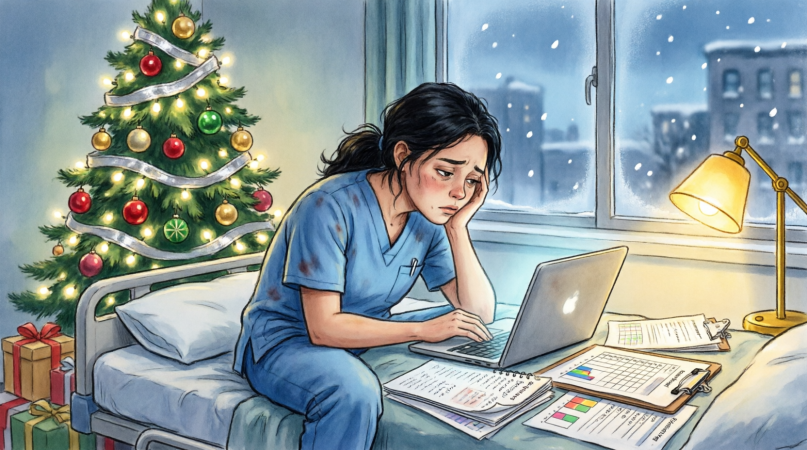
The room around me was dark except for the blue glow of the screen and the thin stripe of streetlight leaking through my blinds. I was still wearing my scrub top—wrinkled, faintly smelling of antiseptic and someone else’s fear—because I’d stumbled home from the hospital and collapsed on the bed without even making it. Twelve hours in the ICU had left my body buzzing in that strange way exhaustion does, where you’re so tired you can’t actually sleep.
A notification hovered on my lock screen:
Family Reality Check — new messages
My thumb paused mid-air.
I didn’t recognize the group chat name. I didn’t recognize the icon either—some generic gray silhouette. For a second, I wondered if it was a work thread I’d forgotten about, or one of those spam groups that add random numbers at night.
Then I saw the list of participants. My stomach tightened.
David. Sarah. Chloe. Aunt Renee. Cousin Olivia. Mom.
My family.
Someone had accidentally added me to a chat they’d meant to keep me out of. Or they’d meant to remove me and clicked the wrong name. The kind of mistake that happens when you’re laughing too hard to double-check.
My hand hovered over the screen, and I told myself to be rational. Maybe it was an old group thread. Maybe it was a plan for a surprise gift. Maybe it was nothing.
I unlocked the phone.
The first message I saw made my blood run cold.
Sarah: Thank God she’s covering the turkey again this year. I’m not about to spend $150 on that.
David: She wants to be included. She’ll pay for anything. It’s kind of sad.
Olivia: Holiday parasite strikes again 🎄💸🤣
I stared at the words until they lost their meaning. Parasite. The word scraped across my brain like a sharp instrument.
Then I scrolled.
And the room tilted.
The conversation hadn’t started tonight. It hadn’t started last week. It had been active for three years.
Three years of messages. Screenshots. Memes. A running tally of my kindness like it was a sport. There were pictures of my Venmo payments with sobbing-laugh reactions. There were jokes about my “nurse money” and how I was “too naive to realize she’s being used.” There was a photo my mother had sent—someone tossing cash into a fire—with text over it that said: Lily’s Christmas Spirit.
Lol.
Lily. That was me.
A sound came out of my throat—small, strangled—like I’d tried to laugh and it turned into choking. My hands began to shake so hard the phone vibrated against my palm.
I scrolled up and up and up, each flick of my thumb dragging more of it into the light.
There was a betting pool on what I would pay for next.
There were jokes about how if someone mentioned “Mom’s health,” I would “open my wallet like a trained seal.” There were emojis of seals and circus tents. There were screenshots of my texts—my real texts—where I’d written things like Of course, don’t worry, I’ll send it right now and Anything you need, I’ve got you.
They had been laughing at those messages like they were punchlines.
My throat clenched so tight it hurt to breathe.
I lay there in my studio apartment—the one I could barely afford because I’d been sending money home for every holiday, birthday, and emergency my family could invent—and the darkness felt suddenly hostile, like it was watching me realize something I should have known.
My mother had called me earlier this month, crying about a medical bill. I sent her $2,500 without blinking. I ate ramen for a week afterward and told myself it was fine, because she was my mother, because I had a stable job, because family helps family.
Now, in the chat, I found the truth.
Mom: Told Lily I need help with medical costs. She sent it immediately.
Olivia: Where are you going with it?
Mom: Cabo 😘
My fingers went numb.
They weren’t struggling. They weren’t barely making it. They were spending my money on vacations, Botox, designer bags, and cabin rentals, while I was washing human waste off strangers and holding dying hands so those people wouldn’t be alone when the machines started screaming.
The messages blurred as tears pooled in my eyes. I wiped them away with the back of my hand, smearing salt across my cheek.
Then I saw the one from Chloe—my younger sister, the one I’d practically raised through money and worry, the one whose textbooks and food plan and sorority dues I’d covered because she couldn’t bear the idea of being “left out.”
Chloe: Lily is working another holiday shift this year. More money for us.
Sarah: You’re a demon lol.
David: Honestly she makes it too easy. She offers. That’s on her.
Chloe: Maybe I’ll finally get that Gucci bag since she’s covering Christmas dinner and gifts for Mom and Dad.
My chest tightened so hard I pressed a hand to it like I could physically hold my heart in place.
I had worked that last holiday shift because David had called me the day before, voice frantic, telling me his electricity was about to be shut off. He needed $400 immediately. I picked up overtime, sent the money, and spent my birthday alone in my apartment with a grocery store cupcake because I was too tired to go out.
Two days later, he posted photos of a brand-new gaming PC. He grinned into the camera, surrounded by monitors and neon lights, and wrote: New setup, finally!
I remember liking the post. I remember feeling happy for him. I remember telling myself he must have gotten a deal.
Now I scrolled and found the message about that, too.
Olivia: She worked her birthday so she could “help” David.
Sarah: That’s so depressing.
David: Electricity wasn’t even getting shut off lol.
Chloe: Priorities 😭🤣
Fifteen laugh reactions.
My hands shook so badly I almost dropped the phone. I caught it against my stomach, breathing fast like I’d been running.
I scrolled again, because once you’ve opened the door, you can’t pretend you didn’t see inside.
They weren’t just mocking my money. They mocked my body, my dating life, my clothes, my job stories.
Olivia: Remember her Target dress at my wedding?
Sarah: What do you expect from someone who spends everything on other people?
David: Cognitive dissonance is wild. She won’t buy herself a real dress but will pay for Mom’s Botox.
Mom: Bless her little heart. She tries.
They ridiculed me for being cheap while simultaneously draining every extra dollar from me. They made fun of my “sad little apartment” while using the money that could have bought me something bigger.
Then I found the message that made me go completely still.
Two Christmases ago, I had asked my mother if I could bring someone to dinner. A guy from my hospital—James, a respiratory therapist with kind eyes and a laugh that made my shoulders unclench. We’d been seeing each other for three months. I was excited, nervous, hopeful. I wanted to introduce him like it was proof that I had a life beyond work and family obligation.
My mother told me there wasn’t room.
I believed her. I apologized for even asking. James smiled and said it was okay, but his eyes looked disappointed in a way he tried to hide.
Now I saw what my mother had told the chat that night.
Mom: Lily asked if she can bring a guy to Christmas. I told her there’s no space 😂
Olivia: Good. We can’t have her distracted from her duty as family ATM by a boyfriend.
David: Exactly. If she gets a life we lose a sponsor.
Sarah: Keep her lonely, keep her paying.
I stopped breathing for a second.
My stomach rolled.
James and I broke up two months later because he told me I was never available, always picking up extra shifts, always dealing with family emergencies. He said it felt like I was married to my family. He said he wanted to build a life with someone who could show up.
I cried that night and promised myself I’d do better next time.
But there hadn’t been a next time, because my family had made sure loneliness stayed close to me like a leash.
It wasn’t just manipulation. It was engineering.
They isolated me so I would keep coming back to them for connection. They kept me exhausted so I wouldn’t have the energy to question. They kept me guilty so I would keep paying.
I stared at the last messages at the bottom of the chat thread. It was still active. Someone had typed just minutes ago.
Sarah: Is Lily coming this year? I need to know if we should bother cooking or if she’ll pay for catering like last time.
David: Oh she’ll come. Where else would she go? She lives for work and being our Santa.
My hands stopped shaking.
Something cold and hard settled into my chest, replacing the tears with a strange, steady rage.
They assumed I had no life.
They assumed I was so desperate for their acceptance that I’d keep funding theirs forever.
They assumed wrong.
I sat up in bed. The room was still dark, but my mind felt painfully awake, sharpened to a single point.
I swung my feet onto the floor, stood, and walked to my tiny kitchen. The linoleum was cold under my bare feet. I poured water from the tap and drank it standing at the sink, staring at my own reflection in the window. My face looked pale, eyes swollen, hair pulled into a messy knot that still held the impression of my scrub cap.
I looked like someone who had been giving away pieces of herself for years and only now noticed the holes.
My phone buzzed again. More messages in the chat.
I didn’t read them.
I opened my laptop.
If my family wanted a reality check, I was about to deliver one with receipts.
First, I logged into every account that had my name attached to their convenience.
For years, I’d treated it like a small thing. It’s only Netflix. It’s just the phone plan. It’s easier if I handle it.
It was never small. It was a system.
The Hulu account? Mine. Netflix? Mine. Disney+ for the kids? Mine. Spotify family plan? Mine. Amazon Prime? Mine. iCloud storage for my mother’s ten thousand photos? Mine.
And the phone plan.
I stared at the Verizon dashboard and felt my stomach flip again. Six lines. Six. All under my name. Paid with my bank account.
I clicked through usage.
David averaged forty-seven gigabytes a month. Streaming, gaming, whatever else he did while complaining about financial hardship. Sarah’s phone line showed endless social media use, hours and hours of scrolling through other people’s lives while living off mine. Chloe had been making international calls—France—because her boyfriend was studying abroad. That explained the extra fees I’d been paying for months without question.
My mother had discovered TikTok at some point and was now chewing through data like it was candy. My father barely used his phone, but it was still there—one more leash in the system.
I didn’t cry again. I didn’t have room for it.
I did what I’d learned to do in the ICU when a patient started crashing: I stabilized the situation first. Panic later.
I created a new email address—one my family didn’t know. I set up a Google Voice number that none of them had ever seen. I enabled two-factor authentication on every account, using the new email and new number.
Only when I was sure they could not lock me out of my own life did I begin dismantling theirs.
The phone plan came first.
Six lines cost me around $300 a month. Three years of that was more than ten thousand dollars, and I’d treated it like background noise.
I called Verizon. A cheerful agent answered, asking how she could help.
“I need to disconnect all secondary lines immediately,” I said.
There was a pause. “We can transfer the numbers to the other users,” she offered brightly, like she was doing them a favor.
“No,” I said, voice flat. “Disconnect them. No transfer.”
Another pause, longer this time. “Ma’am, they will lose their numbers.”
I smiled, but it wasn’t happiness. It was relief.
“Good,” I said.
She tried again. “Are you sure? Sometimes family members—”
“Disconnect them,” I repeated.
The agent’s tone shifted into professional compliance. “All right,” she said. “Your primary line will remain active. Secondary lines will disconnect in forty-eight hours.”
“Thank you,” I said, and meant it.
I set a calendar reminder for the exact time the lines would die.
Then I moved on to streaming services, and for the first time in hours, something like grim amusement bubbled up in my chest.
Netflix had four profiles.
None were mine.
David had been bingeing true crime. Sarah watched reality shows about rich housewives—which felt painfully on-brand. Chloe watched romantic comedies. My mother watched British baking competitions, over and over, like she was trying to absorb kindness from a screen.
I deleted every profile but my own. I changed the password. I clicked “sign out of all devices.” A tiny thrill ran through me when the screen confirmed it.
Then Hulu. Disney+. HBO Max. Paramount+. Every one of them got the same treatment: password changed, devices removed, security tightened.
I canceled the Costco membership next. When I logged in, I discovered I could view purchase history.
My mother had been shopping there twice a week.
Not just groceries. Luxury items. A $500 outdoor furniture set. A stand mixer. Cases of premium wine. Party platters for gatherings I had never been invited to.
David had purchased auto supplies—winter tires in October.
The same month he’d told me he couldn’t afford repairs and I’d sent him $400.
I stared at the purchase list until my jaw hurt from clenching.
I terminated the membership and requested a prorated refund. Seventy-five dollars slid back into my account like a small insult.
Then iCloud.
This one was petty, and I knew it, and I enjoyed it anyway.
My mother had backed up her entire digital life on my two-terabyte plan. Photos, videos, documents, everything. I dropped the plan to the free five gigabytes and watched the system immediately start sending alerts.
Your storage is full. Your backup has failed.
She wouldn’t lose anything permanently, not right away—but she’d have to deal with it. She’d have to feel friction. She’d have to understand what it meant when something she assumed would always work suddenly didn’t.
At her age, with her limited patience for technology, she would be furious for weeks.
I imagined her calling David for help.
David realizing his phone line would be dead in forty-eight hours.
The dominoes were already falling.
The bigger cancellations came next.
I had been paying David’s auto insurance. He’d called me crying about losing coverage and I’d added his car to my policy. Two hundred dollars a month. Gone.
I called the insurance company and removed his vehicle immediately. The representative warned me there might be a gap in his coverage.
“That’s his problem,” I said, and felt something inside me unclench.
Chloe’s gym membership. A fancy club she “needed for mental health.” Seventy-five a month. Canceled.
My mother’s subscription boxes—three different ones. Beauty products, snacks, books. One hundred and twenty a month. Canceled.
Sarah’s meal kit service, because she “didn’t have time to grocery shop.” Two hundred and twenty a month. Canceled.
Dad’s roadside assistance package. Canceled.
Extended warranty for David’s TV. Canceled.
A meditation app for Chloe. Canceled.
I combed through seventeen months of credit card statements and found forty-three recurring charges tied to my family.
Some were small: $4.99 here, $12.99 there.
Some were enormous, like the $180 “grandma care fund” I’d been paying every month. I’d assumed it was for medications or assisted living.
In the chat, I learned the truth.
Grandma was fine. Subsidized senior housing, full coverage, stable.
The “care fund” was David’s yacht money.
They’d literally created a fictional old woman emergency to drain me steadily, and they’d laughed about it.
By seven in the morning, I had canceled or transferred all forty-three services.
My monthly costs dropped by $1,600 in a single night.
I stared at the number like it was a hallucination.
$1,600.
That was my rent.
That was groceries, gas, insurance, and still enough to save.
I felt queasy. Then I started laughing.
It came out wrong at first—sharp, breathless. Then tears came with it, and I was laughing and crying at the same time, sitting on my kitchen floor in yesterday’s scrubs, because the absurdity was too large for my body to hold.
I had been calling myself responsible, stable, generous.
But I had been paying for an entire ecosystem of people who called me a parasite.
The irony was so vicious it circled back into clarity.
I wiped my face, stood up, and went back to the laptop.
If I was going to burn the bridge, I was going to do it properly.
I pulled up my spreadsheets.
I had always kept records. Nurses learn documentation the same way we learn to wash our hands: as survival. If you don’t write it down, it didn’t happen. If you can’t prove it, you’re the one who gets blamed.
For years, I’d tracked everything I sent my family. Not because I planned to confront them—because I told myself maybe it would help on taxes, maybe it would count as dependent care, maybe it would matter someday.
It mattered now.
I started tallying.
Last year’s Christmas: $10,500. Cabin rental. Gas money. Food. Gifts. Decorations. “Extra help” for people who had apparently been able to afford Vegas trips and designer bags.
Thanksgiving over three years: $7,500.
Unpaid “emergency loans”: $12,500.
Chloe’s school expenses: $5,500.
David’s kids’ birthdays and holiday gifts: $3,000.
Phone costs: $3,800 over three years.
Streaming services: $6,500.
Insurance premiums and warranties: $5,000.
“Medical crises” that turned out to be vacations: $3,700.
Mom’s subscription boxes: $2,800.
Sarah’s meal kit: $2,500.
Random “crisis payments”: $1,000 here, $600 there, $200 there.
The total crawled upward like something alive.
When it hit $60,000, I stopped.
My breath caught in my throat.
Sixty thousand dollars.
I could have paid off my student loans. I could have put a down payment on a house. I could have traveled, invested, built a life beyond overtime shifts and fluorescent break rooms.
Instead, I had funded their comfort while they laughed at my loneliness.
I exported the spreadsheet into a PDF—thirty-seven pages of receipts, statements, dates, categories. A ledger of their entitlement.
Then I took screenshots of the group chat—every cruel joke, every meme, every line that revealed their system.
I didn’t do it for revenge. Not exactly.
I did it the way we take photos of bruises in the ER: so no one can later claim it wasn’t real.
By the time the sun began to lift the edge of the night, my hands had stopped shaking.
My face felt tight with dried tears, but my mind was clear.
I opened the chat.
Messages had continued while I worked.
Sarah: If we tell her Mom’s heart can’t handle hosting, she’ll cover the cabin again.
Olivia: Genius.
David: Trained seal 😂
Chloe: Don’t push too hard, she might finally grow a spine.
Mom: She won’t.
I stared at that last line.
She won’t.
I typed my message slowly, deliberately, like I was signing a discharge order.
Hi everyone. Looks like I was accidentally added to this chat. How convenient.
I attached the PDF.
Since I’m apparently a “holiday parasite,” I’ve decided to stop feeding the hosts.
Attached is documentation of every payment I’ve made to this family over the last five years. Total: $60,000. Consider it my final Christmas gift.
All shared services and subscriptions have been canceled, effective immediately. The phone plan expires in 48 hours. I will not be attending Christmas this year or any year going forward. I will not be available for emergency loans, holiday funds, or any form of financial support. If you’re unclear why, scroll up.
You’ve spent three years making it obvious how you feel about me. I believe you now.
Merry Christmas. Don’t contact me again.
My finger hovered over send.
There was a moment—small, almost tender—where I felt the old version of myself rise up. The Lily who still hoped someone might surprise her. The Lily who still wanted her mother to be proud for the right reasons. The Lily who still thought love could be earned through sacrifice.
Then I remembered my mother’s message: She won’t.
I pressed send.
Immediately, I blocked every number.
Mother. Father. David. Sarah. Chloe. Aunt Renee. Cousin Olivia. Everyone.
Then I deleted my social media accounts. Every last one.
Instagram, Facebook, Twitter—gone.
I didn’t want to see their replies. I didn’t want their apologies or their rage or their attempts to rewrite history. Going nuclear only works if you don’t stand too close to the blast.
My phone buzzed within minutes—unknown numbers calling, voicemails piling up.
I turned the phone off.
 :
: