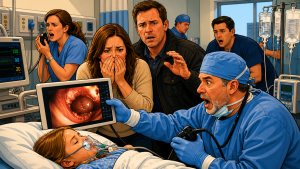
The first thing I noticed was how quiet the waiting room was, like the hospital had decided to hold its breath with us.
Mia lay on the gurney in a gown that swallowed her small shoulders. Her stuffed rabbit—Mr. Buttons—was tucked beneath her arm, its ear damp from where she’d been chewing it. She tried to be brave, but every time she swallowed, her eyes squeezed shut and her chin quivered.
“We’re going to take a little nap,” the nurse told her gently. “And when you wake up, your tummy and throat will feel better.”
Mia nodded like she understood, even though she was six and most of her understanding of hospitals came from cartoons. She reached for my hand, fingers cold and slightly sticky from the popsicle the ER nurse had given her to keep her calm.
“I’m sorry, Daddy,” she whispered.
“For what, peanut?”
“For… for swallowing it.”
My wife Laura stood on the other side of the bed, smoothing Mia’s hair with careful strokes. She’d been doing that all evening—touching, arranging, fixing—like she could soothe the situation into a different outcome. Her wedding ring finger was bare, as it had been for months, but I didn’t think about that then. I was only thinking about my daughter’s throat and the way she’d started coughing during dinner, face turning crimson, little hands clawing at her own neck.
At first, I’d assumed it was a grape. Or a piece of chicken. The kinds of things parents joke about later in the relief of it all.
But Mia had finally coughed and gulped and gasped, and then she said, in a tiny voice that made my blood run cold, “I swallowed something hard.”
“What did you swallow?” Laura had asked, smiling like it was a game.
Mia’s eyes darted to the side. “I don’t know.”
That was the problem. Not knowing.
The X-ray tech had been brisk and kind, moving Mia’s arms with practiced ease. The physician assistant had frowned at the image, then excused himself, then came back with a doctor who spoke in that calm-but-serious tone medical professionals use when they’re trying not to scare you but still need to communicate urgency.
“It’s lodged,” he’d said. “Not in the airway. But it’s in the esophagus, and it’s not going down on its own.”
“Is it a coin?” I asked, because kids swallow coins. Every parent knows that.
“It’s… ring-shaped,” the doctor said slowly. “Metallic. It looks like it could have an engraving.”
Laura’s hand had gone to her mouth. She’d made a small sound, almost like a laugh that couldn’t find its way out.
I should have noticed that.
Instead, I squeezed Mia’s fingers and nodded like I had control over something.
Now, hours later, we were outside Operating Room 2, staring at a door that might as well have been a vault. The gastroenterologist, Dr. Patel, had introduced himself and explained the endoscopy in terms that were designed to reassure. A camera. A small scope. Minimal risk. Quick procedure. We’d signed forms with shaking hands and told ourselves that tomorrow morning this would be a story we told at family gatherings.
The nurse who came to take Mia back had kind eyes and a clipped efficiency. She checked Mia’s bracelet. She checked our names.
“Do either of you know what the object might be?” she asked.
Mia, already woozy from the pre-medication, murmured something I couldn’t make out.
Laura answered too quickly. “A toy. It must have been a toy.”
The nurse nodded, like it didn’t matter what it was as long as it came out.
They rolled Mia away. Her rabbit ear dragged off the edge of the gurney, and Laura snatched it up at the last second, pressing it to her chest as though it could keep Mia tethered to us.
We waited. We watched the clock. I stared at the family photos on the wall—smiling children with bandages on their arms, triumphant parents giving thumbs up—as if the people in those photos could lend us their luck.
Then a door opened, and a surgical tech leaned out.
“Mr. and Mrs. Mercer?” she called.
We stood so fast my knees protested.
Dr. Patel was inside, half turned toward a monitor. The room smelled like disinfectant and plastic. It was brighter than the waiting room, harshly lit, a place where nothing could hide……………………
Mia lay on her side, already asleep, a small mound under warm blankets. The sight of her like that made my chest ache. I stepped closer, but a nurse subtly blocked my path with her body, a gentle reminder that this was a sterile space and I was a visitor, even if it was my child.
Dr. Patel’s face was tight in a way it hadn’t been when he explained the procedure.
“We’re still in the esophagus,” he said, voice lower than before. “We’ve visualized the object.”
“Okay,” I said, because I didn’t know what else to say. “So you’ll remove it?”
He didn’t answer immediately. His right hand held the endoscope controls. His left hovered as if he’d forgotten what to do with it.
On the monitor, Mia’s throat was an alien tunnel—pink, slick, faintly pulsing. The camera’s light made everything gleam. The image was strangely intimate, like being shown the inside of a secret.
Then, as the scope advanced, something appeared.
Metal.
Not the dull gray of a coin. Not the uneven shine of a cheap toy. This was smooth, circular, catching the light in a way that made it look almost alive. For a split second I couldn’t understand what I was seeing, because my brain refused to connect the object inside my daughter with the object that had sat on my finger for ten years.
But it was a ring.
My ring.
Even through the distortion of the camera and the wetness of Mia’s body, I recognized the tiny scratches on the outer band from when I’d scraped it on a doorframe moving furniture. I recognized the faint nick along the edge from when I’d tried to open a bottle in college like an idiot and Laura had laughed and called me a caveman.
Dr. Patel’s breath caught. “This… this is impossible.”
“What do you mean?” Laura asked, and her voice was thin as paper.
He turned the monitor slightly so we could see the engraving more clearly. The camera shifted, and the inside of the band flashed.
Forever. L.
I heard myself make a sound—half gasp, half laugh, as if my body couldn’t decide whether to panic or deny. “That’s… that’s my wedding band.”
Laura’s hand, which had been gripping Mr. Buttons’ ear, started to shake. Not a subtle tremor. A visible, uncontrollable shiver that ran down her fingers into the plush fabric.
Dr. Patel looked at her, then back at me. His jaw tightened, and I saw the moment he made a decision that had nothing to do with medicine.
“How long has this been missing?” he asked.
I swallowed. “Months.”
Laura spoke again, too fast, too bright. “We thought the maid misplaced it. It’s—this is—this is crazy.”
Dr. Patel didn’t look convinced. He lifted his gaze toward a nurse near the door. “Bag and label it as recovered foreign body,” he said. Then, without taking his eyes off us, he added, “And call security. Now.”
Laura’s breath hitched. “Security? Why would—”
“Because,” Dr. Patel said, voice steady and professional, “we have a child with an adult’s wedding ring lodged inside her esophagus. And we need to understand how that happened.”
He pressed a button on the wall intercom. “Security to O2.”
The words landed in the room like a weight.
My heart hammered so hard I could feel it in my fingertips. I stared at the screen, at the ring inside my daughter, and something deeper than fear opened in me—something jagged and old, like a crack forming under pressure.
Dr. Patel turned away from the monitor just long enough to look me directly in the eyes.
“Sir,” he said quietly, “I need you to step outside for a moment.”
But I didn’t move.
Because on that flickering screen, in that impossible image of metal wedged in pink flesh, I saw more than a missing ring.
I saw the outline of a lie.
And the way Laura’s trembling hand tried to crush a stuffed rabbit’s ear into silence.
Part 2
The first security officer arrived within two minutes. The second followed a minute later, along with a woman in navy scrubs whose badge said Patient Advocate. They stood near the door as if they belonged there, as if their presence was routine.
Maybe it was.
To me it felt like a spotlight.
Dr. Patel resumed the procedure with a kind of controlled urgency. He spoke in clipped phrases to his team, and the tools on the tray made faint metallic clinks that sounded too similar to the ring on the screen. I stood frozen at the foot of Mia’s bed while Laura hovered behind me, a pale shadow.
The patient advocate stepped closer. “Mr. Mercer? Mrs. Mercer? I’m Diane. We’re going to ask you a few questions in just a moment. Right now, the doctor needs space to work.”
“Is she going to be okay?” I asked, because my brain latched onto the only acceptable fear.
Dr. Patel didn’t look away from the monitor. “She’s stable,” he said. “But we need to remove it carefully. There’s a risk of abrasion, and—”
“And what about the ring?” Laura interrupted, voice pitching high. “Can’t you just get it out and we go home?”
Diane’s expression didn’t change, but her eyes sharpened. “We’re focused on your daughter. The rest will follow.”
A nurse guided us toward the door. I went because I didn’t want to interfere. Laura followed, clutching Mr. Buttons like a talisman.
Outside, the hallway felt colder. The fluorescent lights buzzed overhead. Somewhere down the corridor a baby cried, and the sound cut through me with a jealousy that surprised me. That baby’s crisis was new and uncomplicated. Ours had roots.
Security asked us to sit in a small consultation room with a table and two chairs. It was the kind of room where people got bad news.
The officer introduced himself as Officer Reynolds. He was polite. Too polite. The second officer, a woman with her hair pulled back tight, leaned against the doorframe, arms folded.
“This is standard procedure,” Reynolds said. “When an unusual foreign body is found in a minor, we document and make sure there’s no risk of intentional harm.”
“Intentional harm?” Laura echoed, as if the words were foreign.
Reynolds slid a notepad in front of him. “Let’s start with basics. How old is your daughter?”
“Six,” I said.
“Any developmental delays? Behavioral issues? Pica?”
“No,” I said again. “She’s… she’s just a kid. She puts things in her mouth sometimes. But not—” I swallowed hard. “Not this.”
Reynolds nodded. “Can you explain the ring? When did it go missing?”
I felt Laura stiffen beside me.
“Maybe four months ago,” I said. “I took it off to wash my hands while I was cooking. I left it by the sink. Later it was gone.”
“Did you file a police report?” Reynolds asked.
“No. I looked everywhere. Laura said maybe the cleaner knocked it into the trash.”
Laura leaned forward. “That’s what happened,” she said brightly. “We had a maid service for a while. Things got misplaced sometimes. It was horrible luck, but—”
Officer Reynolds held up a hand gently. “Ma’am, we’ll ask about that in a moment. Mr. Mercer, do you remember anything else about that day?”
I tried to. I saw the kitchen in my mind—white counters, Mia’s coloring book spread out, Laura on her phone by the window. I remembered being annoyed that Laura didn’t help with dinner. I remembered Mia humming to herself. I remembered nothing about a ring after that.
“No,” I admitted. “Just… gone.”
Reynolds wrote. “Does Mia ever play with jewelry? Does she know what a wedding ring is?”
I hesitated. “She knows it’s important. She called it my ‘forever circle.’”
Laura made a sound that might have been a laugh if it didn’t crack at the edges.
Officer Reynolds glanced up. “What did Mia say tonight? Before the choking started?”
“She said she swallowed something hard,” I said.
“And did she say where she found it?”
“No,” Laura cut in quickly. “She was scared. She didn’t know.”
I turned to look at Laura, because the way she said it—so confident, so absolute—didn’t match the reality of our daughter. Mia always knew. Mia could describe the exact location of a missing crayon from three weeks ago.
“Mia didn’t say,” I repeated carefully, watching Laura’s face as I spoke.
The other officer, the woman by the door, finally spoke. “We will need to speak to Mia when she wakes up, with a nurse present.”
Laura’s fingers tightened on Mr. Buttons’ ear. “She’s a child. She’ll be confused. This is going to scare her.”
“It’s to protect her,” Reynolds said.
A silence settled, heavy and awkward. My mind kept looping back to the monitor. The ring. The engraving. Forever. L.
I tried to picture how it could have gotten into Mia’s throat. The simplest explanation was that Mia had found it, thought it was candy, or wanted to hide it, and swallowed. Kids did strange things. Kids panicked.
But the ring had been missing for months. Where had it been? In a drawer? On a shelf? In a pocket? If it was in our house, why hadn’t it turned up sooner? Why hadn’t Mia swallowed it months ago?
Unless it wasn’t in the house.
Unless it hadn’t been missing. Unless it had been… elsewhere.
Officer Reynolds cleared his throat. “We also need to ask, has there been any domestic conflict recently? Any incidents involving discipline that could be considered excessive?”
“No,” I said instantly. “Never.”
Laura nodded so hard it looked like it hurt. “Of course not.”
Reynolds studied us. “Okay. Dr. Patel will let us know when the object has been removed. It will be bagged and labeled. In situations like this, it may be held as evidence if there’s any concern about neglect or—”
“It’s my ring,” I snapped, the anger finally bubbling through the fear. “It’s mine. It’s not evidence of anything except that my kid swallowed it.”
The patient advocate Diane, who had quietly entered and sat near the corner, spoke softly. “Sir, I understand how upsetting that feels. But the priority is Mia’s safety, and the hospital has protocols.”
Laura’s voice came out in a whisper. “Can we go see her?”
Reynolds nodded. “After the procedure.”
We waited again, but this time the waiting wasn’t empty. It was filled with the weight of implied accusations and the buzzing sensation that something I thought I understood about my own life had shifted.
When Dr. Patel finally appeared, his mask was down, his face tired.
“It’s out,” he said.
I stood so abruptly my chair scraped. “Is she okay?”
“She’ll have a sore throat. We’ll keep her overnight for observation. But she did well.”
Laura let out a sound that was almost a sob. She pressed a hand to her mouth.
Dr. Patel motioned toward a small clear bag in a nurse’s hand. Inside, resting on white gauze, was my ring. Cleaned but still wet, the metal dull under fluorescent light.
For a second, my body relaxed at the sight of it, like a part of me had been missing too and now it was back.
Then Dr. Patel spoke again, and the relaxation died.
“We have to document this,” he said. “And I’m required to report unusual findings involving a minor to the appropriate channels. That doesn’t mean anyone is accusing you of anything. It means we don’t ignore signs that could indicate risk.”
Laura’s eyes were wide. “Risk? She just… she just swallowed it.”
Dr. Patel looked at her, and his voice stayed neutral, but something in his gaze was sharp. “Children don’t typically swallow adult wedding bands. Not by accident. Usually there’s a story behind it.”
I felt my mouth go dry. “Can we talk to Mia? Ask her?”
“When she wakes,” Diane said gently. “With staff present, as Officer Reynolds said.”
We followed Dr. Patel to Mia’s recovery room, but before we reached the bed, the other officer stepped in front of us, palm out.
“Mrs. Mercer, we need to speak to you alone for a few minutes,” she said.
Laura’s face drained. “Alone? Why?”
“Standard,” Reynolds echoed from behind us. “Separate interviews. No pressure. No coaching.”
Laura’s gaze snapped to mine for a fraction of a second, and in that look I saw something that didn’t belong in a mother’s eyes right after her child survived a medical scare.
Not relief.
Calculation.
The officer guided Laura away down the hall. Laura glanced back once, clutching the stuffed rabbit as if it might anchor her to me. Her hand still shook, but now it looked less like fear for Mia and more like fear of what she couldn’t control.
Diane touched my arm. “Mr. Mercer, why don’t you sit with Mia while we finish the paperwork?”
I walked into the recovery room alone.
Mia lay under a blanket, cheeks flushed, hair stuck to her forehead. An IV line snaked from her hand. She looked so small, so breakable, that my anger collapsed into a hollow ache.
I pulled a chair close and took her free hand.
A few minutes later her eyelids fluttered. She blinked like someone swimming up from deep water. Her gaze found me, and she frowned.
“Daddy?” she croaked.
“I’m here, peanut,” I whispered. “You did great.”
She swallowed and winced. “It hurts.”
“I know. It’ll get better.” I forced my voice to stay gentle. “Mia… can you tell me something? Where did you find the thing you swallowed?”
Her eyes shifted toward the window, away from me. A classic kid move. Hiding.
“Mia,” I said softly. “It’s okay. You’re not in trouble. I just need to know.”
Her lower lip trembled. “Mommy said… Mommy said not to tell.”
The room tilted.
I felt the words land inside me like a second foreign object, lodged somewhere deeper than my throat.
“What did Mommy say?” I asked, voice barely controlled.
Mia squeezed my fingers, and for a moment she looked older than six, burdened by a secret too heavy for her small bones.
“She said it was a grown-up thing,” Mia whispered. “And if I told, you’d leave.”
My chest tightened so hard it hurt.
Before I could speak again, the door opened and Laura stepped in, escorted by Diane. Laura’s eyes were red, but her face was composed in a way that felt practiced.
She smiled at Mia. “Hi, sweetie.”
Mia turned her face toward the wall.
Laura’s smile faltered.
I looked at my wife, and the ring that had been missing for months sat somewhere down the hall in a sealed bag like a piece of a crime scene.
Forever. L.
The word forever suddenly felt like a threat.
Part 3
Months earlier, before the hospital lights and the security questions and the impossible image on the screen, I’d thought the biggest danger to our marriage was time.
Not betrayal. Not lies. Just the slow erosion that happens when life gets busy and you assume love will hold its own shape without maintenance.
I worked in commercial real estate, the kind of job that turns your phone into a leash. Deals don’t respect dinner. Clients don’t care about bedtime routines. I traveled enough that Mia called suitcases “Daddy boxes.” Laura had quit her marketing job when Mia was born and never went back, partly by choice, partly because it made sense on paper.
For a while, it worked.
Then Mia started kindergarten, and Laura seemed to float without a schedule. She found new routines. Pilates. A book club. Volunteer shifts at the school. She’d always been social, but now it felt like she was building a life that didn’t include me, brick by brick.
I tried to be present. I really did. I made pancake Saturdays when I was home. I read Mia stories in silly voices. I kissed Laura’s shoulder when she stood at the stove. But there were nights I came home after Mia was asleep, and Laura was on the couch scrolling on her phone, the screen turned slightly away.
“What are you reading?” I’d ask, and she’d say, “Nothing. Just stuff.”
Stuff.
Then, four months before the endoscopy, the ring disappeared.
It was a Tuesday, which I remember because Tuesdays were my least favorite. They were too far from the weekend and too close to Monday. I’d been cooking spaghetti, trying to do something domestic in the middle of a week that had already turned sour.
I took my ring off because I was kneading meatballs and didn’t want raw beef under the band. I set it on the counter by the sink, right next to Mia’s plastic cup with cartoon sharks.
Later, when we were eating, I realized my finger felt oddly light.
“Hey,” I said, glancing toward the sink. “Where’s my ring?”
Laura looked up from her phone. “What?”
“My wedding ring. I took it off. It was right there.”
She stood and walked over, scanning the counter. “Maybe it fell.”
We searched. We checked the drain trap. We moved the toaster and the coffee maker. We emptied the trash, which smelled like onion skins and old coffee grounds. Mia watched, chewing on her fork like it was entertainment.
“Did you take it?” I asked Mia, half joking.
She giggled. “Nooooo.”
Laura sighed. “Ethan, it’s probably in the garbage. Or under the fridge.”
“It’s not,” I said, because I’d already looked.
Laura’s face tightened. “It’s just a ring.”
The way she said just made something flare in me. “It’s our ring.”
Laura rolled her eyes, the gesture sharp and dismissive. “You’re acting like it’s a limb.”
“It matters,” I said.
“It’s a symbol,” she countered. “And you’re obsessed with symbols.”
At the time, I thought we were arguing about sentimentality. About my tendency to cling to physical reminders. I didn’t understand we were arguing about ownership.
The next day, Laura told me she’d called the maid service. “They said they didn’t see anything,” she said, stirring her coffee with unnecessary force. “But you know how they are. Someone probably swept it up.”
“Did you ask them to check the vacuum?” I asked.
Laura shot me a look. “Ethan, stop. It’s gone.”
I didn’t stop. I turned over couch cushions. I checked Mia’s toy boxes. I looked in the junk drawer where we kept expired coupons and tiny screwdrivers. Laura watched me like my searching was a personal insult.
Eventually, she said, “Stop obsessing. It’s just a ring.”
And I did, sort of. I stopped looking. I stopped bringing it up. But I didn’t stop feeling the absence.
When you wear something every day for a decade, it becomes part of your skin. The tan line on my finger was a pale ghost. I’d touch it unconsciously during meetings. I’d notice it when I shook someone’s hand. Each time, a small flicker of loss.
Laura didn’t seem to miss it at all.
Around the same time, Mia’s pediatrician changed.
Our old pediatrician retired, and we switched to a practice closer to home. Dr. Caleb Wren was younger, maybe late thirties, with a calm voice and the kind of face that made people trust him without thinking. He had a way of crouching down to Mia’s level and talking to her like she was a person, not a problem……………………….
Mia loved him. “Dr. Wren has superhero stickers,” she announced after the first visit.
Laura loved him too, though she wouldn’t have said it that way. She started scheduling Mia’s appointments herself, even the little ones. She’d come home from checkups unusually energized, like she’d had coffee with a friend.
“How was it?” I’d ask.
“Fine,” she’d say. “He’s great. Really attentive.”
Once, she added, “He actually listens.”
The emphasis on actually felt like a jab.
I met Dr. Wren only once before the hospital night. Mia had a school physical, and I managed to come along. The clinic smelled like citrus cleaner. Dr. Wren shook my hand, firm grip, direct eye contact.
“Ethan, right?” he said as if we’d met before. “Laura’s told me a lot about you.”
It was a strange thing for a pediatrician to say. I laughed it off. “All good, I hope.”
He smiled. “She’s proud of you.”
Laura looked down at her purse, lips pressed tight, and something passed between them like a shared joke I wasn’t in on.
On the way home, I teased Laura. “You’re proud of me, huh?”
She stared out the passenger window. “Don’t make it weird.”
I didn’t push. I didn’t want to be the suspicious husband. I didn’t want to be the guy who interpreted every awkward moment as an affair. I wanted to believe the best, because believing the best was easier than admitting how fragile things had become.
Then there were the small shifts.
Laura started wearing perfume again, the kind she’d only worn on dates. She began taking “walks” after dinner, phone in hand, sometimes returning with cheeks flushed and hair slightly damp. She kept her phone face-down on the counter. She laughed at texts and didn’t share them.
When I’d ask who it was, she’d say, “Just the moms.”
But the laughter didn’t sound like mom-group laughter. It sounded like something private.
Mia started copying Laura, too. She’d tuck a toy phone under her pillow. She’d whisper to her stuffed animals in a low, secretive voice. Once, I caught her holding a plastic ring from a dress-up set, pressing it to her lips like she’d seen someone do it.
“What are you doing?” I asked, amused.
Mia jumped. “Nothing.”
Then she added, as if reciting, “It’s a grown-up thing.”
I should have asked where she heard that.
Instead I ruffled her hair and moved on.
Because in the slow drift of daily life, you don’t recognize the moment when your child becomes the vault for your spouse’s secrets.
You only recognize it when the vault breaks open under fluorescent lights, and the evidence shines from the inside out.
Part 4
After the hospital, sleep became impossible.
Mia stayed overnight for observation. Laura went home “to shower and grab clothes,” but she returned with fresh makeup and a brightness that didn’t fit the situation. She hovered over Mia’s bed, smoothing blankets, offering sips of water, smiling too wide at nurses.
When Mia slept, Laura talked about logistics. “We should replace the rug in the living room.” “The school fundraiser is next week.” “I’ll call my mom to let her know Mia’s okay.”
Not once did she ask the question that screamed in my own skull.
How did my wedding ring end up inside our daughter?
I asked it once, quietly, around three a.m. Laura was sitting in the plastic chair by the window, scrolling on her phone. The screen reflected in the glass like a second face.
“Laura,” I said. “How did it happen?”
She didn’t look up. “Kids do dumb stuff.”
“It was missing for months,” I said. “It didn’t just materialize in her throat.”
Laura’s thumb paused on the screen. “Ethan, please. Not now.”
“When then?” My voice sharpened despite my effort. “Because security thinks someone made her swallow it.”
Laura finally looked at me. Her eyes were glossy, not from tears but from exhaustion—or performance.
“Nobody made her,” she said. “She probably found it somewhere. Maybe it fell behind the sink and she found it and—she’s a kid.”
“She said you told her not to tell,” I replied, watching Laura’s face.
For a fraction of a second, Laura’s expression slipped. The smile fell away. Her lips parted like she’d been caught mid-step.
Then she recovered. “She’s confused,” she said quickly. “She’s groggy from anesthesia. She’s mixing things up.”
“That’s what you’re going with?” I asked.
Laura’s jaw tightened. “I’m going with the fact that our daughter is alive and safe. That’s what matters.”
Her words had the right shape but the wrong soul.
In the morning, the hospital’s social worker arrived. She was kind, professional, and relentless in the way of someone who had seen too much. She asked about our home environment. She asked about discipline. She asked about caregivers.
Laura answered smoothly. I answered honestly.
When the social worker asked, “Could Mia have had access to the ring recently?” Laura said, “I don’t know. Maybe it turned up.”
I heard the lie like a crack.
The ring itself was taken to be “logged.” Officer Reynolds explained it could be returned later after documentation. I signed forms. Laura signed too, her handwriting neat and controlled.
We took Mia home the next day. She was tired, sore, and strangely quiet. She clung to me more than usual. When Laura tried to hug her, Mia stiffened.
That night, after Mia fell asleep on the couch, I did something I’d never done in our marriage.
I checked Laura’s phone.
It wasn’t unlocked easily. Laura had changed her passcode. That, more than anything, made my hands shake. People don’t change passcodes for no reason.
I tried Mia’s birthday. Wrong.
I tried our anniversary. Wrong.
I tried Laura’s birthday. Wrong.
My chest tightened. I set the phone down and stared at it like it was a sleeping animal that might bite me if I got too close.
Then I remembered something Mia had said a week earlier, singing nonsense in the kitchen: “Six, four, two, nine—my secret line.”
It had sounded like a kid rhyme. A silly tune.
I typed 6429.
The phone opened.
I didn’t feel triumphant. I felt sick.
At first, the texts looked harmless. Group chats with moms. School reminders. Grocery memes. Then I found a contact saved as Client Support. The messages were short, often deleted, but the remaining ones made my stomach turn with the blunt force of their intimacy.
Miss you.
Is he gone?
Tonight?
Your hair smelled like summer.
And then, near the top, a message from earlier that week:
She swallowed it. Laura, what now?
The sender’s name was not Client Support.
It was Dr. Caleb Wren.
I stared at the screen until the words blurred. My mind tried to reject it, tried to build alternate explanations. Maybe someone else used his phone. Maybe it was a joke. Maybe Laura had asked him for advice about Mia swallowing something.
But the phrasing wasn’t medical. It wasn’t concerned. It was panicked, private.
Swallowed it.
Not swallowed something.
Swallowed it.
As if they both knew exactly what it meant.
I took screenshots with my phone, hands steady in a way my heart was not. Then I dug deeper.
Call logs. Late-night calls lasting seven minutes, fourteen minutes, twenty-one minutes. Always when I’d been traveling. Always when I’d been “busy.”
Photos.
Not explicit, but enough. A hotel curtain. Two wine glasses on a small table. A man’s forearm in the corner of the frame, a watch I recognized because I’d seen it on Dr. Wren’s wrist in the clinic.
A selfie of Laura in a bathroom I didn’t recognize, hair damp, wearing a smile I hadn’t seen in years. A ring glinting on her finger.
My ring.
I sat on the edge of the bed and stared at the wall. The room felt too small for my breath.
Behind me, Laura slept facing the wall, phone tucked beneath her pillow like a secret she needed close to her skin. The rise and fall of her breathing sounded normal, peaceful, as if she hadn’t built a second life in the margins of ours.
In the morning, I acted like nothing was different. I made Mia oatmeal. I kissed Laura’s cheek. I packed Mia’s backpack for school.
Then, after dropping Mia off, I drove to the hospital and asked for Officer Reynolds.
He met me in the lobby with the same polite face.
“What’s going on, Mr. Mercer?” he asked.
I showed him the screenshots.
His eyes narrowed. He didn’t gasp or flinch. He just nodded slowly, like a puzzle piece had finally clicked into place.
“I’ll forward this to the social worker and our liaison,” he said. “This may become a family services matter.”
“A matter?” My voice cracked. “My wife’s having an affair with our pediatrician. My daughter swallowed my wedding ring. That’s more than a matter.”
Reynolds exhaled. “Sir, I’m sorry. But you did the right thing bringing this forward. We need to ensure Mia’s safety.”
“Is she not safe with me?” I asked, the fear of losing her suddenly sharp.
“With you, likely yes,” he said carefully. “But we have to follow process.”
Process. Protocol. Words that tried to wrap chaos in bureaucracy.
As I left the hospital, my phone buzzed. A notification from Laura’s number.
Where are you?
No heart emoji. No casual tone. Just control.
I didn’t respond.
Instead, I drove to the pediatric clinic.
I sat in my car across the street for twenty minutes, watching parents walk in with coughing toddlers, watching a man in scrubs step out for coffee, watching the ordinary world continue while mine split in half.
Then I walked inside and asked the receptionist, “Is Dr. Wren available?”
She smiled. “Do you have an appointment?”
“No,” I said. “But he knows my family.”
She hesitated, then buzzed his office. After a moment, she nodded. “He can see you for a few minutes.”
I followed her down a hallway lined with cartoon posters about washing hands.
Dr. Wren’s office smelled faintly of mint. He looked up from his desk and smiled like this was a normal visit.
“Ethan,” he said. “How’s Mia doing?”
I closed the door behind me.
The click sounded final.
I placed my phone on his desk with the screenshot visible: She swallowed it. Laura, what now?
His smile died.
For the first time, Dr. Wren looked like a man, not a professional. His eyes flicked to the door. His throat bobbed.
“Ethan,” he began.
I held up a hand. “Don’t.”
He swallowed. “It wasn’t supposed to go this far.”
“That’s interesting,” I said, voice quiet. “Because it already went far. It’s inside my kid’s throat far.”
He flinched as if struck.
“I didn’t—” He ran a hand through his hair. “I didn’t make her swallow anything.”
“Then explain,” I said, leaning forward. “Explain how my ring ended up inside my daughter.”
His lips parted. He looked like he was calculating what he could say, what he could deny, what he could spin.
Then his shoulders slumped.
“It was… stupid,” he said. “It was a stupid, selfish game.”
My hands tightened into fists. “What game?”
He stared at the desk. “Laura… she took the ring. Months ago. She said she wanted to feel… married again. She said wearing it made her feel honest.”
The word honest hit me like a slap.
Dr. Wren continued, voice low. “She wore it when she came to see me. Once. She joked that it was like… borrowing your life. A dare.”
A dare.
“Then what?” I demanded.
He exhaled shakily. “She left it at your house. We were there. One night. You were away. Mia… she must have seen it. Laura panicked. She told Mia it was a grown-up thing and not to tell you because you’d leave.”
My stomach twisted. I saw Mia’s face in my mind, her serious little eyes, absorbing adult fear like it was a bedtime story.
“She didn’t want you to find it,” Dr. Wren whispered. “Then Mia… swallowed it. Laura called me freaking out, asking what to do. I told her to go to the hospital. She said she couldn’t say what it was.”
“Because it would expose her,” I said, voice dead.
Dr. Wren nodded, shame flooding his face. “I’m sorry.”
“Sorry,” I repeated. The word felt meaningless.
He looked up then, eyes wet. “I can fix this. I can tell—”
“You already told,” I said. “You just didn’t realize it.”
I stood, and my chair scraped harshly against the floor. Dr. Wren flinched again.
As I reached for the door, he said, “Ethan… please. Don’t take this out on Mia. She’s a kid.”
I paused with my hand on the knob.
“I’m not the one who put a lie in her mouth,” I said.
Then I walked out, past the cartoon posters, back into a world that suddenly looked like a set built for someone else’s life.
Part 5
Laura was waiting when I got home.
She stood in the kitchen with her arms crossed, posture too casual for the tension in her eyes. The countertops were spotless, as if she’d been scrubbing away evidence. Mia’s lunchbox sat by the door, packed and ready for pickup later, like she was trying to prove she could still be the mother who handled details.
“Where were you?” Laura asked.
I didn’t answer immediately. I took off my jacket and hung it on the chair instead of the hook, a small act of defiance.
“Ethan,” she said again, sharper. “I texted you.”
“I was busy,” I replied, tasting the irony.
Laura’s eyes narrowed. “With what?”
I walked to the table and placed a small manila envelope down gently, like it might explode. Inside was the hospital’s property receipt and, tucked behind it, a printed photo of the ring on the monitor. I’d asked Dr. Patel’s nurse for it under the pretense of insurance documentation. She’d given me a sympathetic look and printed it anyway.
Laura’s gaze dropped to the envelope. Her face shifted. Color drained, then returned in patches.
“What is that?” she asked, though she knew.
“Open it,” I said.
Her fingers trembled as she slid the photo out. She stared at it like it was a ghost.
Then she whispered, “Ethan… I can explain.”
I let out a slow breath. “Go ahead.”
Laura swallowed. Her eyes flicked toward the hallway, toward Mia’s room, as if Mia might be listening.
“Not here,” Laura said quickly. “We can talk later.”
“No,” I said. “Now. Because later is what you’ve been living on.”………………….
Click Here to continuous Read Full Ending Story :
:
PART 2-“After My Mom’s Funeral, My Dad Tried to Throw Me Out—He Didn’t Know Her Final Clause Would Destroy Him” (End)