Part 1
The first thing I noticed was the smell.
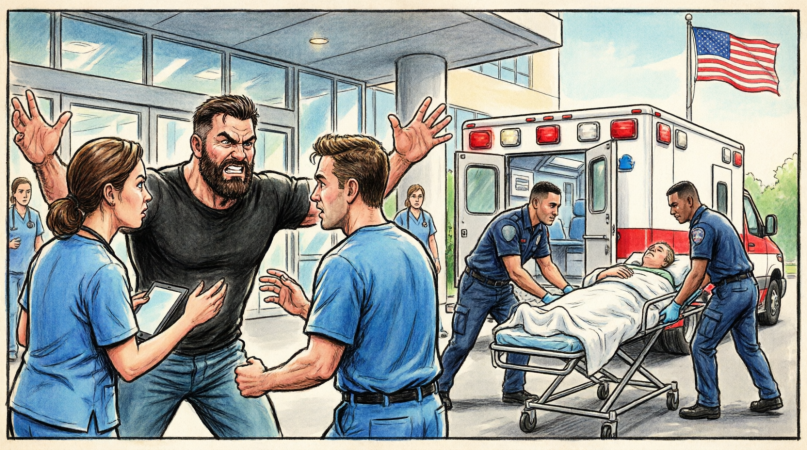
Hospitals always smell like somebody is trying to scrub fear off the walls. Bleach, plastic tubing, burned coffee, hand sanitizer, and underneath all of it, that thin copper scent that tells you blood has been somewhere it was never supposed to be.I sat in a hard chair outside the trauma unit with my elbows on my knees and my hands locked together so tightly my knuckles had gone white. On the other side of the glass, my son Mason lay under a white sheet with tubes coming out of him like somebody had tried to turn a seventeen-year-old boy into a machine.His jaw was wired. His right eye was swollen shut. The left side of his face looked like a map drawn in purple and red. Every few seconds, the ventilator made a soft sighing sound, and the monitor answered with a small green pulse.That little pulse was the only thing keeping me human.A surgeon walked out still wearing gloves stained dark at the fingertips. He was a young man, maybe thirty-five, with tired eyes and a crease between his eyebrows that told me he had practiced bad news in mirrors before.“Mr. Reed?”I stood.“My name is Logan,” I said.He nodded, swallowed, and looked back through the glass at Mason. “Your son survived surgery. He has a fractured orbital socket, three broken ribs, a collapsed lung, and swelling around the brain. We’ve stabilized him, but the next forty-eight hours matter.”The world did not spin. I did not fall. Men like me are trained not to give the body permission to panic.
I had spent twenty-two years teaching elite military teams how to move through darkness, how to breathe under water while their lungs screamed, how to think clearly when everything around them was exploding. I had trained men whose names never appeared in newspapers, men who could cross a border, end a warlord’s career, and leave nothing behind but rumors.And now I stood there in jeans and an old gray flannel, unable to protect my son from a pack of rich boys outside Oak Haven High School.“Who did this?” I asked.The surgeon looked at the floor. “The police are investigating.”That sentence told me more than he meant it to.A minute later, Principal Evan Harper hurried toward me with his tie loose and his hair flattened on one side. He smelled like coffee and rain. I had seen Evan at school meetings, always smiling, always saying words like community and safety while he avoided eye contact with difficult parents.“Logan,” he said softly, “I am so sorry.”I turned to him. “Say their names.”
He flinched. “We don’t know everything yet.”
“Say their names.”
He rubbed his palms together. “Hunter Voss was there. Colin Price. Julian Bell. Two others. But the story is complicated.”
“My son was beaten until he stopped breathing,” I said. “That isn’t complicated.”
Evan’s eyes darted toward a uniformed officer standing near the nurses’ desk. “Hunter’s claiming Mason started it. He says Mason shoved him first. There was a disagreement over—”
“Over what?”
Evan exhaled. “Shoes.”
I looked back at Mason’s broken face.
Mason had saved all summer for those sneakers. He mowed lawns, walked dogs, delivered groceries for old Mrs. Calloway three streets over. He didn’t buy them because he wanted to show off. He bought them because he liked the clean blue stitching and the little sketch of a bridge on the sole. He wanted to be an architect. Everything he loved turned into buildings in his head.
“He got jumped for shoes,” I said.
Evan’s mouth opened, closed, then opened again. “The cameras in that hallway were down for maintenance.”
Of course they were.
I looked at the officer by the desk. He had a square head, a thick neck, and a nameplate that read SGT. KYLE. He was pretending to read something on his phone, but he was listening to every word.
“Where is Hunter now?” I asked.
Evan’s face went pale. “Logan, please. Don’t go near him. His father is Councilman Victor Voss. The situation is delicate.”
I almost laughed.
My son’s teeth had been knocked loose, his lung punctured, his face broken, and this man was worried about delicacy.
I stepped closer to Evan, close enough that he could see the scar under my left eye. “You knew those boys were dangerous.”
“I tried to manage them.”
“No. You tried to survive them.”
He had no answer for that.
I walked into Mason’s room and took my son’s hand. It felt too cold for a boy who used to fall asleep with one foot outside the blanket because he always ran hot. His nails still had a little gray dust under them from the model bridge he’d been sanding in my garage the weekend before.
“I’m sorry,” I whispered.
The ventilator sighed.
“I taught you to be decent,” I said. “I taught you to walk away. I thought that made you strong.”
A nurse shifted behind me, pretending not to hear.
I kissed Mason’s forehead and stood there until the father inside me went quiet and something older took his place.
Outside, the rain had stopped. The school was only four miles from the hospital, and I drove there without turning on the radio. The streets of Oak Haven were slick and shiny under the streetlights. Front porches glowed warm. People were eating dinner. Dogs barked behind fences. The world had the nerve to keep being normal.
I found them in the side parking lot near the gym.
Five boys leaned against a black SUV with music thumping low from the speakers. Hunter Voss stood in the middle like he owned the pavement. Tall, blond, varsity jacket, expensive watch, mouth twisted in the kind of smile boys wear when nobody has ever made them afraid of consequences.
He saw me coming and nudged Colin.
The laughter slowed.
I stopped six feet away.
Hunter looked me up and down. “You Mason’s dad?”
“Yes.”
He grinned. “Man. That sucks.”
One of the boys snorted.
“My son is in intensive care,” I said.
Hunter tilted his head like he was studying a bug. “Maybe he should’ve minded his business.”
“What business?”
“He acted like he was better than us.” Hunter’s eyes dropped to my boots. “Guess he learned he wasn’t.”
My hands stayed loose at my sides. That was important. When men like me clench fists, bad things happen.
“You laughed while he was on the ground,” I said.
Hunter’s smile widened. “He made funny sounds.”
The parking lot went silent except for the SUV’s bass.
Something behind my ribs moved. Not anger. Anger is hot and clumsy. This was colder than that. Cleaner.
Hunter stepped closer. “You want to do something, old man?”
I looked into his eyes and saw nothing grown there. No guilt. No fear. No understanding that the boy in the hospital was a person, not a story he could tell at parties.
“You’ve spent your life hunting kids who couldn’t fight back,” I said quietly. “That makes you feel powerful.”
His smile twitched.
“But you’ve never been hunted.”
For one second, his eyes changed. Just one. A little flicker, like a match almost going out.
Then he laughed.
“My dad owns half this town,” he said. “You’re nobody.”
He climbed into the SUV and slammed the door. As they pulled away, Colin rolled down the window and yelled, “Tell Mason we said sweet dreams.”
Their taillights disappeared around the corner.
I stood in the wet parking lot, breathing slowly, counting four in, four out.
Then I took out a phone I hadn’t used in three years. It was old, black, and heavier than phones should be. I pressed one number.
The line clicked.
A voice answered, low and cautious. “I never expected this phone to ring again.”
“It’s Logan.”
Silence.
Then, “Instructor.”
“I need Blake, Grant, and Victor.”
“What happened?”
I looked at the school’s dark windows. Somewhere inside, a camera had conveniently failed. Somewhere nearby, a police sergeant thought he had buried the truth.
“My son got hurt,” I said. “And the people who did it laughed.”
The voice on the other end changed. Became sharp. Awake.
“What are we doing?”
I watched a janitor push a mop bucket past the front doors. The yellow bucket squeaked, tiny and sad in the night.
“We’re going to teach Oak Haven what consequences smell like,” I said.
And as I hung up, I realized my hands had finally stopped shaking.
Part 2
I did not sleep that night.
I sat in my garage with the overhead light buzzing above me and Mason’s unfinished bridge model on the workbench. Thin strips of balsa wood lay arranged beside a little bottle of glue, a ruler, and one of his pencils chewed at the end. He had sketched arches along the margins of an old math worksheet, clean curves rising over imaginary water.
My son wanted to build things.
Somebody had decided to break him.
At 5:17 in the morning, a black rental SUV rolled quietly into my driveway. The engine cut off, and three men stepped out.
Blake came first. Tall, narrow, clean-shaven, wearing a navy overcoat that made him look like a financial advisor. He had once talked a terrorist courier into giving up three safe houses without raising his voice.
Grant followed, broad-shouldered and silent, with a face that made strangers decide to cross the street. He carried no visible weapon. Grant never needed to.
Victor Reyes climbed out last, small, wiry, hair tucked under a beanie, laptop bag over one shoulder. He had the restless eyes of a man who could read a room and a router at the same time.
They walked into my garage without a word.
For a moment, none of us spoke. We had not been together since a desert extraction that officially never happened. Men like us don’t hug much. We remember who dragged whom through fire and let that stand in place of affection.
Blake looked at Mason’s model bridge.
“That his?” he asked.
I nodded.
Grant’s jaw flexed.
Victor set his laptop bag on the workbench, careful not to touch the bridge pieces. “Tell us everything.”
So I did.
I told them about the hospital, Evan’s shaking hands, Sergeant Kyle’s badge, Hunter’s laugh, the broken cameras, the way those boys talked about my son like he was a crushed soda can.
Blake listened with his hands folded in front of him.
Grant stood near the garage door, looking out at the quiet street.
Victor opened his laptop and began working before I had finished speaking.
“What do you want?” Blake asked when I was done.
It was the right question. Not what do you feel. Not what should happen. What do you want?
“I want truth,” I said. “Then I want consequences.”
Grant looked at me. “Legal consequences?”
I met his eyes. “As legal as we can make them.”
The corner of his mouth moved. Not quite a smile.
Victor tapped keys. “Oak Haven High’s security system is old. Cheap. Patchy. But nobody really deletes anything anymore. They just hide it badly.”
“You can recover the hallway footage?”
“I can try.”
“Try fast.”
He did.
While Victor worked, I drove back to the hospital. Morning sunlight hit the windows in bright, cheerful squares. It made me hate the day a little.
Mason was still under sedation. His mother, Layla, sat beside him with a paper cup of coffee untouched in her hands. She wore the same sweater she’d had on the night before, pale green, sleeves pulled over her knuckles. Our divorce had been final two years, but seeing her like that pulled old memories from places I didn’t want touched.
She looked up when I entered.
“Where were you?”
“Finding out what happened.”
Her eyes flashed with fear. “Logan, don’t.”
“Don’t what?”
“Don’t become that man again.”
That man.
I looked at Mason. A purple bruise crawled down his neck where someone had held him.
“That man may be the only reason anyone tells the truth.”
Layla stood. “The police said they’re investigating.”
“The police are lying.”
“You don’t know that.”
“I do.”
Her face tightened. “Hunter’s father called me.”
That stopped me.
“When?”
“Last night.” She looked down at the coffee cup. “He said this could get ugly if people start making accusations. He said Mason’s future could be damaged by a criminal complaint. Colleges don’t like violent incidents.”
I stared at her. “Mason is the victim.”
“I know.”
“Then why are you repeating his words?”
Her eyes filled. “Because I’m scared.”
I wanted to comfort her. Once, I would have. Once, I would have put a hand on her shoulder and told her I would handle it. But there was a thin crack inside me now, and the shape of it looked too much like betrayal.
“You should be angry,” I said.
“I am.”
“No. You’re afraid of being embarrassed by powerful people. There’s a difference.”
She slapped me.
It wasn’t hard. It made a small sound in the hospital room, like a book closing.
A nurse glanced in, then quickly looked away.
Layla covered her mouth. “I’m sorry.”
I touched my cheek, not because it hurt, but because I needed something to do with my hand.
“So am I,” I said.
I left before either of us could say anything worse.
In the hallway, Principal Evan waited near the vending machines. He held a folder against his chest. His eyes were red, and there was a sheen of sweat on his forehead.
“Logan,” he whispered.
“What?”
He looked around. “I shouldn’t be here.”
“No. You should’ve been here years ago.”
He swallowed that. “Hunter’s crew has been a problem. Not on paper, not officially, but everyone knows. Students change routes to avoid them. Teachers look the other way. Parents complain, then withdraw the complaints.”
“Because of Victor Voss.”
Evan nodded. “And because of Sergeant Kyle. Complaints disappear. Witnesses suddenly remember things differently.”
I stepped closer. “Why tell me now?”
His fingers tightened around the folder. “Because Mason was kind to my daughter.”
That was not what I expected.
“She’s a freshman,” Evan said. “Last fall, some boys were making fun of her speech disorder. Mason sat with her at lunch for three weeks until they stopped. He never told anyone. She did.”
He handed me the folder.
Inside were printed incident reports. Dates. Names. Half-finished statements. Parent emails. All connected to Hunter and his boys, all marked resolved.
“You kept copies,” I said.
“I was afraid I’d need them someday.”
“And now you’re afraid of what happens if anyone knows you had them.”
His shoulders sagged. “Yes.”
Cowardice, I’ve learned, comes in grades. Some people are cowards because they love comfort. Some because they love themselves. And some because they’ve been standing alone too long and forgot what courage feels like.
Evan was the third kind.
“Go back to school,” I said. “Act normal.”
“What are you going to do?”
“I’m going to make sure you get a chance to stop acting afraid.”
My phone buzzed.
Victor.
I answered.
“Tell me.”
His voice was flat. “I recovered footage. Not all of it. Enough.”
I walked toward the stairwell.
“There’s more,” Victor said. “Hunter recorded it on his own phone. He uploaded it to a private group chat. I found thumbnails. I’m still pulling data.”
The stairwell smelled like dust and old paint. I stopped halfway down, one hand gripping the rail.
“How bad?”
Victor didn’t answer right away.
That silence told me enough.
“Logan,” he said carefully, “they didn’t just hit Mason. They performed for each other.”
The cold thing inside me grew teeth.
“Where are the boys now?”
“School. All of them.”
“Hunter?”
“He posted ten minutes ago. Caption says, ‘Back to normal.’”
I looked through the small stairwell window at the town below, waking up under clean blue sky like nothing had happened.
“Normal ends today,” I said.
And when I walked out of the hospital, I knew I wasn’t going to school to confront a bully.
I was going to study a system that had learned how to protect him.
Part 3
Oak Haven High looked harmless in daylight.
Red brick, white columns, a flag snapping in the wind, yellow buses groaning along the curb. A row of maple trees stood near the entrance, leaves turning orange at the edges. You could smell cafeteria syrup through the side doors, sweet and stale, mixed with floor wax and teenage deodorant.
It was the kind of place parents trusted because the walls were bright and the bulletin boards were full of college posters.
I parked across the street and watched.
I have always believed buildings tell the truth if you look long enough. A school with a bullying problem has certain rhythms. Students cluster too tightly in safe zones. Certain hallways stay oddly empty. Teachers pause before turning corners. The weak learn geography better than anyone.
At 8:12, Hunter Voss arrived.
Not alone.
His black SUV rolled into the student lot like a parade float. Colin Price rode shotgun, chewing gum with his mouth open. Julian Bell climbed out of the back looking pale and distracted. Two other boys followed, both trying too hard to laugh.
Hunter wore sunglasses even though the morning was cloudy.
He moved like the sidewalk owed him rent.
A few students looked away as he passed. One boy wearing a marching band hoodie turned so fast he bumped into a locker. Hunter noticed and smiled.
Predators love when the grass bends.
I crossed the street and entered through the front doors.
The security guard at the desk, a retired-looking man with a crossword puzzle and watery eyes, recognized me from the day before. His hand hovered over the phone.
“I’m here to see Principal Harper,” I said.
“Sir, I don’t think—”
“You can call him, or I can stand here until he comes.”
He chose the phone.
While I waited, the hallway traffic thinned. Bells rang. Doors closed. The air settled into that odd school silence made of fluorescent hums and distant chairs scraping.
Then Hunter appeared at the far end of the hall.
He was supposed to be in class. That told me plenty.
Colin walked at his right shoulder. Julian trailed behind. The other two fanned out, not trained, just instinctively mean. They had done this before.
Hunter stopped in front of me and lifted his sunglasses to the top of his head.
“Man,” he said, “you really don’t take hints.”
“I’m not here for hints.”
Colin laughed. “He sounds like Batman.”
Hunter grinned. “No, Batman has money.”
The boys laughed. Julian didn’t.
I watched him.
His eyes were on my hands, then the floor, then the camera dome in the corner. Guilt has its own body language. It makes people search for exits.
Hunter leaned closer. He smelled like mint gum and expensive cologne.
“How’s Mason?” he asked. “Still sleeping?”
The old me would have snapped his wrist before the sentence finished.
The father in me wanted worse.
But the instructor knew something both of them didn’t: a boy like Hunter wanted a reaction more than anything. He wanted proof he could still make adults forget themselves.
I gave him nothing.
“He’s alive.”
“Good,” Hunter said. “Then he can remember.”
A door opened behind me. Evan stepped out with two teachers, both pretending this was a normal hallway misunderstanding. His face was gray.
“Hunter,” Evan said. “Class. Now.”
Hunter didn’t look at him. “We’re talking.”
“No,” I said. “You’re performing.”
His eyes narrowed.
“You need witnesses. You need laughter. You need your friends close enough to prove you’re not afraid.” I glanced at Julian. “But one of them already is.”
Julian’s face drained.
Hunter spun toward him. “What’s that supposed to mean?”
“Nothing,” Julian said too quickly.
Hunter shoved him in the shoulder. Not hard, but enough to mark ownership.
That was the first crack.
I smiled, just a little.
Hunter saw it and hated it.
“You think you know something?” he asked.
“I know you recorded Mason.”
The hallway temperature seemed to drop.
Colin stopped chewing. One of the other boys muttered, “Bro.”
Hunter recovered fast, but not fully. “That’s illegal to say. Accusing a minor and stuff.”
“You should use that line in court.”
Hunter’s cheeks flushed. “There’s no court.”
“Not yet.”
Evan whispered my name like a warning.
Hunter stepped closer, and this time his voice dropped. “Listen to me, old man. You don’t know how this town works. My dad makes phone calls. People move. Records change. Stories disappear.”
There it was. Not confession. Not enough. But arrogance always points to the truth.
I leaned down until only he could hear me.
“I’ve known men with armies who said the same thing.”
He blinked.
“And I buried them in paperwork before breakfast.”
For the first time, Hunter looked unsure.
Not scared. Not yet.
But unsure.
Then the front office door opened, and Sergeant Kyle walked in like he owned the oxygen. His uniform was crisp, his boots shiny, his mouth set in a crooked smile. He looked from Hunter to me and gave a slow shake of his head.
“Mr. Reed,” he said. “We need to talk.”
“No, Sergeant,” I said. “You need to listen.”
His smile thinned. “I got a complaint that you’re harassing students.”
“I got a son in ICU.”
“And I’m sorry about that,” he said, not sounding sorry at all. “But grief doesn’t give you permission to intimidate minors.”
Hunter’s confidence returned like someone had plugged him back in.
“See?” he said. “Told you.”
Kyle put a hand on his shoulder. Too familiar. Too comfortable.
I looked at the hand.
Kyle noticed.
“Problem?” he asked.
“Several.”
He stepped closer, voice low enough for the boys to miss. “Go home, Logan. Whatever you think you’re doing, it ends badly for you.”
I studied him. Small capillaries around the nose. Caffeine breath. Right thumb callus from too much time on a phone screen. He wasn’t a warrior. He was a middleman with a badge.
“Who paid your mortgage?” I asked.
His eyes hardened.
There.
Second crack.
“I don’t know what you’re talking about.”
“You will.”
The bell rang overhead, loud and sudden. Students began pouring into the hallway, and the moment scattered. Hunter backed away with a smug little salute. Kyle pointed toward the exit.
“Out,” he said.
I left because I had what I needed.
Not evidence. Not yet.
Pattern.
Outside, Grant waited in my truck, wearing a baseball cap low over his eyes.
“How’d it go?” he asked.
“They’re scared enough to posture.”
“That’s early.”
“It’ll accelerate.”
My phone buzzed. Victor again.
“I found the group chat,” he said. “And Logan? You need to sit down before you watch this.”
“No.”
“You sure?”
“I need to see what they did.”
Victor exhaled. “I’m sending it.”
The video arrived while I was still sitting in the truck with the school behind me and Grant silent beside me.
I pressed play.
The first frame showed Mason near the service alley, backpack over one shoulder, one hand raised, trying to talk.
Then Hunter entered the frame laughing.
I watched fifteen seconds before my vision narrowed to a tunnel.
Grant reached over and took the phone from my hand.
“Enough,” he said.
“No,” I whispered.
But even as I said it, I knew he was right. Not because I couldn’t handle violence. I had handled more than my share.
Because this was not violence.
It was joy wearing violence as a costume.
Victor’s voice came through the speaker. “There’s something else in the background.”
Grant froze the image.
At the edge of the frame, partly reflected in a dark window, Sergeant Kyle’s cruiser sat with its lights off.
He had been there before the beating ended.
I looked at the reflection until it burned into my mind.
Hunter had broken my son’s body.
Kyle had helped bury the truth.
And somewhere above both of them, Victor Voss had built the roof that kept them dry.
Grant handed the phone back.
“What now?” he asked.
I looked at the school doors where teenagers were laughing between classes, unaware that a war had just changed shape around them.
“Now,” I said, “we stop chasing boys.”
Grant’s face hardened.
“Now we find the men who taught them they were untouchable.”
Part 4
By noon, Victor Reyes had turned a motel room on Route 6 into a command center.
The room smelled like dust, hot electronics, and bad carpet cleaner. The curtains were shut. Three laptops glowed on the table beneath a crooked watercolor print of a sailboat. Cables crawled everywhere. A gas station coffee cup sat untouched beside a stack of printed property records.
Victor had maps on one screen, financial transfers on another, and the recovered video paused on a third.
I kept my back to that screen.
Blake stood near the bathroom door, reading through Evan’s old incident reports. Grant leaned against the wall by the window, arms crossed, watching the parking lot through a slit in the curtain.
“Start with Kyle,” I said.
Victor nodded. “Sergeant Marcus Kyle. Fifteen years on the force. Three complaints for excessive force, all dismissed. Two internal investigations, both sealed. Mortgage paid off six weeks ago through a shell company named Northline Civic Development.
“Owned by Victor Voss?”
“Not directly. That would be too easy. But Northline’s registered agent also represents three companies tied to Voss construction contracts.”
Blake looked up. “Councilman Victor Voss chairs the city development committee.”
“Of course he does,” I said.
Victor clicked to another screen. “Kyle also had access logs on the school server the night after the attack. Somebody used his credentials to mark three cameras as offline for routine maintenance.”
“Were they offline?”
“No. The files were moved, not deleted.”
Grant’s voice was low. “So Kyle watched it, then helped hide it.”
“Yes.”
I stared at the carpet. It had a dark stain near the bed shaped almost like a continent. “And Hunter’s father?”
Blake took that one. “Victor Voss is worse than a protective parent. He’s a pipeline. School board, police department, local judges, construction bids, zoning approvals. Everyone owes him something or wants something. His son learned immunity at the dinner table.”
That sentence hit harder than I expected.
His son learned immunity at the dinner table.
What had Mason learned at mine?
Patience. Decency. Apologies even when they weren’t owed. How to patch drywall. How to hold a door. How to walk away from loud men because loud men were usually empty.
Good lessons, maybe.
Incomplete ones.
Victor’s fingers stopped moving. “Logan.”
I looked up.
He turned the laptop toward me. “Hunter posted again.”
The screen showed a private story. Hunter in a bedroom bigger than my living room, grinning at the camera, holding up Mason’s blue sneaker.
My chest tightened.
He had taken one.
The caption read: Trophy.
For a few seconds, the motel room disappeared. I saw Mason at fourteen, sitting on our front steps, tying his first real pair of running shoes before a charity 5K. He had double-knotted them because he hated stopping mid-race. He came in almost last but smiled the whole way because an old veteran with a cane finished behind him and Mason slowed down to keep him company.
Trophy.
Grant stepped away from the wall. “Say the word.”
“No.”
“Logan.”
“No.”
He stopped.
I took one slow breath. Then another.
The worst thing you can do in a mission is let the enemy decide your tempo. Hunter wanted rage. Rage would make me sloppy. Sloppy would make him sympathetic.
I would not give him that.
“Where is he?” I asked.
Victor checked. “Voss estate. His father pulled him out of school early. There’s a dinner tonight.”
“Who’s attending?”
Blake read from his phone. “Councilman Voss. Police Chief Darden. School board chair Marjorie Ellis. A local judge named Paul Wexler. Sergeant Kyle likely arrives later. Private, no press.”
“A strategy meeting,” I said.
“Or a cover-up dinner,” Blake replied.
I looked at the map of Oak Haven. The town had always seemed small to me, too small after the places I’d been. But corruption doesn’t need size. It needs silence. Silence from teachers. Silence from cops. Silence from mothers afraid of scandal. Silence from boys who held another boy down and later couldn’t sleep.
“What about Julian?” I asked.
Victor pulled up a feed of public posts, search histories, messages. Not details that mattered to a reader, not instructions, just enough to see the shape of panic. “He’s cracking. Searching legal terms. Deleted two messages to Hunter. Keeps replaying the video.”
“He has a conscience,” Blake said.
“Or fear.”
“Sometimes fear opens the door conscience was hiding behind.”
I looked at the clock. 2:14 p.m.
“We approach Julian first.”
Grant frowned. “Before Voss?”
“Voss has walls. Julian has a bedroom window and guilt.”
Blake closed the folder. “What do you want from him?”
“A statement. The location of the brass knuckles. Confirmation Kyle was there.”
“And if he refuses?”
I thought about Mason’s hand lying cold in mine.
“He won’t.”
At dusk, I parked three houses down from Julian Bell’s place.
His neighborhood had basketball hoops over garage doors, trimmed lawns, porch flags, and that nervous quiet of families who believe danger lives somewhere else. The Bell house was beige with green shutters. A ceramic frog sat by the front steps holding a sign that said Welcome Friends.
Julian’s mother left at 6:40 in nursing scrubs, moving fast, phone pressed to her ear. His father wasn’t in the picture according to Blake. Julian was alone.
I waited until 7:15.
Then I walked to the front door and knocked.
No tricks. No shadows. Not yet.
Julian opened it wearing sweatpants and a hoodie. His eyes widened, and all the blood left his face.
“Mr. Reed.”
“Can I come in?”
“I don’t think—”
“Julian.”
His mouth trembled.
I lowered my voice. “You can talk to me on the porch where neighbors can see, or inside where you can keep some dignity. Your choice.”
He stepped back.
The house smelled like microwaved pasta and lemon cleaner. A game show played muted on the living room TV. On the coffee table sat a school binder covered in stickers, a half-empty soda, and a crumpled tissue.
Julian looked smaller without the pack around him.
I stayed standing.
He sat on the edge of the couch and twisted his sleeves.
“I didn’t hit him much,” he said.
That was the first thing out of his mouth.
Not I didn’t do it.
Not I wasn’t there.
I didn’t hit him much.
I let the sentence hang until it began to poison the room.
“Is that what you tell yourself?”
His face crumpled. “Hunter said Mason was talking about him.”
“Was he?”
“No.”
“Then why?”
Julian started crying in quick, embarrassed bursts. “Because Hunter wanted his shoes. Because Mason told him no. Because Colin was filming and everyone was laughing, and once it started, I couldn’t—”
“You couldn’t what?”
“Stop it.”
“You held his arms.”
Julian covered his face.
I stepped closer, not enough to touch him, enough for him to feel the air change.
“My son tried to protect his face. You took his hands away.”
He made a sound like something tearing. “I’m sorry.”
“Don’t give that to me. Give it to the truth.”
I placed a folder on the coffee table. Inside were blank pages, a pen, and printed stills from the video with timestamps.
Julian stared at them like they were snakes.
“You write everything,” I said. “Names. Sequence. Who brought the brass knuckles. Who recorded. Who told you the cameras were handled. What Kyle said.”
Julian whispered, “Hunter will ruin me.”
“No,” I said. “Hunter will blame you first. That’s different.”
His eyes lifted.
That landed.
“He already has a story ready,” I said. “You know that, don’t you? When this breaks, he’ll say you panicked. You hit Mason hardest. You lied to him. He’ll let you drown if it buys him one more breath.”
Julian’s lips parted. He wanted to deny it, but memory beat him to it.
“What happens if I write it?” he asked.
“You face what you did. That part doesn’t go away. But you stop being useful to monsters.”
The house creaked softly around us. Somewhere upstairs, a pipe knocked in the wall.
Julian picked up the pen.
His hand shook so badly the first line came out crooked.
I walked to the window while he wrote. Across the street, a sedan idled with its lights off.
Too clean. Too still.
Someone was watching the house.
My phone buzzed once. Grant.
Three words appeared.
Kyle is outside.
I looked back at Julian, bent over the paper, crying while he wrote.
Then headlights flashed across the curtains, and a car door opened in the dark.
Sergeant Kyle hadn’t come to protect Julian.
He had come to make sure the boy never finished that statement.
Part 5
I turned off the living room lamp.
Julian looked up, pen frozen above the page. “What are you doing?”
“Teaching you the difference between fear and danger.”
Outside, the sedan door closed. Footsteps came up the walkway, slow and heavy. Kyle wasn’t trying to sneak. Men like him preferred people to hear them coming. It gave fear time to spread.
“Take the statement,” I whispered. “Go to the kitchen. Stand behind the island. Don’t move unless I tell you.”
Julian grabbed the papers with both hands and stumbled away.
The doorbell rang.
A friendly sound.
That made it worse.
I opened the door before Kyle could ring again.
He stood on the porch in plain clothes, rain beads shining on his leather jacket. His hair was damp. His smile was hard and dead.
“Logan,” he said. “Funny finding you here.”
“I was invited.”
“No, you weren’t.”
Behind him, Grant stood in the shadows near the garage, invisible unless you knew how to see stillness. Kyle didn’t.
Kyle leaned slightly to look past me. “Julian home?”
“He’s busy.”
“With what?”
“Remembering.”
The smile vanished.
Kyle stepped closer. “You’re interfering with an investigation.”
“You had an investigation?”
His eyes went flat. “Move.”
“No.”
For half a second, he considered pushing past me. I saw it in the shift of his shoulder, the tightening around his mouth. Then he remembered where we were. Suburban porch. Neighbors. Doorbell camera glowing blue above my head.
He looked up at it.
I smiled.
Kyle took a step back. “You think you’re clever.”
“No. I think you’re sloppy.”
His jaw worked.
“You were at the alley,” I said.
“I responded after.”
“You were there before Mason stopped moving.”
Kyle’s nostrils flared. “Careful.”
“Or what?”
The night held its breath.
Then Kyle’s phone rang.
He glanced at the screen, and whatever he saw made his face change. Not fear exactly. Alarm. He answered, turned slightly away, and lowered his voice.
I caught only pieces.
“No, I handled—”
“Not possible—”
“Who has it?”
His shoulders stiffened.
Victor had started the music.
From inside Kyle’s sedan, a muffled sound began to play. Voices. Laughter. A boy begging for air.
Kyle spun toward the driveway.
His own car speakers grew louder.
Mason’s beating filled the quiet street.
Porch lights clicked on one by one. A curtain moved across the road. A dog started barking
Click Here to continuous Read Full Ending Story :
:
“She Sent Me Their Video to Humiliate Me—So I Played It at His Board Meeting”