The morning Clara Valdés became a wife, the snow fell on the Sierra de Chihuahua with a sad patience, as if the sky itself knew that this was not a day of celebration, but of resignation.Clara, twenty-three, looked at herself in the cracked mirror of the adobe house and smoothed her mother’s wedding dress with trembling hands. The yellowish lace smelled of camphor, of years kept hidden, of broken promises. She wasn’t trembling from the cold. She was trembling with shame.His father, Don Julián Valdés, knocked on the door with his knuckles.—It’s time, daughter.Clara closed her eyes for a second.“I’m ready,” she lied.The truth was uglier and simpler. Her father owed fifty pesos to the local bank. Fifty. Exactly the same amount for which she was to be given in marriage to a man she hadn’t chosen. At home they called it an “arrangement.” The bank manager called it a “solution.” Her brother Tomás, who smelled of pulque before dawn, called it “luck.”Clara called him by his name.Sale.The man she was going to marry was named Elías Barragán. He was thirty-eight years old, lived alone on an isolated ranch among pine trees and ravines, and in the town of San Jerónimo everyone said the same thing about him: that he owned good land and that he didn’t speak to anyone. Some called him aloof. Others, crazy. Most simply called him “the deaf one.”
Clara had only seen him twice. The first time was months ago, when he came into the general store for salt, nails, and coffee. Tall, broad-shouldered, silent as a shadow. The second time was a week before the wedding, when her father brought him home. Elias stood in the living room, the snow melting on his boots, and didn’t say a word. He took a notebook from his pocket, wrote something with a short pencil, and handed it to Don Julián.
“Okay. Saturday.”
Nothing else.
No courtship. No questions. Not a single sign of hope.
The ceremony lasted less than ten minutes. Father Ignacio pronounced the words like someone fulfilling an uncomfortable obligation. Clara repeated her vows in a voice that didn’t feel like her own. Elias simply nodded when necessary. When the moment for the kiss arrived, he barely touched her cheek with his lips and immediately pulled away.
He didn’t seem happy.
Nor did it seem cruel.
That, strange as it was, left Clara even more bewildered.
The trip to the ranch took almost two hours. He drove the wagon in silence. She, beside him, rested her hands clasped in her lap, gazing at the white landscape stretching as far as the eye could see. When they arrived, they found a sturdy wooden house, a corral, a barn, a well, and beyond, forest and mountains. No neighbors. No lights nearby. Only wind, snow, and an immense silence.
Elias helped her out of the car and led her inside. The house was austere, but clean. A table, two chairs, a lit fireplace, a small kitchen, and a room at the back. He took out his notebook again and wrote:
“The bedroom is yours. I’ll sleep here.”
Clara looked at him, surprised.
—It’s not necessary.
He wrote again.
“It’s already decided.”
That night, as she unpacked her small suitcase in the room, Clara cried for the first time since it had all begun. She didn’t make a sound. She just let the tears fall onto her mother’s old dress, as if each one buried a piece of the life she was no longer going to have.
The first few days were cold in every sense. Elias would get up before dawn, go out to tend the livestock, repair fences, or chop wood, and return with his clothes soaked with smoke and wind. Clara cooked, swept, sewed, and washed in silence. They communicated using a notebook.
“There will be a storm.”
“I need to check the well.”
“The flour is in the top drawer.”
Nothing else.
However, on the eighth day, something changed.
Clara woke in the middle of the night to a harsh, muffled noise, like the groan of a man trying not to make a sound. She left the room and found Elias on the floor by the fireplace, his hand pressed against the side of his head. His face was contorted with pain, his skin damp with sweat, and his body as tense as a rope about to snap.
Clara knelt beside him.
-What’s the matter?
He couldn’t hear her, of course. But he saw her mouth move and, with a trembling hand, he reached for the notebook. He wrote just two crooked words.
“It happens often.”
Clara didn’t believe him. Nobody who “does it often” ends up like that, writhing on the floor.
She brought him a damp cloth, helped him lie down, and stayed by his side until the spasm subsided. Before falling asleep, Elias wrote a single sentence.
“Thank you.”
From then on, Clara began to observe. She saw how, some mornings, he would involuntarily bring his hand to the right side of his head. She saw bloodstains on the pillow. She saw the way he suppressed the pain, as if it had become part of his routine. One night, she asked him in writing how long he had been like this.
Elijah answered:
“Since I was a child. The doctors said it was related to my deafness. That there was no cure.”
Clara wrote back:
“Did you believe them?”
He took a while to reply.
“No.”
Three nights later, Elias fell from his chair in the middle of dinner. The thud echoed sharply on the floor. Clara rushed to him. He was convulsing in pain, clutching his head. She held a lamp to the side of his face, gently moved his hair aside, and peered into his swollen ear. What she saw chilled her blood.
There was something there.
Something dark.
Something alive.
It moved.
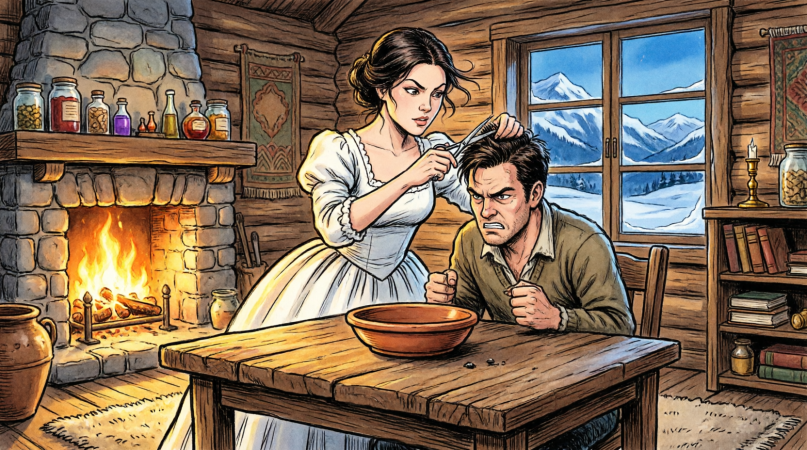
Clara stepped back for a moment, her heart pounding, then took a breath like someone leaping into the void. She prepared hot water, fine sewing tweezers, and rubbing alcohol. Elias, pale and sweaty, looked at her with distrust and fear. She wrote with a steady hand:
“There’s something in your ear. Let me get it out.”
He violently denied it. He snatched the notebook from her and wrote:
“It’s dangerous.”
Clara picked up the pencil and replied:
“It’s more dangerous to leave it there. Do you trust me?”
Elias held her gaze for what felt like an eternity. Then, very slowly, he nodded.
Clara worked with trembling hands, but her resolve was unwavering. She inserted the tweezers slowly, while he gripped the edge of the table until he turned white. She felt resistance. Then a tug. And suddenly, something emerged, writhing from the metal.
A long, dark centipede covered in blood.
It fell into a glass jar of alcohol. Clara stared at it in horror. Elias, on the other hand, looked at her… and then it shattered.
For the first time since she had known him, she cried.
Not with discreet tears, but with deep, heart-wrenching sobs, like a man who had just suddenly recovered twenty-five years of his life. He covered his face with his hands, his head bent with an ancient pain that was no longer physical, but of the soul.
Clara hugged him without thinking.
And he did not turn away.
The next morning, Elias left the room with clearer eyes than ever. He pointed to the jar on the table and wrote:
“It was real.”
Clara nodded.
“Yeah.”
He clenched his jaw, picked up the pencil, and wrote angrily:
“Everyone said I imagined the pain. That I was broken.”
Clara felt something burning inside her.
“You weren’t broken,” she said, though he couldn’t hear her yet. “You were suffering. It’s not the same thing.”
She cared for him for days. She cleaned the wound, changed bandages, prepared remedies with honey and herbs. And while his ear healed, something began to change in him. First, he could distinguish vibrations. Then some sounds. Later, one afternoon in the kitchen, Clara dropped a spoon and Elias jerked his head up.
I had heard her.
“Did you hear me?” Clara asked, holding her breath.
Elias swallowed hard. His voice came out broken and raspy, as if it had been buried for years.
-Yeah.
Clara let out a stifled laugh that turned into tears in the same instant.
His recovery was slow, but real. They practiced words at night. Clara would read aloud by the fire, and he would clumsily repeat, determined like a stubborn and brave child. Her name was one of the first words he tried to pronounce correctly.
—Clara.
When she finally succeeded, she felt a lump in her throat
-Again.
—Clara—he repeated more firmly, and then added, almost as if he found it hard to believe—. My wife.
That night they truly kissed for the first time. It wasn’t a perfect kiss. It was trembling, new, full of everything they hadn’t been able to say to each other. And after that, the notebook ceased to be a barrier and became merely a help. Something unexpected was beginning to blossom between them.
No easy love.
True love.
But peace is short-lived when it is built on the humiliation of others.
A month later, Clara found a crumpled note in the barn that someone had slipped among the tools. She immediately recognized her brother Tomás’s handwriting.
“I told you she wouldn’t dare get married. I lost fifty, but I can still get them back.”
The paper burned his fingers.
That night, she confronted Elias with the note in her hand. He read it and closed his eyes in silent rage.
“Did you know?” Clara asked.
He took a while to reply.
—I found out after the wedding. Your brother came drunk to the ranch and made fun of me. He said he bet some men from the town that I wouldn’t be able to bring a woman home.
Clara felt like shame and fury were suffocating her.
—So I was worth a debt to my father… and a bet to my brother.
Elias looked up.
—Not for me.
She looked at him silently.
—So why did you accept?
He took so long to answer that Clara thought he wouldn’t.
—Because I was tired of being alone. And because I thought a woman forced to come with me wouldn’t expect too much from me.
Those words pierced her.
Two people betrayed by the same world, Clara thought. He, for being different. She, for being a woman.
That night, they didn’t speak anymore. They just sat together by the fire, shoulder to shoulder, knowing that they were finally seeing each other for real.
The conflict arrived with spring.
Tomás showed up at the ranch with two men and a dirty grin. He wanted money. He said that Clara, as Julián Valdés’s daughter, had the right to claim an old family plot of land, and that he could “fix” the matter if she returned to town to sign some papers.
Clara immediately understood the trap. He wasn’t coming out of remorse. He was coming out of self-interest.
“I’m not coming back,” he said firmly.
Tomás burst out laughing.
—I’m not asking you.
Elias stepped forward.
—Yes, you’re asking her. And she already answered.
Thomas looked at him with contempt.
—Just look at that. The deaf man is already speaking.
Elijah didn’t move.
—And listen enough to know that you should leave.
The tension exploded when one of the men tried to grab Clara’s arm. Elias gave him a sharp shove that sent him flying into the corral. The horses became restless. Tomás reached for his belt, where Clara knew he kept a knife.
And at that moment, another voice sounded from the entrance of the ranch.
—I wouldn’t do that if I were you.
It was Don Benjamín Salgado, an elderly rancher who lived several leagues to the north, accompanied by two other armed neighbors. They had heard rumors, had seen strange movements, and decided to approach.
Not everyone in the world looked the other way.
Benjamin calmly dismounted.
—Ms. Barragán isn’t going anywhere with anyone. And if they want a fight, they’re going to have to give us all an explanation.
Tomás, who was only brave when he thought he had the upper hand, backed down. He cursed, spat on the ground, and left, threatening to return. He didn’t.
Over time, the ranch’s story changed. The local doctor, brought by Benjamin, examined Elias and documented that the creature in his ear had been the cause of his suffering and partial hearing loss, and that Clara, with remarkable composure, had saved his life. This didn’t erase the stolen years, but it did restore dignity where there had once been mockery.
A year later, when the wheat fields were beginning to turn golden and the air smelled of the earth, Clara held a newborn baby girl in her arms. Elias, beside her, wept openly as he gently stroked his daughter’s tiny hand.
“What should we call her?” Clara whispered, exhausted and happy.
Elias looked at her, then at the girl.
“Luz,” she said, her voice filled with emotion. “Because that’s what you brought into my life.”.
Clara smiled through her tears.
And so it was.
What had begun as a debt and a gamble ended up becoming a real home. Not perfect. Not easy. But real. Clara was no longer a woman sold for fifty pesos. She was Clara Barragán, the woman who saw where everyone else pretended not to, the one who saved her husband, the one who refused to lower her gaze, the one who learned that love doesn’t always arrive wrapped in tenderness; sometimes it arrives covered in silence, in ancient pain, and in calloused hands.
And Elijah, the man whom the people had called broken for years, discovered that he had never been broken. He had simply waited too long for someone to have the courage to look closely.
Under the immense sky of Chihuahua, with a sleeping daughter between them and the ranch full of life again, Clara finally understood that that wedding born of humiliation had not been the end of her story.
It had been the beginning.
And this time, no one would decide how much it was worth.
But peace, Clara learned, is not something that arrives once and stays forever.
Peace has to be protected.
It has to be guarded at the gate, defended in the heart, and rebuilt after every storm.
For a few months after Luz was born, the ranch felt like a world separate from the one that had wounded them. The winter melted into spring, and spring softened into summer. The pines smelled sharp and clean after rain. The cattle moved slowly across the fields. The baby slept in a cradle Elias had built himself from old cedar, sanding every edge until Clara could run her fingers over the wood without catching a splinter.
Elias changed with fatherhood.
He became gentler in visible ways.
Before Luz, his tenderness had been quiet and uncertain, as if he was afraid too much softness would be taken from him. But with the baby, he seemed to understand that love did not make him weaker. It gave his strength somewhere to rest.
He would sit by the fire with Luz against his chest, one large hand covering almost her whole back, humming clumsily because he was still learning the shape of sounds. Sometimes he hummed off-key. Sometimes he forgot the tune entirely. Luz never minded. She slept best against him.
Clara watched them one evening from the doorway and felt a strange ache in her chest.
Not sadness.
Something deeper.
Recognition.
She had once believed her life had been sold away for fifty pesos. She had once believed the ranch would be a prison, Elias a silent stranger, and the mountains a wall closing around her. But now the ranch was filled with small living sounds: the baby’s sighs, the crackle of firewood, Elias’s rough voice practicing lullabies, the wind moving through the eaves.
Still, the past had not disappeared.
It waited.
It always does.
The first sign came in the form of a letter.
Don Julián Valdés sent it through a mule driver passing near the property. Clara knew her father’s handwriting immediately. Heavy. Uneven. Impatient.
Daughter,
Your mother is sick. If you have any decency left, come home. Tomás says you think yourself above us now because you married land. Do not forget whose blood you carry.
Father
Clara read the letter twice.
Then she folded it and placed it on the table.
Elias was watching her.
“Your father?” he asked carefully.
Clara nodded.
“He says my mother is sick.”
Elias’s expression changed.
“Do you believe him?”
That was the question.
Not because her mother could not be sick. She had always been fragile, worn down by work, silence, and years of living beside a man like Julián.
But Clara knew her family.
Illness could be truth.
It could also be a hook.
“I don’t know,” she said.
Elias sat beside her.
“If you want to go, I’ll take you.”
She looked at him, surprised by the simplicity of it.
No command.
No suspicion.
No fear that she would not return.
Just choice.
That was when Clara understood one of the deepest differences between being owned and being loved.
Ownership says: you cannot leave.
Love says: I will help you go, and I will trust you to return if this is home.
Two days later, Clara wrapped Luz in warm blankets, and Elias hitched the wagon. They rode toward San Jerónimo beneath a gray sky. The town looked smaller than Clara remembered, though nothing had changed. The same chapel bell. The same general store. The same narrow streets where gossip traveled faster than horses.
People stared.
Of course they stared.
They stared at Elias because he was speaking now, not perfectly, but clearly enough.
They stared at Clara because she no longer looked like the frightened girl in yellowed lace.
They stared at the baby because nothing makes cruel people hungrier than proof that someone survived what was meant to destroy her.
At her father’s house, the door opened before Clara knocked.
Tomás stood there.
He looked worse than before. His face was swollen from drink. His eyes were red. His shirt was half-buttoned, and resentment seemed to leak from him like the smell of pulque.
“Well,” he said, smiling without warmth. “The sold bride returns.”
Elias took one step forward.
Clara touched his arm.
“No,” she said softly. “Let him show himself.”
Tomás’s smile twitched.
Inside, Clara found her mother lying in bed.
The illness was real.
That made everything worse.
Dolores Valdés looked half the size Clara remembered. Her hair, once thick and dark, was thin at the temples. Her breathing rattled softly. When she saw Clara, her eyes filled with tears.
“My child,” she whispered.
Clara sat beside her and took her hand.
It was strange
She had wanted to hate her mother for not stopping the marriage, for standing silently while Julián bargained with her future. But holding that weak hand, Clara felt the old anger become complicated.
Dolores had been a woman trapped long before Clara was born.
That did not excuse her silence.
But it explained its shape.
“I’m here,” Clara said.
Dolores looked toward the doorway, where Elias stood holding Luz.
“The baby?”
“Your granddaughter.”
Dolores began to cry.
Tomás muttered from the corner, “Touching. Now that we’ve all had our little reunion, maybe we can talk business.”
Clara did not look away from her mother.
“What business?”
“The land.”
Elias’s jaw tightened.
Tomás stepped into the room.
“Father’s debts didn’t disappear because you ran off to play ranch wife. There’s still the old family plot by the creek. Bank wants payment. If you sign your claim over, we can settle it.”
Clara finally turned.
“My claim?”
Tomás’s eyes flashed.
“So now you remember you’re a Valdés.”
Julián entered behind him, older but still hard, still carrying the same bitterness like a second spine.
“You owe this family,” he said.
Clara stared at him.
“I owe this family?”
“You were fed here.”
“I was sold from here.”
The room went still.
Dolores closed her eyes.
Julián’s face darkened.
“Watch your mouth.”
“No,” Clara said. “I watched my mouth for twenty-three years. I watched it when you traded me for a debt. I watched it when Tomás laughed about the bet. I watched it when everyone called my husband broken because none of you cared enough to look closer.”
Tomás scoffed.
“Husband? Don’t act like this is some great romance. He bought you.”
Elias spoke then, his voice low but steady.
“No. Your father sold her. I was wrong to accept. But I never bought her soul.”
That silence was different.
Even Tomás seemed startled.
Clara turned to Elias.
He looked ashamed, but not afraid.
That mattered.
The past could not be undone, but it could be named.
Julián slammed his hand against the doorframe.
“You sign those papers.”
“No.”
“You will not shame me in my own house.”
Clara stood slowly.
“You shamed yourself when you put a price on your daughter.”
Luz began to fuss in Elias’s arms, as if even the baby could feel the old poison in the room.
Dolores reached for Clara’s hand.
“Don’t sign,” she whispered.
Everyone turned to her.
Her voice was weak, but her eyes were clear.
“Clara, don’t sign anything. Your father and brother already borrowed against that land twice. If you sign, the debt becomes yours.”
Tomás exploded.
“Shut up!”
Elias moved so fast the whole room shifted. He did not strike Tomás, but he placed himself between him and the bed.
“Speak to her like that again,” Elias said, “and you’ll leave this room without teeth.”
His words were rough, imperfect, but the meaning was clear.
For the first time, Tomás looked uncertain.
Clara looked at her mother.
“Why didn’t you tell me?”
Dolores wept silently.
“Because I was afraid.”
Clara wanted to say that fear had cost too much.
She wanted to say that fear had ruined lives.
Instead, she squeezed her mother’s hand.
“Then be afraid and tell the truth anyway.”
Dolores nodded.
That day, Clara left without signing.
But she did not leave her mother behind.
Against Julián’s furious shouting and Tomás’s curses, Elias carried Dolores to the wagon wrapped in blankets. Clara held Luz close and climbed beside them.
As the wagon pulled away, Julián shouted that Clara was no longer his daughter.
She did not turn back.
Some doors do not need to be slammed.
It is enough to stop walking through them.
Dolores lived at the ranch for four months.
They were not easy months.
She was ill, ashamed, and often silent. Clara cared for her with a tenderness that surprised even herself. There were days she resented the work. Days she wanted to ask why her mother had not protected her sooner. Days she looked at Dolores sleeping near the fire and saw not a villain, but a woman worn down by years of fear.
One night, when Luz was asleep and Elias was outside checking the animals, Dolores called Clara to her bedside.
“There is something I must tell you.”
Clara sat down.
Dolores reached beneath her pillow and pulled out a small cloth packet tied with string.
Inside were earrings.
Silver, simple, with tiny turquoise stones.
“My mother gave these to me,” Dolores said. “I was saving them for you. Your father wanted to pawn them after the wedding. I hid them.”
Clara held the earrings carefully.
They were not worth much in money.
But they were the first thing anyone from her birth family had given her without asking for something in return.
Dolores touched her hand.
“I failed you.”
Clara’s throat tightened.
“Yes.”
Dolores flinched, but Clara continued.
“But you told the truth when it mattered.”
“Too late.”
“Maybe. But not never.”
Dolores cried.
Clara did too.
Forgiveness did not arrive like sunlight.
It came slowly, with pain still attached.
Dolores died before summer ended.
They buried her beneath a pine tree on the ridge, facing the mountains. Elias carved her name into a wooden marker because Clara asked him to. Luz was too young to understand, but she touched the fresh earth with one tiny hand and laughed at a butterfly.
Life is cruel that way.
It keeps moving even when grief asks it to stop.
After Dolores’s death, Tomás came one final time.
Not with men.
Not with threats.
Alone.
He arrived thin, dirty, and shaking. Drink had taken much of him. Pride had taken the rest.
Clara found him near the barn at dawn.
“I need help,” he said.
She looked at him for a long time.
He had mocked her.
Bet on her.
Tried to force her into debt.
Threatened her home.
And still, beneath all that ruin, she saw the boy he might have been if their father had not taught him cruelty as a language.
“What kind of help?”
“Money.”
She almost laughed.
“No.”
His face twisted.
“You’d let your own brother starve?”
“No. I will give you food. I will give you a blanket. I will tell Benjamin to help you find work. But I will not give you money to drink.”
He looked at Elias, who had come up silently behind her.
Tomás lowered his gaze.
For once, he did not fight.
That was how broken he was.
Clara gave him bread, dried meat, and coffee. Elias gave him an old coat. Don Benjamín later found him work hauling supplies, and for a while Tomás stayed sober.
Not forever.
But for a while.
That was another lesson Clara learned: saving someone once does not mean you can save them always.
Years passed.
Elias’s hearing never became perfect, but it became enough. He could hear Luz laugh from the yard. He could hear Clara call his name from the porch. He could hear rain on the roof and wolves in the distance. Each sound seemed sacred to him.
Sometimes Clara would catch him standing outside at dawn, eyes closed, listening.
“What do you hear?” she would ask.
He would smile.
“Everything I missed.”
The town changed too.
People who had once called him “the deaf one” began calling him Don Elías. They came to him for advice about cattle, weather, fencing, and seed. Some did it because they respected him. Others because they were ashamed and wanted to pretend they had always known his worth.
Elias treated them with courtesy.
Not warmth.
Courtesy.
There is a difference.
Clara became known as the woman who had pulled a living nightmare from her husband’s ear and given him back the world. Mothers came to her when children had fevers. Ranch wives came when they needed remedies. Girls came when they were afraid of marriages being arranged over their heads.
Clara never called herself wise.
She simply told the truth.
“No debt is worth a daughter.”
“Fear is not obedience.”
“A silent woman is not always a willing woman.”
“Do not marry a man who needs you smaller to feel tall.”
When Luz turned sixteen, she asked about the wedding.
Not the pretty version.
The real one.
Clara and Elias sat with her by the fire, and they told her.
About the debt.
The bet.
The loneliness.
The pain.
The creature in his ear.
The notebook.
The first word.
The first kiss.
The way love had not begun cleanly, but had become clean because they both chose truth after the damage.
Luz listened with tears in her eyes.
“So you didn’t love each other at first?”
Clara looked at Elias.
“No.”
Elias took Clara’s hand.
“But we learned not to own each other,” he said. “That came before love.”
Clara nodded.
“Love that grows after freedom is different from love that grows from fear.”
Luz looked into the fire.
“I don’t want anyone choosing for me.”
Clara smiled.
“Good.”
Years later, when Luz married, she did so under the open sky on the ranch, wearing no yellowed dress and owing no one a peso. Elias walked her down the aisle, hearing every step. Clara watched from the front with silver turquoise earrings in her ears.
When Father Ignacio, now old and bent, asked who gave the bride away, Elias answered clearly:
“No one gives her. She comes freely.”
Clara cried then.
Not from sadness.
From the healing of a circle that had taken a lifetime to close.
At the wedding feast, Don Benjamín, even older now and still stubbornly alive, raised a cup.
“To Clara Barragán,” he said, “who saw what no doctor saw.”
Elias stood beside her.
“And who saw me,” he added.
The guests grew quiet.
Clara looked around at the faces of people who once would have laughed, whispered, judged, or looked away. Now they saw her.
But Clara no longer needed the town’s recognition the way she once might have.
She had earned something better.
Her own.
That night, after the guests left and the lanterns burned low, Clara and Elias sat on the porch. Luz and her new husband had gone inside. The mountains stood dark against a sky full of stars.
Elias reached for Clara’s hand.
“Do you regret it?” he asked.
She knew what he meant.
The forced wedding.
The years of pain.
The life she had never chosen but had made her own.
She thought carefully.
“I regret that I was sold,” she said. “I regret that you were left to suffer. I regret that our beginning had so much shame in it.”
He nodded.
Then she leaned her head against his shoulder.
“But I do not regret what we built after.”
He kissed her hair.
A wind moved through the pines.
Somewhere in the barn, a horse shifted.
The world was quiet.
Not empty.
Quiet.
And Clara understood that silence no longer frightened her.
Once, silence had been the sound of being trapped.
Now it was the sound of peace.
Educational Meaning of the Story
The first educational meaning of this story is that people should never be reduced to what society says they are.
Clara is called “obese,” poor, unwanted, and sellable. Elias is called “the deaf one,” broken, strange, and incapable. Both are labeled before they are understood. Their town looks at them and sees only weakness. But the story proves that labels are often lazy judgments created by people who do not want to look deeper.
Clara is not merely a poor girl forced into marriage. She is observant, brave, practical, and emotionally intelligent. Elias is not merely a deaf farmer. He is a man who has endured pain for years while being dismissed by doctors, neighbors, and society. The story teaches that dignity exists even when the world refuses to recognize it.
The second lesson is that poverty can make people vulnerable to exploitation. Clara’s father owes money, and because he lacks both resources and moral strength, he treats his daughter as a solution to his debt. This is one of the story’s darkest lessons: when families are desperate and patriarchal, daughters may be treated like property. The story condemns this clearly. No debt, no family crisis, and no social pressure can justify selling a human being’s future.
The third lesson is that silence does not always mean consent. Clara does not fight loudly at first because she has been raised in a world where obedience is expected. Elias does not speak because of his deafness, pain, and isolation. Both are silent, but neither is truly free. The story teaches readers to be careful when interpreting silence. A silent person may be afraid, trapped, ashamed, sick, or simply unheard.
The fourth lesson is about medical dismissal. Elias has suffered since childhood because no one looked closely enough. Doctors told him there was no cure. People said his pain was part of his deafness. The town called him broken instead of asking what had happened to him. Clara’s discovery shows the importance of attention, compassion, and second opinions. Many people suffer longer than necessary because others decide their pain is normal, imagined, or unworthy of investigation.
The creature in Elias’s ear symbolizes hidden suffering. It is not just a shocking physical discovery. It represents all the pain people carry inside them while the world tells them to endure it quietly. When Clara removes it, she is not only saving his body. She is proving that his pain was real. This is a powerful message for anyone who has been told they are exaggerating: sometimes the wound is invisible only because no one has cared enough to look.
The fifth lesson is that love cannot begin as ownership and remain healthy. Clara’s marriage begins through debt, arrangement, and humiliation. Elias accepts the marriage partly because he is lonely and expects little from life. This beginning is morally flawed. But the story does not pretend that forced marriage is romantic. Instead, it shows two wounded people slowly choosing respect, honesty, and care after being placed in an unjust situation. Their love becomes meaningful because they stop treating each other as roles and begin seeing each other as human beings.
The sixth lesson is that trust is built through actions, not words. Elias gives Clara the bedroom and sleeps by the fire. He does not force himself on her. Clara cares for him when he is in pain. She watches, learns, and risks helping him. These actions slowly create safety. The story teaches that trust grows when people consistently protect each other’s dignity.
The seventh lesson is about women’s agency. Clara begins the story as someone acted upon. Her father arranges her marriage. Her brother bets on her. The town judges her. But over time, Clara becomes someone who acts. She removes the creature, confronts her family, refuses to sign the land papers, rescues her mother, protects her child, and later teaches other girls to refuse being traded or silenced. Her transformation shows that agency can be recovered even after humiliation.
The eighth lesson is that family does not always deserve obedience. Clara’s father uses blood as a weapon. He tells her she owes the family because she was raised there. But family responsibility does not mean accepting abuse. Clara’s refusal to sign the papers shows that honoring family should never mean participating in your own destruction.
The ninth lesson is that forgiveness is complicated. Clara does not instantly forgive her mother. Dolores failed her through silence. But Dolores also suffered under fear and control. The story does not excuse Dolores, but it gives her humanity. This teaches that some people who hurt us were also trapped. Understanding that can soften hatred, but it does not erase accountability. Clara’s response is mature: she tells the truth, cares for her mother, but does not pretend the past was harmless
The tenth lesson is that not everyone can be saved. Tomás is given food, a coat, and a chance at work, but Clara refuses to give him money. This is important. Compassion does not mean enabling destruction. Clara learns to help without surrendering her boundaries. That is a crucial life lesson: you can offer someone a path without letting them drag you back into their chaos.
The eleventh lesson is about dignity after humiliation. Clara’s life begins again in a marriage marked by shame. Elias’s life begins again after years of being called broken. Neither of them can erase what happened. But they build something real afterward. This teaches that a painful beginning does not have to decide the ending. People can reclaim their lives, even when the first chapters were written by others.
The twelfth lesson is that love becomes strongest when it is tied to freedom. When Luz marries, Elias says, “No one gives her. She comes freely.” This line corrects the injustice of Clara’s own wedding. It shows generational healing. Clara and Elias cannot change their beginning, but they can ensure their daughter is never treated as property. The story teaches that true healing is not only personal; it changes what the next generation inherits.
The final educational message is this:
Do not judge people by their wounds, their bodies, their poverty, their silence, or the rumors spoken about them.
Look closer.
A woman called unwanted may become the person who saves a life.
A man called broken may simply be waiting for someone to believe his pain.
A marriage born from injustice can only become love if both people choose respect, truth, and freedom.
And no daughter should ever be sold, traded, or silenced to pay for someone else’s failure.
Character Analysis
Clara Valdés Barragán
Clara is the emotional center of the story. At the beginning, she is frightened, humiliated, and trapped by poverty. She is being forced into marriage because her father owes money, and she understands clearly that the arrangement is not romantic or honorable. She calls it what it is: a sale. This shows that even when Clara lacks power, she does not lack awareness.
Clara’s body is part of how society judges her. The title describes her as obese, and the town likely sees her as someone with fewer choices because of her appearance. But the story challenges this cruel assumption. Clara’s worth does not depend on beauty, thinness, or desirability. Her value is shown through courage, intelligence, compassion, and moral clarity.
Her greatest strength is observation. She notices what others ignore. She sees Elias’s pain, the blood on the pillow, his hand moving toward his ear, his shame, and his fear. This ability to notice makes her powerful. While doctors dismissed Elias, Clara watches carefully enough to discover the truth.
Her second strength is courage under pressure. Removing the creature from Elias’s ear is terrifying, but she acts anyway. This is not reckless courage. It is practical courage. She prepares hot water, alcohol, tweezers, and gives Elias a choice. She asks for trust instead of forcing action. This shows her respect for him.
Clara’s character grows from passive endurance to active self-respect. At first, she accepts what is done to her because she has no clear escape. Later, she confronts her father, refuses Tomás, rescues her mother, protects her home, and teaches her daughter freedom. Her journey is one of reclaiming agency.
Clara’s love for Elias is not instant. That makes it more believable and meaningful. She does not fall in love because he owns land or because he married her. She grows to love him because he reveals humanity, pain, restraint, and respect. Their love is built from care, not fantasy.
By the end, Clara becomes a woman whose humiliation has become wisdom. She uses her pain to guide others, especially girls and women who face pressure from family or society. She is no longer the girl sold for debt. She is the woman who determines her own value.
Elias Barragán
Elias is a deeply wounded man whose suffering has shaped his entire life. The town calls him “the deaf one,” reducing him to his disability. But his deafness is not his whole identity. He is hardworking, disciplined, lonely, and emotionally guarded.
Elias’s isolation is not only because he cannot hear. It is because people have treated him as strange and broken for so long that he has accepted loneliness as normal. His pain makes him withdraw from the world. The creature in his ear becomes a physical explanation for his suffering, but emotionally, it also represents years of being ignored.
His decision to accept the arranged marriage is morally complicated. He does not force Clara or treat her cruelly, but he participates in a system that takes away her choice. His reason is loneliness and low self-worth. He believes a woman forced to marry him will not expect much from him. This reveals how deeply he has internalized society’s contempt.
However, Elias’s dignity appears in his restraint. He gives Clara the bedroom and sleeps by the fire. He does not demand affection. He communicates respectfully. This does not erase the injustice of the marriage, but it shows he is not a predator. He is another wounded person inside an unjust arrangement.
After Clara saves him, Elias begins to transform. Hearing sound again is not only physical recovery; it is emotional rebirth. He can hear Clara’s voice, the world, and eventually his child. His first attempts at speech are symbolic because he is not only learning sound; he is learning to participate in life again.
Elias’s greatest growth comes when he names the truth. He admits he was wrong to accept the marriage. He defends Clara against Tomás and Julián. Later, when Luz marries, he refuses the language of ownership by saying no one gives her away. This shows he has learned from the injustice of his own beginning with Clara.
Luz
Luz represents healing, renewal, and generational change. Her name means light, and that is exactly what she brings to the story. She is born from a marriage that began in pain, but her life is not defined by that pain.
Through Luz, Clara and Elias prove that they have learned from the past. They do not raise her to be obedient at the cost of herself. They teach her truth. They allow her to ask questions. They give her what Clara never had: the right to choose.
Luz’s wedding is one of the most important moments in the story because it reverses Clara’s wedding. Clara was handed over because of debt. Luz comes freely. Elias does not “give her away.” That line shows that the family has broken the cycle of ownership.
Luz symbolizes the future that becomes possible when parents heal enough not to pass down their wounds unchanged.
Don Julián Valdés
Julián is Clara’s father and one of the story’s main sources of harm. He represents patriarchal authority corrupted by debt, pride, and moral weakness. Instead of protecting his daughter, he uses her as payment.
His greatest failure is that he sees Clara as a resource rather than a person. He justifies the marriage as an arrangement, but Clara knows the truth: it is a sale. Julián’s language is important because abusive systems often rename cruelty to make it sound acceptable.
Julián also uses family duty as manipulation. Later, when he wants Clara to sign over land rights, he tells her not to forget whose blood she carries. This shows that he sees blood not as love but as ownership. To him, being a daughter means obedience.
He is not redeemed because he never truly takes responsibility. His role is to show what happens when a parent chooses pride and survival over morality. He is a warning: a father who sells his daughter loses the moral right to demand loyalty from her.
Tomás Valdés
Tomás is Clara’s brother and a cruel extension of Julián’s values. He mocks Clara’s marriage, participates in the bet, drinks heavily, and later tries to manipulate her into signing dangerous papers. He is selfish, resentful, and cowardly.
His cruelty is often performative. He is brave only when he has support or power. When Don Benjamín and the neighbors appear, Tomás retreats. This shows that much of his aggression comes from insecurity and opportunism.
However, Tomás is also a tragic figure. Later, when he returns broken and asking for help, the reader sees that he too has been damaged by the family system. But unlike Clara, he responded to pain by harming others.
Clara’s treatment of Tomás is important. She does not give him money, because that would enable him. But she gives him food, a coat, and a path toward work. This shows mature compassion. She does not hate him blindly, but she refuses to become his victim again.
Tomás represents the difference between helping someone and letting them exploit you.
Dolores Valdés
Dolores is Clara’s mother, and her character is layered with guilt, weakness, fear, and late courage. She fails Clara by not stopping the arranged marriage. Her silence helps the injustice happen. That cannot be ignored.
But Dolores is not presented as purely cruel. She is a woman who has likely lived under Julián’s control for years. Her silence comes from fear, not malice. This makes her character realistic. Many people who fail to protect others are themselves trapped in fear.
Her moment of truth comes when she tells Clara not to sign the land papers because the debt would become hers. This is a late but meaningful act of protection. It does not erase the past, but it shows that Dolores still has moral awareness.
Her gift of the turquoise earrings is emotionally important. It is the first inheritance Clara receives from her birth family that is not tied to debt, shame, or manipulation. It is small, but it is given freely. That makes it valuable.
Dolores teaches that late truth is not enough to erase old wounds, but it can still matter.
Don Benjamín Salgado
Don Benjamín represents community conscience. He is one of the few people who does not look away. When Tomás and the men threaten Clara and Elias, Benjamín arrives with neighbors and prevents violence. This matters because the story shows that injustice thrives when bystanders remain silent.
Benjamín is not central for emotional transformation, but he is important morally. He proves that not everyone in society accepts cruelty. Some people watch, understand, and act.
His character teaches that good neighbors can become a form of protection when family fails.
Father Ignacio
Father Ignacio’s role is small but symbolic. At Clara’s wedding, he performs the ceremony like someone fulfilling an uncomfortable obligation. He does not stop the injustice. This shows the weakness of institutions that recognize wrongdoing but proceed anyway
Years later, at Luz’s wedding, he witnesses a corrected version of the ceremony. This contrast shows change across time. The same religious structure that once blessed a forced union now witnesses a free one. The meaning of the ritual changes because the people involved have changed.
The Centipede
The centipede is the story’s most shocking symbol. Literally, it is the creature causing Elias’s pain and partial deafness. Symbolically, it represents hidden suffering, misdiagnosed pain, and the way society dismisses what it does not understand.
It also represents the cruelty of being told that your suffering is imaginary. Elias spent years being labeled broken while something real was hurting him. When Clara removes the creature, she removes not only a physical parasite but also the lie that his pain was meaningless.
The centipede teaches that some wounds are hidden deep, and healing begins when someone cares enough to look closely.
The Notebook
The notebook represents communication under limitation. At first, it is a barrier because Clara and Elias cannot speak freely. But it is also a bridge. Through it, they share practical information, fear, gratitude, and eventually trust.
The notebook shows that communication is not only about sound. Elias cannot hear, but he can still be respectful. Clara is afraid, but she can still ask questions. Their relationship begins through written words because both are willing to meet each other where they are.
Later, as Elias begins to hear and speak, the notebook becomes less necessary, symbolizing growth. But it never loses meaning. It was the first place where they learned to be honest.
The Ranch
The ranch begins as a place of exile for Clara. It is isolated, cold, and far from everything she knows. But slowly it becomes a place of transformation. It gives Clara distance from the family that sold her. It gives Elias space to heal. It becomes the home where Luz is born and where a new family pattern begins.
The ranch represents the possibility that a place of fear can become a place of freedom when the people inside it choose truth and respect.
Final Character Lesson
Every major character in this story teaches something different about power.
Julián uses power to sell.
Tomás uses power to mock.
The town uses power to label.
Dolores loses power through fear.
Benjamín uses power to protect.
Clara discovers power through courage.
Elias discovers power through healing.
Luz inherits power through freedom.
That is the heart of the story.
Power is not only money, strength, or authority.
Sometimes power is noticing pain everyone else dismissed.
Sometimes power is saying no to family.
Sometimes power is refusing to let your daughter inherit your silence.
And sometimes power is taking a life that began as humiliation and building from it a home where no one is ever sold again.