After my accident, Mom refused to stay with my six-week-old baby, saying, “Your sister never has these kinds of crises.” Then she left for a Caribbean cruise.
That was the sentence I kept replaying in my mind later, because it was the moment everything in my life split cleanly into before and after.
Before that phone call, I still believed my mother was difficult, dramatic, occasionally selfish, but ultimately family.
After it, I understood something far worse: she had built her entire life around the assumption that I would keep rescuing her no matter how badly she treated me.
My name is Melissa Parker, and the day that illusion died began with a routine pediatric appointment.
My son, Owen, was six weeks old.
He had finally started sleeping in stretches longer than ninety minutes, which meant I had just begun to feel like a human being again.
I was tired in the bone-deep way only new mothers understand, but I was also happy.
The kind of fragile, grateful happy that comes after childbirth when every tiny milestone feels like a miracle.
The appointment had gone well.
Owen was healthy, gaining weight, and perfect in the way babies are perfect even when they keep you up all night.
I buckled him into his car seat, kissed his forehead, and started the drive home.
At a red light, I checked the mirror and watched him sleeping.
His mouth was slightly open.
One hand had slipped free of the blanket and curled into a fist.
I remember thinking I should text Jacob a picture when I got home.
Then the truck hit us.
It ran the red light so fast I had no time to react.
One second the intersection was normal, the next it was all impact and noise.
Metal folded.
Glass shattered.
Airbags detonated in a burst so violent my ears rang instantly.
My body jerked against the seat belt, pain tearing through my hip and shoulder with such force that I thought, absurdly, that something inside me had exploded.
And through all of it, I heard Owen crying.
That sound cut through the chaos more sharply than the crash itself.
When I came back to myself, paramedics were pulling open the crumpled driver’s side door.
One of them kept telling me not to move.
Another was checking Owen, telling me he was alive, he was crying, that crying was good.
I clung to that sentence like a life raft.
At Franklin Memorial Medical Center, the doctor explained the injuries with efficient kindness.
Fractured pelvis.
Torn ligament in my shoulder.
Significant bruising.
Mandatory observation for several days.
No lifting my baby.
No driving.
Limited mobility.
“Your son appears to be okay,” she told me.
“The car seat probably saved his life.”
I cried then.
Not loud, dramatic sobs.
Just quiet tears that slid into my hairline while I stared at the ceiling and thanked every force in the universe for that car seat.
Then reality pressed in.
My husband, Jacob, was in Denver for work, stranded by a storm that had grounded flights.
He was frantic, calling between gate changes, trying to piece together rental cars and impossible connections.
He kept apologizing, his voice rough and helpless.
“I’m trying,” he said.
“Mel, I swear I’m trying.”
“I know,” I told him.
“It’s not your fault.
Just get home when you can.”
The bigger problem was immediate.
I was in a hospital bed.
Jacob was states away.
Owen was six weeks old.
And I needed help.
I thought of my mother first.
That alone should tell you how hard it is to unlearn old instincts.
Susan Parker lived twenty minutes from the hospital.
She had no job to rush to.
No health problem that would prevent her from caring for a baby overnight.
And for nine years, I had been sending her $4,500 a month because she said she couldn’t survive without it.
That arrangement began after my father died.
He had always handled the finances.
After the funeral, my mother sat at my kitchen table and cried over a stack of bills.
She said she did not know how she was going to keep the house.
She said she was embarrassed even asking.
She said she was scared.
I was grieving too, but she was my mother.
I believed her.
Jacob and I reviewed our budget, made cuts, postponed plans, and set up a monthly transfer.
“Just until she gets steady,” I told him back then.
The months became years.
She never got steady.
If I gently asked whether she had looked for a way to reduce expenses, she became wounded.
If I mentioned downsizing, she called me heartless.
If I said maybe we should review the bills together, she accused me of treating her like a child.
So eventually I stopped asking and kept paying.
What made that easier to justify was guilt.
My mother knew how to use it with surgical precision.
She reminded me that I had a husband and a successful career while she had been left alone.
She praised my younger sister, Lauren, as low-maintenance and understanding, while suggesting I was cold whenever I hesitated.
Somehow, no matter the subject, I ended up feeling responsible for her well-being.
So from my hospital bed, bruised and shaking, I called her.
She answered cheerfully.
“Hi, honey! I’m packing my bags.”
“Mom, I’m in the hospital,” I said.
“There’s been an accident.
I need you to take Owen tonight.
Just tonight.”
There was a pause.
Then a sigh.
“Melissa, I can’t.
I have plans.”
“I can’t stand up by myself.
He’s only six weeks old.
Jacob is stuck in Denver.”
Her tone cooled instantly.
“Your sister never has emergencies like this.
Lauren handles her responsibilities.
You always create chaos.”
The unfairness of it hit me so hard I almost couldn’t breathe.
I had been hit by a truck.
I was not asking her to refinance a home or donate an organ.
I was asking for one night with her grandson.
“Mom, please.”
“I’m leaving on a cruise this afternoon,” she said.
“Everything is paid for.
I deserve this break.
Call someone else.
And don’t try to make me feel bad.”
Then she hung up.
No concern for Owen.
No question about my injuries.
Nothing.
Just gone.
A nurse tried to soothe Owen in the hallway while I stared at my phone and felt something inside me turn from hurt to ice.
I solved the immediate problem first.
I booked a certified overnight postpartum nurse.
Then I hired a daytime caregiver recommended by the hospital’s family services office.
I paid
the rush rates without blinking.
Then I opened my banking app.
SUSAN – SUPPORT.
Automatic monthly transfer.
$4,500.
I clicked into the transfer history and scrolled back farther than I ever had before.
Nine years.
Four hundred eighty-six thousand dollars.
I canceled it.
Not with anger.
With clarity.
An hour later, my mother sent me a selfie from the pier.
White hat.
Sunglasses.
Suitcase.
Blue water sparkling behind her.
Relax and recover! 🙂
It was such a grotesque message that I actually laughed once, a short broken sound that startled the nurse beside me.
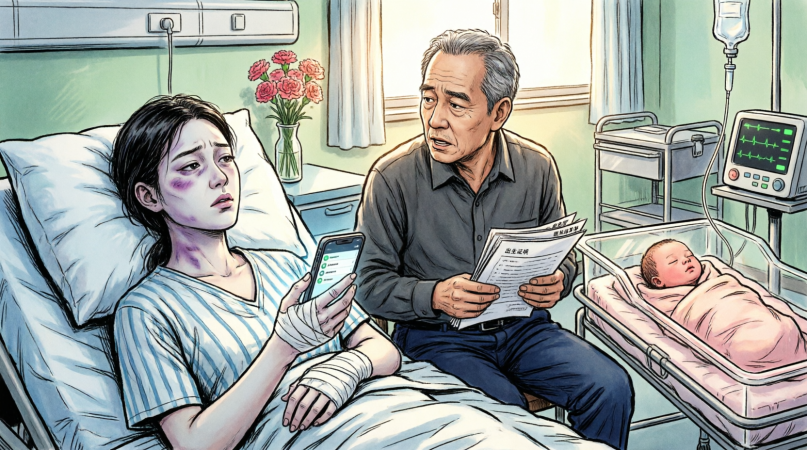
That was when my grandfather arrived.
Harold Bennett was my mother’s father.
He was eighty-two, stubborn, formal, and so observant that people often felt he knew what they were hiding before they said a word.
He entered my room carrying a paper bag from his favorite deli.
He looked at my bruises, then at Owen, then at my face.
“Melissa,” he said quietly, sitting down.
“Tell me exactly what your mother just did.”
So I did.
I told him everything, from the accident to the cruise to the canceled transfer.
He listened without interrupting, but with every detail his expression sharpened.
By the time I mentioned the selfie, his jaw was set so tightly I could see the muscle jumping.
Then he reached into his jacket and pulled out an old leather document holder.
“There’s something you need to know,” he said.
He placed several folded papers on my blanket.
I recognized the address of my mother’s house immediately.
Then I saw my father’s name.
I looked up.
“What is this?”
“Your father’s estate documents,” he said.
“And the mortgage release.”
“Mortgage release?”
His eyes did not leave mine.
“Melissa, your father paid off that house before he died.”
I just stared at him.
“No,” I said automatically.
“Mom told me—”
“I know what she told you,” he said, his voice going cold.
“I was there when the paperwork was signed.
The house was free and clear.
Your father also left a small life insurance policy and a separate maintenance account intended for taxes, insurance, and repairs for several years.
He asked me to keep copies in case there was ever confusion.”
The room seemed to tilt.
“That can’t be right,” I whispered.
He slid the document closer.
There it was in black and white: the house had been paid off months before my father’s death.
I saw signatures.
Dates.
The notarization stamp.
I felt sick.
“Then what was I paying for?”
He was silent for a beat too long.
“That,” he said, “is exactly what I intend to find out.”
I called Jacob and told him.
He was quiet for several seconds.
“Mel,” he said finally, very softly, “I always thought the numbers didn’t make sense.
But every time I brought it up, you looked so guilty that I backed off.
I’m sorry.”
I started crying then, not just because of my mother, but because shame flooded in all at once.
Half a million dollars.
Years of sacrifice.
And the worst part was that I had defended her to everyone.
Grandpa Harold took over before I could spiral.
He called his attorney from the chair beside my hospital bed.
Then he called the accountant who had handled my father’s final paperwork.
By evening, both had…………………………..
 :
: