“Your hallway is such a mess, as always. Is it really so hard to keep it clean?”
The door wasn’t even fully shut when Patricia said it.
It was 8:14 on a Thursday morning. I was barefoot, holding a half-folded dish towel, and my mother-in-law was already inside my house.
She stepped over my son’s dinosaur backpack, bent with two fingers like she was lifting something damp and suspect, and exhaled in a way that suggested she had discovered rot.
“I raised Cole better than this,” she said softly.
That soft voice was always the worst part. Patricia never needed volume. She had spent a lifetime learning how to cut cleanly without raising her hand.
I watched her set the backpack on the entry bench I had been meaning to clear off for two days, and the old familiar tightness gathered beneath my ribs. Not surprise. Not even anger, not at first. Just that deep, immediate recoil that had become second nature whenever I heard the turn of her key in my lock.
That was how she entered my life now. Not with a knock, not with a text, not with a simple “are you home?” but with metal against metal, as if access itself were her birthright.
My name is Madison Harper Whitaker. I’ve been married to Cole Whitaker for three years. For three years, his mother, Patricia Whitaker, treated our home like her personal inspection site. She didn’t visit. She assessed. She didn’t offer help. She established precedent. And by the time I truly understood what she was doing, she had already collected enough little moments to build a whole story about me—one I had never agreed to tell with my life.
That Thursday morning, though, I still hadn’t shown my hand.
Noah was in the den with blocks and cartoons, still in his pajama shirt, humming to himself in the blissfully self-contained way toddlers do when the adults in the house are carrying storms they can’t yet name. Cole had already left for the office. He always left before eight on Thursdays. Patricia knew that. She knew his schedule better than I did sometimes. She missed very little when there was advantage in not missing it.
She walked past me into the kitchen without waiting to be invited further, glanced at the counter, and opened the silverware drawer.
I stared at her hand on the handle.
That drawer had become an obsession for her. Forks never where she’d put them. Serving spoons “mixed in with everyday utensils.” Child-safe bowls “cluttering visual lines.” Once, three months earlier, I found a stack of sticky notes in her neat slanted handwriting inside it: salad tongs should go left side, child cups should be lower cabinet, steak knives not with common flatware. It would have been laughable if it hadn’t felt so much like trespass.
Patricia pulled out the cutlery organizer and clicked her tongue.
“You really ought to separate the teaspoons from the dessert spoons,” she said. “Some women just aren’t built for managing a household.”
She said it to the spoons, not to me, which somehow made it worse.
There was a time when I would have swallowed that line and found a way to reinterpret it into something survivable. She’s old school. She likes order. She doesn’t know how that sounds. That was the soundtrack of my early marriage—translation, softening, excusing. I had become so efficient at it I barely noticed how much of my energy went into making Patricia tolerable to myself.
But that morning, something in me had already begun to harden into clarity.
I dried my hands on the towel and said, evenly, “Please don’t reorganize my kitchen.”
She looked up, mildly surprised, like the toaster had suddenly spoken.
“I’m only helping.”
“I know you call it that.”
A pause.
Then a small smile touched the corners of her mouth, so controlled it almost didn’t register. Patricia smiled like some women wear perfume—subtly, but with the expectation that you would notice and make inferences about quality.
“You seem tense,” she said. “Did you sleep badly?”
That was one of her favorite pivots. If I objected to anything she did, she never responded to the boundary. She responded to my emotional state, turning my discomfort into evidence about me rather than information about her.
Noah called for me from the den just then, and I took the escape without commenting further. Patricia returned to the silverware.
The sound of spoons being moved around in their tray followed me down the hall like a small insult dragging its own tail.
By the time Noah was in his shoes and I was zipping his jacket for preschool, Patricia had wiped the coffee drips from the machine, stacked yesterday’s mail in size order, and left a lemon scone on the counter “for later,” as though that neutralized everything else.
When she finally left, after making a pointed remark about how children thrive on structure, the house did what it always did after she was gone. It exhaled.
That was the strange thing about Patricia. She rarely raised her voice. She didn’t stomp or rage or slam doors. If you described her behavior item by item to someone who had never met her, a lot of it would sound almost generous.
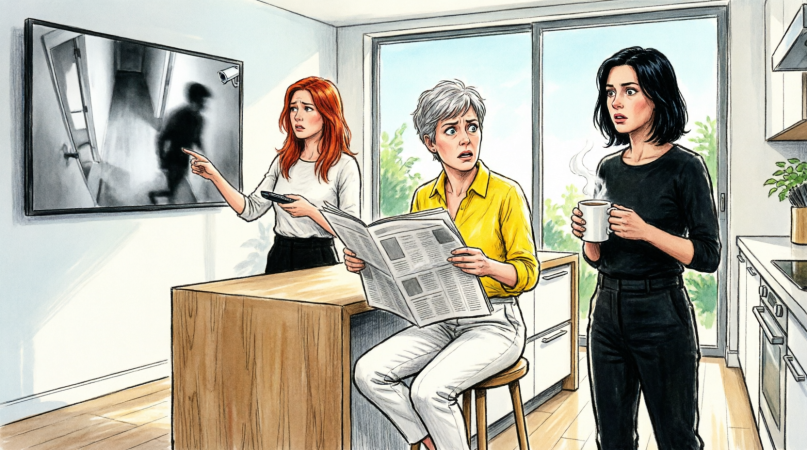
She brought casseroles.
She watered plants.
She folded laundry.
She stocked my freezer with little labeled containers of soup as if I were permanently one rough week away from collapse.
That was how she began—helpfully.
If you’re looking for villains in families, you’ll almost always miss them if you expect horns. The most dangerous kind is the one who arrives carrying food.
When Cole and I first got married, Patricia was merely overinvolved in the way many mothers of sons seem to pride themselves on being. She called often. She had opinions about everything from our mattress to our toothpaste. She sent me articles about freezer organization, proper linen storage, and the psychological benefits of family dinners prepared from scratch. At first I treated it like weather. Something annoying, recurring, but not personal enough to anchor a conflict around.
She called me Maddie even after I told her, twice, that I preferred Madison.
“Maddie’s friendlier,” she said.
Everything with Patricia came packaged as a refinement. She never openly contradicted you. She simply improved what you’d said until it no longer belonged to you.
In those first months of marriage, her intrusions were mild enough that Cole could dismiss them honestly.
“That’s just Mom,” he’d say with a shrug.
Those three words became the soundtrack of my marriage.
If she commented on my body eight weeks after I gave birth—“some women hold onto fluid in the face longer than others”—that was just Mom.
If she stopped by our anniversary dinner because she “happened to be nearby” and then stayed for forty-five minutes talking about cabinet hinges, that was just Mom.
If she showed up at nine on a Saturday morning and let herself in because she’d brought muffins and “didn’t want to wake the baby with the bell,” that was just Mom.
Every boundary became a misunderstanding once he wrapped it in that phrase.
That’s just Mom.
At first I think he meant it as comfort. Not to dismiss me, but to suggest harmlessness. She’s not targeting you. She’s just particular. She doesn’t mean anything by it. She’s always been like this.
But “always been like this” is not the same thing as “safe,” and men raised by women like Patricia often confuse familiarity with innocence.
The key changed everything.
We had Noah in the spring of our first year married. The birth was harder than I’d expected. Forty-one hours of labor, an emergency C-section, two nights of crying in the hospital bathroom because my body felt less like mine than a room people kept entering to adjust equipment. I loved my son instantly and fiercely and with an animal ferocity I had never known was in me, but the months after he was born were not soft in the cinematic way I’d been promised. I was exhausted, leaking, hungry all the time, weepy at odd hours, and jumpy about things that would have seemed absurd before—a blanket near Noah’s face, silence during nap time, the possibility of missing a call from the pediatrician.
I sought counseling six weeks postpartum because I wanted help before anxiety turned into something more structural. I was proud of that at the time. Proud that I recognized I needed support and got it. It made me feel adult, steady, responsible.
Patricia learned about it because Cole told her.
Not maliciously, I think. Carelessly. The way people from families with no privacy boundaries mistake information-sharing for closeness.
At the time, she responded beautifully.
“I’m so glad you’re taking care of yourself,” she told me, one hand warm on my forearm. “Mental health matters.”
She even brought over herbal tea and a book about maternal rest that she said had helped one of her friends “through a rough patch.” For a little while, I mistook that for solidarity.
Then the comments started changing texture.
“Don’t push yourself too hard if your nerves are still tender.”
“Sleep deprivation can really affect judgment.”
“New mothers don’t always realize how much support they need.”
None of it was harsh. That was what made it useful to her. You can’t object to concern without sounding unstable. You can’t defend yourself from sympathy without looking defensive. Patricia knew that the way some people know exactly how much salt to add without tasting.
The key came two months after Noah was born.
Patricia framed it as common sense.
“In case of emergencies,” she said.
Cole agreed before I could answer.
“Honestly, it’s smart. If we’re ever stuck somewhere or Noah has an issue or we lock ourselves out—”
“We’ve never locked ourselves out,” I said.
He was already at the kitchen table with the hardware store envelope open. Patricia sat across from him, smiling into her coffee like a woman at the center of a perfectly ordinary family conversation.
“It’s not about what has happened,” she said. “It’s about being prepared.”
The brass copy disappeared into her designer handbag that afternoon. I remember watching it go with a tightness in my chest so sharp it felt like instinct, and then immediately scolding myself for it. Why am I reacting like this? She’s his mother. It’s only for emergencies. Normal families do this.
Normal. Another dangerous word.
After that, the drop-ins became routine.
Patricia would come by when Cole was out and say she was “just in the area.” She’d let herself in if I didn’t answer quickly enough. Once, when I was upstairs changing Noah after a diaper explosion, she knocked, waited maybe twenty seconds, then used the key and later timed how long it took me to come down.
“Forty-six seconds,” she said with a smile. “Too long if there were ever a real emergency.”
I stood at the bottom of the stairs holding a crying baby and a dirty onesie and thought, You’re not the emergency. You’re the test.
She watered my plants as though my fern’s survival depended on her intervention. She refolded towels. She restacked the spice drawer. She took dishcloths from one cabinet and returned them to another because “that’s where they made more ergonomic sense.” She once opened the pantry, stared for a long moment at the cereal shelf, and said, “In my house breakfast foods were always grouped by nutritional value.”
The absurdity of it all made it harder to name. People imagine serious threats arriving wrapped in seriousness. Patricia’s threat lived in domestic detail. She weaponized normalcy. If I complained that she moved things, Cole would laugh a little and say, “Babe, she just likes organizing.”
When I said I didn’t want her letting herself in, he frowned like I was being needlessly territorial.
“She’s family.”
Exactly, I wanted to say. Which is why she should know better.
The first time I realized Patricia wasn’t merely meddling but collecting, Noah was nearly two.
I had taken him to the pediatrician for a routine follow-up after a nasty ear infection. He was cranky, sticky from the lollipop they’d given him after the exam, and I was ten minutes late to a client call because the traffic near the office was backed up. When I finally got home, there was a photo text from Patricia waiting on my phone.
Two cereal bowls in the sink.
A plate with half a sandwich crust.
A burp cloth on the arm of the couch.
Just trying to make things easier for you too, she wrote.
There was a smiley face at the end.
I stared at the image for a long time. Not because it was damning. Because it wasn’t. Because it was so mundane it almost escaped the category of offense entirely. But the caption changed it. The caption made it clear she had entered my home while I was gone, photographed small domestic evidence of having lived in it, and then sent it to me as though she were monitoring performance.
When I showed Cole that night, he rubbed the back of his neck and sighed.
“She probably just thought you’d want a heads-up.”
“A heads-up about what? That my family ate lunch?”
He looked tired. That always made me feel guilty, his tiredness. As if my hurt had bad timing.
“She means well, Maddie.”
There it was again.
That’s just Mom.
I began noticing that Patricia almost never crossed a line in front of him cleanly enough for him to be forced into action. When he was home, she stayed within the range of plausible deniability. Small comments. Loaded concern. Tight smiles. The real invasions happened in his absence, then returned to him translated into her language.
Which is why I don’t think it was an accident that the texts began showing up privately on his phone.
I discovered that by mistake. Or maybe by pattern finally becoming visible enough that even accidents wanted to help me.
Cole had left his phone on the kitchen counter one night while he bathed Noah. It buzzed twice, and because I was chopping strawberries with wet hands and assumed it might be work, I glanced at the screen.
Patricia.
The preview read: Just keeping you informed. I worry about the baby’s environment.
I froze.
That phrase sat on the lit screen like something sticky.
The baby’s environment.
Not Noah’s nap schedule, not whether he was eating, not how he’d been fussy or sweet or funny that day. Environment. The kind of word institutions use. Courts. Evaluators. People documenting.
I should have put the phone down. I know that. But intuition has rights too, and mine had been trying to get my attention for months.
I unlocked the screen. Cole and I knew each other’s passcodes then, before all this changed the climate of trust between us.
There were photos. Screenshots. Notes.
Laundry baskets.
Crumbs under Noah’s high chair.
The hallway when his toys were spread from one end to the other during a game.
My open laptop on the table beside a preschool art project and a coffee mug.
Just keeping you informed.
She seems overwhelmed.
I worry about how chaotic things are getting.
Noah needs stability.
Some women aren’t cut out for doing this alone.
The last sentence made the room tilt.
Doing this alone.
Cole traveled twice a month for work. I freelanced from home, which Patricia never treated as real work because it happened in the same rooms where life did. I was the one waking with Noah, managing preschool forms, handling grocery runs, client deadlines, fevers, appointments, laundry, bills, and the twenty invisible tasks that keep a household from sliding into static. But in Patricia’s narrative, I was floundering while she and Cole stood outside the frame, sane and organized, watching conditions deteriorate.
When Cole came back into the kitchen, Noah damp-haired and drowsy against his shoulder, I was still holding the phone.
“What’s this?” I asked.
He glanced at the screen and then at me.
“Madison…”
“No, tell me what this is.”
His expression changed immediately into caution, which was somehow worse than denial. He didn’t look shocked. He looked caught in a middle he had been comfortable occupying until it became visible.
“She just worries,” he said. “You know how she is.”
“How she is?” I heard my own voice rising and forced it back down because Noah was right there. “She’s taking pictures of my house and sending them to you.”
“Our house.”
The correction came out so fast I almost missed it, but not fast enough.
“Our house,” he repeated.
He meant to include himself in ownership. What he accidentally did was confirm how easily he could shift whose space it was depending on who he needed to defend.
I set the phone on the counter very carefully.
“And why are you letting her?”
He sighed. “Maddie, she’s not trying to attack you. She’s just concerned.”
“About what?”
He hesitated. “Things have seemed… off lately.”
Off.
That was the first crack, not because I had never felt unsupported before, but because the language had changed. He wasn’t telling me his mother was being rude. He was asking whether I might, in fact, be the problem she had described.
That night, after Noah was asleep, we had the kind of argument that does the most damage because it never quite admits it’s an argument. No slammed doors. No names. Just questions that sound reasonable while leaving cuts.
Mom says you’ve seemed stressed lately.
I am stressed. That’s not evidence of incompetence.
Maybe there are things you’re not seeing because you’re in it all day.
Maybe there are things you’re not seeing because you’re not.
He paced once. Sat down. Stood again.
“She’s just trying to help.”
“By documenting me?”
He rubbed his forehead. “That sounds dramatic.”
My laugh came out hollow. “That’s because it is dramatic.”
But after he went to bed, after the house had gone quiet and the dishwasher ticked through its cycle in the dark, I lay awake staring at the ceiling and replayed every visit, every comment, every note on the fridge, every “helpful” rearrangement and every time Cole had waved it away.
And then it hit me so cleanly I almost sat up.
Patricia wasn’t trying to embarrass me.
She was building a case.
Once I saw it, I couldn’t unsee it.
The comments about Noah’s routine.
The photos.
The carefully worded concern.
The way she inserted phrases like stability, environment, overwhelmed.
The way she always did it with just enough softness to appear maternal rather than strategic.
She wasn’t improvising. She was narrating.
The humiliation, when it finally came into the open, happened at my own table.
Patricia insisted we host Sunday lunch for the whole family three weeks after I saw those texts. She framed it as togetherness.
“It’ll be good for Noah to have everyone around him,” she said. “And good for you, Maddie. You’ve seemed isolated.”
I wanted to say no. I absolutely wanted to say no.
But by then refusal itself had become complicated. Patricia had spent so long making my boundaries look like symptoms that every no felt like a trap. If I declined, I’d be cold. Unwelcoming. Maybe too overwhelmed to host. Maybe proving exactly what she’d been hinting.
So I said yes.
Then I spent two days preparing like a woman trying to pass an inspection she had not consented to.
I cleaned until midnight the night before. The hallway was clear. The throw blankets folded. The toys sorted into baskets. Noah’s room looked like a catalog version of childhood instead of the real, cheerful wreck of it. I made a roast, two salads, lemon bars, a spinach tart, and enough pasta for the cousins who never liked what everyone else ate. I polished the silver serving spoons Patricia had once informed me made the table “look less haphazard.”
By the time Sunday came, the house was spotless in a way that didn’t feel like home at all. It felt staged. My stage. Her audience.
Patricia arrived early, of course.
White blazer. Pearl earrings. Low heels that clicked like punctuation on my hardwood floors. She walked through the house with that same mild, appraising gaze she wore in galleries and funerals. Never overtly disapproving. Much worse than that. Measuring.
“Lovely,” she said, taking in the table.
I almost thanked her. Old instincts die slowly.
The lunch began normally enough. Twelve people. Cousins, an aunt, Cole’s older brother Daniel and his wife, Brooke from two streets over who’d known Patricia since church choir days, even Cole’s uncle Howard who made bad jokes about cholesterol and considered that a personality. The room filled with the noise of ordinary family gatherings—forks, glasses, overlapping conversations, Noah laughing when Daniel balanced a dinner roll on his head.
I remember thinking, halfway through the main course, that maybe I had overestimated her. Maybe Patricia had only wanted a family lunch. Maybe my nerves had turned pattern into plot.
That’s the thing about people like Patricia. They survive on your hope that you were unfair.
Dessert had just been served when she tapped her fork lightly against her glass.
The sound was delicate. Almost dainty.
Conversation dimmed.
She smiled around the table, every inch the gracious matriarch.
“I just want to say something,” she began.
My stomach dropped so fast it felt physical.
Patricia reached into her handbag and withdrew a stack of papers.
At first I thought maybe recipes. Or old family photos. Something harmless and sentimental enough to make me hate myself for the cold certainty gathering in my chest.
Then she laid the papers on the table.
Printed photographs.
My hallway with Noah’s rain boots tipped over.
A laundry basket beside the couch.
Two unwashed mugs in the sink.
Blocks on the living room rug.
A changing pad left open on the nursery floor.
A screenshot of the pediatrician reminder I had forgotten to clear from the whiteboard.
Not filth. Not danger. Just life, arrested mid-motion and presented like evidence.
I heard someone shift in their chair.
Patricia placed one manicured hand on the stack.
“We all care about little Noah so much,” she said, voice soft with sorrowful reason. “And lately I’ve been concerned about the conditions he’s been in.”
For a second my brain refused to accept what my ears had heard.
Conditions.
Cole looked at the photos and then at me, bewilderment knitting his forehead. He did not defend me. He did not say Mom, what are you doing? He just looked confused, as if he had stumbled into an argument already underway and needed more data before deciding whether I belonged on the right side of it.
His aunt leaned toward me and whispered, “Honey, are you okay?”
I did not answer because the real answer was changing by the second.
Patricia continued.
“I know motherhood can be overwhelming. Especially when someone is trying to do too much. And I think, as a family, we have a responsibility to talk honestly about what’s best for the baby.”
The room went very still.
Daniel’s wife set down her fork.
Uncle Howard stopped chewing.
Noah, blissfully unaware, was under the table trying to peel a sticker off his sock.
Patricia lifted one of the photos between two fingers as though she were reluctant to expose us all to it. It was a shot of the hallway taken from the front door while Noah’s toys were lined up along the baseboard in what he called his “train road.”
“I’m not trying to shame anyone,” she said. “Sometimes love means stepping in when a mother can’t cope.”
That sentence entered me like ice.
There are humiliations that explode. This one spread. Quiet. Methodical. It didn’t just accuse me of failure. It announced to a table full of witnesses that Patricia had already built a case and brought exhibits.
I had the strangest immediate instinct to laugh.
Not because anything was funny. Because the absurdity was so naked I could feel the room straining to decide whether it was witnessing concern or cruelty, and I realized in one clean flash that whichever one I chose to perform next would determine the story.
If I cried, Patricia would call it fragility.
If I shouted, she would call it instability.
If I defended myself point by point, I would be granting legitimacy to the photographs themselves.
So I did the only thing that preserved me.
I stood.
“Excuse me,” I said.
My voice sounded very far away and very calm.
Then I walked to the downstairs bathroom, shut the door, and locked it.
Inside, I braced both hands on the sink and stared at my reflection until the shaking slowed.
My face looked almost ordinary. A little pale. Eyes wider than usual. Hair pinned back too neatly. You could not see from the outside how thoroughly the floor of me had shifted.
I waited.
One minute. Two. Long enough for the first surge of adrenaline to pass. Long enough to hear muffled voices in the dining room and not rush back to defend myself inside a frame Patricia had built.
I splashed water on my wrists and looked at myself again.
She wants you frantic, I thought.
She wants you messy enough to fit the photographs.
No.
When I came back to the table, I did not sit immediately. I crossed to Noah, who had started whining under Daniel’s chair because someone had moved his juice cup, picked him up, and set him on my hip.
“Who wants lemon bars?” I asked him.
It was ridiculous. Deliberate. Perfect.
He clapped.
No one else did.
Patricia’s mouth tightened for one brief second before she smoothed it back into concern.
The lunch ended soon after. People left in little clusters, making eye contact with me in that helpless, embarrassed way people do when they know something wrong has happened but they don’t yet know what version of it they’re allowed to acknowledge. Daniel hugged Noah too hard. Aunt Brooke touched my arm and said, “Take care of yourself, sweetheart,” which was useless and sincere at the same time.
After the door closed on the last guest, the house looked like a crime scene disguised as Sunday.
Half-empty dessert plates.
Coffee cups with lipstick crescents.
Patricia’s printed photos still fanned across the table like place cards from hell.
Cole stood in the kitchen with his hands on his hips and said, “Mom’s just worried. Maybe things have been a little chaotic lately.”
Chaotic.
That word finished what the photographs began.
I turned and looked at him.
Not with anger. Anger would have given him something active to answer. What I felt instead was colder. A kind of sudden clarity that makes grief feel almost clinical.
“Do you hear yourself?” I asked.
He frowned. “I’m not saying she handled it well.”
“But you are saying she’s right.”
“No. I’m saying maybe she sees things we don’t.”
I almost smiled at that.
We.
Again…………………………………………..
Click Here to continuous Read Full Ending Story :“3 years. MIL had a key. Walked straight in. Then I changed the locks.”__PART2 (ENDING)