Part 1
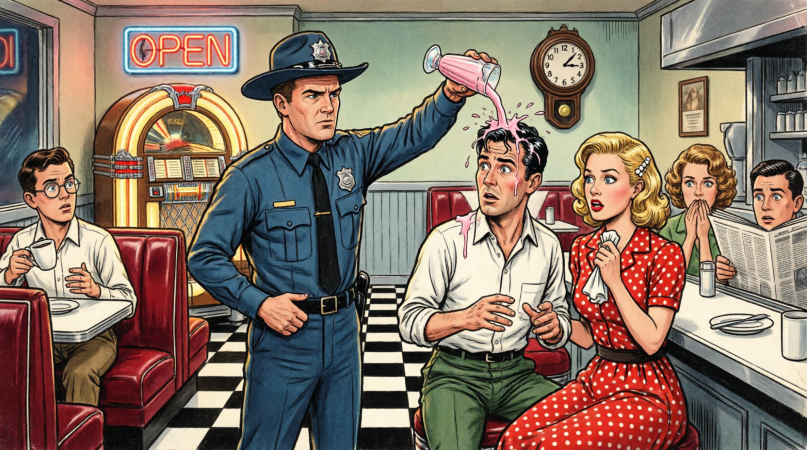
The strawberry milkshake hit the back of my neck like a cold, wet slap.
For one second, everything in the Rusty Spoon diner stopped moving. Forks hung in the air. The old ceiling fan clicked above us. The jukebox in the corner kept playing some country song about leaving home, but even that sounded far away, like it was coming from the bottom of a well.
The shake slid down my hair, over my collar, and soaked into my favorite gray flannel shirt. It was thick, freezing, and sweet enough that the smell made my stomach turn.
Sheriff Dominic Vance stood behind me, holding the empty glass upside down.
Then he laughed.
Not a normal laugh. A loud, barking sound meant for an audience. A sound that said he had done this before, and nobody had ever made him pay for it.
“Well,” he said, loud enough for the whole diner, “looks like the town ghost finally got some color on him.”
Nobody laughed at first. Then one man at the counter forced out a nervous chuckle, and two others followed because fear can sound a lot like agreement when a bully is standing in the room with a badge.
I did not stand up.
I did not grab him.
I did not even wipe my face.
I only looked across the booth at my wife.
Amelia sat with her purse in her lap and her phone still glowing beside her plate. She had ordered a turkey club and only taken two bites. Her dark hair was tucked behind one ear, her lipstick untouched, her eyes sharp as broken glass.
I waited for her anger.
I waited for her to say my name like she still loved me.
Instead, she sighed.
“Logan,” she whispered, tight and embarrassed. “Why do you always have to make things worse?”
That was the moment the cold milkshake stopped mattering.
Outside, October sunlight poured through the diner windows, bright and clean and cruel. We were in a small Montana town where everybody knew everybody, and everybody knew Sheriff Vance ruled the county like it belonged to him. He decided who got tickets, who got warnings, whose business license got delayed, whose son got arrested after a football game, and whose daughter got escorted home with a smile.
I had moved there three years earlier after retiring from the Navy. I wanted quiet. I wanted open sky, black coffee, old trucks, and a wife who looked at me like I was finally home.
At least, that was what I thought I wanted.
Dominic leaned down beside my ear. His cologne was heavy, all spice and arrogance.
“You got something to say, ghost?”
My hands were under the table, relaxed on my knees. I could hear his breathing. I could see his reflection in the chrome napkin holder. Big man. Six-two, maybe two-forty. Right shoulder slightly lower than the left. Old injury or poor posture. Weight balanced wrong. Too confident.
If I moved, he would hit the floor before anyone understood what happened.
But I had spent half my life learning the difference between a threat and bait.
This was bait.
I picked up a napkin and slowly wiped pink milkshake from my eyebrow.
“No,” I said quietly. “I’m done eating.”
Dominic smiled like he had won something. “That’s what I thought.”
Amelia pushed herself out of the booth so quickly her purse strap caught on the table.
“I’ll be in the car,” she snapped. “Try not to embarrass me more than you already have.”
She walked toward the door.
Dominic was still grinning, but as Amelia passed him, something small happened.
Too small for most people.
His smile twitched.
He gave her one brief nod.
And Amelia lowered her eyes like she had expected it.
The bell above the door jingled when she left. The sound cut through me deeper than any insult Dominic had thrown.
I stood, milkshake dripping from my sleeves onto the tile floor. Nobody looked directly at me. The waitress, Nora, stood behind the counter with her hand over her mouth. An old veteran named Clyde stared into his coffee like he wished he had gone blind.
Dominic stepped aside, spreading his arms.
“Careful out there,” he said. “Roads get dangerous for men who don’t know their place.”
I walked past him without touching him.
But as I stepped into the sunlight, one thought settled behind my ribs with the weight of a loaded weapon.
The milkshake had been public.
The nod had been private.
And my wife had not looked surprised.
### Part 2
Amelia drove home with both hands locked around the steering wheel.
Her knuckles were pale. Her jaw was tight. She kept her eyes on the road like the yellow centerline had personally offended her.
I sat in the passenger seat, still sticky, still smelling like sugar and strawberries and humiliation.
For ten miles, she said nothing.
The road out of town passed cornfields, a feed store, a church with a cracked bell tower, and a row of cottonwoods shedding gold leaves into the ditch. On any other October afternoon, I might have noticed the beauty of it. That day, all I could see was Amelia’s reflection in the window.
She looked angry.
Not hurt for me.
Angry at me.
Finally, I said, “He dumped a milkshake on me in front of everyone.”
“I know what happened.”
“Then why are you acting like I caused it?”
She laughed once, but there was no humor in it. “Because you did, Logan. You always do.”
I turned slightly toward her. “By sitting there?”
“By being you.” Her voice cracked on the word, but not with sadness. With disgust. “That silent, judgmental look. Like everyone around you is weak. Like this town is beneath you.”
I watched her profile. She had been the woman who once touched the scar beneath my ribs and whispered that whatever happened before her, I was safe now. She had been the woman who made pancakes at midnight because I couldn’t sleep. She had been the woman who cried when I told her I had trouble remembering the faces of men I saved, but never the ones I lost.
Now she was a stranger with my last name.
“I never thought this town was beneath me,” I said.
“Dominic does.”
The name came out too easily.
Not Sheriff Vance.
Dominic.
I filed that away.
When we reached the house, she parked crooked in the driveway and got out before the engine finished ticking. I followed slower. My boots crunched over fallen leaves. The house looked normal from outside. White porch. Blue shutters. One loose railing I had been meaning to fix. A clay pot of dead mums by the steps because Amelia had forgotten to water them.
Inside, she dropped her purse on the table.
“I can’t do this right now,” she said.
“Do what?”
“Be responsible for your moods.”
“My moods?”
She spun around. “Yes. Your moods. Your silence. Your old war stories you don’t tell but somehow make everyone feel. I married a man, Logan. Not a stone wall.”
The words landed, but I did not let them show.
“You married me knowing exactly who I was.”
“No.” Her eyes flashed. “I married the version of you who still tried.”
Then she walked into the bedroom and shut the door.
I stood in the kitchen, listening to the old refrigerator hum. The clock above the stove ticked once, twice, three times. My hands smelled like fake strawberry.
I went to the bathroom, turned the shower as hot as it would go, and stepped in fully clothed for the first minute.
The water ran pink around my boots.
I peeled off the flannel and let it fall heavy into the tub. Steam filled the room. My skin burned. I scrubbed my neck until it hurt.
But the dirt I wanted gone was not on me.
When I shut the water off, the house was quiet.
Too quiet.
I wrapped a towel around my waist and opened the bathroom door.
That was when I heard Amelia in the bedroom.
Her voice was low.
“No, he didn’t do anything.”
Pause.
“I know. It was bad.”
Another pause.
“No. He suspects nothing.”
My hand tightened around the towel.
Then her voice dropped even softer.
“I’ll see you later. Just be careful. He notices things.”
I stepped back into the bathroom before the floorboard could creak beneath my weight.
For a long moment, I stood there dripping onto the bath mat, listening to my own heartbeat remain steady.
He suspects nothing.
She was wrong about that.
I had noticed the nod. I had noticed the name. I had noticed the smell of Dominic’s cologne lingering near our booth before he ever walked in.
Now I had noticed this.
When I finally walked into the bedroom, Amelia sat on the edge of the bed with her phone face down beside her.
She looked up too fast.
“Feel better?” she asked.
I smiled like a man who had heard nothing.
“Cleaner,” I said.
Her smile twitched.
And for the first time since the diner, I saw fear behind her eyes.
### Part 3
I did not confront her.
Confrontation is what people do when they want relief more than truth.
I wanted truth.
So I sat in the armchair by the bedroom window and watched Amelia pretend not to watch me. She brushed her hair in front of the mirror, each stroke careful, each movement too normal. Her phone sat on the nightstand within reach of her left hand.
“Who were you talking to?” I asked.
“My mom.”
Her answer came instantly.
Too instantly.
Amelia’s mother lived in Arizona and treated phone calls like medical procedures. Scheduled, brief, and never before dinner. I had heard her say more than once that afternoon calls were for emergencies and lonely people.
“Oh,” I said. “Everything okay?”
“She wanted to know if we’re coming for Thanksgiving.”
“In October?”
Her hand paused in her hair for half a second.
Then she recovered.
“She plans early.”
I nodded.
The lie sat between us like a dead animal neither of us wanted to mention.
She put the brush down. “I’m going to the store. We’re out of milk.”
I almost laughed.
Milk.
After the day I’d had, the word felt like a private joke written by a cruel God.
“Need me to go?” I asked.
“No.” She grabbed her keys. “I need air.”
The front door opened and closed. Her car started. Tires rolled over gravel. Then silence came back to the house.
Not peace.
Silence.
I moved fast.
In the garage, behind a rack of socket wrenches and dusty paint cans, sat a red tool chest I had owned since my second deployment. Amelia thought it held old parts. Mostly, it did.
But the bottom drawer had a false panel.
Beneath it was a black waterproof case, scratched from years of travel. I opened it and looked down at things I had promised myself I would never need again.
Small cameras.
Audio bugs.
Signal receivers.
A burner phone wrapped in foil.
And a folded cloth holding a silver trident I had not worn in years.
I touched it once with two fingers.
Not for pride.
For memory.
People thought men like me missed the action. They were wrong. I missed clarity. Overseas, danger came wearing danger’s face. At home, it wore lipstick, a wedding ring, and a sheriff’s badge.
I placed one recorder behind the headboard, another beneath the kitchen table, and a pinhole camera in the living room bookshelf facing the front door. In the driveway, I slid a magnetic tracker beneath Amelia’s rear bumper, working by feel, my shoulder pressed against cold gravel.
Then I put everything back exactly as it had been.
When Amelia returned forty-seven minutes later, she carried one grocery bag.
One carton of milk.
No receipt.
She kissed my cheek as she passed me in the kitchen. Her lips were dry.
That was when I smelled it.
Cigar smoke.
Faint, buried under her perfume, but there.
Dominic smoked cigars. Thick brown ones he chewed more than smoked, leaving wet tobacco flakes near the station steps. I had noticed because noticing had kept me alive long before Amelia ever learned my name.
“Long line?” I asked.
She opened the refrigerator. “What?”
“At the store.”
“Oh. Yeah. A little.”
The nearest grocery store had self-checkout and three cars in the lot at that hour.
I smiled and poured coffee I did not want.
For the next two days, I became exactly what they expected.
Quiet.
Wounded.
Ashamed.
I stayed home. I fixed the loose porch railing. I changed oil in my truck. I let Amelia catch me staring into space. She mistook control for defeat, which told me she had never really understood me at all.
On Thursday afternoon, I drove toward the hardware store.
Halfway there, blue lights flashed behind me.
A young deputy strutted up to my window, one hand on his belt, the other shaking slightly.
“License and registration.”
“What’s the stop?”
“You crossed the centerline.”
“I didn’t.”
His eyes hardened. “Step out of the vehicle.”
For forty minutes, he made me stand beside the road while neighbors slowed down to stare. Wind pushed dust across my boots. A woman from church drove past and quickly looked away.
When the deputy finally handed back my papers, he added a reckless driving ticket.
“Sheriff sends his regards,” he said.
I watched his cruiser pull away.
Then I looked at the ticket.
It was not harassment anymore.
It was construction.
They were building a version of me the town could believe in later.
Unstable Logan.
Dangerous Logan.
The veteran who finally snapped.
That night, while Amelia slept beside me, I listened to the kitchen recorder through one small earpiece.
Her voice came first.
“He’s getting quieter.”
Then Dominic’s.
“Good. Quiet men break loud.”
Amelia laughed softly.
“When do we finish it?”………………………………