At breakfast, my father announced our family trip to Italy as if he were mentioning a small change in the weather.
He did not make eye contact at first.
He cut into his eggs, lifted his coffee, and said, “We booked a trip to Italy.
Just the six of us.
You get it?”
The words landed in the middle of the table and nobody flinched.
My mother kept stirring sugar into her coffee, though it had already dissolved.
My sister Claire smiled into her orange juice.
Her husband Caleb glanced down at his phone, probably checking wine tours.
My younger brother Mike pretended to scroll.
His girlfriend, Tessa, reached for the butter and asked if Florence would be too crowded in July.
There were seven chairs at that table.
Six people were going.
I looked at my father, waiting for anything that might soften the sentence.
A reason.
An apology.
Even one of those fake little phrases people use when they want the credit for kindness without the inconvenience of feeling it.
But he only looked back at me with the flat confidence of a man who had already decided how I was supposed to respond.
“You get it,” he repeated.
That was never really a question in our family.
It was a command dressed up as understanding.
It meant: do not make this awkward.
It meant: absorb this and smile.
It meant: we are going to hurt you, and you are going to help us pretend we did not.
So I said, “Of course.”
My mother exhaled like I had done her a favor.
Claire immediately started talking about food.
Caleb mentioned a private tasting outside Siena.
Mike complained about baggage fees.
Tessa laughed and said my father would never survive with only a carry-on.
Nobody asked whether I minded.
That was almost worse than being excluded.
They did not forget to include me.
They had simply grown used to leaving me outside the warmest parts of the family while still expecting me to keep the lights on.
I had been useful for years.
When my mother panicked over a bill, I paid it.
When my father needed to borrow money until Friday, Friday turned into silence.
When Claire needed a deposit for something important, I was the responsible one with savings.
When Mike’s rent was late, I was the emergency plan.
They called it family.
I called it a pattern, though never out loud.
After breakfast, I drove home with one hand on the wheel, my prosthetic leg rubbing against the socket in the humid air.
I kept waiting for anger to erupt, but nothing dramatic happened.
No shaking hands.
No tears.
Just a clean, cold realization.
They meant it.
They were not embarrassed.
They were not conflicted.
They had planned the flights, hotels, meals, tours, and transfers.
They had sat at that table and told me about the trip only after every decision had already been made.
I went home, made myself tea, and tried not to think about it.
That night at 11:42, my phone lit up.
Bank alert: $1,850 charged in Rome.
Before I could process it, another notification appeared.
$2,300 in Venice.
Then Florence.
Then a restaurant reservation.
Then a private tour.
Then two boutique hotel deposits.
I sat up in bed and opened
the banking app with a strange heaviness spreading through my chest.
The charges were not random.
They matched every bright, careless detail they had discussed over breakfast.
Rome.
Venice.
Florence.
Hotels.
Tours.
Meals.
Transfers.
The dream vacation for six people, billed to the one person who had been told to understand why she was not included.
The total was $9,200.
For a long time, I just stared at the screen.
I thought about calling my mother.
I thought about texting Claire.
I thought about asking my father how he could stand in front of me and exclude me while using my card to pay for the trip.
Then I remembered something he had said to me the last time he borrowed money and never repaid it.
“Family doesn’t keep score.”
So I did not call.
I opened the app.
I disputed every charge.
I reported the card compromised.
I froze it.
Then I waited in the dark until the confirmation email arrived.
Fraud case opened.
Card locked.
Merchant payments reversed pending review.
The next morning, my mother sent me a picture of linen pants laid neatly across her bed.
“Almost packed,” she wrote, with three heart emojis.
I stared at the message until the screen dimmed.
Then I put my phone down without replying.
For six days, nobody mentioned the card.
That was how I knew they had not made a mistake.
If a charge had been accidental, someone would have called in panic.
If they had believed I had offered, someone would have thanked me.
Instead there was silence, that old family silence that had always meant they were waiting for me to behave.
On the morning of their flight, I woke before sunrise.
I made coffee and sat by the window, watching the streetlights fade.
I felt strangely calm, as if I were standing behind glass.
At 7:18, Claire texted the family group chat.
“Is anyone else having trouble opening the hotel confirmation?”
At 7:26, Caleb wrote, “Our Venice tour says payment failed.
Weird.”
At 7:41, Mike asked, “Dad, did you use the wrong card or something?”
At 8:03, my mother messaged me directly.
“Honey, do you know why our boarding passes vanished?”
I read the words several times.
Not because I did not understand them, but because they were finally asking the right person the wrong question.
I typed back, “I’m not on the trip.”
The response was immediate chaos.
Dad called.
Mom called.
Claire called.
Dad called again.
Mike sent question marks.
Caleb wrote one message in the group chat, then deleted it.
I let every call ring out.
By noon, they were at the airport with six suitcases, six passports, six neck pillows, and no functioning reservation chain.
The hotels had not confirmed.
The tours had been canceled.
The airline booking, tied to the same flagged payment trail, had been frozen for review.
My father had used my card as if it were an invisible family fund, but the moment I reported the charges, every linked purchase started collapsing.
The first photo came from Mike by accident.
He sent it to the family group chat instead of to Dad.
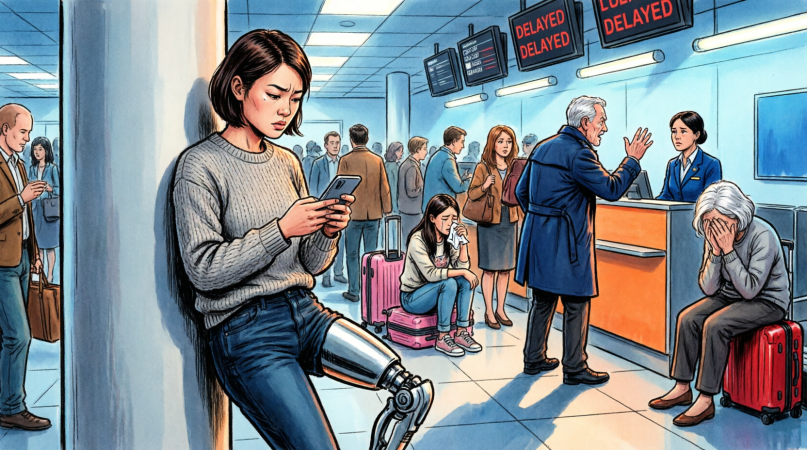
Six suitcases were lined up against a wall in Terminal 3.
My mother sat on one with her face in her hands.
Claire was crying into
a napkin.
Caleb looked furious.
Tessa stood a few feet away, pale and embarrassed.
My father was at the counter, leaning forward with both hands planted hard on the desk while an airline employee looked at him with exhausted patience.
Mike captioned it, “This is insane.”
For the first time all week, I almost laughed.
Not because they were stranded.
Because consequences had finally found the correct gate.
They spent the first night in Terminal 3 arguing, calling banks, trying to rebook with cards that did not have enough available credit.
My mother left voicemails that began with tears and ended with accusations.
Claire called me cruel.
Caleb said I had humiliated everyone.
Mike said I had gone too far.
My father sent one text.
“You’re proving why we didn’t invite you.”
That message changed everything.
Until then, a small, foolish part of me had wondered if I should soften the report.
Maybe tell the bank I recognized the people involved.
Maybe call it a family misunderstanding.
Maybe absorb the loss one more time, because that was what I had been trained to do.
But there it was in writing.
Not an apology.
Not fear.
Not shame.
Just punishment.
He had used my money, excluded me from the trip it bought, and still believed he had the right to judge my reaction.
The bank investigator called the next morning.
He was polite, careful, and serious.
He asked whether I had authorized the charges.
I looked across my apartment at an old framed family photograph on the hallway wall.
Seven people smiling.
Six people chosen.
One person paying.
“No,” I said.
He asked me to repeat it for the recorded line.
“No.
I did not authorize those charges.”
After that, the situation moved faster than my family expected.
The bank requested documentation.
I sent screenshots of old messages where my father asked to use my card and promised to pay me back.
I sent transfer records.
I sent unpaid loan reminders.
I sent the new text where he said I was proving why they had not invited me.
It was amazing how much evidence a person collects when they spend years telling themselves they are not keeping score.
On the third day, Tessa called me.
I almost ignored her.
She was the newest person in the family and technically had nothing to do with me.
But something about the timing made me answer.
She was whispering.
“I need you to know something,” she said.
In the background, I could hear airport announcements and my father’s voice, low and sharp, telling someone to stop making things worse.
Tessa told me that after the breakfast announcement, she had seen my father hand Caleb a printed folder.
Inside were hotel bookings, tour vouchers, and payment confirmations with my name on them.
“He told everyone you offered,” she said.
“He said you felt bad about not coming, so you wanted to help.”
My hand tightened around the phone.
“Everyone believed that?”
She hesitated.
That hesitation hurt more than the answer.
“Your mom knew before breakfast,” Tessa said.
“Claire knew too.
Mike said he thought it was messed up, but your dad told him to stop being dramatic.
Caleb said if you had a problem with it, you would say something.”
For a moment, I could
not speak.
Then Tessa said, “There’s one more thing.”
She had taken a picture of a page from the folder because it looked wrong to her.
She sent it while we were still on the phone.
It was a payment authorization form.
At the bottom was my name.
Not typed.
Signed.
Except I had not signed it.
The signature was close enough to fool someone who did not know my handwriting, but I knew immediately.
The angle was wrong.
The loop on the last letter was wrong.
And the date was impossible because it was from a Tuesday when I had been at a prosthetics appointment across town, sitting on an exam table while a technician adjusted the socket that had been bruising my leg.
My father had forged my signature.
The strange thing about betrayal is that sometimes the worst part is not the act itself.
It is how much planning it required.
He had not simply grabbed my card in a desperate moment.
He had printed forms.
He had signed my name.
He had told the family I volunteered.
Then he had sat across from me at breakfast and told me I would not be coming.
When I sent the form to the investigator, his tone changed.
He told me to preserve all messages and avoid direct confrontation.
He said the bank would handle the merchant disputes and that the forged authorization could become a separate matter.
He did not dramatize it, but I understood enough from his careful pauses.
This was no longer just a family fight.
By the fourth day, my family was back from the airport without ever making it to Italy.
They had paid for two nights in a cheap hotel near the terminal using Caleb’s emergency credit card.
My parents had missed work.
Claire had lost nonrefundable vacation days.
Mike and Tessa had fought so badly that she went home separately.
Then my father came to my apartment.
I knew it was him before I opened the door because he knocked the way he did everything else: like the door was being unreasonable by standing between him and what he wanted.
I did not let him in.
I opened the door with the chain still latched.
He looked tired, older, but not sorry.
My mother stood behind him with red eyes.
Claire was in the hallway, arms crossed tightly over her chest.
“You need to call the bank,” my father said.
Not hello.
Not I am sorry.
I looked at him through the gap.
“Why?”
“Because this has gone far enough.”
“You forged my signature.”
My mother’s face crumpled, but she did not look surprised.
Claire looked down at the floor.
That told me everything.
My father lowered his voice.
“Don’t use words like that.”
“What word would you prefer?”
“I used your name because you’re my daughter.”
For years, that sentence would have worked on me.
It had the old ingredients: authority, guilt, obligation.
But something in me had shifted at that breakfast table, and something else had locked into place when I saw that fake signature.
“I am your daughter,” I said.
“That is why you thought I would be easy to steal from.”
My mother started crying then.
She said they were embarrassed.
She said they never meant for it
to get so serious.
She said my father was under pressure and Claire had been looking forward to the trip and everyone had already requested time off.
I listened until she ran out of breath.
Then I asked, “When did you know?”
She wiped her face.
“Know what?”
“That I wasn’t invited, but my card was paying.”
The hallway went silent.
Claire whispered, “Mom.”
My mother closed her eyes.
And just like that, the last little shelter of doubt collapsed.
They had all known enough.
Maybe not every detail.
Maybe not the forged form.
But enough to let me sit at that breakfast table and be humiliated while my money carried their luggage across Italy.
I unlatched the chain, not to let them in, but to step into the hallway.
“I am not calling the bank,” I said.
“I am not withdrawing the complaint.
I am not paying for Italy, the airport hotel, the missed work, or the shame you created.
If the bank asks me for the truth, I will give it to them.
If anyone else asks, I will do the same.”
My father stared at me as if I had slapped him.
“After everything we did for you?” he said.
I looked down at my prosthetic leg, visible beneath the hem of my pants.
For years, he had used my disability as both evidence of his sacrifice and a reason I should be grateful for crumbs.
He loved reminding people that family had stood by me after the accident.
He never mentioned how quickly support became control.
“You did not buy permanent access to me,” I said.
Claire began to cry quietly.
My mother covered her mouth.
My father turned red.
“You will regret this,” he said.
For once, the threat sounded small.
“Maybe,” I said.
“But not as much as I regret letting you convince me this was love.”
They left with nothing.
The bank ruled in my favor on the disputed charges.
The merchants pursued the failed payments through the accounts attached to the bookings, which led straight back to my father’s information and the forged authorization form.
He did not go to prison, but he was forced into a repayment agreement, and the bank closed several accounts connected to the fraud review.
My parents had to sell one of their cars to cover the mess.
Claire and Caleb paid for their part because Caleb’s card had been used for the airport hotel.
Mike apologized two weeks later in a text that was clumsy but real.
Tessa broke up with him anyway, telling me once that she could not marry into a family that practiced betrayal like a tradition.
My mother called often at first.
Every message sounded like grief trying to disguise itself as blame.
I did not answer until she finally left one voicemail that contained the words I had waited years to hear.
“I knew enough,” she said.
“And I let it happen.”
I listened to that message three times.
Then I saved it, not because it fixed anything, but because truth matters when a family has survived by editing it.
I took the old family photograph off my hallway wall a week later.
For a while, the empty rectangle of lighter paint bothered me.
Then it started to feel honest.
passed before I used my new card for anything larger than groceries.
The first real purchase I made was a plane ticket.
Not to Italy.
Not yet.
I chose a quiet coastal city I had always wanted to see, booked an accessible room with a balcony, and paid for it myself.
On the first morning there, I sat alone with coffee, watching sunlight spread across the water.
No one asked me to cover a bill.
No one told me to understand.
No one needed me to shrink so their cruelty could feel less obvious.
For years, I thought being included meant earning my place at the table by being useful.
But the truth was simpler and much harder to accept: a seat that costs your dignity is not a seat.
It is a bill.
Sometimes I still wonder whether they truly believed I would never say no, or whether they simply built their lives around the hope that I would not.
The biggest red flag was not that they left me out.
It was that everyone at that table knew I had been left out, and still expected me to pay for the view.