“Sell the house,” my father had shouted, lifting a baseball bat in my grandmother’s living room while my mother begged me to think about my sister’s mounting debts. The first strike dropped me to my knees, and seconds later the front door burst open, flooding the room with bright light and the presence of law enforcement. The moment froze in my chest: officers’ faces grim, hands on weapons, and the words that changed everything—my rank spoken aloud.
The crack of the bat against the hardwood echoed in the room like a thunderclap. I felt the air ripped from my lungs, coppery and sharp. Grandma’s braided rug pressed against my cheek, carrying the faint, familiar scent of lilac lotion. The rug smelled like home, like past Sundays of quiet and safe corners, and for a fleeting moment, I thought I could breathe in that security. But the pain in my left side reminded me that safety was long gone.
Dad’s boots planted near my face, the same boots that once kicked soccer balls in the backyard. His plaid shirt stretched as he raised the bat again, voice cutting through the silence. He invoked my sister, the house, the money, each word a lever to bend me to his will. I tried to rise. Pain shot through my ribs. I collapsed back, whispering pleas that sounded too weak even to me.
Mom hovered in the doorway, helpless, wringing her hands in a motion I had seen a thousand times before, between arguments, between decisions she did not want to make. My sister shrank behind her, the eternal victim, expecting rescue that had never come fast enough. The bat scraped the floor, Dad adjusting his stance. Through the cracked window, Mrs. Patterson’s wind chimes sang obliviously, a stark, surreal counterpoint to the violence in the room.
I whispered a thin, defiant “I’m not selling.” The words felt fragile, almost pathetic, yet they were mine. Dad’s knuckles whitened around the handle. He raised the bat higher, ready to strike. Then everything changed. The front door exploded inward. Police. Shouts. Commands. Weapons trained on him. The bat clattered to the floor. Dad froze, cuffs appearing around his wrists. The deputy read rights, monotone echoing off the walls.
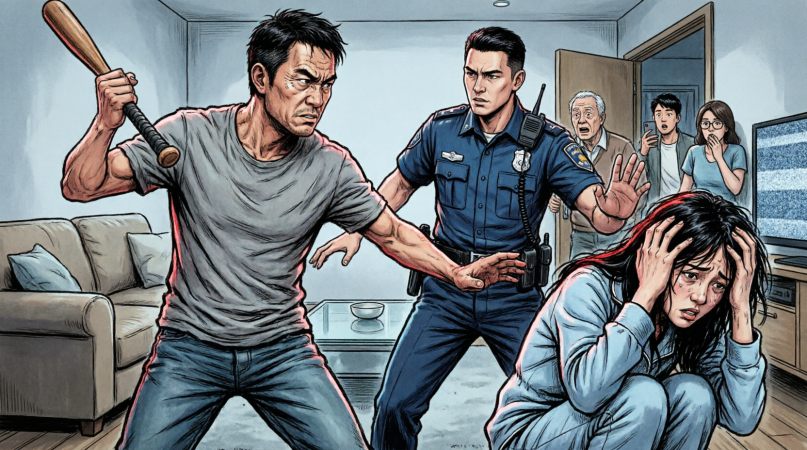
One of the sailors, Ellison, barely older than twenty, freckled and serious, looked past my father and saw me. Posture straightened, shoulders back. His words landed like anchors: “Captain Hart. Ma’am, are you injured?” Silence fell. Mom’s hand flew to her mouth. My sister’s jaw dropped. Dad looked between us, then at the shadow box above the mantle, my ribbons pinned neatly inside. Recognition came too late.
Paramedics arrived. Gloves, gurney, ice. Shirt cut. Ribs pressed. Names confirmed: Captain Naomi Hart. The authority, the uniform, my commission—it all mattered now. Dad’s face drained of color, the fire of anger extinguished, replaced with confusion, shame, fear.
As they wheeled me past the mantle, Grandma’s photograph caught my eye. Her Sunday hat, a tiny feather tucked in, eyes soft yet amused. She seemed to know how this night would unfold before any of us did. Dad, guided by the deputy toward the porch, whispered in a broken voice, “I didn’t know.” I didn’t respond. Nine years of silence, nine years of assuming, all led to this moment. The ambulance doors closed. Sirens wailed into the night. And behind me, Mrs. Patterson’s wind chimes kept singing their bright, oblivious song.
Every step into the ambulance was heavy, my ribs aching, my heart racing. Officers and medics coordinated quietly around us. My mother followed, pale and rigid. My sister’s figure seemed smaller than ever, crouched in fear. Ellison stayed close, eyes scanning, ensuring nothing shifted in the chaos.
A second envelope, barely tucked beneath Grandma’s wicker basket, caught my attention. My name printed across the front. Its presence was deliberate, as though Grandma herself had prepared for this exact moment. Every careful note, every hidden account, every meticulous instruction for the house was encapsulated here. It was proof, it was power, it was the truth I had carried quietly for years.
I reached for it. Fingers trembling. Mom leaned forward, voice barely audible: “Naomi… what is that?” Ellison’s gaze was sharp. “Do not touch it yet. It’s evidence.” Dad, for the first time, looked small, the weight of his actions finally recognized. My sister, frozen in her fear, could only watch. Every past debt, every manipulated choice, collided with this moment of revelation.
The night stretched, the ambulance doors opened and closed, sirens mingling with distant neighborhood sounds. My mother held herself rigid. Ellison guided me gently, cautious but firm. The envelope remained in my hands, a tangible signal of authority and history. Each fold of paper carried consequence, accountability, and the seeds of a new understanding.
I took a deep breath, absorbing the night, the pain, the betrayal, the relief. I had survived the immediate threat, claimed my space, asserted my rank, and finally had something concrete to ground the chaos that had become my family’s legacy. Every lesson Grandma had embedded in me, every whispered instruction, every act of subtle preparation culminated in the clarity of that moment. I was Captain Naomi Hart. And nothing would allow them to forget it.
Outside, neighbors watched silently, their phones raised as witnesses to a drama that had exploded in the suburban night. The wind chimes continued their bright, steady song, indifferent to human conflict. They would outlast our anger, our fear, our fleeting triumphs. Yet, amidst that sound, I felt the first taste of control and recognition I had not known in years.
And somewhere, in the quiet aftermath, I realized: not grief. Not fear. Not one moment wasted. Everything here—pain, pride, rage, silence—was documentation. Every detail recorded, every witness present, every law enforced. This was my inheritance as much as Grandma’s house had been. And for the first time, I could use it. Everything could be accounted for. Everything could be confronted. Nothing hidden.
The story was far from over, but the first chapter had been decisively claimed. My body ached, my heart raced, my mind cataloged every step. I was present. I was protected. I was recognized. Captain Naomi Hart had faced the storm, and for the first time, the storm had paused.”,