Rain had been coming down for hours by the time Officer Michael Carter looked at the clock and realized it was nearly midnight.
The wall clock above the dispatch desk read 11:46 p.m.
The lobby of the small-town police station smelled like wet concrete, old coffee, and the metallic dampness that always seemed to cling to uniforms after a storm.
A small American flag hung near the front desk, its corner moving whenever the wind pushed cold air under the door.
Carter had worked nights for twelve years.
He knew what midnight brought.
It brought people who had held themselves together all day and finally broke when the house went quiet.
It brought teenagers who had run out of gas and courage at the same time.
It brought mothers who whispered instead of spoke because someone back home might notice they were gone.
That night, his coffee had already gone cold beside the incident log.
He was reaching for the mug anyway when the front door burst open so hard the frame shook.
For a second, all he saw was rain.
Then he saw a little girl.
She was tiny, no more than five years old, with brown hair flattened against her face and lips turned bluish from the cold.
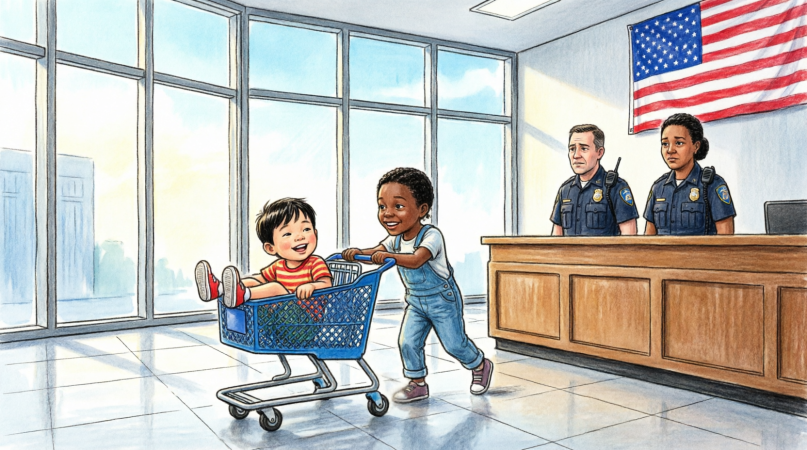
Both of her hands were wrapped around the handle of an old rusty shopping cart.
She was pushing it with her whole body.
Her shoulders were hunched.
Her sneakers squeaked against the tile.
Every breath came out of her like she had been running for longer than a child should ever have to run.
Inside the shopping cart was another little girl.
Same small face.
Same wet hair.
Same soaked dress.
Her twin.
But the second child was not sitting up.
She was curled on her side, one hand tucked under her chin, her eyelids fluttering like she was trying to wake up and could not quite reach the surface.
Her breathing sounded thin and rough.
Her stomach pushed against the wet fabric of her dress in a way that made Carter’s body go still before his mind had time to name why.
It was too round.
Too tight.
Wrong in a way he could not explain in a single glance but understood with the part of him that had been trained to recognize danger.
Carter stood so quickly his chair scraped across the tile.
“Easy, sweetheart,” he said, already reaching for the radio. “Where’s your mother?”
The girl did not answer.
She looked down at the child in the cart.
Then she looked back at him.
There was fear in her face, but fear was not what made Carter’s stomach drop.
It was purpose.
Children that young were supposed to cry when they were lost.
They were supposed to ask for their mom.
This child had come to the station as if she had followed instructions.
As if she had been waiting for the right time.
“She’s sick,” the girl whispered.
Carter knelt beside the cart.
The twin’s forehead was slick with fever sweat, her skin pale under the fluorescent lights, her lips dry and cracked.
“What’s your name?” he asked.
“Emily.”
“And your sister?”
“Emma.”
At the sound of her name, the child in the cart made the smallest movement.
Not enough to wake.
Enough to prove she was still fighting.
Carter keyed his radio.
“Dispatch, ambulance needed at the station,” he said. “Urgent pediatric case. Possible abdominal emergency. Log time of arrival at 11:47 p.m.”
The dispatcher turned in her chair.
The young officer near the vending machine looked up from his paper coffee cup.
Carter kept his face calm because Emily was watching him like his expression might tell her whether her sister would live.
“Emily,” he said gently, “I need you to tell me what happened. Did Emma fall? Did she eat something? Did somebody hurt her?”
Emily’s little fingers tightened around the cart handle.
Her knuckles went white.
“Daddy put something inside her.”
For a moment, the station seemed to lose every ordinary sound.
No typing.
No radio chatter.
No vending machine hum.
Just rain on glass and the uneven breathing of the child in the cart.
Carter felt his jaw lock.
He made himself speak carefully.
“Inside where, Emily?”
Emily lifted one trembling finger and pointed to her sister’s belly.
“He said it was nothing,” she whispered. “He said it would go away by itself. But it didn’t.”
There are sentences that do not sound real until you have to write them down.
Carter knew that better than most.
The first time you hear them, your body wants to reject them.
Your hand wants to become a fist.
Your mind starts looking for any explanation that would make the world less ugly than it suddenly is.
But anger feels useful for about three seconds.
After that, procedure saves more lives than rage ever will.
The sirens reached the block before Carter could ask the next question.
Red light flashed across the wet lobby windows.
Two paramedics came through the door with a stretcher, rain dripping from their jackets and boots squeaking hard on the tile.
The older paramedic took one look at Emma and stopped wasting words.
“Set her here.”
Carter helped steady the cart while the paramedics lifted the child out.
Emma made a weak sound.
Emily tried to climb after her.
Carter caught her gently by the shoulder.
“They’re going to help her,” he said.
Emily twisted toward the doors. “I have to go with her.”
“I know,” he said. “But I need you safe too.”
“She’s going to die.”
The words were so flat that they hurt worse than screaming.
Carter bent to her level.
“Not if I can stop it.”
The paramedics moved fast.
One checked Emma’s pulse.
The other pressed gently near her abdomen, then looked at Carter with a face that said more than an official report ever could.
Critical.
Now.
They got Emma onto the stretcher and rolled her back into the storm.
Emily stood in the middle of the lobby under a towel too big for her shoulders, staring after the ambulance until the red lights disappeared.
Water dripped from the hem of her dress.
It collected on the tile around her feet.
Carter pulled the incident report toward him.
Time of arrival: 11:47 p.m.
Minor female, approximately five years old.
Twin sibling transported unconscious.
Possible concealed foreign object or internal abdominal trauma.
He did not like the phrase.
He wrote it anyway.
Police work has a language for things human beings should not have to describe.
That language is cold on purpose.
Cold keeps the next step clear.
“Emily,” he said, “is there someone we can call for you?”
She reached into the pocket of her dress.
Her fingers came out holding a folded piece of paper wrapped twice in plastic.
The paper was soaked around the edges anyway.
“My grandma gave it to me,” Emily said. “Just in case.”
Carter took it like evidence because that was what it felt like before he knew why.
“Just in case what?”
Emily swallowed.
“Just in case one day she wasn’t there anymore.”
The dispatcher stopped moving.
Carter unfolded the paper under the desk lamp.
Across the top, in shaky blue ink, were two names.
Emily and Emma.
Below that were three lines, a phone number, and an address.
On the back was a date from two years earlier.
The first sentence read: If they come to you alone, do not call their father.
Carter read it again.
Then he read the second line.
If Emma’s belly is swollen, get her to a hospital before he can explain it away.
The room changed.
Not loudly.
Not like in movies.
It changed the way a room changes when every adult inside suddenly understands that a child has been telling the truth longer than anyone has been willing to hear it.
Carter looked at Emily.
“Did Grandma write this for you?”
Emily nodded.
“She said I had to hide it.”
“Where is your grandmother now?”
Emily’s mouth moved once before sound came out.
“She got sick.”
“Is she at home?”
Emily shook her head.
“Daddy said she went away.”
Carter did not ask away where.
Not yet.
A five-year-old could only carry so much before the carrying became another kind of injury.
At 12:03 a.m., the hospital intake desk called the station line.
Carter answered.
He listened.
The nurse on the other end spoke quickly, using the careful voice of someone trying not to frighten the person hearing the truth.
Emma was being taken straight into emergency treatment.
They needed consent information.
They needed guardianship details.
They needed to know whether the child might have been forced to carry something in her body.
Carter closed his eyes for one second.
Then he opened them.
“Treat the child,” he said. “We are documenting emergency circumstances. I’m sending what we have.”
The dispatcher had begun checking local records.
She found an old welfare call from the same address.
Then another.
Neither had gone far.
One was listed as unfounded.
One had been closed after an adult said the children were with relatives.
No one had spoken to the girls alone.
Carter looked at that line for a long time.
No one had spoken to the girls alone.
Sometimes a system does not fail because nobody cares.
Sometimes it fails because the person lying is louder, older, and standing in the doorway when the questions are asked.
The dispatcher found a school office emergency contact card in an older file.
Emma and Emily were listed together.
The grandmother’s number appeared as secondary contact.
The father’s number had been written in twice.
Then crossed out once by hand.
Carter placed the grandmother’s note into an evidence sleeve.
He wrote the time across the top.
12:08 a.m.
Warning note received from minor child.
He asked Emily if she knew the address on the back.
“That’s Grandma’s friend,” she said.
“Did you ever go there?”
“When Grandma took us.”
“Was that where she told you to go?”
Emily looked at the front door.
Rain kept hitting the glass.
“She said police first if Emma couldn’t wake up.”
Carter felt something hot and useless rise in his chest.
He pictured a grandmother, old enough or sick enough to know she might not be able to stand between the girls and danger forever, writing three lines in blue ink because she knew someday a child might need instructions more than comfort.
He wanted to find her.
He wanted to find the father.
He wanted the night to give him one clean target for everything he was feeling.
Instead, he did the work.
He sent one unit to the residence listed for the twins.
He sent another to the address on the back of the note.
He requested a child welfare worker on emergency callout.
He forwarded the warning note to the hospital intake desk.
Then he sat down across from Emily with a blanket, a bottle of water, and a pencil.
Not to interrogate her.
To let her draw while he asked only what had to be asked.
“Can you tell me how you got here?”
Emily drew a square.
Then two smaller squares inside it.
“Cart was behind the grocery store.”
“You pushed Emma all the way?”
She nodded.
“How far?”
She shrugged.
Far did not mean anything to her except tired.
Cold.
Dark.
Keep going.
“Did anyone see you?”
“A man at the gas station yelled.”
“What did he yell?”
“He said I couldn’t take the cart.”
Carter wrote that down too.
Not because it mattered more than the rest.
Because everything mattered.
A gas station.
A grocery cart.
A child walking through rain with her twin curled inside it.
Those details were the bones of the truth.
At 12:26 a.m., the first unit called in from the residence.
No one answered the door.
A light was on in the back.
There was a family SUV in the driveway.
The mailbox was dented.
The front porch had a small flag bracket but no flag.
Officers could hear a television inside.
Carter told them to hold position until the supervisor arrived.
At 12:31 a.m., the hospital called again.
Emma was alive.
For the first time all night, Emily’s face changed.
It did not become happy.
It became less gone.
“She’s alive?” she asked.
“She’s alive,” Carter said.
The nurse could not share details over an open line, but she said enough.
The doctors had found what they feared they would find.
Not an illness.
Not a normal swelling.
A foreign object that should never have been inside a child.
It had caused infection.
It had nearly killed her.
Carter wrote it down with his hand steady and his pulse hard in his ears.
Foreign object recovered.
Emergency treatment ongoing.
Police report updated.
Emily watched the pencil move.
“Is Emma bad?” she asked.
Carter looked up.
“No.”
“Daddy said bad girls make things happen.”
“No,” Carter said again, and this time his voice sharpened in spite of him.
Emily flinched.
He softened immediately.
“No, sweetheart. Emma is not bad. You are not bad. What happened was done to her. That is not the same thing.”
She stared at him like she wanted to believe it but did not yet know where inside herself belief was kept.
At 12:44 a.m., the unit at the grandmother’s friend’s address made contact with an older woman who opened the door in a robe and slippers, one hand pressed against her chest.
She knew the girls.
She knew the grandmother.
She knew the note.
Her name did not need to become famous for what she did next.
She simply said, “I told her if they ever came, I’d come get them.”
By 1:10 a.m., she was at the station.
She smelled like rain and lavender soap.
Emily saw her and ran so fast the blanket fell off her shoulders.
The woman dropped to her knees on the wet tile and caught her.
For the first time, Emily made a sound that belonged to a child.
Not a witness.
Not a messenger.
A child.
She cried into the woman’s shoulder until her whole small body shook.
Carter stepped away.
There are moments an officer is not the center of the room, even when he is the one holding the report.
He let the woman hold Emily while the dispatcher printed the hospital update, the emergency contact card, and the old call logs.
Paper kept coming out of the machine.
White sheets.
Black ink.
Small proof of large failures.
At 1:22 a.m., officers at the residence detained the father without incident.
He tried to talk immediately.
Carter was not there, but he could hear the tone over the radio.
The tone of a man who believed explanations could still get ahead of evidence.
He said the girls were confused.
He said Emma was sickly.
He said the grandmother had always hated him.
He said he was being misunderstood.
People who hurt children often count on adult discomfort to do half their work.
They count on people looking away because the truth is too ugly to hold.
That night, the truth had arrived in a shopping cart.
It had wet hair, blue lips, and a five-year-old girl’s hand wrapped around it.
By 2:05 a.m., Carter drove to the hospital.
The storm had weakened to a steady rain.
The streets shone under the patrol car headlights.
At the emergency entrance, a nurse met him with an intake form, a sealed evidence bag, and the careful expression of someone who had seen too much and still showed up for work.
Emma was in recovery.
She was not safe yet, but she had survived the first hour.
That mattered.
Sometimes survival begins as a number on a monitor.
Sometimes it begins as a doctor saying, “She made it through.”
Carter stood outside the room and looked through the glass.
Emma looked impossibly small beneath the hospital blanket.
A bandage secured tubing near her arm.
Her face was pale.
Her breathing was steadier than it had been in the cart.
Emily was not there yet.
The hospital needed to keep the room calm.
The child welfare worker had arrived at the station and was arranging emergency placement with the grandmother’s friend until family court could review the situation.
Everything moved in steps.
Hospital intake.
Police report.
Evidence sleeve.
Emergency custody petition.
Family court hallway.
Words that sounded cold because they had to hold what warm language could not.
Carter handed the nurse the note.
She read the first line and pressed her lips together.
“Grandmother knew,” she said.
“I think she tried,” Carter answered.
The nurse looked through the glass at Emma.
“Trying matters.”
Carter thought about that all the way back to the station.
He thought about a grandmother writing a warning because nobody had believed enough the first time.
He thought about Emily pushing a cart through a storm because she had remembered every word.
He thought about how a child can become brave in a way that should make every adult ashamed.
By sunrise, the rain had stopped.
The police station lobby looked almost ordinary again.
The puddles had been mopped.
The coffee had been replaced.
The little American flag near the dispatch desk hung still in the morning air.
But the shopping cart remained by the wall, tagged with evidence tape.
Its wheels were rusted.
One handle grip was split.
There was a tiny muddy footprint on the lower rack.
Carter stared at it longer than he meant to.
A shopping cart is supposed to carry groceries.
Cereal.
Milk.
Maybe a birthday cake if the week is lucky.
That night, it had carried a child to the only door her sister knew might open.
At 7:18 a.m., the hospital called.
Emma had woken up.
Not fully.
Not enough to talk.
But enough to squeeze a nurse’s finger when asked.
Carter told Emily himself.
She was sitting in a plastic chair beside the grandmother’s friend, wearing dry clothes from the station’s emergency donation bin.
The sleeves were too long.
Her hair had dried in uneven waves.
“Emma squeezed somebody’s hand,” Carter said.
Emily blinked.
“Hard?”
“Hard enough.”
Emily nodded like that answered the only question that mattered.
Then she asked, “Can I see her?”
The child welfare worker said they were arranging it.
Emily accepted that the way children accept adult words when they are too tired to fight them.
But her hand stayed wrapped around the plastic sleeve that had held the note.
The original was evidence now.
Carter had made her a copy.
She folded and unfolded it until the creases softened.
Before noon, the grandmother’s friend gave a formal statement.
She said the grandmother had come to her months earlier, frightened and weak, asking whether she would take the girls if something happened.
She had written the note because she believed the father was using fear to keep everyone away.
She had tried to report.
She had tried to be heard.
Then she got sick.
Then she disappeared from the girls’ daily life.
Carter did not make promises he could not keep.
He did not tell the woman everything would be simple.
It would not be.
There would be hearings.
Medical reports.
Statements.
Questions asked gently and then asked again months later by people wearing suits.
There would be nights when Emily woke up wanting to know whether she had pushed the cart fast enough.
There would be mornings when Emma’s body remembered pain before her mind had words for it.
But there would also be records now.
There would be adults outside the father’s house.
There would be a hospital file, a police report, and a judge reading lines that nobody could cross out with a pen.
By the end of the week, emergency custody had been granted to the grandmother’s friend pending further review.
The father remained in custody while investigators built the case.
The mother, who had been described by Emily only as “sick,” was located through hospital records and interviewed separately when she was able.
That part was complicated.
Most real stories are.
Pain does not arrange itself into clean villains and easy endings for the comfort of the people hearing it.
But one fact stayed clean.
Emily had saved her sister.
Not with strength an adult would recognize.
Not with a plan written in official language.
With memory.
With a warning note.
With both hands on a rusty cart in the rain.
Weeks later, Carter visited the hospital again after being told the girls were allowed a short supervised meeting.
He stood outside the room and did not go in until invited.
Emma was sitting up against pillows, thinner than any five-year-old should look but awake.
Emily sat beside her on the bed, holding a cup with a straw.
When Emma’s hand slipped, Emily caught the cup before it spilled.
It was such a small movement.
Automatic.
Care shown before anyone asked.
Carter had seen grown adults make speeches about love and then fail at the first inconvenience.
Emily did not make speeches.
She noticed.
Emma looked at Carter and then at Emily.
“Is he the police?” she whispered.
Emily nodded.
“He helped.”
Emma studied him with solemn eyes.
Then she looked back at her sister.
“You pushed me?”
Emily nodded again.
“In the cart?”
“Yeah.”
Emma thought about that for a long moment.
“Was it raining?”
Emily’s mouth trembled.
“A lot.”
Emma reached for her hand.
Emily took it.
Carter looked away, because some moments deserve privacy even in a room full of medical equipment.
Near the end of the visit, Emily asked for the copy of the note.
The grandmother’s friend had brought it in a folder with the hospital paperwork.
Emily unfolded it carefully.
The first line was still there.
If they come to you alone, do not call their father.
Emily touched the words.
“She knew,” she said.
The grandmother’s friend nodded, eyes wet.
“She knew you were brave.”
Emily shook her head.
“I was scared.”
Carter answered before he could stop himself.
“Brave usually is.”
The room went quiet.
Not the heavy quiet from the station.
A different kind.
The kind that comes after someone tells the truth and nobody punishes them for it.
Months later, Carter would still remember the shopping cart before he remembered the paperwork.
He would remember the rain on Emily’s hair.
The tiny hands gripping the handle.
The way the station froze when she said what her father had done.
He would remember the grandmother’s warning note, creased and soft from being carried by a child who understood only that it mattered.
And he would remember the line he wrote at the bottom of his final supplemental report, after the medical records, after the evidence log, after the emergency placement order.
Minor Emily arrived at station with twin sibling and requested help.
That was the official version.
It was true.
It was not enough.
Because what really happened was this: a little girl walked through a storm carrying a whole buried crime, and when every adult system had already been too slow, she found the one door with a light on and pushed her sister through it.