Dad wanted my sister’s attack buried before anyone outside our house could name it.
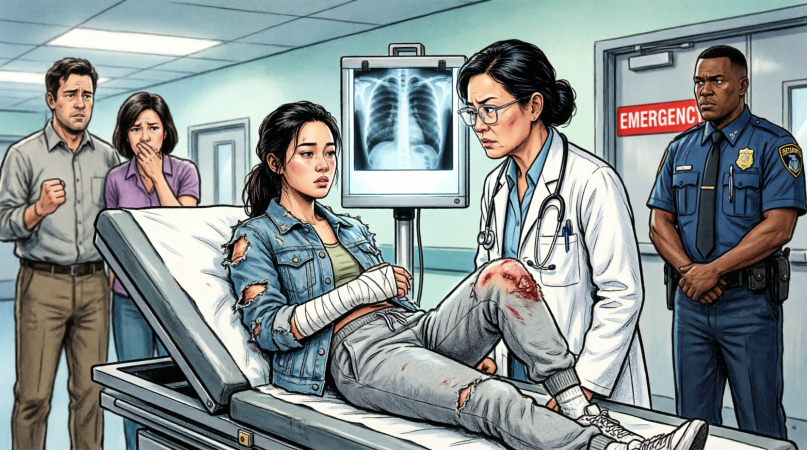
He stood beside my emergency room bed at St.
Agnes Medical Center in Cleveland with his hand cinched around my wrist and said, “We’ll handle this at home,” as if two fractured ribs were a private disagreement and not evidence.
I was eighteen, old enough to vote, old enough to sign my own discharge papers, and somehow still not old enough in that room to tell the truth without feeling like I was betraying my whole family.
My left shoulder throbbed.
Every breath sent heat through my side.
A nurse had cut open the front of my blouse to examine the bruising, and purple marks were already spreading across my ribs and upper arm.
My cheek had started to swell where the ceramic mug had clipped me.
Mom stood near the sink with her hands folded together so tightly her knuckles had gone pale.
Mia sat in the corner in her gray hoodie, her face dry and unreadable, like none of this belonged to her.
That was the part people outside our house never understood about Mia.
She could be screaming one minute and empty the next.
At sixteen, she had become the center of gravity in our home.
Every conversation bent around her moods.
Every plan depended on whether she was calm.
Dad called it protecting her.
Mom called it getting through a difficult stage.
What it really meant was that the rest of us learned to shrink.
We learned what footsteps meant trouble.
We learned how to hand over a charger, a sweatshirt, a set of keys, an apology we didn’t owe, because resisting always cost more.
That afternoon it was the car.
Mia had taken mine twice that month without permission.
The first time she brought it back with fast-food wrappers in the back seat and a fresh scrape near the tail light.
The second time she returned it with the gas tank nearly empty and blamed me for “hiding” the spare key, even though I had kept it in the same kitchen drawer for years.
Dad made me apologize for escalating things.
When Mia came down the stairs that day and said she needed the car again, I told her no.
Just once, clearly and without backing up.
She followed me into the kitchen.
I remember the blue mug by the sink because it was one of the last gifts Grandma had given Mom before she died.
Mia grabbed it and threw it before I even finished turning around.
It hit the side of my face.
My vision flashed white.
I reached for the counter, but she was already on me, both hands shoving hard into my chest.
I stumbled backward through the basement door and went down the stairs sideways.
My shoulder hit first, then my ribs, then my wrist.
I landed in a heap at the bottom, looking up at the ceiling bulb while dust drifted through the air.
Above me, Mia was breathing hard, more furious than frightened.
Dad came down first.
He didn’t kneel.
He didn’t ask if I could move.
He looked from Mia to me and made the calculation he always made.
“We are not making this bigger than it is,” he said.
Then he took
my phone from my hand before I could call anyone.
By the time Mom helped me into the car, the story had already been decided.
I slipped.
I missed the step.
Mia tried to catch me.
Dad repeated it twice on the drive to the hospital, like he was rehearsing all of us for a role.
What made it worse was how familiar it felt.
There had been the time Mia broke a picture frame across my mouth when I wore the sweater she wanted, and Dad told the dentist I had walked into a cabinet door.
There had been the night she locked me in the basement storage closet from the outside because I told her to stop reading my messages, and Mom slipped crackers and a bottle of water under the door while whispering that everything would be better if I stayed quiet until Dad got home.
There had been the winter she shoved me into the metal garage shelving and left me with a shoulder injury so painful I couldn’t lift my backpack properly for weeks.
Dad said I must have slipped on ice.
There were smashed phones, hidden keys, bruises in odd places, excuses stacked on excuses until I had almost stopped noticing how absurd they sounded.
Dr.
Evelyn Carter noticed.
She entered the room carrying my x-rays, small and gray-haired and calm in a way that made Dad underestimate her immediately.
She barely glanced at him.
She clipped the films into place, studied them, and then turned to me.
“Claire,” she said, “you have two fractured ribs, a hairline fracture in your wrist, significant bruising on your back and upper arms, and an older healed fracture near your collarbone.
When did that happen?”
The question hit harder than the diagnosis.
I looked at the pale line she indicated and knew exactly what she was seeing.
The garage shelves.
The winter lie.
The injury nobody had ever bothered to treat.
Dad stood so fast his chair legs screeched across the floor.
“She fell,” he said.
“Like I told the nurse.
We’ll handle this at home.”
Dr.
Carter’s voice didn’t rise.
“Mr.
Walsh, I need to speak with Claire alone.”
“That’s not necessary.”
“It is.”
Mom stared at the floor.
Mia’s face stayed flat, but for one second I saw fear open in it like a crack.
Not guilt.
Not remorse.
Fear that someone had finally found a piece of the story that didn’t fit.
Dr.
Carter stepped to the wall phone and made the mandatory report right in front of us.
She gave my name, my injuries, the version my father had offered, and then added, “The injuries are inconsistent with the history, and there is evidence of prior trauma.” Dad actually took a step toward her before a security guard appeared in the doorway.
That was the moment I understood the situation had moved beyond his control.
Within twenty minutes two police officers arrived with a child protective services investigator named Dana Mitchell.
Because Mia was still a minor and the report suggested ongoing violence in the home, Dana explained they had to assess the situation immediately.
She was wearing a navy coat dusted with melting snow and carrying a leather folder thick enough to make my stomach turn.
She pulled a chair next to
my bed and said, very gently, “You are not in trouble.
I need the truth, and I need it from you, not from anyone standing behind you.”
At first I still tried to protect the lie.
I heard myself say I fell.
I heard how thin it sounded.
Dana didn’t argue.
She asked whether anyone had ever hurt me before.
Dad answered before I could speak.
He called me dramatic.
He said I had always wanted attention.
Dr.
Carter looked at him and said, “Then she has gone to extraordinary lengths to break her own ribs and explain away an older fracture.” The room went silent after that.
Dana asked again, quieter this time, whether this was the first time my sister had put her hands on me.
I looked at Mom.
She was trembling.
I looked at Mia.
She wasn’t crying.
She wasn’t apologizing.
She was waiting.
Waiting for Dad to shut everything down the way he always had.
Something inside me shifted then, maybe because of the pain, maybe because Dr.
Carter had pointed to proof on the x-ray, maybe because I was suddenly so tired of hearing my own life retold as an accident.
I said no.
Then I said it again, louder.
Once it started, it didn’t stop.
I told Dana about the closet.
I told her about the garage shelves and the shoulder injury nobody treated.
I told her about the cracked phone screens, the bite on my shoulder, the time Mia stood outside my bedroom door at two in the morning whispering that she knew where I hid my keys.
I told her how Dad always used the same lines: don’t ruin her future, don’t make this public, don’t force strangers into family problems.
I told her Mom had started sleeping with her own bedroom door locked months earlier.
As I talked, Dana wrote everything down without interrupting, and one of the officers moved Dad farther from the bed when he tried to cut in.
Mom broke when Dana asked whether there had ever been a time she felt unsafe leaving me alone with Mia.
She covered her mouth and nodded before any words came out.
Then the words came all at once.
She admitted she had hidden kitchen knives in the trunk of her car during one especially bad month.
She admitted she had started keeping my bedroom laundry basket against my door because I said the scraping sound would wake me if anyone tried to come in.
She admitted a school counselor had once suggested emergency family intervention after Mia threatened me in front of another student.
Dad had pulled Mia out of counseling that same week and changed doctors two months later.
Hearing Mom say it out loud was almost worse than hearing the rest.
She had known.
She had always known.
Dana opened the leather folder she had brought.
There were already notes inside with my name on them.
A school nurse had called the previous year about bruises on my upper arm that looked like finger marks.
A guidance counselor had documented that I was afraid to sleep at home.
Both reports had gone nowhere because I had minimized everything when asked, and because Dad had insisted we were dealing with normal sibling conflict.
Dana slid the pages back
into the folder and said quietly, “This was never normal.” No one argued with her.
The officers went to the house that evening with Mom to photograph the scene and collect some of my belongings.
Dad was furious, but by then refusing would only make him look worse, and for once he knew it.
They found broken pieces of the blue ceramic mug in the kitchen trash under coffee grounds and paper towels, like someone had tried to hide them quickly.
They found a smear of blood on the basement stair rail.
They found the old storage-closet latch mounted on the outside of the door, exactly where I said it had been when Mia trapped me in there.
When Dana came back and told me that, I felt something strange and awful: relief.
Proof had always existed.
We had just been taught not to use it.
Mia did not help herself when they spoke to her alone.
At first she repeated the story about me slipping.
Then, when one of the officers mentioned the mug and the bruises on my arms, she snapped.
“She always acts like she’s better than me,” she said.
“And they always take her side after.” Dana later told me that when asked whether she thought her parents would fix this for her, Mia answered, “They always do.” That single sentence broke whatever was left of the family story Dad had tried to hold together.
Dana told me I could not safely return to the house that night.
The question should have terrified me, but it felt like being offered oxygen.
I called my Aunt Robin, Mom’s older sister, who lived in Parma and had spent years asking careful questions nobody in our house answered honestly.
She arrived still wearing scrubs from her nursing shift, took one look at my face, and said only, “You’re coming with me.” Dad tried to object.
One of the officers stepped between us before he could get close enough to grab my arm again.
The next two days passed in a blur of pain medication, statements, and a silence so deep it felt unreal.
From Aunt Robin’s guest room, I turned over everything I had: old photos of bruises, a notes app where I had typed dates and incidents because some part of me had wanted a record even when the rest of me was pretending nothing was wrong, and a string of texts Dad had sent after the attack while I was waiting for x-rays.
Most of them said variations of the same thing: Don’t exaggerate.
Tell them you fell.
Don’t destroy this family over one mistake.
Dana said those messages mattered because they showed active pressure to lie after a serious assault.
Within a week, the county filed a juvenile assault complaint against Mia.
Because of the severity of my injuries and the documented history of violence, she was placed first in emergency psychiatric evaluation and then in a court-ordered residential treatment program for teens with behavioral crises.
Dad spent the first forty-eight hours insisting everyone was overreacting.
That changed when investigators confronted him with his text messages, the prior counseling withdrawal, and the evidence collected from the house.
He was later charged with obstructing the investigation after trying to coach both Mom and me to change our
statements.
He kept calling it betrayal.
I had never understood until then how often powerful people use that word when they really mean consequences.
Mom moved out a month later.
She rented a small apartment and started cooperating fully.
She apologized more than once, and every time she cried before I did.
I believed she was sorry.
I also believed sorry was not the same thing as safe.
We met for coffee the first time without Dad or Mia, and she told me she had spent years convincing herself that keeping the family together was the same as protecting us.
She said she saw now that she had protected the structure and sacrificed the people inside it.
I didn’t know how to forgive her on command, so I didn’t try.
I just told the truth: that her silence had hurt almost as much as Mia’s hands.
I stayed with Aunt Robin through the end of the school year, started therapy, and learned how strange normal can feel when you’ve been trained to expect an explosion.
At first I woke up at every sound in the hallway.
I flinched whenever someone reached too quickly for a mug or a set of keys.
Dr.
Carter checked on my healing at a follow-up appointment and told me my ribs were knitting the way they should.
I wanted to tell her she had done more than fix my fractures.
She had looked at a picture of my body and seen my life clearly enough to refuse the lie everyone else was prepared to sign.
The no-contact order stayed in place.
Mia wrote two letters from the treatment center.
The first said she was angry.
The second said she didn’t know why she expected everyone to keep saving her after everything she had done.
I never answered either one.
Maybe one day I will know what to do with those pages.
Maybe not.
Some damage stops being about reconciliation and becomes only about distance.
People still ask which part was the worst: the fall, the broken ribs, the years of excuses, the look on my father’s face when the lie failed.
The answer changes depending on the day.
But the one thing I can’t stop thinking about is how ordinary it all looked from the outside.
A nice house.
Two daughters.
A father who talked about family loyalty like it was holy.
A mother who always smiled too quickly.
If Dr.
Carter hadn’t noticed one old fracture that didn’t belong to the story he told, I might have gone home that night and learned all over again what silence costs.
Even now, when I think about forgiveness, I don’t wonder first whether Mia deserves it.
I wonder how many earlier red flags had to be explained away before hurting me started to feel normal to everyone but me.