I remember the exact sound the laminator made.
It wasn’t loud. It was worse than loud. It was a steady, warm plastic hiss—like something sealing shut. Like a mouth closing around a sentence you’d regret if you said it out loud. It was 9:18 p.m. on a Friday, because I checked my watch the way I always do when something feels off. Police brain. Timestamps. Anchors. Proof that you weren’t imagining it.
Kira slid the sheet across the kitchen island like it was dessert.
“Happy anniversary,” she said.
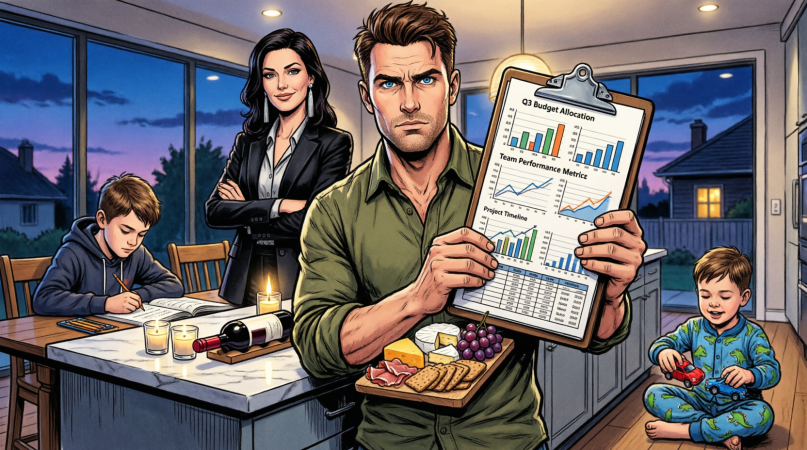
She’d lit two candles, the kind in heavy glass jars that make the room smell like a catalog. The table had a bottle of red wine and a charcuterie board arranged with the patience of someone who believes presentation can fix anything. Her hair was smoothed back, earrings catching the light when she turned her head. She looked like a person in control.
I blinked at the sheet. Typed. Numbered. Bold headers. Laminated.
The title was centered at the top, crisp and merciless:
Things Your Kids Need To Stop Doing In My House
Fourteen points. And because she’d laminated it, it wasn’t a note. It wasn’t a suggestion. It was meant to last.
I looked up at her. “Is this a joke?”
Kira smiled the way she did when she wanted me to accept something without asking questions—calm, polished, a smile with corners too clean.
“It’s boundaries,” she said. “Healthy ones.”
Noah was at the table with a math worksheet, nine years old, chewing the cap of a marker like he was trying to swallow the day. Eli, six, in dinosaur pajamas, had his little plastic cars lined up wheel-to-wheel on the floor, perfect and straight, as if order could protect him.
Both boys went still.
Kids don’t always understand words, but they understand tone. They understand when the temperature changes. When adults begin measuring them.
Kira tapped the list with one manicured nail. “Read it,” she said, like I’d asked for homework.
My mouth went dry so fast my tongue stuck to my teeth. I picked up the sheet. The laminate was warm, still holding the imprint of the machine’s heat.
Point one: No running in the hallway.
Point two: No loud voices after 7:00 p.m.
Point three: No leaving shoes by the door. Put them in the garage.
Point four: No asking for snacks without permission.
Point five: No touching the living room pillows.
Point six: No cartoons on the main TV. That’s for adults.
Point seven: No roughhousing. My furniture is not your playground.
Point eight: No talking back.
Point nine: No interrupting adult conversations.
Point ten: No leaving kid mess in shared spaces.
Point eleven: No friends over. This isn’t a daycare.
Point twelve: No attitude. I won’t be disrespected in my own home.
Point thirteen: No asking me for things. Ask your father.
Point fourteen: No calling it our house. This is my house.
I read every word. I read them the way I read statements at work—slow, clean, taking in details I’d have to remember later. The room felt too quiet. The candle flames didn’t even flicker.
My brain did that thing it does at scenes: count.
Four chairs. Three people breathing. One list.
Noah’s eyes flicked to me and dropped back to his worksheet, like he could disappear into fractions. Eli’s lips parted like he wanted to ask something, but he didn’t. He just held his breath.
Kira folded her arms. “It’s not personal,” she said. “It’s structure.”
Eli whispered, barely a sound. “Dad… are we in trouble?”
I didn’t look at Kira when I answered him.
“No,” I said. “You’re not in trouble.”
Kira exhaled like I’d inconvenienced her. “Sam,” she said, “I need you to take this seriously. I didn’t marry into chaos.”
Chaos.
That word had become her favorite weapon because it sounded reasonable. Nobody wants chaos. You can justify anything if you frame it as preventing chaos.
I stared at the line that said, my house, and something in me went very cold. Not angry. Not loud. Just clear, like a streetlight snapping on over a dark intersection.
I folded the laminated sheet carefully, like evidence.
I slipped it into my pocket.
I looked at her and said, “Thank you.”
Kira’s shoulders dropped like she’d won. She smiled, relieved. “Good,” she said. “I knew you’d understand.”
I didn’t scream. I didn’t argue. I did the quiet thing.
I started planning.
My name is Sam. I’m a cop. I’m thirty-four. We live outside Dayton, Ohio, in a house Kira bought before we met. She reminded me of that a lot—like it was a moral achievement, like owning a deed meant you owned whatever happened inside the walls.
My boys are mine from my first marriage. Noah is nine and apologizes when someone bumps into him. Eli is six and talks to strangers like they’re friends. He still believes adults mean what they say.
Their mom, Jenna, died two years ago. Drunk driver. A call you never forget, even if you’re trained to handle calls. Even if you’ve delivered death notices and seen the worst of people on the worst days.
After Jenna, I promised myself one thing: my boys would never feel unwanted in their own home.
I didn’t realize how easy it is to break a promise without meaning to. All it takes is exhaustion and a person who smiles like stability.
When I met Kira, she worked in real estate. She had the kind of confidence that made me feel like a man who owned one good suit and wore it to every funeral. She said the right things. She didn’t flinch when I talked about Jenna. She didn’t act threatened by a ghost.
“I’m not trying to replace her,” she told me early on, one hand resting lightly on my arm. “I just want to support you.”
I wanted to believe her. Grief makes you tired. It makes you crave anything that looks like a solid surface to stand on.
When she was nice, she was really nice. She brought meals when I worked doubles. She bought Eli a Lego set just because. She called Noah “buddy” and laughed at his jokes like he was funny, not just a kid trying hard.
But cruelty doesn’t always show up with sharp teeth. Sometimes it shows up in small corrections that sound like manners. Sometimes it shows up dressed as “structure.”
The first time I saw the real Kira was small.
We’d been dating four months. Noah came inside after playing in the yard and forgot to take off his shoes. Two muddy prints on the mat. Nothing serious. The kind of mess you wipe up and forget.
Kira stared at the prints like they were blood.
“Oh my God,” she said. “Sam, seriously?”
I laughed once, trying to keep it light. “He’s nine. He forgot.”
Her smile didn’t match her eyes. “I grew up in a house with standards,” she said, like standards were hereditary and my kids were a disease.
Noah heard it.
I watched his shoulders tighten the way a seat belt locks when you brake too hard.
“Noah,” I said gently, “buddy, take your shoes off.”
He did it fast. Too fast. Like the floor might yell at him.
Later that night, I told Kira she’d been harsh. She leaned on the counter with a glass of wine, the stem pinched between two fingers like she was holding a delicate truth.
“Harsh,” she repeated. “Sam, I’m helping you. Your kids need structure.”
That word again. It sounded reasonable. That’s how people get away with cruelty—wrap it in a reasonable word, offer it like medicine.
Incident two was Eli and a cup of juice.
He spilled it on kitchen tile, not the couch, not anything expensive. Just a small orange puddle near the chair.
He froze instantly, eyes wide, lip trembling.
Before I could grab paper towels, Kira snapped, “Are you kidding me?”
Eli whispered, “I’m sorry.”
Kira didn’t look at him. She looked at me, as if I was the employee who’d made a mistake.
“Clean it. Now.”
I got down and wiped it up while my six-year-old stood there shaking like he expected punishment to drop from the ceiling.
That night, Eli climbed into my bed, small body stiff against my side, and said, very quietly, “Does Kira hate me?”
My throat burned.
“No,” I lied, because I thought it was temporary. Because I thought she was adjusting. Because I thought love could be taught like math.
It wasn’t.
Incident three was the first time she used the house like a weapon.
Noah brought home a drawing from school: three stick figures, our names written carefully, a dog added in the corner because he wanted one. At the top, he wrote, My family in big letters.
He handed it to Kira with that careful hope kids have, the kind that breaks easy.
Kira looked at it. “Cute,” she said.
Then she handed it back like it was a flyer someone gave her at a stoplight.
“But don’t put my name on stuff like that,” she added. “It’s a lot.”
Noah nodded too fast. He didn’t cry. He just folded the paper smaller and smaller in his hands, like he could shrink the embarrassment until it disappeared.
That was the moment I realized my kid was learning to shrink, and I was letting him. Not because I agreed with Kira. Because I was tired. Because I was afraid of more loss. Because I kept telling myself, once we’re married, she’ll feel secure and soften.
She didn’t soften.
She laminated.
The list showed up on our first anniversary like a punch delivered with a smile. After I folded it into my pocket, Kira acted relieved, like she’d just solved the boys. She kissed my cheek and said, “I’m glad you’re mature about this.”
Noah didn’t eat dessert. Eli didn’t ask for a second cookie. They went upstairs without being told, quiet as ghosts.
I tucked them in and Noah asked, “Are we staying here forever?”
I didn’t answer right away. My brain was counting again, tallying exits, weighing options the way I do when a call feels dangerous.
“Go to sleep,” I told him. “I’ve got you.”
He nodded like he wanted to believe me, but didn’t know if he was allowed.
When I came back downstairs, Kira had put the list on the fridge anyway—front and center, like a trophy.
“You really want that up?” I asked.
She shrugged. “So everyone’s clear.”
“Everyone,” I repeated.
She smiled. “Yes, everyone.”
Then she added, casual as breathing, “And I don’t want them calling it our house anymore. It confuses things.”
“What things?” I asked.
Kira tilted her head. “Ownership,” she said.
I stared at her. My voice stayed calm. “We’re married.”
She smiled again. “Marriage doesn’t change deeds.”
There it was. Not love. Not family. A deed.
That night she went to bed happy. I stayed up. I sat at the kitchen table and opened my Notes app like I was writing a report.
Timeline. Details. Quotes.
Because that’s what I do when something feels wrong and nobody else wants to name it.
I took a photo of the list on the fridge. Clear date stamp. Then I made a folder and labeled it Anniversary.
I wasn’t being dramatic. I was documenting.
At 11:47 p.m., my phone buzzed. A text from upstairs.
Make sure they don’t leave their backpacks by the stairs tomorrow.
I stared at it.
Then I heard it—soft, cautious creaking in the hallway upstairs. Eli’s room. A whisper.
“Dad?”
I went up. Eli stood in his doorway holding his stuffed T-Rex like it could protect him. His face was blank in that too-old way kids get when they’re trying to be careful.
“Am I allowed to go pee?” he asked.
For a second, I didn’t understand what I’d heard. My brain tried to reroute, the way it does when a fact doesn’t fit the world you thought you were in.
“What?” I said.
He swallowed. “The list says no loud doors after seven. The bathroom door is loud.”
I just stood there, and my hands went cold.
My six-year-old was asking permission to use the bathroom because a laminated list made him scared of existing.
I crouched so my face was level with his. “Listen to me,” I said quietly. “You are always allowed to go pee. Always.”
He nodded, but he didn’t relax. His eyes flicked down the hall toward the master bedroom.
“Will she be mad?” he whispered.
I looked at the closed door at the end of the hallway. I didn’t answer Eli with words.
I answered him by making a decision.
The next step wasn’t a fight.
It was logistics.
At 12:10 a.m., I started a load of laundry—not because we needed it, but because the dryer would cover the sound of suitcases coming out of the closet. The rumble and thump became my cover.
At 12:34 a.m., I laid out clothes in the boys’ rooms: two outfits each, warm layers, socks, their favorite hoodies. Noah’s hoodie had a faded logo from a baseball team he didn’t even watch anymore, but it was soft, and soft matters when you’re scared.
At 12:50 a.m., I grabbed the important documents: birth certificates, Social Security cards, school paperwork, Jenna’s death certificate, custody documents. The folder of things I never wanted to touch but kept because life doesn’t care what you want.
At 1:12 a.m., I went into the garage and pulled out the camping duffel. Kira hated the garage. That’s why she wanted shoes out there—so kid life stayed hidden.
Fine. I used her hiding place to save us.
At 2:03 a.m., my phone buzzed again.
You’re being weird. Come to bed.
I stared at it and typed, In a minute.
Neutral. Calm. No trigger words.
At 2:17 a.m., I opened my banking app and checked the balance. My paycheck had cleared. I had enough. Not for luxury—for safety.
At 2:40 a.m., I called my friend Marcus.
He’s a fellow cop, the kind of guy who doesn’t ask for gossip when your voice sounds wrong. He answered groggy.
“Sam?”
“You awake enough to do me a favor?” I asked.
Silence, then a shift in his breathing. “Yeah,” he said. “What’s up?”
“I need a place for me and the boys for a bit.”
He didn’t ask why.
“Come,” he said. “Rooms are ready.”
At 3:05 a.m., I emailed Noah’s school.
Subject: Student pickup change.
Effective immediately, only Samuel—my last name—authorized for pickup. Attached: photo of my ID.
I wasn’t guessing. I wasn’t hoping. I was closing doors.
At 3:40 a.m., I walked into Noah’s room.
He was awake. Of course he was. Smart kids don’t sleep when the air feels dangerous.
He looked at me and said, “Are we leaving?”
I swallowed. “Yeah.”
He didn’t ask where. He didn’t argue. He just nodded.
“Okay.”
That okay hit me like a brick, because it wasn’t surprise—it was relief.
I woke Eli next. He sat up with his hair sticking up, eyes heavy.
“Is it morning?” he mumbled.
“It’s early,” I said. “We’re going on a drive.”
He frowned, trying to find the rule he’d broken. “Did I do something wrong?”
“No,” I said, firmer than before. “You didn’t break anything.”
We moved like shadows. Shoes on. Coats. Backpacks. Eli grabbed his T-Rex. Noah grabbed his math worksheet, like even in an escape, he needed something that made sense.
At 4:58 a.m., I walked through the kitchen one last time. The list gleamed on the fridge, shiny in the dim light like it was proud of itself.
I pulled it off.
I set it on the counter.
Then I grabbed a Sharpie from the drawer where Kira kept office supplies arranged by color.
I wrote one more line at the bottom in my handwriting:
15. If my kids feel unwanted, we leave. No discussion.
I didn’t leave a speech. I left a fact.
At 5:00 a.m., I locked the door behind us.
At 5:01 a.m., we were in the truck.
At 5:03 a.m., Noah whispered, “Is she going to be mad?”
I kept my eyes on the road.
“She can feel whatever she wants,” I said. “We’re safe.”
That was the moment I stopped arguing and started protecting.
Kira woke up at 7:12 a.m.
I know because my phone started buzzing like a grenade.
First call. Missed.
Second call. Missed.
Then texts, rapid-fire.
Where are you?
Why is the house spotless?
Are you seriously playing some kind of game?
When are you back?
I looked at Noah in the passenger seat. He held his backpack in his lap like it was his whole life. Eli was in the back, half asleep, T-Rex under his chin.
My hands were steady on the wheel.
I typed, We’re not.
Three dots appeared immediately.
What? Don’t do this, Sam. Stop.
What about us?
We pulled into Marcus’s driveway at 7:41 a.m.
Marcus opened the door in sweatpants. He saw my face and stepped aside without questions.
“Rooms ready,” he said.
Noah and Eli walked inside like they’d been holding their breath for weeks.
Eli looked around the living room—messy in a normal way, shoes by the door, a blanket thrown on the couch—and whispered, “This house feels nice.”
That almost broke me.
I walked back out to my truck and sat in the driver’s seat, phone in my hand.
Kira’s texts kept coming.
You can’t just take them.
This is my house.
My jaw tightened. Not because she said my, but because she said them—like my sons were furniture she’d misplaced.
I replied: Read point 15. I added one.
There was a long pause.
Then: You can’t add points to my list.
I stared at that text and actually laughed once, quiet and humorless, because it told the truth she didn’t realize she was telling: she thought the list belonged to her the way she thought the house belonged to her the way she thought the people inside should belong to her.
At 8:09 a.m., I sent one message in the family group chat—Kira, her mom, her sister, and me.
The boys and I are safe and not returning. Please communicate through text only.
No explanations. No debate.
Her sister replied at 8:17: Wow.
Her mom replied at 8:19: This is immature. Marriage takes work.
Kira called again at 8:22. I didn’t answer.
At 8:45 a.m., Marcus texted from inside:
She’s here.
Of course she was.
She didn’t know Marcus’s address because I’d given it to her. She knew because she’d checked the shared iPad we kept on the kitchen counter—location history, maps, the kind of quiet surveillance she’d frame as “being a couple.”
That’s what she meant by ownership.
I stepped outside.
Kira stood on the porch in clean leggings and a hoodie that looked like it had never been worn to clean anything. Her hair was perfect. Her phone was in her hand like a prop. Her face shifted into concern when she saw me, like she was stepping into a role.
“Sam,” she said softly. “We need to talk.”
I didn’t move closer. I kept my voice calm.
“What do you want?” I asked.
She blinked, as if directness was rude.
“I want you to come home,” she said. “This is ridiculous.”
“No,” I said.
Her smile twitched. “You’re overreacting,” she said. “It was just rules. Every house has rules.”
I nodded once. “Not like that.”
Kira’s eyes narrowed. “So you’re choosing your kids over your wife.”
I stared at her. “You just asked me that like it’s a bad thing.”
Her cheeks flushed. The mask slipped for half a second, revealing the anger underneath.
“I’m your wife,” she snapped. “This is supposed to be our life.”
“My kids are my life,” I said.
Kira took a step forward, then stopped when she noticed Marcus behind me, arms crossed, watching. Witness. Her posture adjusted, shoulders softening, voice lowering.
“Sam,” she said, sweet again. “You can’t keep them from me. They live in my house.”
I took a breath. Then I said, loud enough for both Kira and Marcus to hear.
“They’re not your property.”
Her face hardened. “You can’t do this,” she hissed. “I’ll call someone.”
I nodded. “Go ahead.”
Because I already had.
At 9:30 a.m., while Kira sat in her car outside with the engine running, I was on the phone with a family law attorney my union recommended.
I didn’t tell the lawyer a dramatic story. I told her facts: dates, quotes, behaviors, the laminated list, the “my house” language, the impact on the boys.
And then I said the line that mattered.
“My six-year-old asked if he was allowed to use the bathroom.”
The attorney went quiet for a beat.
“Keep every message,” she said. “Do not meet her alone. Do not return to that house.”
At 10:12 a.m., Kira texted:
If you don’t come home, you’re abandoning your marriage.
I replied:
I’m exiting a situation that hurts my children.
At 10:14, she texted:
So that’s it.
 :
: