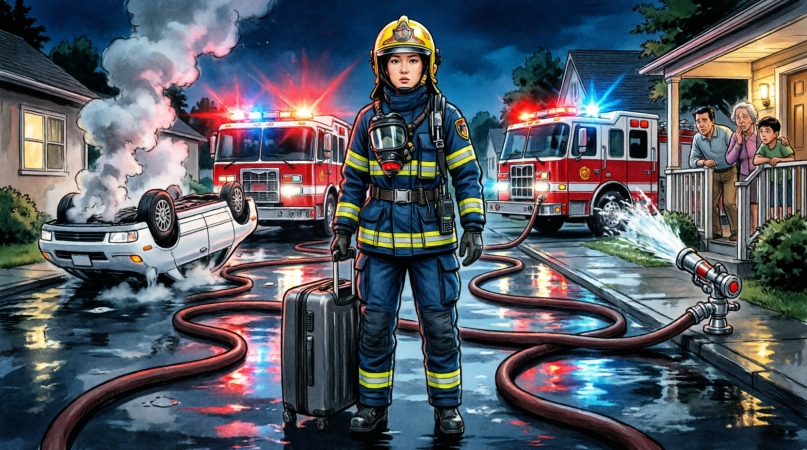
By the time I turned onto our street, the sirens were already painting the houses blue and red.
The smell reached me before I saw the flames had died down: burnt rubber, melted plastic, gasoline, wet ash.
My car, my mother’s car, the one I had spent three years paying off, sat in front of the house like a black skeleton with headlights for empty eyes.
I stopped in the middle of the sidewalk and felt something inside me go silent.
Denise stood on the porch in a cream silk robe, one hand resting on the railing like she was hosting a party.
Her hair was brushed.
Her lipstick was still fresh.
When she saw me, she laughed with the bright, vicious satisfaction of someone finally saying out loud what she’d been wanting to do for months.
“You should have handed it over,” she called.
“If you can’t give this car to my daughter, it can’t be yours either.”
A firefighter turned and looked at her like he wasn’t sure he had heard correctly.
My father, Mark, came rushing barefoot across the lawn, his face ghost-white.
“Denise,” he said, voice breaking, “what did you do?” She lifted one shoulder and said, “I solved a problem.” I should have screamed.
I should have cried.
Instead, I looked at the car and realized that the worst mistake Denise had made wasn’t the fire.
It was thinking the fire had destroyed what she needed hidden.
The car had never been just transportation.
My mother bought it six months before cancer took her.
It wasn’t new, and it wasn’t flashy.
It was a silver Honda Civic with a small stain in the back seat from the iced coffee I spilled on the test drive, and my mother had laughed so hard that day she had to wipe tears from her eyes.
After she died, I took over the payments because selling it felt like losing her twice.
I worked double shifts, skipped weekends, and lived on takeout ramen more times than I want to admit.
One winter, when my hours were cut, Dad covered the last two payments.
Denise turned that small favor into a permanent argument that he had bought the entire thing.
She started asking for the car three months earlier, at first as a suggestion, then as a demand, then as if it had already been decided.
Brianna needed something reliable, Denise said.
Brianna deserved a break.
Brianna was trying to rebuild her life after two parking tickets, a repossession, and a short-lived job she lost because she “didn’t like the tone” of her manager.
The more ridiculous Brianna became, the more Denise treated her like a misunderstood princess.
The morning it all finally snapped, Denise leaned against the kitchen counter and asked for my keys the same way someone might ask to borrow sugar.
“You’re young,” she said.
“Take the bus for a while.” I set the keys on the table where she couldn’t reach them.
“No.
That car is mine.” Her smile went cold.
“Your father bought it.” I looked straight at her.
“My mother chose it.
I paid for it.
It’s in my name.” Brianna, standing in the doorway, folded her arms and hissed, “You’re so selfish.
You have the better job.
I need it more.”
What neither
of them understood was that by then the car meant more to me than mobility.
It had become the only thing in that house I trusted.
After Denise married Dad and moved in with Brianna, little things started disappearing.
My mother’s photo albums vanished from the living room cabinet.
A bracelet went missing from my dresser.
Bank statements started showing up late.
One credit-card alert appeared two weeks after the envelope had been delivered.
Then a certified letter I had been expecting from my mother’s estate attorney never arrived at all.
Denise always had explanations.
Maybe the post office messed up.
Maybe I had misplaced it.
Maybe I was too suspicious.
She said the word suspicious the way some people say unstable.
But I knew the problem was inside the house.
So I installed an aftermarket security system in the car: front camera, rear camera, cabin camera, parking mode, motion alerts, cloud backup.
I parked facing the mailbox and the front steps every night.
From the windshield, the camera caught almost everything on the porch.
The first night Denise noticed the tiny blinking indicator light, she asked why I suddenly needed “surveillance.” I told her because things kept going missing.
She laughed and called me dramatic.
What she didn’t know was that I had a reason to be especially careful.
I had just turned twenty-five.
My mother’s attorney, Ms.
Alvarez, had emailed me a month earlier to say there were final trust documents she needed me to sign.
My mother bought the house before she ever married my father.
In her estate plan, she allowed Dad to live there until I turned twenty-five, then the property was supposed to transfer to me outright.
Dad knew that.
We had talked about it once, awkwardly, after the funeral, when he was grief-struck and thin and promised he would honor everything Mom wanted.
Then life happened.
He remarried.
Denise moved in.
Brianna spread herself through every room like spilled glitter.
And somehow the conversation never came back up.
Or at least I thought it had somehow disappeared under the weight of avoidance.
Looking back, it hadn’t disappeared at all.
Denise had simply gotten to it first.
The night of the fire, I was ten minutes from the end of my shift when Dad texted me a single question mark.
I almost called him, but the floor was short-staffed and I shoved the phone back into my pocket.
By the time I clocked out and rode home with a coworker, the neighborhood was flashing.
I smelled the smoke before I reached the gate.
My bag slipped from my shoulder when I saw the car.
Denise smiled like a woman admiring her own handiwork.
When she made her little speech about the car not being mine either, one firefighter actually took a step back and glanced at his captain.
Dad looked at me with the helpless confusion of someone watching the consequences of years of denial arrive all at once.
“Please say this is not what it looks like,” he said to Denise.
She rolled her eyes.
“Oh, stop.
It was just a car.” Just a car.
As if memory, work, grief, and ownership could be burned down into something ordinary.
I went inside without another word.
Dad followed me to the entryway, asking where
I was going, asking what I was doing, asking me not to leave.
I opened my closet, pulled out two duffel bags, packed clothes, my laptop, chargers, my document folder, and the fireproof safe I kept under my bed.
In the safe were my passport, my Social Security card, my title paperwork, and copies of every email Ms.
Alvarez had sent me about the house transfer.
I had printed them after the certified letter failed to appear.
Some instinct had told me paper might matter soon.
On my way out, Denise blocked the hallway for half a second, chin lifted.
“Where are you going?” she asked.
“Away,” I said.
She scoffed like I was being theatrical.
Dad reached for my elbow, then let his hand drop when I flinched.
That moment told me almost everything I needed to know.
He hadn’t lit the match, but he had allowed the room to fill with fumes for a very long time.
I didn’t go to a friend’s house first.
I went to a motel off the highway because I wanted a door that locked and silence I didn’t have to explain.
I set my bags on the stained carpet, opened my laptop, and logged into the cloud account attached to the car.
There were eight motion alerts from that evening.
The first clip nearly made me sick.
Brianna stood at the curb holding up her phone flashlight while Denise unscrewed a red gas can and poured gasoline across the hood and windshield.
She was careful, almost patient.
When she stepped back, she said, “After tonight she’ll stop acting like anything in this family belongs to her.” Brianna laughed and asked if they should move it farther from the house.
Denise answered, “No.
Let her see it from the street.” Then she lit it.
I thought that would be the worst thing on the footage.
It wasn’t.
Three days earlier, parking mode had captured Denise walking to the mailbox in slippers, looking over her shoulder, and pulling out a thick certified envelope with my name on it.
Even through the grainy night view, I could see Ms.
Alvarez’s return address.
Denise opened it right there on the porch.
Brianna asked, “What is it?” Denise lowered her voice, but the cabin microphone still caught her.
“Transfer papers,” she said.
“The house goes to her now, not Mark.
If he sees this, we’re done here.”
My whole body went cold.
Brianna said, “Then what do we do?” Denise didn’t miss a beat.
“We make sure he never sees them.
Then we get that car from her too.
She’s not walking around acting better than my daughter in my house.” My house.
She had been saying it for months, and all that time she knew it wasn’t hers at all.
I sent both clips, along with every other saved file, to the fire investigator whose card I had grabbed from the driveway and to Ms.
Alvarez.
It was past midnight, but I didn’t care.
I left one voicemail, then another.
Ms.
Alvarez called me at 5:12 a.m.
Her first question was, “Are you somewhere safe?” When I said yes, her voice turned hard and precise.
She told me the certified envelope contained the final title-release documents.
The transfer should have happened within thirty days of my
birthday.
She had sent two notices, both signed for electronically by someone at the house.
I had never seen either one.
“Your father has a temporary right of occupancy in the trust,” she said, “but ownership was never his, and certainly never Denise’s.
If she concealed legal notices and destroyed your property to force you out, she has done more than commit arson.” I stared at the motel wallpaper and asked the question that had been rattling around in my skull since the porch: “Did my father know?” Ms.
Alvarez was quiet for a second too long.
“He knew the house would transfer to you,” she said carefully.
“Whether he knew Denise intercepted the notices is another matter.”
An hour later the fire investigator called me back.
He had already watched the clips.
His tone was the opposite of Denise’s laughter—flat, stunned, professional.
He told me not to delete anything, not to return to the house, and to forward the full archive to a secure evidence link.
By eight that morning, two detectives, a deputy fire marshal, and a postal inspector were on their way to my father’s house with warrants.
Dad called me twelve times before I answered.
When I finally picked up, he sounded older than he had the night before.
“Denise says it was an accident,” he said.
“She says she was moving gas for the mower and—” I cut him off.
“Check your email.” There was a long silence while he opened the first clip.
I didn’t hear the video, but I heard his breath change.
Then I heard the second clip.
When he spoke again, his voice was wrecked.
“She knew about the house?” he whispered.
“Yes,” I said.
“And you were supposed to tell me the truth months ago.”
By noon, the truth was no longer something anyone in that house could avoid.
The search turned up a stack of opened mail in Denise’s dresser: my bank statements, two letters from Ms.
Alvarez, insurance correspondence, and a folder containing printed forms for a home equity line that listed forged signatures for both me and my father.
Brianna’s room held the empty gas can and the shoes she’d worn in the video.
Dad called me from the driveway while officers were still inside.
He was crying so hard he could barely form words.
I listened, but I didn’t comfort him.
Denise was arrested that afternoon for arson, mail theft, destruction of property, and attempted insurance fraud after detectives learned she had already called an insurer pretending to ask about a claim.
Brianna was charged as an accessory and later took a plea deal after admitting she had acted as lookout and helped hide my mail.
Her first statement was exactly what I expected: that her mother had pressured her, that she hadn’t thought Denise would really do it, that everything got out of control.
Maybe some of that was true.
It still didn’t change the flashlight in her hand.
The hardest part wasn’t watching Denise get handcuffed in the body-camera clip the investigator later showed me.
It was the moment Dad came to see me two days later at a coffee shop near the motel.
He looked like he hadn’t slept.
He sat down and said, “I knew the house would be yours when you
turned twenty-five.
Denise kept saying we needed more time, and I let myself believe paperwork was flexible.” He pressed his palms together like prayer.
“I didn’t know about the mail.
I didn’t know about the fire.
I didn’t know she would do this.” I believed only half of what he said, and even that half hurt.
“You didn’t know because not knowing was easier,” I told him.
“Every time she called my mother’s things clutter, every time my mail disappeared, every time Brianna treated me like I owed her my life, you chose quiet.” He started crying again, right there between the sugar packets and the napkin holder.
People at the next table looked away out of courtesy.
I didn’t.
Some grief deserves privacy.
Some needs witness.
Ms.
Alvarez moved fast.
She filed an emergency petition to enforce the trust, remove unauthorized occupants, and complete the title transfer.
The judge signed the order within a week, helped along by the arson report, the footage, and the stolen mail.
Dad was allowed ten days to remove his personal belongings because the trust had given him temporary occupancy, but Denise and Brianna had no legal right to remain on the property at all.
By the second Friday after the fire, the locks were changed.
Denise tried one last performance from jail through her lawyer.
She claimed she had been emotionally provoked, that the car was a “shared family asset,” that I had manipulated my father and exaggerated her comments.
The prosecutor played the clip where she smiled into the dark and said, “If he sees this, we’re done here,” while holding my certified envelope.
Then he played the porch confession in front of firefighters and neighbors.
Her lawyer stopped using the word misunderstood after that.
Restitution covered part of the car’s value, and the insurance company, once they received the footage, didn’t fight me for a second.
The money wasn’t the point, though.
I bought another used Civic three months later because the old one was beyond saving, but for a long time I couldn’t turn a key without smelling smoke.
The spot in the driveway where the fire had burned hottest stayed darker than the concrete around it.
I left it that way on purpose.
Dad moved into a small apartment across town.
He asked more than once whether we could start over.
I told him starting over was for people who had lost something together, not for people who watched you lose it alone.
That answer broke him, but it was the only honest one I had.
Eventually we settled into a thin, careful contact built from short phone calls and holidays in public places.
He never defended Denise again.
He never asked me to.
Six months later, Denise pleaded guilty to arson and mail theft to avoid a trial she was never going to win.
Brianna testified against her mother in exchange for probation and community service.
When I heard that, I felt no satisfaction, only a tired kind of clarity.
Loyalty is easy when the prize is somebody else’s property.
It looks different under oath.
The day I moved fully back into the house, I opened every curtain, aired out every room, and carried my mother’s surviving photo albums from storage to the living room cabinet.
I planted
new lavender along the front walk because Mom loved the smell and Denise hated it.
I replaced the mailbox too.
Not because I needed a new one, but because I wanted to stop touching the metal Denise’s hands had turned into a hiding place.
People who heard the story later always asked the same question: was I angrier at Denise for striking the match, or at my father for letting everything before the match happen? I never had a clean answer.
Fire is obvious.
Neglect is quieter.
One destroys in a night.
The other teaches destruction where to live.
What stays with me most is not the charred frame of the car or even Denise in handcuffs.
It’s Denise laughing on the porch, certain she had won, while the one thing she needed most—control of the story—was already gone, uploaded, timestamped, and waiting.
The biggest red flag wasn’t the fire.
It was how long everyone had expected me to treat her cruelty like personality, her greed like stress, and my silence like weakness.
In the end, the bomb she set off in that house wasn’t hidden in the car at all.
It was the truth, and once it blew open, every person inside had to live with what they had protected, what they had ignored, and what they had finally been forced to see.