She came to Fort Mason only to watch her son graduate, clap softly, and leave before Franklin could perform.
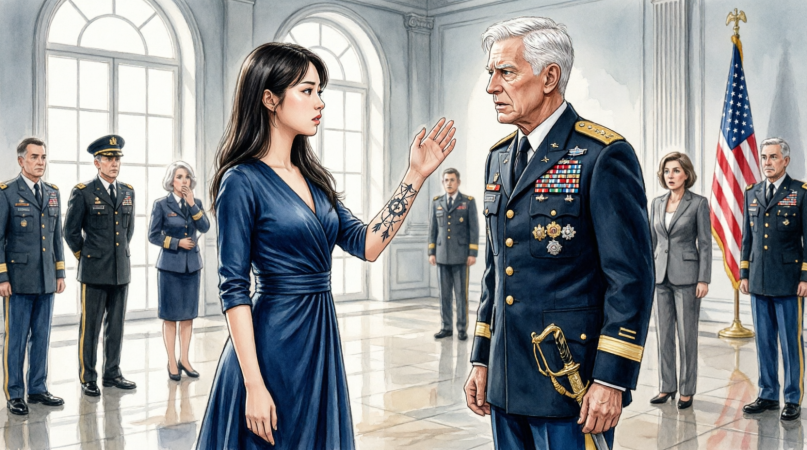
Instead, Lieutenant Colonel Daniel Mercer stared at her tattoo as if the past had walked through the reception hall armed.
“What happened to Unit Raven?” he asked, and the silence around them became heavier than thunder.
Olivia felt Caleb’s eyes on her from across the room, confused, frightened, and suddenly much younger than twenty-three.
Franklin Hayes stepped forward with a laugh too sharp to sound natural, trying to reclaim the room.
“Unit Raven?” he said loudly. “That sounds dramatic, Olivia. What, did you join a motorcycle club after our divorce?”
A few people almost smiled, but Lieutenant Colonel Mercer did not move a single muscle.
His eyes remained fixed on Olivia with an expression that carried grief, respect, and disbelief at once.
“Sir,” Mercer said coldly, without looking at Franklin, “you should choose your next words very carefully.”
That was the first moment Franklin understood he was not standing above me anymore.
Caleb crossed the room slowly, every polished step carrying years of unanswered questions between us.
“Mom,” he said, voice barely steady, “what is he talking about?”
I looked at my son and saw the little boy who once slept beside my toolbox during late repairs.
I saw the teenager who stopped asking about my past because every silence wounded him differently.
Most of all, I saw the young man I had tried to protect from a truth too heavy for childhood.
“Not here,” I whispered, but the past had already chosen the parade field as its stage.
Mercer turned toward the officers gathering near the doorway and gave one brief nod.
Within seconds, another officer moved to the entrance, quietly preventing curious guests from drifting closer.
Franklin noticed the shift and straightened, because men like him feared exclusion more than danger.
“Now wait a minute,” he snapped. “This is my son’s graduation event, not some secret theater production.”
Marissa placed a manicured hand on his sleeve, but even she seemed uncertain where cruelty ended and fear began.
Lieutenant Colonel Mercer finally turned his gaze toward Franklin, and the temperature in the room seemed to drop.
“Your son’s graduation,” he said, “may be the only reason this woman ever walked onto this installation again.”
Caleb’s face tightened, and I knew he heard the respect hidden beneath Mercer’s words.
I could have lied again, tucked my sleeve down, and walked back into the small life I had built.
But Caleb deserved more than a mother made of locked doors and half-truths.
I slowly rolled my sleeve higher, revealing the faded wing, the blade, and the identification sequence beneath them.
Several older soldiers nearby inhaled sharply, recognizing a symbol most people had never seen publicly.
Mercer’s voice softened when he spoke again, as though addressing a memory that still bled.
“Raven Seven,” he said. “I was Raven Three. I thought everyone on that ridge died.”
The room blurred for a second, not from weakness, but from the violence of remembering.
Rain, rotor smoke, broken radio traffic, and the smell of burned metal returned like ghosts with teeth.
Twenty years disappeared, and I was twenty-six again, bleeding through a field bandage beneath a foreign moon.
Franklin stared at my arm like it had insulted him personally.
“You told me that tattoo was from a mistake,” he said, anger covering the panic in his voice.
“It was,” I answered quietly. “But not the kind you told Caleb about.”
Caleb’s jaw clenched at hearing his father’s name folded into another old lie.
Mercer looked toward the parade field visible through the reception hall windows, where graduates waited beneath flags.
“Ma’am,” he said, choosing the word deliberately, “the commanding general needs to know you are here.”
I shook my head before he could finish, because instinct still warned me against attention.
“I came for my son,” I said. “Nothing else.”
Mercer lowered his voice, but everyone close enough still heard the ache inside it.
“Your son deserves to know why some of us are alive to stand here today.”
Before I could answer, a young captain hurried in, whispering urgently into Mercer’s ear.
Mercer’s face changed again, not with shock this time, but with the discipline of sudden decision.
He looked at me as though history had just become operational.
“Mrs. Carter,” he said, “General Abernathy wants you escorted to the reviewing stand immediately.”
Franklin laughed once, but the sound broke apart before it reached confidence.
“Escorted?” he demanded. “She fixes trucks in Ohio. What exactly is happening here?”
I turned toward him slowly, feeling twenty years of swallowed humiliation rise behind my ribs.
“What is happening,” I said, “is that you finally entered a room where your version of me has no authority.”
Caleb flinched, not because I sounded cruel, but because I finally sounded free.
Outside, the graduation ceremony began assembling, brass music rolling across the field under the brutal Georgia sun.
Families filed toward bleachers while officers moved with quiet purpose around me, creating a path I never requested.
Franklin followed anyway, furious that my silence had become more important than his noise.
Marissa trailed beside him, her polished smile gone, eyes darting between uniforms, medals, and my covered arm.
Caleb walked close to me, not touching, but near enough that I felt his need for answers.
At the edge of the parade field, General Thomas Abernathy waited beside the reviewing stand.
He was older than I remembered, his shoulders heavier, but his eyes sharpened the moment he saw me.
For two decades, I had believed memory would fade if nobody spoke my name aloud.
Instead, the general looked at me and whispered my former call sign like a prayer.
“Raven Seven,” he said. “Olivia Carter.”
Then, in front of my son, my ex-husband, and half of Fort Mason, he saluted me.
The movement was formal, complete, and devastating enough to silence even Franklin Hayes.
I did not want the salute, because salutes returned you to a world where ghosts stood in formation.
But refusing it would have dishonored the dead who could no longer lift their hands.
So I straightened, lifted my chin, and returned the salute with a hand that trembled only slightly.
Caleb stared as if he had discovered a hidden country inside his own mother.
The general stepped closer, his voice low enough to spare me, but not low enough to hide truth.
“We searched for you after the extraction,” he said. “We were told Raven Seven was lost.”
“I was,” I answered. “Just not in the way the report needed me to be.”
His expression tightened, because commanders understand wounds that paperwork cannot carry.
Franklin shoved forward, unable to endure a conversation where nobody sought his permission.
“Someone better explain why my ex-wife is being saluted at my son’s commissioning ceremony,” he said.
General Abernathy turned toward him slowly, with the patience of a man facing an unnecessary obstacle.
“Mr. Hayes,” he said, “your ex-wife once led an extraction that saved sixteen American lives.”
The words struck the air so hard that even distant guests seemed to feel them.
Caleb turned toward me, eyes shining with confusion, awe, and something painfully close to betrayal.
“Mom,” he whispered, “you were in the Army?”
I looked at the parade field, because looking at him might have broken me open.
“Not exactly,” I said. “I worked beside them, under a program most people were never supposed to hear about.”
Franklin scoffed automatically, but the sound died when no one joined him.
The general continued, because now that the door had opened, history demanded witnesses.
“Unit Raven operated in hostile regions where official presence could not be acknowledged,” he said carefully.
“They recovered captured personnel, redirected evacuations, and entered places most units were ordered never to approach.”
Mercer stood behind him, his face pale with memories he had carried longer than medals.
“On Raven Ridge,” Mercer said, “Olivia stayed behind after communications failed and guided us out under fire.”
Caleb’s lips parted, but no question came out.
I remembered carrying Mercer’s blood on my sleeves, remembered screaming coordinates into a dying radio.
I remembered choosing the ridge because extraction birds could not see the valley through smoke and weather.
I remembered the moment the blade emblem was burned into all of us as a promise to return together.
Only six returned.
For years, I let Franklin call me unstable because it was easier than explaining nightmares classified men denied.
I let his father call me trash because nobody could weaponize secrets they never understood.
I let my son believe I was merely quiet, stubborn, and ashamed of something I had done.
That was the part I regretted most.
General Abernathy glanced toward Caleb and softened in a way I had never seen from him before.
“Candidate Hayes,” he said, “your mother’s name appears on recommendations that were sealed for national security reasons.”
Caleb straightened automatically, caught between military respect and the trembling confusion of a son.
“Sir,” he said, voice cracking slightly, “why didn’t anyone tell me?”
The general looked at me, because only I could answer the wound beneath that question.
I stepped closer to Caleb, ignoring Franklin’s stare and the crowd gathering beyond the rope line.
“Because I wanted you to grow without carrying my ghosts,” I said, each word costing more than the last.
Caleb swallowed hard, and for the first time that day, he looked angry at me.
“You let Dad tell me you were nothing,” he said. “You let him make me pity you.”
Those words hit harder than any round that had crossed Raven Ridge.
“I know,” I said, because excuses would have insulted the pain I had created.
Franklin seized the opening like a man reaching for a weapon.
“Exactly,” he said. “She lies, Caleb. She always has. This whole performance proves it.”
Marissa whispered his name, warning him to stop, but pride had already deafened him.
Franklin pointed at me in front of officers, graduates, and families who had slowly turned toward us.
“She abandoned her marriage, hid her past, and let me raise our son with stability,” he declared.
My hands curled once, then relaxed, because the woman he remembered would never have answered.
But I was no longer living inside his story.
“You raised him with your last name,” I said quietly. “I raised him with lunch money, fever nights, and repaired engines.”
The crowd fell silent enough for the flags to sound loud above us.
“You told him I was dangerous,” I continued. “Because calling me broken helped you avoid admitting I was stronger.”
Franklin’s face reddened, but this time nobody rushed to protect his dignity.
General Abernathy stepped between us, not to rescue me, but to restore the purpose of the day.
“This ceremony belongs to the graduates,” he said. “But truth also belongs wherever lies have been given rank.”
Then he turned to the adjutant beside him and issued an order that made my stomach drop.
“Add Olivia Carter to the recognition sequence,” he said. “Raven Seven will stand with the honored guests.”
I shook my head immediately, panic rising like fire under my skin.
“No,” I said. “General, please don’t do that.”
His expression gentled, but his answer remained immovable.
“Olivia, you disappeared because the mission required silence, not because your sacrifice deserved erasure.”
Caleb looked at me then, and something in his face changed from anger into pleading.
“Mom,” he said softly, “stand there.”
Those two words undid me more completely than any command ever could.
I took my place near the reviewing stand while the graduation ceremony began under the hammering sun.
Rows of young soldiers stood straight, their faces bright with fear, pride, and the beginning of impossible futures.
Caleb was among them, jaw set, eyes forward, yet somehow still searching for me.
Franklin sat in the front family section, no longer laughing, while Grandpa Dale whispered angrily beside him.
Marissa stared at her lap, perhaps realizing cruelty loses glamour when witnessed by uniforms.
The ceremony moved through speeches, oaths, and applause, but I heard only echoes from another battlefield.
Then General Abernathy approached the podium and adjusted the microphone with both hands.
“Before we conclude,” he said, “Fort Mason will acknowledge a guest whose service remained classified for many years.”
The air shifted, and every person on the field seemed to lean into the sentence.
He did not reveal missions, locations, or secrets that still belonged behind locked doors.
Instead, he spoke about courage without naming the country, the ridge, or the six who never came home.
He said a young operative stayed behind during a failed extraction and transmitted coordinates until rescue arrived.
He said her final confirmed message saved sixteen personnel while placing her own survival beyond expectation.
He said her name was Olivia Carter.
The applause did not begin immediately, because silence sometimes becomes the first form of respect.
Then one pair of hands started, then another, until the entire parade field rose around me.
I stood frozen beside the reviewing stand, suddenly more exposed than I had ever been under enemy fire.
Caleb turned his head slightly from formation, tears bright but controlled in his eyes.
When the ceremony ended, graduates broke formation and families surged forward across the grass.
Caleb did not run to Franklin, Grandpa Dale, or the officers waiting to shake his hand.
He came straight to me.
For one terrifying second, I thought he might ask why again, and I deserved that question.
Instead, he wrapped his arms around me with the same desperate strength he had at six years old.
I held him tightly, feeling the uniform beneath my fingers and the boy beneath the soldier.
“I’m sorry,” I whispered into his shoulder. “I thought silence would protect you.”
His voice was muffled against my hair, but I heard every broken word.
“It didn’t protect me, Mom. It just made me believe him.”
I closed my eyes, accepting the wound because truth should never ask the injured to comfort the guilty.
“I know,” I said. “I will spend the rest of my life answering everything you ask.”
Franklin approached then, stiff and furious, pretending outrage was still a kind of authority.
“Caleb,” he said sharply, “don’t let this nonsense ruin your day.”
Caleb released me slowly and turned toward his father with a steadiness I had never seen before.
“You ruined enough days by lying about her,” he said.
Franklin stared at him as if obedience had suddenly died in front of witnesses.
“I gave you a respectable life,” Franklin snapped. “She gave you secrets and grease-stained hands.”
Caleb looked down at his own polished shoes, then back at the mother he finally understood differently.
“She gave me everything,” he said. “You just gave speeches about yourself.”
The words struck Franklin with a force no salute could match.
Grandpa Dale started forward, red-faced, but Mercer stepped slightly into his path without saying a word.
That was the strange mercy of soldiers: they knew when a woman deserved room to breathe.
Later, after photographs and handshakes ended, Caleb and I walked alone beside the old stone wall.
The noise of celebration drifted behind us, softened by distance and late afternoon heat.
He asked about the tattoo first, because some questions need symbols before they can touch blood.
I told him the wing meant extraction, the blade meant risk, and the numbers belonged to those who returned.
Then I told him about Raven Ridge, stopping before details that still belonged to locked rooms.
I told him about Mercer, wounded and refusing evacuation until the youngest soldier was lifted first.
I told him about the radio battery dying in my hands while I kept transmitting coordinates from memory.
I told him that after rescue came, another agency pulled me into silence before enemy networks could identify survivors.
My official death was never declared publicly, but my existence became inconvenient, complicated, and buried.
When I finally returned home, I was told speaking openly could endanger people still operating overseas.
Franklin knew only enough to resent the shadows, and he filled the rest with poison.
Caleb listened without interrupting, though each answer seemed to rearrange his childhood in painful ways.
“Did Dad know you saved people?” he asked finally.
“He knew I served somewhere difficult,” I said. “He chose the version that made him feel superior.”
Caleb nodded slowly, and I watched the last pieces of a false father settle differently inside him.
The truth did not destroy his love instantly, because love never dies as neatly as anger wants.
But truth gave him a door, and for the first time, he knew which way led out.
That evening, Fort Mason hosted a small reception for the graduating class.
I planned to skip it, but Caleb arrived at my motel door wearing determination with his new uniform.
“You’re coming,” he said. “And this time, you’re not sitting in the back.”
So I went.
Inside the hall, people looked at me differently, but not all attention felt like judgment.
Some approached quietly, offering thanks with the awkward tenderness people use around sacred pain.
Mercer found me near a window and stood beside me without demanding conversation.
For a long time, we watched families celebrate across the room while old ghosts stood between us.
“I looked for you,” he said finally. “For years.”
“I know,” I answered, because part of me had always hoped someone did.
He nodded, accepting what neither of us could fully say in a crowded reception hall.
Franklin entered late with Marissa and Dale, but the room did not rearrange itself around him anymore.
He saw me standing beside Mercer, saw Caleb beside me, and understood something permanent had shifted.
No dramatic apology came, because men like Franklin rarely surrender while witnesses remain.
But his silence was almost satisfying.
Caleb raised his glass later, drawing attention with the nervous confidence of a newly commissioned officer.
“I thought today was about becoming a soldier,” he said, glancing at me with wet eyes.
“But today I learned I was raised by one long before I earned this uniform.”
The room applauded gently, but Caleb kept looking only at me.
“My mother taught me service before I knew the word,” he continued. “I just didn’t know her battlefield.”
I covered my mouth with one hand, but the tears came anyway.
For twenty years, I had believed being unknown was the price of keeping people safe.
Maybe sometimes safety becomes another prison when silence protects liars better than loved ones.
After the reception, Caleb drove me back to my motel in my old Ford.
He laughed when the engine rattled, and I laughed too, because joy felt unfamiliar but possible.
At the door, he hugged me again, longer than before, less like farewell and more like beginning.
“I have questions,” he said.
“I have answers,” I replied. “Some will hurt, but none will be lies.”
He nodded, then looked at the tattoo disappearing beneath my sleeve.
“Don’t hide it from me anymore.”
I rolled the fabric back slowly, letting the old ink meet the porch light without shame.
“I won’t,” I said.
The next morning, Caleb posted one graduation photo online, and it changed everything Franklin had carefully arranged.
In the picture, Caleb stood in uniform beside me, my sleeve rolled up, the Raven tattoo visible.
His caption was simple, direct, and impossible to twist.
“My mother came to sit in the back row, but she belonged on the field all along.”
By noon, Franklin called eleven times.
I answered none of them.
Some doors do not need slamming; they only need to remain closed while you keep walking.
A week later, Caleb visited Ohio before reporting to his first assignment.
He sat in my kitchen, the same tiny kitchen where rain once slid behind his worried face.
This time, he brought a notebook.
We spent three nights writing down the story carefully, not for newspapers, but for him.
I told him what I could, paused where I had to, and cried when names became harder than events.
He never rushed me.
Sometimes he fixed coffee; sometimes he held my hand; sometimes he just listened like a soldier learning terrain.
On the final night, he asked whether I regretted disappearing.
I looked at the old tattoo, the scar beneath it, and the son sitting across from me.
“I regret letting your father define the silence,” I said. “But I do not regret surviving.”
Caleb nodded, and something peaceful entered the room like sunlight after a long storm.
Franklin had spent years making me small in stories where he always stood taller.
But the truth did not need to shout, beg, or fight for space forever.
It waited beneath a sleeve, faded but alive, until the right eyes recognized it.
I went to my son’s Army graduation expecting to clap quietly from the back row.
Instead, the past stepped onto the parade field, saluted me, and returned my name.
And when Caleb finally saw who I had been, he did not lose the mother he knew.
He found the woman who had carried him, protected him, and survived history without ever asking for applause.