A corrupt Texas cop stole from drivers for years… until he pulled over the wrong woman.
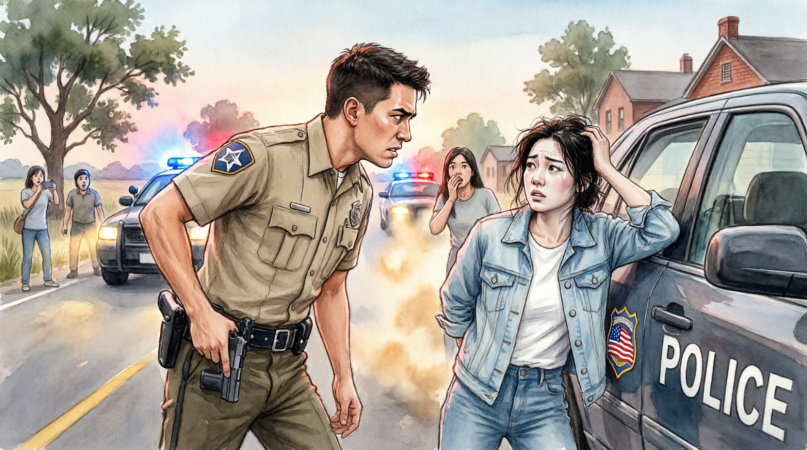
The gun was the first thing Delaney Voss noticed once Harlon Quill stopped pretending this was a normal traffic stop.
Not his badge.
Not his cruiser.
Not the dust blowing across the shoulder of that East Texas road.
The gun.
It sat at the end of his outstretched arm, black and steady, pointed straight at the center of her chest while the sun hit the barrel hard enough to make it flash.
Delaney stood against the hood of the rental SUV with both hands flat on the metal.
The hood was hot enough to sting her palms.
Gravel pressed through the soles of her sneakers, and somewhere behind her, the engine ticked as it cooled.
She could smell asphalt, weeds, and the sour edge of old coffee from the paper cup in the console.
Officer Quill smiled like he had done this before.
That was the part that made Delaney still.
Not the weapon.
The smile.
It was too comfortable.
Too practiced.
Too certain that whoever he had in front of him would fold before anything official had to be written down.
Three days earlier, her younger brother Ronan had sounded exactly like someone who had folded because he believed he had no choice.
He called at 7:18 p.m. from a gas station bathroom near Austin.
Delaney could hear the hand dryer roaring on the other side of the door, then stopping, then roaring again.
“Laney,” he said, and she knew before he explained that something was wrong.
Ronan was the kind of kid who apologized to parking meters when they took his last quarter.
He had worked warehouse shifts all spring, stacked boxes until his shoulders ached, and skipped takeout with friends because orientation fees and tuition deposits did not care that he was tired.
He had kept the cash in a bank envelope because the school office had told him the deadline was firm.
He said a local officer stopped him on a two-lane road outside Cedar Ridge.
He said the officer claimed Ronan had drifted over the line.
Then the officer saw the envelope.
“What’s that kind of cash doing in your car?” the man had asked.
Ronan had tried to explain.
College orientation.
Tuition payment.
Receipts in his email.
A deadline he could not miss.
The officer called it suspicious.
He used words Ronan barely understood, words like seizure and investigation and probable cause.
By 7:46 p.m., the envelope was gone.
There was no receipt.
No property form.
No report number.
Just a citation Ronan managed to photograph with shaking hands before the officer took it back.
At the bottom was one name.
Harlon Quill.
Delaney listened without interrupting.
Then she asked Ronan the questions that frightened him more than comforted him.
Exact time.
Exact road.
Direction of travel.
What hand the officer used when he took the money.
Whether the body camera light was on.
Whether the patrol unit had a dash camera.
Whether anyone else passed by.
Ronan answered what he could.
The rest sat between them like a bill neither of them could pay.
“I messed up,” he whispered.
“No,” Delaney said. “You got robbed by someone wearing a badge.”
She did not say the other thing.
Not yet.
She did not say that badge abuse has a rhythm.
It starts with one person who knows exactly who will not be believed.
A teenager with cash.
A waitress driving home late.
A contractor with poor English.
A grandmother too embarrassed to complain.
Corruption does not always look like a movie villain.
Sometimes it looks like paperwork that never gets filed.
Delaney was officially on administrative leave.
That mattered.
She was not supposed to go looking for trouble.
She was supposed to rest, answer emails when necessary, and let the formal complaint process move at the slow speed of offices that use words like review and chain of command.
But her brother’s voice stayed in her head.
So did the number on that envelope.
Every dollar Ronan had saved had a bruise attached to it.
A missed dinner.
A double shift.
A ride he did not take because gas was expensive.
Delaney printed the citation photo at 9:03 p.m.
She circled Quill’s name.
She saved Ronan’s phone screenshots.
She wrote down the time stamps.
She called one colleague she trusted and said she needed to verify a pattern without making noise.
By the next morning, she had three things.
A rental SUV.
A small camera hidden low near the dash.
And a route through Cedar Ridge that would take her past the stretch of road where Quill liked to sit.
She did not bring a uniform.
She did not bring a marked vehicle.
She dressed like anyone else passing through Texas in the summer: jeans, gray T-shirt, sunglasses, hair tied back, no jewelry except the watch she used when she wanted exact minutes without looking at her phone.
At 2:13 p.m., she passed a faded barbecue sign and saw the patrol car tucked behind it.
There was a small American flag on a pole outside a feed store up the road, snapping hard in the hot wind.
The sky was too bright.
The kind of bright that makes every lie look clean until you step close enough to see the dirt.
Delaney kept the SUV two miles under the limit.
The patrol car pulled out behind her.
At first, it stayed at a polite distance.
Then it crawled closer.
Closer.
Closer still.
Its grille filled her rearview mirror.
Delaney touched the brake lightly, just enough to mark space.
The lights came on almost immediately.
Red and blue burst across the back window.
She inhaled once.
“Here we go,” she said.
The hidden camera kept recording.
She eased onto the gravel shoulder, shifted into park, turned off the engine, rolled down both front windows, and placed her hands at the top of the steering wheel.
Everything clean.
Everything visible.
The patrol cruiser door opened behind her.
Boots hit gravel.
Quill approached like a man walking through his own living room.
He was big, broad, and sun-reddened, with a tan uniform stretched tight over his stomach and one thumb hooked near his belt.
He did not say hello.
“You know how fast you were going, darling?”
Delaney looked straight ahead.
“Below the speed limit, officer.”
He gave a dry little laugh.
“My radar says different. Reckless driving in a construction zone.”
“There hasn’t been a construction sign for miles.”
The laugh stopped.
He leaned closer.
“You calling me a liar, girl?”
“I’m stating a fact,” Delaney said. “And I’d appreciate you not calling me that.”
The shift was immediate.
His face tightened.
His shoulders filled the window.
What had been lazy authority became something colder.
“Step out of the vehicle.”
“May I ask why?”
“Because I told you to.”
Delaney knew what the law said.
She also knew what the roadside allowed a frightened person to survive.
She opened the door slowly.
Heat hit her like a wall.
Quill stepped close enough that she had to turn sideways to get out.
“Hands on the hood.”
She obeyed.
The metal burned through her palms.
He moved in behind her.
“I smell marijuana.”
There it was.
The sentence that turns an ordinary traffic stop into an excuse.
Not evidence.
Not fact.
A key.
He patted her down with the slow confidence of a man who had learned that humiliation could be disguised as procedure.
Delaney kept her jaw locked.
For one ugly heartbeat, she wanted to twist, drop him, and end it right there in the gravel.
She did not.
Rage is not a plan.
Evidence is.
Quill saw her bag on the passenger seat.
“What’s in there?”
“My identification,” Delaney said. “And my badge.”
He laughed.
“Your badge? What are you, mall security?”
Delaney turned her head enough for her voice to carry.
“I’m a special agent with the FBI. And you are making a very serious mistake.”
For a moment, there was only wind.
A truck passed in the opposite lane.
Its driver slowed, looked, and kept going.
Quill stared at her as if waiting for the punch line.
Then he laughed again.
“Sure you are.”
“I’m going to retrieve my credentials.”
She moved slowly toward the open passenger door.
“Don’t move!” Quill barked.
The Glock came out so fast the air seemed to snap around it.
Delaney stopped.
The gun was pointed at her chest.
Not low.
Not at the ground.
At her.
Inside the SUV, the camera caught the angle.
It caught the weapon.
It caught Quill’s face.
It caught the distance between them.
It caught the fact that Delaney’s hands were open and empty.
Quill did not know that yet.
He only knew what he had always known.
A badge could make people quiet.
A gun could make them smaller.
A woman alone on the shoulder could be made to disappear into paperwork that never existed.
Then Delaney saw movement in her side mirror.
A second vehicle turned slowly onto the shoulder behind his cruiser.
No siren.
No lights.
Just an unmarked SUV pulling in with the patience of someone who already knew where to park.
Quill’s smile twitched.
Delaney kept her hands visible.
“Officer Quill,” she said, “I am advising you one more time. My credentials are in the bag. My recording device is active. Lower your weapon.”
His eyes flicked toward the mirror.
Then back to her.
“You think I’m scared of some rental-car camera?”
The unmarked SUV stopped.
The driver’s door opened.
A man in a plain shirt stepped out with one hand raised.
The passenger door opened next.
A woman came around the front holding a folder tight against her chest.
Quill looked at the folder.
That was when Delaney saw the first real crack in him.
Not fear exactly.
Recognition.
The woman opened the folder just enough for Delaney to see the top page.
Ronan’s citation photo was clipped to it.
Below that were two more names.
Two more traffic stops.
Two more cash seizures that had never become official cases.
The woman’s hand shook hard enough to bend the corner of the page.
“Harlon,” the man in the plain shirt said, “put the weapon down.”
Quill’s mouth opened.
Nothing came out.
For the first time, he looked less like a man in control and more like a man standing in the exact frame of the evidence he had created himself.
Delaney did not move.
She had learned years earlier that the most dangerous second is not when a bully thinks he can win.
It is when he realizes he might lose.
“Put it down,” the man said again.
Quill lowered the gun two inches.
Then stopped.
His finger shifted.
Delaney saw it.
So did the man near the unmarked SUV.
“Do not make this worse,” he said.
The wind moved dust across the shoulder.
The American flag at the feed store snapped once, sharp and bright in the distance.
Quill’s arm finally dropped.
The woman with the folder let out a breath that sounded almost like a sob.
Delaney lifted both hands away from the hood slowly.
“I’m reaching for my credentials now,” she said.
Nobody laughed this time.
She took her badge from the bag and held it where he could see it.
The color drained from Quill’s face.
There are moments when a lie does not fall apart loudly.
It just loses its legs.
Quill stared at the badge, then at the camera mount, then at the folder, as if he could make one of them vanish by choosing not to understand it.
Delaney looked at him and said, “You stopped my brother three days ago.”
His eyes snapped back to hers.
There it was.
The recognition he had tried not to show.
“Ronan Voss,” she said.
Quill swallowed.
The man in the plain shirt stepped closer, careful and controlled.
“Harlon, turn around.”
Quill’s hand twitched near his belt again.
Delaney’s voice cut through the heat.
“Do not.”
He froze.
For once, the command on that roadside did not belong to him.
The man secured Quill’s weapon first.
Then the woman with the folder read from the top sheet in a voice that shook but did not break.
Three complainants.
Three missing cash amounts.
Three stops with no completed seizure records.
A fourth incident now recorded from start to finish.
Quill kept saying the same thing.
“This is a misunderstanding.”
Nobody answered him.
Misunderstandings have forms.
This had victims.
At the local department office, the air conditioning felt too cold after the roadside heat.
Delaney sat in a plain interview room while the camera file was copied, logged, and sealed.
She watched an evidence technician label the drive with the date and time.
2:13 p.m. initial contact.
2:19 p.m. search claim.
2:22 p.m. firearm drawn.
2:24 p.m. unmarked unit arrival.
Process verbs matter when people have spent years hiding behind feelings.
Copied.
Logged.
Sealed.
Submitted.
The folder grew thicker by the hour.
One complaint had come from a nurse driving home after a night shift with cash meant for rent.
One came from a landscaper paid in cash after a weekend job.
One came from Ronan, who had been too ashamed to tell anyone except his sister.
Delaney called him from the hallway at 5:36 p.m.
He answered on the first ring.
“Did you find him?” he asked.
“Yes,” she said.
There was a pause.
“Did he do it to other people?”
Delaney leaned against the wall and closed her eyes.
“Yes.”
Ronan was quiet for so long she thought the call had dropped.
Then he said, “So I wasn’t stupid.”
Delaney’s throat tightened.
“No,” she said. “You were brave enough to make the call.”
The money did not come back that evening.
Real life rarely moves that cleanly.
There were forms.
Interviews.
Statements.
Chain-of-custody questions.
A review of Quill’s old stops.
A check of dash camera gaps that were too convenient to be accidental.
But the first door had opened.
By the following week, Quill’s name had been removed from the duty roster pending investigation.
By the end of the month, more people had come forward.
Some brought citations.
Some brought bank withdrawal slips.
Some brought nothing but memory and anger and the kind of shame that makes honest people whisper when they should not have to.
Delaney sat with Ronan when he gave his formal statement.
He wore the same hoodie he had worn to orientation, the cuffs pulled over his hands.
At first, his voice shook.
Then the interviewer asked what he thought when Quill took the money.
Ronan looked down at the table.
“I thought no one would believe me,” he said.
Delaney did not touch his arm.
Not then.
She knew he needed to finish under his own strength.
He did.
When he walked out, he stood in the parking lot for a long moment with the sun on his face.
“I still missed orientation,” he said.
“We’ll call the school office again,” Delaney told him.
“And if they say no?”
“Then we ask for the next person.”
He almost smiled.
That was how care looked in their family.
Not big speeches.
Phone calls.
Receipts.
Showing up.
Staying until the person at the desk found the right form.
Months later, when the hearing finally began, Delaney saw Quill again in a hallway that smelled like floor wax and coffee.
He was not smiling.
He looked smaller without the roadside around him.
No cruiser.
No heat.
No woman alone on gravel.
Just a man in a suit that did not fit quite right, standing beside an attorney while people he had counted on forgetting him walked past with folders in their hands.
Ronan saw him too.
His shoulders tightened.
Delaney leaned close.
“You don’t have to look down.”
So Ronan did not.
The hidden camera footage played later in a room full of people who suddenly understood what tone, posture, and silence can become when they are backed by a badge.
They watched Delaney’s hands on the hood.
They watched Quill claim marijuana he had not smelled.
They watched him laugh at the word badge.
They watched the gun rise.
Nobody in that room moved when the barrel lined up with Delaney’s chest.
Even on video, it made the air change.
Then the unmarked SUV appeared in the side mirror.
Then Quill’s face changed.
That was the part Delaney watched most closely.
The moment a man who thought he owned the road realized the road had been watching him back.
The outcome did not fix everything.
It could not give people back the nights they spent wondering whether they had done something wrong.
It could not return every dollar immediately.
It could not erase the way Ronan’s voice sounded from that gas station bathroom.
But the missing money was documented.
The complaints were reopened.
The stops were reviewed.
And Quill, who had spent years making people feel powerless on the shoulder of a highway, had to sit still while other people read his actions into the record.
Delaney never called it revenge.
Revenge would have been too small.
This was proof.
And proof has a weight that anger does not.
On the day Ronan finally made it to campus, he carried a backpack, a folder of corrected paperwork, and a receipt for the payment that had almost been stolen from his future.
Delaney drove him there in her own car.
They stopped for coffee on the way.
He bought hers before she could argue.
At a red light outside Austin, he looked over and said, “You really didn’t get scared when he pulled the gun?”
Delaney watched the light turn green.
“I got scared,” she said.
“Then how did you not move?”
She thought about the hot hood under her hands.
The gun.
The camera.
The second SUV turning in behind Quill’s cruiser.
She thought about how many people had been made to feel foolish for trusting their own fear.
“I remembered why I was there,” she said.
Ronan nodded like that answer was enough.
Maybe it was.
Because that was the truth waiting under the whole story.
Quill had believed he was stopping another driver.
Another envelope.
Another person too frightened to complain.
But he had pulled over Delaney Voss.
And the moment he pointed that gun at her chest, he did not make her disappear.
He put himself on record.