The smell arrived before the child did.
It slipped through the automatic doors of St. Jude’s Medical Center in that clean Chicago suburb and moved ahead of the stretcher like a warning no one could ignore.
It was sweet at first, almost chemical, then metallic, then rotten in a way that made every nurse at the front desk lift their head at the same time.
The floor had been mopped fifteen minutes earlier.
The hallway still smelled faintly of bleach and rubber wheels and warmed plastic tubing.
But underneath it came something spoiled and wet, something that belonged in a locked room no one wanted to open.
Dr. Sarah Jenkins had worked emergency medicine for eight years.
She knew the difference between ordinary fear and the silence that comes before catastrophe.
Ordinary fear made parents talk too fast.
Catastrophe made trained people stop moving.
Marcus was the first to reach her.
He was twenty-four, broad-shouldered, and usually calm in the way former athletes often are in hospitals, as if pressure was only another kind of game clock.
That evening, his skin had gone gray above his mask.
“Dr. Jenkins, now,” he said.
Sarah was already walking before he finished.
“Pediatric. Eight years old. Mom says mild flu. Heart rate 140, temp 103.8, pressure dropping. He’s barely responding.”
He swallowed hard.
“It’s his arm.”
The triage screen read 6:47 p.m.
The intake form, printed before anyone had laid eyes on the child properly, said flu symptoms.
That detail would matter later.
So would the timestamp.
So would the photographs Clara had the presence of mind to take before the cast came off.
Sarah did not know that yet.
All she knew, as she pushed through the doors into Trauma Room 2, was that the air hit her so hard she nearly stepped back.
The boy on the bed looked too small to be eight.
His name was listed on the chart, but for the first few seconds Sarah could not make herself look away from his face long enough to read it.
His lips were cracked.
His cheeks were hollow.
His eyes were open, but they were not watching the ceiling or the nurses or his mother.
They were fixed somewhere far behind the room.
His right arm lay across the bed, trapped from the knuckles to above the elbow in a fiberglass cast.
Sarah had removed hundreds of casts.
Children broke arms in soccer games, on playground slides, in backyards, on bicycles, in living rooms where nobody admitted they had been jumping from the couch.
A normal cast collected marker signatures, dirt at the edges, stickers, crumbs, and a little childhood grime.
This cast was different.
It was blackened in patches.
Dark rings stained the fiberglass near the wrist and elbow.
The edge had frayed into something sharp and filthy, and where it touched the boy’s skin, the flesh was swollen and purple.
His fingertips were blue.
Sarah pressed one.
The color did not return.
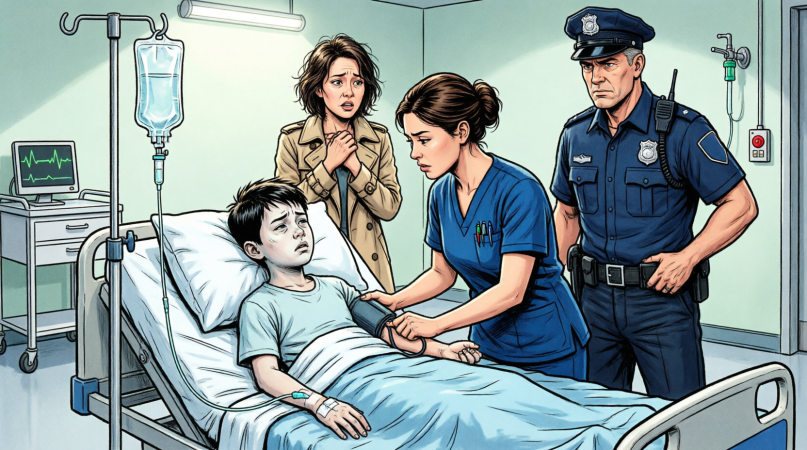
Clara, the veteran nurse who had seen more disasters than most people survived, clipped the pulse ox to his other hand and looked at the numbers.
She went still.
In emergency rooms, stillness is sometimes louder than screaming.
“How long has this cast been on?” Sarah asked.
The boy’s mother stood in the corner holding a Starbucks cup.
Martha Harris did not match the room.
She was blond, polished, and composed in a cream sweater that looked too clean for the smell around her.
A pearl necklace sat perfectly at her throat.
Her nails were manicured in pale pink.
Even her expression looked arranged.
“Oh, about a month,” Martha said.
She gave Sarah a tight smile.
“He’s clumsy. Always falling out of trees in the backyard. We’re really just here because he felt warm this morning. Probably a seasonal bug.”
Sarah looked at the boy’s arm again.
A month did not look like that.
A month did not smell like that.
She had learned, over the years, that danger often entered hospitals wearing ordinary clothes.
Sometimes it wore work boots.
Sometimes it wore a church dress.
Sometimes it wore pearls and carried coffee.
“Mrs. Harris,” Sarah said carefully, “your son is in septic shock. The cast has to come off now. He may lose that hand. He may lose his life.”
Martha’s smile disappeared.
“No,” she said.
The word was immediate.
Not confused.
Not afraid.
Immediate.
“His orthopedic surgeon said two more weeks. Give him antibiotics and we’ll leave.”
Clara’s hand paused above the IV line.
Marcus looked at Sarah.
The monitor kept beeping too fast, a thin mechanical sound that made the boy’s silence feel worse.
Sarah felt anger rise in her throat and locked it down.
Anger had no place near a dying child.
Precision did.
Three years earlier, Sarah had treated a little girl whose mother used the word clumsy the same way Martha had just used it.
That mother had cried on command.
She had answered questions with just enough detail to sound believable.
Sarah had sensed something wrong but had let one pause pass because the room was crowded, the injuries were not yet conclusive, and the social worker had been tied up with another case.
The paperwork came back too late.
The little girl survived, but not whole.
Some mistakes leave lessons.
Some leave ghosts.
Sarah had carried that ghost into every pediatric room since.
“Clara,” she said quietly, “start documenting. Full set of photos before removal. Marcus, note the time. Then call security and bring me the cast saw.”
Martha lunged before the guards even arrived.
“You can’t touch him!” she shouted. “I’ll sue this hospital!”
Her coffee sloshed over the lid.
Clara stepped between Martha and the bed with both hands raised.
“Back up, ma’am.”
Martha’s face changed from polished annoyance to something raw and animal.
“You don’t understand. He has a specialist. He has instructions. You people are overreacting.”
Sarah did not answer that.
She was watching the boy’s fingers.
Blue.
Cold.
Unresponsive.
A child’s body does not negotiate.
It only tells the truth.
The two security guards came through the door fast, one moving to Martha’s left side, the other to her right.
They did not grab her roughly.
They did not have to.
They positioned themselves between her and the child, and Martha reacted as though they had dragged her into court.
Her Starbucks cup hit the floor.
The lid popped off.
Coffee spread across the white tile in a slow brown fan, sliding toward the biohazard bin.
The room froze around it.
Clara’s camera hovered near the cast.
Marcus stood with one glove on and one glove half-open in his hand.
One security guard stared at the monitor as though the numbers could explain the smell.
The other watched Martha’s hands.
The boy did not move.
The only thing crossing the floor was coffee.
Nobody moved.
Then Martha whispered, “Don’t open it.”
Sarah looked up.
The voice did not match the woman from thirty seconds earlier.
It was smaller.
Almost pleading.
“Please,” Martha said. “Don’t open it.”
That was the moment Sarah knew the cast was not merely neglected.
It was hiding something.
The cast saw screamed to life.
The sound filled the room, high and metallic, vibrating against bone and fear.
Sarah leaned close to the boy.
“I’m going to help you,” she said, though she did not know if he could hear her.
He did not blink.
He did not flinch.
He lay beneath the bright ER lights while the blade touched the filthy fiberglass and began to cut.
Dust rose immediately.
It was dark and bitter and wrong.
Marcus gagged once, turned toward the hall, then forced himself back into position.
Clara turned her face for half a second, her eyes wet above her mask, then raised the camera again.
The fiberglass was too thick.
Sarah felt it almost immediately.
A standard cast has resistance, but this had layers.
Someone had built it up.
Someone had reinforced it.
Someone had made sure no casual inspection would see what was beneath.
Sarah cut slowly along the forearm.
Sweat slid under her mask.
Her fingers tightened around the saw until her knuckles ached.
At 6:58 p.m., Marcus said, “Documenting removal.”
Clara took another photo.
The hospital intake form said flu symptoms.
The triage timestamp said 6:47 p.m.
The security log would later show when the guards entered.
The record was forming around the child in real time, not because Sarah was thinking about court, but because she had learned that truth without evidence can be talked to death by people with clean clothes and expensive vocabulary.
The cast cracked.
The sound was small.
Everyone heard it.
Sarah turned off the saw and slid in the spreaders.
For one second, nothing happened.
Then the fiberglass opened.
A rusted chain fell loose against the boy’s wrist.
Marcus made a sharp sound and stepped back.
Clara’s breath broke inside her mask.
The chain had been hidden beneath the fiberglass, wrapped where no chain should ever touch a child.
A heavy padlock pressed into swollen skin.
Beneath the padlock, tucked carefully into the ruined cast, was a sealed plastic bag.
Inside it was something folded.
Martha stopped fighting.
She looked at the bag.
Then at Sarah.
Then at her son.
“Please,” she whispered.
Sarah reached for the plastic with gloved fingers.
When her thumb found the seal, Martha closed her eyes like she already knew what was inside.
Sarah opened it anyway.
The plastic made a faint crinkling sound.
It seemed impossible that anything so quiet could make a room feel so loud.
Inside were four items.
The first was a folded school absence note.
The second was a pharmacy receipt.
The third was a photocopy of orthopedic discharge instructions with the date scratched through.
The fourth was a photograph.
Sarah lifted it carefully.
It showed the same boy sitting on a porch, thinner than he should have been but smiling faintly, his right arm visible and free.
No cast.
No sling.
No swelling.
The date stamp on the back was three weeks after Martha claimed the cast had been put on.
Clara lowered the camera slightly.
“Sarah,” she whispered.
She almost never used Sarah’s first name in a trauma room.
Martha slid down the wall.
Her perfect sweater wrinkled under her hands.
Her pearl necklace shifted crooked against her throat.
“You don’t understand,” she said.
Her voice had gone flat.
“He was going to tell.”
The words landed harder than the chain.
Sarah felt the room tilt.
“Tell what?” she asked.
Martha did not answer.
The boy made a sound.
Not speech.
Not even a clear cry.
A breath with a shape.
His fingers twitched once beneath the chain.
Then his eyes moved toward the doorway.
Everyone turned.
A man stood just outside Trauma Room 2.
He wore a dark jacket and held a child-sized backpack against his chest.
He looked exhausted in a way Sarah recognized from waiting rooms, court hallways, and ICU doors.
Not drunk.
Not lost.
Searching.
When he saw the boy, his face changed.
He said the boy’s name.
Martha whispered, “No.”
Sarah did not know him, but she saw the child’s eyes sharpen for the first time since entering the room.
The man took one step forward, then stopped when security raised a hand.
“I’m his father,” he said.
Martha snapped, “He is not allowed near him.”
The man did not look at her.
He looked at Sarah.
“My name is Daniel Harris,” he said. “I’ve been trying to find my son for twenty-three days.”
The room seemed to tighten.
Sarah asked Marcus to call hospital administration, child protective services, and police.
Not one after another.
All of them.
Now.
Daniel held up the backpack with both hands as if offering proof.
“His teacher called me,” he said. “She said he hadn’t been in school. Martha told them he was staying with relatives. She told me he was with her sister. Then she stopped answering.”
Martha laughed once.
It was a broken sound.
“He’s dramatic,” she said. “They’re both dramatic.”
But the performance was gone.
Sarah had seen people lie under pressure.
Some grew louder.
Some grew softer.
Martha began doing both, changing tactics with every breath.
The boy’s condition was worsening.
That mattered more than any confession.
Sarah cut the remaining cast away.
The smell intensified.
Clara documented the chain, the padlock, the torn skin, the swelling, the color of his hand, the indentation beneath the metal.
They removed the chain with bolt cutters from the hospital maintenance cabinet because waiting for anything else might have cost the boy his hand.
He was started on aggressive IV antibiotics.
Fluids ran wide open.
Blood cultures were drawn.
A surgical consult was paged.
The orthopedic surgeon on call arrived so quickly his coat was not fully buttoned.
His face went still when he saw the arm.
“This was not my cast,” he said.
That sentence mattered too.
Martha had used an imaginary surgeon as a shield.
Now a real one was standing in front of her.
Police arrived at 7:18 p.m.
By then, Daniel had given his statement in the hallway with the backpack clutched against his chest.
Inside it were school papers, a small stuffed dinosaur, and a photocopy of a temporary custody petition he had filed two weeks earlier.
He had not lost interest in his son.
He had been locked out.
Martha had told neighbors the boy was with Daniel.
She had told Daniel the boy was with relatives.
She had told the school he had the flu.
She had told the hospital the cast was normal.
Different rooms.
Different lies.
Same child.
When Officer Elena Ruiz stepped into Trauma Room 2, Martha straightened like she had found a new audience.
“I want a lawyer,” she said.
Officer Ruiz looked past her at the bed, at the chain in the evidence bag, at the photograph, at the child whose body was fighting to stay alive.
“That is your right,” she said.
Martha’s chin lifted.
Then the boy whispered one word.
“Dad.”
Daniel folded at the sound.
He did not cross the room until Sarah nodded.
When he reached the bedside, he took his son’s left hand because the right one was covered in monitors, dressings, and the terrible evidence of what had been done.
“I’m here,” he said. “I’m here. I found you.”
The boy’s eyes closed.
For one horrifying second, everyone thought he had slipped away.
Then the monitor continued.
Fast.
Weak.
But there.
Sarah exhaled through her mask.
No one celebrated.
There was nothing to celebrate yet.
The next hours were surgery, cultures, wound care, fluids, vasopressors, and the kind of controlled urgency that leaves no room for feelings until later.
The chain had caused deep pressure injury.
The infection had spread.
The cast had trapped heat, moisture, filth, and whatever Martha had been trying to hide beneath a hard shell of fiberglass.
The surgeon told Daniel the hand might not be saved.
Daniel heard the words without moving.
Then he looked at Sarah and asked, “Will he live?”
Sarah answered honestly.
“We’re doing everything possible.”
That night, Martha Harris was escorted out of St. Jude’s in handcuffs.
She did not scream anymore.
She did not threaten lawsuits.
She stared straight ahead while Officer Ruiz carried the sealed evidence bags.
The chain.
The padlock.
The plastic bag.
The altered discharge sheet.
The photo.
The absence note.
The pharmacy receipt.
The objects were ordinary enough to fit in labeled bags.
Their meaning was not.
By sunrise, the boy was in pediatric intensive care.
His fever had begun to drop.
His blood pressure stabilized with support.
His father sat beside him in a vinyl chair, still holding the backpack on his lap, as if someone might try to take even that.
Sarah checked on them before the end of her shift.
Daniel looked up when she entered.
He had aged ten years overnight.
“Did I miss something?” he asked.
It was not an accusation.
That made it worse.
“I kept calling. I filed papers. I went to the school. I called her sister. I went to the house and no one answered. Did I miss something?”
Sarah had no comforting lie for him.
“You kept looking,” she said.
He stared at his son.
“It wasn’t enough.”
Sarah thought of the little girl from three years earlier.
She thought of every pause she had ever mistrusted.
“Sometimes,” she said, “the person hiding a child counts on everyone else being polite.”
Daniel covered his mouth with one hand.
That sentence stayed with Sarah.
It became part of how she later explained the case to a resident who asked why she had pushed so hard.
Because politeness is not neutral when a child is dying.
Because a clean sweater is not a medical record.
Because an intake form can say flu symptoms while a cast hides a chain.
The investigation took months.
The court process took longer.
Sarah testified about the condition of the cast, the smell, the boy’s vital signs, the timing of removal, and the items found inside.
Clara testified about the photographs.
Marcus testified about Martha’s first refusal and her whispered plea not to open the cast.
The orthopedic surgeon testified that no legitimate post-fracture care required anything resembling what had been found.
The school provided attendance records.
Daniel provided custody filings and call logs.
Neighbors provided statements about not seeing the boy outside for weeks.
Martha’s attorney tried to suggest panic.
He tried to suggest misunderstanding.
He tried to suggest an overwhelmed mother who had made bad choices under stress.
The jury saw the chain.
That changed the air in the courtroom.
Sarah was not there for every day of the trial, but she was there when the evidence photographs were shown.
Martha looked away.
Daniel did not.
He forced himself to look at every image, not because he wanted to suffer, but because his son had endured it alone.
Someone had to witness it without flinching.
The boy survived.
He lost some function in his hand, but not the hand itself.
Months of treatment followed.
Physical therapy.
Scar care.
Nightmares.
Court appointments.
Small victories measured in finger movement and appetite and the first time he laughed at a bad joke in the hospital playroom.
His father brought him to every follow-up.
At first, the boy would not let anyone touch his right arm without warning him twice.
Sarah learned to ask before lifting a sleeve.
Clara brought him stickers for his new brace, and he placed one dinosaur sticker on the side with great seriousness.
Marcus visited once with a foam football, then cried in the supply closet afterward where he thought no one could see.
Emergency medicine teaches people to move forward.
It does not teach them to forget.
Martha was eventually convicted on multiple charges related to child abuse, unlawful restraint, and medical neglect.
The exact legal language mattered in court.
To Sarah, the truth had always been simpler.
A mother had tried to bury a child’s voice under fiberglass.
She had failed because the body tells the truth when words cannot.
Years later, Sarah still remembered the smell first.
Not the chain.
Not the photograph.
Not Martha’s pearls.
The smell.
The warning that reached the hallway before the stretcher cleared the doors.
She also remembered the boy’s first clear sentence after surgery.
Daniel had been sitting beside him, reading from a dinosaur book he had already read four times.
The boy opened his eyes, looked at his father, and asked, “Did you bring my backpack?”
Daniel lifted it immediately.
The boy nodded once and closed his eyes again.
That backpack became proof of something no evidence bag could hold.
He had belonged to someone before the room.
Someone had been looking.
Someone had come.
The rotting smell in Trauma Room 2 was unbearable, but what fell from that cast was not only a chain, a padlock, and a hidden bag.
It was a lie losing its shape under bright hospital lights.
It was a room full of adults finally refusing to look away.
And it was the first moment an eight-year-old boy stopped being hidden.

