I never told my in-laws who my father really was, because I had learned early that powerful names change how people treat you.
They make some people polite, some people hungry, and some people afraid.
When I married David, I wanted to know which version of him was real.
Not the version who shook hands in courthouse hallways.
Not the version who smiled in Christmas photos.
Not the version who told everyone at dinner parties that his wife was quiet because she was “private,” as if quiet were a decoration he had chosen for me.
I wanted to know how he treated me when he thought I had no one behind me.
By the time I was seven months pregnant, I had my answer.
His mother, Sylvia, lived in a neat suburban house with a bright wreath on the front door, a small American flag by the porch steps, and a kitchen so polished it looked more like a place to display food than cook it.
That Christmas morning, I arrived before sunrise because Sylvia had told David that “a good wife helps without being asked.”
He repeated it in the car like it was harmless.
“She just wants the day to go smoothly,” he said, turning into the driveway while frost still clung to the grass.
I had a hand on my belly, feeling our baby shift under my coat.
“I’m seven months pregnant,” I said. “I can help, but I can’t be on my feet all day.”
David sighed like I had asked him to cancel Christmas.
“Please don’t start,” he said. “My colleagues are coming. This matters.”
That was how he measured everything.
What mattered was what other people saw.
What did not matter was what happened behind the kitchen door.
By 5:00 a.m., I was standing at Sylvia’s stove while the house filled with the smell of turkey, butter, onions, cinnamon, and the lemon cleaner she sprayed every time I set down a spoon.
The oven heat pushed into my face every time I opened the door.
My lower back throbbed in a deep, steady way that made my jaw clench.
The baby pressed against my ribs as if trying to move away from the noise, the light, the constant sharp little orders.
“Not that pan,” Sylvia said.
“Slice those thinner.”
“David likes the potatoes whipped, not mashed.”
“Don’t drip on the floor.”
She never asked how I felt.
She asked whether the rolls were warm.
By nine, my ankles were swollen.
By eleven, I had to lean both hands on the counter every time a cramp traveled through my back.
By noon, David had changed into a crisp shirt and was greeting people in the dining room as if he had cooked the meal himself.
His colleagues arrived with bottles of wine and polite smiles.
They called him “counselor” and joked about his promotion.
He laughed in that easy, polished way I used to find charming.
I watched him from the kitchen, one hand against my stomach, and understood that charm was just a door he opened for strangers.
At home, he kept it locked.
Sylvia moved between the dining room and the kitchen in a simple holiday dress, accepting compliments on “her” dinner.
She told one woman the gravy had taken all morning.
She told a man the pies were an old family tradition.
She did not mention that I had been rolling dough while sitting on a step stool because standing made black dots float in my vision.
No one asked.
People often miss suffering when it is served quietly.
When the table was finally full and every platter had been carried out, I stood in the doorway with a damp towel in one hand and a pain burning low in my spine.
The dining room glowed with candles.
Silverware clicked.
Wine moved from glass to glass.
Someone laughed about a judge David had impressed.
Someone else told Sylvia the house looked beautiful.
I waited for David to notice that I had not sat down once.
He did not.
So I asked.
“Sylvia,” I said, keeping my voice soft because I already knew how easily she turned softness into proof of weakness, “could I sit for a minute before we eat? My back is really hurting.”
Her hand came down on the table.
The sound snapped through the room.
Forks paused.
A candle flame jumped.
Sylvia looked at me as if I had tracked mud across her carpet.
“Servants don’t sit with the family,” she said.
The words landed in front of everyone.
No one laughed.
No one corrected her.
She went on anyway, her voice bright and cruel, as if cruelty sounded better when wrapped in etiquette.
“You can eat in the kitchen, standing up, after we’re done,” she said. “It’s good for the baby. Know your place.”
For a second, I thought David would be embarrassed enough to stop her.
Not because he loved me.
Because people were watching.
Instead, he lifted his wine glass, took a slow sip, and looked at me over the rim.
“Listen to my mother, Anna,” he said. “Don’t embarrass me in front of my colleagues.”
There are moments in a marriage when the whole thing shows itself at once.
Not in one big betrayal, but in a small public choice.
A chair.
A sentence.
A husband deciding that his wife’s humiliation is less inconvenient than his mother’s anger.
I felt the baby move.
Then a cramp seized me so suddenly that I caught the doorframe.
The room blurred at the edges.
“David,” I whispered. “It hurts.”
His mouth tightened.
Sylvia stood so quickly her chair scraped the floor.
“Oh, for heaven’s sake,” she said. “Now she’s performing.”
I turned toward the kitchen because I did not want to collapse in front of his colleagues.
I still had enough pride to want privacy for pain.
The tile felt cold through the thin soles of my shoes.
The air in the kitchen was thick with oven heat and steam.
I reached for the chair near the breakfast nook, but Sylvia followed me, her heels clicking hard and fast.
“Don’t you dare make a scene in my house,” she said.
“I need to sit,” I told her.
“You need to finish cleaning.”
“I can’t.”
That was all I said.
I can’t.
Two words.
To Sylvia, they sounded like rebellion.
Her face changed.
She stepped close, close enough that I could smell her perfume over the turkey and butter.
“Faking it again,” she said, “to get out of work?”
I tried to move around her.
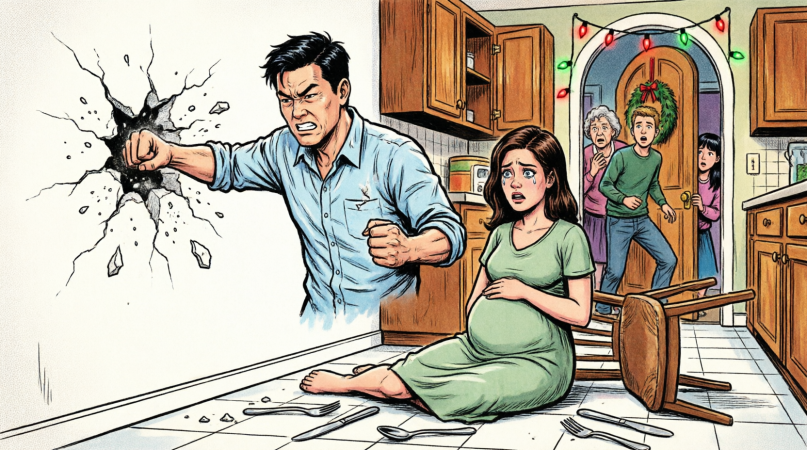
She shoved both hands into my shoulders.
I fell backward.
My lower back hit the granite counter with a crack of pain so bright that I could not breathe.
For one frozen second, the whole kitchen went silent around me.
Then my body slid, my hand clutched my stomach, and the dish towel I had been holding slipped to the floor beside a serving spoon.
A terrible pain tore through me low and deep.
Not a normal cramp.
Not the ache I had been trying to ignore all morning.
This was something wrong.
“My baby,” I whispered.
The dining room noise thinned.
A chair moved.
David came into the kitchen.
He saw me on the floor.
He saw my hand on my belly.
He saw the panic in my face.
And still, the first thing he noticed was what the guests might see.
“Anna,” he hissed. “Get up.”
I stared at him.
“Call 911,” I said.
He looked back toward the dining room, where people were pretending not to listen.
“Get up and clean this,” he said. “Do you want everyone to see?”
The old Anna might have apologized.
The old Anna might have tried to stand before her legs were ready.
The old Anna might have protected his reputation while her own body begged for help.
But pain has a way of burning through training.
“Call 911,” I said again, louder. “Now.”
David’s face hardened.
I reached for my phone on the counter.
He got there first.
His hand closed around it before mine could.
“Give it to me,” I said.
“No.”
“David, I need an ambulance.”
“There will be no ambulance.”
The words were so calm that for a moment I did not understand them.
No ambulance.
No help.
No flashing lights in the driveway because the neighbors might talk.
No report because his promotion mattered.
No truth because truth would make him look bad.
I pushed myself up on one elbow and reached again.
He lifted my phone and threw it against the wall.
The crack shot through the kitchen.
Pieces hit the tile.
A guest gasped from the doorway.
Sylvia said my name like a warning, as if I were still the problem.
David stood over me, chest rising, his polished face slipping just enough for everyone to see the man underneath.
“I just got promoted,” he said. “I don’t need police cars in my driveway on Christmas.”
“You broke my phone,” I said.
“You were hysterical.”
“I asked for help.”
“You were making a scene.”
That was his gift.
He could take anything he did and rename it before anyone else had time to understand it.
Fear became hysteria.
Pain became drama.
A cry for help became embarrassment.
He crouched, not to help me, but to get close enough that I could hear every word.
“I’m a lawyer,” he said. “I play golf with the sheriff. If you say one word, I’ll tell them you’re unstable.”
His eyes moved over my face, measuring how much damage his words had done.
“You’re an orphan,” he said. “Who do you think is going to believe you?”
For years, I had let him believe that.
Not exactly a lie.
My mother was gone.
My father and I were not the kind of family who posted smiling photos every weekend.
He was busy, guarded, and careful with the public parts of his life.
I was careful too.
I had never wanted to be loved because of a title.
So when David asked why my father never came around, I said he worked too much.
When Sylvia asked whether I had “any real family,” I let the silence answer.
When David made jokes about my background, I filed them away like evidence.
Not because I planned revenge.
Because some part of me knew that a person’s real character comes out when they think there will be no record.
Now there was a broken phone on the tile.
There was a room full of witnesses pretending not to breathe.
There was my husband using the law like a locked door.
And there was my baby, still inside me, depending on the one thing David had never understood about me.
I was quiet, not helpless.
I looked at him and swallowed the scream rising in my throat.
I wanted to hit him.
I wanted to crawl through the pain and drag myself to the porch.
I wanted to make every person in that dining room admit what they had just watched.
Instead, I put both hands around my belly and made myself speak slowly.
“You’re right, David,” I said.
His mouth curved.
He thought I was surrendering.
“You know the law,” I continued. “But you don’t know who writes it.”
The smile stopped.
Sylvia shifted behind him.
“What is that supposed to mean?” David asked.
“Give me your phone,” I said.
“No.”
“Then call my father.”
He stared at me.
For one second, confusion opened in his face.
Then he laughed.
It was the same laugh he used when a waiter brought the wrong drink, or when I asked him not to speak to me like I was stupid.
“My God,” he said. “You want your daddy?”
Sylvia laughed too, thin and delighted.
“Call him,” she said. “Maybe he can talk sense into her.”
That was the second mistake they made.
They thought cruelty was safer when shared.
David pulled his phone from his pocket.
The screen glowed in his palm.
His fingers moved with theatrical patience as I gave him the number.
He repeated each digit loudly enough for the people in the doorway to hear, as if the number itself were part of the joke.
Then he pressed call.
“Speaker,” Sylvia said.
David smiled at me.
“Oh, absolutely.”
He tapped the button and held the phone out toward the kitchen like he was presenting evidence.
The ring filled the room.
Once.
Twice.
A third time.
The oven fan clicked.
A wine glass trembled in someone’s hand.
My back burned against the cabinet, and my dress clung to my skin from the heat of the kitchen and the cold fear moving through me.
I kept one hand on my belly and watched David enjoy what he thought was my final humiliation.
He had built his confidence on one idea.
Anna had no one.
Anna would be too ashamed to speak.
Anna would protect the marriage, the house, the Christmas table, the smiling photographs, the promotion, the name.
Anna would always absorb the blow.
The line connected.
For half a breath, there was only silence.
Then a man’s voice came through the speaker.
It was low.
Controlled.
Official in a way David should have recognized before he opened his mouth.
“Identify yourself,” my father said.
David’s grin widened, because arrogance can be deaf when it wants to be.
He stood a little taller in his polished shoes, surrounded by the broken phone, the cold tile, his mother’s frozen smile, and the witnesses he had forgotten were still watching.
“This is David Miller,” he said. “Anna’s husband.”
I closed my eyes for one second, not because I was afraid of what came next, but because I finally understood that the silence I had carried for years was over.
David kept talking.
“Your daughter is making a scene,” he said, “and I need you to explain to her that…………………….