“The hospital called me before midnight and told me my six-year-old son was dying. But the part that still haunts me is not the call.

Part 1

It is my mother laughing when I asked what happened—and my sister saying, as if she were discussing spilled milk, “He got what he deserved.”
I was in the hallway of a Denver hotel at 11:47 p.m., still wearing my conference badge, one heel already rubbing a blister into my skin. I had just left a client dinner and was mentally running through the presentation that could save my job the next morning.
When my phone rang, I almost ignored it.
Then I saw the Dallas number.
“Is this Emily Carter?” a woman asked.
“Yes.”
“This is St. Catherine’s Children’s Hospital in Dallas. Your son, Noah Carter, has been admitted in critical condition.”
For a second, the hotel hallway stretched endlessly in both directions. Someone laughed near the elevator. Ice clattered in a bucket. The carpet beneath my shoes was patterned with gold vines, and I remember staring at them like they could explain why my world had just split open.
“What happened?” I whispered.
The nurse paused too long.
“Ma’am… you need to come immediately.”
I don’t remember getting back to my room. I remember my purse hitting the floor. I remember my hands shaking so badly I dropped my phone twice before I could dial my mother.
She was supposed to be watching Noah for three days.
My younger sister, Madison, had been staying with her too. I had not wanted to leave him there. Something in my stomach twisted the moment I packed his dinosaur pajamas and favorite blue blanket into his little backpack. But my sitter canceled at the last minute, my ex-husband was stationed overseas, and if I missed that Thanksgiving business trip, I would lose the promotion keeping us afloat.
So I told myself three days would be fine.
My mother answered on the fourth ring.
“Why is Noah in the hospital?” I cried.
Silence.
Then she laughed.
Not a shocked laugh. Not a nervous one.
A cold, satisfied laugh.
“You never should’ve left him with me,” she said.
My blood went ice-cold.
“What did you do?”
Before she answered, I heard Madison in the background.
“He never listens,” my sister said flatly. “He got what he deserved.”

Noah was six.
He loved plastic dinosaurs, strawberry yogurt, and wearing only one sock to bed because he said two socks made his “feet angry.” He cried during movies when animals got lost. He still climbed into my bed during thunderstorms, pressing his little forehead against my shoulder until he fell asleep.
There was no world where my child deserved pain.
I booked the first red-eye flight to Dallas. The hours blurred into airport lights, stale coffee, and terror. I imagined every possible accident. A fall. A car. A pool. The stairs.
But under every thought, my mother’s voice kept repeating.
You never should’ve left him with me.
When I reached St. Catherine’s just after sunrise, a pediatric surgeon and a police detective were waiting outside the ICU.
That was when my knees almost buckled.
The surgeon spoke carefully. Noah had severe internal injuries, bruised ribs, a fractured wrist, and older marks that suggested this had not happened once. It had happened before.
The detective added quietly, “Your mother and sister did not call 911. A neighbor heard screaming and found him unconscious near the backyard shed.”
The shed.
My mother’s shed behind her house in Oak Cliff. The one she always kept locked. The one Noah once told me made “bad noises” at night.
Through the ICU window, I saw my little boy buried beneath tubes and wires, his face swollen, his hand wrapped in gauze, his body impossibly small against the white hospital sheets.
I pressed my palm to the glass and felt something inside me harden.
My mother and sister had not simply hurt him.
They were hiding something.
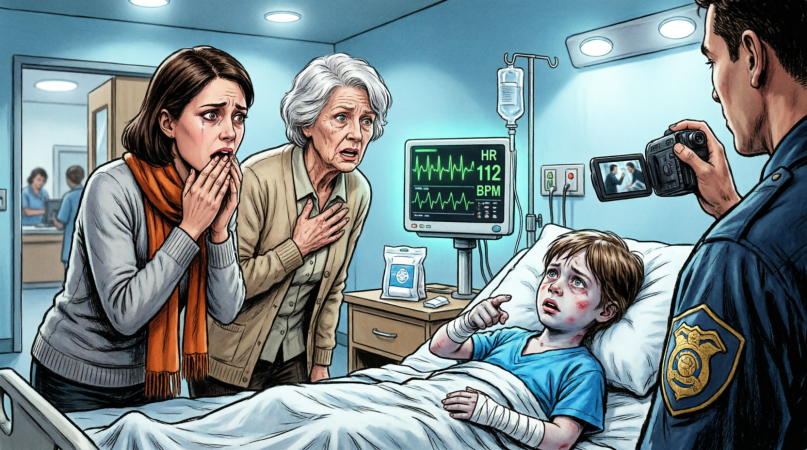
Detectives asked me to stay at the hospital while they questioned them separately. By the next morning, my mother and Madison arrived at the ICU pretending to cry. My mother clutched tissues. Madison covered her mouth and whispered, “Poor baby,” as if she had not said he deserved it.
Then they stepped into Noah’s room.
His eyes fluttered open.
Slowly, trembling, my son lifted one small hand and pointed straight at them.
The heart monitor began screaming.
Noah’s swollen lips parted, and one broken word escaped.
“Monster.”
My mother staggered backward.
Madison screamed.
And behind them, the detective pulled a small hidden camera from inside his jacket and said, “We know what happened in that shed.”
My mother’s face turned white.
But then Noah whispered something else—
Something that made every adult in the room freeze.

Part 2

Noah’s voice was barely louder than the hiss of the oxygen tube beneath his nose.

But the room heard him.

Every doctor, every nurse, every detective, every guilty soul standing too close to his bed heard the word that slipped from his swollen mouth.

“Not… them.”

The detective froze with the hidden camera still raised in one hand.

My mother stopped backing away.

Madison’s scream died in her throat.

I gripped the bed rail so tightly my fingers went numb. “Baby,” I whispered, leaning closer. “What do you mean?”

Noah’s eyes rolled toward me, wet and terrified, as if even looking at my mother and sister hurt him. His tiny chest rose and fell under the hospital blanket.

“Monster,” he breathed again. Then his gaze shifted past them, toward the glass ICU door. “The man.”

A silence fell so sharply it seemed to cut the room in half.

Detective Harris turned first.

There, beyond the ICU window, stood a man in a dark jacket, half-hidden behind two nurses at the station.

He was not family.

He was not hospital staff.

And when Noah looked at him, the heart monitor began screaming again.

The man moved.

Not quickly enough to look guilty to anyone else.

But fast enough for Detective Harris.

“Stop him!” he shouted.

The hallway erupted.

The man bolted toward the stairwell. A uniformed officer lunged after him. Madison spun around, knocking into my mother, and for one horrible second I saw something pass between their faces.

Not confusion.

Not fear.

Recognition.

My mother whispered, “Oh God.”

I turned on her. “Who is he?”

She clutched her tissues against her chest, all the fake crying gone from her face. For the first time in my life, Margaret Ellis looked small.

Madison shook her head violently. “Don’t say anything.”

“Who is he?” I screamed.

My mother’s lips trembled. “His name is Calvin Reed.”

The name meant nothing to me.

But it meant everything to Detective Harris.

He turned slowly. “Calvin Reed? The man who was supposed to have died twelve years ago?”

Madison collapsed into the chair behind her.

My stomach dropped.

“What are you talking about?”

Detective Harris did not answer immediately. He looked at Noah, then at me, as if weighing how much truth a mother could survive beside her son’s hospital bed.

Then he said, “Calvin Reed was connected to a missing child case in Dallas. Your mother was questioned at the time.”

“My mother?”

Madison covered her ears. “Stop.”

The detective’s voice hardened. “A four-year-old boy disappeared from a daycare in 2014. The case went cold after the main suspect allegedly died in a warehouse fire.”

My mother’s face had gone gray.

I stared at her. “What does that have to do with Noah?”

The answer came from the doorway.

An officer returned, breathing hard. “He got out through the east stairwell. Security lost him near the ambulance bay.”

Detective Harris cursed under his breath.

Then Noah whimpered.

I forgot everyone else.

I turned back to my son, brushing damp hair from his forehead. “I’m here, baby. Mommy’s here.”

His little fingers twitched beneath the blanket. “The shed,” he whispered. “Door under floor.”

The detective’s eyes sharpened.

My mother let out a sound like a wounded animal.

Madison stood so suddenly her chair scraped backward. “He doesn’t know what he’s saying. He’s drugged.”

Noah flinched at her voice.

And that was when I knew.

Whatever happened in that shed, whatever hidden door waited under its floor, my son had not imagined it.

He had survived it.

Detective Harris stepped toward Madison. “Sit down.”

She did not.

Instead, she pointed at me, her face twisting with years of resentment I had mistaken for ordinary jealousy. “This is your fault, Emily. Everything is always your fault. You leave, you come back, you get the praise, you get the sympathy, you get the perfect little boy—”

“My son is dying,” I said.

Her mouth trembled, but she kept going. “And you still make yourself the victim.”

The slap of those words should have broken me.

Instead, something inside me became terrifyingly calm.

I looked at the detective. “Search the shed.”

He nodded to the officer. “Get a warrant fast. Call Oak Cliff. Tell them there may be a hidden compartment under the structure.”

My mother suddenly stepped forward. “Please,” she said. “Please don’t.”

Detective Harris turned to her. “Why?”

She looked at Noah.

Then at me.

And for one second, I saw the mother I had spent my whole childhood chasing. Not loving. Not kind. Just afraid.

“There are things buried under that house,” she whispered.

Madison lunged toward her. “Shut up!”

Two officers grabbed Madison before she reached my mother. She fought them, sobbing now, no longer polished, no longer cold.

“You promised!” Madison screamed. “You promised he’d never come back!”

My knees weakened.

“Who?” I asked.

Madison’s eyes snapped to mine.

She smiled through her tears.

“Your father.”

The room tilted.

My father had died when I was nine.

At least, that was the story.

A drunk driver. A closed casket. A funeral where my mother never cried.

For twenty-six years, I had carried a photograph of him in my wallet: Robert Carter, smiling in a faded denim jacket, lifting me onto his shoulders at the state fair.

Dead.

Gone.

Untouchable.

But now Madison was staring at me like she had just torn the earth open.

Detective Harris went still. “Emily, what was your father’s name?”

“Robert Carter,” I whispered.

His expression changed.

Not surprise.

Recognition.

“Your father’s full name?”

“Robert Elias Carter.”

The detective turned to the officer at the door. “Call missing persons archives. Now.”

My mother sank to the floor, tissues scattered around her knees.

“I didn’t know Calvin would hurt Noah,” she sobbed. “I swear I didn’t know.”

I looked down at her with a coldness I did not know I possessed.

“You left my six-year-old with a man who was supposed to be dead.”

She covered her face. “He said he just needed the shed. He said nobody would find it.”

“What was in the shed?”

She did not answer.

But Noah did.

His eyes were closing again, exhaustion dragging him under.

“Pictures,” he whispered. “Lots of kids.”

Then his tiny fingers squeezed mine with impossible strength.

“And Grandpa.”

Part 3

By sunset, the shed behind my mother’s house was surrounded by police tape, floodlights, and men in gloves moving like ghosts.

I was not supposed to be there.

Detective Harris had told me to stay at the hospital, and part of me wanted to. Noah had survived emergency surgery, but his condition remained fragile. Every beep of his monitor felt like a thread holding the world together.

But when a nurse told me he was stable enough for me to step out, I went.

Not because I trusted the police.

Because I no longer trusted anyone else to stand between my son and the truth.

The shed looked smaller than I remembered.

Weather-beaten wood. Rusted lock. Peeling green paint. A place children were told not to enter.

A place monsters used because adults preferred not to ask questions.

Detective Harris met me near the driveway. “Emily, you shouldn’t be here.”

“You found something.”

His jaw tightened.

That was answer enough.

He led me no closer than the edge of the yard. Under the harsh white lights, officers carried out boxes sealed in evidence bags. Old photographs. VHS tapes. Children’s clothing tags. A metal cashbox. A cracked leather wallet.

Then one officer emerged holding a clear plastic sleeve.

Inside was a driver’s license.

The face was older than the photograph in my wallet, thinner, bruised by time.

But I knew him.

My father.

Robert Elias Carter.

The breath left my body.

“He was alive?” I whispered.

Detective Harris did not soften the truth. “We believe your father discovered what Calvin Reed was doing in 2014. We think he tried to expose him.”

“My mother said he died when I was nine.”

“She lied.”

The words struck harder than any scream.

Behind us, my mother sat handcuffed in the back of a patrol car. Madison sat in another, her face turned away from everyone.

But neither of them was crying anymore.

They were waiting.

Waiting for the final secret to surface.

An officer called from the shed. “Detective!”

Harris stepped away, then returned carrying a small sealed evidence bag.

Inside was a child’s blue dinosaur.

Noah’s favorite.

The one he had begged to bring to Grandma’s house.

My hand flew to my mouth.

“He hid it?” I asked.

Harris nodded. “Under a loose board near the trapdoor. With this.”

He showed me a folded piece of paper in a second evidence sleeve.

The handwriting was shaky and large.

Noah’s.

MOMMY, THE MAN IN THE SHED SAYS GRANDPA IS BAD BUT GRANDPA CRIED WHEN HE SAW ME. GRANDPA SAID FIND THE BLUE DINOSAUR.

My vision blurred.

“Grandpa cried when he saw me?”

Detective Harris looked toward the shed.

Then, for the first time, his voice changed.

“He may still be alive.”

The next three hours became a nightmare of radio calls, search dogs, and flashlights sweeping through the dark.

The trapdoor beneath the shed led to a narrow cellar reinforced with concrete. From there, police found an old tunnel running beneath the neighboring abandoned property.

Calvin Reed had not returned to my mother’s house to hide evidence.

He had returned because something—someone—was still hidden there.

At 11:47 p.m., exactly twenty-four hours after the hospital called me, they found my father behind a false wall beneath the abandoned property next door.

Alive.

Barely.

He was sixty-two years old and weighed almost nothing. His hair had gone white. His body carried the ruin of years no human being should survive.

But when paramedics carried him into the ambulance, his eyes opened.

I ran beside the stretcher.

“Dad?”

For a second, he stared at me as if time had folded wrong.

Then tears slid into his hair.

“Emily,” he rasped.

I broke.

Not gracefully. Not quietly.

I fell against the side of the ambulance and sobbed so hard a medic had to hold me upright.

My dead father was alive.

My mother had buried him without burying him.

And my son, my brave little Noah, had been beaten nearly to death because he found him.

Calvin Reed was captured two counties away before dawn. He was hiding in a roadside motel under a fake name, with a bag full of cash, passports, and my mother’s old wedding ring.

That detail made Detective Harris look at my mother differently.

It made me understand the final piece.

My mother had not merely been afraid of Calvin.

She had loved him.

She had helped him.

Years earlier, when my father discovered Calvin’s crimes and tried to report him, she chose the monster. Together, they staged my father’s death, trapped him where no one would look, and fed the world a lie.

Madison had been old enough to know.

Old enough to help.

Old enough to grow cruel inside the secret.

And Noah?

Noah had unlocked the shed while looking for his lost blue dinosaur. He had heard crying beneath the floor. He had found the hidden latch.

He had met a starving old man in the dark who told him, with the last strength he had, “Find your mother. Tell Emily I’m sorry I couldn’t come home.”

My son tried.

Calvin caught him.

Madison watched.

My mother laughed later because she thought the truth had finally been silenced.

But the truth had inherited my son’s stubborn little heart.

Weeks passed before Noah could speak without pain.

My father recovered more slowly. Some wounds were too old for medicine to fix quickly. Yet every afternoon, hospital staff wheeled him into Noah’s room, and my son would lift one finger from beneath his blanket.

My father would touch it gently.

“Dinosaur guard,” Noah whispered once.

My father smiled through tears. “Best one I ever had.”

Madison took a plea deal only after Calvin turned on her. My mother refused to confess until prosecutors played the hidden camera footage from the ICU—her face turning white, her voice begging them not to search the shed.

In court, she looked at me as if I had betrayed her.

Not Calvin.

Not Madison.

Me.

“I gave you a good life,” she said during sentencing.

I stood at the victim impact podium with Noah seated beside me in his wheelchair and my father behind us, one trembling hand resting on my shoulder.

“No,” I said. “You gave me a beautiful lie and called it love.”

My mother’s expression cracked.

Madison stared at the floor.

Calvin never looked up once.

They were sentenced on the same rainy morning.

When it ended, Noah tugged my sleeve.

“Mommy?”

“Yes, baby?”

“Can we go home now?”

I looked at my father. Then at my son. Then at the courthouse doors opening onto a gray Dallas sky washed clean by rain.

For the first time in my life, home did not mean the place I came from.

It meant the people who survived it with me.

“Yes,” I whispered. “We can go home.”

Two months later, Noah turned seven.

He wore one sock to bed the night before because, he informed my father very seriously, “Two socks still make my feet angry.”

My father laughed so hard he cried.

We celebrated in my apartment with strawberry yogurt cups, dinosaur balloons, and a cake shaped like a blue triceratops. Noah blew out his candles while sitting on my father’s lap, both of them too fragile and too alive to be anything but miracles.

That night, after Noah fell asleep, my father handed me an old envelope.

“I kept this hidden before everything happened,” he said. “I thought someday I’d give it to you.”

Inside was a photograph I had never seen.

My father holding me as a baby.

My mother beside him.

And standing behind them, smiling with one hand on my mother’s shoulder, was Calvin Reed.

I stared at it, confused.

Then I saw the date written on the back.

Three months before I was born.

My father’s voice broke.

“I loved you from the moment you opened your eyes,” he said. “Nothing else matters.”

But the room had gone silent around me.

Because suddenly I understood why my mother had hated me so quietly my whole life.

Why Madison resented me.

Why Calvin came back when Noah found the hidden room.

Not because my son had discovered my father.

Because Noah had discovered the proof of something even worse.

Calvin Reed was my biological father.

The monster in the shed was not my father.

The man who survived beneath it was.

I looked through the bedroom doorway at Noah sleeping under his blue blanket, one small hand resting on his dinosaur.

Then I looked at Robert Carter—the man who had lost twenty-six years, the man who still chose to love a child born from betrayal, the man Noah had called Grandpa before anyone told him to.

And I made the only decision that mattered.

I tore the photograph in half.

Not to erase the truth.

But to choose which truth would define us.

My father watched me, tears shining in his tired eyes.

I placed the half with Calvin’s face into the trash.

Then I kept the half with Robert holding me.

“Dad,” I said softly.

He closed his eyes like that single word had brought him home.

In the next room, Noah stirred and murmured in his sleep.

“Monster gone.”

And for once, he was right.

Leave a Reply

Your email address will not be published. Required fields are marked *