By the time I reached the last bend in the road, the mountains were wrapped in that washed-clean stillness that comes after rain.
The dirt track leading to my cabin in Colorado was dark with moisture, and the air drifting in through the cracked window smelled like wet pine needles, stone, and cold earth.
It should have been the kind of evening that made my shoulders finally drop.
I had driven up for exactly two reasons: to be alone and to breathe.
The previous month had been relentless.
Work had been loud, family had been louder, and I was tired in the particular way women my age know too well—the kind of tired that doesn’t come from one bad night of sleep, but from too many years of being the person everyone assumes will handle things.
My cabin had always been the one place where nobody asked anything from me.
It stood on a patch of land outside town, tucked between tall pines and outcroppings of rock, small enough to be manageable, beautiful enough to feel hard-earned.
I built it after my divorce, when I was fifty-one and determined to prove to myself that the rest of my life did not have to be a long apology.
I paid for it with overtime, careful saving, and the stubbornness that got me through years when there was never quite enough money to do anything the easy way.
Every beam, every floorboard, every chair, every framed photograph had been chosen by me.
It was not just property.
It was proof.
So when I turned the corner and saw three vehicles parked outside, I felt the peace leave my body before I had even put the SUV in park.
One of the vehicles was my son Robert’s truck.
I sat there for a few seconds, hands still on the steering wheel, telling myself there had to be some harmless explanation.
Maybe Robert had stopped by to check on a leak.
Maybe Sharon had sent him to drop off supplies.
Maybe one of the neighbors had called about a problem.
Then I noticed the second vehicle, a dark sedan I recognized from one Thanksgiving two years earlier.
Sharon’s parents.
By the time I stepped onto the porch, my pulse had started to pound.
I unlocked the door with my key and pushed inside.
My hand was still on the doorknob when I saw the wall across from the fireplace.
My photos were gone.
My parents’ wedding portrait, the black-and-white one I always hung near the hearth in winter.
My grandparents in their Sunday clothes.
Robert at six holding a fish that was almost as long as his arm.
All of it gone.
In their place were decorative plaques and a cluster of cheerful framed prints that belonged to Sharon’s family.
That wall told me everything before anyone spoke.
The living room was full of signs that this was not an accidental stop-in.
Wine bottles stood open on the dining table.
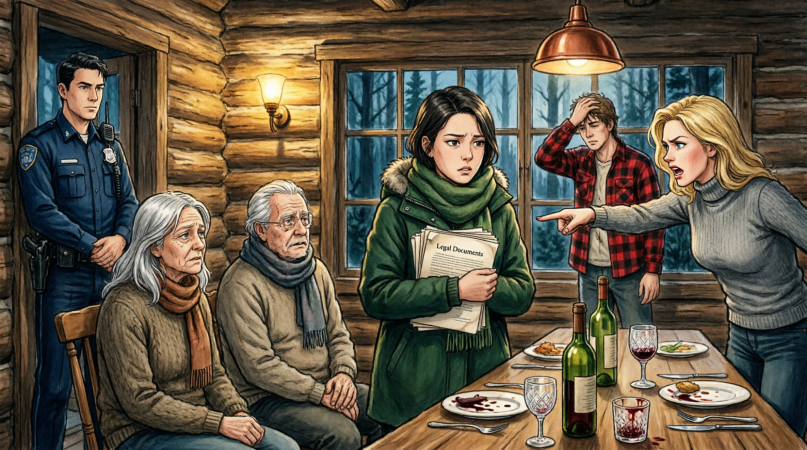
Grocery sacks were half-unpacked across the counter.
A pair of slippers I had never seen before sat beside the fireplace.
Sharon was lounging on my favorite couch.
Her mother was folded into my reading chair under one of my blankets.
Her father barely glanced away from the television.
Robert stood near the window with
the expression of a man already regretting his own cowardice.
No one looked shocked to see me.
They looked inconvenienced.
‘Why are you here?’ I asked.
It was the wrong question, and I knew it the second it came out.
The real question was why they were there.
But my mind had not yet caught up to the violation of seeing my life removed from my own walls.
Sharon stood up and pointed toward the door.
‘You need to leave right now, or I’ll call the police.’
It was not shouted.
That would have at least sounded unstable.
It came out smooth and certain, as though she were invoking a right she had already granted herself.
I looked at Robert, waiting for him to correct her.
He said nothing.
A coldness moved through me then, different from anger.
Anger is hot and fast.
This was slower.
Heavier.
It was the feeling of something inside me falling into place in the worst possible shape.
Sharon’s father tried to soften things.
Robert invited us, he said.
Robert told us you were coming later.
Robert said it was all settled.
I looked at my son.
He could not meet my eyes.
That was when I understood that whatever had happened here, it was not confusion.
It was permission granted by someone who had no authority to give it.
I set my purse down by the door.
Inside it was a folder I had brought because I was planning to meet with a contractor and my attorney the following Monday.
The folder held property documents, repair estimates, insurance papers, and a draft trust agreement I had not yet signed.
The hard corner of that folder pressing into my hand steadied me.
Sharon kept talking.
Families shared things, she said.
Robert had every right to use the place.
Maybe I had forgotten the conversation.
Maybe I was tired and making a scene.
Then she made the call.
She put dispatch on speaker and said, in a softened frightened voice, that there was a woman in their house causing a disturbance.
Their house.
I sat down and listened to my daughter-in-law erase me in real time while my son stared at the floorboards.
By the time the patrol car pulled up the drive, the cabin felt smaller than I had ever known it to feel.
Two officers stepped inside and looked around once.
One of them asked the simplest possible question.
‘Who owns the property?’
Sharon started answering immediately, but I was already standing.
The older officer turned toward me and asked if I had proof the cabin was mine.
I took the folder from my purse and set it on the table between us.
The first pages were straightforward: deed, tax records, insurance.
Every document showed my name—Elaine Carter—and no one else’s.
‘This property belongs to Ms.
Carter,’ the officer said after a quick review.
Sharon crossed her arms.
‘He’s her son.
He invited us.
That counts.’
‘No, ma’am,’ the officer said evenly.
‘It doesn’t.’
Then I slid the last printed page forward.
Three weeks earlier, Robert had emailed me asking whether Sharon’s parents could stay at the cabin for a month because they were ‘in a temporary housing crunch.’ My response was direct and polite.
I had said no.
I explained that the guest
bathroom was awaiting repair from winter pipe damage, my insurance would not cover long-term unauthorized occupants, and I planned to be up there myself.
I had also told him that if his in-laws needed help finding a rental, I would gladly contribute to a short-term place in town.
Robert had answered with one line: Understood.
The officer read the exchange.
So did Sharon’s father, leaning over farther than dignity allowed.
He went pale.
‘You told us she agreed,’ he said to Sharon.
Sharon snapped, ‘I said she would calm down once you were here.’
Her mother covered her mouth.
That was the moment the room broke open.
The officers separated fact from noise quickly after that.
I stated plainly that I had not authorized any of them to occupy my property.
Robert finally admitted he had used the old emergency key I once gave him years before.
Sharon insisted they only needed a little time.
Her father, mortified, kept repeating that he had been told this was settled.
Then I saw two envelopes on my kitchen counter.
They were addressed to Sharon’s parents at my cabin address.
One was from the DMV.
The other was from a bank.
My stomach dropped.
I handed them to the officer.
His tone changed immediately.
‘Were you trying to establish residency here?’ he asked.
Sharon did not answer.
She did not need to.
Everything about the room answered for her.
The grocery bags.
The new decorations.
The removed photos.
The slippers by the fire.
They had not come for a weekend.
They had started moving in.
The officers gave them a choice: pack up and leave peacefully, or be cited for trespassing and false reporting issues could be referred for review.
Sharon argued.
Robert finally told her to stop.
Her mother started crying.
Her father asked for ten minutes to gather their things.
I wish I could say I felt victorious.
I didn’t.
I felt old in a new way.
While they packed, I went upstairs with the second officer.
My bedroom drawers had been opened.
Not ransacked, but touched.
Shifted.
Someone had moved my late mother’s quilt from the cedar chest and put it across the guest bed downstairs.
In the hall closet, I found my framed family photographs wrapped in bath towels like breakable clutter.
One of the frames had cracked in the corner.
That damage hurt more than the wine bottles and the lies.
Erasing me had required time.
Deliberate hands.
As Sharon carried a suitcase toward the door, she said the ugliest truthful thing she had said all night.
‘It would’ve been Robert’s one day anyway.’
I looked at her and answered quietly, ‘No.
It would have been respected one day, if he had earned that.’
Robert’s head jerked toward me.
He saw something in the folder then—a tab from my attorney’s office labeled Carter Family Cabin Trust.
The color drained from his face.
He did not ask about it in front of Sharon.
He just stared.
The officers stayed until all four of them were in their vehicles.
Sharon received a formal trespass warning.
They were told not to return without my written permission.
Robert tried to speak to me on the porch, but I stepped back and said, ‘Not tonight.’
When the taillights disappeared down the dark road,
the silence that followed did not feel peaceful.
It felt ravaged.
I locked the door, checked it twice, and stood in the middle of my own living room looking at the empty hooks on the wall.
Then I did the only thing I could manage.
I unwrapped the photographs and leaned them back where they belonged, one by one, even though I was too exhausted to hang them properly.
I built a fire, sat on the floor in front of it, and cried harder than I had cried in years—not because Sharon had lied, but because Robert had watched her do it.
The next morning, he came back alone.
The rain had started again, thin and gray.
I opened the door but did not invite him in.
He stood on the porch in the same jeans he had worn the night before, looking as though he had not slept.
‘I’m sorry,’ he said.
I almost laughed.
Not because it was funny, but because the phrase was insultingly small.
‘For which part?’ I asked.
‘Giving away my cabin? Letting your wife call the police on me? Watching my photos come off the wall?’
He flinched.
Then, finally, he told me the truth.
Sharon’s parents had sold their house before the purchase of a smaller place went through.
There had also been debt—more than he admitted to me at first.
Sharon panicked.
She said my cabin sat empty too often and that family property should be used to solve family problems.
Robert had asked me for permission, and when I said no, Sharon kept at him until he agreed to let them in with the old key.
He told himself it would only be temporary.
He told himself I would be angry but would not force them out once they were settled.
He told himself a dozen things cowards tell themselves when they want the outcome without owning the choice.
‘Why didn’t you stop her from calling the police?’ I asked.
He looked away.
‘I froze.’
That answer hurt because it was true.
Not noble.
Not complicated.
Just true.
I went to the kitchen table, opened the folder, and pulled out the draft trust agreement.
I handed it to him.
He read the first page.
Then the second.
Then he sat down heavily without asking.
For two months, my attorney and I had been working on a plan to place the cabin into a protected trust.
The idea was simple: I would keep full control during my lifetime, but after my death the property would pass to Robert in a way that would shield it from creditors, forced sale, and marital claims.
It was not ownership as entitlement.
It was stewardship after responsibility.
I had brought the papers up that weekend because I wanted to read through them one last time in the place itself before signing.
Robert stared at the signature line left blank at the bottom.
‘I didn’t know,’ he said.
‘I know,’ I replied.
‘That’s part of the problem.
You acted like it was already yours, and you never once asked what I had actually planned.’
He started crying then—quietly, like someone ashamed to make sound.
I did not comfort him.
Love and comfort are not always the same thing.
‘I can love you,’ I told him, ‘and still
lock my door.’
He nodded.
He knew he had earned nothing else.
That Monday, I met with my attorney as planned.
I changed everything.
I kept the cabin in my name alone.
I revoked Robert’s emergency access in writing, changed every lock, updated the gate code, installed cameras, and filed formal no-trespass notices naming Sharon specifically.
The trust draft that would have made Robert successor steward was withdrawn.
In its place, I created a much simpler estate plan: the cabin remains mine for as long as I live, and after my death it will go into a conservation-backed retreat program that offers restorative stays to women rebuilding their lives after divorce, caregiving burnout, or loss.
It felt right.
That cabin had once saved me from disappearing into everyone else’s needs.
Maybe one day it could do the same for someone else.
A week later, Sharon’s parents mailed me a handwritten apology.
It was awkward, sincere, and stained near the bottom where I think her mother had cried over it.
They returned a small brass photo frame that had been packed by mistake.
Sharon sent one email that managed to be both apologetic and defensive.
I did not answer.
Robert called often at first.
I rarely picked up.
Months passed before I agreed to see him again outside town for coffee.
He had started therapy.
He had also, for the first time in his life, stopped expecting forgiveness to arrive just because he was sorry.
That mattered.
The first time I allowed him back at the cabin was six months later, on a Sunday afternoon, for three hours.
No overnight stay.
No guests.
No assumptions.
We rehung the photographs together.
He held the ladder while I placed my parents back above the hearth.
He handed me the frame of himself at seven without speaking.
When I set it on the nail, I saw him swallow hard.
‘That’s the moment I keep thinking about,’ he said quietly.
‘The wall.
I should’ve stopped it before that.’
‘Yes,’ I said.
That was all.
Some injuries do not need speeches.
They need accuracy.
He left before dusk and thanked me at the door, not for the cabin, but for the chance to help put one thing back where it belonged.
Sharon has never returned.
The cabin is peaceful again now.
On cold evenings, the fire still throws the same orange light across the floorboards.
After rain, the road still smells like wet pine and earth.
My photographs are back on the wall where they belong, and no one enters that house now unless I choose it.
People love to say blood should make forgiveness automatic.
I don’t believe that anymore.
I think forgiveness and access are two different things.
I think love can survive a betrayal that trust cannot.
And I think the biggest red flag is never just the lie itself—it is the entitlement underneath it, the quiet belief that your peace is available for other people to take.
That night in the mountains, Sharon treated me like a trespasser in my own home.
Robert let her do it.
I may forgive my son for freezing, one careful year at a time.
But I will never again confuse being family with having rights over what I built.
Some doors should stay locked until respect