WHEN I WALKED INTO THE COURTROOM. MY PARENTS LAUGHED: “YOU’RE TOO POOR TO HIRE A LAWYER. PATHETIC.” EVERYONE AGREED… UNTIL THE JUDGE ASKED HIS LAWYER: “YOU REALLY DON’T KNOW WHO SHE IS?” THEIR FACES WENT WHITE.
You really don’t know who she is. The judge’s voice cut through the courtroom like a clean blade, calm, controlled, but carrying a weight that made every head turn. For a moment, no one breathed. Not the clerk, not the baiff, not even my parents. And then I watched it happen. My mother’s lips parted the color draining from her face. My father shifted in his seat, suddenly smaller than I had ever seen him.
across the aisle. Their attorney, so confident just seconds ago, stared at me like he was seeing a ghost. Their faces went white. But that moment didn’t begin there. It began the second I walked into that courtroom. The courthouse in Norfol, Virginia, hasn’t changed much in 30 years. Same stone steps worn smooth from decades of footsteps. Same heavy wooden doors that groan when you push them open. I remember thinking as I stood outside that morning how many people had walked through those doors carrying burdens they never thought they’d have to face.
I adjusted the strap of my worn leather bag on my shoulder. It wasn’t expensive, never needed to be. It had traveled with me through deployments across bases, through courtrooms most civilians would never see. It had held documents that decided futures, careers, sometimes even lives. That morning, it carried everything I needed to face my own family. Inside, the air smelled faintly of old paper and floor polish. The kind of smell that doesn’t change no matter how many years pass.
I signed in quietly, nodding to the clerk and made my way down the hallway toward courtroom 3B. I could hear voices before I even reached the door. My mother’s voice, sharp, controlled, just loud enough to be heard. She won’t even show up with a lawyer, she said. I told you she never had the discipline to make anything of herself. I stopped just outside the doorway. Not because I was surprised, but because even after all these years, it still landed.
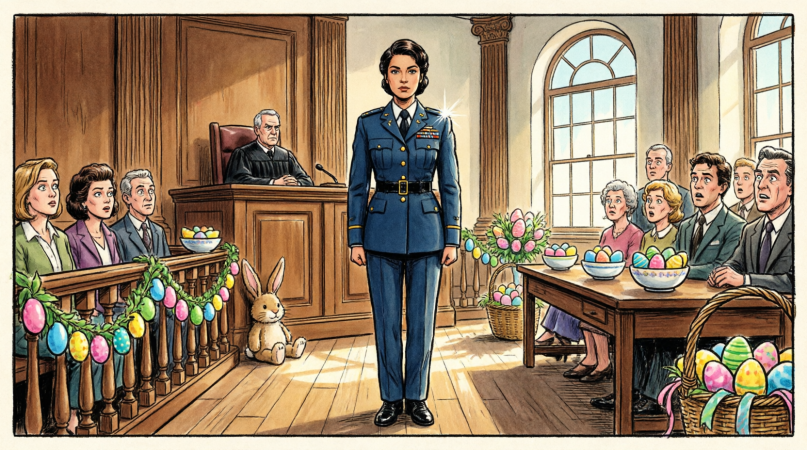
I took a slow breath, the kind you learn to take when you’ve spent decades keeping your composure under pressure. Then I pushed the door open and stepped inside. The room quieted for a moment, not out of respect, but curiosity. I saw them immediately. My parents sat together at the plaintiff’s table, dressed the way they always had, pressed, polished, carefully put together. Appearances mattered to them. Always had. My father’s silver hair was combed back neatly. My mother wore pearls like she was attending a lunchon instead of a courtroom.
Across from them sat their attorney, a younger man, maybe early 40s. Expensive suit, confident posture, the kind of confidence that comes easy when you think you already know how things will end. My mother noticed me first. Her eyes swept over me, taking in every detail. The simple blouse, the modest slacks, the absence of anything flashy. And then she smiled, not warmly. “Look who decided to show up,” she said loud enough for half the room to hear. “A few heads turned.
I walked to the defense table without responding and set my bag down carefully. I didn’t rush. I didn’t hesitate. Every movement measured. My father leaned back slightly, studying me like I was something distant, something unfamiliar. “You come alone?” he asked. “I met his gaze.” “Yes, that was all it took.” My mother let out a soft, dismissive laugh. “You’re too poor to hire a lawyer,” she said. “Pathetic.” A couple of people in the gallery shifted uncomfortably. Others didn’t.
Some even nodded quietly, agreeing with what they thought they were seeing. I didn’t react, didn’t look away, didn’t correct her. Because I had learned a long time ago that people will believe what they want to believe until the truth gives them no choice. I’ll be representing myself, I said calmly, pulling out a folder from my bag. Their attorney raised an eyebrow, exchanging a quick glance with my parents. I could see it in his face. He had already decided what I was.
Inexperienced, unprepared. An easy win. The baleiff called for order just as the judge entered. All rise, we stood. The judge, a man in his 60s with steady eyes and a quiet presence, took his seat and surveyed the room. There was nothing flashy about him. But there was something else, something you only recognize if you’ve spent enough time in courtrooms. He paid attention. Be seated, he said. The case was called. My name sounded different in that room. Not because it had changed, but because of who was saying it and why.
As proceedings began, I could feel the weight of the room pressing in. Not fear, not exactly. Expectation. Their attorney started strong, confident, structured. He laid out their case like it was already decided, painting me as absent, disconnected, uninvolved, someone who had walked away from family responsibilities and was now trying to claim something she didn’t deserve. I listened, took notes, waited. Every word he spoke told me exactly what he thought this was. What he thought I was. At one point, he gestured subtly in my direction.
The defendant has chosen to proceed without legal representation, he said almost politely, which I believe speaks for itself. A few quiet murmurss rippled through the room. The judge didn’t react. He simply turned his attention to me. Ma’am, he said, “You understand you have the right to counsel?” “I do your honor,” I replied. “And you’re choosing to wave that right?” “Yes, sir.” He held my gaze for a moment longer than expected, not challenging, not dismissive, assessing. Then he nodded once, “Very well.” As the hearing continued, I began to respond carefully, precisely, not rushing, not overreaching.
The first time I objected, their attorney blinked just slightly, like he hadn’t expected it. The second time, he adjusted his stance. By the third, the room had grown noticeably quieter. I could feel it shifting. Not completely, but enough. Still, my parents didn’t see it. Not yet. To them, I was still exactly who I had always been in their eyes. The daughter who didn’t follow the path they had chosen for her, the one who walked away. the one who in their minds had never amounted to anything.
And for a while, I let them believe that because sometimes the truth is more powerful when it arrives all at once. And when it finally did, it changed everything. I didn’t correct them that morning. Not when my mother called me poor. Not when their lawyer implied I didn’t understand the law. Not even when I saw the quiet judgment in the eyes of strangers sitting behind me. Because if there’s one thing the Navy taught me, it’s this. Timing matters and truth when delivered at the right moment carries more weight than any argument shouted too soon.
I wasn’t always the woman sitting in that courtroom. Once I was just a girl in a neat little house with polished floors and expectations that felt heavier than anything I would later carry in uniform. I grew up in Virginia Beach. My father ran a successful contracting business. My mother managed everything else. our home, our image, our place in a community where appearances weren’t just important. They were everything. We had Sunday dinners that looked perfect from the outside.
Fine china, ironed tablecloths, conversations that stayed polite and carefully controlled. But underneath that polish, there were rules, unspoken, but always understood. You succeed the right way. You associate with the right people. You never step outside the line. And from the time I was old enough to understand, I knew I didn’t quite fit inside those lines. I remember the first time I told them I wanted something different. I was 22, sitting at that same dining table, hands folded in my lap, trying to keep my voice steady.
I’m thinking about joining the Navy, I said. The silence that followed wasn’t loud. It was worse. My mother set her fork down slowly like she was afraid she might break something. My father didn’t even look up at first. He just kept cutting his steak like maybe if he ignored it, the words would disappear. The Navy, he repeated finally. Yes, sir. My mother shook her head, a small disapproving smile forming. That’s not something you need to do. I want to, I said.
That word want didn’t sit well in our house. My father leaned back in his chair, studying me the same way he did that morning in court. You’ve been given opportunities, he said. Good schools, a future. And you want to throw that away? For what a uniform. It’s not throwing it away, I said quietly. But to them, it was. And from that moment on, something shifted. I left 3 months later. No big goodbye, no proud sendoff. Just a suitcase, a one-way ticket, and a silence that stretched longer than I expected.
Boot camp wasn’t easy. It wasn’t supposed to be. But for the first time in my life, the rules made sense. You earn respect. You carry your weight. You stand by the person next to you. No pretense, no performance, just accountability. And I thrived there. Not because it was easy, but because it was honest. Years passed. I didn’t just stay in. I built a career. I went through officer training, then law school through the Navy’s program. Long nights, hard work, no shortcuts.
I became a Jag officer, Judge Advocate, General’s Corps, a Navy lawyer. The first time I stood in a military courtroom, I felt something settle inside me. A sense of purpose I had never found sitting at that polished dinner table back home. These cases weren’t about appearances. They were about truth, responsibility, justice, and I was good at it. Not flashy, not loud, but steady, reliable, the kind of lawyer people trusted when things really mattered. I tried in those early years to reconnect with my parents.
I called, wrote letters, sent updates about promotions, deployments, even small things. Most of the time, I got nothing back. When I did, it was brief, polite, distant. My mother once wrote, “We hope you’re doing well with your work. Not career, not service, just work.” Like it was something temporary, something that didn’t quite count. Over time, I stopped trying as hard. Not out of anger, just acceptance. You can’t make people see what they’ve already decided to ignore. The years moved forward the way they do.
Assignments changed. Cases came and went. I spent time overseas, time on bases across the country, built relationships that felt more like family than anything I had left behind. I learned to carry myself quietly, to let my work speak, to walk into a room without needing anyone’s approval. And then about a year ago, I got the call. My father’s health had started to decline. Not dramatically, but enough that certain decisions were being made about assets, property, long-term arrangements.
A lawyer contacted me, not my parents. A lawyer. There were documents I needed to sign, or rather documents they assumed I would sign. papers that effectively removed me from any claim to family property, transferred ownership, consolidated everything under my parents’ control, and eventually into trusts I had no part in. I read them carefully, line by line, and what I saw wasn’t just exclusion. It was manipulation, legal on the surface, but built on assumptions that I wouldn’t question it, that I wouldn’t understand, that I would simply accept it.
They didn’t know me. Not anymore. Maybe they never had. I didn’t call them. Didn’t argue. I simply declined to sign and requested a formal review. That’s how we ended up in that courtroom. Not because I wanted a fight, but because I wasn’t willing to disappear quietly. Back in the present, sitting at that defense table, I listened as their attorney continued presenting his case. He spoke confidently about family intentions and reasonable expectations. words that sounded respectable but didn’t hold up under scrutiny.
I noted every inconsistency, every assumption, every place where truth had been adjusted. At one point, I glanced over at my parents. They weren’t watching the proceedings closely. They were watching me, still trying to figure out why I hadn’t folded yet, why I hadn’t apologized, why I was still sitting there calm and composed as if I belonged in that room. They thought they knew my story, but they had only ever seen the parts they chose to see, and soon they were going to see the rest.
By midm morning, the courtroom had settled into a rhythm. Papers shuffled, pens scratched quietly across legal pads. The soft hum of the air conditioning filled the pauses between arguments. It was the kind of steady, familiar cadence I had lived in for decades. But for everyone else in that room, it was just another case. For me, it was something else entirely. Their attorney, Mr. Callahan, I’d learned was good. Confident, articulate, well-prepared in the way most civilian attorneys are when they believe the facts are on their side.
He spoke with the ease of someone used to being listened to, and up until that morning, he probably was. He walked the judge through documents that had been carefully organized, financial summaries, property transfers, statements of intent. On the surface, it all looked clean, reasonable, even fair. This, he said, gesturing to a highlighted section of a document, reflects the long-standing understanding within the family structure. My clients have maintained and managed these assets for decades, while the defendant has remained largely absent.
Absent. That word lingered in the air. It wasn’t inaccurate, at least not in the way he meant it. I had been gone. But absence doesn’t always mean neglect, and presence doesn’t always mean honesty. I made a note in the margin of my folder. Then another, then another. I didn’t interrupt right away. That’s something younger attorneys often do. They jump in too quickly trying to prove something before the moment is right. But I had learned patience. Let them build their case.
Let them commit to their narrative. Because once it’s on record, it’s harder to walk back. Furthermore, Callahan continued, “The defendant has demonstrated no active involvement in the management or preservation of these assets. There is no evidence of financial contribution, no documentation of participation. ” Objection, your honor. The word came out steady, clear, not loud, but firm enough to stop him mid-sentence. The room shifted slightly. Callahan turned just a fraction slower than before, not irritated yet, but surprised.
The judge looked at me. On what grounds? Assumes facts, not in evidence, I said, and mischaracterizes the nature of contribution. A pause. Not long, but long enough. The judge nodded once, sustained counsel rephrase. Callahan adjusted his tie, offering a polite nod. Of course, your honor, but I saw it. that first crack. He continued more carefully now, choosing his words with a little more precision, which meant he was thinking, and that was good. As the hearing moved forward, I began to respond more frequently.
Not aggressively, not emotionally, just accurately. Each time he overstated something, I corrected it. Each time he leaned on assumption, I brought it back to fact. At first, it was subtle. A clarification here, an objection there, but gradually the pattern became harder to ignore. At one point, he presented a timeline, a neat structured summary of my supposed absence. Years reduced to bullet points, dates, locations, gaps. He placed it on the stand like it told the whole story. Your honor, he said, this timeline clearly demonstrates the defendant’s prolonged disengagement from the family’s affairs.
I stood slowly. permission to approach. The judge nodded. I walked forward, each step measured, and took a look at the document. Then I looked up. Is this timeline intended to represent my full professional history? I asked. Callahan hesitated just briefly. It reflects the relevant periods of absence. Yes. Absence from this household, I said. Not absence from service. He didn’t answer right away. Didn’t need to. The distinction had already landed. Your honor, I continued, I would request that the court recognize the difference between physical absence and professional obligation.
The judge leaned slightly forward. You may elaborate. And so I did calmly without raising my voice. I explained assignments, deployments, legal postings. Not in detail, just enough. Just enough to show that those gaps weren’t empty. They were filled with work, responsibility, service. The room grew quieter. Not dramatically, but noticeably. Even the people in the back, the ones who had been whispering earlier, had gone still. I returned to my seat. Callahan didn’t rush to continue this time. He took a sip of water, adjusted his notes, recalibrating.
Across the room, my parents were watching more closely now. The confidence they had walked in with hadn’t disappeared, but it had shifted. Something small, something uncertain. Still they didn’t understand. Not yet. The next phase of the hearing moved into documentation, financial records, ownership transfers, legal filings. This was where they believed they were strongest. Paper after all, tends to favor those who control it and for years they had controlled everything. Callahan presented the transfer documents, outlined the reasoning, framed it as a necessary step, protecting assets, simplifying management, ensuring continuity.
All decisions, he said, were made in good faith with the understanding that the defendant had neither the interest nor the capacity to participate. There it was again. Assumption, wrapped in polished language. I stood. Your honor, may I? The judge nodded. I approached the table again, this time with my own folder, carefully organized, indexed, tabbed. I placed a document on the stand. Exhibit B, I said. The clerk stepped forward, taking it. Callahan leaned slightly, trying to see. This, I continued, is correspondent sent to my parents’ legal office 12 months prior to the transfer.
 :
: