The Graduation That Was Supposed to Be My Proudest Day
My name is Natalie Richards.
At twenty-two years old, I believed graduating with honors from University of California, Berkeley would be the proudest moment of my life.
Instead, it became the day my father publicly disowned me in front of everyone I knew.
What he didn’t realize was that I had been carrying his darkest secret for years.
And that day… I finally had nothing left to lose.
I grew up in suburban Chicago in a house that looked perfect from the outside.
A two-story colonial home.
Perfectly trimmed lawn.
Spotless windows.
Everything about it reflected my father’s obsession with image.
My father, Matthew Richards, was the Chief Financial Officer of a respected financial firm downtown. To him, success had only one acceptable form: prestigious schools, powerful careers, and the approval of men who wore the same expensive suits and identical watches.
In the Richards household, expectations were not suggestions.
They were rules.
He rarely needed to raise his voice. A slight change in tone could silence an entire dinner table.
And we all learned quickly that disappointing him was not an option.
The Quiet Sacrifice of My Mother
My mother, Diana Richards, had once been a completely different person.
Before marrying my father, she studied art history and dreamed of working in museums.
But after twenty-five years of marriage, that dream had faded.
Instead of curating art collections, she curated our family’s social image.
Sometimes, when my father traveled for work, she would secretly take me to art exhibitions. In those quiet museum halls, I caught brief glimpses of who she used to be—her eyes bright with excitement.
At home, though, she repeated the same phrase whenever my father criticized me.
“Your father means well.”
Even when he treated an A-minus like a failure.
Even when he mocked my interests.
Even when he made it clear I wasn’t quite the daughter he wanted.
The Sons Who Followed the Script
My older brothers had no trouble fitting into the life my father had designed.
James Richards, the eldest, was practically my father’s clone. He studied business at Northwestern, dressed exactly like him, and spoke with the same calm authority.
Tyler Richards showed a brief spark of rebellion once. During college he nearly turned a study-abroad semester in Spain into a gap year.
My father flew to Spain personally to correct that mistake.
Soon after graduating from the University of Chicago’s business school, Tyler joined my father’s firm.
They followed the family blueprint.
I didn’t.
The Daughter Who Refused the Plan
While my brothers played stock-market simulations with my father, I buried myself in books about the Supreme Court and civil rights law.
Our dinner table often turned into a battlefield.
My father would listen to my arguments, then slice into his steak and dismiss them with a single sentence.
“The law is for people who couldn’t succeed in finance,” he’d say.
“It reacts to problems instead of preventing them.”
At the time, I didn’t understand how ironic that statement would eventually become.
The Decision That Changed Everything
During my senior year of high school, acceptance letters began arriving.
I had applied to business schools to keep the peace.
But secretly, I had also applied to pre-law programs.
When my acceptance letter from Berkeley arrived—along with a substantial scholarship—I knew my life was about to change.
That evening I called a family meeting.
My hands trembled as I spoke.
“I’m going to Berkeley,” I said. “I’m studying pre-law.”
My mother looked both proud and terrified.
James scoffed.
Tyler stared at the floor.
My father simply repeated the word:
“Berkeley.”
Then he said three words that altered my life forever.
“Without my support.”
The Day My Father Cut Me Off
He didn’t shout.
He didn’t argue.
He spoke with the same tone he used to discuss investment portfolios.
“I allocated funds for your education based on certain expectations,” he said calmly.
“If you choose this path, those funds will be reallocated.”
“You’re cutting me off because I want to study law?” I asked.
“I’m reallocating resources where they will provide better returns.”
To him, it wasn’t about his daughter.
It was about investment strategy.
That night, my mother slipped quietly into my room.
She handed me an envelope.
Inside was $5,000.
“He can’t know,” she whispered.
That money became the first step toward my independence.
Starting Over at Berkeley
Arriving in California with two suitcases and limited money was both terrifying and exhilarating.
My scholarship covered tuition at Berkeley.
Everything else was my responsibility.
While some classmates posted photos of luxury vacations, I worked three jobs:
Morning shifts at a campus coffee shop.
Evenings at the library.
Weekends assisting a law professor with research.
Sleep became a luxury.
But slowly, I built something better than approval.
I built a life.
The Family I Chose
My roommate Stephanie Carter was the first person who truly understood me.
She often found me asleep at my desk and draped blankets over my shoulders.
“You know beds exist, right?” she joked one morning, handing me coffee.
Soon our circle grew.
Rachel Alvarez, a fearless environmental science major who organized protests and challenged every authority figure she met.
Marcus Chen, a brilliant computer science student who somehow loved debating constitutional law almost as much as I did.
They reminded me of something I had never truly believed before:
Family is not always defined by blood.
The Mentor Who Changed My Future
One of the most influential people I met at Berkeley was Professor Eleanor Williams.
She was famous on campus for her demanding constitutional law seminars.
After dismantling my argument during my first semester, she asked me to stay after class.
“You argue like someone who’s been defending herself her whole life,” she said thoughtfully.
“That’s not a weakness.”
“It’s power—if you learn to use it.”
Under her mentorship, I transformed from an exhausted student trying to prove herself into someone confident in her voice.
Finding My Purpose
By junior year, Professor Williams recommended me for an internship at Goldstein & Parker.
The firm specialized in corporate accountability cases.
Ironically, I spent my days studying how powerful corporations hid unethical behavior.
My supervisor, Laura Goldstein, noticed my dedication.
“You understand how these companies think,” she told me once.
“But you still have a conscience.”
“That combination makes dangerous lawyers—in the best way.”
For the first time, someone valued the exact qualities my father had criticized.
The Success He Never Saw
By senior year I had accomplished everything I once dreamed about.
Top of my class.
President of the pre-law society.
Early acceptance into three prestigious law schools.
Including my dream: Yale.
But my bank account was nearly empty, and exhaustion had become normal.
Still, I had done it.
Without my father.
The Graduation Invitation
Out of obligation, I sent my family graduation invitations.
Three weeks later my mother emailed me.
“Natalie, we can’t attend. Your father has an important client meeting.”
I wasn’t surprised.
My friends stepped in immediately.
Rachel planned a huge celebration.
Marcus’s parents insisted on “adopting me for the day.”
For the first time, I believed graduation could still feel special—even without my family there.
Graduation Morning
The morning of graduation arrived with perfect Berkeley weather.
Sunny skies and a cool breeze.
Stephanie woke me dramatically.
“Rise and shine, future Supreme Court justice!”
Rachel arrived with bagels and celebration shirts.
Marcus brought his parents, who handed me flowers and a card that nearly made me cry.
We walked toward the ceremony surrounded by excitement and laughter.
And for once, the absence of my family didn’t hurt as much as I expected.
Until I looked toward the audience.
The Faces I Never Expected to See
Out of habit, I scanned the crowd.
Not expecting anything.
Not hoping for anything.
Then I saw them.
Four rows back.
On the left side.
My entire family was sitting there.
And suddenly, I realized my graduation ceremony was about to turn into something none of us would ever forget.
My father, ramrod straight in an expensive suit that looked out of place among the more casual California crowd. My mother beside him, clutching her purse with white knuckles. James and Tyler flanking them like bookends.
My heart lurched so violently I nearly lost my balance.
Rachel caught my elbow. “What’s wrong? You look like you’ve seen a ghost.”
“They’re here,” I whispered, unable to tear my gaze away. “My family. They came after all.”
Rachel followed my gaze, her expression hardening slightly. She’d heard enough stories over four years to form her own opinions about my father. “Well,” she said finally, squeezing my hand, “now they get to see what they almost missed.”
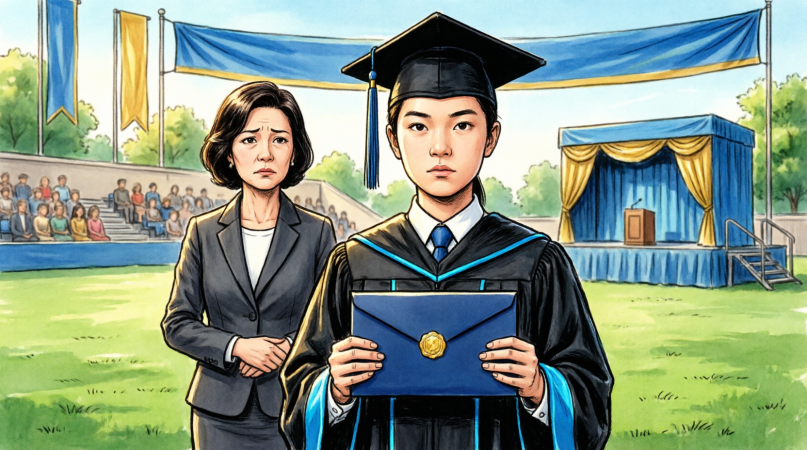
The ceremony passed in a blur. When they called “Natalie Richards, summa cum laude,” my friends cheered wildly as promised. From my position on stage, I could see my mother clapping enthusiastically, Tyler joining in with genuine smiles. James offered restrained applause. My father’s hands came together exactly three times, the minimum requirement of acknowledgement.
Still, they had come. That had to mean something.
After the ceremony, I navigated through the crowd toward them, my pulse racing with a confused mixture of hope and dread. My mother reached me first, pulling me into a perfume-scented embrace.
“I’m so proud of you,” she whispered fiercely. “So, so proud.”
Tyler gave me an awkward but sincere hug. “Nice job, sis. Berkeley looks good on you.”
James offered a stiff handshake. “Congratulations on your achievement.”
My father remained slightly apart, evaluating me as though I were a balance sheet with concerning numbers. “Natalie,” he said finally, extending his hand formally. “Congratulations.”
I shook it, feeling the familiar distance despite our physical proximity. “Thank you for coming. I thought you had an important meeting.”
“Plans change,” he replied cryptically.
Before the conversation could become more strained, Stephanie bounded over with her family, followed by Rachel, Marcus, and his parents. Introductions were made, with my friends’ families filling the awkward gaps with cheerful chatter about the ceremony and plans for celebration.
“We’ve made lunch reservations for everyone at Bayside Restaurant,” Marcus’s father announced. “Our treat. We’re celebrating all these amazing graduates.”
My father’s jaw tightened at being included in someone else’s plans, but my mother jumped in quickly. “How thoughtful. We’d be delighted.”
The restaurant gathering was an exercise in contrasting worlds.
My California life collided with my Chicago past as conversations about law school plans and campus memories mixed uncomfortably with my father’s probing questions about starting salaries and firm rankings.
While my friends’ parents spoke about their children with unabashed pride, my father found ways to turn each of my accomplishments into a question.
“Yale Law School has accepted you. Interesting choice. I would have thought Harvard would align better with serious career objectives.”
“Constitutional law focus. Rather abstract when corporate law offers more substantial opportunities.”
“Student body president. Administrative experience is valuable. Though I wonder if your time might have been better spent on judicial internships.”
With each comment, my friends exchanged glances, and their parents became increasingly bewildered by my father’s inability to simply celebrate his daughter’s achievements. My mother attempted to redirect conversations while my brothers looked increasingly uncomfortable.
As lunch progressed, Tyler made a genuine effort to connect, asking about my favorite classes and experiences in California. When I mentioned Professor Williams and her mentorship, he seemed genuinely interested.
“She sounds amazing,” he said. “You always did need strong teachers who challenged you.”
My father cut in before I could respond. “What Natalie has always needed is practical guidance. These academic mentors fill students’ heads with idealistic notions that don’t translate to the real world.”
The table fell awkwardly silent.
Marcus’s mother, June, who had been nothing but warm all day, finally spoke up. “Well, from what we’ve seen, your daughter has a remarkable ability to translate her education into practical skills. Her work with that corporate accountability firm was quite impressive.”
My father’s eyebrows raised slightly. “Corporate accountability? What exactly does that entail?”
The tone in his voice made my stomach tighten. We were approaching dangerous territory.
“We investigate corporate fraud and represent whistleblowers,” I explained carefully. “The firm specializes in cases where companies have misled investors or engaged in financial misconduct.”
Something flickered across my father’s face, so quickly I might have missed it if I hadn’t spent a lifetime studying his expressions for signs of approval or disapproval.
“Sounds like glorified tattling,” he said dismissively. “The business world requires discretion and loyalty.”
“I think it requires ethics and transparency,” I countered before I could stop myself.
The temperature at the table seemed to drop ten degrees. My mother’s hand flew to her necklace, her nervous tell. James shifted uncomfortably while Tyler studied his water glass with sudden fascination.
We managed to navigate through the rest of lunch with superficial conversation, but the tension remained palpable. As we prepared to leave for the afternoon graduation reception on campus, my father announced he had made dinner reservations for just our family at Laurel Heights, the most expensive restaurant in Berkeley.
“We need family time,” he stated in a tone that brooked no argument. “Seven o’clock.”
My friends looked concerned, but I assured them I would meet up with them afterward for our planned celebration. As we parted ways, Rachel squeezed my arm.
“Text us if you need an emergency rescue,” she whispered. “We can fake a crisis in ten minutes flat.”
I laughed, but part of me wondered if I might need exactly that before the night was over.
Laurel Heights restaurant exuded old-world luxury, all polished wood, crystal glasses, and hushed conversations. My father had reserved a table in the main dining room rather than a private space, which surprised me given his usual preference for privacy. The restaurant was filled with other graduation parties, families beaming with pride as they toasted their graduates. The contrast with our table couldn’t have been more stark.
My father ordered an expensive bottle of wine without consulting anyone’s preferences, then spent the first twenty minutes of dinner interrogating me about my decision to accept Yale’s offer over other law schools.
“New Haven,” he said with thinly veiled distaste. “Another four years away from Chicago. One might think you’re deliberately choosing locations based on their distance from family.”
“I’m choosing based on the quality of education and career opportunities,” I replied evenly, determined not to let him provoke me on what should have been a celebratory day.
“Yale does have an excellent reputation,” my mother offered tentatively.
My father continued as if she hadn’t spoken. “And your focus on constitutional law. What exactly do you plan to do with that? Spend your career arguing theoretical points while making a public defender’s salary.”
Tyler attempted to deflect. “Dad, Nat only just graduated summa cum laude from Berkeley. Maybe we could just celebrate that tonight.”
“I’m simply trying to understand the return on investment here,” my father replied, swirling his wine with precision. “Four years of education should lead to tangible outcomes.”
“My education isn’t a stock portfolio,” I said, feeling heat rise in my cheeks despite my determination to remain calm. “Its value isn’t measured only in dollars.”
James, ever the peacemaker when it served his interests, jumped in. “How’s your roommate Stephanie handling job hunting? Finance, wasn’t it?”
“Environmental science,” I corrected, “and she’s already accepted a position with a climate research institute.”
My father scoffed. “Another idealist. You certainly found your people out here.”
With each passing minute, the tension mounted. Nearby tables were celebrating with champagne toasts and warm speeches while our conversation grew increasingly strained. A family at the next table had just presented their graduate with a new car key, everyone laughing and taking photos.
“Now that’s a practical graduation gift,” my father remarked pointedly. “Useful for entering the real world.”
“I don’t need a car in New Haven,” I said. “The campus is walkable.”
“That wasn’t my point, Natalie,” he replied coldly.
 :
: