The rain tapped softly against the kitchen windows as Adrian Brooksfield suddenly collapsed onto the cold tile floor, his body going still in a way that instantly told me something was terribly wrong. For a brief second I told myself he had only fainted from exhaustion after months of fourteen hour workdays, but when I reached his hand and felt no resistance at all, fear took over everything inside me.
The paramedics worked with urgency, their voices sharp and practiced as they tried to bring him back while I stood frozen beside them. At Riverside Memorial Hospital in Eugene, Oregon, a doctor with tired eyes finally spoke to me in a quiet tone and explained that Adrian had suffered a catastrophic aortic rupture, something so sudden that survival had never truly been possible.
I called my parents while sitting outside the intensive care unit, my clothes still damp and my hands trembling uncontrollably from shock. My mother answered with irritation already in her voice, and when I whispered, “Mom, Adrian is gone,” there was a pause that held no grief, only inconvenience.
“We are at your sister’s birthday dinner,” she said flatly, as laughter echoed in the background. “Can this wait until tomorrow because tonight is important.”
I tried again, my voice breaking as reality crushed me, but she repeated, “We are busy tonight, Courtney only turns thirty five once,” and ended the call without another word.
I sat there staring at my phone until my daughter Mia, only eight years old, climbed into my lap and asked if her grandparents were coming. I told her they were on their way even though I already knew they were not coming at all, because she had just lost her father and I could not take anything else from her in that moment.
They never showed up at the hospital, they never came to the visitation, and they never stood beside us at the funeral where I tried to explain to my daughter why her father would never come home again. Meanwhile, Courtney posted smiling pictures from a vineyard trip while I stood beside a polished casket pretending I was still strong enough to hold everything together.
Four days after the burial, my parents finally appeared at my house dressed in expensive coats and carefully arranged expressions that looked like grief but felt empty. My mother did not hug me, and my father did not even glance toward Mia, which told me everything before they even spoke.
“We heard Adrian left behind a life insurance policy and business assets,” my father said, clearing his throat as if discussing something routine. “Since family shares both burdens and blessings, we expect half of what remains.”
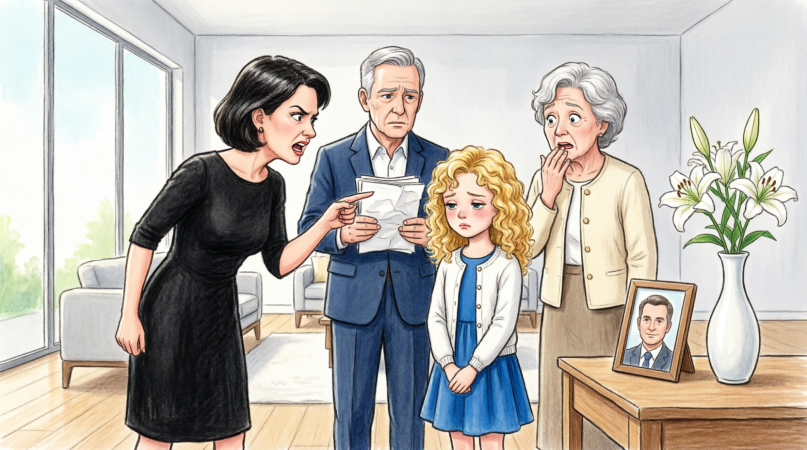
I could not respond because the words felt unreal, like something spoken in a different world that had nothing to do with loss or love. Before I could gather myself, Mia stepped forward from the hallway holding a sealed envelope with both hands and said calmly, “This is what you came for.”
My mother opened the envelope, and the color drained from her face instantly while my father leaned closer to read. Their hands began to tremble as they realized that instead of easy money, they were staring at consequences they never expected.
Inside the envelope was a notarized document showing a personal loan of one hundred eighty seven thousand four hundred dollars, signed by both of them eighteen months earlier when Courtney’s failing bakery needed rescue. Adrian had helped them despite my hesitation, but he insisted on formal paperwork because he understood how money could change people.
The second document was a letter from attorney Eleanor Hayesfield, stating that the full amount was now due within thirty days with no extensions or exceptions. It also made clear that failure to repay would result in legal action including interest, fees, and a lien on their lake cabin in Bend, Oregon.
The third document shook them the most because it contained a certified transcript of the phone call I made the night Adrian died. It showed every word, including my broken voice saying he was gone and my mother’s cold response about being busy celebrating a birthday.
My father snapped first, his voice rising with anger as he tried to regain control. “That loan was for Courtney, and Adrian knew we were acting on her behalf.”
“Yes,” I replied quietly, “that is exactly why both of you signed it personally.”
My mother finally looked at me and asked, “You would really take legal action against your own parents,” as if she had not just revealed who she truly was.
“You did not come here as my parents,” I said, feeling something inside me finally settle into clarity. “You came here as people who owe money.”
Mia stepped closer to me and held my hand, her small fingers cold but steady as she spoke again. “You did not come when my dad died,” she said, her voice calm but firm in a way that felt older than her years.
My father muttered that it was not fair, but Mia lifted her chin slightly and answered, “No, it wasn’t,” and in that moment I saw Adrian in her completely.
My parents tried to justify themselves, talking about obligations and events, but every excuse sounded weaker with each word. I told them clearly that I was done rearranging my life around Courtney’s constant crises, and that Adrian’s death had drawn a line I would not cross again.
They left without resolution, and that evening I spoke with Eleanor who confirmed that Adrian had updated his will months earlier. He had created a trust for Mia and me, with strict conditions preventing any financial help to my side of the family without careful oversight.
She read me his personal statement, and I broke down as I heard his words describing exactly what had just happened. He had understood the pattern long before I accepted it, and he had protected us even after his death.
In the following days, Courtney tried to manipulate public opinion through social media, portraying herself as a victim while my parents quietly spread false narratives among relatives. I refused to respond emotionally and instead forwarded everything to Eleanor, who quickly issued legal notices and documented every attempt at coercion.
Soon after, a financial review revealed that a large portion of the original loan had been diverted to cover my parents’ personal debts rather than Courtney’s business. This discovery strengthened the legal case significantly and removed any illusion of misunderstanding.
My parents returned again, this time desperate and shaken as they asked to resolve everything privately. I stepped outside to speak with them while Mia watched from the window, knowing I had to show her something different from what I had learned growing up.
“I want distance,” I told them firmly. “I want the harassment to stop, the lies corrected, and the debt repaid exactly as documented.”
My mother cried, but this time her tears came from fear rather than regret, and my father looked at me as though I had become someone he did not recognize. In truth, I finally had become someone who would not accept the same patterns anymore.
Within a month, Courtney was forced to sell part of her business, and my parents arranged loans to begin repaying what they owed. Legal agreements replaced empty promises, and boundaries replaced the expectations that had defined my entire life.
Mia began therapy and slowly found her way back to laughter, while I rebuilt a life shaped by loss but guided by clarity. Adrian’s company was sold to a trusted colleague, and the trust he created ensured stability for our future without interference.
Sometimes I still remember that phone call and feel the ache rise again, but now it is followed by something stronger. The day my daughter handed them that envelope, she did more than expose their intentions, she ended a pattern that had defined generations.
In the trembling of their hands, I saw the truth finally break through everything I had been taught to ignore. And for the first time in my life, I understood that protecting my child mattered more than preserving a version of family that had never truly protected me.