My 7-year-old daughter sent a boy to the hospital.
That was the sentence everyone wanted to start with, because it sounded simple.
It sounded like guilt.
It sounded like a case already solved before anyone had asked why a child with a bandaged hand kept whispering the name of another boy.
The principal’s office smelled like floor wax, copier toner, and coffee that had gone bitter in a paper cup on the edge of the desk.
The fluorescent lights buzzed above us.
Every few seconds, Damian Ashford shifted in the chair across from me, and the chemical-blue ice pack crackled against his swollen jaw.
His mother stood beside him in a beige blazer that looked too sharp for an elementary school office.
His father placed a folder on the principal’s desk like he was dropping evidence in front of a jury.
“Your daughter violently assaulted our son,” Mrs. Ashford said.
Her voice was clipped, polished, and cold.
I had heard that tone before from people who were used to being believed.
Mr. Ashford tapped the folder with two fingers.
“We are filing a civil suit,” he said. “The starting figure is $500,000. Given the severity of the trauma, we are also pressing criminal charges.”
Five hundred thousand dollars.
Criminal charges.
I looked at the principal.
I looked at the counselor.
I looked at Officer Caldwell, who stood near the wall with his notebook open and his jaw tight.
Nobody said what I was thinking.
Lily was seven.
She still asked me to cut the crusts off her toast when she was tired.
She still put stickers on my lunch cooler when she thought I needed cheering up.
She apologized to ants on the sidewalk if her sneaker landed too close.
At 8:05 that morning, I had signed the emergency contact card on the clipboard outside the school office.
I had checked her inhaler instructions.
I had written a note on her napkin that said, “Good luck on spelling. Love, Dad.”
By 2:17 p.m., my daughter had been turned into a school incident report, three witness statements, and a county juvenile intake sheet.
The first report said Damian had been struck with enough force to damage his jaw.
The second said Lily refused to explain.
The third said several children had seen the punch but not what happened before it.
People with money know how to make injury sound like a verdict.
Parents like me learn how fast a number can become a threat.
Officer Caldwell stepped forward.
His expression was apologetic, but the notebook in his hand was not.
“Sir,” he said, “based on the witness statements and the injuries, I have to take Lily to the station for processing. We need prints.”
The word went through me like cold water.
Prints.
A mugshot.
A file number.
A seven-year-old child with a record before she had even lost all her baby teeth.
The principal’s secretary stopped typing outside the half-open door.
The counselor’s pen hovered over her yellow legal pad.
Damian’s breathing went quiet for one strange second.
Mrs. Ashford watched me like my fear proved her case.
For one ugly heartbeat, I pictured myself sweeping the folder off the desk.
I pictured all those clean legal pages scattering across the carpet.
I pictured saying something so loud that everyone in that office would finally remember Lily was a child.
Instead, I folded my hands together until my knuckles hurt.
“I want to see my daughter,” I said. “Now.”
Mrs. Ashford inhaled like she intended to object.
I turned toward her.
“Now.”
The hallway outside the office was covered in construction-paper tulips, crayon suns, and little blue clouds cut by safety scissors.
Somewhere down the corridor, a class was singing the alphabet.
My shoes sounded too loud on the tile.
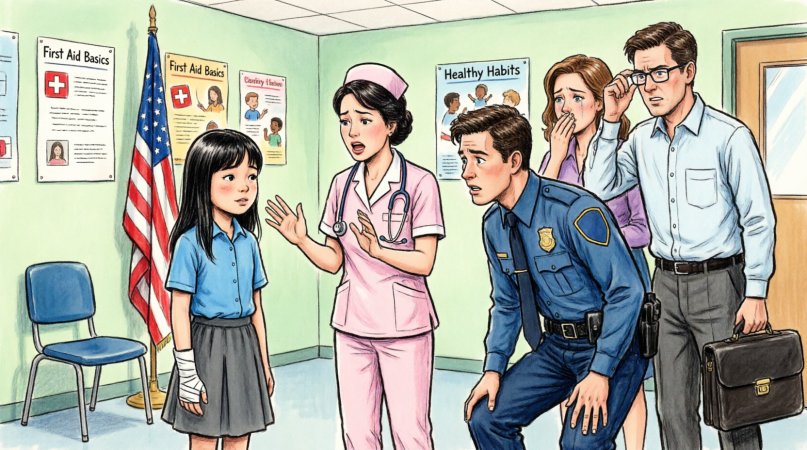
The nurse’s office smelled like antiseptic, latex gloves, and old Band-Aids.
Lily sat on the exam table with the paper cover wrinkled beneath her legs.
One sneaker swung once, then stopped when she saw me.
Her right hand was wrapped in thick white gauze.
Tiny dried red specks marked the bandage over her knuckles.
When she looked up at me, I expected panic.
I expected guilt.
I expected the scared face she made when she broke a mug or spilled juice on the rug.
That was not what I saw.
I saw certainty.
Cold, fierce certainty.
Not cruelty.
Not pride.
Certainty.
The nurse touched my sleeve and lowered her voice.
“She won’t explain,” she said. “She keeps asking if Tommy is okay. I don’t know who Tommy is, but she has asked four times.”
I knew Tommy.
I had never met him, but I knew him through Lily’s little Tuesday stories after reading-buddy time.
Tommy liked dinosaurs.
Tommy hated loud bells.
Tommy wore a brace under his shirt, and some kids called him robot boy until Lily walked him to the cafeteria and told them to stop.
She once told me he called her “the brave one.”
I had smiled and packed her lunch for the next day.
I thought it was one of those tiny loyalties children build before adults understand they matter.
I had not known it was evidence.
I sat beside Lily and took her uninjured hand.
It was cold and damp inside mine.
“Honey,” I whispered, “the police are here. You need to tell me what happened.”
Lily looked past me.
Officer Caldwell stood in the doorway.
Behind him were the Ashfords, the counselor, and the principal.
Damian leaned against his mother with the ice pack pressed hard to his face.
The whole group had followed us because nobody wanted the truth.
They wanted the ending.
Lily squeezed my hand.
Then she raised her bandaged one.
“He hurt Tommy first.”
The sentence landed so softly that for a second the room did not understand it.
Then the nurse covered her mouth.
Officer Caldwell’s hand stopped near the cuffs on his belt.
Damian’s eyes shot toward his father.
Mrs. Ashford snapped, “That is a lie.”
Lily did not look at her.
She looked at Damian.
“You pushed Tommy by the lockers,” she said. “You said he walked weird. Then you tried to pull the brace off.”
Damian made a sound through his teeth.
Mr. Ashford stepped forward.
“Officer, I would caution everyone against taking an unverified statement from a child who is clearly trying to avoid consequences.”
Officer Caldwell did not answer him.
He looked at Lily.
“What brace, sweetheart?”
Lily’s eyes filled, but her voice stayed steady.
“The one under his shirt. The hard one. His doctor said nobody can touch it.”
The counselor lowered her yellow legal pad.
I saw it then.
The first page of her witness notes did not have Tommy’s name on it.
The second page did.
It had been there, half-hidden under the incident report, the corner folded over where someone had flipped too fast.
At 2:03 p.m., the playground aide had written “possible bullying near hallway lockers.”
At 2:06 p.m., the nurse had logged “student Tommy complaining of brace pain.”
At 2:09 p.m., Damian had been brought in with a jaw injury.
Those three times had never been put together in one sentence.
That is how truth gets buried sometimes.
Not under a conspiracy.
Under paperwork.
The nurse’s desk phone rang.
No one moved.
The nurse answered it with shaking fingers, and her face changed before she even spoke.
She pressed the receiver tighter to her ear.
“Yes,” she said. “This is the school nurse.”
Then she looked straight at Lily.
“It’s the hospital intake desk,” she whispered. “They have Tommy in pediatric surgery prep. The surgeon wants the officer and the parents there now.”
For the first time since I had walked into that school, Mrs. Ashford stopped looking in charge.
Mr. Ashford went pale.
Damian turned his face into his mother’s blazer.
Officer Caldwell closed his notebook.
“Mrs. Ashford,” he said, “before I process a second-grader, I am going to hear from the other child.”
The hospital was fifteen minutes away.
I rode in the back of Officer Caldwell’s cruiser with Lily beside me because I refused to let her ride alone.
She kept her bandaged hand in her lap.
The closer we got to the hospital, the smaller she looked.
All that fierce certainty had cost her something.
Her shoulders had started shaking.
I wanted to ask her why she had not told the principal.
I wanted to ask why she had let them say all those awful things without defending herself.
But I already knew part of the answer.
Children who protect other children often forget they are allowed to ask for protection too.
So I only said, “I’m here.”
Lily nodded without looking at me.
At the hospital intake desk, everything was too bright.
White floors.
White walls.
A television mounted in the corner with the sound off.
A small American flag stood near a stack of visitor badges, beside a plastic cup full of pens.
Mrs. Ashford came in ahead of us, already speaking to someone on her phone.
Mr. Ashford followed with the folder tucked under his arm.
Damian was taken toward imaging with a nurse and a fresh ice pack.
The Ashfords wanted the room to be about Damian.
For a while, it was.
There were forms.
There were intake questions.
There was a police report number written on a sticky note and attached to Officer Caldwell’s clipboard.
There was a radiology order for Damian’s jaw.
Every document seemed to make Lily shrink deeper into the chair beside me.
Then a nurse in navy scrubs opened a door and called for Officer Caldwell.
“Doctor is ready.”
We followed her down a hall that smelled like disinfectant and warm plastic.
Lily’s fingers were tucked into my palm.
I could feel the tremor in them.
The pediatric surgeon stood at the end of the hallway with a chart in his hand.
He was not what I expected.
He did not look angry.
He did not look rushed.
He looked tired in the way hospital people look tired, like they have carried other families’ worst days for years and still learned how to speak gently.
Officer Caldwell stepped forward.
“Doctor, this is the child involved in the incident.”
The surgeon looked at Lily.
Then he stopped.
Not politely.
Not professionally.
He stopped like the room had changed shape.
Mrs. Ashford saw it and seized on it.
“Yes,” she said, “that is the girl who attacked my son.”
The surgeon did not look at her.
He walked straight to Lily.
I felt my whole body tense.
So did Officer Caldwell.
The nurse behind the desk lifted her hand like she might need to intervene.
The surgeon crouched in front of my daughter instead.
“Lily?” he asked.
Lily’s lower lip trembled.
“Yes.”
The surgeon’s eyes softened.
Then he did something nobody in that hallway expected.
He held out the bottom of Tommy’s chart and a pen.
“Would you mind signing this for me?” he asked.
The silence that followed was so complete I could hear the overhead light humming.
Mrs. Ashford blinked.
Mr. Ashford looked at the chart like it had betrayed him.
Officer Caldwell said, “Doctor?”
The surgeon kept his voice calm.
“Tommy told us about Lily months ago,” he said. “He calls her the brave one.”
Lily’s face crumpled.
The surgeon turned the chart slightly so the adults could see the plastic sleeve tucked inside.
There was a drawing in it, creased from being folded and unfolded too many times.
A dinosaur with a crooked smile.
A girl with a ponytail standing in front of it like a shield.
At the bottom, in careful second-grade handwriting, were the words: Lily the Brave.
The L was backward.
The y curled too high.
It was my daughter’s handwriting.
“Tommy brought this to every appointment,” the surgeon said. “He said his friend signed it so the scary stuff would know who it was dealing with.”
Lily covered her mouth with her good hand.
I had to look away for one second because I could not breathe.
The surgeon stood.
“Tommy’s brace was not a toy,” he said. “It was protecting his healing spine and ribs. Someone yanked at it hard enough to shift the padding and bruise the skin underneath.”
Mrs. Ashford said nothing.
The surgeon looked at Damian’s parents then.
“I am not here to decide school discipline or legal fault,” he said. “I am telling you the medical facts. If Lily struck Damian while he was pulling on that brace, then she interrupted a serious risk to my patient.”
The words did not make my daughter innocent all by themselves.
They made the room finally ask the right question.
What happened first?
Officer Caldwell asked for the full timeline.
The nurse at the school faxed over the logs.
The counselor emailed the second page of witness notes.
The principal, to her credit, stopped protecting the school and started correcting the record.
At 4:41 p.m., one of the playground aides gave a statement saying she had heard Damian call Tommy “robot boy” near the lockers.
At 5:06 p.m., a fourth-grade student told Officer Caldwell she saw Damian grab the side of Tommy’s brace through his shirt.
At 5:22 p.m., Tommy’s mother arrived with eyes so swollen from crying that she could barely speak.
She saw Lily in the hallway and went straight to her knees.
Lily tried to apologize.
Tommy’s mother shook her head and pulled Lily gently into her arms.
“You got help,” she said. “You got him off my boy.”
That was when Lily finally sobbed.
Not the polite little crying children do when they are afraid of getting in trouble.
Real sobbing.
The kind that bends the whole body.
I knelt beside her and held her as carefully as I could around the bandage.
Across the hall, Damian sat with his father.
He would need treatment.
His jaw was injured.
Nobody denied that.
But injury is not the same as innocence.
That was the difference the Ashfords had tried to erase with a folder and a dollar amount.
The civil suit did not disappear that night, because people who threaten half a million dollars do not usually apologize on hospital tile.
But the shape of it changed.
Officer Caldwell amended his report before he left the hospital.
He noted Tommy’s medical statement.
He noted the surgeon’s timeline.
He noted that Lily had not been fingerprinted or processed.
Those words mattered.
Not processed.
I stared at them on the paper longer than I meant to.
Mr. Ashford saw me looking.
For the first time all afternoon, he did not have anything prepared to say.
Mrs. Ashford still tried.
“This does not excuse violence,” she said.
The surgeon turned to her.
“No,” he said evenly. “And neither does a child putting hands on another child’s medical brace.”
That was the sentence that emptied her face.
At home that night, Lily sat at the kitchen table in one of my old sweatshirts while I made toast she barely touched.
Her bandaged hand rested on a folded dish towel.
The house was quiet except for the refrigerator hum and the soft click of the heater kicking on.
She looked smaller than she had that morning.
I sat across from her.
“Why didn’t you tell them right away?”
She rubbed the edge of the towel with her thumb.
“Because Damian said if I told, his mom and dad would make Tommy’s mom pay. He said they know judges.”
I closed my eyes.
There are things adults say around children because they think children do not understand power.
Children understand plenty.
They just do not have the words for it yet.
I reached across the table and covered her good hand with mine.
“Listen to me,” I said. “You should never have had to carry that by yourself.”
She nodded.
Then she whispered, “Am I bad because I hit him?”
That question broke me more than the $500,000 threat.
More than the police report.
More than the folder on the desk.
I wanted to give her a clean answer.
Parents love clean answers because they make us feel useful.
But the truth was not clean.
So I told her the truth in the gentlest words I had.
“Your hand hurt someone,” I said. “But your heart was trying to stop someone from hurting Tommy. We are going to talk about safer ways to get help. But you are not bad.”
She cried again, softer this time.
The next morning, I met with the principal, the counselor, and Officer Caldwell.
There were no Ashfords in the room.
The folder on the desk was different.
It had Lily’s name on it, Tommy’s statement, the nurse’s log, and a revised incident summary.
The principal apologized.
It was not dramatic.
It was not enough.
But it was specific.
She apologized for separating the events.
She apologized for letting the loudest parents set the first version of the story.
She apologized for allowing a seven-year-old to sit in the nurse’s office believing she was alone.
I accepted the apology because Lily would still have to walk those hallways.
I did not mistake it for repair.
Repair came slower.
Tommy came back to school two weeks later.
He wore a looser sweatshirt over his brace.
Lily walked beside him down the hallway while a teacher stood near the lockers and pretended not to cry.
Damian did not return to that hallway right away.
When he did, he was kept away from Tommy.
The Ashfords never collected $500,000.
They never got criminal charges pressed against my daughter.
The school district closed the incident with a revised finding that included bullying, medical interference, and defensive action by a minor child.
Those were ugly words.
They were also safer than the first words.
“Violently assaulted our son.”
That first sentence had almost swallowed my daughter whole.
Sometimes the truth does not arrive like thunder.
Sometimes it arrives as a timestamp, a nurse’s log, a child’s drawing, a surgeon who remembers the name on a crooked dinosaur picture.
A few months later, Lily asked if we could visit Tommy after one of his follow-up appointments.
I drove her to the hospital with a pack of markers and a folder full of printer paper.
The same surgeon saw us in the hallway.
He smiled and held up a clean sheet.
“Still taking autographs from brave people,” he said.
Lily blushed so hard she hid behind my arm.
Then she signed her name in big purple letters.
Lily.
No title this time.
No brave one.
Just Lily.
And that was enough.