The Hot Chocolate Secret That Turned a Millionaire’s Mansion Into Monterrey’s Most Terrifying Family Scandal – samsingg

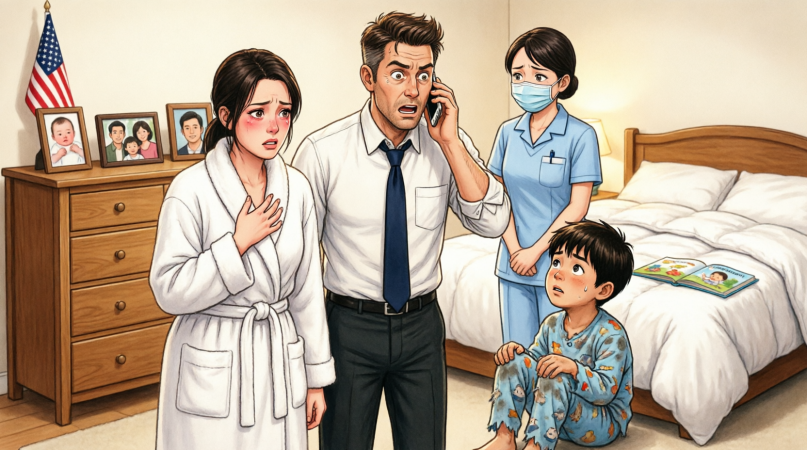
“Open my belly, Dad!” Emiliano screamed, folding himself against the cold marble floor like pain had broken every bone inside him.
His father, Rodrigo Arriaga, stood frozen at the bedroom door, holding a phone he had forgotten how to use.
The boy was eleven years old, thin from weeks of sickness, and trembling under pajamas damp with fever sweat.
On the bedside table, a white cup of hot chocolate still steamed beside a silver spoon and a folded napkin.
That cup should have meant comfort.
In that house, it had become a warning.
Rodrigo owned towers, highways, private clinics, and half the political favors in northern Mexico.
Yet none of that power helped when his son looked at him with desperate eyes and begged to be opened like a locked box.
“There’s something alive inside me,” Emiliano sobbed.
Daniela Arriaga appeared behind Rodrigo, dressed in a white silk robe and wearing sadness like expensive perfume.
She did not rush toward the child.
She did not kneel.
She only sighed, softly enough to sound wounded, and looked at Rodrigo as if he were the victim.
“This cannot continue,” she whispered.
Her voice was smooth, controlled, and practiced.
“Emiliano needs help, Rodrigo.”
The words landed in the room like another diagnosis.
Anxiety.
Grief.
Attention-seeking behavior.
Rejection of the stepmother.
Those were the words doctors had used after three emergency visits, four scans, and a dozen expensive consultations.
Rodrigo had believed them because they came from men in white coats and papers stamped with official seals.
He had believed them because the alternative was too monstrous.
He had believed them because Daniela cried every time Emiliano accused her.
But children do not always have legal evidence.
Sometimes they only have terror.
“I’m not lying,” Emiliano whispered.
His small fingers dug into his stomach as if holding something back.
“She puts something in my chocolate.”
Daniela closed her eyes and gave a broken little laugh.

“There it is again.”

She pressed one hand to her chest.

“I wake up early to make him something warm, and this is how he repays me.”

Rodrigo wanted to comfort his son.

He also wanted the screaming to stop.

That shameful truth would haunt him later.

He was tired.

He was embarrassed.

He was angry that a house filled with servants, cameras, guards, and money could not give him one peaceful morning.

“Enough,” Rodrigo said.

His voice came out rougher than he intended.

“If you accuse Daniela again without proof, I will sign the clinic papers today.”

The silence that followed was worse than any scream.

Emiliano stared at him.

In that instant, Rodrigo saw something leave his son’s face.

Trust.

It did not shatter loudly.

It simply disappeared.

From the hallway, Lucía Hernández watched the scene with her hands clasped so tightly her nails hurt.

She had been hired as the new nanny two weeks earlier.

Two weeks was not long in a normal home.

In the Arriaga mansion, it was long enough to understand where fear lived.

Fear lived in Emiliano’s bedroom.

Fear lived in the kitchen after everyone slept.

Fear lived behind the cinnamon jars.

That was where Lucía had found the bottle.

It was small, dark, and unlabeled.

No pharmacy sticker.

No prescription number.

No name.
Just a torn strip of paper wrapped around the glass, stained at the edge by something brown and sticky.

Lucía had grown up in a village where women knew plants, remedies, and dangerous little bottles that should never sit near a child’s drink.

She did not know exactly what was inside.

She only knew Daniela kept it hidden.

On her fourth night, Lucía took a photograph.

On her sixth night, she watched Daniela remove it.

On her ninth night, she recorded the impossible.

At 11:42 PM, Daniela entered the kitchen alone.

The mansion cameras covered the front hall, garage, garden, and gate.

They did not cover the pantry corner.

Daniela knew that.

Lucía watched from the service corridor, barely breathing.

Daniela warmed milk, added cocoa, stirred in sugar, then opened the dark bottle.

One drop fell.

Then another.

Then a third.

She stirred until the surface looked innocent again.

After that, she carried the cup upstairs to Emiliano and kissed his forehead in front of Rodrigo.

That was the night Lucía stopped wondering.

That was the night she understood.

A rich house can hide murder behind polished wood, clean sheets, and polite voices.

Now, standing outside the bedroom while Emiliano writhed on the floor, Lucía knew silence had become participation.

“Mr. Rodrigo,” she said.

Her voice was not loud.

It still cut through the room.

“Do not let the boy drink anything else prepared by señora Daniela.”

Daniela turned slowly.

“What did you say?”

Lucía stepped into the room.

She felt the housekeeper behind her freeze.

She felt the security guard look away.

She felt every old rule about servants and employers pressing against her throat.

Still, she spoke.

“I saw what you put in his chocolate.”

Daniela’s mouth opened.

For half a second, the sadness vanished.

What appeared underneath was not grief.

It was rage.

Rodrigo looked at Lucía as if she had slapped him.

“Be careful,” he said.

“I am being careful,” Lucía answered.

“That is why I waited until I had proof.”

She pulled her phone from her apron pocket.

Her hands shook.

The video did not.

On the screen, Daniela stood in the kitchen wearing the same white robe.

She lifted the dark bottle.

She counted the drops.

She stirred.

Rodrigo watched without blinking.

The room seemed to tilt around him.

The woman on the screen was his wife.

The woman beside him was suddenly a stranger.

Daniela reached for the phone.

Lucía pulled it back.

“That video is already saved elsewhere,” Lucía said.

It was a lie.

But it was the kind of lie poor women tell rich monsters when truth alone is not enough protection.

Rodrigo moved to the bedside table.

He picked up the cup.

The chocolate was thick at the bottom, clinging to the porcelain.

“Don’t shake it,” Lucía warned.

Rodrigo held the cup under the lamp.

At first, he saw only cocoa.

Then the liquid settled.

Something thin and black dragged itself through the last dark smear.

Rodrigo nearly dropped the cup.

Behind him, Emiliano whispered, “I told you.”

Those three words destroyed Rodrigo more than any accusation could have.

I told you.

Not once.

Not twice.

Again and again, while adults translated his terror into a problem with behavior.

Daniela’s voice returned colder.

“This is absurd.”

She pointed at Lucía.

“She planted it.”

The housekeeper gasped.

The guard finally looked up.

Lucía opened her apron pocket and placed a folded page on the nightstand.

“I wrote everything down,” she said.

“Every night he got sick.”

Rodrigo unfolded the page.

Dates.

Times.

Symptoms.

Who prepared the drink.

Who insisted he finish it.

Who cleaned the cup afterward.

The pattern was so clear that Rodrigo felt physically ill.

Daniela had created a schedule.

A slow ritual.

A bedtime performance of affection that ended with a child begging for rescue.

Rodrigo turned to his wife.

“What is in the bottle?”

Daniela said nothing.

For the first time since he had known her, she had no prepared expression.

Her silence filled the bedroom.

Then Emiliano screamed again.

This time, Rodrigo did not hesitate.

He crossed the room, lifted his son in both arms, and shouted for the driver.

Daniela blocked the door.

“You are not taking him anywhere with that girl’s fantasy.”

Rodrigo looked at her.

Something old and dangerous awakened behind his eyes.

“Move.”

She did not.

He stepped closer.

“I said move.”

Daniela moved.

Not because she was afraid of the law.

Because she finally understood Rodrigo had chosen his son.

At 5:41 AM, the black SUV tore through the gates of the Arriaga estate.

Lucía sat in the back with Emiliano’s head on her lap.

Rodrigo held the cup inside a sealed kitchen bag.

The driver kept glancing at the rearview mirror, afraid to ask why his boss looked like a man returning from war.

They did not go to the private clinic Daniela preferred.

Rodrigo ordered the driver to go to Hospital Universitario.

He wanted doctors who owed Daniela nothing.

He wanted toxicology.

He wanted specialists.

He wanted proof that could not be cried away.

At reception, nurses recognized him immediately.

Power opened doors.

Fear kicked them down.

“My son may have been poisoned,” Rodrigo said.

Every head turned.

The word traveled faster than a shout.

Poisoned.

In a child.

In a millionaire’s house.

By morning, the first rumor had already reached someone’s cousin, someone’s driver, someone’s sister-in-law who worked near the hospital.

That was how scandals are born.

Not from newspapers.

From whispered certainty.

The pediatric gastroenterologist arrived first.

Then toxicology.

Then a hospital administrator.

Then two police officers, because Lucía had called emergency services from the SUV while Rodrigo held Emiliano’s hand.

Daniela arrived twenty minutes later in another car.

She had changed clothes.

No silk robe.

No morning softness.

Now she wore beige trousers, a cream blouse, sunglasses, and the face of a woman preparing for cameras.

She tried to enter the examination room.

The officer stopped her.

“I am his stepmother,” she said.

“I need to be with him.”

Rodrigo stepped into the hallway.

His shirt was stained with chocolate.

His face was gray.

“You are not going near him.”

Daniela removed her sunglasses slowly.

“You will regret humiliating me.”

Rodrigo stared at her.

“If he dies, regret will be the smallest thing in this hospital.”

Inside, Emiliano was given medication, fluids, and tests that took too long for a father’s heart.

The moving thing from the cup was taken to a lab.

The dark residue was collected.

Lucía’s video was copied by police.

The folded notes were photographed.

Every detail became evidence.

Yet evidence does not heal what disbelief has already broken.

When Emiliano finally slept, Rodrigo sat beside him and looked at the small bruises on his son’s arms from needles.

For weeks, Emiliano had begged.

For weeks, Rodrigo had scolded.

For weeks, Daniela had stood between them smiling with cups of chocolate.

Rodrigo lowered his forehead to his son’s hand.

“I am sorry,” he whispered.

Emiliano did not wake.

That made the apology feel even more useless.

By noon, the first post appeared online.

It came from an anonymous account.

A millionaire’s son in Monterrey hospitalized after suspected poisoning inside luxury mansion.

No names.

No details.

Only enough to ignite speculation.

By evening, everyone knew the name.

Arriaga.

People searched old photos.

Wedding pictures resurfaced.

Rodrigo and Daniela smiling beneath white roses.

Emiliano standing beside them in a navy suit, unsmiling, holding his father’s hand.

Comment sections exploded.

Some called Daniela a monster.

Some blamed Rodrigo.

Some accused the nanny of chasing money.

Some asked why nobody believed the child sooner.

That was the question people shared most.

Why does a child have to almost die before adults listen?

The story became bigger than one family.

It became a mirror.

Parents argued.

Doctors argued.

Teachers argued.

Domestic workers argued.

Stepparents argued.

Influencers made videos in their cars, crying about intuition and child safety.

Psychologists warned against dismissing children as dramatic.

Lawyers explained custody, negligence, and attempted harm.

Everyone had an opinion.

Everyone wanted a villain.

The truth was worse.

There was more than one.

Daniela was not arrested that first day.

Her lawyers arrived before sunset.

Three men in dark suits entered the hospital with the confidence of people who usually make consequences disappear.

They called the evidence incomplete.

They called Lucía unstable.

They called Emiliano emotionally disturbed.

They suggested Rodrigo was reacting from guilt over his first wife’s death.

That line made Rodrigo stand up so fast his chair hit the wall.

His first wife, Mariana, had died two years earlier in a car crash on the highway to Saltillo.

Emiliano had been nine.

Rodrigo had buried his wife and returned to work three days later because men like him are taught to mistake collapse for weakness.

Daniela entered his life six months later.

She was elegant, charitable, and impossibly understanding.

She organized fundraisers for children’s hospitals.

She sent flowers on Mariana’s birthday.

She told Rodrigo that Emiliano needed structure.

She told Rodrigo that grief could become manipulation if a child learned adults would obey tears.

At first, Rodrigo believed she was helping.

Then she began replacing people.

The old cook was fired.

The family driver was transferred.

Mariana’s sister was no longer welcome without notice.

Emiliano’s therapist was changed.

Every person who knew the boy before Daniela slowly disappeared from the house.

Rodrigo called it adjustment.

Daniela called it order.

Now, sitting under hospital lights, Rodrigo realized it had been isolation.

The second day brought the lab’s preliminary report.

The substance in the cup contained compounds that could cause severe gastrointestinal distress, hallucination-like sensations, muscle spasms, and panic.

It was not ordinary cocoa.

It was not cinnamon.

It was not a harmless remedy.

The moving material found in the cup was sent for further analysis.

Doctors said it may have come from contaminated organic matter mixed into the drink.

They avoided dramatic words.

Police did not.

They opened a criminal investigation.

Daniela’s lawyers argued that no one could prove she intended harm.

Lucía’s video proved drops.

The medical report proved danger.

The notes proved repetition.

Intent, however, is the favorite hiding place of people with money.

Daniela gave a statement.

She said the bottle contained an imported digestive herbal solution.

She said Emiliano refused to eat.

She said she only wanted to calm his stomach.

She said Lucía misunderstood.

She said Rodrigo had become emotionally unstable.

She said the boy needed psychiatric care, not police attention.

The statement leaked.

Social media erupted again.

One side said any motherly figure could make mistakes.

The other side asked why a mistake needed hiding behind cinnamon jars.

The phrase became a hashtag.

Behind the cinnamon jars.

People used it to describe every secret families hide in plain sight.

Abuse behind respectability.

Neglect behind wealth.

Cruelty behind perfect photos.

Rodrigo watched the storm from Emiliano’s hospital room.

He had spent years controlling public narratives.

Now strangers were dissecting his family like a crime documentary.

He hated it.

He also knew it was deserved.

Because public outrage was doing what private power had failed to do.

It was keeping Daniela from disappearing the evidence.

On the third day, Emiliano woke properly.

His lips were still pale.

His voice was tiny.

But his eyes were clear.

Rodrigo leaned close.

“I’m here.”

Emiliano looked at him for a long time.

“Are you going to send me away?”

The question split Rodrigo open.

“No.”

“You said you would.”

“I was wrong.”

Emiliano turned his face toward the window.

Children can forgive.

But they also remember.

Rodrigo understood then that saving his son’s life was not the same as regaining his trust.

Lucía entered quietly with a nurse’s permission.

Emiliano saw her and immediately reached out.

That simple movement told Rodrigo everything.

The nanny of two weeks had become safer than the father of eleven years.

Lucía sat beside the bed.

“You were very brave,” she said.

Emiliano shook his head.

“I was scared.”

“Being brave does not mean you were not scared.”

He looked at his father.

“I told you she was doing it.”

Rodrigo nodded.

“I know.”

“You believed her.”

The room went silent.

Rodrigo did not defend himself.

He did not blame doctors.

He did not blame grief.

He did not say Daniela fooled everyone.

That would have been easy.

Easy explanations are another kind of hiding.

“Yes,” he said.

“I believed her when I should have believed you.”

Emiliano’s eyes filled with tears.

Rodrigo’s did too.

Outside the room, cameras gathered near the hospital entrance.

Reporters wanted a statement.

Online audiences wanted updates.

Daniela wanted control.

Rodrigo wanted the past month erased.

None of them got what they wanted.

At 6:00 PM, police arrived with a warrant to search the Arriaga mansion.

They found the dark bottle.

They found two more bottles inside a locked drawer in Daniela’s dressing room.

They found deleted messages on a tablet after specialists recovered backups.

They found searches about symptoms, doses, and how long certain substances remain detectable.

They found a draft email to a private residential clinic describing Emiliano as dangerous, delusional, and in need of immediate confinement.

That draft was dated for the next day.

The day Rodrigo had threatened to sign the papers.

The internet did not know that detail at first.

Police kept it sealed.

Rodrigo learned it from the investigator.

When he read the draft, he had to sit down.

Daniela had not merely wanted Emiliano sick.

She had wanted him labeled.

She wanted him discredited so completely that anything he said afterward would sound like madness.

A poisoned child is one crime.

A silenced child is another.

Together, they created something almost unspeakable.

The next question was motive.

Money was obvious.

But motive in rich families usually wears several coats.

Emiliano was Rodrigo’s only biological child.

Mariana’s will had placed part of her family inheritance in trust for Emiliano.

Rodrigo’s own company succession documents named Emiliano as future principal beneficiary.

Daniela had no children.

Not yet.

But investigators discovered fertility clinic appointments.

They discovered messages between Daniela and her mother discussing inheritance, control, and “the problem with the boy.”

One message said, “If Rodrigo accepts he is unstable, everything becomes easier.”

Another said, “A clinic is not prison, but it can work like one.”

That message eventually leaked.

It became the sentence that turned public anger into fury.

A clinic is not prison, but it can work like one.

People repeated it in videos, posts, and editorials.

Mental health advocates condemned the weaponization of psychiatric care.

Parents of neurodivergent children shared stories of being dismissed.

Former domestic workers shared stories of secrets they had been too afraid to report.

The scandal grew teeth.

Daniela was arrested on a Thursday morning outside her lawyer’s office.

She wore large sunglasses and held her chin high.

Reporters shouted questions.

“Did you poison Emiliano?”

“What was in the chocolate?”

“Why did you hide the bottle?”

“Did Rodrigo know?”

That last question hit the public hardest.

Did Rodrigo know?

Legally, he did not.

Morally, the answer was harder.

He had not known.

But he had ignored.

He had not harmed his son with his hands.

But he had handed power to the person who did.

The court of public opinion understood that difference.

It also refused to let him hide inside it.

For days, his company’s pages were flooded with comments.

Believe your children.

Money cannot buy instinct.

Where was the father?

Rodrigo did not respond publicly at first.

His advisors begged him to release a careful statement.

His lawyers wanted words like ongoing investigation, family privacy, and trust in authorities.

Rodrigo read the draft and threw it away.

On the seventh day, he recorded a video from an empty conference room.

No logo.

No suit.

No polished lighting.

He looked older than he had looked one week earlier.

“My son told me he was afraid,” he said.

“I did not listen quickly enough.”

The video spread within minutes.

“I trusted appearances, professionals, and my own exhaustion more than I trusted his fear.”

He paused.

“That failure belongs to me.”

Some praised the confession.

Others said it was too late.

Both reactions were fair.

The video did not save his reputation.

It did something more painful.

It made the story harder to dismiss as simple evil by one woman.

It forced people to ask how many children are telling the truth in rooms where adults are tired, proud, distracted, or manipulated.

Meanwhile, Emiliano recovered slowly.

The physical symptoms began to fade after the contaminated drinks stopped.

The nightmares did not.

He woke asking whether Daniela was in the hallway.

He refused hot chocolate.

He refused any drink he had not seen opened.

He asked three times a day whether Lucía was still there.

Rodrigo hired security for Lucía’s family after anonymous accounts began accusing her of blackmail.

A television panel even suggested she had staged the video for money.

That accusation lasted until investigators confirmed timestamps, metadata, recovered kitchen footage, and the bottle location.

Even then, some people refused to believe a domestic worker over a woman in pearls.

Class prejudice does not disappear when evidence arrives.

It simply changes clothes.

Lucía became a reluctant public figure.

Journalists camped outside her neighborhood.

Neighbors suddenly remembered every kindness she had ever done.

Strangers called her a hero.

She hated the word.

A hero sounds fearless.

Lucía had been terrified.

She had worried about losing her job, being sued, being deported from opportunity, being crushed by people whose names opened doors.

Her courage was not a lack of fear.

It was a decision that a child’s life weighed more than her own safety.

When a reporter asked why she spoke up, Lucía gave one sentence.

“Because he kept saying the truth, and nobody richer than me wanted to hear it.”

That sentence became another viral wave.

Nobody richer than me wanted to hear it.

It captured the entire scandal better than any headline.

Because this was never only about chocolate.

It was about power.

It was about who gets believed.

It was about polished women who weaponize tears and powerful men who outsource parenting to convenience.

It was about doctors who see frightened children through checklists.

It was about workers who see everything and are expected to say nothing.

Daniela’s pretrial hearing drew national attention.

The courtroom was packed.

Rodrigo sat behind the prosecutor, wearing a dark suit and a face carved from regret.

Lucía testified behind protective arrangements.

Emiliano did not appear in person.

His recorded statement was played privately for the judge.

In it, he described the taste.

Bitter under the chocolate.

Metallic after swallowing.

Burning in his stomach.

Movement that doctors had told him was imagination.

He described Daniela standing in his doorway and whispering that no one would believe a spoiled little boy.

He described his father shouting.

He described deciding, at eleven years old, that maybe he really was going crazy.

That was the part that broke the courtroom.

Not the symptoms.

Not the bottles.

Not even the video.

The most devastating harm was hearing a child admit he had begun doubting his own reality because adults preferred a prettier lie.

Daniela’s defense attacked the statement.

They said grief distorts memory.

They said children repeat suggestions.

They said Rodrigo and Lucía had influenced him.

The prosecutor responded by playing the kitchen video.

Again.

The courtroom watched Daniela count the drops.

One.

Two.

Three.

No one spoke.

Some evidence does not need dramatic narration.

It only needs to be seen.

The judge ordered Daniela held while proceedings continued.

Her face remained calm until the decision was announced.

Then she looked back at Rodrigo.

For a moment, he saw the woman he had married.

Then he saw the woman who had stood between him and his sick child.

He looked away first.

Not from fear.

From disgust at himself.

The scandal did not fade quickly.

It became a social media storm because it contained every ingredient that makes people stop scrolling.

A beautiful mansion.

A sick child.

A charming stepmother.

A rich father.

A nanny with a cracked phone.

A cup of hot chocolate hiding something monstrous.

But underneath the viral elements was the part that made people share it with trembling captions.

This could happen anywhere adults ignore a child.

Not the exact poison.

Not the exact mansion.

Not the exact crime.

But the pattern.

The child speaks.

The adult explains it away.

The child insists.

The adult gets annoyed.

The abuser performs innocence.

The system demands proof from the person with the least power.

That pattern was familiar to too many people.

Thousands commented, “I was Emiliano.”

Thousands more wrote, “I was Rodrigo, and I regret it.”

Some parents admitted they had dismissed their children’s fears.

Some stepfamilies discussed resentment and loyalty.

Some medical professionals defended the doctors.

Others admitted that emotional explanations can become dangerous shortcuts.

The best discussions were uncomfortable.

The worst ones became cruel.

People invented details.

They posted fake photos.

They claimed Daniela belonged to secret groups.

They accused Rodrigo’s first wife’s family of revenge.

They accused Lucía of seduction, extortion, and conspiracy.

Every real tragedy attracts parasites of attention.

Rodrigo learned that truth quickly.

He hired a legal team not to save his image, but to remove fake posts using Emiliano’s hospital photos.

He asked news outlets to stop showing the boy’s face.

Some complied.

Others blurred it badly and called that ethics.

Meanwhile, Emiliano asked a question no viral audience could answer.

“Why does everyone know my pain now?”

Rodrigo had no good response.

Because adults failed privately.

Because scandal travels faster than protection.

Because the world often notices children only after something terrible happens.

Instead, he said, “I am sorry.”

He said that often now.

Not as a solution.

As a beginning.

After Emiliano left the hospital, Rodrigo did not bring him back to the mansion.

They moved temporarily to Mariana’s old family home outside the city.

The house was smaller, quieter, and filled with photographs Daniela had once called unhealthy reminders.

Emiliano slept in his mother’s old room for three nights.

On the fourth, he asked if Lucía could sit near the door until he fell asleep.

Rodrigo agreed.

He did not make it about pride.

He did not say, “I am your father, you should feel safe with me.”

Safety cannot be demanded.

It must be rebuilt.

Piece by piece.

Night by night.

Truth by truth.

Rodrigo began therapy with Emiliano.

He also began alone.

In one session, the therapist asked Rodrigo what frightened him most.

He expected to say Daniela.

He expected to say the poisoning.

Instead, he said, “That I almost helped her.”

The therapist did not comfort him quickly.

That was merciful.

Some guilt should not be rushed out of the room.

It should be examined.

Rodrigo had loved his son.

He had also been vulnerable to convenience.

Daniela had not fooled him only with beauty.

She had fooled him by offering explanations that let him keep working, keep sleeping, keep believing his home was under control.

Every manipulator needs a door.

Rodrigo’s door had been pride.

He believed he could read people.

He believed wealth protected his family.

He believed a second wife could repair loneliness without disturbing the structure of his life.

He believed expert language could replace listening.

Those beliefs had nearly cost Emiliano everything.

The investigation revealed one more detail that nearly broke him.

Mariana’s sister, Valeria, had tried to warn Rodrigo months earlier.

She had sent messages saying Emiliano sounded afraid of Daniela.

She had asked to visit.

She had requested a private conversation with the boy.

Daniela had told Rodrigo that Valeria was jealous, bitter, and trying to control the family through grief.

Rodrigo had blocked her for two months.

When he finally called Valeria, she did not answer.

He went to her apartment personally.

She opened the door and slapped him before he could speak.

Then she hugged him and cried.

Families are not repaired by dramatic apologies.

They are repaired by enduring the consequences of what apologies cannot erase.

Valeria visited Emiliano the next day.

He ran to her.

Rodrigo watched from the doorway as his son clung to the aunt he had been kept from.

That embrace was another indictment.

Daniela had not only poisoned a drink.

She had poisoned relationships.

She had made isolation look like order.

She had made protection look like interference.

She had made concern look like jealousy.

That was why the story mattered beyond one crime.

Because many dangerous people do not enter lives with knives.

They enter with calendars, rules, polite suggestions, and soft voices that separate victims from witnesses.

Months passed before the forensic report was complete.

The final findings were more clinical than the public expected.

No horror movie creature.

No supernatural parasite.

No impossible monster.

The “thing alive” was contaminated organic material mixed into the drink, along with a harmful compound that caused spasms and sensations of internal movement.

The truth was less cinematic than rumor.

It was also more horrifying.

Because Daniela did not need fantasy.

She needed access.

A cup.

A child.

A father willing to doubt him.

When the report became public, some people complained it was not shocking enough.

Those people had misunderstood the story.

The monster was never the thing in the cup.

The monster was the performance around it.

The silk robe.

The fake tears.

The hospital labels.

The hidden bottle.

The father’s threat.

The way a child’s truth had to crawl through chocolate before anyone looked closely.

At trial, Daniela’s team attempted one final strategy.

They portrayed her as overwhelmed.

A woman trapped in a wealthy household with a grieving child who rejected her.

They argued she administered an inappropriate folk remedy, not poison.

They said she hid it because Rodrigo hated unapproved treatments.

They said she cried because she was afraid.

The prosecutor answered with the clinic draft.

Then the deleted messages.

Then the pattern chart.

Then Lucía’s video.

Then Emiliano’s statement.

The jury did not need long.

Daniela was convicted on multiple charges related to child endangerment, poisoning, evidence concealment, and attempted unlawful institutionalization.

The sentence became breaking news.

Outside the courthouse, crowds shouted Lucía’s name.

She walked out with her mother, head lowered, holding a paper cup of coffee with both hands.

Rodrigo offered to pay for her education, her housing, and anything else she wanted.

Lucía accepted tuition assistance for nursing school.

She refused a luxury apartment.

“I want a life,” she told him.

“Not another cage with better furniture.”

That line never went public.

Rodrigo remembered it anyway.

Emiliano asked to see Daniela once after sentencing.

His therapist advised careful preparation.

Rodrigo was terrified.

But he did not forbid it.

For once, he did not confuse control with protection.

The meeting happened through glass.

Daniela wore prison beige instead of silk white.

She looked smaller without the mansion around her.

Emiliano sat beside Rodrigo but spoke for himself.

“Why did you do it?”

Daniela looked at him for a long time.

Then she smiled faintly.

“You were always in the way.”

Rodrigo’s hands clenched under the table.

Emiliano did not cry.

He nodded once.

That answer was cruel.

It was also clean.

No more fake illness.

No more fake concern.

No more pretending.

On the drive home, Emiliano looked out the window and said, “At least now I know.”

Rodrigo understood.

Sometimes the truth is not comforting.

Sometimes it is simply the first solid ground after months of drowning.

One year later, the Arriaga mansion was sold.

Rodrigo donated part of the proceeds to a foundation supporting child abuse reporting, domestic worker protections, and trauma-informed pediatric care.

Skeptics called it image repair.

They were partly right.

Public acts can carry mixed motives.

But the foundation funded hotlines, legal support, and training programs that helped real children.

Good born from guilt is still good if it reaches someone vulnerable.

Rodrigo did not ask the public to forgive him.

He stopped giving interviews.

He reduced his company role.

He attended school meetings.

He learned the names of Emiliano’s friends.

He learned to cook badly.

He learned that parenting is not a title preserved by money.

It is a daily practice of noticing.

Emiliano never drank hot chocolate again.

Not in winter.

Not at parties.

Not even when classmates joked that it was just a drink.

Some scars do not need to be cured for a survivor to be whole.

He became quieter, but not broken.

He grew close to Valeria.

He visited Lucía’s nursing school graduation three years later with flowers and an awkward smile.

When reporters recognized him, he walked past them without answering.

He had learned that not every audience deserves access to your healing.

Years later, when people still discussed the scandal online, many remembered the shocking title.

The boy who begged his father to open his belly.

The nanny who found the secret in hot chocolate.

The stepmother behind the cinnamon jars.

But those who followed the story closely remembered something deeper.

They remembered the father saying, “I did not listen quickly enough.”

They remembered the nanny saying, “Nobody richer than me wanted to hear it.”

They remembered the message saying, “A clinic is not prison, but it can work like one.”

They remembered how quickly a child’s fear can be renamed until it becomes invisible.

That is why the story kept returning to timelines, comment sections, podcasts, and dinner table arguments.

It was not only sensational.

It was accusatory.

It asked every adult a question.

When a child says something is wrong, do you investigate, or do you explain it away?

When someone less powerful sees danger, do you listen, or do you question their motives first?

When comfort and truth stand on opposite sides of the room, which one do you walk toward?

Rodrigo would spend the rest of his life answering those questions through actions.

Some days, Emiliano laughed again.

Some days, he flinched when a spoon touched porcelain.

Some days, he trusted his father enough to speak.

Some days, he did not.

Rodrigo accepted both.

Trust rebuilt after betrayal does not follow a straight road.

It circles.

It hesitates.

It tests the floor before stepping forward.

On Emiliano’s fifteenth birthday, Rodrigo made breakfast.

The eggs were overcooked.

The toast was burned.

The orange juice was sealed, opened only after Emiliano sat down.

Rodrigo did that without being asked.

Emiliano noticed.

He said nothing at first.

Then he poured two glasses.

One for himself.

One for his father.

That was not forgiveness.

Not fully.

But it was a door left unlocked.

Rodrigo took the glass with both hands.

Across the table, morning light filled the kitchen.

No silk robe.

No hidden bottle.

No cup of chocolate steaming like a threat.

Only a father and son sitting inside a quiet room, surrounded by everything that had almost been lost.

Emiliano looked at him and said, “Dad?”

Rodrigo immediately answered, “Yes?”

The boy paused.

Then he said, “Thank you for listening now.”

Rodrigo closed his eyes.

The words hurt.

The words healed.

Both things were true.

Outside, the world had moved on to new scandals, new villains, and new hashtags.

But inside that kitchen, the real ending was smaller than the headlines.

A child spoke.

An adult listened.

And this time, nobody told him he was crazy.

Leave a Reply

Your email address will not be published. Required fields are marked *