The first explosion tore through Air France Flight 447 like the sky itself had cracked open. At thirty-one thousand feet over the black Atlantic, the Boeing shuddered violently, lights flickered, oxygen masks trembled behind their panels, and a smell of burning plastic began crawling through the cabin before most passengers even woke up. In the cockpit, fire erupted from behind the electrical panel, orange and white, fed by wiring, heat, and the kind of failure no checklist ever truly prepares a human being to face. Captain Dubois fought it with a fire extinguisher while First Officer Martinez worked the backup controls, but the instruments were dying one by one, screens going black, warning tones overlapping until the cockpit became a screaming box of smoke and sparks. “Catastrophic electrical fire,” Dubois shouted into the radio, his voice already breaking. “Losing all systems. Unable to control spread.”
Thirty seconds later, Martinez looked at the fire crawling toward the fuel-line systems and said the sentence every pilot fears more than death. “If it reaches them, we explode.” The captain stared through smoke at the sealed cockpit door behind him, knowing that beyond it were two hundred seventy-three passengers sleeping, reading, breathing, dreaming, and trusting him with the dark. There was no clean choice left. Stay, and the plane would become a fireball over the ocean. Leave, and the aircraft might remain on autopilot long enough for some impossible chance to appear. His hand shook as he grabbed the PA. “Ladies and gentlemen,” he said, choking on smoke and horror, “God forgive me. Catastrophic fire. We cannot control it. I am evacuating. God help you all.” Then he triggered the emergency windscreen bolts.
The forward glass blew outward with a deafening crack, and Atlantic night exploded into the cockpit. Wind slammed through the opening at hundreds of miles per hour, shredding loose papers, tearing smoke backward, feeding the flames and freezing the men in the same breath. Captain Dubois looked once at the burning controls, once toward the cabin door, then jumped into darkness. His parachute opened seconds later, a pale bloom against a black sky. Martinez followed five seconds after him, another white canopy falling away from the crippled aircraft. The pilots were gone. The plane was still flying. And for the passengers waking to smoke, alarms, and the captain’s broken farewell, the world had just become a sentence with no ending.
In the last row, seat 38F, eleven-year-old Maya Chen had not been asleep. She had been too excited, too uncomfortable, and too close to the toilets to drift off properly. It was her first solo flight from Paris to New York, her parents having kissed her too many times at the gate and tucked snacks, a tablet, and a little notebook into her backpack before telling her to be brave. Maya was small for her age, skinny, with short black hair in two braids and thick glasses that made her eyes look larger than they were. She wore jeans and a purple hoodie with a unicorn on it, and before the explosion she had been reading a book about pilots, rescue crews, flight surgeons, and impossible landings. After the cockpit blew open, she saw the first parachute pass her window. Then the second. She understood before the adults around her did: the people meant to save them had left.
The cabin erupted. Men fumbled with phones, women clutched children, teenagers screamed, and strangers reached for one another with the desperate intimacy of people who know there may be no tomorrow. The businessman in 38E was filming himself through tears, trying to leave a message for his children. Maya stood up. No one noticed at first because panic makes adults very large and children invisible. She stepped into the aisle, clutching the seatbacks as the aircraft trembled, and began moving forward. She did not know how to fly a jetliner. She did not know how to fight a cockpit fire. But she knew something everyone else had missed, something she had noticed during boarding because children who love stories about heroes memorize details adults overlook.
In the forward galley, the flight attendant Patricia stood frozen, staring toward the smoke seeping around the cockpit door. Maya touched her sleeve. “Excuse me, ma’am.” Patricia looked down at the little girl, tried to produce a reassuring face, and failed. “Sweetheart, go back to your seat.” “You need to ask if anyone can fly,” Maya said. Patricia blinked. “I already asked. Nobody answered.” “Ask again. Use the PA. Say any pilot, military or civilian, anyone with flight experience.” There was something strange in Maya’s voice, not childish command exactly, but a clarity so sharp it cut through Patricia’s shock. Patricia lifted the handset with a shaking hand. “Ladies and gentlemen, if anyone on board has flight experience, any pilot, current or former, military or civilian, please identify yourself immediately.”
Nothing. Only crying, praying, coughing, and the thin hiss of fear filling the cabin. Patricia lowered the handset, tears in her eyes. “Nobody.” Maya shook her head. “There is someone. Seat 23D. The woman sleeping there.” Patricia stared. “How do you know?” “I saw her wrist when she boarded. A tattoo: wings with a medical symbol. That is an Air Force flight surgeon mark. I saw it in my book. She is a doctor and a pilot.” Patricia did not argue. She ran down the aisle, and Maya followed.
The woman in 23D was still asleep, drugged by exhaustion more than peace, a cardigan pulled over hospital scrubs, dark hair falling across her face. Patricia shook her hard. “Ma’am, wake up. Both pilots are gone. We need a pilot. Can you fly?” The woman jolted awake, disoriented, then saw the smoke, the emergency lighting, Maya’s pale little face, and the panic moving through the cabin. Her hand went instinctively to the small tattoo on her wrist. Wings and a caduceus. “How long?” she asked. “Two or three minutes,” Patricia said. The woman stood too fast and had to catch the seatback. “I can fly,” she said, voice rough. “Air Force C-130s. Years ago. But this is commercial, and I haven’t flown in a long time.”
Maya looked up at her. “You’re Dr. Emma Cross.” The woman froze. “How do you know my name?” “You’re Angel,” Maya said, eyes wide behind her glasses. “The pilot who flew humanitarian missions into impossible places. Haiti, Somalia, earthquake zones, war zones. You landed anywhere if people were dying.” Emma Cross looked as if the child had reached into a locked room inside her chest and pulled out a name she had buried. “I was Angel,” she said quietly. “Not anymore.” Maya stepped closer, small hands curled into fists. “You are still Angel. And right now, two hundred seventy-three people need you to be Angel one more time.” In the burning, screaming darkness of that aircraft, the words found the part of Emma she had spent years trying to silence.
Emma had left flying after a mission that ended badly, after a field hospital evacuation where weather, fuel, and bad intelligence cost lives she still counted in dreams. She became a surgeon because surgery gave her walls, lights, instruments, and the illusion that if she worked perfectly, no one would die because of decisions made in the air. That night, she had been flying to New York straight from a fourteen-hour operation, still in scrubs, going to help with her estranged sister’s cancer surgery. She had taken a sleeping pill after takeoff because exhaustion had finally outranked vigilance. Now a child in a unicorn hoodie was telling her the sky needed her again. Emma looked toward the cockpit door, where smoke curled like black fingers. “I’m going in,” she said. “But I need help.” Patricia nodded. “I’ll help.” Emma looked at Maya. “No. She will be my co-pilot.”
Patricia gasped. “She’s eleven.” “I know,” Emma said. “But she is calm, observant, and already saved time by finding me. I need someone who can follow instructions exactly and not freeze.” She crouched to Maya’s level. “Can you do that?” Maya swallowed, terrified but steady. “Yes, ma’am.” Emma grabbed two oxygen masks from the emergency panel, handed one to Maya, and tied wet cloths around their hands as best she could. “Stay low. Smoke rises. Do not touch hot metal unless I tell you. Read what I ask you to read. If you are scared, say so, but keep doing the job.” Maya nodded once. Emma looked at Patricia. “Close the cockpit door behind us. Keep smoke out of the cabin. If I do not call for evacuation, follow standard ditching prep.” Patricia’s face crumpled. “You’ll be trapped in there.” Emma said, “Better us than all of them.”
The cockpit was hell. Heat smashed into them like an open furnace, and the wind from the missing windscreen tore at their masks, clothes, and hair. Flames licked across panels, wiring spat sparks, melted plastic dripped in hot strings, and loose debris whipped around the cockpit like shrapnel. Emma blasted the worst fire with an extinguisher and bought herself perhaps thirty seconds of clarity. She slid into the captain’s seat, too tall for the position, no time to adjust. Maya climbed into the first officer’s seat, feet not reaching the floor, but eyes finding the few surviving backup instruments. “Altitude,” Emma said. “Find the number showing how high we are.” Maya scanned, then pointed. “Twenty-eight thousand feet. It is going down slowly.” “Good. Tell me if it drops faster than five hundred feet per minute. That is our safety margin.” “Yes, ma’am.”
Emma keyed the radio with fingers already burning through the cloth. “Mayday, mayday, mayday. Air France Flight 447. Both pilots evacuated. This is Dr. Emma Cross, former Air Force pilot, taking control. Catastrophic cockpit fire. We are over the Atlantic and preparing for emergency water landing. Need rescue assets to our position immediately.” Static swallowed her voice, then a stunned controller answered. “Air France 447, confirm both pilots evacuated?” “Affirmative. Passenger pilot in command. Call sign Angel.” A pause, then a senior voice came on. “Angel, nearest land is the Azores, eight hundred miles. You will not make it with that fire.” “I know,” Emma said. “Calculate optimal rescue position. I am ditching in the Atlantic.” Another pause. “Have you ever ditched a commercial aircraft?” “No,” she said. “But I have landed C-130s where no aircraft had any right to land. This is just another impossible place.”
The fire kept returning. Electrical fires do not surrender; they retreat, find another wire, another fuel source, another hidden path. Emma fought with one hand and flew with the other until the extinguisher ran thin and her palms blistered under heat. Maya watched the altitude, voice trembling but faithful. “Twenty-seven thousand five hundred. Descent still steady.” “Good,” Emma said. “You are my eyes.” Those words changed Maya’s posture. She sat straighter. The job gave her fear somewhere to go. Behind the cockpit door, Patricia and the other flight attendants moved through the cabin, getting life vests onto passengers, drilling brace positions, ordering people not to inflate until outside the aircraft. Panic did not vanish, but instruction built a narrow bridge over it.
At twenty thousand feet, two F/A-18 Super Hornets found them. “Air France 447, this is Navy Strike Fighter Two-Zero-One-One. We have visual. We see the fire.” Emma glanced through the destroyed windshield and saw them sliding alongside, gray shadows with blinking lights, steady and real against the dark. “Navy 2011, I need you to illuminate the ocean surface for ditching. Approximately ten minutes.” There was silence, then the pilot’s voice changed. “Angel? The Angel? Haiti relief? Somalia missions?” Emma’s throat tightened. “That was me.” “Ma’am, half our strike group knows your name. We are honored to assist. Flares inbound. Every rescue asset in range is coming.”
At ten thousand feet, Emma disengaged the autopilot and took full manual control. The aircraft responded like a wounded beast, slow and heavy, hydraulic authority degraded, every input delayed. Fire had eaten into systems she needed, and the yoke felt mushy under her burned hands. “Altitude?” “Nine thousand eight hundred,” Maya said. “Still descending.” “Good.” The fighters dropped illumination flares ahead, and the ocean suddenly appeared below, not as water, but as a field of moving black mountains capped with white. Emma’s heart sank. Thirty-foot swells. Storm water. No moon. She would have to land a burning commercial jet on a sea trying to tear it apart.
She configured from memory and prayer. Gear up, because landing gear would catch the water and flip the aircraft. Partial flaps, because full flaps might produce a pitch change the damaged controls could not handle. Nose slightly up, speed as low as she could manage without stalling. She had taught ditching procedures before in classroom settings and watched simulations, but no pilot truly practices this. Not like this. Maya’s voice came small through the mask. “Are we going to make it?” Emma looked at her, this brave child who should have been reading books and eating snacks, not helping land a burning aircraft over the Atlantic. “Yes,” Emma said. “Because I have never failed when people needed me and I could still move. Right now, you need me. They need me. So we are going to make it.”
At five thousand feet, the main hydraulic line burned through. Fluid sprayed, feeding the flames, and the controls went worse than mushy, almost dead. The aircraft wanted to roll right. Emma fought it with both hands now, unable to fight the fire anymore. It spread behind her, heat climbing up her back, smoke eating her lungs. Maya kept reading. “Four thousand. Three thousand five hundred. Three thousand.” At one thousand feet, Emma pressed the PA one last time. “Brace. Brace. Brace. Head down, arms over. Now.” Her voice sounded calm even as the cockpit burned around her.
At five hundred feet, Emma committed. No going around. No second try. At two hundred, waves became individual shapes, rising and falling like moving cliffs. At one hundred, she eased the nose up, bleeding speed, feeling the aircraft hover on the edge between flying and falling. At fifty feet, she looked at Maya. “Close your eyes, sweetheart. Hold on tight. Do not let go.” Maya shut her eyes and gripped the seat. Emma whispered a name no one else could hear. “Marcus, I’m bringing them home this time.” Then the ocean hit.
The first impact felt like concrete. The fuselage slammed the wave crest at one hundred twenty knots, flexed, screamed, skipped, and rose again like a stone thrown by a giant. Passengers were thrown forward against belts. Overhead bins burst. Luggage, phones, shoes, and fear became airborne. The second impact was harder, twisting the tail, tearing metal, but the body held. The third impact drove the nose down and sent water exploding through the missing windscreen. Freezing seawater swallowed the cockpit. Emma blacked out.
She came to underwater, salt burning her throat, darkness churning around her. She forced herself up, coughing, gasping, water already waist-deep and rising. “Evacuate,” she shouted into a damaged PA handset. “Evacuate, evacuate, evacuate. All exits.” Then she tried to stand and could not. Something from the shattered instrument panel pinned her leg. Maya hung limp in the first officer’s seat, blood darkening her forehead. Emma pulled at the debris until pain flashed white behind her eyes. It would not move. “Help!” she screamed. “Someone help!”
Patricia forced her way into the flooded cockpit, water already to her shoulders. “Dr. Cross!” “My leg is pinned,” Emma gasped. “Get Maya. Save the girl.” Patricia looked from Maya to Emma and shook her head. “I’m getting both of you.” Together they heaved against the wreckage. The metal shifted just enough. Emma screamed as her leg came free, then grabbed Maya from the seat. The aircraft tilted, stern sinking, water roaring in through the open front. They stumbled toward the exit, Patricia half carrying Maya, Emma dragging one useless leg behind her. A life raft waited outside. Patricia jumped with Maya first. Emma followed, collapsed into the raft, and immediately pressed two fingers to the child’s neck. Pulse. Breathing. Alive.
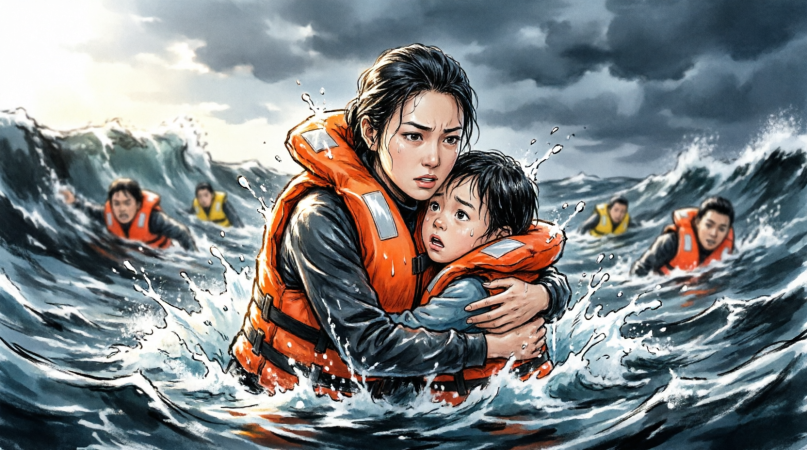
Around them, the Atlantic was full of lights, rafts, vests, crying children, stunned adults, and the roar of rescue helicopters. MH-60 Seahawks hovered above, searchlights cutting across the waves. Rescue swimmers dropped into the water. Coast Guard cutters and Navy ships raced toward the site. Flares from the fighters turned the storm-tossed sea silver and white. A rescue coordinator’s voice crackled across the network: “All souls accounted for. Two hundred seventy-three passengers, nine crew. Zero fatalities. Repeat, zero fatalities.” Emma held unconscious Maya against her chest and wept into the child’s wet hair. “You did it, Maya,” she whispered. “You were my angel tonight.”
Emma woke two days later aboard the USS Comfort, a Navy hospital ship. Her throat was raw from smoke, her hands and forearms wrapped thick with bandages, her leg splinted, lungs aching with every breath. A Navy doctor told her the burns were severe, with possible nerve damage in her fingers. Fine surgical control might never return. Emma looked at the bandages that covered the hands she had spent years training after walking away from the sky. “Then my hands do not matter,” she said quietly. “I would burn them again.” The doctor told her everyone had survived. That was the only part that mattered.
Maya visited three days later, small head wrapped in bandages, glasses slightly crooked, smile bright enough to undo something inside Emma. “Angel, you’re awake.” Emma hugged her carefully. “My brave co-pilot.” Maya studied her hands. “Are you going to be okay?” “I am,” Emma said. “Because of you.” The girl frowned. “You saved everyone.” Emma shook her head. “You found me when I had forgotten who I was. You made me stand up. Without you, I might have stayed in my seat with everyone else.” Maya smiled. “I just reminded you. Angel never quits.”
Over the next week, passengers came to Emma’s room. Patricia brought flowers and cried. A young mother brought her newborn and said they had renamed her Emma Grace. An elderly couple married fifty-two years held hands beside the bed and thanked her for more time. Navy pilots who had dropped the flares saluted her. Former Air Force squadron mates offered reinstatement, consulting roles, instructor positions. Captain Dubois and First Officer Martinez came last, faces haunted by guilt. “We abandoned them,” Dubois said. Emma stopped him. “You made the only decision that gave anyone a chance. If you had stayed, the plane would have exploded. You kept it flying long enough for a handoff.” They left with less weight, though not no weight. Some burdens remain even when forgiven.
The greatest healing came from Rebecca, Emma’s sister, who knocked on her apartment door in Paris two weeks later. They had not spoken in eight years, ever since Rebecca accused Emma of choosing strangers over their dying mother during a humanitarian deployment that Emma could not abandon. Rebecca had cancer now, and Emma had been flying to New York to help with her surgery when the aircraft failed. When Emma opened the door, Rebecca broke down immediately. “I was wrong,” she sobbed. “I watched the news. You were coming for me, even after everything I said.” Emma held her, both of them crying into years of lost time. “You are my sister,” Emma whispered. “That was never negotiable.”
Three months later, the passengers formed the Angel Foundation, funding scholarships for future pilots, flight surgeons, trauma doctors, rescue medics, and emergency responders. They called the date of the ditching their second birthday. At the first reunion, Sarah Martinez, the young mother, stood with baby Emma Grace in her arms and said, “A woman in hospital scrubs walked into fire and brought us home.” Emma insisted Maya stand with her. “I did not save everyone alone. Maya Chen was my co-pilot. She read the instruments. She stayed calm. She reminded me who I was.” Maya blushed, scar barely visible under her hair, and said, “I only helped a little.” Emma hugged her. “You saved me first.”
The official investigation found the cause: a faulty electrical panel scheduled for replacement, overheated wiring, suppression systems overwhelmed by a cascading fire. The pilots had made the only survivable choice available to them. Emma declined interviews, book deals, movie rights, and lifetime free flights. Instead, she joined Doctors Without Borders as a flight surgeon, combining the two lives she had once believed could not coexist. Her hands never fully recovered, but they recovered enough for field surgery, enough to clamp bleeding arteries, deliver babies in tents, stitch wounds under headlamps, and fly medical teams into disaster zones. She visited Maya whenever she could. At sixteen, Maya began flight lessons. “I want to save people like you,” she told Emma. “You already did,” Emma answered.
Five years later, at the annual reunion, the Angel Foundation had already funded hundreds of scholarships. Maya, now taller, steadier, and heading toward the Air Force Academy, stood beside Emma as survivors embraced like family. Emma spoke that night with scarred hands resting on the podium. “Five years ago, I was hiding from who I used to be. Then an eleven-year-old girl reminded me that you do not stop being Angel because you are tired or ashamed or afraid. You fly into hell when people need you. You bring them home if there is any way to do it.” She looked at Maya. “That night, Maya saved all of us.” Maya stood with tears in her eyes and said, “You saved us, Angel. That is who you are.”
Years became legacy. Emma flew humanitarian missions until age and damaged hands finally grounded her, then taught young pilots and field medics how to stay calm when panic was easier. Maya became Major Maya Chen, call sign Little Angel, leading humanitarian air operations across the world. The Angel Foundation trained thousands of pilots and doctors, all carrying forward a lesson born in fire over the Atlantic. At the Air Force Museum, an exhibit displayed Emma’s old C-130 flight suit, mission logs, Navy rescue footage, and the purple unicorn hoodie Maya had worn that night. A little girl once approached Emma at the opening and asked if she was the real Angel. Emma smiled. “I was, a long time ago.” The child said she wanted to save people when she grew up. Emma knelt, hands stiff with age, and said, “Being Angel is not about flying. It is about helping when someone needs you most.”
Emma Cross died at eighty-five, surrounded by family, friends, survivors, and the generations made possible by one night she refused to quit. Maya, now a general, gave the eulogy. “Emma was Angel not because of a call sign, not because of awards, but because she could not say no when people needed help. She taught me that heroes are not special people. They are ordinary people who refuse to let fear make the final decision.” The foundation continued. The scholarships continued. The story continued every time a student pilot steadied trembling hands, every time a doctor ran toward disaster, every time someone small and overlooked noticed the person who could help and found the courage to wake them. Angel did not end in a cockpit, in a hospital ship, or at a funeral. Angel lived wherever someone stood up in the darkness and said, “I can help.” THE END