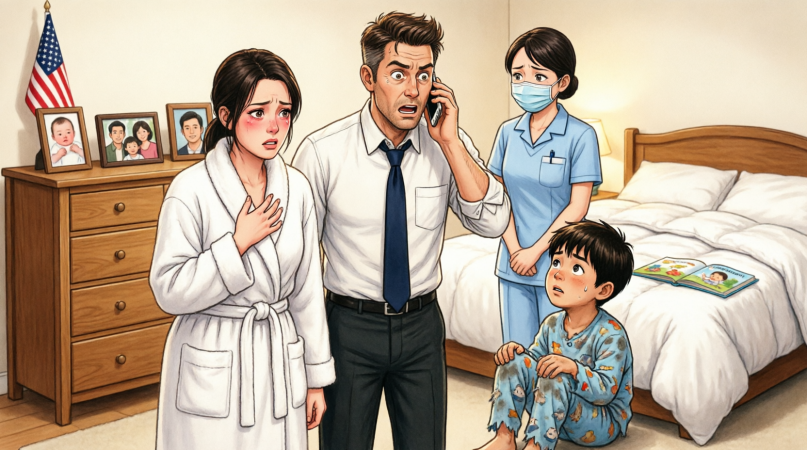
“Open my belly, Dad!” Emiliano screamed, folding himself against the cold marble floor like pain had broken every bone inside him.
His father, Rodrigo Arriaga, stood frozen at the bedroom door, holding a phone he had forgotten how to use.
The boy was eleven years old, thin from weeks of sickness, and trembling under pajamas damp with fever sweat.
On the bedside table, a white cup of hot chocolate still steamed beside a silver spoon and a folded napkin.
That cup should have meant comfort.
In that house, it had become a warning.
Rodrigo owned towers, highways, private clinics, and half the political favors in northern Mexico.
Yet none of that power helped when his son looked at him with desperate eyes and begged to be opened like a locked box.
“There’s something alive inside me,” Emiliano sobbed.
Daniela Arriaga appeared behind Rodrigo, dressed in a white silk robe and wearing sadness like expensive perfume.
She did not rush toward the child.
She did not kneel.
She only sighed, softly enough to sound wounded, and looked at Rodrigo as if he were the victim.
“This cannot continue,” she whispered.
Her voice was smooth, controlled, and practiced.
“Emiliano needs help, Rodrigo.”
The words landed in the room like another diagnosis.
Anxiety.
Grief.
Attention-seeking behavior.
Rejection of the stepmother.
Those were the words doctors had used after three emergency visits, four scans, and a dozen expensive consultations.
Rodrigo had believed them because they came from men in white coats and papers stamped with official seals.
He had believed them because the alternative was too monstrous.
He had believed them because Daniela cried every time Emiliano accused her.
But children do not always have legal evidence.
Sometimes they only have terror.
“I’m not lying,” Emiliano whispered.
His small fingers dug into his stomach as if holding something back.
“She puts something in my chocolate.”
Daniela closed her eyes and gave a broken little laugh.
“There it is again.”
She pressed one hand to her chest.
“I wake up early to make him something warm, and this is how he repays me.”
Rodrigo wanted to comfort his son.
He also wanted the screaming to stop.
That shameful truth would haunt him later.
He was tired.
He was embarrassed.
He was angry that a house filled with servants, cameras, guards, and money could not give him one peaceful morning.
“Enough,” Rodrigo said.
His voice came out rougher than he intended.
“If you accuse Daniela again without proof, I will sign the clinic papers today.”
The silence that followed was worse than any scream.
Emiliano stared at him.
In that instant, Rodrigo saw something leave his son’s face.
Trust.
It did not shatter loudly.
It simply disappeared.
From the hallway, Lucía Hernández watched the scene with her hands clasped so tightly her nails hurt.
She had been hired as the new nanny two weeks earlier.
Two weeks was not long in a normal home.
In the Arriaga mansion, it was long enough to understand where fear lived.
Fear lived in Emiliano’s bedroom.
Fear lived in the kitchen after everyone slept.
Fear lived behind the cinnamon jars.
That was where Lucía had found the bottle.
It was small, dark, and unlabeled.
No pharmacy sticker.
No prescription number.
No name.
Just a torn strip of paper wrapped around the glass, stained at the edge by something brown and sticky.
Lucía had grown up in a village where women knew plants, remedies, and dangerous little bottles that should never sit near a child’s drink.
She did not know exactly what was inside.
She only knew Daniela kept it hidden.
On her fourth night, Lucía took a photograph.
On her sixth night, she watched Daniela remove it.
On her ninth night, she recorded the impossible.
At 11:42 PM, Daniela entered the kitchen alone.
The mansion cameras covered the front hall, garage, garden, and gate.
They did not cover the pantry corner.
Daniela knew that.
Lucía watched from the service corridor, barely breathing.
Daniela warmed milk, added cocoa, stirred in sugar, then opened the dark bottle.
One drop fell.
Then another.
Then a third.
She stirred until the surface looked innocent again.
After that, she carried the cup upstairs to Emiliano and kissed his forehead in front of Rodrigo.
That was the night Lucía stopped wondering.
That was the night she understood.
A rich house can hide murder behind polished wood, clean sheets, and polite voices.
Now, standing outside the bedroom while Emiliano writhed on the floor, Lucía knew silence had become participation.
“Mr. Rodrigo,” she said.
Her voice was not loud.
It still cut through the room.
“Do not let the boy drink anything else prepared by señora Daniela.”
Daniela turned slowly.
“What did you say?”
Lucía stepped into the room.
She felt the housekeeper behind her freeze.
She felt the security guard look away.
She felt every old rule about servants and employers pressing against her throat.
Still, she spoke.
“I saw what you put in his chocolate.”
Daniela’s mouth opened.
For half a second, the sadness vanished.
What appeared underneath was not grief.
It was rage.
Rodrigo looked at Lucía as if she had slapped him.
“Be careful,” he said.
“I am being careful,” Lucía answered.
“That is why I waited until I had proof.”
She pulled her phone from her apron pocket.
Her hands shook.
The video did not.
On the screen, Daniela stood in the kitchen wearing the same white robe.
She lifted the dark bottle.
She counted the drops.
She stirred.
Rodrigo watched without blinking.
The room seemed to tilt around him.
The woman on the screen was his wife.
The woman beside him was suddenly a stranger.
Daniela reached for the phone.
Lucía pulled it back.
“That video is already saved elsewhere,” Lucía said.
It was a lie.
But it was the kind of lie poor women tell rich monsters when truth alone is not enough protection.
Rodrigo moved to the bedside table.
He picked up the cup.
The chocolate was thick at the bottom, clinging to the porcelain.
“Don’t shake it,” Lucía warned.
Rodrigo held the cup under the lamp.
At first, he saw only cocoa.
Then the liquid settled.
Something thin and black dragged itself through the last dark smear.
Rodrigo nearly dropped the cup.
Behind him, Emiliano whispered, “I told you.”
Those three words destroyed Rodrigo more than any accusation could have.
I told you.
Not once.
Not twice.
Again and again, while adults translated his terror into a problem with behavior.
Daniela’s voice returned colder.
“This is absurd.”
She pointed at Lucía.
“She planted it.”
The housekeeper gasped.
The guard finally looked up.
Lucía opened her apron pocket and placed a folded page on the nightstand.
“I wrote everything down,” she said.
“Every night he got sick.”
Rodrigo unfolded the page.
Dates.
Times.
Symptoms.
Who prepared the drink.
Who insisted he finish it.
Who cleaned the cup afterward.
The pattern was so clear that Rodrigo felt physically ill.
Daniela had created a schedule.
A slow ritual.
A bedtime performance of affection that ended with a child begging for rescue.
Rodrigo turned to his wife.
“What is in the bottle?”
Daniela said nothing.
For the first time since he had known her, she had no prepared expression.
Her silence filled the bedroom.
Then Emiliano screamed again.
This time, Rodrigo did not hesitate.
He crossed the room, lifted his son in both arms, and shouted for the driver.
Daniela blocked the door.
“You are not taking him anywhere with that girl’s fantasy.”
Rodrigo looked at her.
Something old and dangerous awakened behind his eyes.
“Move.”
She did not.
He stepped closer.
“I said move.”
Daniela moved.
Not because she was afraid of the law.
Because she finally understood Rodrigo had chosen his son.
At 5:41 AM, the black SUV tore through the gates of the Arriaga estate.
Lucía sat in the back with Emiliano’s head on her lap.
Rodrigo held the cup inside a sealed kitchen bag.
The driver kept glancing at the rearview mirror, afraid to ask why his boss looked like a man returning from war.
They did not go to the private clinic Daniela preferred.
Rodrigo ordered the driver to go to Hospital Universitario.
He wanted doctors who owed Daniela nothing.
He wanted toxicology.
He wanted specialists.
He wanted proof that could not be cried away.
At reception, nurses recognized him immediately.
Power opened doors.
Fear kicked them down.
“My son may have been poisoned,” Rodrigo said.
Every head turned.
The word traveled faster than a shout.
Poisoned.
In a child.
In a millionaire’s house.
By morning, the first rumor had already reached someone’s cousin, someone’s driver, someone’s sister-in-law who worked near the hospital.
That was how scandals are born.
Not from newspapers.
From whispered certainty.
The pediatric gastroenterologist arrived first.
Then toxicology.
Then a hospital administrator.
Then two police officers, because Lucía had called emergency services from the SUV while Rodrigo held Emiliano’s hand.
Daniela arrived twenty minutes later in another car.
She had changed clothes.
No silk robe.
No morning softness.
Now she wore beige trousers, a cream blouse, sunglasses, and the face of a woman preparing for cameras.
She tried to enter the examination room.
The officer stopped her.
“I am his stepmother,” she said.
“I need to be with him.”
Rodrigo stepped into the hallway.
His shirt was stained with chocolate.
His face was gray.
“You are not going near him.”
Daniela removed her sunglasses slowly.
“You will regret humiliating me.”
Rodrigo stared at her.
“If he dies, regret will be the smallest thing in this hospital.”
Inside, Emiliano was given medication, fluids, and tests that took too long for a father’s heart.
The moving thing from the cup was taken to a lab.
The dark residue was collected.
Lucía’s video was copied by police.
The folded notes were photographed.
Every detail became evidence.
Yet evidence does not heal what disbelief has already broken.
When Emiliano finally slept, Rodrigo sat beside him and looked at the small bruises on his son’s arms from needles.
For weeks, Emiliano had begged.
For weeks, Rodrigo had scolded.
For weeks, Daniela had stood between them smiling with cups of chocolate.
Rodrigo lowered his forehead to his son’s hand.
“I am sorry,” he whispered.
Emiliano did not wake.
That made the apology feel even more useless.
By noon, the first post appeared online.
It came from an anonymous account.
A millionaire’s son in Monterrey hospitalized after suspected poisoning inside luxury mansion.
No names.
No details.
Only enough to ignite speculation.
By evening, everyone knew the name.
Arriaga.
People searched old photos.
Wedding pictures resurfaced.
Rodrigo and Daniela smiling beneath white roses.
Emiliano standing beside them in a navy suit, unsmiling, holding his father’s hand.
Comment sections exploded.
Some called Daniela a monster.
Some blamed Rodrigo.
Some accused the nanny of chasing money.
Some asked why nobody believed the child sooner.
That was the question people shared most.
Why does a child have to almost die before adults listen?
The story became bigger than one family.
It became a mirror.
Parents argued.
Doctors argued.
Teachers argued.
Domestic workers argued.
Stepparents argued.
Influencers made videos in their cars, crying about intuition and child safety.
Psychologists warned against dismissing children as dramatic.
Lawyers explained custody, negligence, and attempted harm.
Everyone had an opinion.
Everyone wanted a villain.
The truth was worse.
There was more than one.
Daniela was not arrested that first day.
Her lawyers arrived before sunset.
Three men in dark suits entered the hospital with the confidence of people who usually make consequences disappear.
They called the evidence incomplete.
They called Lucía unstable.
They called Emiliano emotionally disturbed.
They suggested Rodrigo was reacting from guilt over his first wife’s death.
That line made Rodrigo stand up so fast his chair hit the wall.
His first wife, Mariana, had died two years earlier in a car crash on the highway to Saltillo.
Emiliano had been nine.
Rodrigo had buried his wife and returned to work three days later because men like him are taught to mistake collapse for weakness.
Daniela entered his life six months later.
She was elegant, charitable, and impossibly understanding.
She organized fundraisers for children’s hospitals.
She sent flowers on Mariana’s birthday.
She told Rodrigo that Emiliano needed structure.
She told Rodrigo that grief could become manipulation if a child learned adults would obey tears.
At first, Rodrigo believed she was helping.
Then she began replacing people.
The old cook was fired.
The family driver was transferred.
Mariana’s sister was no longer welcome without notice.
Emiliano’s therapist was changed.
Every person who knew the boy before Daniela slowly disappeared from the house.
Rodrigo called it adjustment.
Daniela called it order.
Now, sitting under hospital lights, Rodrigo realized it had been isolation.
The second day brought the lab’s preliminary report.
The substance in the cup contained compounds that could cause severe gastrointestinal distress, hallucination-like sensations, muscle spasms, and panic.
It was not ordinary cocoa.
It was not cinnamon.
It was not a harmless remedy.
The moving material found in the cup was sent for further analysis.
Doctors said it may have come from contaminated organic matter mixed into the drink.
They avoided dramatic words.
Police did not.
They opened a criminal investigation.
Daniela’s lawyers argued that no one could prove she intended harm.
Lucía’s video proved drops.
The medical report proved danger.
The notes proved repetition.
Intent, however, is the favorite hiding place of people with money.
Daniela gave a statement.
She said the bottle contained an imported digestive herbal solution.
She said Emiliano refused to eat.
She said she only wanted to calm his stomach.
She said Lucía misunderstood.
She said Rodrigo had become emotionally unstable.
She said the boy needed psychiatric care, not police attention.
The statement leaked.
Social media erupted again.
One side said any motherly figure could make mistakes.
The other side asked why a mistake needed hiding behind cinnamon jars.
The phrase became a hashtag.
Behind the cinnamon jars.
People used it to describe every secret families hide in plain sight.
Abuse behind respectability.
Neglect behind wealth.
Cruelty behind perfect photos.
Rodrigo watched the storm from Emiliano’s hospital room.
He had spent years controlling public narratives.
Now strangers were dissecting his family like a crime documentary.
He hated it.
He also knew it was deserved.
Because public outrage was doing what private power had failed to do.
It was keeping Daniela from disappearing the evidence.
On the third day, Emiliano woke properly.
His lips were still pale.
His voice was tiny.
But his eyes were clear.
Rodrigo leaned close.
“I’m here.”
Emiliano looked at him for a long time.
“Are you going to send me away?”
The question split Rodrigo open.
“No.”
“You said you would.”
“I was wrong.”
Emiliano turned his face toward the window.
Children can forgive.
But they also remember.
Rodrigo understood then that saving his son’s life was not the same as regaining his trust.
Lucía entered quietly with a nurse’s permission.
Emiliano saw her and immediately reached out.
That simple movement told Rodrigo everything.
The nanny of two weeks had become safer than the father of eleven years.
Lucía sat beside the bed.
“You were very brave,” she said.
Emiliano shook his head.
“I was scared.”
“Being brave does not mean you were not scared.”
He looked at his father.
“I told you she was doing it.”
Rodrigo nodded.
“I know.”
“You believed her.”
The room went silent.
Rodrigo did not defend himself.
He did not blame doctors.
He did not blame grief.
He did not say Daniela fooled everyone.
That would have been easy.
Easy explanations are another kind of hiding.
“Yes,” he said.
“I believed her when I should have believed you.”
Emiliano’s eyes filled with tears.
Rodrigo’s did too.
Outside the room, cameras gathered near the hospital entrance.
Reporters wanted a statement.
Online audiences wanted updates.
Daniela wanted control.
Rodrigo wanted the past month erased.
None of them got what they wanted.
At 6:00 PM, police arrived with a warrant to search the Arriaga mansion.
They found the dark bottle.
They found two more bottles inside a locked drawer in Daniela’s dressing room.
They found deleted messages on a tablet after specialists recovered backups.
They found searches about symptoms, doses, and how long certain substances remain detectable.
They found a draft email to a private residential clinic describing Emiliano as dangerous, delusional, and in need of immediate confinement.
That draft was dated for the next day.
The day Rodrigo had threatened to sign the papers.
The internet did not know that detail at first.
Police kept it sealed.
Rodrigo learned it from the investigator.
When he read the draft, he had to sit down.
Daniela had not merely wanted Emiliano sick.
She had wanted him labeled.
She wanted him discredited so completely that anything he said afterward would sound like madness.
A poisoned child is one crime.
A silenced child is another.
Together, they created something almost unspeakable.
The next question was motive.
Money was obvious.
But motive in rich families usually wears several coats.
Emiliano was Rodrigo’s only biological child.