When the elevator doors close, you exhale so hard it almost bends you.
“Do not,” Ava says gently, “mistake that feeling for regret.”
You laugh once, then cry once, then somehow do both at the same time.
Outside, rain has started again, light and needling. Seattle doing what Seattle does, rinsing the city without asking anyone’s permission. Ava loads your bags into the back seat of her Subaru. You sit in the passenger seat staring at the apartment building while warm air blows from the vents and the windows begin to fog.
“You want to talk?” she asks.
“Not yet.”
“You want fries?”
“Yes.”
“That,” she says, pulling out onto the street, “is the healthiest answer you’ve given all night.”
At Ava’s townhouse, her guest room is already made up. Of course it is. She is the kind of woman who keeps extra blankets, good batteries, and emergency dark chocolate in a basket labeled FOR THE APOCALYPSE, which until now had mostly seemed funny. She sets your bag down, hands you one of her ancient college sweatshirts, and says she’ll be downstairs if you need to spiral. Then she closes the door halfway behind her, which is exactly the amount of love that leaves room to breathe.
You sit on the edge of the bed and look at your phone.
Thirty-four unread messages.
Some are from guests checking on you. Some are from acquaintances who clearly want gossip disguised as concern. Several are from your husband.
Where are you?
Come home.
This is insane.
You made a huge mistake.
We need to talk now.
Answer me.
Then, fifteen minutes later:
I’m sorry you felt disrespected.
That one actually makes you laugh. The passive voice of emotional cowards. Disrespect appears from nowhere, apparently, like mildew.
You set the phone face down.
Only one message matters right then. It is from your older sister, Tessa, who lives in Portland and has spent three years disliking your husband with the patient discipline of a woman waiting for a bridge to collapse exactly where she predicted.
Ava called. I’m proud of you. Also, if he shows up acting sad and complicated, remember raccoons can also open containers.
You laugh hard enough that it hurts.
The next morning, grief arrives before coffee.
That is the rude part nobody advertises. Leaving with dignity still feels like being scraped hollow the day after. You wake up in a room that smells like detergent and lavender and not at all like the home you built, and for one irrational second you almost get up to make his coffee the way you always do on Sundays. Then memory catches up and sits on your chest like wet cement.
Ava knocks once and pushes the door open with two mugs.
“Alive?” she asks.
“Debatable.”
She hands you coffee. “Excellent. That’s a start.”
You sit cross-legged on the bed while rain ticks softly against the window. The sweatshirt sleeves swallow your hands. Your face feels swollen. Your heart feels like an organ someone returned without instructions.
“Did I do the right thing?” you ask.
Ava looks offended on morality’s behalf. “Yes.”
“It was public.”
“He made it public.”
“It was dramatic.”
“It was accurate.”
You stare into your coffee. “I keep thinking maybe I could’ve just waited. Left quietly later.”
“You did leave quietly later,” she says. “You just also stopped him from telling the story first.”
That lands.
Because she’s right. If you had slipped out after the party, he would have had hours or days to spin you into the villain. Too sensitive. Too jealous. Unstable. Cold. Impossible to please. Public performance was his weapon. Public clarity was your shield.
You spend Sunday doing practical things because practicality is the rope bridge over emotional canyons.
You call your bank and separate what still needs separating. You update passwords. You email yourself copies of the lease, the utility records, the furniture receipts, the insurance policy. You make a spreadsheet because heartbreak behaves better when cells and columns contain it for a while. Ava brings you toast and clementines and only makes fun of the spreadsheet twice.
Your husband keeps texting.
I can’t believe you’d do this over nothing.
Everyone thinks you lost it.
Nicole already left. Happy now?
Call me.
Then later:
Can we please talk like adults?
That one almost deserves an award.
You do not respond.
By Monday, the hangover of the party has spread through your social circle like weather. Two people send you screenshots of group chats where guests are processing what they saw. One says your husband “looked awful.” Another says the whole thing made them rethink times he’d spoken over you at dinners, times he joked about your being “intense,” times he called you “adorably stubborn” when you were actually correct. It is strange, the way one bright public rupture can throw light backward across years.
At work, you spend the day in your truck moving between job sites and trying not to cry in parking lots.
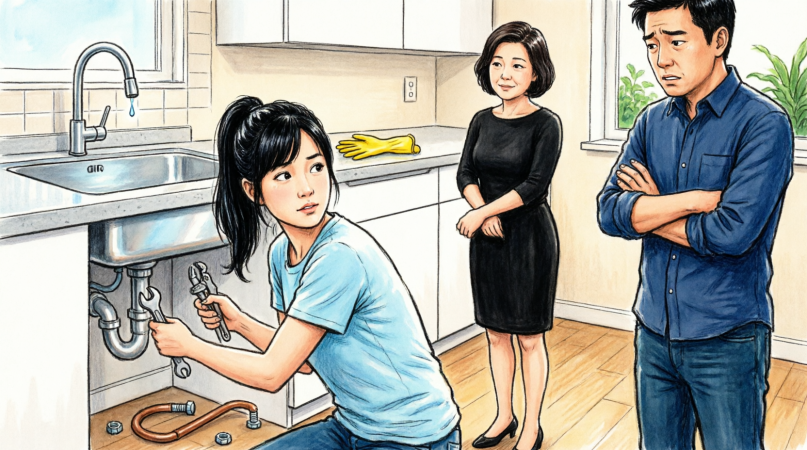
You work for a small residential repair company that mostly services old houses and rental properties around Seattle. Broken faucets. Electrical quirks. Drywall patches. Rotting porch steps. The jobs are physical and finite, which is one reason you love them. A leaking pipe does not gaslight you. A door either hangs straight or it does not.
Around noon, your boss, Marisol, knocks on your window while you are eating a granola bar and staring at nothing.
“You got ten minutes?” she asks.
You nod.
She climbs into the passenger seat, shutting the door against the drizzle. Marisol is in her fifties, tough without theatrics, the kind of woman who can rewire a panel and detect nonsense through two layers of drywall.
“Heard a version from Ava,” she says. “You want to give me yours?”
So you do. Not every detail, but enough.
She listens without interruption, then leans back and says, “That man doesn’t want a partner. He wants an audience that can also cook.”
You bark a laugh.
She nods toward the steering wheel. “You got a place to land?”
“For now.”
“Good.” She pauses. “You need extra hours, take them. You need a random Wednesday off to cry in a hardware aisle, take that too.”
Your throat tightens. “Thanks.”
She shrugs. “Anyone who can rebuild a subfloor can rebuild a life. Different mess, same principles.”
That becomes the sentence you carry all week.
Your husband escalates on Tuesday.
He emails.
The subject line is: Let’s Be Reasonable.
You almost delete it unopened, but curiosity has terrible survival instincts. Inside, he has shifted tactics. The rage is gone. In its place is a long, polished appeal full of words like misunderstanding, stress, optics, miscommunication, and emotional timing. He says he feels “blindsided by the intensity” of your response. He says he was only trying to show that he believes in healthy, evolved friendships. He says he hates that “our private dynamics” were exposed in a way that damaged trust.
Damaged trust.
You read that sentence three times.
Then you forward the email to Tessa and Ava with no comment.
Tessa replies first.
“Private dynamics” is a beautiful way to say he wanted secrecy for behavior that required witnesses to become visible.
Ava replies thirty seconds later.
I’ll kill him and make it look like a rustic accident.
You do not answer either of them right away because for the first time all week, you are not crying. You are angry in that clean, efficient way anger gets when grief has burned off the fog. You open a new document and begin listing every moment from the last two years when your discomfort was rebranded as insecurity. Every “joke” at your expense. Every dismissal. Every time he made your labor invisible by narrating the results as mutual. By the third page, your pulse is loud and your posture has changed.
You are not overreacting now. You are catching up.
On Wednesday evening, he shows up at Ava’s townhouse.
Not at the door, thank God. At the curb. He texts from his car.
I know your truck is here.
Can we please talk.
Ava peers through the blinds and snorts. “He looks like a man auditioning for a premium apology package.”
You stand beside her and look.
He is leaning against his car in a navy jacket he knows makes him look regretful and expensive at the same time. Hands in pockets. Head lowered. If a string quartet emerged from the bushes, he would probably nod like it was appropriate.
“I hate him,” Ava says conversationally.
“I know.”
“He thinks he’s in a perfume ad for consequences.”
You laugh so hard you have to sit down.
In the end, you do go outside. Not because he deserves it, but because you need one clear conversation in daylight, on neutral ground, with no furniture or shared photos around to distort the scale.
Ava insists on standing on the porch.
“Absolutely not,” you tell her.
“I’ll be subtle.”
“You have the energy of a visible weapon.”
“Thank you.”
He straightens when you step onto the sidewalk. Relief flashes across his face because he has mistaken access for influence.
“Finally,” he says.
You stop several feet away. “Make it short.”
Rain beads on his jacket. He looks tired, and a week ago that would have softened you. Now it just registers as weather.
“I’m sorry,” he says. “I really am.”
You wait.
He shifts. “I didn’t realize how hurt you were.”
That is not an apology. That is an indictment of your legibility.
“You realized enough to tell me I could leave,” you say.
“I said it in frustration.”
“No. You said it with confidence.”
He exhales, looking upward like the sky might provide better reception. “Can we not do word-for-word courtroom stuff?”
“You invited the witness.”
His mouth tightens. “Do you want to be right or married?”
It is such a revealing question that for a second you almost thank him.
“I wanted respect,” you say. “You kept offering me alternatives.”
He rubs his face. “Nicole didn’t mean anything.”
“Then why was it so important that she be there?”
He opens his mouth, closes it, opens it again. “Because I didn’t want to feel controlled.”
You stare at him.
And there it is. Finally. Not friendship. Not maturity. Not evolved social boundaries. Power. The ability to do something he knew would wound you and still be obeyed. The right to prove that your discomfort could be outranked by his preference.
“That,” you say softly, “is why I’m done.”
He looks genuinely confused. Not theatrically. Deeply. As if a key premise of his universe has failed.
“I came here,” he says. “I’m apologizing.”
“You came here because public opinion shifted.”
“That’s not fair.”
“It’s accurate.”
He takes a step toward you. “I love you.”
The old you might have folded at that. Love has always been the lever he reaches for once shame fails. But love without safety becomes debt. Love without respect becomes theater. Love without accountability becomes a room where only one person gets to be human.
“I believe you,” you say.
Hope flashes across his face.
Then you finish.
“I also believe you love yourself more.”
He actually recoils.
Behind you, the porch light clicks on. Ava has either turned it on for visibility or drama. Possibly both.
“You’re being cruel,” he says.
“No,” you answer. “I’m being clear in a voice you don’t enjoy.”
You tell him future contact should go through email regarding logistics only. You tell him you will arrange a time to collect the rest of your things with Ava and Tessa present. You tell him if he shows up unannounced again, you will not come outside. Then you walk back toward the porch before he can reorganize himself into another role.
He calls after you once.
“You’re really going to end everything over this?”
You turn halfway.
“No,” you say. “I’m ending it because this explained everything.”
By Friday, you have a retrieval plan.
Tessa drives up from Portland in a gray SUV packed with snacks, legal pads, and the wrath of an older sister who has waited years for confirmation. She hugs you so hard your spine clicks.
“Tell me what room to be menacing in,” she says.
The apartment looks smaller when you return.
Funny how betrayal changes square footage.
Your husband is there, of course. He said he would “respect boundaries,” but also that he needed to be present “for closure,” which in his language usually means for control. He is trying very hard to look composed. The ring is gone from his hand. Whether that is strategy or sulking, you do not ask.
Ava heads for the bedroom with boxes. Tessa stations herself in the kitchen like a federal agency. You move through the rooms collecting what is yours, and the apartment begins to transform as you do. Your tools. Your books. The blankets your aunt quilted. The framed print above the desk. The ceramic bowl you bought on your anniversary trip and then, later, could not remember whether you liked because of the bowl or because of the time in your life when you bought it.
He follows you once into the bedroom. “You’re taking everything.”
You zip a duffel bag. “No. Just what’s mine.”
“This is so cold.”
You look up. “You mistook my warmth for permanence.”
He stops speaking after that.
In the bathroom cabinet, you find the extra toothbrush heads you bought in bulk because he always forgot. In the hall closet, you find the lightbulbs, batteries, and extension cords you organized into bins. In the kitchen drawer, you find the tiny wrench set you bought because the cheap faucet hardware in the apartment required odd sizes. Every item is a quiet record. Not of romance, but of maintenance. Of the invisible labor that makes a life function long enough for someone else to call it effortless.
When you remove your grandmother’s recipe box from the shelf, he says, “Do you have to take that too?”
You pause with it in your hands. “Especially this.”
By the time the last box is loaded into the SUV, the apartment looks less like a home and more like a stage after a show closes. Something essential has gone. Not glamour. Infrastructure.
At the door, he tries once more.
“We could still fix this.”
You glance back into the stripped, echoing room. “I already fixed the part that was mine.”
Then you leave him standing in the shell of a place he thought your labor would keep inhabitable no matter how he treated you.
Weeks pass.
Then months.
The first month hurts in practical rhythms. You miss stupid things. The specific mug you always reached for. The shape of your old couch corner under your hip. The way another person’s footsteps sound in an apartment when life still feels shared. But you do not miss the vigilance. You do not miss monitoring your tone so his ego never bruises too publicly. You do not miss explaining your own pain in paragraphs only to have it returned as a personality flaw.
You rent a small place of your own in Ballard with slanted afternoon light and a landlord who leaves you alone. The bathroom tile is tragic, the kitchen cabinets are older than some republics, and the bedroom closet door sticks in damp weather. You love it immediately. Not because it is perfect, but because every silence inside it belongs to you.
You paint one wall deep blue.
You build a workbench in the corner by the window.
You sleep.
The guests from the party scatter into categories over time. Some become closer because they tell you the truth. Some vanish because they were never really your people, only orbiting the gravity of couplehood. A few try to remain neutral in that performative adult way that always seems to benefit the person who caused harm. You let them. Neutrality is not your administrative burden anymore.
Nicole messages you once, three months later.
I know I was part of something ugly. I’m sorry. I should have left the second I understood.
You stare at the message for a long time. Then you write back:
You should have never come. But I hope you’ve learned the difference.
She leaves a heart reaction and says nothing else.
Your husband, soon-to-be ex, cycles predictably through denial, charm, woundedness, and strategic self-improvement theater. He posts a few tasteful gym selfies. A quote about growth. A photo of a mountain trail with the caption Learning to listen. Tessa sends them to you under the heading National Geographic: Males in Rebranding Season.
You laugh every time.
The divorce is not dramatic, which somehow feels like a reward. No affairs proved in court. No screaming on courthouse steps. Just paperwork, division, signatures, the slow bureaucratic untangling of what never should have been knotted that way. He wants to keep the apartment. You let him. You do not want the floor plan that taught you the final lesson. You keep your truck, your savings, your tools, your recipe box, your grandfather’s watch, and your name without his attached.
That last part feels oddly luxurious.
In spring, Marisol promotes you to lead tech on a renovation project for an old craftsman house with sloping floors and three generations of bad repairs hidden inside its walls. The place is a puzzle box of deferred consequences, and you love it with almost embarrassing intensity. Day by day, you open surfaces and find rot, patchwork, shortcuts, hopeful lies. Day by day, you remove what cannot be trusted, reinforce what can, and rebuild.
One afternoon, standing in a room full of stripped studs and sunlight, you realize why the project feels so good. It is not just restoration. It is honesty. The house only gets better once everything false is exposed.
You lean against a beam and laugh out loud by yourself.
Marisol hears you from the hallway and pokes her head in. “You okay?”
“Yeah,” you say. “I just had an extremely annoying personal metaphor.”
She nods. “Construction is full of those.”
By summer, your new place looks like you in a way the old apartment never quite did. Not prettier. More exact. There are tools on open shelving because you use them. Books in uneven stacks. Plants that survive because you remember water schedules better than anniversaries. A dining table you found secondhand and refinished yourself. A heavy ceramic lamp that Tessa says looks like “something a formidable widow would own,” which you choose to take as a compliment.
Ava comes over often. Sometimes with Thai takeout, sometimes with a bottle of cheap prosecco, sometimes just to sit on your floor while you both scroll real estate listings you cannot afford and invent histories for the people in them. Tessa visits less often but more intensely, arriving with trunkfuls of produce, legal updates, and unsolicited commentary about men in fleece vests.
One evening, the three of you sit on your balcony with drinks while the sky turns blue-gray over the city.
Ava nudges your knee. “So what’s the official review now, months later?”
You look out at the rooftops. “On what?”
“On the party.”
You think.
Then you smile.
“I think,” you say slowly, “that it was the first housewarming where the person who left ended up more at home.”
Ava groans softly. “That’s disgustingly good.”
Tessa lifts her glass. “To leaving correctly.”
You clink all three glasses together.
In the end, the most shocking part is not that he invited his ex.
It is not even that he told you that if you could not accept it, you could leave. Men like him say those things every day, in polished apartments and messy kitchens, in marriages that look stable from the outside because one person has become very skilled at swallowing the bill for the other’s comfort. The truly shocking part is what happened when you believed him.
You left.
Not hysterically. Not with revenge that stained your own hands. Not with broken plates or screaming neighbors or midnight ultimatums. You left with lists and witnesses and your own key already unclipped from his future. You left so calmly that people mistook your peace for cruelty, because the world is still far more comfortable watching women absorb disrespect than watching them return it unopened.
But that was the mature answer, after all.
Not staying.
Not performing acceptance for the sake of appearing evolved.
Not confusing tolerance with wisdom.
The mature answer was understanding that a home is not made sacred by the people who are invited into it. It is made sacred by the standards that are protected inside it. And the night he asked you to welcome humiliation across your own threshold, he told you everything you needed to know about the kind of home he wanted.
So you gave him exactly what he offered.
You left.
And for the first time in a long time, the door closed behind you like a blessing.