The sound of the slap stayed in the room longer than anybody else did anything about it.
That was the first thing I noticed.
Not the sting in my face. Not Michelle’s hard breathing. Not the little gasp her sister let out like she couldn’t quite believe the moment had gone as far as it had. What I noticed first was the silence. A heavy, stunned silence hanging over my own dining room table while everybody looked at me as if I were the one who had crossed a line.
My name is Daniel Mercer. I’m a contractor. I’ve spent most of my adult life building things with my hands and fixing what other people let fall apart. Decks, kitchens, foundations, framing, tile, drywall, trim, roofs, whatever paid. I’ve worked in heat that felt like punishment and cold that turned steel into ice in your fingers. I’ve gone home with my knees throbbing, shoulders burning, nails split, and I never once minded the work because the work made sense. Something was broken. You saw it. You measured it. You did what had to be done. When the job was finished, the result stood in front of you solid and real.
Marriage, I learned, didn’t work like that.
It was dinner in my house. My table. My plates. My food. Michelle had cooked with groceries I paid for, in a kitchen I renovated with my own hands, under lights I installed, inside a house I bought two years before I ever met her. Around that table sat my wife, her mother, her father, her two brothers, and her sister. Six of them. One of me. They’d been living under my roof for five years without paying rent, utilities, or groceries. Five years of muddy shoes in the hallway, half-finished cups in the living room, loud televisions, slammed doors, empty refrigerators, broken things no one admitted breaking, and constant criticism from people who had not spent one honest dollar on the place they inhabited.
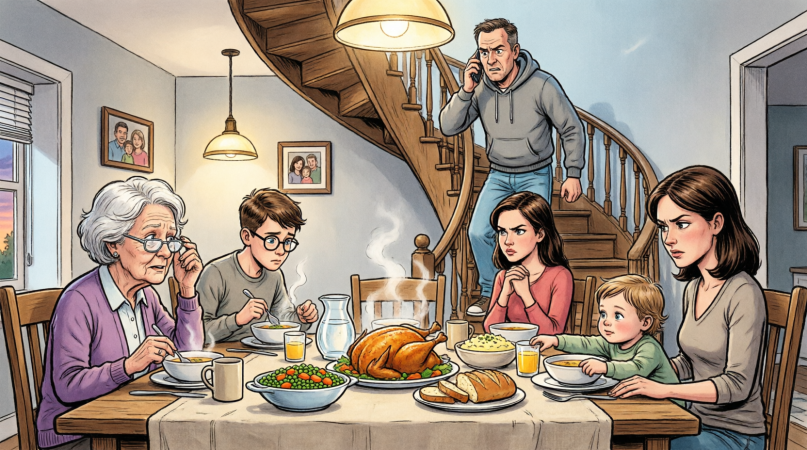
Usually I kept quiet. It was easier. Not better. Just easier.
Michelle’s mother was doing what she always did, talking with that false softness she wore when she wanted to insult me without using words anyone else could object to.
“If Daniel pushed himself a little more,” she said, stirring her tea though she was finished with it, “you two wouldn’t feel so stretched all the time. A man has to think ahead. Security matters. A wife should never have to worry.”
Michelle nodded while cutting her chicken.
Her father leaned back like a judge listening to reason.
Her younger brother was shoveling food into his mouth with his elbows on my table, and her sister was scrolling through her phone under the tablecloth, half listening, already bored by the conversation but still happy to let me be the target.
I had heard some version of the same speech a hundred times.
Work harder.
Make more.
Be more.
Provide better.
Never mind that I worked sixty-hour weeks while none of them worked at all. Never mind that the “stretch” they kept talking about was caused by six adults and a teenager eating, bathing, using electricity, running heat and air, driving up every bill in the house while contributing exactly nothing but opinions. Never mind that Michelle herself had quit her receptionist job three years into our marriage because her mother “needed help,” even though no doctor had ever named a condition and the only thing her mother truly seemed too weak to do was wash a dish or make a bed.
Maybe it was the way her mother said it that night. Maybe it was the casual certainty in Michelle’s face, like she agreed. Maybe it was just that something in me had finally run out.
I set down my fork and said, “Maybe if I wasn’t supporting six extra people, we’d have more money.”
That was it.
One sentence.
Not shouted. Not mean. Just flatly true.
The room stopped breathing.
Michelle’s mother froze with her glass halfway to her mouth. Her father stared at me. One brother actually looked down at his plate as if he could disappear into it. Her sister’s phone dropped slightly in her hand.
Michelle turned to me so fast her chair creaked.
“What did you just say?”
I looked at her.
“You heard me.”
The slap came before I finished the second word.
Sharp. Fast. Full force across my face in front of everyone.
For a second the whole room flashed white.
I turned with it, more from surprise than impact, and when I looked back, Michelle was standing now, her face bright red, her chest rising and falling hard.
“Don’t you dare disrespect my mother.”
Nobody moved toward me.
Nobody said Michelle.
Nobody said enough.
What happened instead was worse. Her father pushed his chair back and stood up, full of borrowed authority.
“You need to apologize right now.”
I touched my cheek. It was hot already.
I looked around the table at every single face.
At the people who slept in my rooms.
At the people who ate my food.
At the people who watched me leave before dawn in winter and come back after dark with sawdust in my hair and pain in my spine while they sat in climate-controlled comfort and criticized how fast I was paying for their lives.
At my wife, who had just hit me because I told the truth once in her mother’s hearing.
“No,” I said.
Michelle blinked.
Her father stared.
“You heard me,” I said again, standing up slowly. “No.”
My chair scraped the floor. The sound made everyone flinch.
Michelle’s mother found her voice first, not loud, but vicious.
“How dare you.”
I laughed then, one short bitter sound that didn’t feel like mine.
“How dare I?” I repeated. “How dare I say I’m tired of carrying all of you?”
“Daniel,” Michelle snapped, her voice warning now, as if I were the unstable one. “Sit down.”
I looked at her.
I had loved this woman for seven years.
Long enough to know the difference between her soft face and her hard face, between the smile she wore for strangers and the one she wore when she knew I’d give in just to stop the scene. Long enough to know that half the time she wasn’t consciously choosing her mother over me. It was more automatic than that, more deeply trained. Her family spoke, she aligned. They wanted, she justified. They took, she explained. If they crossed a line, I was always the one asked to step back from it.
“Daniel,” she said again, lower this time. “Sit down.”
I picked up my water glass, drained it, set it down carefully, then said, “I’m done.”
Her father took one step toward me. “You don’t walk away from this table after insulting my wife.”
I looked at him and for the first time in five years I didn’t feel even a flicker of respect. Not because he was older than me, not because he was family, not because he’d once worked construction management and liked reminding me he used to supervise men like me. All I felt was exhaustion.
“It’s my table,” I said. “In my house.”
Then I turned, walked out of the dining room, and went upstairs.
Nobody followed at first.
That surprised me. I guess they thought I was just cooling off, that I’d be back down in a few minutes with the same tired look I’d worn so many other nights when I let things pass because the alternative seemed worse.
I went into our bedroom—my bedroom before we married, though even that had long ago stopped feeling like mine—grabbed a duffel bag from the closet, and started throwing things into it.
Jeans.
Two work shirts.
Underwear.
Socks.
Toothbrush.
Razor.
Phone charger.
Laptop.
Folder with the house papers I kept hidden in the back of the dresser because Michelle had started asking too many questions about deeds and estate planning and “making things simple if something ever happens.”
The house was loud below me now. Chairs scraping. Voices rising. Michelle calling my name like it was an accusation, not concern.
I zipped the bag, slung it over my shoulder, and went back downstairs.
They were all still there.
Exactly where I had left them. Frozen around the wreckage of the dinner. My plate still on the table. My napkin still crumpled by the fork. Michelle standing at the end of the table, arms crossed now. Her mother in her chair, chin lifted in outrage. Her father planted beside her like security. Her siblings seated and watching with the hungry stillness of people who know something permanent might be happening and don’t want to miss it.
I looked at Michelle.
“I’ll be back tomorrow,” I said.
Her lips parted.
“Back for what?”
I tightened my grip on the duffel.
“You’ll see.”
Then I walked out the front door and into the cold.
The air hit my face and made the sting of the slap bloom all over again. I crossed the driveway without looking back, threw the bag in the passenger seat of my truck, and just sat there for a minute with both hands on the wheel.
The porch light glowed yellow over the front steps. Through the dining room window I could still see silhouettes moving. Michelle’s father pacing. Her mother throwing her hands up. Michelle turning toward the hallway like she might come after me, then not coming.
That was when I knew.
Not that the marriage was over. That part had probably been true long before the slap.
What I knew, sitting in the dark with my cheek burning, was that if I walked back into that house without changing the terms completely, I would spend the rest of my life being the man everyone in that family knew they could hit—if not always with a hand, then with expectation, obligation, noise, and need.
So I took out my phone and made the call I should have made years earlier.
“Steve,” I said when he answered. “It’s Daniel. I need to file for divorce tonight.”
There are men you call because they’ll tell you what you want to hear, and men you call because they’ll tell you the truth quickly enough to be useful.
Steve Patterson was the second kind.
I’d remodeled his kitchen the year before after his wife saw my work on a custom walnut island and decided she could not live another month without one. Steve had watched me measure twice, cut once, show up when I said I would, and finish what I started. After that he trusted me. I trusted him because he was one of the only lawyers I knew who didn’t waste words pretending reality was kinder than it was.
He met me at his office at nine that night in jeans, loafers, and a sweater thrown over whatever he’d been wearing for family Christmas photos. He unlocked the side entrance himself and let me in without comment beyond, “Coffee’s terrible, but it’s hot.”
His office sat above a pharmacy downtown and smelled like paper, toner, and whatever cologne rich men wear when they want to smell expensive without seeming as if they care. Diplomas on the wall. Family pictures on the credenza. A framed newspaper clipping from some ugly lawsuit he’d won in the nineties that he kept because it made him look like a man no one should lie to.
He sat behind his desk, opened a yellow legal pad, and said, “Tell me everything.”
So I did.
Not just the slap.
All of it.
Meeting Michelle eight years earlier at a church barbecue when she was laughing over burnt burgers and looked at me like I was the only man there not trying too hard. Getting married a year later in a small church with too many hydrangeas because that was what her mother wanted. Thinking I’d gotten lucky because Michelle was warm and bright and family-oriented, and not yet knowing that “family-oriented” in her world meant every boundary was temporary if blood stood on the other side asking for something.
I told him about the first request.
It came two years into the marriage. Her father’s construction company went under after a bad investment and a worse partner. Michelle sat on the couch beside me one Sunday night, curled into my arm, and said, “Can Mom and Dad stay with us a little while? Just until they get back on their feet.”
A little while.
That phrase should be printed on warning labels.
I said yes because at the time I still believed temporary hardship behaved like weather. You waited it out. You did the decent thing. You helped family. The guest room was empty. Her father had worked hard his whole life. Her mother cried when they moved in and called me a blessing.
Three months later, her younger brother Aaron got kicked out by his roommate after “some misunderstanding” involving missing rent and a broken television. Michelle asked if he could take the basement for a while.
Then her sister Tara “just needed a place to reset” after ending another relationship.
Then the other brother, Neil, started spending more and more nights on the den sofa because driving back across town after gaming with Aaron was “pointless.”
At some point the house stopped feeling crowded in a temporary way and started feeling occupied in a permanent one.
Guest room gone.
Basement gone.
Den converted to a second bedroom.
Garage packed with other people’s junk.
Pantry emptied twice as fast.
Hot water gone by the time I got home from work.
Laundry stacked like a motel backroom.
No room in the fridge for my lunch containers because Tara was experimenting with “wellness meal prep” on ingredients I paid for and nobody ate.
Michelle quit her job in the middle of all this.
That still makes me laugh, sometimes, though there’s nothing funny in it.
She had worked front desk at a dental office. Not glamorous, but steady. One Tuesday night she sat me down and said she didn’t think it made sense for her to keep working while her mother was “so unwell.”
I asked what the diagnosis was.
She said her mother had a lot of stress-related symptoms and needed support during the day.
I said, “Support doing what?”
She cried.
That was the answer.
I told Steve about the years after that. Sixty-hour weeks. Sometimes more. Taking every decent contract I could find. Whole-house remodels. Commercial drywall. Emergency repair work after storms. Decks in summer heat. Interior jobs through winter when the air inside half-finished houses was full of plaster dust and cold. I left before dawn. Came back with my shoulders screaming and my knees swollen and my hands split open in the dry season.
And every night I came home to noise.
Her father in my recliner watching cable news and asking if I was going to fix the loose handrail in the hallway as if I hadn’t rebuilt half the damn house already.
Her mother in the kitchen criticizing the brand of coffee I bought while drinking it.
Aaron in the basement “building a startup” that never once produced a dollar.
Neil drifting in and out of gig jobs, always just about to catch a break, always somehow still borrowing gas money from Michelle.
Tara treating the place like a recovery spa after one failed romance after another, posting inspirational quotes from my breakfast nook while I paid the internet bill that let her do it.
And Michelle, always in the center of it, smoothing, translating, excusing.
“Dad’s pride is hurt.”
“Mom’s not feeling well.”
“Aaron’s trying.”
“Tara’s fragile.”
“Neil just needs support.”
“They’re family, Daniel.”
I kept waiting for the season to change.
For her father to get a job.
For one sibling to move out.
For Michelle to notice that I was disappearing in plain sight.
For gratitude.
For a thank-you.
For one meal where I wasn’t also the subject of a lecture about what more a man should do.
None of it came.
Instead the criticism got bolder because that’s what happens when entitlement lives too long rent-free: it stops disguising itself as need and starts calling itself fairness.
Steve listened without interrupting, which was somehow more brutal than sympathy would have been.
When I finished, he looked down at his notes, then back at me.
“The house is in your name only?”
“Yes.”
“You bought it before the marriage?”
“Two years before.”
“No kids together?”
“No.”
“Any major marital assets besides furniture, appliances, regular household stuff?”
“Nothing big.”
He tapped the pad with his pen.
“Daniel, if what you’re telling me is clean—and I believe it is—then the divorce itself is straightforward. The complication is occupancy.”
I frowned.
“What does that mean?”
“It means your wife and her family have been living in that house long enough that even without paying rent, they’re going to argue they have tenancy rights or at least residency rights. We can beat most of that because title is clean and the marriage is breaking down, but we need to move carefully enough that you don’t accidentally give them a better story than the one they already have.”
I leaned back in the chair.
“I don’t care about their story.”
“You will when they start telling a judge you threw out an entire family, including a sick mother, with no notice, right after a domestic argument.”
I looked at him.
“She hit me.”
His expression changed. Sharpened.
“Any witnesses?”
“Her whole family.”
“Convenient.”
I laughed without humor.
“Yeah.”
He sat back.
“Do you want the quick version or the correct version?”
“Both.”
“The correct version is I file the divorce first thing tomorrow morning. We ask for exclusive occupancy of the marital residence based on the fact that it is separate property, solely titled to you, and the environment has become hostile. The quick version is we also move like hell before they figure out how serious you are.”
He turned his monitor slightly, opened a file, and started typing.
“Did Michelle leave marks?”
“On my face? Probably red for a bit.”
“You take pictures?”
I hadn’t.
He cursed softly under his breath.
“All right. We still move. You need distance tonight. Hotel. No contact besides writing. Keep every text, every voicemail, every threat. Do not answer emotional calls unless you want evidence.”
“What about the house?”
He looked at me over his glasses.
“Do you want them out?”
“Yes.”
“All of them?”
“All of them.”
“Then you need to stop thinking like a husband and start thinking like an owner.”
That sentence changed something in me.
Because for years I had been doing the opposite. Thinking like a husband while everyone else lived like my house was a resource to strip. Thinking my patience would eventually be recognized as love. Thinking quiet sacrifice counted for something besides availability.
Steve went on.
“We serve the divorce tomorrow. I’ll have my clerk walk it personally if I have to. In the meantime, separate your finances completely. Freeze the joint account if you can. Open a new one. Stop paying for anything that is not legally required. Utilities, internet, extras—everything in your name gets reviewed. And Daniel?”
“Yeah?”
“When you go back to that house, don’t go back like a man asking permission to protect himself.”
I stayed at a Marriott that night on the edge of downtown in a room that smelled faintly of bleach and old carpet and peace. I sat on the bed in my jeans staring at the handprint glow still faintly visible on my cheek in the bathroom mirror and felt something I had not felt in years.
Clarity.
Not relief. That came later. Not joy. Certainly not that.
Clarity.
At seven the next morning Steve called to say the papers were filed. By noon Michelle had been served at the house by a process server wearing a navy parka and the detached expression of a man whose whole career depended on not caring whose holidays he ruined.
My phone lit up almost immediately.
Seventeen missed calls in under an hour.
Then texts.
We need to talk.
This is insane.
Are you serious right now?
Daniel answer me.
I let them stack.
Finally one came from Michelle alone.
Please come home. We can work this out.
I stared at the screen, then typed back:
Nothing to work out. You made your choice when you slapped me.
She called the second the message went through. I watched the name flash until it stopped.
Then I called the utility companies.
One after another.
Electric.
Gas.
Water.
Internet.
“My name is Daniel Mercer. I’m the sole account holder at this address and I need service discontinued.”
The first customer service rep asked if I was moving.
“Yes.”
“Do you need transfer service?”
“No.”
“When would you like shutoff?”
“Tomorrow at noon.”
By the fourth call, the words came easy.
It wasn’t revenge. Not exactly. It was triage. Stop the bleed. End the open drain. My whole marriage had become a system of leaks I was expected to patch while six adults widened the holes with their own comfort.
After the utilities, I called a locksmith.
“Do you own the property?”
“Yes.”
“Only owner?”
“Yes.”
He met me there at four that afternoon.
Michelle’s car was gone. Her father’s truck too. Lucky timing. Maybe grocery shopping. Maybe they’d gone to one of those “urgent family meetings” Monica liked to hold in coffee shops whenever she wanted her siblings to feel like a crisis was really about unity instead of money.
The locksmith worked fast.
Front door.
Back door.
Garage.
Side gate.
New deadbolts.
New keys.
He asked no questions beyond what he needed to finish the job. Tradesmen are good that way. We know better than most people that houses carry stories we are not invited to understand, and that sometimes the lock itself is the whole point.
While he worked, I walked through the rooms with my phone and took pictures.
Dishes in the sink.
Laundry piled in baskets and on floors.
Empty beer cans in the den.
The basement couch stained and burned at one arm from Aaron’s stupid hookah phase.
My tools missing from the garage wall.
The guest room—once clean and pleasant, now sagging under Michelle’s mother’s clutter and pill bottles and decorative pillows she had never bought herself.
Our bedroom with the closet half overtaken by Michelle’s sister’s overflow storage because apparently my marriage hadn’t required enough roommates.
I photographed everything.
Not because I wanted memories. Because I was done being the only one in that family without proof.
When the locksmith finished, I paid him cash, pocketed the keys, and stood in the entryway for one long minute looking at the inside of the front door.
Five years earlier I had stood in almost the same spot carrying one suitcase of Michelle’s parents’ things, smiling while her mother cried and called me a good man.
There are moments in a life that deserve more suspicion than they receive at the time.
I stepped outside, locked the door, and walked away.
At six-oh-three, Michelle finally reached me on my work phone.
“What did you do?”
Her voice came at me in a shriek already hoarse from using it on everyone else first.
“What needed to be done.”
“The locks are changed. We can’t get in.”
“I know.”
A beat of silence. Then, “Daniel, this is our house.”
I leaned against my truck and looked at the roofline glowing gold in the late winter light.
“No,” I said. “It’s my house. You’re just finally hearing that out loud.”
She started shouting then, so loud I had to pull the phone away from my ear.
“You can’t do this. My family has nowhere to go. My mother’s medication is inside. Tyler’s clothes are inside. My dad—”
“Your dad has had five years to figure out where he was going to live after losing a free ride.”
“The heat’s not working!”
“I know. I shut that off too.”
That got me a silence so clean it almost sounded like thought.
When she spoke again, her voice had gone low and dangerous.
“You’re going to regret this.”
“I already regret the last five years.”
She hung up.
Ten minutes later her father called.
I let it go to voicemail.
The message was exactly what you’d expect from a man who had spent half a decade living off someone he believed was too decent to react.
“You spineless piece of—” long inhale, then more yelling. “Locking us out of our home? We’ll sue you. We’ll take everything. You think a judge’s going to side with some abusive husband who throws a sick old woman into the cold?”
Deleted.
Her brother texted threats.
Her sister called crying.
Her mother left a three-minute voicemail about betrayal, vows, and what kind of man turns on family.
I blocked all of them.
Only Michelle stayed unblocked.
Steve had told me to preserve her words, not her access.
That night, close to midnight, she sent a text long enough to scroll.
Please. I’m sorry about the slap. I was wrong. I know I was wrong. But you can’t punish my whole family for one mistake. They have nowhere to go. My mom is sick. My dad is looking for work. Aaron’s trying. Tara’s falling apart. Just let us back in for a few days. We’ll figure something out. Please.
I read it twice.
Then typed one sentence.
You chose them. Now live with them.
She didn’t respond.
The next morning I drove past the house just once.
Three vehicles in the driveway. Frost on the windows. No smoke from the chimney. Nobody coming or going. Just six people sleeping in cars because for the first time in five years they had run out of other people’s warmth to stand under.
I kept driving.
If you have never cut off a whole section of your life, people love to imagine that the hardest part is action.
It isn’t.
The hardest part is staying still after the action and listening to every old reflex tell you to go back and make it softer.
I had those reflexes.
Every hour.
What if Michelle really means it?
What if her mother is sicker than I know?
What kind of man sleeps in a hotel while his wife sleeps in a car?
What if all you’ve done is become crueler than they were?
But then I would remember the slap.
The table.
Her father ordering me to apologize.
Five years of silence mistaken for consent.
Cruelty and boundary are not the same thing, no matter how hard users want to confuse them.
Two days later, Michelle came to my job site.
We were framing a raised deck on the back of a brick colonial in Naperville. It was one of those jobs that should have been simple if the original builder hadn’t decided code was a suggestion. I was checking ledger placement when her car rolled up beside the dumpster and stopped hard enough to spray gravel.
My crew noticed before I did.
Manny, who had been swinging a hammer since before I met Michelle and had hated her family since year two, muttered, “Trouble.”
Michelle got out of the car with no coat despite the cold, which told me she had not planned the scene as much as she thought she had. Her hair was pulled into a messy knot. Her eyes were raw around the edges. She looked like she hadn’t slept, which should have softened me and didn’t.
“Daniel,” she called.
I set down the hammer but didn’t go to her immediately. Let her walk across the dirt. Let her feel all the eyes on her the way I had felt them at my own table.
When I did step down from the frame and approach, I stopped far enough away that she’d have to speak at a normal volume if she wanted privacy and close enough that my crew could still hear if she decided to perform.
“We need to talk.”
“I’m working.”
“This can’t wait.”
I looked at her.
“That’s what you said about your family five years ago.”
She flinched. Good.
She lowered her voice.
“My parents are in a motel. Ninety dollars a night. My brothers are sleeping in the truck. Tara’s hysterical. My mother had a panic attack.”
None of those things were good. None of them were my problem.
“What do you want?”
Her face crumpled then pulled itself back together.
“Please let us back in. Just for a month. Thirty days. I’ll sign whatever you want. We just need time.”
“Sign the divorce papers.”
She stared.
“That’s it?”
“That’s the start.”
She looked over my shoulder at the crew, then back at me.
“And then?”
“You move out.”
“We have nowhere to go.”
“You’ve had somewhere to go for five years. You just chose not to find it while the rent was free.”
Tears gathered, but I no longer trusted tears from anyone in that family. They cried when cornered and called it sincerity.
“I made a mistake,” she whispered.
“No.”
Her head snapped up.
“One mistake,” she insisted. “One.”
I shook my head.
“That slap was one moment. This?” I gestured nowhere and everywhere—the motel, the cars, the legal papers, the years. “This is five years of choices.”
“That’s not fair.”
“What’s not fair is carrying six adults until you forget your own life is supposed to have weight too.”
She cried then, properly or at least more honestly than before. Real tears. Real shaking.
My chest hurt in a deep old place I wished had gone numb.
I had loved her. That didn’t vanish because she became someone I couldn’t live beside. Love often lingers long after trust is dead. It becomes one more injury to treat.
“If I sign the papers,” she said, “will you let us back into the house for one month so we can figure this out?”
I looked at her for a long time.
Five years.
Five years of me handing over checks, buying groceries, staying late on jobs I hated, pretending the strain was temporary, apologizing for my own exhaustion, sitting silent while her mother criticized my earning power from a chair I paid for.
“No,” I said.
It was the hardest easy word of my life.
Her face collapsed.
“Please.”
“No.”
“My mom—”
“Your mother should have raised you better.”
That one cut. I saw it cut. But by then there was nothing in me left for soft lies.
I walked back toward the frame.
Behind me, she said, “I hate you.”
I didn’t turn around.
“No you don’t,” I said. “You just finally can’t use me.”
Her sob hit the cold air behind me and stayed there.
The town got involved next.
Small towns and near-suburbs are all the same once something messy gets public. Nobody knows the facts, but everyone knows what kind of face to make while asking questions.
Michelle’s brother Aaron posted first.
Long paragraph.
No punctuation worth mentioning.
Big language about abuse, betrayal, kicking a sick woman and her family into winter, controlling husband, financial cruelty.
It went around fast because outrage always does.
For a day and a half I got messages from people I hadn’t spoken to since high school.
Man, if it’s true, that’s rough.
You should be careful. People are talking.
Did you really throw her mom out?
Whatever happened, brother, she’s still your wife.
Then people who actually knew me started replying publicly.
Manny commented first.
Daniel fed that family for 5 years while they sat on their asses. Best man I know. If anything he should bill them back rent.
Then Mrs. Larkin from across the street wrote:
I’ve watched Daniel leave for work before sunrise for years while that whole family sat on the porch drinking coffee at noon. Don’t smear a decent man because the free ride ended.
Then the guy who ran the lumber yard chimed in about all the materials I’d bought on my own account for “house repairs” over the years while Michelle’s family drove nicer cars than his assistant manager.
The comments turned.
Why didn’t any of them work?
Five years rent-free?
How sick was the mother if nobody can name the illness?
Why did she slap him?
If the house was his before the marriage, why were all those adults there to begin with?
Michelle deleted her social media within forty-eight hours.
Her sister Tara got a cashier job at a grocery store.
Aaron moved in with an ex-girlfriend he’d once called psycho.
Neil took a room from some guy near the interstate and started detailing cars for cash.
Her parents found a cheap apartment across town with stained carpet and a landlord who didn’t care about pride.
Michelle signed the divorce petition two weeks later.
Steve called to tell me before she did.
“She wants to do it in person,” he said. “You don’t have to.”
“I’ll come.”
Steve’s office looked the same as the night I first called him, but I didn’t.
I realized that the moment I caught my reflection in the conference room glass.
My shoulders were lower. My face looked less tight. Exhaustion was still there—divorce paperwork doesn’t restore sleep—but something else had lifted. The constant anticipatory strain of living under judgment in my own home had faded. There’s a particular kind of tension you stop noticing until it’s gone, like noise from bad wiring in the walls. Once it disappears, you understand how much of your life had been spent bracing against it.
Michelle arrived five minutes late with no makeup, hair pulled back, a legal folder in her arms like it weighed more than paper should. She didn’t look at me when she sat down. Steve slid the papers forward. She signed where indicated with quick angry strokes, not because she was trying to get it over with, but because slowness might have required feeling.
When she finished, she pushed the pen away and finally lifted her eyes to mine.
“You ruined my family,” she said quietly.
I looked at her.
For a moment I saw the woman from the church barbecue again. The woman who laughed with smoke on her sweater and handed me a paper plate with potato salad on it and asked if I always looked that serious or if the sun was just in my eyes.
Then I saw the woman at the table.
The woman whose hand flashed across my face.
The woman who stood in the kitchen talking about me like I was overhead.
“No,” I said. “Your family ruined themselves. I just stopped protecting them from it.”
She swallowed.
Steve gathered the signed papers and left the room, which was his way of being decent without making a production of it.
Michelle twisted the tissue she’d brought into smaller and smaller knots.
“I thought if I kept everybody together, it meant I was a good person,” she said, mostly to the table.
I didn’t answer.
She looked at me then, really looked. Not as a husband. Not as a wallet. Not as a man she could still talk around into doing more. Just as the person sitting across from her.
“They all blame me now,” she said.
There was no pleasure in hearing that. Only a tired kind of inevitability.
“Of course they do.”
Her laugh cracked in the middle. “My mom says if I had kept you happy, none of this would’ve happened.”
I leaned back.
“And what do you say?”
She stared at the legal pad on the table.
“I say maybe I never learned the difference between loyalty and obedience.”
That was the first thing she said in months that sounded like truth.
The divorce finalized six weeks after I first called Steve.
Clean break.
No alimony.
No claim to the house.
No children between us to force a lifetime of coordinated civility.
Minimal shared assets divided by receipt and practicality.
Legally, it was easy.
Emotionally, it was surgery without anesthesia for a while, then scar tissue.
The house took longer than the marriage.
I changed every door code. Repainted the guest room. Tore out the carpet in the basement because it still smelled like Aaron’s smoke and damp laundry. Donated bags of clothes none of them had bothered to claim. Sold half the furniture from the den because I couldn’t stand the shape of it anymore. Repaired cabinet doors, patched holes, replaced a cracked tile in the hall bathroom that Tara had hidden under a bathmat for who knew how long.
Cleaning out a house after people misuse it is strange.
At first it feels like evidence removal. Every drawer tells on them. Every room holds the contour of where they sat and took and left things unfinished. But gradually, with enough trash bags and paint and fresh air and open windows, it becomes something else.
Reclamation.
I found myself doing little things I hadn’t done in years.
Cooking one meal and eating it at the table without commentary.
Leaving a tool on the counter and finding it exactly where I left it.
Sitting in the living room with no television blaring from another room.
Taking a shower after work and getting hot water immediately.
Reading half a book in one evening because nobody knocked on the bedroom door asking if I’d seen the car keys or could look at the Wi-Fi or had time to drive someone somewhere.
The silence changed too.
At first it was loud because I was hearing all the missing chaos. Then it settled and became what silence actually is when it doesn’t live beside resentment.
Peace.
Six months later I saw Michelle again in the frozen-food aisle of a grocery store.
I almost passed her without noticing because she looked smaller. Not physically exactly, though she’d lost weight. Smaller in posture. Less arranged. No family clustered around her. No mother’s voice at her shoulder, no sister’s constant witness, no father in the background silently certifying every opinion. Just Michelle in a gray coat holding a carton of eggs and looking more tired than I had ever seen her.
She saw me at the same time.
For a second we both stopped.
Then I nodded once and kept walking.
“Daniel, wait.”
I stopped because I am not cruel, whatever anybody told themselves about me after the locks changed.
I turned.
She came closer, but not too close. There was that, at least. Some part of her understood distance now.
“What?”
Her hands tightened around the grocery basket.
“I need to tell you something.”
“Okay.”
She took a breath that looked painful.
“My family doesn’t speak to me anymore.”
I said nothing.
“After the divorce,” she went on, “after the apartment, after everything… they blamed me.” Her mouth twisted. “They said I should have controlled you better. My mother said losing the house proved I’d failed as a wife and daughter. My dad called me ungrateful because I didn’t fight harder to get alimony.”
I listened.
Not because it changed anything.
Because this, too, was part of the truth.
A system built on using one person will always look for the next available body when that source dries up. Michelle had spent years believing she was protected because she was aligned. She had not understood that alignment is never safety with people like that. It is just deferred consumption.
“I’m sorry to hear that,” I said.
She blinked, maybe because she’d expected coldness, maybe because she didn’t think she deserved even that much.
“Are you?”
I thought about it.
“Yeah,” I said. “Actually, I am. Nobody deserves to be chewed up by their own family.”
She looked down.
“I finally see it now,” she whispered. “What they are. What I let them turn me into.”
I didn’t rescue her from that sentence. It was hers to sit inside.
She looked up again.
“For what it’s worth, you were right.”
I waited.
“About all of it. About them using you. About me choosing them over you every single time.” Her voice thinned. “I did. And I’m sorry.”
There are apologies that come too late to repair anything but still matter because truth matters. This was one of those.
I nodded once.
“Thank you for saying it.”
“Does it change anything?”
“No.”
She almost smiled. Sad, but real.
“I didn’t think so.”
I started to turn away.
“Daniel.”
I looked back.
“Are you happy?”
I thought about my house at dusk. The chair on the porch. The sound of one cup in the sink instead of a tower of dishes. The simple fact of opening my front door and not feeling my body prepare for work before I had even set down my keys.
“Yeah,” I said. “I am.”
She looked at me for a long second, then nodded.
“Good,” she said. “You deserve that.”
I watched her walk away pushing the cart with both hands like she needed the stability of it.
Part of me felt sorry for her.
Most of me felt free.
That night I went home, took a beer out to the porch, and sat in the quiet.
The house behind me no longer smelled like six different soaps and reheated leftovers and other people’s expectations. It smelled like wood stain from the hallway trim I’d finished that afternoon, like clean laundry, like the basil plant I’d started in the kitchen window because for once I had space to care about things that weren’t emergencies.
There are people who think freedom has to arrive dramatically.
It doesn’t.
Sometimes it arrives in the shape of ordinary evenings finally left alone.
The thing I learned, after all of it, was simple enough to sound obvious and hard enough that it took me years to believe it.
You can love someone and still be wrong about them.
You can sacrifice for people and still not be honorable in their eyes because some people don’t measure love by what it costs you, only by what it continues to provide them.
And you can mistake being needed for being cherished for a very long time if you grew up thinking a good man proves himself by carrying more than he should.
My family—hers, then mine by marriage—didn’t destroy me.
That would have required me to keep staying.
What they did was teach me exactly how expensive peace becomes when you postpone it too long.
I don’t miss the marriage.
Sometimes I miss the version of Michelle I met at twenty-nine with smoke in her hair and mustard on her thumb from a church barbecue and no visible sign that family could swallow her whole. But that woman wasn’t gone because I failed her. She was gone because for a long time being her family’s daughter mattered more to her than being my partner. Maybe she sees that now. Maybe not. Either way, it is no longer my work to understand.
My work is easier these days.
Not physically. Construction never gets easier on the body. But life around the work does. I leave for jobs early and come home to quiet. I still build decks and kitchens and additions and the occasional whole-house renovation. I still measure twice. I still fix what’s broken when I can.
The difference is this: now, when I come home, I’m not walking into a place that consumes me faster than I can repair it.
I’m walking into my own house.
My porch.
My kitchen.
My water bill.
My chair.
My peace.
And no one in the world is waiting inside to tell me I should have done more.