Part 2
Noah held the lockbox like it might explode.
The tape with Jake’s handwriting trembled between his fingers, and for one irrational second I thought maybe if I didn’t touch it, none of it would be real.
“Mom?” he said. “Why would Dad write that?”
Behind me, I could hear the muffled sounds of people drinking in the spring room. Lily’s soft voice. Diane’s shoes on the floorboards. Frank coughing.
I took the box from Noah and forced myself to breathe.
“Take your sister outside,” I said quietly.
His eyes narrowed in that too-old way he’d picked up after the funeral. “This is bad.”
“Yes.”
“How bad?”
I looked at the words again.
If you found this, run.
The room seemed to shrink around me. My skin went cold despite the heat pressing against the walls.
“Bad enough that I need you to do exactly what I say,” I told him. “Take Lily to the porch. Stay where I can see you from the window. Do not let anyone come in here. Not Grandma. Not Grandpa. Nobody.”
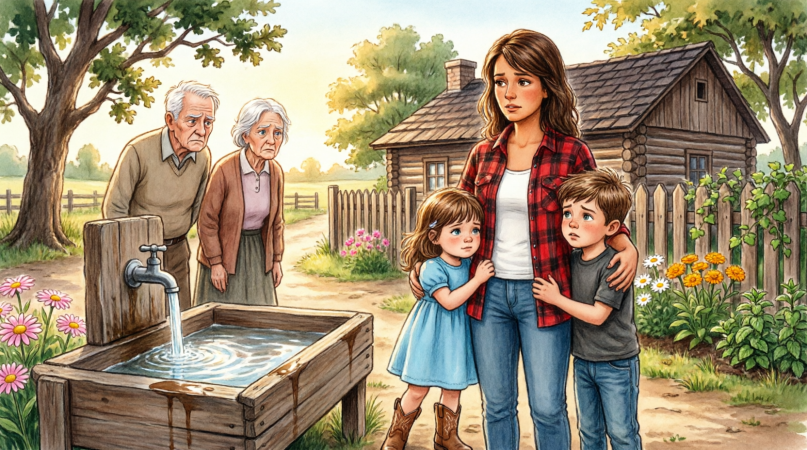
He swallowed and nodded once. He had Jake’s eyes when he got serious.
After he left, I slid the hook-and-eye latch across the door and set the metal box on the worktable we’d built from salvaged planks.
It was old. Army green under the rust. Heavy. There was no lock anymore; just a bent clasp and dirt packed into the seam. I pried it open with the flat edge of my screwdriver.
Inside were five things.
A thick envelope with my name on it in Jake’s handwriting.
A flash drive wrapped in wax paper.
A folded survey map.
A small leather notebook swollen from age.
And an old brass key tied to a tag that read: BOX 118 – FIRST FARMERS BANK.
I grabbed the letter first.
The paper crackled when I unfolded it.
Emily,
If you’re reading this, then either I ran out of time or things got worse exactly the way I thought they would. I’m sorry. I was trying to fix it before it could reach you and the kids.
Listen to me carefully. Do not trust my father. Don’t tell my mother anything until you know what she knows, and even then be careful. If anyone besides you finds this box, take Noah and Lily and go somewhere public. Witnesses matter. Cameras matter. Noise matters. Quiet is where men like this do their best work.
My hands started to shake harder.
I read on.
The cabin was Aunt Ruth’s. After she died, Dad and Garrison Reed tried to bury the deed in a pile of tax liens so nobody would look too closely at the property. They wanted the spring. Not just the spring under the floor—the whole aquifer line under Black Ridge. I found the survey in Dad’s office and started asking questions. That was when the lies started.
If they’re desperate, it means the drought is worse than expected. If they know the cabin has been opened up, they’ll come. They’ll call it unsafe or condemned or claim emergency access. Don’t sign anything. Don’t hand over the originals. Use the flash drive. Make copies. Trust Mara Benton at the county records desk. She noticed things too.
“Do not speak to him like that.”
Frank raised both hands. “I didn’t mean—”
“No,” I said. “You meant exactly what you sounded like.”
Diane’s composure slipped another inch. “Emily, if Jake left something, I should see it.”
“Why?”
“Because I’m his mother.”
I laughed, and it came out harder than I intended. “You threw his children out like garbage eight hours ago.”
Color climbed her throat. “That was between us.”
“No. That was the kind of thing people remember forever.”
Lily came into the hall clutching her rabbit. “Mommy?”
I softened instantly. “Hey, bug.”
“Why is everyone fighting again?”
Because the dead were still speaking and the living had started to crack.
Because your father had seen something big enough to bury under a condemned cabin.
Because I suddenly did not know which people in this house were dangerous and which were merely cruel.
Instead I knelt and touched her cheek. “Because grown-ups make bad choices when they’re scared.”
She thought about that. “Are you scared?”
“Yes,” I said.
She put one little hand on my shoulder. “Me too.”
That nearly undid me.
I stood and made my choice.
“Everybody out,” I said.
Diane blinked. “Excuse me?”
“You needed water. You got water. Now I need you off my property.”
Frank stared. “Your property?”
I smiled without warmth. “You’d be amazed what five dollars can buy.”
His face changed.
Only for a second. But it changed.
He knew.
That was all I needed.
I stepped forward and opened the front door. “Go.”
Diane looked from me to Frank and back again. “Emily—”
“Out.”
Frank started to protest. Noah picked up the crowbar from beside the wall.
He didn’t swing it. He just held it with both hands and stared at his grandfather with Jake’s exact expression when someone pushed too far.
Frank stopped talking.
Diane left first. Frank followed. Jake’s sister, Melissa, trailed them with her two children, exhausted and confused. Before she got into the SUV, she looked back at me.
“I didn’t know,” she said quietly.
I believed her.
But belief and trust were no longer the same thing.
As soon as the SUV disappeared down the gravel road, I locked the door, bolted the windows, and pulled every curtain.
Noah set the crowbar down carefully. “Okay,” he said. “Now can we panic?”
“Only a little.”
Lily tugged my shirt. “Is this about Dad?”
I looked at my children—muddy, hot, scared, brave—and realized I had crossed into a different kind of motherhood. Not the kind where you soften the world for them.
The kind where you show them how to stand in it.
“Yes,” I said. “It’s about Dad. He left us something important.”
“Money?” Noah asked hopefully.
I almost smiled. “Maybe better.”
He frowned. “How is anything better than money right now?”
“Truth,” I said.
He considered that and made a face. “That sounds like the kind of answer poor people give.”
Despite everything, I laughed.
Then I got to work.
The first thing I did was plug the flash drive into the battered laptop a follower had mailed us two weeks earlier after one of my videos blew up. It took forever to boot. My nerves twitched with every second.
The drive held three folders.
SURVEY
LEDGER COPIES
IF SOMETHING HAPPENS
I opened the last one first.
There were six audio files and two videos.
The first audio file was dated nine days before Jake died.
I clicked play.
Static crackled. Then Jake’s voice filled the room.
“Testing. If this works, good. If not, then I’m apparently talking to a piece of junk for no reason.”
My knees went weak.
Noah looked up sharply. Lily froze.
I sat down hard in the nearest chair.
Jake cleared his throat on the recording. “If you’re hearing this, it means I didn’t get the chance to explain in person. Em, I’m sorry. Kids, if you’re old enough to understand this one day, none of this was because of you.”
I pressed a hand to my chest.
On the recording, papers rustled. Jake sounded tired. Not scared exactly. Furious, controlled, trying not to show it.
“Dad and Reed have been buying parcels around Black Ridge for months through dummy companies. They’re planning to flip water rights once the county declares emergency shortage. Aunt Ruth’s place is the center line. They thought nobody knew she’d signed the old mineral-and-water reservation before she died, but I found the survey. If they get the cabin parcel, they control the cleanest source on the ridge.”
There was a long silence, then Jake said something that made the room go cold.
“I think Dad had my brakes tampered with last week. Mechanic said the rear line looked cut, not worn. I didn’t tell Emily because I wanted proof first. That was stupid. If anything happens to me, start with Reed. Then look at Dad.”
Noah whispered, “What does tampered mean?”
I closed my eyes.
“It means someone messed with it,” I said.
“With Dad’s truck?”
“Yes.”
“On purpose?”
I couldn’t answer.
The recording ended with Jake saying my name softly, like he was trying to say more and couldn’t.
I played the second audio file.
Jake had recorded a conversation from farther away. Men’s voices. One was definitely Frank.
“You bury the lien and starve the access road,” Frank said. “Nobody touches that place.”
Another voice answered, smooth and oily. “Until the declaration comes through.”
“Jake’s getting nosy.”
“Then handle your son.”
The sound cut off.
Lily climbed into my lap without asking and pressed her face against my neck.
I could feel her heartbeat racing.
I held her tighter and clicked through the rest.
More copies of checks. Photos of documents. A scanned deed showing that Jake—not Frank—had been named contingent heir to Aunt Ruth’s cabin parcel, including “all associated water access and subterranean rights” if he made a claim within five years of her death.
He never had the chance.
Or maybe he’d been trying when he died.
The final video was dark and shaky, filmed inside what looked like a parking lot at night. Frank stood beside Garrison Reed, a man I recognized vaguely from county events and real estate billboards. Their faces were lit by the yellow glow of a streetlamp.
I turned the volume up.
Frank said, “You said scare him. Not kill him.”
Reed snapped, “Then maybe your boy should’ve stayed scared.”
The camera jerked and the clip ended.
Noah stared at the screen.
Lily started crying silently into my shirt.
For a long minute I couldn’t move.
Then instinct took over.
I copied every file onto the laptop, an external drive, and the cloud account a sponsor had helped me set up for video storage. I emailed the whole folder to a brand contact, to my own backup email, and to the address listed on an old business card I still had from Mara Benton at the county office.
Subject line:
Need help now. Jake was right.
After that, I packed a bag.
Not clothes. Evidence.
The originals, the flash drive, the key, the laptop, the charger, the notebook.
When the sun started dropping, I loaded the kids into the truck and drove up the highest part of the ridge until my phone caught one wavering bar of service.
Three voicemails had already come in from unknown numbers.
Two were blank.
The third was Mara.
“Emily? I got your email. Listen to me carefully. Do not take those papers to the sheriff. Not local. Reed has friends there. Drive to my house if you can, or meet me somewhere public. And Emily? If Frank knows you found the box, don’t be alone tonight.”
I looked at the clock. 7:12 p.m.
Too late to drive safely off-ridge with the kids. Too much risk on the road if someone wanted those documents badly enough.
I turned the truck around.
We were staying.
But we were not staying quiet.
By dark, I had every battery charged, every camera set, every solar floodlight aimed at the yard, and one of our donated Wi-Fi hotspots perched in the kitchen window where it caught the best signal.
Then I did the boldest, dumbest, smartest thing I’d done in months.
I opened my video app.
I titled the livestream:
I Found Something Under the Five-Dollar Cabin Floor
For ten seconds, nobody joined.
Then a hundred people.
Then a thousand.
Comments started flying so fast I could barely read them.
IS THIS ABOUT THE SPRING?
girl why do you look like you’ve seen a ghost
where are the kids
blink twice if we need to call somebody
I looked straight into the camera.
“My name is Emily Walker, and this is the Black Ridge cabin people have been following online. Today I found a lockbox under the foundation. It belonged to my husband, Jake Walker, who died last year in what I was told was an accident. I have evidence suggesting it may not have been an accident.”
The comments exploded.
I kept going.
“I’m saying this publicly because public is safer than private right now. If anything happens to me, to Noah, or to Lily, the files have already been sent to multiple people. Including the press.”
That part was only partly true.
But it became fully true thirty seconds later when a local reporter named Tess Molina—one of the stations that had been chasing the cabin story—commented publicly:
Check your inbox. I’m coming with a camera crew now.
Good.
Let the whole county watch.
I didn’t show the documents on the livestream. I didn’t need to. I explained enough: the spring, the land, the water rights, the recordings, Jake’s letter.
Then headlights swept across the yard.
Not one vehicle.
Three.
Noah came running from the back room. “Mom—”
“I know.”
I stood and picked up the phone so the livestream could see the front door.
The first truck that pulled in belonged to Tess and her crew.
The second was a county SUV.
The third was a black Escalade I somehow knew belonged to Garrison Reed before he even stepped out.
“Well,” Noah muttered, “that feels bad.”
“Stay behind me,” I said.
Lily whispered, “Can I hold the rabbit or the hammer?”
“The rabbit.”
“Okay.”
I opened the door before they could knock.
Tess came fast, all purpose and microphone wire, followed by a camera operator sweating through his collar. “Emily, are you safe?”
“At this exact moment? Jury’s out.”
The county SUV door opened and a uniformed man in a light-gray emergency management shirt strode up the walk with a folder.
“Ma’am,” he said, glancing at the camera and clearly regretting his timing, “under temporary drought powers, the county is authorized to assess and access private water sources for emergency allocation.”
“Funny,” I said. “You got here fast.”
Reed smiled from behind him.
He looked exactly like the kind of man who believed the world was made of doors meant to open for him—silver hair, expensive shirt, teeth too even.
“Emily,” he said warmly, as if we were old friends. “Heard you’ve had quite a day.”
“Jake thought you had him killed.”
That landed harder than I expected.
Even Tess blinked.
Reed’s smile thinned. “Now, that’s a serious accusation to make in front of a camera.”
“Good,” I said. “Then answer it in front of one.”
The emergency official lifted his folder. “Ma’am, I’m here regarding water access.”
“Show me the signed emergency order.”
He did.
I scanned it.
It granted assessment authority. Not seizure. Not transfer. Not ownership.
I looked up. “This lets you inspect. It doesn’t let him set foot on my spring.”
Reed spread his hands. “Nobody wants a fight.”
“Then leave.”
He stepped closer instead.
“You’ve built a charming little story here,” he said softly. “Widow. Children. Ruined cabin turned miracle. The public eats that up. But stories don’t hold up against paperwork.”
I almost laughed.
He had no idea what I was holding.
Behind him, another set of headlights cut through the dark.
Diane’s SUV.
Of course.
She got out before it had fully stopped, Melissa right behind her.
Diane took one look at the cameras, then at Reed, then at me.
“What have you done?” she whispered.
“Probably the first smart thing in months,” I said.
Reed turned toward her, annoyance flickering over his face. “Mrs. Walker, this doesn’t concern—”
“My son is dead,” she snapped. “Everything concerns me.”
That shut him up.
For one blessed second, nobody moved.
Then Frank climbed out of the passenger side of Diane’s SUV.
He looked twenty years older than he had that morning.
When he saw the cameras, he stopped cold.
Tess’s cameraman swung toward him instinctively.
And suddenly the whole scene clicked into focus.
Public. Witnesses. Noise.
Exactly what Jake had told me.
I stepped onto the porch so everyone could hear me.
“I found a lockbox under this cabin today. In it were documents, recordings, and a letter from my husband. He wrote that if he died, it was not an accident. He named two people he believed were involved in a scheme to hide the value of this property and take control of the water beneath Black Ridge.”
I turned my head and looked straight at Frank.
“And one of those people was his father.”
Frank’s face crumpled.
Not in outrage.
In collapse.
Diane made a sound I have no word for—a small, shocked animal sound from somewhere below language.
“That’s not true,” she said. Then, to Frank, “Tell me that’s not true.”
Frank opened his mouth. Closed it.
Reed cut in smoothly. “This is grief, not evidence.”
I held up my phone. “I have recordings.”
He laughed once. “Recordings can be edited.”
“Then let’s talk about the mechanic who noted Jake’s brake line looked cut.”
Frank’s knees actually buckled.
Diane stared at him.
“Frank,” she said again, but this time his name sounded like a blade.
The cameraman was close enough now to catch every expression. Every flinch.
Reed took a step back toward his SUV.
Tess noticed first. “Sir, where are you going?”
He pointed at me. “This woman is making criminal allegations online in the middle of a public emergency. I’m leaving before this circus becomes actionable.”
Frank suddenly shouted, “He said it would be enough to scare him!”
Everything stopped.
Even the cicadas seemed to go quiet.
Diane turned slowly toward her husband.
“What?”
Frank’s eyes were wild. “He said if Jake thought the truck was unsafe, he’d stop digging. That’s all. He said we’d slow him down until the filings cleared. I never— I never told anybody to kill him.”
Melissa made a choking noise and backed away from her father like he was radioactive.
Reed went white with fury. “Shut up.”
But Frank had been quiet too long.
“No,” he said, and the word shook. “No, I’m done. I’m done.”
He pointed at Reed with a trembling hand. “He had men watching Jake. He had county clerks bury notices. He paid for the road easement to lapse so nobody would bother with the cabin. He said once the shortage hit, they’d acquire everything at a discount and sell access back to the county. Jake found the survey. He found the old deed from Ruth. He wouldn’t let it go.”
Diane’s face emptied out.
“I asked you,” she whispered. “After the crash, I asked you if there was anything I didn’t know.”
Frank looked at the ground. “I thought he’d just back off.”
“You let me bury my son beside a lie.”
He started crying then. Ugly, shocked, helpless crying. The kind that comes too late to mean anything.
Noah stood beside me, rigid as wire.
Lily held the rabbit so tightly one button eye was about to pop off.
Reed made his move.
He spun and bolted for the Escalade.
Tess cursed. The camera swung wildly. The county official shouted something about staying put.
I didn’t think. I just moved.
Not toward Reed.
Toward the floodlight switch.
I hit every outdoor light at once.
The yard exploded white.
Reed froze halfway to the driver’s door, suddenly visible from every angle, every camera, every phone. The livestream comments were ripping past so fast they looked like rain.
Then, from the road below, came the sound of sirens.
Real ones.
State police.
Mara, I thought wildly.
Bless that woman forever.
Two cruisers tore up the drive and boxed in the Escalade. Officers spilled out with the kind of focus that told me they had been briefed properly.
Not local.
Not friendly.
One officer ordered Reed to the ground.
Another took Frank aside.
Another came to me.
“Mrs. Walker?”
“Yes.”
“Are you in possession of evidence related to a possible homicide investigation and public corruption case?”
I looked past him at the porch, at my children, at the open cabin door with warm light spilling through it, at the spring room hidden below the floorboards where all of this had started.
“Yes,” I said.
His voice gentled a fraction. “Then I need you and your kids somewhere safe tonight.”
I almost laughed from sheer exhaustion.
“Safe sounds incredible.”
We spent that night in a church fellowship hall in the next town over because it was public, staffed, and full of people too nosy and kind to let anything happen quietly.
Mara met us there carrying two canvas bags and a folder under one arm like she’d been born for exactly this level of chaos.
She was in her late fifties, square-shouldered, silver-haired, and had the expression of a woman who had spent decades watching men underestimate clerks.
“I always liked Jake,” she said by way of greeting. “He asked dangerous questions politely.”
That nearly made me cry again.
Instead I hugged her.
She handed me one bag. “Peanut butter crackers, juice boxes, coloring books. For the kids. The other bag is for you. Coffee, charger, legal pad, and the number of an attorney who hates Garrison Reed on principle.”
“I think I love you.”
“That’s a reasonable response.”
While Noah and Lily sat with volunteers in the corner coloring dinosaurs purple, Mara and I spread the documents across a folding table beneath a giant poster about Vacation Bible School.
She walked me through what she knew.
Aunt Ruth had never trusted Frank. Years ago, after a fight nobody at the courthouse ever fully understood, she had quietly filed a reservation of water and subsurface rights tied to the cabin parcel. Then she left the property to Jake contingent on claim filing, not to Frank. After her death, someone had made sure the notice was hard to find. Mara suspected Frank. She didn’t know Reed was involved until Jake started asking for copies.
“And after Jake died?” I asked.
Mara’s mouth flattened. “Records moved faster than usual. That’s always a bad sign. But without proof, all I had was a bad feeling and a job I couldn’t afford to lose.”
“You called state police fast.”
She almost smiled. “I did not call them tonight. I called them this morning, the second I saw your email. Tonight they got a judge to move.”
Something in me steadied.
For so long I had felt like I was trapped in a story other people controlled. Their money. Their silence. Their rules.
But paper mattered.
Timing mattered.
Truth, apparently, had allies.
By dawn, Reed was in custody pending questioning. Frank had given a formal statement. State investigators had sealed several county offices. Melissa had texted me once:
I’m sorry. I really didn’t know. Mom is shattered.
I didn’t answer.
Not because I hated her.
Because I was too tired to carry anybody else.
The weeks that followed were a blur of interviews, depositions, grief I had to re-open like a wound, and more public attention than any person should reasonably survive.
The Five-Dollar Cabin stopped being a quirky internet story and became something heavier.
People came not just for before-and-after renovation videos, but for updates.
For justice.
For the drought response.
For the impossible fact that a condemned shack with a hidden spring had exposed half the county.
The investigators confirmed what Jake had suspected: Reed and his associates had been using shell companies to acquire land over the Black Ridge aquifer while lobbying county officials to delay infrastructure repairs elsewhere. Frank had helped hide Aunt Ruth’s deed chain and suppress the cabin parcel’s value. There were payments. Favors. False filings.
And Jake’s truck?
A forensic team found evidence that the brake line had indeed been cut.
Not worn.
Cut.
I got that news in a parking lot outside the attorney’s office with Noah and Lily eating gas station popsicles in the backseat.
I sat behind the steering wheel and cried so hard I scared myself.
Not because I hadn’t suspected.
Because certainty is a crueler thing than fear.
Fear lets you bargain.
Certainty just stands there.
That night, after the kids fell asleep on mattresses in the cabin loft, I walked down to the spring room with a flashlight.
Water moved through the stone basin in its constant, patient way.
Jake had stood here once. Or near enough. Maybe he had touched the same rock and thought about how to save us.
Maybe he had been scared.
Maybe he had been trying to be brave.
“I found the crack in the wall,” I whispered into the dark.
The spring kept running.
Diane came to see me one month later.
Not with an SUV this time. Not with an audience. She drove herself up the ridge in a dusty sedan that looked rented.
I almost didn’t let her in.
But Noah saw her first through the window and said, “She looks old.”
Cruel. Accurate.
I stepped onto the porch and closed the screen behind me.
Diane stood at the bottom of the steps with no jewelry on and no makeup, which was somehow more shocking than tears would have been.
“I know I don’t deserve even one minute of your time,” she said.
“That’s true.”
She nodded like she’d expected nothing else. “Frank took a plea. He’s cooperating. Reed is trying to drag everyone down with him. The attorneys say the trials could take years.”
“Okay.”
She swallowed. “I came to say I was wrong.”
I waited.
About Jake. About you. About all of it.
She looked up at me then, and I saw it—the thing I had wanted from her for years and no longer needed.
Regret.
Raw. Human. Too late.
“I built my life around appearances,” she said. “Good schools, good tables, good marriages, good photographs. Jake loved you because you didn’t care about any of it, and I punished him for that. I punished you for that. When he died, I wanted someone to blame that wasn’t myself or Frank, and you were there. So I became monstrous.”
There it was.
Plain as weather.
I thought it would feel better.
Instead it just felt tired.
“Do you want me to forgive you?” I asked.
She flinched. “No. I don’t think that’s mine to ask for.”
That was the first wise thing I’d ever heard her say.
Behind me, the screen door opened a crack and Lily peered out. “Is she being mean?”
Diane’s face folded.
“No,” she said softly. “Not today.”
Lily looked at me. I nodded once. She came out and stood beside my leg.
Diane crouched slowly, keeping her distance. “Hello, Lily.”
Lily considered her with all the ruthless seriousness of a child.
“Mom says people can change if they tell the truth for long enough.”
I glanced down at her. “I say that?”
“You said it to Noah when he lied about the missing screwdriver.”
“That was different.”
“No, it wasn’t,” she said.
Diane let out a sound halfway between a laugh and a sob.
Noah came to the door next. He did not come outside.
“Did Grandpa really hurt Dad?”
The question hung there.
Diane closed her eyes.
“He helped something terrible happen,” she said. “And he lied after. That’s the truth.”
Noah nodded once, as if filing that away in the cabinet where children keep the things that shape them.
Then he said, “You gave Mom five dollars.”
Diane blinked.
He disappeared into the house and came back with the bill.
I had flattened it and tucked it into the edge of the bulletin board above my workbench.
He held it up between two fingers.
“You can’t have it back,” he said. “It’s worth more now.”
For the first time in my life, Diane had no comeback.
She stood, wiped her face, and looked at me.
“I put the house on the market,” she said. “My lawyer will contact yours. Jake’s portion of the estate was mishandled. So were several other things. They’ll be corrected.”
I said nothing.
She nodded, like silence was fair payment.
Then she turned and walked back to her car.
I watched until she was gone.
Lily tugged my hand. “Do we hate her?”
“No,” I said after a moment. “We just know who she is.”
Noah folded the five-dollar bill with great care and handed it to me.
I smoothed it flat again.
By the time the first frost touched Black Ridge, the cabin was no longer temporary.
It had a new roof, proper footings, insulated walls, solar backup, a legal water system, and a deed chain so locked down even the state attorneys joked about framing it.
The channel grew. The sponsors stayed. But I changed what we did with the attention.
Part renovation. Part story. Part mutual aid.
When the drought still hadn’t broken, we opened the property one day a week for community water fill-up under county supervision—real supervision this time, with signed agreements and transparent records. Then we built a covered spring station with donated lumber and local labor.
People came carrying coolers, buckets, old detergent bottles, whatever they had.
Nobody got turned away.
Not because I was noble.
Because I knew exactly what it felt like to stand on someone else’s porch hoping pride wouldn’t kill you before thirst did.
The name changed too.
It stopped being The Five-Dollar Cabin in my head.
It became Jake’s Spring House.
Not because he owned it.
Because he tried to protect it.
And us.
On the first anniversary of the night we found the lockbox, I hung the five-dollar bill in a simple wooden frame by the front door.
Under it, I placed a small brass plaque Noah insisted on making in his crooked block letters:
START ANYWAY.
That evening, we ate dinner on the porch while the last orange light slid through the trees. Lily talked nonstop about a frog she had decided to adopt spiritually but not physically. Noah was planning a pulley system for firewood and explaining it like a contractor. The air smelled like pine, earth, and woodsmoke.
Afterward, I walked down to the spring alone.
The water was silver in the fading light.
I sat on the flat stone beside the basin and let the quiet settle around me.
There was still grief.
There would always be grief.
Jake was still gone. Frank would still face sentencing. Reed would still stand trial. Diane’s apology had not rebuilt what she burned.
But the ending of a thing doesn’t always arrive as a clean door closing.
Sometimes it arrives as water that keeps running after the storm.
As children laughing inside a house that should never have survived.
As your own name on a deed nobody can steal now.
As the moment you realize you are no longer waiting to be rescued.
I looked up at the cabin glowing warm above the slope, at the porch light Noah had remembered to turn on, at Lily’s shadow darting past the curtain, and I felt something I had not let myself feel in a very long time.
Not relief.
Belonging.
I touched the edge of the stone basin and smiled into the dark.
“You were wrong about one thing,” I told Jake softly.
The spring answered in its steady underground language.
“I’m not the strongest thing in this family.”
From the porch, Noah’s voice carried through the trees.
“Mom! Lily’s trying to teach the rabbit to swim again!”
I laughed and stood.
Then I climbed the path back to the cabin we bought for five dollars, the one they thought would bury us, the one that became a home, a witness, a lifeline, and finally—after all the lies had cracked open—the place where our story stopped being about what was taken from us.
And started being about what we built.
The end.
Part 3
The first snow came late that year.
Not a hard storm. Just a quiet one.
I woke before dawn because the cabin had gone unnaturally still, the kind of stillness that makes you sit up in bed even before your brain catches up. For one groggy second I thought something was wrong with the spring pump, or the battery bank, or one of the roof panels Noah had become suspiciously obsessed with “improving.”
Then I saw the white light on the loft wall.
Snow.
I slipped out from under my blanket, careful not to wake Lily, who had somehow managed to fall asleep sideways with one sock on and one sock missing. Noah snored softly from the bunk across the room, one arm hanging over the edge like he’d been trying to hold onto a dream and lost his grip halfway through.
I pulled on Jake’s old flannel and stepped down the ladder.
The cabin glowed in that soft blue-gray winter light that makes even patched walls look holy. The little woodstove in the corner had gone down to embers. Our mugs from the drying rack cast thin shadows across the kitchen shelf. The framed five-dollar bill by the front door caught the pale morning light and looked almost ceremonial.
START ANYWAY.
Noah had hammered the brass plaque a little crooked. I’d left it that way on purpose.
Outside, the ridge was white.
The trees had a dusting on every branch, and the yard looked like it had been gently erased and redrawn. The covered spring station we’d built in the fall stood near the slope, roof lined with snow, hand-painted sign still visible beneath it:
JAKE’S SPRING HOUSE – TAKE WHAT YOU NEED
I wrapped both hands around the porch rail and breathed the cold in.
There were still lawyers. Still court dates. Still statements and depositions and county meetings that made my head throb. There were still nights when Jake’s absence landed on me so hard it felt brand new.
But there was also this.
A real roof.
Heat.
Food in the pantry.
My children asleep under quilts in a cabin nobody could take from us.
The spring still singing under the hill.
And for the first time in longer than I wanted to measure, there was a future in front of us that looked bigger than survival.
The screen door squeaked behind me.
“You came outside without coffee?” Noah said, scandalized.
I turned.
He stood there in thermal pants and a hoodie, hair standing up in six directions, already carrying the dented kettle. I had no idea when he had become the kind of child who woke up prepared to make hot drinks, but grief does strange things to time. It ages some parts of a person and softens others.
“It snowed,” I said.
He peered past me, then gave a low whistle. “Okay. That’s fair.”
Lily burst through the door a second later wrapped in a blanket so thoroughly she looked like a traveling burrito.
“IS IT CHRISTMAS?”
“No,” Noah and I said together.
She frowned at the yard. “Then why did weather do presents?”
That was such a Lily question that I laughed before I could stop myself.
She grinned, pleased with the effect, then toddled onto the porch and gasped like she’d just discovered diamonds.
“It’s perfect,” she whispered.
For a while none of us said anything.
We just stood there on the porch, looking out over the white ridge, while Noah held the kettle and Lily leaned into my side.
Then Lily pointed toward the spring station.
“There’s someone there.”
We all squinted.
There was, in fact, a figure moving through the snow with careful steps and a knit hat pulled low. Whoever it was carried two metal jugs and walked with the kind of caution people use when they know they are trespassing emotionally, even if not technically.
I knew that posture before I recognized the coat.
Diane.
Noah stiffened immediately.
Lily tightened her blanket around herself like armor.
Diane reached the station, filled one jug, then looked up and saw us on the porch. She froze.
Noah muttered, “Of course.”
I rested a hand on his shoulder. “Stay here.”
He caught my wrist. “Mom.”
“I’m just talking to her.”
“She makes talking feel like getting paper cuts.”
It was, unfortunately, an excellent description.
“I know.”
I walked down the path slowly, boots sinking into new snow.
Diane waited beside the spring station without moving, gloved hands wrapped around the handle of the jug. Up close, she looked better than the last time I’d seen her and worse in an entirely different way. Rested, maybe. But stripped down somehow, as if life had removed all the decorative layers and left only the person underneath.
“I should have texted,” she said.
“You hate texting.”
“I’m trying to change in several areas.”
The answer was so unexpectedly dry that I looked at her twice.
Her mouth twitched. Not quite a smile. Not yet.
“What are you doing here?” I asked.
She glanced at the spring. “The church collection barrels froze. Mara said this line still runs because of the stone channel. I thought I’d come fill jugs for the warming shelter.”
I blinked.
“The warming shelter?”
“At the old elementary gym.” She shifted the handle in her hands. “Several families from the east side lost water after the last pressure drop. We’ve been bringing supplies.”
We.
I had no idea who we was anymore when it came to Diane, and that uncertainty sat awkwardly between us.
Behind me, the porch boards creaked. Noah and Lily were still watching.
Diane saw them and lowered her voice.
“I know they don’t trust me.”
“That makes sense.”
“It does.” She exhaled slowly. “I’m not asking you to fix that.”
Snow gathered on the shoulders of her coat. The spring bubbled steadily between us.
Finally I said, “You could have sent Melissa.”
“Yes.”
“But you came yourself.”
“Yes.”
“Why?”
Her eyes moved to the hand-painted sign over the station.
Because this place was once a weapon in her family’s hands, I thought. Because now it had become something else, and maybe she needed to stand in front of that and feel it.
But when she answered, it was simpler than that.
“Because the children at the shelter are thirsty,” she said. “And because I’m tired of delegating everything that matters.”
That one landed.
I looked back toward the porch. Lily had pressed both hands to the screen, fogging the glass. Noah stood beside her, arms crossed so tightly he looked bolted together.
“Take the water,” I said.
Diane nodded.
Then, after a long hesitation, she added, “I brought something else.”
She opened the back door of her car and lifted out a flat cardboard portfolio, sealed in plastic.
“Bank box,” she said. “My attorney got emergency access through the estate filings. They wanted to wait until all the paperwork settled, but…” She looked up at me. “It’s Jake’s. Or yours, now.”
My breath caught.
The brass key from the lockbox.
BOX 118.
I had been so drowned in legal meetings and practical emergencies that the bank box had become a thing sitting in the corner of my mind, important but not urgent. And then winter came. And school schedules. And county hearings. And grief, which is the least efficient assistant in the world.
“What’s in it?” I asked.
“I didn’t open the sealed envelope. The manager did an inventory in front of counsel. Deeds. Copies of surveys. A cashier’s check. Some letters.” Her expression softened in a way I was not used to seeing. “And a folder labeled For later, when it’s safe.”
For one second I couldn’t speak.
Jake’s voice seemed suddenly very close again. Not the voice from the recordings. The ordinary one. The one that said ridiculous things while chopping onions. The one that hummed badly in hardware stores. The one that used to call from the porch at dusk, Em, you coming or what?
I took the portfolio with both hands.
“Thank you,” I said.
Diane nodded once, almost formally, then lifted the water jugs.
I should have let her go.
That would have been cleaner. Simpler.
Instead, maybe because it was snowing and the world looked gentler than it usually did, I heard myself say, “Do you want coffee first?”
She stared at me like I’d spoken another language.
On the porch, Noah’s body language transformed into visible outrage.
Lily, by contrast, waved enthusiastically.
Diane looked at the children, then back at me. “Are you sure?”
“No,” I said honestly. “But I’m asking anyway.”
That was how she came into the cabin for the first time without a fight.
There is nothing quite as strange as sitting at your own kitchen table with the woman who once told you to get out of her house in ten minutes while your son stirs cocoa on the stove and your daughter explains the emotional structure of snowmen.
Lily had decided that any snowman worth building needed “kind eyes and a complicated backstory.” Noah was trying to argue for structural integrity.
“Carrot nose first,” he said.
“No,” Lily said. “Feelings first.”
“Feelings are not a construction step.”
“Maybe not for you.”
I set four mugs on the table.
Diane watched the children the way a person watches fire after nearly burning down the house—careful, reverent, uncertain they still had the right to come close.
“This place feels different in winter,” she said quietly.
“It feels smaller.”
“It feels…” She searched for the word. “Held.”
That surprised me.
I poured coffee into her mug. “The insulation helps.”
“I wasn’t talking about insulation.”
Noah carried over the cocoa pot and served Lily with exaggerated professionalism. Then he looked directly at Diane.
“Mom said you’re helping at the warming shelter.”
Diane straightened. “Yes.”
“Why?”
The bluntness of children would have ended civilization by now if it weren’t occasionally useful.
She didn’t flinch this time.
“Because for a long time I thought being useful was the same thing as being in control,” she said. “I’m learning those are not the same.”
Noah considered that, spoon hovering over his mug.
“That sounds like therapy talk.”
“It is.”
I nearly choked on my coffee.
Diane gave me a look that was almost embarrassed. “Melissa insisted.”
“Melissa got you into therapy?”
“She said if I was going to keep crying in her guest room and criticizing how she loaded the dishwasher, I had to earn my keep.”
Lily giggled so hard cocoa almost came out her nose.
Noah, despite himself, looked interested. “Did you criticize it because she did it wrong?”
“Yes.”
He nodded thoughtfully. “That seems fair.”
I closed my eyes for a second.
When I opened them, Diane was watching me, and for the first time there was something like shared amusement between us. Thin. Fragile. But real.
After coffee, the children dragged me outside to build a snowman with “kind eyes and advanced engineering,” which naturally turned into two snowmen, one lopsided rabbit, and a brief but intense snowball conflict. Diane stayed on the porch at first, arms folded against the cold.
Then Lily marched up to her with one mitten half-off and announced, “You can either help or be tragic.”
Diane blinked. “Those are my options?”
“Yes.”
I bit my lip hard enough to hurt.
Diane looked at me.
I shrugged. “She gets that from Jake.”
That did something to both of us.
Then Diane stepped down off the porch, removed her gloves, and helped Lily press pebbles into the snowman’s face.
Noah pretended not to notice. But later, when the second snowman started leaning, he accepted Diane’s suggestion about widening the base without arguing more than usual, which in Noah terms was practically a peace treaty.
By afternoon the ridge had turned silver-blue. Diane loaded her water jugs into the car, paused beside the path, and said, “There’s a community meeting next Thursday. About the spring rights and winter distribution plans.”
I groaned. “Another one?”
“Yes. But this time people are on your side.”
“That sounds dangerously optimistic.”
Her mouth moved almost into a smile. “Come anyway.”
After she left, Noah stood at the window watching her drive down the slope.
“Do you think she means it?” he asked.
“I think she’s trying.”
“That’s not the same.”
“No,” I said. “It isn’t.”
Lily climbed onto the bench beside him. “But sometimes trying turns into real.”
We both looked at her.
She shrugged. “That’s what happened with our house.”
The folder from the bank box sat unopened on the table until after dinner.
Not because I wasn’t desperate to see it.
Because some things deserve a little ceremony.
We ate soup and grilled cheese. Noah gave the snowman outside a weather report through the window. Lily fed imaginary crumbs to her rabbit. The cabin smelled like tomato, woodsmoke, and damp mittens drying by the stove.
Then I cleared the plates, lit the small lamp over the table, and brought the cardboard portfolio down from the shelf.
Noah leaned forward immediately. Lily crawled onto the bench beside me and tucked one cold foot under my leg.
“Is it treasure?” she whispered.
“Probably paperwork,” Noah said.
“Paper can be treasure,” I said.
I cut the plastic wrap and opened the flap.
Inside were exactly what Diane had described: certified copies of the survey maps, old title work, a cashier’s check for twenty thousand dollars made out to Jake Walker, and three sealed letters.
One had my name on it.
One said Noah – when you can read without pretending you can’t reach the hard words.
The third said Lily – ask somebody patient to help you.
Lily gasped. “Dad wrote to me?”
My vision blurred instantly.
“Yes, baby.”
She put both hands over her mouth.
Noah reached for his own letter, then stopped. “Am I supposed to open it now?”
“That’s up to you.”
He looked at the envelope like it might rearrange his whole body.
“Can we do yours first?” he asked.
So we did.
Jake’s handwriting tilted across the page exactly the way I remembered. Confident until he got emotional, then slightly messier, as if feeling was a thing his hand had to push through.
Em,
If you’re reading this, I either got smarter too late or luckier than I deserved for a little while. I’m hoping for the second one, planning for the first.
First: the check is from the sale of the boat Dad thought I didn’t know he was trying to move off the books. Legally recovered, long story. Use it for the cabin, the kids, or something impractical that makes you laugh. Preferably all three.
Second: if you ended up back at Ruth’s place, then maybe the world is stranger and more circular than I thought. She used to say the ridge takes things and returns them different. I hated that when I was ten. Feels smarter now.
Third: in the folder marked SAFE there are sketches. Not because I think you need a plan from me. You never needed that. But because I drew them on nights I couldn’t sleep and kept picturing a version of life where nobody was pretending anymore. You, me, the kids, maybe a little kitchen window over the sink, maybe a long table, maybe a porch that always had too many muddy boots on it. If you never build any of it, that’s okay. I just wanted one place in the world where the truth and the dream existed at the same time.
I know I made mistakes. Big ones. Trying to protect you without trusting you was one of them. If I had another shot, I’d tell you sooner. I’d hand you every ugly fact and let you stand beside me instead of behind me. You always hated being managed. One of your best qualities.
I laughed through tears. “True.”
Noah nodded. “Very true.”
I kept reading.
If the kids are with you while you open this, tell Noah being brave is not the same thing as never being scared. Tell Lily she was born with enough heart for six people and should spend it wisely.
Lily sat up straighter, glowing.
And you—Em, if by some awful road you had to become the one holding all of it together, please remember you do not have to hold it all alone forever. Build a wall if you need one. Build a door when you’re ready.
Love of my life,
Jake
I pressed the letter to my chest for a second because there was nowhere else to put that much ache.
Then Noah cleared his throat. “Okay,” he said, too casually. “I want mine.”
He opened his envelope with slow, deliberate hands.
He read in silence for a minute, eyes moving fast. Then slower. Then stopping altogether.
I waited.
Lily waited too, which for her was an act bordering on sainthood.
Finally Noah handed the letter to me wordlessly.
Jake had written:
Noah,
If you got this, I’m guessing you’re doing that thing where you act like everything is fine because you think that helps your mom. It helps some. But not all the way. So here’s a secret: the strongest men I’ve ever known were the ones who could carry wood, fix a leak, and tell the truth when their heart was cracked open. Aim for that.
Take care of your sister, but don’t become a second parent. She needs a brother more than a bodyguard. Your mom will need help, but she also needs you to stay a kid while you still can. Build weird things. Ask hard questions. Learn one skill that would impress your great-aunt Ruth and one that would make absolutely no sense to her.
Also, if the pulley system idea still seems good when you’re older, it probably is.
I looked up sharply. “Pulley system?”
Noah’s mouth fell open. “I’ve never told anyone that.”
“He knew you,” I said softly.
Noah took the letter back and stared at the page like it was both a wound and a miracle.
Lily bounced on the bench. “Mine! Mine!”
Her letter was shorter, full of simpler sentences and crooked little doodles in the margins—a rabbit, a flower, a badly drawn cloud with a smiley face.
When I read it aloud, she listened with her hands clasped under her chin.
Lily-Bug,
If you’re hearing this, I need you to do something important: keep being exactly enough. You do not need to become smaller, quieter, or easier so other people can understand you. Be kind, yes. But stay bright. There are people in this world who survive because someone like you walks into a room and makes it warmer.
Please hug your mom a lot. She’ll pretend she’s fine. Double-check.
And tell Noah he’s not in charge of absolutely everything even if he thinks he is.
Noah sighed. “Rude.”
Lily grinned triumphantly.
Then the last lines hit me so hard I had to stop and start again.
I loved being your dad. That’s all. That’s the whole important thing.
Lily slid off the bench and climbed into my lap without a word.
We sat that way for a long time—the three of us at the table, letters open, lamp warm above us, snow deep outside.
Then Noah remembered the folder Jake had mentioned.
“SAFE,” he said.
I pulled it out.
Inside were pencil sketches.
Cabin sketches.
Not exact blueprints. More like dreams with measurements.
A larger porch wrapped along the south side.
Window seats under the front glass.
Built-in bunks for the loft.
Shelves in the spring room.
A long harvest table in the kitchen.
And, tucked at the very back, a separate drawing labeled in Jake’s handwriting:
RUTH HOUSE IDEA / COMMUNITY KITCHEN? / WINTER SHELTER?
I stared at it.
A larger outbuilding, simple and sturdy, near the spring station. Benches. A big stove. Storage shelves. Notes about hot meals and drying racks and a covered place for people to gather.
Noah leaned closer. “He wanted to build that?”
“Looks like it.”
Lily tapped the page. “Can we?”
I almost said no automatically.
Too much money. Too much work. Too much history. Too many moving parts.
But then I looked at the cashier’s check.
At the sketches.
At my children.
At the cabin Jake had imagined in pieces before it ever existed.
And I heard myself say, “Maybe.”
Lily threw both arms into the air like she’d just won an election.
Noah narrowed his eyes at the drawing. “We’d need better footings.”
“You’re ten.”
“I’m right.”
“You are.”
He grinned, and it was the first fully unguarded grin I’d seen on his face in months.
That night, after I tucked them into bed, I sat by the stove with Jake’s sketchbook pages spread over my knees until the fire burned low.
A wall if you need one. A door when you’re ready.
Maybe Part 2 of our story had been about surviving.
Maybe Part 3 was about opening the door.
The community meeting the next Thursday was held in the library because the school gym had a burst pipe and the town hall boiler had given up with a kind of bureaucratic finality.
I almost didn’t go.
Not because I was scared of public speaking anymore. That nerve had apparently burned away somewhere between the livestream and the state investigation.
I almost didn’t go because I was tired.
Because legal exhaustion is its own weather system. Because every meeting seemed to ask me to relive the worst parts of our life in a folding chair under fluorescent lights.
But Diane had been right.
People were on our side now.
Or at least enough people were that the room felt more like a gathering than a fight.
Mara was there with three binders and a pen tucked into her hair. Melissa had brought muffins and the expression of a woman determined to build a better branch of her family tree. Tess the reporter was in the back, off duty for once but clearly incapable of existing in any room without also sort of covering it. Half the church volunteers were there. So were families from the ridge, two teachers, the volunteer fire chief, the owner of the feed store, and Mr. Alvarez from the hardware place who had once given Noah a discount “for entrepreneurial attitude.”
When I walked in, people made space.
That still startled me.
For so long my life had been about not taking up too much room.
Now people were pulling out chairs.
Mara stood and cleared her throat. “All right. We are here to discuss the proposal for a formal community trust connected to Jake’s Spring House, winter access logistics, and whether Emily Walker can be convinced not to do all of this alone like a raccoon with a crowbar.”
“I heard that,” I said.
“Good.”
A ripple of laughter moved through the room.
Then the real meeting began.
The county couldn’t seize the spring, not after the deed corrections and the state oversight. But it could partner with a community trust to support emergency access, infrastructure upkeep, and legal protection. There were grants available now that Reed’s network had been broken open. There were volunteers. A retired contractor. A foundation interested in rural water resilience. Even one regional nonprofit that wanted to fund a warming kitchen if we could show local support.
I sat there stunned as people discussed our place like it mattered beyond our survival.
Melissa stood up halfway through and said, “I can run donation records and scheduling. I used to do event management before my ex-husband decided that my time was somehow less real than his. Joke’s on him. I now own color-coded spreadsheets.”
Mr. Alvarez said he’d donate materials at cost.
The church ladies volunteered meals.
The volunteer fire chief offered safety inspections.
Noah, who had come because he claimed all serious meetings needed “someone who understands pulleys,” raised his hand and asked, “If we build the kitchen, can there be a tool wall that’s organized by actual logic and not by vibes?”
The retired contractor, a broad-shouldered woman named Denise, pointed at him and said, “That kid’s got vision.”
Lily, seated between me and Mara, whispered loudly, “I think vibes are important too.”
Diane arrived late and slipped into the back row, snow still on her coat.
I saw several people notice her.
Nobody said anything.
When the discussion turned to matching funds for the grant, she stood.
The room quieted.
“I sold the house,” she said. No preamble. No throat-clearing performance. Just the fact laid flat in the air. “Part of the proceeds are already being used to settle estate obligations and legal costs. The remaining unrestricted portion…” She looked at me, then around the room. “I’d like to donate the first fifty thousand dollars to the trust, if Emily is willing to accept it.”
The whole room went still.
I stared at her.
Fifty thousand dollars.
Enough to build the kitchen. Maybe more.
Enough to change what was possible.
My first instinct was refusal. Pride. History. Anger with good posture.
But then I thought of Jake’s sketch labeled COMMUNITY KITCHEN?
I thought of thirsty families filling jugs in freezing weather.
I thought of all the harm that had come from money in that family when it was used to control and conceal.
Maybe the truest way to break that pattern was to make it serve something clean.
Mara looked at me over her glasses but said nothing.
The choice was mine.
Finally I said, “If that money comes with no strings, no naming rights, no controlling vote, no hidden expectations, and no one ever gets to use it later as proof they own what we built—then yes.”
Diane nodded immediately.
“Yes.”
I held her gaze another second.
Then I nodded too.
The room exhaled.
And just like that, with a snowstorm outside and a dozen people talking over each other in the library, the next chapter of our life began.
We built through the rest of winter in pieces.
That’s how most good things happen, I think.
Not all at once.
In pieces.
Denise organized the build days like a military operation run by someone who baked excellent banana bread. Mr. Alvarez delivered lumber and twice as many screws as anyone thought we needed because, in his words, “projects eat hardware when you’re not looking.” Melissa made schedules so efficient that even Mara called them “sexy spreadsheets,” which nearly killed us all.
Noah became apprentice to every adult with a tool belt and returned home each day with sawdust in his hair and opinions about load-bearing walls. Lily appointed herself director of morale and spent large portions of each workday handing out stickers and assigning emotional identities to random objects.
“This ladder is trying really hard,” she informed Denise one afternoon.
“I can tell,” Denise said solemnly.
The warming kitchen rose beside the spring station exactly where Jake had sketched it.
Simple. Strong. Beautiful in the honest way useful buildings can be beautiful.
Wide doorway. Insulated walls. Big sink. Two sturdy stoves. Shelves for dry goods. Hooks for coats. A long center table scarred by use before it was even finished because Noah dropped a clamp on it and Lily insisted the mark meant it was officially loved.
I hung Jake’s kitchen sketch by the entry during construction, laminated so the snow wouldn’t ruin it.
People kept stopping to look.
It was strange, watching a dead man’s pencil lines become walls under living hands.
But it didn’t feel haunted.
It felt accompanied.
Diane came most Saturdays.
At first she stood out so sharply it was almost painful—better boots than anyone else, hands too soft for the work, a stiffness in her shoulders that said she was waiting to be told she didn’t belong.
Nobody told her that.
They just put her to work.
Peeling labels off canned-goods donations. Sanding shelves. Running soup to volunteers. Learning how to hand someone a hammer without making it about lineage and guilt and all the wreckage before.
She was bad at some of it.
But she kept coming.
One Saturday I found her in the nearly finished kitchen beside Lily, both of them covered in flour.
I stopped dead in the doorway.
“What happened?”
Lily looked delighted. “Biscuits.”
Diane looked resigned. “Catastrophe.”
The counter was a disaster zone. The recipe card had vanished under a drift of flour. One measuring cup was somehow stuck in a mixing bowl handle. Lily’s rabbit sat on a chair wearing an apron.
“I told her gentle hands,” Diane said.
“I have gentle feelings,” Lily corrected.
I laughed so hard I had to grab the doorway.
Diane, to my utter astonishment, laughed too.
Then Noah walked in carrying drill bits and stopped short. “Why does it look like a bakery exploded?”
“Family recipe,” Diane said, deadpan.
“Did the family hate each other?”
That was Noah—arrow-straight and impossible to resent.
Diane set down the rolling pin. “Yes,” she said. “For a while, yes.”
He studied her face.
Then, very carefully, he put the drill bits on the counter and said, “I can cut butter into flour without overworking it.”
Diane blinked. “You can?”
“Internet,” he said.
That was the moment, I think.
Not forgiveness. Not all at once.
But the first real bridge.
The four of them made biscuits together while I leaned against the sink and watched, unable to decide whether life was absurd or kind. Probably both.
When the first batch came out lopsided and golden, Lily bit into one and announced, “These taste like trying.”
No one in the room had any defense against that.
Spring came early.
The snow receded. The ridge thawed. Mud returned with its usual lack of dignity. Daffodils appeared by the porch steps where I could have sworn we’d planted nothing, and Mara claimed flowers like that were the land’s way of gossiping.
The legal cases moved forward too.
Frank took a plea deal that included testimony, restitution, and enough public disgrace to flatten whatever pride he had once worshiped. Reed was indicted on charges broad enough to make headlines in three counties. Every few weeks a new article came out about shell companies, forged filings, county collusion, and the long quiet theft of a public resource.
People kept asking how I felt.
Vindicated? Angry? Relieved?
The truth was messier.
I felt like I had finally stopped arguing with reality.
That was a kind of peace.
One afternoon in April, after the first full week the warming kitchen stayed open without chaos, I got a letter from Frank.
I almost threw it into the stove.
Instead I sat on the porch with it for an hour while Noah built something incomprehensible out of pulleys and Lily held a tea party for rocks.
Then I opened it.
It was only two pages.
No excuses. No self-pity, surprisingly. Just facts and remorse stripped bare enough to be almost unrecognizable.
He wrote that silence had always felt easier than conflict, until silence became its own form of violence. He wrote that he had mistaken comfort for character for most of his life. He wrote that Jake had been better than him in exactly the ways he used to mock. He wrote that there was no sentence the court could give him that would restore what he had helped destroy.
At the end, he said:
If there is anything decent left in my name, let it be whatever the children choose to do without me.
I folded the letter and put it away.
I didn’t answer.
But I didn’t burn it either.
Sometimes that is the most honest mercy you can offer.
We dedicated the kitchen in May.
Not with ribbon-cutting pomp. With food.
That felt more right.
The porch had been expanded by then, just like Jake’s sketch. The window seat was in. The bunk beds in the loft were built and already covered in books, socks, and one deeply unsettling doll Lily had thrifted and named Beatrice Thunder. The spring station had new stonework and a handrail. The kitchen beside it shone with fresh pine, clean counters, and shelves lined with donated supplies.
Noah had gotten his tool wall.
Lily had gotten a chalkboard labeled TODAY’S SOUP + FEELINGS.
Denise claimed both were structurally important.
By noon, people had come from all over the ridge.
Families carrying casserole dishes. Volunteers with folding chairs. Church women with pies. Reporters, but fewer this time and gentler. Tess brought flowers and no camera, which meant more than she probably knew. Mara brought a framed copy of Aunt Ruth’s original water-rights filing and insisted it belonged in the office corner “where everyone can admire legally weaponized stubbornness.”
Melissa ran the welcome table.
Diane stood beside her, taking coats and somehow managing to look elegant while wearing an apron that said BISCUITS BEFORE BREAKDOWNS. Lily had made it for her with fabric paint and no sense of spatial planning.
At one point I saw Noah explaining the pulley-assisted wood rack to a group of adults twice his age with the solemn authority of a bridge engineer.
At another, I found Diane kneeling to tie a little boy’s boot while his mother filled water jugs by the station.
The whole day felt slightly unreal.
Not polished. Not perfect.
Realer than that.
A little loud. A little muddy. Children running underfoot. Steam on the windows. Soup ladled into mismatched bowls. The smell of fresh bread and coffee and woodsmoke braided together.
At three o’clock, Mara clinked a spoon against a mug.
“Attention,” she called. “If everyone could stop being charming for two minutes, Emily needs to say something.”
Groans. Laughter. People turned.
I stood near the long center table Jake had drawn years earlier in a folder labeled for later, when it’s safe.
And because life was rude, my throat closed immediately.
Noah whispered, “Use your internet voice.”
I shot him a look. It helped.
So I began.
“A year ago,” I said, “my kids and I slept in a car with almost nothing. We had a five-dollar bill, no real plan, and a condemned cabin nobody wanted.”
A murmur moved through the crowd. Not pity. Recognition.
“We came up here because we ran out of doors,” I said. “And we found a crack in the wall instead.”
Mara bowed her head a little at that, because she knew where it came from.
“This place started as survival. Then it became proof. Then it became work. And somewhere along the way, because of all of you, it became community.”
I looked around the room.
At Denise with sawdust on her jeans. At Melissa’s color-coded sign-in sheets. At Tess. At Mr. Alvarez. At the volunteers. At the children. At Diane, standing very still with both hands clasped.
“At first I thought the best ending to our story would be justice,” I said. “And justice matters. It does. Truth matters. Accountability matters.”
I took a breath.
“But they’re not the whole ending. The whole ending is this. A warm room. A running spring. My children laughing. People who were strangers becoming neighbors. A place that was almost used to hurt people becoming a place that helps them instead.”
Lily raised her hand.
“Yes?” I said.
She smiled. “And biscuits.”
The room broke into laughter.
“And biscuits,” I said.
Then I did the thing I had been thinking about for weeks and scared myself with every time.
I reached into my pocket and unfolded the original five-dollar bill.
A hush fell over the room.
I held it up.
“This bought the cabin,” I said. “But it also bought the story people thought they were writing for us. Small. Disposable. Easy to erase.”
I looked at Noah and Lily.
“Turns out they were wrong.”
Then I walked over to the wall beside the kitchen entry, where a simple empty frame had been hanging all morning, and slid the five-dollar bill inside behind the glass.
Below it was a new plaque Denise had made, straighter than Noah’s first one but carrying the same spirit.
NOTHING WASTED
The room went quiet in that full, breathing way quiet sometimes does when people are feeling the same thing together.
Then someone started clapping.
Then everyone.
I’m not proud of how hard I cried.
But then again, maybe I am.
That evening, after the last dish was washed and the last chair folded, the cabin finally settled into itself.
Noah was asleep on the couch with a screwdriver still in one hand.
Lily had passed out upstairs in a heap of blankets and victory.
The spring ran silver in the twilight.
I stepped onto the porch with two mugs and found Diane at the railing, looking out toward the kitchen.
“I brought tea,” I said.
She accepted it carefully. “Thank you.”
For a minute we just stood there.
The ridge was turning gold, then blue. Frogs had begun their evening nonsense down near the lower creek. Somewhere in the distance a dog barked twice and gave up.
Finally Diane said, “Jake would have loved this.”
“Yes,” I said.
“And hated the crowd.”
I laughed softly. “Also yes.”
She nodded toward the kitchen. “Lily gave three people jobs today that did not exist.”
“She’s a visionary.”
“Noah corrected my shelf spacing.”
“He was probably right.”
“He was.”
Another quiet stretch.
Then she said, “I know I don’t get to claim this place. Or any piece of what you built. But if you ever need help—real help, practical help—I’d like to be someone you can call.”
I looked at her.
Once, words like that from Diane would have felt like strategy. Leverage. Performance.
Now they felt like something harder and humbler.
An offer.
Not a rewrite of the past.
Just an offer.
“I won’t promise more than I can give,” I said.
“You shouldn’t.”
“But… I believe you mean that.”
Her eyes shone suddenly. “That’s more than I deserve.”
“Maybe,” I said. “But it’s where we are.”
She nodded and wiped at one eye with the heel of her hand, annoyed at herself for being visibly human.
Then headlights appeared at the bottom of the drive.
Melissa.
She climbed out, took one look at our faces, and said, “Oh good. You’re having an emotionally repressed porch moment without me.”
Diane sighed. “Must you phrase everything like a hostage negotiator?”
“Yes,” Melissa said. “It’s my gift.”
I laughed. Diane almost did. Melissa came up the steps carrying a foil-covered pan.
“Leftover peach cobbler,” she announced. “Also my kids are asking if they can come next weekend and ‘work at the soup place,’ which is apparently what they think this is.”
“It’s not inaccurate,” I said.
“Good. Because I told them yes.”
She disappeared inside.
Diane looked at me, half-apology and half-amusement.
And I realized something that startled me with its simplicity.
This wasn’t forgiveness like people put in greeting cards.
It wasn’t clean enough for that.
It was better.
It was a future with edges. Honest. Earned. Still in progress.
A door, maybe.
Not flung open.
But open enough.
That summer the ridge turned green and full.
The drought finally broke in June with three long days of rain so steady the whole county smelled like wet earth and relief. Children danced barefoot in the yard. Adults stood under porches grinning like idiots. At Jake’s Spring House we kept the water station running anyway, because emergencies end unevenly and trust is built by not vanishing the second headlines move on.
The kitchen stayed open two days a week and expanded to include after-school meals once Mara discovered there were grant funds for that and treated the application like a blood sport.
Noah’s pulley systems multiplied.
Lily painted signs.
Melissa became unofficial operations director. Denise bullied the roofline of the storage shed into decency. Mr. Alvarez started drinking coffee on our porch on Thursdays and telling stories no one had requested but everyone enjoyed.
And me?
I stopped waiting for the other shoe to drop.
Not all at once.
In pieces.
One morning I realized I had bought curtains because I liked them, not because they were cheap.
One afternoon I caught myself planning three months ahead without superstition.
One evening I laughed so hard at dinner I had to put down my fork, and instead of guilt, I felt gratitude.
That was how healing arrived.
Not as a grand announcement.
As ordinary joy that stopped apologizing for itself.
On the last Saturday of August, we held a summer supper under strings of borrowed lights between the cabin and the kitchen.
Long tables.
Too much food.
Children everywhere.
A fiddler from town who took requests badly but enthusiastically.
Lily wore a flower crown that made her look like she was either blessing the feast or preparing to overthrow local government. Noah spent most of the evening explaining the difference between “supportive structure” and “reckless decoration” to anyone who would listen.
As twilight settled, I stepped away from the crowd for a moment and walked down to the spring.
It was quieter there.
Always quieter.
The water moved clear over stone, steady as breath.
I sat on the flat rock beside the basin the way I had so many times before.
But this time, I wasn’t there to survive a feeling.
I was there to notice one.
The cabin above glowed warm through the trees. Laughter drifted down the slope. Somewhere Lily shouted, “That’s not how crowns work, Noah!” and Noah shouted back, “There are no structural standards for crowns!”
I smiled.
Then I looked at the water and said softly, “You were right about the ridge.”
The spring answered with its small, constant music.
It takes things and returns them different.
A cruel sentence, once.
A mercy, now.
I heard footsteps behind me and turned.
Noah stood there, hands in his pockets, trying to look casual and failing.
“Mom,” he said.
“Yeah?”
He sat beside me on the stone, shoulder bumping mine.
For a while he said nothing.
Then, in that careful voice kids use when they’re trying not to make a big deal out of the biggest things, he asked, “Do you think Dad knows?”
I looked at him.
“The kitchen. The people. All of it. Do you think he knows we did okay?”
The ache of that question was tender now, not sharp.
I put my arm around him and kissed the top of his head, even though he pretended to hate that now.
“I think,” I said slowly, “that if love leaves anything behind, it leaves direction. And I think we followed it.”
He leaned into me for exactly three seconds, which was his upper limit in public.
Then he nodded. “That sounds like one of your poor-people truth answers.”
“Rude.”
“But good.”
We sat there a little longer.
Then Lily’s voice rang down the hill.
“MOM! GRANDMA DIANE IS LOSING TO A SEVEN-YEAR-OLD AT CORNHOLE!”
Noah stood immediately. “I need to see that.”
We climbed back toward the lights together.
Toward the tables. The noise. The food. The people.
Toward the cabin that had once been a ruin, then a refuge, then a witness, and now was simply home.
And as I stepped into the warm spill of lantern light, with Noah at one side and Lily barreling toward me from the other, I understood something that would have sounded impossible on the day I was handed five dollars and told to leave.
The happiest ending was never revenge.
It was this.
A life rebuilt so fully that kindness had room to grow in all the places cruelty once tried to own.
A family not restored to what it had been, but remade into something truer.
A house full of muddy boots and loud children and food on the stove.
A spring that kept running.
A table long enough for everybody.
And when Lily crashed into my legs and wrapped both arms around me, laughing so hard she could barely breathe, I looked past her to the framed five-dollar bill by the kitchen door, glowing softly in the light, and felt the whole story settle where it belonged.
Not in the moment we were cast out.
Not in the moment the truth exploded.
But here.
In the place we built after.
In the place that held.
In the place that, against every version of the future other people had tried to hand us, turned out to be full of warmth, second chances, and more love than any of us had lost.