Before leaving for work, my neighbor asked me, “Is your daughter going to miss school again today?” I replied, “No, she goes every day.” The neighbor added: “But I always see her leaving with your husband during the day.” Sensing that something was wrong, I took the next day off and hid in the trunk of the car. Then the car started moving… toward a place I never could have imagined.
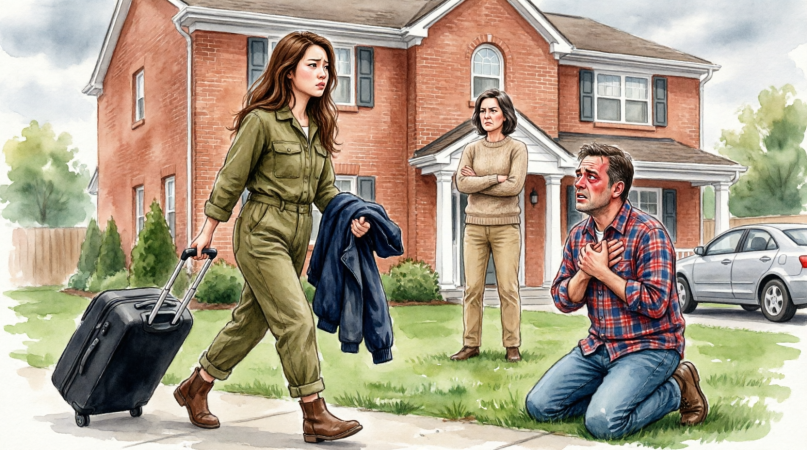
Before leaving for work, my neighbor asked me, “Is your daughter going to miss school again today?” I replied, “No, she goes every day.” The neighbor added: “But I always see her leaving with your husband during the day.” Sensing that something was wrong, I took the next day off and hid in the trunk of the car. Then the car started moving… toward a place I never could have imagined.
Mrs. Barragán dropped the question into the morning with the same tone other people used for discussing the weather, as if she had no idea that a few simple words could split open a life.
“How strange that Emilia didn’t go to school again today,” she said, adjusting the shawl around her shoulders as she stood on the sidewalk outside the building. “Your husband always leaves with her after you’ve gone.”
Verónica felt her smile hold in place for half a second too long.
“No, Mrs. Barragán,” she replied. “Emilia goes every day.”
The older woman frowned, not with accusation, but with honest confusion.
“Then I don’t understand. Because I’ve seen them several times. Almost always in the middle of the morning.”
That was the part that stayed with Verónica. If the woman had sounded eager, nosy, or pleased with herself, it would have been easier to dismiss her. If she had leaned in with the hungry tone of someone bringing gossip disguised as concern, Verónica could have told herself exactly what people always tell themselves when they need to make discomfort manageable: that neighbors exaggerate, confuse details, and build stories out of boredom.
But Mrs. Barragán did not sound gossipy.
She sounded puzzled.
And that was worse.
Verónica said goodbye with a quick, dry laugh that didn’t feel like hers, climbed into her car, and drove toward the office through the usual dense movement of Narvarte traffic. The city behaved as though nothing had happened. Motorcycles threaded between lanes. A delivery truck blocked an intersection too long. A man selling coffee in paper cups shouted through a row of idling vehicles. Somewhere a horn stayed on long enough to become part of the morning’s background music.
But inside Verónica, the day had already gone wrong.
All morning, the sentence drilled into her mind.
Your husband always leaves with her after you’ve gone.
Every email blurred around it. Every call seemed to come from a great distance. She sat through a meeting about late invoices and supplier delays with a legal pad in front of her and realized afterward that she had written the same thing three times in the margin without knowing she was doing it.
Mid-morning.
Several times.
Leaves with her.
Maybe Mrs. Barragán was mistaken.
Maybe she had seen another child.
Maybe she had mixed up the days, or maybe Emilia had stayed home sick once or twice and Verónica had forgotten amid everything else weighing on her.
That last possibility almost felt plausible. The previous few months had dragged her thin. Work had become relentless. Debt settled in her chest like something physical. The mortgage pressed from one side, grocery prices from the other, and every quiet conversation with Daniel about money seemed to begin with restraint and end in silence. Their marriage had not shattered. It had simply become one more room in which tension moved carefully, without ever fully leaving.
The last thing Verónica needed was a new suspicion.
But once suspicion enters a house, it doesn’t stay politely by the door. It moves through everything. It sits at the edge of routine and changes the meaning of whatever used to feel ordinary.
When she got home that afternoon, Emilia was in her room with her school uniform folded neatly over the chair and her tablet open to a math exercise. The girl looked up when her mother stepped into the doorway and offered a small smile, soft and automatic, the kind children give when they sense the day should still be normal.
Daniel was in the living room, leaning back on the couch with his phone in his hand.
Verónica set her bag down and made herself sound casual.
“Did you take Emilia out for anything today?”
Daniel didn’t even look up.
“No. Why?”
“No reason.”
The answer came too quickly.
Or perhaps, she thought, the suspicion was already doing what suspicion does, bending tone and timing into evidence.
At dinner, Emilia talked about a classmate who had brought mosaic gelatin to recess. Daniel complained about traffic on Viaducto and said one of his coworkers was convinced the city had become unlivable after 6 p.m. Verónica smiled when she needed to smile. Answered when someone spoke directly to her. Poured water, cleared plates, and watched the three of them move through the familiar choreography of family life while feeling more and more like an outsider to it.
It was not that anything looked wrong.
It was that everything looked practiced.
That night, sleep would not come properly.
Verónica lay beside Daniel in the dark and listened to his breathing settle into the steady unconscious rhythm of someone who had either nothing to fear or hid it better than she knew. Beside that sound, she replayed the recent months differently now. Emilia complaining about stomachaches. Emilia saying she didn’t want to go to school. Emilia insisting she felt strange, tired, upset, afraid of nothing she could explain clearly enough for an adult to respect. Verónica had answered like a mother who believed discipline was a form of love.
Everyone gets tired.
School matters.
Life doesn’t stop just because you wake up feeling bad.
Now, in the dark, those answers sounded flatter than they had in the moment. Not cruel. Just insufficient. The kind of responses busy parents reach for when there is too much to manage and too little energy left for mystery.
At 5:40 in the morning, before the alarm even rang, she decided she would not go to the office the next day.
She would not announce it as a confrontation. She would not accuse Daniel of anything she could not prove. She would simply stay behind and see with her own eyes what Mrs. Barragán had thought she saw.
By 7:10, she was dressed as usual, heels in one hand, bag over her shoulder.
“I have an early meeting,” she said.
Daniel stepped close enough to kiss her cheek.
“Good luck.”
Emilia sat at the table with cereal, her eyes fixed on the television in that glassy, waking-up way children sometimes have before the day fully catches them.
“Be good, my love,” Verónica said.
“Yes, Mom.”
Then she stepped into the hall, pulled the door closed behind her, and went downstairs.
The plan felt absurd even as she carried it out. The kind of thing suspicious spouses do in bad television dramas. She hated that about it. Hated that she had already crossed from discomfort into secrecy. But by then the alternative felt worse. Asking directly had gotten her nowhere. If Daniel was hiding something, he had already decided she was not supposed to know.
She waited until she heard the garage door open and Daniel’s car leave.
Only after the engine noise faded at the end of the block did she go back upstairs.
She unlocked the apartment quietly, stepped inside, slipped off her shoes, and stood in the hallway without moving. The house felt different when you were inside it as a witness instead of a participant. Every sound sharpened. The hum of the refrigerator. A faucet ticking once somewhere in the kitchen. The faint, uneven voices of morning television still leaking from the living room. The air itself seemed to hold its breath with her.
She stayed there.
At 9:17, the garage door opened again.
Daniel had come back.
Her heart began pounding so hard she had to brace one hand against the wall.
She cracked open the hallway door enough to see the edge of the living room and, moments later, Emilia’s bedroom door slowly opening. The girl stepped out fully dressed. Her hair had been combed and tied back neatly. A backpack hung on her shoulders. The thing that made Verónica go cold, however, was not the backpack or the clothes.
It was Emilia’s face.
She looked serious in a way children should not look when simply heading out for an ordinary errand. Not upset. Not playful. Not reluctant in the familiar dramatic way of school mornings. Quiet. Focused. Almost resigned.
Daniel stood by the entrance and spoke in a low voice.
“Ready?”
Emilia nodded.
Ready.
Verónica felt the word hit her almost physically.
Ready for what?
Something sharp went through her chest, a fear so immediate it outran thought. She didn’t stop to weigh possibilities. Didn’t step back to ask herself what a reasonable explanation might still look like. Suspicion had already built its own logic, and panic finished the work.
She moved before she could reconsider.
While Daniel helped Emilia into the back seat in the garage, Verónica slipped down the hall, through the kitchen entrance, and into the garage on silent feet. The trunk was open for one moment as Daniel shifted something near the rear bumper. She saw her chance and took it. She lifted the trunk just enough to slide inside, folding herself small, bag clutched tight against her chest, then pulled it down without a sound.
Darkness swallowed her immediately.
Part 2
The trunk smelled of hot rubber, gasoline, and old dust.
It was warmer than she expected, the enclosed air dense enough to make her breathing sound louder in her own ears. Verónica curled her knees up to keep herself from shifting when the car moved. Her bag strap dug into her shoulder. A loose tool somewhere near the spare tire pressed against her hip. Above her, she heard Daniel close the passenger door, then the driver’s side. A second later, the engine turned over.
The car began to move.
At first she told herself she could still make this make sense.
Maybe Daniel was taking Emilia to a dentist appointment he had forgotten to mention. Maybe a school meeting. Maybe some errand that looked suspicious only because it had already been filtered through Mrs. Barragán’s misunderstanding and Verónica’s own sleepless imagination. She clung to those possibilities as long as she could.
For the first several minutes, she tried to track the route by feel.
She counted turns. Estimated stops. Noted the rhythm of traffic lights through the rise and fall of the engine. She knew the roads around Narvarte well enough that she expected, sooner or later, to recognize the pattern toward Emilia’s school or toward Daniel’s office. A right turn here. The long light near the pharmacy. The stretch of broken pavement before the avenue opened up.
But the route twisted differently.
After nearly 20 minutes, the pavement changed.
The tires no longer hummed against clean city asphalt. Instead they rattled over rougher ground, uneven enough that the whole trunk vibrated beneath her. Gravel, maybe. Or old industrial pavement breaking down into stone. The movement became bumpier, more irregular. Then a sharp turn. Then another.
Verónica pressed one hand against the side panel to steady herself.
Where were they going?
She listened for voices.
At first she heard nothing except the engine and the occasional sound of Emilia shifting in the back seat. Then, faintly, Daniel spoke.
“Almost there.”
Emilia didn’t answer loudly enough for Verónica to catch the words, but she heard the low murmur of a child’s voice, flat and small.
The car drove on.
The city began to sound different too, or rather, it stopped sounding like the city she knew. The layered noise of traffic thinned. No buses groaned nearby. No street vendors called out. No motorcycles cut close. In their place came longer stretches of emptiness between sounds, as if they were moving into a quieter district, one more removed from the familiar compression of neighborhood life.
Then the car slowed.
Stopped.
The engine idled for a few seconds before cutting off.
Verónica lay still in the trunk, barely breathing.
She heard Daniel get out. Then the rear passenger door opening. The sound of Emilia stepping down. A pause. A metallic gate, perhaps, or some heavy latch being pulled back. Then footsteps over what sounded like concrete.
The voices were clearer now, though not by much.
“Remember what we talked about,” Daniel said.
Emilia answered, but too softly for Verónica to make out the words.
Her entire body had gone tight with the instinctive need to move, to push out of the trunk, to confront whatever was happening immediately. But another part of her, colder and more terrified, held her still. She did not yet know where they were or who else might be there. Bursting out blindly might do nothing except reveal her before she understood the danger.
Then the trunk shifted slightly as someone brushed past the rear of the car.
Verónica closed her eyes and kept her breathing shallow.
A door opened somewhere nearby. Not the car. Something heavier. A metal door, maybe, or one with a thick frame. She heard it close again with a muffled, final sound that made something turn over inside her.
They were inside now.
Verónica counted to 30, then 60, then 100.
No footsteps returned.
Very slowly, carefully, she pushed upward against the trunk.
To her immediate relief, it was not fully latched. Daniel must not have checked it properly in his distraction, or the force of the ճանապարհ, the rough road, had shifted it just enough to spare her. She lifted it a few inches, enough to let in a sliver of daylight, and looked out.
She did not recognize where they were.
The car sat in what looked like the rear lot of a low industrial building. Not abandoned exactly, but not active either. The structure was long and gray, with no visible sign on the wall she could see from her angle. One side was lined with barred windows. The lot was enclosed by a high metal fence with a sliding gate. A few weeds grew through cracks in the concrete. Farther back stood a loading door half rusted at the edges.
Nothing about it suggested school.
Nothing about it suggested anything a child should need to visit mid-morning in secret.
Verónica climbed out of the trunk on shaking legs and crouched behind the car immediately, scanning the lot. The gate was closed. The street beyond looked narrow and unfamiliar, lined with warehouses, repair shops, and shuttered storefronts. She turned back toward the building.
The door Daniel had used stood ahead on the side wall.
Plain gray metal. No number. No window.
She moved toward it without fully feeling her feet on the ground.
When she reached it, she realized her hands were trembling too badly to grip the handle properly the first time. She tried again. It was unlocked.
Inside, the air changed at once.
Cooler. Stale. Faintly chemical, as though the place had once been cleaned aggressively or used for something medical or institutional. A narrow hallway stretched ahead beneath fluorescent lights that hummed too loudly in the stillness. At the far end, a reception counter stood empty. Two plastic chairs sat against the wall. A framed poster hung crookedly above them, the kind of generic smiling-family image used in clinics or administrative offices.
Verónica’s mind reached for explanations again.
A therapist’s office? A private tutoring center? Some special program Daniel had arranged for Emilia without telling her? The hallway was not overtly sinister. It was worse than that. It was ordinary in a way that made secrecy feel even more dangerous.
Then she heard Emilia cry out.
Not loudly. More a choked, frightened protest, quickly suppressed.
Verónica moved.
She ran down the hall, turned past the reception counter, and found a second corridor branching to the right. One door stood partially open. Through it she saw Daniel kneeling beside Emilia while another woman, maybe 50, stood near a desk with a folder in her hands.
Everyone turned when Verónica appeared.
For one terrible second, no one spoke.
Daniel’s face emptied in a way she had never seen before. Not guilt. Not surprise. Something closer to pure alarm at the collapse of a plan.
“Verónica—”
She didn’t let him finish.
“What is this?”
Her voice cracked through the room sharper than she intended, sharp enough that Emilia flinched visibly.
The room itself was small and utilitarian. Desk. Filing cabinet. Two chairs. A box of tissues. Children’s drawings pinned to a corkboard in an attempt to soften the space. On the wall behind the desk hung a framed certificate she did not have time to read fully.
The woman near the desk recovered first.
“Mrs. Salgado?”
Verónica looked at her blankly.
“No one told me you were coming today.”
Today.
The use of the word made her stomach drop further.
Daniel rose slowly.
“It’s not what you think.”
Verónica actually laughed then, one short, shocked sound with no humor in it at all.
“I found my husband taking my daughter in secret to an unknown building after telling me she was at school,” she said. “I am very interested to hear what else I’m supposed to think.”
Emilia began to cry openly now, silent tears first, then harder, uglier sobs that seemed to come from somewhere deeper than the moment itself. Daniel turned toward her automatically, but Verónica got there first. She crouched in front of her daughter and gathered her into her arms, feeling how rigid the small body remained even while shaking.
“It’s okay,” she whispered, though nothing was okay. “I’m here.”
Emilia clung to her with a desperation that terrified her more than the building had.
The woman behind the desk spoke carefully.
“My name is Laura Sarmiento. I’m a child psychologist.”
Verónica lifted her head.
“What?”
Daniel stepped forward.
“She’s been seeing Emilia for 3 months.”
The words hit with the force of a confession because that was exactly what they were.
“Three months?”
He nodded once, shame now visible all over his face.
“I wanted to tell you.”
“When?”
“That’s not fair.”
“No,” Verónica said, standing so fast the chair beside her scraped hard against the tile. “What’s not fair is you taking our daughter to therapy behind my back and making me think she was in school.”
Emilia made a broken sound from the chair behind her, but Verónica could not stop. Weeks of strain, suspicion, work, fear, and the physical humiliation of hiding in her own trunk surged upward too fast to manage.
“What is wrong with her?” she demanded. “What did you think I would do if you told me?”
Daniel swallowed.
“Nothing is wrong with her.”
“Then why is she here?”
Dr. Sarmiento answered this time, and there was enough professional restraint in her voice to keep the moment from tipping fully into chaos.
“Because Emilia has been showing clear signs of school-related anxiety and panic for some time. Your husband contacted me after the episodes worsened.”
Episodes.
Verónica turned slowly toward Daniel.
“What episodes?”
The silence that followed lasted only a few seconds, but it stretched long enough to change the emotional geometry of the room. Daniel looked at Emilia. Then at the floor. Then finally at Verónica.
“She’s been having panic attacks.”
The phrase emptied the room of everything else.
Panic attacks.
Not stomachaches. Not laziness. Not ordinary school resistance. Not childish dramatics she had been too tired to interpret with patience. Panic attacks. Actual fear. Real enough that Daniel had chosen secrecy over confrontation because he believed telling her would only make things worse.
“What are you talking about?” she asked, but the question had already turned inward. She was not only asking Daniel. She was asking every recent morning, every conversation, every dismissal that now came back altered.
Emilia’s voice, small and shredded from crying, rose from behind her.
“I told you.”
That was the moment the anger cracked open and something far worse flooded in.
Not suspicion now.
Recognition.
Verónica turned.
Emilia sat folded inward in the chair, hands twisted in the straps of her backpack, eyes red and wet and old in a way no 8-year-old’s eyes should ever look.
“I told you my stomach hurt,” she said. “I told you I got scared.”
Verónica knelt in front of her again because her legs no longer felt dependable.
“My love…”
But Emilia kept going, because once a child begins telling the truth they have rehearsed alone too many times, adults rarely get to interrupt on their own terms.
“I tried,” she whispered. “But you always said I had to go. And Dad said this doctor helps when the scared feeling gets big.”
Dr. Sarmiento sat quietly, saying nothing. Daniel stood at the edge of the room with the posture of a man who already understood that whatever good intentions had led him here had also led him through betrayal.
Verónica reached for Emilia’s hands.
“Why didn’t you tell me again?”
Emilia gave her a look of such raw, confused hurt that the answer became obvious before the child spoke it.
“Because you were always tired.”
That truth landed without cruelty, which made it worse.
Not an accusation. Just fact.
Verónica lowered her head.
For months she had been coming home with work still burning inside her nerves, with bills in her bag and silence growing between her and Daniel and a constant sense that one more complication might finally break something she could not afford to lose. Emilia’s fear had reached her through that exhaustion again and again, and each time Verónica had answered not as a mother who did not care, but as one who could no longer distinguish between normal childhood resistance and a real emergency.
Daniel’s secrecy now looked different too.
Not righteous.
Not excusable.
But less like betrayal and more like desperation.
He finally spoke again.
“The school counselor called me in April. Emilia had an episode in class. Crying, shaking, couldn’t breathe right. They thought it was asthma until it kept happening.”
Verónica looked up slowly.
“And you didn’t tell me.”
“I tried the first week,” he said. “You were already drowning. Rent. Work. Everything. Every time I started, you were either exhausted or angry or both, and I…” He stopped, then forced himself to continue. “I thought if I handled it first, got answers first, I could tell you when it wasn’t just fear and confusion.”
“So you lied.”
“Yes.”
The room held that for a moment.
“Yes,” he repeated, more quietly. “I lied.”
It would have been easier if he had been cruel. Easier if the hidden morning trips had led somewhere sordid or unforgivable in a simpler way. But this was worse because it exposed not one betrayal, but many smaller failures braided together until they became a secret life inside the family’s ordinary one.
Verónica had not seen clearly enough.
Daniel had not trusted her enough.
Emilia had been the one paying for both.
Part 3
The rest of that morning unfolded in fragments, all of them quieter than Verónica would once have imagined a confrontation like this would be.
There was no dramatic departure. No shouted ultimatum. No clean moral position from which one adult could condemn the other and leave carrying righteousness like a shield. There was only damage and the slow, humiliating work of seeing it clearly.
Dr. Sarmiento, to her credit, did not let the room remain suspended inside accusation for long.
“I think,” she said, folding her hands on the desk with deliberate calm, “that today should not become a lesson Emilia has to carry alone.”
The sentence steadied something by naming the true center of the moment. Not the secrecy. Not the marriage. Not Verónica’s humiliation or Daniel’s fear. Emilia.
The girl sat bent in the chair with her backpack still on as if she might be forced to leave quickly if the adults around her failed in some decisive way.
Dr. Sarmiento asked, gently, whether Emilia would like a glass of water.
Emilia nodded.
While Daniel stepped out to get it from a cooler in the hall, Verónica remained crouched in front of her daughter, aware with painful clarity that she was now being seen through the eyes of a child who had both loved and feared disappointing her.
“What does it feel like?” Verónica asked softly.
Emilia wiped her face with the heel of one hand.
“My chest gets tight,” she whispered. “And my stomach hurts. And I think something bad is going to happen at school even if I don’t know what.”
The words came with effort, but now that they had started, they seemed to arrive from a place where they had been waiting a long time.
“Sometimes when Mom says I still have to go,” Emilia added, “it gets worse.”
Verónica closed her eyes for one second.
Not because she wanted to escape hearing it.
Because she wanted to survive hearing it without making her daughter responsible for the effect.
“I’m sorry,” she said. “I am so, so sorry.”
When Daniel returned with the water, Emilia took it from him but did not immediately drink. Her hands were still trembling.
Dr. Sarmiento explained the situation more fully then. The panic symptoms had first become unmistakable 4 months earlier. The school had contacted Daniel because Emilia’s first severe episode happened on a day Verónica was unreachable in back-to-back work meetings. Daniel came. Emilia calmed with him eventually, but the pattern continued. Mornings were hardest. Transitions. Crowded classrooms. Noise. The idea of being left somewhere while adults expected her to function normally through the fear.
“She is not being disobedient,” Dr. Sarmiento said, not sternly, but with enough emphasis to cut through whatever remained of the old family reflexes. “And she is not manipulative. Her body is going into alarm.”
Verónica nodded because words felt suddenly less reliable than listening.
Daniel sat in the chair by the wall, elbows on his knees, looking like a man who had slept badly for months. For the first time since she had climbed into the trunk, Verónica noticed things she had not wanted to notice before. The strain around his mouth. The way his hands stayed clenched even when still. The fatigue in him that was not separate from hers, only differently managed.
“You should have told me,” she said finally.
He did not defend himself.
“I know.”
“I might have reacted badly.”
“I know that too.”
“Then why didn’t you trust me enough to let me react?”
His face tightened.
“Because I was scared that if you saw it the way you saw everything else lately, through pressure, through deadlines, through survival… you’d tell her to push through again. And I couldn’t let that keep happening.”
It was not a kind thing to hear.
That did not make it false.
The session did not continue in any ordinary therapeutic sense after that. It became instead a kind of emergency family triage, an attempt to stop the adults’ shame, anger, and fear from becoming yet another crisis Emilia would absorb and carry.
By noon, Verónica had agreed to do what she had not imagined doing when she hid in the trunk.
She stayed.
She listened as Dr. Sarmiento outlined a treatment plan Daniel had already been quietly following. Reduced school exposure while they built coping tools. Coordination with the school counselor. Breathing exercises. Gradual reentry strategies. Monitoring triggers. No more secrecy. No more pretending the problem belonged only to the child.
When they left the building together, the industrial lot no longer felt sinister.
Just sad.
A place she had entered expecting to uncover one kind of betrayal and in which she instead found another, less dramatic and more ordinary, the slow fracture of a family under strain until compassion and honesty no longer arrived in the same room at the same time.
The ride home was silent.
Emilia sat in the back seat exhausted into stillness, clutching her backpack in her lap. Verónica rode in the passenger seat this time and watched the city come back around them in reverse, the same turns and rough stretches she had tried to decode from inside the trunk now rendered banal and visible. Repair shops. Storage lots. A bakery on the corner of a street she had never learned the name of. Then busier roads. Traffic. Familiar avenues. The known world reassembling itself with cruel ease.
At home, Emilia went to her room and fell asleep on top of the comforter without changing clothes.
Daniel stood in the kitchen as though unsure whether he belonged there.
Neither of them spoke for a full minute.
Then Verónica said, “How many times?”
He understood immediately what she meant.
“Eight sessions.”
Eight.
She put one hand flat on the counter because suddenly the room seemed to tilt slightly.
“You made an entire life around this without me.”
His expression sharpened with pain.
“No,” he said. “I made appointments. I drove her. I sat in waiting rooms. That’s not a life. That’s me trying to keep things from getting worse while not knowing how to bring you in without everything exploding.”
Verónica laughed once, bitterly.
“Well. That worked out beautifully.”
Daniel looked away.
“I know.”
The silence after that was not peaceful, but it was honest.
There would be no quick resolution between them, not after this. Trust had been damaged in 2 directions. He had deceived her. She had failed to see their daughter clearly. Neither fact canceled the other. Neither one made the other less painful.
That afternoon Verónica did not go to work. She called in. Her supervisor, already irritated by previous absences, was curt enough to make it clear that another missed day would be remembered later. Verónica said she understood and hung up before the shame could bloom properly.
Then she sat at the kitchen table with a notebook and wrote down everything Dr. Sarmiento had said.
Panic symptoms.
Breathing sequence.
School counselor contact.
Triggers.
Emergency plan.
She wrote as if precision alone might redeem the months of not understanding. It didn’t. But it gave the grief shape.
That evening, while Daniel picked up medicine from the pharmacy, Verónica sat on Emilia’s bed and watched her daughter color in silence. The room smelled faintly of crayons and the strawberry shampoo Emilia liked. Afternoon light filtered through the curtains in warm stripes. It was, in every visible way, an ordinary child’s room. That perhaps made the conversation harder.
“Why didn’t you tell me you were seeing the doctor?”
Emilia did not look up right away.
“Dad said we should wait.”
“Did you want to wait?”
The girl pressed the purple crayon too hard and broke the tip.
Then, very quietly, “I didn’t want you to be mad.”
The words were small enough that another adult might have missed how devastating they were.
Verónica reached for the broken crayon, set it aside, and took her daughter’s hand instead.
“I wasn’t mad at you,” she said.
Emilia’s eyes finally rose to meet hers.
“I know. You were mad at everything.”
That sentence stayed.
It stayed that night when Daniel slept on the couch without being asked. It stayed the next morning when Verónica made breakfast and watched Emilia approach the kitchen with caution before realizing no one was going to force the old routine back into place. It stayed when Verónica apologized to Dr. Sarmiento over the phone for barging in the way she had, and the woman, practical and unsentimental, said only, “What matters is what you do now.”
What they did now was slow and unglamorous.
They adjusted.
Verónica attended the next session.
Then the next one after that.
She sat in a chair beside Daniel and listened to the school counselor explain how anxiety often masks itself badly in children, stomachaches, resistance, tears, irritability, silence, and how easy it is for families already stretched thin to interpret those signs as attitude instead of distress. Each explanation landed with the heavy relief of something painful finally named correctly.
Emilia improved, though not in a straight line. Some mornings were easier. Some were not. There were setbacks, crying in the hallway before class, panic in the car, days when the thought of school still brought a visible tremor into her shoulders. But there was also progress once the adults around her stopped treating the fear like weakness or inconvenience.
Three weeks later, Mrs. Barragán saw Verónica on the sidewalk again.
The older woman’s face lit with the guilty curiosity of someone who knows they started something and has been waiting to find out whether it made matters better or worse.
“Everything all right, dear?”
Verónica paused.
It would have been easy to say yes and keep walking. Easier still to blame the neighbor inwardly for having disrupted the house at all. But that would have been dishonest. Without that awkward conversation on the sidewalk, Verónica might have stayed blind longer.
“My daughter was getting help,” she said. “I just didn’t know.”
Mrs. Barragán’s expression softened.
“Oh.”
Then, after a moment, “Well. I’m glad you know now.”
Verónica nodded.
“So am I.”
By December, the routines of the house had changed enough that even the air in it felt different. Daniel no longer moved around difficult subjects as if silence itself were a strategy. Verónica no longer answered every sign of distress with urgency and instruction. They spoke, sometimes clumsily, often late, about money, about pressure, about how fear had made both of them worse versions of themselves in different ways.
None of that fixed the breach between them immediately.
Trust did not repair because truth had finally arrived. It repaired, if it repaired at all, through repetition, through transparency, through ordinary proof. Daniel began sharing everything related to Emilia’s care, appointments, notes, school emails, concerns, all of it. Verónica admitted when she didn’t know what to do instead of covering uncertainty with authority. It was not graceful. But it was real.
One Saturday morning, almost 2 months after the day in the trunk, Verónica woke early and found Emilia already in the kitchen.
The girl sat at the table in pajamas, drawing.
“What are you making?”
Emilia looked up.
“A map.”
“A map of what?”
The girl shrugged with the seriousness children bring to unfinished imagination.
“How to get somewhere if you don’t know where you’re going.”
Verónica sat down across from her.
The paper showed streets, arrows, landmarks that only half resembled the real neighborhood, and at the edge, in big uneven letters, one word: HOME.
Verónica felt something catch in her throat.
“That’s a good map,” she said.
Emilia considered it, then added another arrow.
“I think so too.”
Later that day, while Daniel fixed a broken cabinet hinge in the kitchen and the radio murmured softly from the counter, Verónica stood in the garage for a long minute looking at the car.
The trunk sat closed, ordinary, empty, incapable now of holding the terror she had poured into it that morning in October and yet forever marked in her mind by what it had revealed. She had hidden there expecting to uncover infidelity or danger. What she found instead was something more ordinary and therefore more devastating, a child in pain, a husband afraid, and a mother so overrun by life she had stopped hearing what her daughter was trying to say.
When Daniel came out to ask if she needed something, she only shook her head.
“No,” she said. “I was just thinking.”
“About what?”
She rested one hand on the car roof.
“How close you can live to people and still not see what’s happening.”
He did not answer right away.
Then he said, “I think we both learned that.”
She looked at him, and in that moment there was no clean forgiveness, no cinematic reconciliation, no useful simplification of what had happened between them. There was only the shared knowledge that marriage, parenthood, and exhaustion had brought them to a place where love alone had not been enough to keep them honest.
But honesty had arrived eventually.
And perhaps that was where repair had to begin.
That night, after Emilia fell asleep, Verónica opened the hallway closet and found the backpack her daughter had worn that day to Dr. Sarmiento’s office. It still sat in the corner where it had been tossed weeks ago. She unzipped it.
Inside were crayons, tissues, a small stuffed rabbit, and a folded paper.
Verónica opened it carefully.
It was one of the first drawings Emilia had made during therapy. A car. A building. A tiny figure hidden in a black rectangle at the back of the car. Three stick figures standing outside the building afterward, one crying, one with arms open, one with no mouth at all.
At the top, in a child’s uneven handwriting, Emilia had written:
That was the day Mom found out.
Verónica sat on the hallway floor holding the picture for a long time.
Then she folded it again, not away, but carefully, and understood at last what the day in the trunk had really been.
Not the moment her marriage broke.
Not the moment suspicion was proved right.
The moment the hidden life inside her home became visible.
The moment a child’s fear finally forced the adults around her to stop performing normal and begin telling the truth.