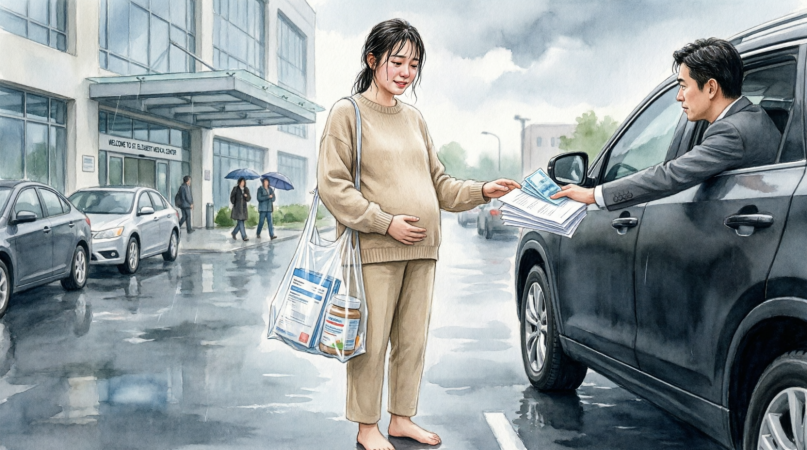
I STOOD OUTSIDE A CHARLOTTE HOSPITAL WITH FRESH STITCHES BURNING THROUGH MY ABDOMEN, WAITING FOR THE BLACK CHEVY TAHOE I HAD BOUGHT FOR MY PARENTS TO TAKE ME HOME—BUT WHEN MY MOTHER CRACKED THE WINDOW ONLY AN INCH, DROPPED A WET TWENTY INTO THE PUDDLE BY MY SHOES, AND SAID SHE WOULDN’T LET HER LEATHER SEATS SMELL LIKE DISINFECTANT OR SICKNESS, SOMETHING IN ME WENT COLD ENOUGH TO KILL—BECAUSE THEY STILL THOUGHT I WAS THE GRATEFUL DAUGHTER THEY COULD BLEED DRY, NOT THE WOMAN WHO HAD QUIETLY BUILT EVERY INCH OF THEIR LUXURY LIFE AND COULD ERASE IT ALL BEFORE THEY EVEN MADE IT HOME – Part 2 ENDING
It was late Saturday afternoon, the air thick with the cloying scent of imported citronella candles and roasting meat. Celeste was hosting a twilight dinner party on the back patio for the most elite members of her social circle. I was already feeling deeply unwell. A sharp twisting ache had planted itself in my lower abdomen right after lunch, radiating outward with a nauseating intensity that left me clammy and breathless. I approached my mother in the kitchen, quietly explaining the severe pain and asking if I could just remain in my cramped basement room for the evening. Celeste scoffed loudly, handing me a massive stack of heavy linen tablecloths. She commanded me to stop making excuses and make myself useful, sharply, reminding me that I was currently living under their roof, rent-free, and owed them my labor. The task she assigned was brutal. I had to haul several heavy crates of crystal glassware, bulky floral centerpieces, and heavy porcelain serving dishes from the elevated stone patio down a steep narrow flight of outdoor stairs to the lower garden staging area. I knew those stairs intimately, and I knew they were a death trap. three separate times over the past four weeks. I had sent Graham detailed emails with highresolution photographs showing the severe wood rot eating away at the main structural support of the right side handrail. I had verbally warned him that the damp cedar was decaying rapidly. He had dismissed every single message and conversation. He claimed replacing the custom wood was a completely unnecessary expense right before the summer entertaining season, accusing me of constantly exaggerating minor aesthetic flaws just to cause trouble. He flatly refused to spend the money. I picked up the second heavy crate of crystal, my stomach muscles clenching an agonizing protest with every step. The sun was setting, casting long, deceptive shadows across the uneven moss-covered brick work. As I reached the top step to begin my descent, a sudden, blinding spike of pain shot through my midsection, far worse than before. The agony caused my knees to buckle momentarily, losing my balance under the weight of the heavy box. I instinctively threw my left hand out, grabbing the wooden railing with all my body weight to steady myself. There was zero resistance. The sound of the rotting wood snapping was terrifyingly loud, like a dry tree branch breaking in a silent forest. The railing simply disintegrated into damp, spongy splinters beneath my grip. Gravity seized me violently. I tumbled forward, the heavy wooden crate flying from my hands and shattering against the sharp edge of the brick steps. I fell hard, my body twisting awkwardly in the air. My lower abdomen slammed with brutal, devastating force against the solid stone corner of the landing. The impact completely knocked the oxygen from my lungs. A white hot flare of absolute agony exploded in my gut. So intense and absolute that my vision instantly blacked out at the edges. I lay crumpled on the damp grass at the bottom of the ruined staircase, gasping for air like a drowning woman, unable to move my legs or arms. In any normal household, this would be the moment of pure, unadulterated parental terror. I expected the immediate panicked rush of footsteps. I expected my father to yell my name, to slide down the stairs to check my pulse. Instead, Graham appeared at the top of the landing, looking down not at my broken body, but at the scattered, ruined crystal glittering in the twilight. His face was twisted in absolute fury. He shouted down at me, his voice echoing across the lawn, furious that I had completely ruined the centerpiece presentation. He yelled that replacing the imported Italian glasses would cost an absolute fortune and that I was unbelievably clumsy. Celeste rushed out onto the patio seconds later, she completely ignored my inability to stand or speak. She began frantically pulling at her hair. Whining loudly to Graham that the luxury catering staff was arriving in exactly 20 minutes and this mess was an unacceptable disaster. Only when I failed to respond to their harsh commands to get up and clean the broken glass. Only when they saw me curled in a fetal position, coughing up a small, terrifying trace of blood. Did they realize I was severely incapacitated? Celeste finally pulled out her phone to call for an ambulance, but her tone was not one of panic. She sounded like a highly inconvenienced hostess complaining about a delayed floral delivery. I heard her actually ask the emergency dispatcher if the paramedics could please park the ambulance down the street and walk up the driveway quietly, specifically requesting they turn off the flashing lights so they would not distress her arriving high society guests.
The ride to the trauma center was a dark, agonizing blur of violent bumps and the sterile metallic smell of the paramedics equipment. Graham rode in the front seat, complaining incessantly to the driver about the evening traffic ruining their schedule. The moment we arrived, the chaotic, high-speed machinery of the emergency room swallowed me whole. The attending trauma surgeon quickly assessed my rigid, deeply bruised abdomen. He ordered an immediate scan, which revealed massive blunt force trauma. I had suffered severe internal bleeding from a ruptured blood vessel and significant soft tissue damage surrounding my organs. Emergency surgery was the only option to stop the hemorrhaging and save my life. While I was being prepped for the operating room, drifting in and out of a terrified, pain-filled narcotic haze, the hospital financial administrator approached Graham in the waiting area to process the intake. I learned the exact details of this exchange hours later, but the sheer calculated cruelty of it was perfectly in character. The administrator requested an initial payment method or insurance verification to formally process the emergency surgical intake. Graham possessed a platinum secondary credit card in his wallet at that very moment. It was a card tied directly to my personal corporate accounts, an account I had intentionally left active and fully funded. He could have swiped it without a single second of hesitation. Instead, he coldly and deliberately refused. He crossed his arms, looked the administrator dead in the eye, and stated that my financial affairs were currently a chaotic legal mess. He told the hospital staff that they would just have to figure out the billing on their own because he was not putting his name on any financial liability for my mistakes. He abandoned me financially right at the very threshold of the operating room.
Then Brier arrived. I had managed to hit the emergency dial shortcut on my phone while lying immobilized in the wet grass before the ambulance even arrived. She stormed into the hospital lobby like a tactical strike force just after midnight. She bypassed my parents completely, marching straight to the administration desk. She slammed down her own heavy black card, signed every necessary financial guarantee, and authorized the life-saving surgery without blinking. But Brier did not stop at simply securing my medical care. Her mind was always a cold, calculating engine of strategy. While I was unconscious under the surgeon’s knife, she went to work building our arsenal. She formally requested and secured the hospital admission logs, permanently documenting Graham’s explicit refusal to provide the payment card he carried. She obtained the official paramedic dispatch report detailing Celeste’s bizarre, vain request to hide the ambulance from her dinner guests. Most importantly, she logged into my remote cloud server and pulled the exact digital trail we needed. She downloaded the three specific emails I had sent my father warning him about the rotten handrail complete with timestamps and the highresolution photos. She also downloaded his dismissive, arrogant replies refusing to authorize the repairs. The snapped wood was no longer just an unfortunate random household oversight. By explicitly refusing to fix a known documented structural hazard simply to save a few dollars for a party and then actively denying medical payment after that exact hazard nearly killed me. My parents had inadvertently handed us the ultimate devastating weapon. It was no longer a petty family dispute over money. It was now a clear, legally documented case of gross negligence and reckless endangerment. They had enthusiastically built their own legal coffin. All I had to do now was survive the surgery, wake up, and nail the lid shut.
I spent four days staring at the acoustic tiles of my sterile hospital recovery room, wrapped in a haze of surgical pain and forced reflection. On the morning of my medical discharge, I sent a brief text message to my mother. It was a simple factual notification that I was being released. I did not send that message because I harbored any lingering delusions of a tearful, loving family reunion. I sent it because I needed to look them in the eyes one final definitive time. I needed to witness with absolute and unwavering clarity the exact volume of humanity they had left inside their souls before I burned their world to the ground. The result was the encounter at the curb, the locked doors of the luxury vehicle, the refusal to look my way and the crumpled $20 bill casually tossed into the oily puddle at my feet. The metallic disgusted voice of my mother complaining about the lingering smell of disinfectants.
As I sat in the back of the hired car, pulling away from the medical center, the city of Charlotte blurring past the tinted windows, I felt a profound chemical shift in my brain. My abdomen throbbed with a dull, vicious ache from the fresh internal sutures, but my mind was sharper and colder than it had been in a decade. I looked down at my lap. Resting on my thigh was the wet, crumpled $20 bill I had painfully retrieved from the pavement. It was damp with dirty puddle water and smelled faintly of motor oil. When the driver pulled up to the private subterranean loading dock of my downtown residential building, the fare had already been secured through the application on my phone. I handed the driver the wet bill anyway. I told him to keep it as an extra gratuity. I refused to keep that specific piece of paper in my possession for another second. Handing it over felt like physically stamping the opening receipt for the final reckoning. It was the absolute cheapest buyout of a bloodline in recorded human history.
The private elevator ascended smoothly to the 98th floor. When the polished steel doors parted, stepping into my penthouse felt like stepping onto a completely different planet. The apartment was a sprawling, immaculate expanse of floor-to-ceiling glass, cold gray marble, and minimalist Italian furniture. It was a high-altitude fortress my parents did not even know existed. Waiting for me at the massive quartz dining table were Nolan Voss and Brier McCall. The surface of the table was completely covered with open laptops, glowing monitors, neatly stacked legal dossiers and steaming cups of black coffee. They looked less like my corporate attorney and my media strategist and more like a tactical military tribunal preparing to authorize a devastating drone strike. I walked slowly over to the table, forcing myself to ignore the sharp, tearing sensation in my core and took the seat at the head. I did not need to debrief them on the hospital curb encounter. Brier took one look at my face, saw the dead, flat, absolute emptiness in my eyes, and simply nodded. She pushed a sleek silver laptop toward me and handed me a heavy , 8 giâygold fountain pen.
I gave the execution orders in a voice that I barely recognized. It was completely devoid of , 15 giâyhesitation, grief, or doubt. I instructed Nolan to immediately contact the executive branch of my wealth , 22 giâymanagement division. I ordered the permanent, irreversible freezing of every single secondary credit card issued to Graham and Celeste Jenkins, , 31 giâythe platinum travel accounts. the premium dining cards, the exclusive department store charge lines, all of them terminated with extreme prejudice. , 42 giâyI then targeted the absolute lifeblood of their daily existence. I ordered the immediate and total cessation of the automated monthly allowance wire , 50 giâytransfers that silently fed their joint checking account. Next on the chopping block was the black luxury sport utility , 57 giâyvehicle. I authorized the immediate cancellation of the premium insurance policy covering that specific asset. Under the strict ironclad terms of the vehicle’s title, which my holding company owned, operating the machine without full premium coverage was a material breach of contract. This legal maneuver allowed my security team to remotely disable the engine block via the onboard satellite telematic system. The car was now nothing more than a $75,000 paperweight sitting in their driveway. They were permanently grounded. Finally, we moved to the residential estate. I told Nolan to activate the nuclear option. We triggered the immediate termination clause regarding their conditional right of residency. Nolan drafted the formal eviction notice, giving them exactly 96 hours to vacate the premises entirely before formal public removal proceedings would be initiated by the county sheriff’s department. Nolan did not stop there. He slid a crisp, thick legal document across the cold court surface of the table. It was a formal spoliation of evidence mandate. He was dispatching a private process server to physically hand them a legally binding order to preserve the ruined outdoor staircase and all associated digital communications. The document explicitly laid the aggressive groundwork for a massive civil liability lawsuit regarding my near fatal injuries, effectively trapping them in a brutal legal corner. If my father tried to quietly fix the rotting stairs to hide the hazard, he would be committing felony destruction of evidence. If he left it untouched, it stood as a permanent, undeniable monument to his gross, almost homicidal negligence.
As I signed the final authorization, Brier leaned forward, her expression turning distinctly predatory. She tapped a thick manila folder resting near my left elbow. She explained that while I was unconscious under heavy anesthesia on the operating table, her forensic accounting team had flagged a highly suspicious critical anomaly in my broader financial portfolio. Exactly two weeks prior, while I was living in their damp basement, eating tightly rationed slices of cheap bread, Graham and Celeste had made a bold, breathtakingly desperate move. They had attempted to forcibly penetrate a high yield private equity fund held solely in my name at a boutique downtown brokerage firm. They did not just ask the broker nicely. They had submitted a completely fabricated, durable power of attorney document. The paperwork was complete with a forged notary public seal and a heavily doctored physician statement falsely claiming I had suffered a total psychological collapse and was mentally unfit to manage my own assets. The brokerages internal fraud department had immediately flagged the amateurish forgery, locking the digital portal and denying the transfer. But my parents had left a glaring, undeniable, and highly illegal paper trail of their attempted grand larceny. They had crossed the definitive line from being emotionally abusive, greedy parents to committing actionable federal financial fraud. The late afternoon sun began to set over the Charlotte skyline, casting long, sharp, golden shadows across the marble floor of the penthouse. I sat back in the leather chair and looked at the mountain of printed evidence, the drafted termination notices, and the undeniable proof of their criminal intent. The woman who had stood trembling on the hospital curb just a few hours ago, harboring a pathetic, lingering hope for a ride home, was completely dead and buried. By that evening, I was no longer a victim seeking validation. I was no longer a daughter trying to buy love. I was the architect of their total systematic destruction. I had become the sole undisputed authority in the universe, deciding exactly what my parents were going to lose, the precise, agonizing order in which they would lose it, and exactly how deeply the consequences would cut into their flesh.
The crumpled $20 bill tossed into the dirty water had been the final signal flare. The grace period was over, and the war of attrition had officially begun. I sat in the absolute silence of my downtown penthouse, watching the digital notifications roll across my laptop screen. Brier had stationed a discreet private investigator near the suburban shopping district to ensure my parents did not cause a public disturbance that might circle back to my corporate reputation. Through the investigator’s real-time text updates and the cascade of declined transaction alerts hitting my inbox, I watched my parents carefully constructed universe shatter into pieces. The sheer speed of their downfall was a beautiful, terrifying thing to witness. At exactly in the afternoon, my father walked into a high-end horology boutique. He was accompanied by two of his wealthiest friends from the country club, men whose approval he valued above his own breathing. Graham was trying to purchase a vintage imported watch, a piece priced at roughly $40,000, purely to show off his enduring financial dominance despite his daughter’s supposed legal troubles. He leaned against the polished glass display case, laughing loudly with his friends, and handed the clerk his glossy black secondary card. The clerk swiped the plastic. The terminal emitted a sharp, negative beep. Graham smiled a tight, condescending smile, loudly blaming a banking security measure and told the young man to run it again. The clerk complied. The same sharp beep echoed in the quiet store. The clerk lowered his voice, politely, informing my father that the issuing bank had completely frozen the account. Graham’s face turned a violent shade of purple. His friends abruptly stopped laughing, suddenly finding the ceiling tiles incredibly interesting. My father snatched the card back, muttering furiously about incompetent bankers, and stormed out of the boutique, leaving his shredded dignity on the pristine marble floor.
While Graham was being humiliated among the watch cases, Celeste was experiencing her own public execution at a luxury department store across the plaza. She had piled the cosmetics counter high with imported facial serums, rare perfumes, and designer makeup palettes. When the cashier presented the total, Celeste casually handed over her premium platinum card. The system instantly rejected it. Annoyed, she dug into her designer purse and produced a second card. Denied, her breathing grew shallow as she handed over a third option, a card reserved for emergency travel expenses. The machine rejected that one as well. A line of impatient, impeccably dressed women had formed behind her. They began to shift their weight and whisper to one another. Celeste, a woman who had built her entire identity on being the wealthiest person in any given room, was forced to snatch her empty purse and walk away from the mountain of luxury goods. She had to endure the searing, pitying glances of the sales associates and the open disdain of her peers. They retreated to the sweltering outdoor parking lot, meeting beside the massive black sport utility vehicle. They were both shaking with rage, completely convinced that my financial mess had merely caused a temporary administrative glitch. They climbed into the leather seats. Graham pressed the ignition button. The engine remained completely dead. Instead of the familiar roar of a powerful motor, the digital dashboard illuminated with a stark red warning message. The vehicle telematic system informed them that the engine immobilizer had been activated remotely due to a canceled insurance policy by the registered owner. The car was entirely bricked. They were trapped in a baking parking lot in a $75,000 piece of useless metal. While they sat sweating in the silent vehicle, both of their phones chimed in unison. It was an automated email from the Brook Glass Civic Club board of directors. The message formally stated that their quarterly membership dues, which had always been automatically drafted from the accounts I just closed, had failed to process. Effective immediately, their membership privileges were fully suspended. They were barred from the dining room, the golf course, and all social events until the balance was settled. The absolute worst fear they harbored, the loss of their elite social standing, had just become a recorded reality. They were forced to call a cheap local taxi to take them back to the estate.
Sitting in the stained back seat in complete terrified silence, the true devastation arrived right after sunset. I was pouring myself a glass of cold water when my phone screen lit up with an incoming call from Graham. I let it ring three times before sliding my finger across the glass to answer. I did not say hello. I just listened to the heavy, furious breathing on the other end of the line. Graham did not sound like a concerned father. He sounded like a feral animal trapped in a corner. He screamed into the receiver, his voice echoing with absolute rage. He demanded to know what kind of sick game I was playing. He ordered me to immediately call the banks, unlock the vehicles, and fix the country club issue before he came downtown and dragged me out of whatever hole I was hiding in. He used his deepest, most terrifying voice, the exact same tone that had made me shake with guilt and obedience since I was a small child. But as I stood looking out over the glittering city skyline, I felt absolutely nothing. My heart rate did not increase. My hands did not tremble. The psychological chains he had wrapped around my mind for 34 years had dissolved completely. I let him yell until his voice cracked. When he finally paused to take a breath, I spoke. My voice was quiet, flat, and completely devoid of mercy. I told him that I did not own the house he was standing in, and neither did he. I informed him that exactly 10 minutes ago, a private process server had taped a formal notice of lease termination to his heavy front door. I advised him to go read it. I told him he had exactly 96 hours to pack his personal clothing and vacate the premises before the county sheriff arrived to throw his belongings onto the street. I heard Celeste screaming hysterically in the background. She had just logged into her private laptop and discovered that her personal checking account, the one she used to hide money from my father, was completely frozen. She shrieked that she could not even buy groceries, that she had no cash to borrow, and that she was completely ruined. Graham tried to muster his authority one last time, threatening to sue me for everything I owned, claiming I owed them for raising me. I took a slow sip of my water. I told him he could certainly try to sue me, but he would have a very hard time finding a lawyer to represent a man facing federal forgery charges. The silence that fell over the phone line was profound. It was the sound of a massive, impenetrable ego suddenly hitting a concrete wall. I calmly explained that my forensic accounting team had secured the fabricated durable power of attorney he and Celeste had submitted to my private equity firm. I mentioned the forged notary stamp and the fraudulent medical evaluation. I told him that the evidence was already neatly organized in a file. Sitting on my attorney’s desk, fully prepared for submission to the federal authorities. The blustering arrogance evaporated instantly. The terrifying realization washed over Graham. He finally understood that he was no longer dealing with a desperate daughter begging for scraps of affection. He was negotiating with a hostile corporate entity that held the keys to his freedom. From thinking he could simply yell and bully his way back to luxury. He suddenly realized that the ground beneath his feet had completely collapsed and he was staring straight down into the dark abyss of a federal prison sentence. I did not wait for his response. I ended the call, set the phone down on the marble counter, and enjoyed the quiet night.
Instead of the crushing weight of impending federal charges forcing a sincere, desperate apology, the realization that they were legally cornered triggered a completely different survival instinct in my parents. They chose the dirtiest, most familiar weapon in their arsenal. They chose the suburban smear campaign.
Within twenty-four hours of our final phone call, the vicious whispers began to circulate through the manicured lawns, the tennis courts, and the mahogany dining rooms of their elite social circle. They did not admit to the forged documents or the canceled credit lines. They certainly did not mention the rotting staircase or the hospital abandonment. Instead, Graham and Celeste launched a perfectly choreographed, highly aggressive offensive, casting themselves as the tragic, aging victims of a mentally unstable, wildly ungrateful daughter. The narrative they spun was a masterpiece of upper middle class manipulation, carefully designed to elicit maximum sympathy from people who traded in gossip like currency. They told their horrified friends at the Brook Glass Civic Club that the heavy anesthesia and the severe trauma of the emergency surgery had triggered a massive, irreversible psychotic break in my mind. They claimed I had become a paranoid, controlling megalomaniac overnight. The true story of me being left bleeding on the hospital curb was twisted into a malicious, paranoid delusion I had entirely fabricated to justify my sudden, unprovoked cruelty toward them. According to their tearful recounting over afternoon tea and evening cocktails, I was currently being aggressively brainwashed by my ruthless corporate attorney and my cold-blooded media strategist. They painted Brier and Nolan as parasitic opportunistic manipulators who had deliberately isolated me from my loving family in order to systematically drain my corporate assets for their own personal gain. It was a brilliant, venomous lie designed to completely discredit anything I might say or do before I even had the chance to present my side of the story. They were salting the earth of my reputation so that nothing I planted there would ever grow. Graham did not stop at mere neighborhood gossip. Desperate to maintain his physical grip on the sprawling estate he still believed was his rightful kingdom. He ventured into a decaying strip mall on the outskirts of the city and hired a discount. Desperate litigator. This attorney, likely working for a flat fee my father had scraped together by pawning a few remaining valuables, immediately filed an emergency injunction at the county courthouse. The legal filing was a frantic, messy, shotgun approach document aimed squarely at stalling the 96-hour eviction process. It wildly cited alleged elder abuse, severe emotional distress, and my supposed sudden mental incompetence as imperative reasons to halt the removal. It was a transparent, pathetic attempt to buy time. Graham was gambling on the idea that the sheer stress of a messy prolonged public legal battle would eventually force me to fold, drop the eviction, and quietly reinstate their luxurious allowances just to make the headache go away. Celeste, true to her nature, took a much more theatrical, emotionally manipulative approach.
On a rainy Tuesday morning, my building concierge called my secure line to inform me there was a highly emotional disturbance occurring in the main lobby. I rode the private elevator down to the ground floor to find my mother putting on an award-winning performance for the bewildered doormen and passing affluent residents. She was dressed in a simple, understated beige trench coat, a stark, calculated departure from her usual flashy designer wear, and she was clutching a damp tissue. Her face was streaked with perfectly calibrated tears, her makeup artfully smudged to convey deep maternal suffering. When the polished steel doors opened, and I stepped out, she rushed toward me, her voice trembling and cracking. She loudly begged her little girl to please come back to her senses. she wailed, making sure her voice echoed off the high marble walls. That she forgave me for everything. That a family should never let a misunderstanding over money tear them apart, and that my father’s heart was breaking from the separation. It was the exact same heavy emotional trap I had fallen into a hundred times before over the last 34 years. the public spectacle, the manufactured tears, the heavy suffocating implication that I was the cold-hearted monster tearing the loving family apart. But standing in that cold, bright lobby, looking at the very same woman who had casually thrown a crumpled $20 bill into a puddle of dirty water while I bled, I felt absolutely nothing but a deep clinical disgust. I did not raise my voice. I did not engage in the manufactured drama. I did not offer a single word of defense or explanation. I simply looked her directly in the eyes, a gaze devoid of any remaining daughterly affection. I turned to the head of building security, calmly instructed him to permanently add her face to the banned trespassers list and to call the police if she ever returned. And then I turned my back on her weeping figure. I stepped back into the elevator and rode straight back up to my sanctuary, leaving her to sob to an empty room.
While Graham and Celeste were busy exhausting themselves with their pathetic amateur theater, my team was operating with the lethal, silent efficiency of a tactical strike force. Brier was not wasting a single second responding to the country club rumors. She was quietly, methodically archiving the absolute undeniable truth. Her digital vault of evidence grew heavier and more devastating by the hour. She formally secured the unedited high-definition hospital security footage. The video was crisp and damning. It clearly showed the black luxury vehicle stopping, the tinted window cracking open just a fraction, the money fluttering down into the dirt and the car speeding away while I stood hunched over, clutching my wounded stomach. She organized the chronological timeline of my ignored emails regarding the rotting staircase. complete with red receipts. She compiled the undeniable bank records showing the exact minute my accounts were frozen, immediately followed by the frantic, illegal attempts to breach my private equity funds using the fabricated power of attorney document. She even recovered deleted text messages between my parents from the night of my surgery, casually discussing how to lock down the money before the anesthesia wore off.
Then Nolan unearthed the absolute crown jewel of our case. During a deep forensic sweep of my father’s recovered communications, an email surfaced that made the air in the penthouse turn to ice. It was a message Graham had sent to a senior banking executive exactly 4 months prior. long before the wooden stairs ever collapsed. In this chillingly polite email, my father casually inquired about the specific legal mechanisms required for a family member to assume emergency financial oversight in the event that the primary account holder suffered a catastrophic incapacitating physical injury. It was the ultimate terrifying proof of premeditation. They had not simply panicked in the heat of the moment during my surgery. They had been actively praying for a tragedy. They had been silently, patiently calculating the exact legal pathways to my fortune, treating my potential death or severe injury not as a horrifying nightmare, but as a highly anticipated retirement payout.
The instinct for any high-profile corporate executive facing a vicious coordinated public smear campaign is to immediately retaliate, to issue fierce press releases, and to aggressively shut down the rumors before they impact the bottom line. But looking at the mountain of devastating, irrefutable evidence Nolan and Brier had assembled on the court’s table, I made a completely different tactical decision. I ordered absolute total silence from my camp. I refused to engage in a messy public war of words. I refused to defend my sanity to people who only cared about their next country club tea time. I realized that the greatest mistake you can make when your enemies are actively destroying themselves is to interrupt them. I wanted Graham and Celeste to feel confident. I wanted them to believe their pathetic legal stall tactics and their neighborhood lies were actually working. I needed them to step so far into the snare, to commit so deeply to their fraudulent narrative that turning back or claiming a misunderstanding would be a physical and legal impossibility. My strategic silence heavily emboldened them, convinced I was paralyzed by the public shame and terrified of their legal threats.
Graham’s discount lawyer pushed aggressively forward. He formally demanded a hearing before a superior court judge. He wanted to consolidate the eviction dispute. the questions regarding my mental fitness and his absurd counter claims into one massive definitive legal showdown fully expecting me to surrender before we ever saw the inside of a courtroom. It was exactly the fatal mistake we were waiting for. Nolan smoothly agreed to the consolidated docket without raising a single objection. The court officially scheduled a comprehensive binding hearing. It was set for a Thursday morning exactly two weeks away. This would not be a private negotiation or a quiet swept under the rug settlement behind closed doors. It would be a sprawling public judicial proceeding where the strict rules of evidence applied, where perjury carried a mandatory prison sentence and where the complete unvarnished truth would be permanently entered into the public record. The masks were finally going to be ripped off under the harsh, unforgiving fluorescent lights of a courtroom, and I was going to ensure they never found a way to put them back on.
The courtroom was a stark, unforgiving arena that stood in massive contrast to the luxurious, insulated world my parents were so desperately trying to cling to. It smelled faintly of lemon floor wax and old paper, illuminated by harsh buzzing fluorescent lights that offered absolutely no shadows to hide in. I sat quietly beside Nolan at the heavy oak plaintiff table, wearing a tailored charcoal suit that felt like a suit of armor. Across the wide center aisle, Graham and Celeste were already putting on the theatrical performance of a lifetime. They had intentionally dressed down for the occasion. My father wore a slightly wrinkled, dull gray suit that purposely made him look frail and diminished, while my mother had completely abandoned her heavy designer jewelry and perfect makeup. They huddled closely together at their table, trying their absolute best to look like two terrified, vulnerable, elderly victims facing a ruthless corporate machine. When the honorable judge called the hearing to order, the discount attorney my father had hired immediately launched into a highly emotional, completely baseless opening statement. He aggressively painted me as a deeply unstable, vindictive woman who had suffered a severe post-operative mental breakdown. He called Graham to the witness stand first. My father slowly walked up, placed his right hand on the holy book, swore to tell the whole truth, and immediately began lying with breathtaking ease. He spoke with a carefully manufactured, trembling voice, claiming to the court that I had explicitly promised them the massive estate as a permanent, unconditional gift to thank them for their years of unwavering parental support. He testified under oath that my sudden decision to freeze their accounts and issue an eviction notice was an act of uncontrollable insane retaliation for imaginary slights. Celeste wept openly in the wooden gallery benches, nodding along as he detailed how they had always rushed to my side during every single crisis, sacrificing their own health and happiness to care for me. I felt absolutely no anger watching them commit perjury. I just felt a cold clinical detachment. I gave Nolan a brief silent nod. He stood up, buttoned his suit jacket, and approached the bench. He did not raise his voice or engage in their cheap emotional theatrics. He simply began handing the judge a stack of crisp, undeniable reality. First, he submitted the original, heavily notarized trust agreement for the property. He methodically pointed out the specific ironclad termination clauses and the extremely clear legal definition of their conditional residency. He proved beyond a shadow of a legal doubt that they had never owned a single brick or blade of grass on that property. The judge carefully examined the documents, his expression turning distinctly cold as he peered over his glasses at my father, but the property dispute was merely the opening skirmish.
Nolan called Brier to present the digital evidence we had gathered. The court bailiff dimmed the overhead lights and the large television monitor mounted on the sidewall flickered to life. The high-definition hospital security footage began to play. The entire courtroom watched in absolute horrified silence as the massive black luxury vehicle pulled up to the hospital curb. They watched the heavy tinted passenger window roll down exactly 2 in. They watched my mother casually drop the crumpled $20 bill directly into a filthy puddle of water. And then the court watched me, hunched over in visible agony, clutching my freshly bleeding abdomen as I painfully bent down to retrieve the wet money while my parents simply accelerated and drove away. The silence in the room was thick and suffocating. It was a heavy collective disgust that seemed to press down physically on Graham and Celeste, but Nolan was far from finished. He immediately submitted the sworn signed affidavit from the hospital financial administrator. The document confirmed that Graham had explicitly refused to use the active secondary credit card sitting right in his wallet to pay for my emergency life-saving surgery. Following that, Nolan projected the series of emails I had sent weeks prior. The messages explicitly warned my father about the rotting outdoor staircase, complete with highresolution photographs of the danger, followed by his arrogant, dismissive replies refusing to spend a single dime on repairs. The false narrative of a tragic, unavoidable household accident completely evaporated into thin air, instantly replaced by documented, undeniable negligence that had nearly resulted in my death.
The final devastating blow was delivered a few minutes later by a senior fraud investigator from my wealth management firm. He took the witness stand and closely examined the durable power of attorney document my parents had attempted to submit. He walked the judge through the amateurish desperate forgery, pointing out the obviously doctored physician signature and the completely fake notary public stamp. He confirmed for the official record that the attempt to seize my private equity funds had been immediately flagged as a fraudulent criminal act before a single dollar could be transferred. The judge did not even need to recess to deliberate. He looked down at Graham and Celeste with a mixture of profound anger and absolute judicial contempt. He struck down every single one of their delay requests with a sharp echoing bang of his wooden gavel. He fully upheld the eviction notice, ordering them to vacate the property within twenty-four hours. Then he delivered the killing strike. He formally announced to the courtroom that he was forwarding the forged power of attorney documents directly to the district attorney office for an independent criminal investigation regarding felony financial fraud.
Court was abruptly dismissed. Graham and Celeste completely collapsed into their chairs. The color drained entirely from their faces as the terrifying reality of potential prison time finally broke through their lifelong delusions of invincibility. I stood up, calmly gathered my legal files, and walked out the heavy double doors into the wide marble hallway. They scrambled out of the courtroom right after me, their previous arrogance completely gone. They cornered me near the elevator banks. They were no longer angry. They were consumed by sheer panic. Celeste reached out to grab my arm, her voice a high-pitched wail of pure terror, begging me to withdraw the criminal complaint, promising they would leave the state, promising they would do whatever I wanted. Graham was stammering uncontrollably, his hands shaking violently, asking how his own flesh and blood could possibly destroy him like this. I looked at the two terrified strangers standing before me. I opened my slim leather briefcase and reached inside. I pulled out the exact same $20 bill from the hospital curb. It was dry now, carefully pressed flat, but it was still permanently stained with the dark oil of the puddle. I stepped forward and placed the bill gently onto the polished wooden bench sitting right between them. I looked my mother directly in the eyes.
“Take a taxi,” I said, my voice perfectly steady and completely devoid of any emotion. “I do not want my life smelling like you two anymore.” I turned around and walked toward the waiting elevator. I did not look back once. Behind me stood two people who had just permanently lost their luxury estate, their unlimited access to my wealth, their elite social standing, and their absolute final chance at redemption. I stepped into the elevator car and watched the polished steel doors slide shut, severing the connection forever.
An hour later, I was back at Meridian Harbor Risk Advisory. The office was quiet and empty. I walked into my corner suite, turned on the warm overhead lights, and sat down at my heavy mahogany desk. I opened my laptop, ready to work, and felt a profound, incredible sense of peace wash over my entire body. I finally understood that true justice was not about screaming louder than the people who hurt you. It was about calmly, quietly closing the door at the exact right moment and having the absolute strength to never open it again.