I married my 80-year-old neighbor to save his house… and then I got pregnant and his family came for bl00d
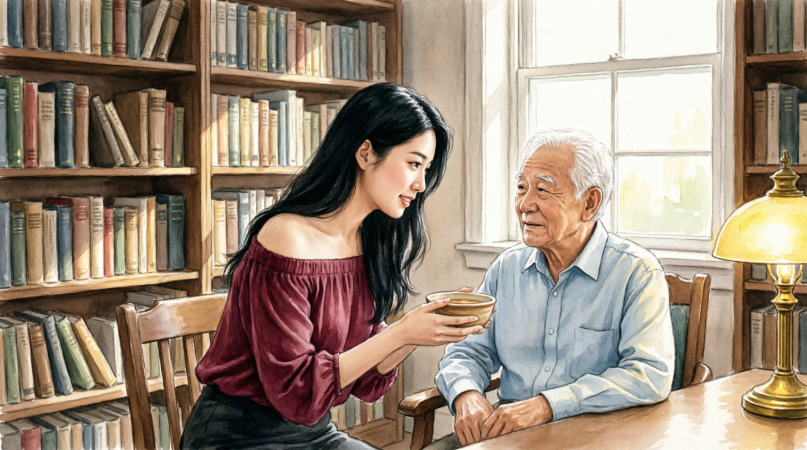
The phone call kept me awake all night.
It came a little after one in the morning, when the house was finally still and the only sound inside our bedroom was the old ceiling fan clicking once every full turn as if it had a private complaint it refused to let go of. I remember the darkness very clearly. I remember the pale line of moonlight on the wardrobe door. I remember the shape of my husband sleeping beside me, one hand resting over the blanket, his breathing slow and fragile and hard-earned. And I remember the voice.
It was a woman’s voice, low and unfamiliar, not rushed, not hysterical, not even angry. That was what made it so much worse.
“DNA scandal,” she said.
I sat up in bed, thinking I had misheard.
“DNA scandal,” she repeated, almost gently, as if she were reminding me of something I ought to have expected.
Then, before I could speak, before I could ask who she was or what she wanted or whether she had the courage to say anything with her own name attached to it, she whispered it a third time.
“DNA scandal.”
The line went dead.
For several seconds I stayed frozen with the phone in my hand, staring at my reflection in the black screen. Beside me, Don Raúl shifted but did not wake. His face remained relaxed in sleep, softened by age, by trust, by the exhaustion of a man who had spent too much of the past year defending his right to exist in peace.
Outside, somewhere beyond the courtyard, a dog barked once and then again farther away. The lemon tree brushed lightly against the outer wall in the night breeze. The whole house felt tense after that call, as if the walls themselves were holding their breath.
I got out of bed carefully so I wouldn’t disturb him, crossed the cool tile floor, and stepped onto the little covered veranda that faced the courtyard. The air smelled of damp earth and lemon leaves. The bougainvillea along the far wall was dark and still. The iron bench beneath the tree looked almost black in the moonlight. This house had once been the safest place I knew. That night it felt like the center of a storm that had not yet arrived but was already named.
I was twenty-nine years old then, visibly pregnant, legally married to an eighty-year-old man, and living in a town where people considered other people’s private lives a form of public entertainment.
By morning, I knew the rumors would get worse.
What I did not yet know was how much uglier people become when money, inheritance, and wounded pride all start dressing themselves up as morality.
My name is Lara Mendoza, and before the courts, the whispers, the anonymous calls, and the headlines written by people who never once asked me for the truth, I had been a fairly ordinary woman with a careful job and a quiet life. I worked in accounting for a wholesale appliance distributor in Santa Paloma, a town small enough that nothing stayed private and large enough that everyone pretended they were above gossip while living on it like sugar. I rented a small apartment behind a bakery on Calle Jacaranda. I paid my bills on time. I kept my head down. I believed in neat columns of numbers, in receipts, in signatures, in the comfort of paper proving what people liked to deny. I did not think my life was headed toward scandal. I thought it was headed toward something modest, maybe even invisible.
Then I met Raúl Hernández, and invisible stopped being possible.
When I first rented the apartment, he lived next door in the yellow house with the faded blue shutters, the courtyard full of flowers, and the cracked iron gate that complained loudly whenever anyone opened it. Everybody in that part of town knew who he was. He was one of those older men who become woven into a neighborhood so completely that people forget there was ever a time before them. He knew children by name and grown men by their fathers’ nicknames. He fixed stuck locks, loose hinges, window latches, and squeaking gates for anyone who asked. When he accepted payment at all, it was usually in the form of coffee, fruit, or fresh bread somebody’s wife had made that morning. He had once run a small repair shop near the bus station with his wife Elena, who had died six years before I met him. After she passed, he closed the shop, but he never closed himself to people.
His house looked like memory. Not wealth. Not grandeur. Memory.
There was a crooked lemon tree in the middle of the courtyard that leaned slightly to one side as if listening. A bougainvillea climbed the back wall in an explosion of fuchsia so bright it seemed impossible in summer. A rusted iron bench sat under the shade, and every afternoon, unless rain or pain prevented him, Raúl would sit there with a book or a newspaper and read until the light began to fade.
The first time we spoke, I was standing on a chair in my kitchen trying to reach a leaking pipe under the sink with a wrench that belonged to the previous tenant and had probably last functioned sometime during the previous century. The chair wobbled, the wrench slipped, and I muttered a word my mother would have smacked out of my mouth when I was thirteen. A dry voice from the open window said, “If you turn it like you’re strangling it, niña, it will only get more stubborn.”
I nearly fell off the chair.
When I looked out, there he was, smiling from his side of the wall, one eyebrow raised.
“I can manage,” I said, because pride arrives fastest when we’re embarrassed.
“I’m sure you can,” he said. “But the pipe can’t.”
Ten minutes later he was under my sink, muttering to the plumbing with the stern patience of a man who had seen every household disaster twice before breakfast. He wore an old brown cardigan with leather patches at the elbows and smelled faintly of lemon soap and tobacco that he claimed to have quit three years earlier but carried in his clothes as if memory itself had nicotine in it.
“That should hold until the landlord gets around to pretending he’s surprised,” he said, straightening up slowly, one hand on his knee.
I offered him money. He looked offended.
So I gave him coffee instead.
That became our beginning.
At first, it was nothing dramatic. A cup of coffee at my kitchen table after work. A wave across the courtyard. The exchange of groceries when one of us had bought too much of something sensible like tomatoes or onions. I would come home tired, drop my bag on the chair by the door, and find him outside trimming a plant or sanding some old piece of wood no one else would have saved. He had the kind of silence that never felt empty. That was rare. Most silences with other people carry awkwardness or judgment or the expectation that you should fill them. Raúl’s silence made space.
He asked questions the way truly kind people do, without greed. Not the sticky curiosity of neighbors, but the patient attention that lets a person decide how much of themselves they can bear to hand over.
I told him about my job. About numbers. About how I liked the certainty of balance sheets because life itself almost never balanced. He laughed and said that explained why I frowned at grocery receipts like they were confessions.
In time I told him more.
I told him my mother died when I was fourteen from a stroke no one in our family was financially prepared for and emotionally destroyed by. I told him my father had not known how to be a widower without becoming a ghost, and that by the time I was twenty, I had learned not to expect rescue from men who looked overwhelmed by pain. I told him I had once nearly married someone named Julián, a mechanic with beautiful hands and a talent for making devotion sound like ownership. He wanted a wife who stayed grateful and small, and I wanted a life that did not require asking permission to breathe. We ended badly, quietly, and for the best.
Raúl listened without interrupting. Then he told me about Elena.
She had been fierce, practical, and impossible to out-argue, according to him. She kept the repair shop accounts on paper even after everyone else moved to computers because she liked seeing mistakes in ink. She loved boleros, overwatered the roses, and had once threatened to lock him out of the house with nothing but his own toolbox for company if he ever brought muddy boots into her kitchen again. They had no children. Once, early in their marriage, there had been a pregnancy that ended too soon. After that, life moved in other directions. Work. Family obligations. Surviving. Years stacked themselves up before they fully understood what would never happen.
“She used to say the house sounded happier when there were children somewhere nearby,” he told me one afternoon. “That’s why she always left the gate open after school. Half the neighborhood used to come in for lemonade.”
“Maybe they came because of her lemonade,” I said.
“No,” he said, smiling. “They came because she listened to them as if their small problems were important.”
He looked away then, toward the lemon tree, and for the first time I saw not simply an old man living alone, but the outline of the life that had preceded me. The empty chair. The habits that remained after the person who shared them was gone. I had known loneliness in cramped, hungry forms when my mother died and my father disappeared into himself. But his loneliness was different. It was spacious. Polite. Furnished with memories. Somehow that made it ache more.
His nephews appeared in late April.
At first, it was just one of them, Esteban, the older one, broad-shouldered and too well dressed for a man claiming to be “just checking in on tío.” He drove a silver SUV that looked expensive enough to advertise success but not expensive enough to prove it honestly. He came on a Tuesday afternoon carrying a bakery box and wearing the smile of a man who thought sugar could disguise hunger.
I was getting home from work when I saw him on the front steps speaking loudly enough that half the block could hear.
“You shouldn’t be handling these things alone anymore, tío,” he was saying. “It’s not safe.”
Raúl stood in the doorway, one hand on the frame. “What things?”
“The house. Your papers. The taxes. Life.” Esteban gave a little laugh, as if this were all affectionate concern. “You’re eighty. No one expects you to manage everything yourself.”
Raúl’s face changed in a way that was easy to miss if you didn’t know him yet. He smiled, but his eyes cooled.
“I manage what belongs to me,” he said.
Esteban noticed me then. His gaze moved over me once, dismissive and measuring, and in that instant I understood he had already calculated my age, my rent, my usefulness, and my lack of legal significance.
“Neighbor,” he said with a nod.
“Accountant,” Raúl corrected dryly, though I had not announced it.
That was the first time I saw Esteban’s expression tighten.
Three days later I saw his younger brother Mauricio opening Raúl’s mailbox without permission.
I had come home early with a headache and was cutting through the narrow side alley between our properties when I saw him standing there, half-turned away from the street, flipping through envelopes like a man sorting restaurant menus. He did not hear me at first.
“What are you doing?” I said.
He jerked around so hard one envelope slipped from his hand.
He was leaner than Esteban, quick-eyed, dressed in a pressed shirt that tried very hard to suggest respectability. “Family business,” he said.
“That is not your mailbox.”
He smiled in a way that made my skin go cold. “When something belongs to family, boundaries are flexible.”
“No,” I said. “Laws are not.”
For one second I thought he might actually laugh at me. Then he bent, picked up the fallen envelope, tucked the stack under his arm, and said, “You should be careful, señorita. People start talking when outsiders involve themselves in family matters.”
I went straight to Raúl’s door.
He was in the kitchen making lentil soup. When I told him what I had seen, he did not look surprised. He only sighed and turned off the stove.
That afternoon, for the first time, he admitted the full shape of the problem.
There were overdue property taxes. Not catastrophic yet, but enough to invite notices. There was an old business loan from the last years of the repair shop, refinanced badly after Elena’s illness, then left to drift because pride and grief are both terrible financial advisors. There had also been offers—helpful offers, always presented as family duty—from Esteban and Mauricio to “organize” his paperwork, “streamline” his obligations, “protect” the house from bad decisions. When he refused, the offers became warnings. Then the warnings became pressure.
“They want me declared unfit,” he said quietly, sitting at the table while I spread the bank notices in front of us. “Too old. Confused. Vulnerable.”
“Are you?” I asked.
He gave me a sideways look. “Confused? Sometimes. Vulnerable? Obviously. Old? Ruthlessly.”
“Unfit.”
“No.”
I read in silence for several minutes, my pulse rising with each page. It was all there. The tax delinquency notices. The bank’s escalated language. The refinancing terms on the old loan. The penalty schedule. The dates. The deadlines. The kind of paper trail that, in the wrong hands, becomes a story: elderly widower, debt pressure, neglected property, concerns about judgment, attentive nephews stepping in for his own good.
“It’s not just the debt,” I said slowly. “The debt is the excuse.”
He watched me.
“They’re building a case. If they can show you’ve mishandled the property and ignored legal notices, they can push for guardianship or conservatorship or whatever equivalent the court grants. Once that happens, they control the house.”
He folded his hands. “Yes.”
I looked up sharply. “You knew.”
“Enough.”
“Why didn’t you do something sooner?”
He smiled without humor. “Pride, niña. And the foolish belief that family would stop before it became indecent.”
That night I stayed for soup, then for tea, then for two more hours while we built a payment schedule, listed creditors, and outlined what documentation he needed to prove competency and independent decision-making. My headache disappeared under adrenaline and anger.
When I finally stood to leave, he said, “You don’t owe me this.”
The sentence hit something old in me, something inherited from my mother’s tired face in hospital light, from my own promises at fourteen that I would never again stand by while a decent person was quietly cornered because no one wanted inconvenience.
“I know,” I said. “That’s why I’m doing it.”
From then on, the line between our lives blurred.
At first I was simply helping with paperwork. I created folders, called offices, negotiated installment plans, challenged improper fees, and documented every contact from the nephews that smelled even faintly coercive. I taught Raúl how to sign and date everything in duplicate. I made him a list and taped it inside the pantry door: do not hand over keys, do not sign anything without reading, do not accept “help” without witnesses, do not discuss finances on the porch, call me if anyone mentions doctors, capacity, or institutions.
He teased me about turning his kitchen into a war room. I told him wars are won by people who can find their papers when necessary.
The nephews did not back off. If anything, my involvement sharpened them.
Esteban began stopping by more often, always with the same performance of affectionate concern. He brought fruit, medicine no one asked for, brochures for “excellent residential care facilities,” and once a glossy folder from a legal service that claimed to specialize in “protecting seniors from financial manipulation.” He looked directly at me when he said those last two words.
Mauricio took a different approach. He liked implication. He leaned against the gate and made comments that sounded harmless if written down but carried rot in the tone.
“You spend a lot of time here.”
“People are imaginative.”
“Some men confuse gratitude with attachment.”
“Some women confuse charity with opportunity.”
I learned quickly that the ugliest kind of harassment is designed to leave no bruises a court can photograph.
Meanwhile, the neighborhood began to notice. Doña Pilar from across the street asked one morning whether I had “taken on caregiving,” a phrase she delivered with so much innocence that it could have meant anything from cooking soup to preparing to inherit a cathedral. A cashier at the grocery store smiled too knowingly when I bought Raúl’s preferred tea. A woman at the salon told another woman, not quietly enough, that young ladies who spend that much time around lonely older men usually have “either a saint’s heart or a thief’s imagination.”
I stopped going to the salon.
What made it harder was that some people’s suspicion did not feel entirely irrational. I could hear how the story sounded from the outside. Twenty-nine-year-old tenant. Eighty-year-old widower. Debt. House. Family dispute. Courts. It was exactly the kind of story that makes decent people feel superior while pretending not to be entertained.
Only the actual daily truth was more mundane and more intimate than gossip ever allows.
The truth was that Raúl took his medications with an orange juice glass that had a chip at the rim because Elena had once used it. The truth was that he still folded dish towels the way she used to fold them because that was how they fit best in the drawer. The truth was that some mornings his hands trembled from arthritis and he refused help opening jars unless I looked away while he fought them. The truth was that he hated being treated like fragile furniture. The truth was that under the lemon tree in late afternoon, when the sun broke gold across the courtyard and the whole house smelled like leaves and old stone, he looked less like an old man guarding property and more like a human being defending the last intact shape of his life.
I had not meant to fall into the rhythm of him.
But I did.
I began eating dinner there most nights because it seemed silly to cook for one when he made enough stew for a small militia and complained that old age ruined portions. We argued about newspapers, salt, politics, and whether my generation truly believed all problems could be solved by an app. He told stories about the years when the street flooded every summer and children sailed washbasins through the gutters like pirate ships. I read his notices out loud and he read me lines from old books. Some evenings he played boleros softly from a radio in the kitchen while I organized receipts, and I would look up to find him watching me with a mixture of affection and concern, as if he was trying to decide whether helping him had become too costly in ways I would not yet admit.
One rainy night in June, while thunder walked slowly across the sky and the power flickered twice without actually giving up, I told him more about my mother than I had told anyone in years.
Maybe it was the weather. Maybe it was the way grief becomes easier to name in houses where other grief is already known. Maybe I was simply tired.
“She died in the kitchen,” I said. “Not instantly. She collapsed, and by the time the neighbors heard me yelling and the ambulance came, something had already gone too far. Afterward, people kept saying she hadn’t suffered. I hated them for that. As if my problem was not having enough medical detail.”
Raúl sat across from me, both hands wrapped around a mug of tea.
“My father was still alive,” I continued. “But not really. He loved her. I know he did. But some people don’t know what to do with love once it gets injured. He became smaller and more silent and less available every month after she was gone. Eventually I realized I was the only adult in the house even though I was a teenager.” I swallowed. “So I made myself useful. Bills, papers, appointments, groceries. And I promised myself something stupid and grand and fourteen-year-old. I promised myself I would never look away when someone decent was being left alone with too much.”
Raúl’s eyes held mine for a long time. “That promise does not sound stupid.”
“It sounds expensive.”
“Yes,” he said. “Most decent promises are.”
The rain went on for hours. We talked until well past midnight. About loneliness. About dignity. About how families sometimes circle the weak not to protect them but to feed. At some point he said, almost casually, that if the nephews succeeded, they would place him somewhere “clean and efficient” and sell the house before the bougainvillea had time to realize it had been orphaned.
Something inside me hardened.
I do not know exactly when the thought first took shape. I only know that by the time I said it aloud, it had already become inevitable.
“Marry me,” I said.
The rain seemed to stop listening for a second.
Raúl blinked once. “What?”
“If I’m your wife, they have a much harder time removing you from your own house. Spouses complicate everything. Rights, residence, standing, inheritance, decision-making. It changes the terrain.”
He stared at me as if I had suddenly begun speaking fluent lightning.
“Lara.”
“I’m serious.”
“You are twenty-nine.”
“Yes.”
“I am eighty.”
“I know how numbers work.”
He actually laughed then, one startled burst of sound, but it vanished quickly.
“No,” he said.
“Why?”
“Because people already talk. Because they will say you trapped an old man. Because they will say I took advantage of a young woman. Because your life will become a courtroom and a joke and a cautionary tale all at once.”
“My life is already becoming a courtroom.”
“That is not funny.”
“I’m not joking.”
He stood, then sat again as if his knees had changed their minds halfway through. “You would tie your name to mine because my nephews are greedy?”
“I would tie my name to yours because they are using the law to erase your choices.”
His face softened and tightened at the same time. “That is not a reason to marry.”
“Maybe not the most romantic one,” I said. “But it’s a practical one.”
“You deserve romance.”
I looked at him then, really looked. At the grooves time had carved into his face. At the steadiness that remained under fatigue. At the humility with which he had received help. At the old wound of being loved by people until property entered the room.
“Maybe,” I said quietly. “But I also deserve to live in a way that lets me respect myself.”
He lowered his eyes. For a long time neither of us spoke.
Finally he said, “You don’t know what it means to be attached to me when the town starts chewing.”
I almost smiled. “You don’t know what it means to be a woman in this town. They chew either way.”
That should have been the end of the conversation, or the beginning of a sensible retreat. Instead it became the start of three days of argument.
He said I was impulsive. I said he was proud. He said I was underestimating scandal. I said he was underestimating strategy. He said marriage was not a legal tool. I said law had always treated marriage like one, so we might as well stop pretending purity where the system itself saw paperwork. He asked whether I thought I could live with the humiliation. I asked whether he thought I could live with doing nothing while they emptied his life room by room under the language of concern.
On the fourth day he went quiet.
On the fifth, he asked, “If we do this, there can be no lying between us.”
I nodded.
“You must understand that I have little to offer except this house, my company, and trouble.”
I almost laughed. “You have better soup than most men my age.”
“That is not the point.”
“I know.”
He looked toward the courtyard, where the lemon tree was dropping tiny white blossoms that smelled like clean mornings. Then he turned back to me and said, very softly, “If you are certain, then I will not insult you by treating you like a child who cannot choose.”
We married at the civil registry on a Tuesday morning so bright it felt indecently cheerful for the kind of scandal we were birthing.
There was no church, no flowers except the ones Doña Pilar clipped from her own garden and pushed into my hands at the last minute, no music, no guests beyond the two witnesses we needed and the clerk who blinked at our documents twice before professionalism won. I wore a cream dress I already owned because buying something new would have felt too theatrical. Raúl wore a dark suit he had last worn to his wife’s memorial and apologized three times for the fact that the jacket hung more loosely on him now.
“Stop apologizing,” I whispered while we waited outside the office door.
“Old men apologize for things like collar buttons and weather,” he murmured back. “It’s how we survive.”
Our witnesses were Doña Pilar and Don Emilio, the retired bus driver from two houses down who had known Raúl for forty years and whose outrage at the nephews had become a kind of hobby. The clerk read the legal language in a bored voice, but when she reached the part about mutual care and free consent, something in the room shifted. Maybe it was my hand in Raúl’s. Maybe it was the utter lack of greed in his face. Maybe it was the fact that ridiculous situations become less ridiculous when the people inside them are sincere.
When it was done, when the signatures dried and the clerk pushed the stamped certificate across the desk, I looked at my new husband and saw that his eyes were wet.
Outside, on the registry steps, he said, “You can still back out before the town hears.”
I tucked the certificate into my bag. “Too late,” I said. “Now I’m impossible.”
He smiled then, the deep, weary, astonished smile of a man who has been handed hope and is afraid to touch it too firmly.
The town heard by noon.
By sunset, Santa Paloma had done what Santa Paloma does best: transform private legal action into communal theater. By morning the bakery where I used to buy sweet bread went silent when I walked in. A teenage cashier in the pharmacy asked whether I wanted my receipt “for the estate records” and then turned red when I stared at him long enough to make him understand what he had done. At work, two women from payroll lowered their voices every time I approached. My supervisor, who prided himself on “professional discretion,” called me into his office and suggested I consider how “public controversy” might affect the company’s image.
“I do accounting,” I said. “Not brand endorsements.”
He did not laugh.
Raúl’s nephews responded faster than even I expected. Within a week they filed a petition challenging the validity of the marriage on grounds of undue influence, coercion, and suspected cognitive decline. Their lawyer, Arturo Vélez, was a man with polished hair, expensive cuffs, and the kind of smile that always seems pre-laundered of humanity. He framed the case exactly as I knew he would: lonely old widower, financially distressed, vulnerable to manipulation by much younger tenant who positioned herself as caregiver and then secured legal standing through a suspiciously timed marriage.
Suspiciously timed. As if there were a proper season for emergency dignity.
The petition included insinuations so ugly they felt oily to hold. It suggested I had isolated Raúl from family. It implied I had accessed his financial information improperly. It called our marriage “structurally predatory.” When I read that phrase, I had to set the papers down because my hands were shaking too hard to turn the page.
Raúl read the petition in silence, then folded it carefully and said, “They speak about me as if I were already dead.”
That was the moment I stopped seeing the case as merely defensive. This was not about paperwork anymore. It was about narrative. If they got to define him as confused, me as greedy, and our marriage as absurd, they would win socially before the court ever spoke.
So I became organized in a way that frightens dishonest people.
I documented every visit. Every mailbox incident. Every witness statement. Every time Esteban or Mauricio referred to institutions, incapacity, or “what’s best.” I obtained records showing how rarely they had visited before the tax notices escalated. I found evidence that one of them had once tried to redirect bank correspondence to his own office address under the claim of “assistance.” I gathered receipts proving I had paid household expenses from my own income after the marriage, not siphoned from Raúl. I compiled medical records confirming he was mentally competent, physically frail in expected ways, but entirely capable of understanding legal decisions. I met with a lawyer named Clara Reyes, recommended by a former coworker of Elena’s, and the moment she read the petition, her mouth flattened into something promising.
“They think they’re prosecuting appearances,” she said. “Good. We’ll answer with facts.”
Clara was younger than Arturo, less polished, and infinitely more dangerous because she loved precision more than performance. She did not flatter me. She asked hard questions. Did I love him? Had the marriage been consummated? Did I expect inheritance? Had we discussed wills? Had I pressured him in any way? Could anyone claim I had restricted his contact with others? She wanted truth not because truth is holy, but because court is less forgiving to surprises than to discomfort.
I answered everything.
“Good,” she said at the end. “You’re either very brave or very foolish.”
“Can I be both?”
“In family court? Often.”
The months that followed turned my life into a corridor lined with doors I never wanted to open. Depositions. Affidavits. Financial disclosures. Medical evaluations. Neighbors offering support in one breath and gossip in the next. Strangers staring openly when Raúl and I walked together to the market. A local radio host describing the case as “the lemon tree marriage,” as if reducing us to scenery made their mockery charming.
And yet, beneath all that noise, something quieter was growing.
Marriage, even one entered under legal pressure and public suspicion, is still made of daily life.
I moved into the house by necessity at first. It made no sense to maintain separate residences once the case framed me as central to his care and once security became a real concern. The first night I carried my boxes across the courtyard, Raúl stood holding the front door open and said, with ceremonial gravity, “Welcome to your scandal.”
Inside the house, our life began to knit itself together in strange, ordinary ways. My dresses appeared beside Elena’s old cedar chest. My accounting folders colonized a corner of the dining room. I learned which floorboard near the kitchen door creaked even when no one stepped on it. He learned that I hated overcooked eggs and left my coffee half-finished unless I was upset. We negotiated territory like any married couple, only ours included medication charts, legal binders, and a town waiting for spectacle.
He was careful with me in ways I had not expected. Not distant. Careful. He asked before moving Elena’s framed photograph from the hallway table to make room for a bowl of my keys. He apologized the first time he forgot and called me vecina instead of esposa, then laughed at himself so helplessly that I laughed too. Once, when I came home from a brutal day at work and court prep and found him polishing the old iron bench because he said it “looked depressed,” I stood in the courtyard and realized I felt less alone than I had in years.
People who never saw us inside the house assumed fraud because fraud was more entertaining than tenderness.
They did not see him wait up when I worked late on spreadsheets. They did not see the way he listened when I read legal drafts aloud and stopped me every so often to ask whether I was eating enough. They did not see the morning he found me crying quietly over my mother’s birthday—a date I had stopped telling anyone about years earlier—and simply sat beside me at the kitchen table until I could breathe normally again. They did not see how grief recognized grief and stopped performing.
The first time he touched my face, it was to brush flour from my cheek while I was trying to make bread from one of Elena’s recipes and failing so spectacularly the dough looked like an argument. He did it absentmindedly, tenderly, as if the gesture had existed in the room before either of us noticed it.
We both went very still.
It would be prettier to say our love arrived all at once. It did not. It arrived like dawn in winter, slowly enough that you doubt it until the room is already full of light.
I do not know which of us crossed the line first. Maybe it was neither of us and simply the fact that companionship, when it is honest and sustained and grateful, eventually changes temperature. What I know is that one evening in late November, after a day so bitter I thought the town itself might crack from cold, we sat under blankets in the living room while rain tapped at the windows and the radio played softly from the kitchen. I had spent the afternoon with Clara reviewing evidence. He had spent it giving a humiliating but necessary cognitive interview to a court-appointed physician who left smelling of peppermint and condescension.
When I came home, he looked more tired than I had ever seen him.
“Do you regret it?” he asked suddenly while I poured tea.
“The marriage?”
“Yes.”
I set the kettle down. “Do you?”
He took time answering. “No. But I regret what it has cost you.”
I sat beside him on the sofa. “You didn’t cost me this. Greedy men did.”
His hand rested on the blanket between us, veins fine and blue beneath the skin. “They existed before. I am the one who gave them a target.”
“No,” I said. “They chose one.”
He turned toward me then, his face lined with something more naked than sorrow. “Lara, I had made peace with being old. I had not made peace with being erased. You gave me back something I thought was gone.” His voice lowered. “I do not know what name to give that.”
I did.
But I was afraid of it.
So instead I said, “Maybe it doesn’t need a name yet.”
His fingers moved, barely, until they touched mine. I did not pull away.
When he kissed me for the first time, it was not dramatic. There was no music swelling, no thunder, no sudden certainty. It was careful. Shaking. Human. His mouth was warm and hesitant, and for one strange second I was aware of every rumor in town crashing uselessly against the private truth of that moment.
I kissed him back.
Afterward he whispered, “Tell me this is not pity.”
I put my forehead against his. “If it were pity, I would be the saddest woman alive.”
He laughed softly then, relief moving through him like light returning to a room.
I am telling you this because people like scandal better than complexity. They prefer stories where motives stay singular: greed, manipulation, lust, delusion. But love is rarely polite enough to arrive in forms the public approves. What grew between us was not born from some reckless fantasy of mine about old men and rescue. It grew from watching a person remain dignified under humiliation. It grew from shared labor, from truth told without vanity, from the strange intimacy of being believed by someone when the rest of the world has decided you are ridiculous.
Yes, he was eighty.
Yes, I was twenty-nine.
Yes, we became husband and wife in every sense that word can carry.
And yes, it was real.
I discovered I was pregnant in February.
The first sign was not nausea or dizziness but rage. I was standing in line at the bank because one clerk had once again “misplaced” the documentation proving Raúl’s payment plan was current, and the woman in front of me was taking seven years to fill out a deposit slip while breathing through her mouth like a punishment. Suddenly I wanted to cry and bite someone in equal measure. By the time I got back to the house, the smell of onions in the kitchen nearly sent me running to the sink.
Raúl looked up from the newspaper. “You’re pale.”
“I’m fine.”
“You are never fine in that tone.”
By evening I had bought a test at a pharmacy on the far side of town where I hoped no one knew me. I waited until after dinner, after the dishes, after he fell asleep in his chair with the radio murmuring nonsense. Then I locked myself in the bathroom and watched my future appear as two clear lines.
I sat on the closed toilet lid for a long time, holding the test like evidence from another planet.
Pregnant.
At twenty-nine, that word should not have felt impossible. But impossibility was exactly what the town would hear. Not simply because of my husband’s age, though that would be scandal enough, but because our entire marriage had already been declared by hostile people to be strategic, unnatural, staged. A pregnancy would not soften them. It would weaponize them.
I walked into the bedroom with my pulse in my throat. Raúl was awake now, propped against the pillows with his glasses low on his nose.
“What happened?” he asked the moment he saw my face.
I held out the test.
For one heartbeat he did not understand. Then he did.
He removed his glasses very slowly. “Lara.”
I sat beside him. “I know.”
“You’re sure?”
“No,” I said, because my voice had stopped belonging to me. “But the little stick is annoyingly confident.”
He stared at it, then at me, then back at it as if numbers had failed him for the first time in his life.
I had expected fear. I had expected calculations. I had expected some practical discussion about doctors and stress and timing and the war this would ignite.
Instead tears filled his eyes.
He covered his mouth with one hand and looked away.
“Raúl?”
When he turned back, his face was open in a way I had never seen. Wonder, grief, joy, terror—everything at once.
“Elena always wanted…” He stopped and shook his head. “I never thought—at my age—after everything—”
I took his hand. It was trembling.
He laughed through the tears. “You marry me to save my house and now the universe decides subtlety is for other people.”
That broke me and I laughed too, and then somehow we were both crying, the ridiculousness and tenderness of it too large for any cleaner response.
The doctor confirmed it two days later. Eight weeks. Healthy so far. Early, precarious, real.
We told no one for four days.
Those four days were ours, and I treasure them more than I can explain. The world had not yet touched the news. The courts had not yet smelled fresh blood. It was just the two of us moving through the house with a stunned kind of reverence, as if every room had become fragile. Raúl touched my stomach once, almost shyly, though there was nothing to feel yet. He began talking to the lemon tree as if informing it of a miracle under official review. He started making lists of names in a notebook and then denying it when I found them. He bought me oranges, crackers, and ginger tea with the solemn urgency of a man provisioning a ship.
On the fifth day, Mauricio saw me leaving the clinic.
I knew the moment he recognized the building. His expression changed—not curiosity, not even suspicion, but triumph. That ugly, immediate triumph of people who experience another person’s vulnerability as usable information.
By evening the first whisper had reached the bakery.
By morning the whole street knew.
By the next afternoon my phone rang with the anonymous woman’s voice saying, “DNA scandal.”
The nephews’ lawyer moved fast. Arturo filed a supplemental motion arguing that my pregnancy, if claimed to be Raúl’s, constituted clear evidence of fraudulent inheritance positioning. He did not openly accuse me of adultery because men like him prefer suggestion when filth will do. Instead he used phrases like biological improbability, suspicious timing, manufactured legitimacy, strategic maternity. Reading it, I realized there are people who can turn even conception into a slur if money stands nearby.
The town erupted.
Some women looked at me with pity, which I found more insulting than contempt. Some men looked at me with a smugness that implied they knew exactly how pregnancies happened and exactly which version of the story would amuse them most. A grocery clerk actually asked if I wanted help carrying my bags “or is your husband strong enough for that?” The cruelty in small towns is rarely cinematic. It is petty, repetitive, and confident because it hides inside jokes.
At work, my supervisor told me perhaps I should consider unpaid leave until “things settled.” I asked whether pregnancies were now grounds for accounting instability. He said it wasn’t that. I asked whether it was the rumor that unsettled him or the court filings. He said the company could not be associated with “public impropriety.” I resigned the next day before he could turn cowardice into dismissal.
Raúl was furious in the old-fashioned way dignified men become furious: cold, precise, and more frightening than shouting.
“They will not drive you out of your livelihood and call it propriety,” he said.
“They already did.”
“Then we make sure it costs them.”
Clara added defamation concerns to her growing file, though she warned me that social damage rarely yields clean legal remedy. “People can ruin you in ways that are too diffuse to invoice,” she said.
The court ordered a genetic test in March.
I knew it was possible. Clara had prepared me. With inheritance disputes and the paternity claim now tied to standing and future rights, a judge could justify testing in the name of clarifying the estate and limiting later litigation. Logic did not make it less humiliating.
The order arrived on a Tuesday morning. I opened it at the dining room table while the house was still cool from night. By the time I reached the second paragraph my vision had blurred.
Raúl took the papers gently from my hand and read them himself.
For several minutes the only sound was the wall clock.
Then he said, “We can refuse.”
I looked up. “Can we?”
“We can refuse and fight the order.”
“And then?”
“And then they will say refusal is proof.”
I pressed my palms against my eyes. “I know.”
He sat down beside me with a care that made me want to scream. Not because he was weak. Because he was trying so hard not to be one more burden.
“This is my body too,” I whispered. “My pregnancy. My child. They’re turning it into a courtroom exhibit.”
“Yes,” he said. “They are.”
The thing about humiliation is that it often arrives mixed with guilt. Part of me hated needing the test even while knowing exactly what it would show. Part of me felt disloyal to our private truth by submitting it to strangers. Part of me was furious at myself for caring what those strangers thought. Part of me wanted to burn the whole town down and leave with whatever money we could carry and never let anyone say the word legitimacy in my direction again.
Instead I nodded and said, “We do it.”
The testing center was in the city, three hours away, where no one knew us and therefore no one pretended compassion while silently enjoying the show. The clinic smelled of antiseptic and printer toner. The waiting room television played a cooking show no one watched. A receptionist with expertly neutral makeup handed us forms without once looking directly at the age line beside Raúl’s name, which somehow made me respect her more than half the people I’d known all my life.
The process was exactly what I hated most: cold, procedural, bloodless in tone, invasive in meaning. Swabs. Signatures. Identity verification. Sealed envelopes. Chain of custody. At one point the technician asked me, with bureaucratic politeness, to confirm the alleged father’s full legal name. Alleged. The word landed like a slap.
Raúl squeezed my hand so tightly my ring pressed into my skin.
On the drive home, neither of us spoke for a long time. The highway rolled out ahead of us under a harsh white sky. Trucks passed. Billboards advertised insurance, furniture, cheap chicken. Ordinary life continued with insulting enthusiasm.
Finally Raúl said, “If they had not ordered this, I would never have asked you for proof.”
I turned toward him. “I know.”
“And if biology had made a fool of us somehow, I would still have stood beside you.”
I stared at him, feeling tears rise so suddenly they hurt. “You don’t have to say that.”
“I do,” he said. “Because this child began in love, not strategy. No court has the authority to redefine that.”
I leaned my head back against the seat and let the tears fall quietly.
The weeks waiting for results were some of the worst of my life.
Rumor became a form of weather. People I had once considered decent spoke around me in voices pitched just high enough to ensure I heard them. Someone slipped an anonymous note under the gate that read HOW MUCH DID YOU CHARGE PER PERCENTAGE? Another letter came without return address and simply said BABIES DON’T HIDE LIES. I stopped answering unknown numbers after midnight because half of them were either prank calls or breath held on the line like cowardice with a pulse.
But support came too, and because human beings are inconsistent, it came from corners I did not expect.
Doña Pilar began appearing every Thursday with soup and unsentimental instructions that I rest more and argue less. Don Emilio started sitting on the bench near the gate in the evenings “for the air,” though everyone understood he was there because the nephews’ friends had taken to slowing their cars in front of the house. A woman from my old workplace, Maribel from inventory, came by one afternoon with a folder of freelance bookkeeping contacts and said, “Your supervisor is a coward and his wife cheats at church raffles.” It was not the most elegant expression of solidarity, but it nourished me anyway.
Even Clara, who treated sentiment like a rash, softened exactly once.
I met her at her office to review hearing strategy, and she studied me over her glasses for a moment before saying, “You know, most people would not still be standing this straight.”
“That’s because most people aren’t too stubborn to lie down.”
She almost smiled. “Good. Stay that way.”
Raúl, meanwhile, began aging in ways that had nothing to do with birthdays.
Stress is a thief with manners. It does not crash through doors. It empties drawers slowly. He still read under the lemon tree, still corrected newspaper headlines aloud as if editors were personal enemies, still insisted on carrying his own tea to the courtyard even when I told him I had hands for a reason. But I saw the cost. The extra pauses when he stood. The deeper shadows under his eyes. The way betrayal, more than age, seemed to weigh on his shoulders.
Once, after a particularly vicious round of filings from Arturo implying that our entire marriage had been engineered for estate theft, I found Raúl in the living room holding an old photograph of himself and Elena outside the repair shop, both of them laughing at something beyond the frame.
“Do you miss her more now?” I asked softly.
He nodded without looking up. “I miss the years when love did not require witnesses.”
That sentence broke something open in me.
I knelt beside his chair. “I’m sorry.”
He set the photograph down and touched my hair. “No, Lara. Listen to me. I am not sorry I married you. I am sorry the world insists on making tenderness defend itself as if cruelty were the default truth.”
I put my face in his lap and cried in a way I had not allowed myself to cry since my mother died—without posture, without strategy, without any attempt at dignity.
A week before the results were due, the nephews escalated again.
Mauricio cornered me outside the pharmacy in broad daylight.
He did not touch me. Men like him understand the legal value of restraint. He only stood too close and smiled as if we were cousins exchanging recipes.
“You should prepare yourself,” he said.
“For what?”
“For embarrassment. If I were you, I’d leave town before the result. People are kinder to absences than to public mistakes.”
I tightened my grip on the medicine bag. “If I were you, I’d stop speaking to pregnant women like you’re auditioning for prison.”
His smile thinned. “All this for a house.”
“All this because you can’t bear the idea that an old man made a choice you couldn’t control.”
For one second the mask slipped. Underneath was something rawer than greed. Injury. Entitlement denied often mutates into moral outrage because that sounds nobler than wounded ownership.
“He’s family,” Mauricio said.
“No,” I answered. “He’s property to you. Family would have noticed him before there was a chance to inherit the walls.”
He stepped back then, eyes flat. “You think the result saves you. It only changes the shape of the scandal.”
He walked away before I could say anything else.
That night I told Raúl what happened. He listened, expressionless.
Then he stood, went to his desk, and took out a sealed envelope.
“If anything happens to me before the hearing,” he said, “Clara knows where the originals are. But I want you to know this exists.”
Inside the envelope was an updated will, a handwritten letter to the court, and a note to our unborn child.
My hands began to shake. “Why are you giving me this now?”
“Because I am old, Lara.” He said it calmly, not bitterly. “Old men do not get to pretend tomorrow is guaranteed just because they are in love.”
I hated him for being right.
He sat down slowly and gestured for me to do the same. “I’ve also asked Clara to arrange a video statement.”
“A what?”
“In case the court wants my voice when I am too tired to lend it live. Or in case,” he said gently, “they delay until after I am gone.”
I stared at him. “Don’t say that.”
“It is not disloyal to life to speak accurately about death.”
“No,” I said, and to my horror my voice broke. “But I need you here.”
His face changed then, softened by an ache so deep it almost looked like peace.
“My dear girl,” he said, “I am here.”
The video was recorded two days later in his armchair by the window, the one Elena had once called his throne when she wanted to tease him out of bad moods. Clara arranged a videographer with a neutral legal seal and an expression that suggested he had filmed everything from wills to murder confessions and found none of it surprising anymore.
Raúl wore his navy sweater and refused makeup.
When the camera light came on, he sat very straight.
“My name is Raúl Hernández,” he began. “I am of sound mind, irritated by lawyers, and fully aware of who I married.”
Even the videographer smiled at that.
Then he went on. He spoke about the house. About Elena. About loneliness. About how greed often dresses itself in concern. He said he had chosen me freely, knowingly, gratefully. He said no nephew who had ignored him for years got to call attention love just because the property had become vulnerable. And then, after a pause that felt like a heartbeat placed carefully on the table, he said the words that would later silence a courtroom.
“I know my family may fight this,” he said. “But even if biology had said otherwise, that child would still be my son. Blood may begin life—but love is what sustains it.”
When the recording ended, no one in the room spoke for several seconds.
Clara cleared her throat and said, almost roughly, “That should hold.”
But I knew by then that this case had moved beyond documents. It had become a referendum on what people believed counted as legitimate love.
The results arrived on a Thursday.
The hearing was scheduled for noon, but by ten-thirty the courthouse steps were already crowded. Not with journalists from anywhere important—our town was too small for national scandal and too self-important for privacy—but with local onlookers, amateur moralists, and the particular species of spectator who believes witnessing other people’s humiliation is a civic activity. Someone from the radio station had a microphone. A woman I vaguely recognized from the market pretended not to stare while staring. Arturo entered through the side, immaculate as ever, accompanied by Esteban and Mauricio in dark suits that made them look like undertakers for a conscience they never had.
Raúl wore charcoal gray and a tie Elena had once chosen for him because it made his eyes look “less argumentative,” according to an old story he liked to repeat. I helped him up the courthouse steps, one hand under his elbow, and the silence that fell for those three seconds was almost more satisfying than applause would have been.
Inside, the courtroom was packed. Spectators lined the benches. The air smelled of paper, old wood, and stale ambition. Clara arranged her files with surgical calm. I sat beside Raúl and tried not to vomit from nerves, pregnancy, or fury. Perhaps all three.
The judge, Marta Villaseñor, had the face of a woman who had seen every permutation of family disgrace and trusted none of them to be original. She called the room to order, reviewed the procedural posture, and made it clear in exactly three clipped sentences that she would not tolerate circus behavior. The warning failed to reduce the spectators’ appetite, but it did improve my mood.
Arturo spoke first. Of course he did. Men like him enjoy the choreography of insinuation. He stood, buttoned his jacket, and launched into a performance about safeguarding the dignity of the elderly, ensuring estate clarity, and protecting the legal system from manipulative opportunism. He never once said gold-digger, liar, adulteress, or trap. He didn’t need to. He arranged the words so the room could do the dirty work for him.
Then Clara rose and disassembled him by increments.
She reminded the court of the nephews’ infrequent contact before debt notices appeared. She introduced witness statements regarding mailbox interference, pressure tactics, and residential care suggestions made before any medical basis existed. She entered financial records proving I had stabilized—not exploited—Raúl’s accounts. She submitted the physician’s capacity findings. She did not romanticize us. That was one of the reasons she was brilliant. She simply insisted on fact until sentiment began to look cheap.
Finally, the judge called for the lab report.
The courtroom changed then. The air itself seemed to lean forward.
A clerk handed the sealed envelope to the judge. Judge Villaseñor opened it with the practical boredom of someone determined not to be seduced by drama. She read silently for several seconds.
I could hear my own pulse in my ears.
Raúl’s hand found mine under the table. His grip was steady.
Then the judge looked up and read the conclusion into the record.
“The probability of paternity is consistent with Mr. Raúl Hernández being the biological father of the unborn child, with overwhelming statistical certainty.”
For one heartbeat the room forgot how to breathe.
Then sound returned all at once: a sharp inhale from the benches, the scrape of someone’s shoe, a muffled curse from somewhere behind Arturo, the radio woman’s whispered “Dios mío” before the bailiff glared her into silence.
I did not cry immediately. Shock came first. Not because I had doubted Raúl. Because for months I had been forced to live inside a reality where truth needed permission to enter the room. When it finally did, it felt almost violent.
Mauricio’s face went white.
Esteban looked as if someone had struck him in public.
Arturo recovered first, because lawyers are trained to metabolize disaster into posture.
He rose halfway, perhaps to contest some procedural issue, but Clara was already on her feet.
“In light of the result,” she said, “we would now request admission of Mr. Hernández’s recorded statement and immediate disposition on the validity challenges, given that the petitioners’ theory of fabricated inheritance fraud has collapsed under its own weight.”
Collapsed under its own weight. I loved her in that moment more than some people love priests.
The judge allowed the video.
They wheeled in a monitor. The lights dimmed slightly. And there was my husband, on the screen, sitting in his armchair with the window light on one side of his face and the dignity of a whole lifetime in his posture.
He spoke calmly. Clearly. No melodrama. No plea for pity. He simply told the truth with the authority of someone whose truth had been too long insulted.
When he said, “Blood may begin life—but love is what sustains it,” the courtroom fell into a silence so complete it felt sacred against its will.
I turned and looked at the spectators. Some lowered their eyes. A few women were openly crying. One older man in the second row nodded once, almost to himself, the way people do when they’ve just seen something settle an argument they didn’t realize they were still having.
The judge took off her glasses and set them down.
Then she spoke.
Her ruling was not sentimental either, which made it devastatingly effective. She found no evidence of coercion. She affirmed Raúl’s legal capacity. She noted the petitioners’ speculative and reputationally damaging conduct. She upheld the validity of the marriage. She recognized the forthcoming child’s rights accordingly. She confirmed that the property and estate arrangements in favor of the lawful spouse and child stood absent any future legitimate challenge. She reserved language on sanctions, but the warning in her tone suggested the nephews would be wise not to confuse family court with a playground any longer.
Arturo requested leave to appeal.
The judge granted the procedural right but not the dignity of optimism.
As we stood to leave, chaos tried to bloom—spectators whispering, a reporter stepping too close, Esteban saying something furious under his breath. The bailiff barked order. Clara guided us toward the side exit.
Then a voice rose from the benches.
It was Doña Pilar.
She had somehow gotten a seat in the back, and she stood now, handbag clutched against her chest like a weapon of righteousness.
“Shame on all of you who enjoyed this,” she said to no one and everyone.
The bailiff should have stopped her. For some reason he didn’t.
“Shame on anyone who thought an old man’s dignity was a joke and a woman’s pregnancy was public sport. Shame on family who show up only when property starts breathing its last.”
No one answered her. The silence itself was an indictment.
Outside the courthouse, the radio woman shoved a microphone toward me.
“Lara, how do you feel about the shocking result?”
I looked straight at her. “Less shocked than the people who confused age with impossibility and greed with love.”
Then I kept walking.
The appeal came, exactly as Clara predicted, because men humiliated in public often mistake persistence for power. But appeals require actual grounds, not merely wounded entitlement, and the higher court had little appetite for revisiting a record so thoroughly dismantled. Within months the challenge failed. The marriage stood. The will stood. The child stood, growing stronger inside me every day while the town tried to decide whether to shift from mockery to revisionist respectability.
Of course not everyone surrendered their version of the story. Some people simply altered the slant. They stopped calling me a fraud and started calling me “lucky.” As if I had won a lottery rather than survived a crucifixion. Others adopted the tone of tolerant sophistication, telling one another that love has many forms now, as if they had not spent half a year sharpening knives on my name. I did not bother correcting them. Victory teaches you how boring explanation becomes once facts have already spoken.
What hurt more than the town, in the end, was what the case did to Raúl.
The year of filings, whispers, examinations, and public insult aged him more quickly than the decade before it. Once the legal fight ended, his body seemed to notice all at once how hard it had been working simply to stay upright through the battle. He was not suddenly ill in some dramatic, literary way. That is not how decline always works. He just became more tired. The walk from bedroom to courtyard required more pauses. His hands shook more often when he buttoned his shirt. He still joked. Still read. Still argued about newspaper errors as if punctuation were a moral issue. But betrayal had reached him where time alone had not.
One evening in early autumn, when my belly was full and heavy and our son shifted inside me like a determined fish, I found Raúl under the lemon tree with a blanket over his knees and a notebook open on his lap.
“What are you writing?” I asked.
He closed it too quickly.
“Nothing.”
“You’ve never been believable.”
He sighed and handed it over.
Inside were letters.
One for the child’s first birthday.
One for age five.
One for age ten.
One for the day he might first feel ashamed of loving someone different from what the world expects.
One for the day he might be told men must become hard to survive.
One for the day he might ask what kind of man his father was.
I could not speak.
Raúl looked out at the courtyard while I turned the pages with shaking fingers. “A man of my age learns not to negotiate with time.”
Tears blurred the ink. “Don’t do this to me.”
He smiled sadly. “I am doing this for you. There is a difference.”
“Stay,” I whispered, ridiculous with love and fear.
He reached for my hand. “I am trying.”
Our son was born in November just before dawn, after thirteen hours of labor, three failed attempts at breathing calmly, one nurse I nearly cursed into another religion, and a storm so violent the hospital windows rattled with each burst of rain. Clara later said it was fitting that the child who had already survived a courtroom entered the world with weather.
We named him Mateo Elena-Hernández Mendoza, because I wanted the woman who had loved Raúl before me woven into the child who would love him after me.
When the nurse first placed Mateo in my arms, he was red, furious, wet-haired, and impossibly alive. I looked at his tiny mouth, his clenched fists, the old-new shock of a face that had never existed before and yet somehow already belonged to us, and the whole year behind me collapsed into one hard, bright point.
Raúl arrived two hours later in a wheelchair because walking long corridors now took more out of him than pride could conceal. When the nurse placed Mateo in his arms, he held him as if the entire room had become sacred and breakable at once.
His hands trembled.
Tears slid down his face without embarrassment.
“Hola, hijo,” he whispered.
Mateo opened one eye, frowned as if evaluating the world’s noise level, and sneezed.
Raúl laughed so helplessly that the nurse covered her own mouth.
Then he looked at me over our son’s head and said the sentence I will hear in my bones until I die.
“Life is not measured in years,” he said, voice breaking, “but in the moments that make those years meaningful.”
The neighbors celebrated quietly, the way true affection does. Food appeared at the gate. Blankets. Tiny sweaters knitted by women who had once gossiped and now preferred repentance in yarn. Don Emilio fixed the nursery window latch without being asked. Doña Pilar came every other day to hold Mateo and criticize my feeding schedule with the authority of a woman who had raised five children and two brothers and therefore considered all modern advice decorative.
Some people still believed I had married for money. I learned to recognize them by the way they studied the house instead of the baby.
I no longer argued.
The truth was too lived-in to need defense.
We had two years with Mateo and Raúl together.
Two years of mornings under the lemon tree, where Raúl would sit wrapped in a blanket with Mateo on his lap and point to birds as if conducting a private seminar on flight. Two years of Raúl teaching him to tap wooden spoons on pots in rhythm, calling it music while I called it noise and secretly adored both. Two years of stories from the repair shop, from Elena, from floods and festivals and the old bus route before they moved it. Two years of Mateo learning that his father’s hands were lined and warm and infinitely patient.
Raúl tired more quickly, but with Mateo he seemed to discover a second country inside himself. There is a tenderness in old men with late children that does not resemble the energy of youth. It is slower. More astonished. Less arrogant. He was never under any illusion that he would see everything. First school day. First heartbreak. First shave. First lie. First impossible dream. Perhaps that was why he loved so unguardedly. He had no time left for the vanity of withholding.
When Mateo was almost two, Raúl’s heart finally began speaking more loudly than all the rest of him.
The doctors used cautious language, but the meaning was plain. Age. Fatigue. Limited reserve. Manage comfort. Reduce strain. Treasure time, though they did not say the last part because doctors are trained to treat bodies and often leave souls to fend for themselves.
We brought him home.
Of course we did. There was never another possibility. He would not leave the house that had held his marriage, his widowhood, his defense, his son’s first laughter, and my stubborn young heart growing into something I had once thought impossible. We set up a bed near the window in the room that faced the courtyard so he could see the lemon tree even when he was too tired to sit under it. Mateo learned to climb carefully onto the mattress beside him with books. I learned how to lift medicine spoons and pretend my hands were steadier than they were. At night, after putting Mateo down, I sat with Raúl in lamplight while the house breathed around us and grief arrived not as catastrophe but as company.
One evening he asked me to bring the notebook of letters.
“Not all at once,” I said.
He smiled. “I am not issuing them immediately.”
I sat beside him and placed the notebook in his hands.
He touched the cover. “You once asked why I accepted your proposal.”
I looked at him. “You spent five days arguing with me.”
“Yes. Which is how men of my generation surrender with dignity.” His eyes gleamed with tired amusement. Then they softened. “The truth is I said yes because when you looked at me, you did not look away from age. You saw it and stayed. That is rarer than beauty.”
I could not answer.
He took my hand. “Promise me something.”
“Anything.”
“Do not spend the rest of your life proving your love to people who enjoyed doubting it.”
I bowed my head and cried into our joined hands.
He died in spring, just after dawn, with the window open, the smell of lemon blossoms in the room, and Mateo asleep down the hall with one sock on and one somewhere under the crib. I had been awake most of the night because his breathing had changed and because some parts of the body know before language does. Near the end he seemed to wake from a long inward distance, looked past me toward the courtyard, and smiled.
“Elena would have liked the boy,” he whispered.
Then he looked at me and said, very clearly, “You gave me back my house. Then you gave me back my life.”
I kissed his forehead and told him to go where he was loved.
And he did.
Grief after public scandal is strange. People who once doubted you become eager to witness your mourning as if that retroactively makes them allies. The funeral was crowded. Too crowded, if I’m honest. Men who had mocked us stood stiffly with their hats in hand. Women who had repeated rumors pressed my fingers and told me he had been “such a special man.” The radio woman attended in black and cried more than necessary. Esteban and Mauricio came too, pale and careful and flanked by a legal caution they now wore like shame. They did not approach the coffin. They did not approach me. That was wise.
Clara stood beside me through the service with her jaw set like a guardrail.
After everyone left, after the flowers and the murmured condolences and the casserole dishes and the spectacle of socially acceptable grief, I took Mateo into the courtyard and sat beneath the lemon tree.
He was too young to understand death. He patted my face when I cried and then became distracted by a leaf. There was mercy in that.
I looked at the bench.
At the house.
At the place where the bougainvillea still climbed the wall in unreasonable color.
And I realized something the courts had never been equipped to understand.
Property had never been the center of this story.
The house mattered because it held a life honestly lived.
The child mattered because he came from love that had been insulted and survived.
The marriage mattered because it gave dignity legal form when greed tried to call dignity confusion.
And Raúl mattered because he had remained gentle in a world that rewards hardness and stillness in a world that rewards noise.
I did not become rich after his death. That is another fantasy people prefer. Houses like ours carry repair needs, tax burdens, memories, cracked tiles, and leaking corners. Wealth, if that is what people imagined, was never stacks of cash waiting in hidden drawers. It was continuity. Safety. A courtyard where my son could run. A room where no one could evict our history because they found it inconvenient.
I returned to accounting slowly, first from home, then through private clients who cared more about accurate books than local rumor. People forget scandal faster when they need their taxes done well. Mateo grew. The lemon tree kept dropping blossoms every spring like small white verdicts in our favor. Clara became godmother in everything but church paperwork. Doña Pilar aged into even more aggressive tenderness. Don Emilio taught Mateo how to whistle with two fingers and denied it when I complained.
And the town, as towns do, moved on to fresher sin.
Still, every so often some outsider or newly curious acquaintance would ask, in that falsely casual tone people use when they want permission to be nosy, whether it had all been worth it.
I stopped answering with explanations a long time ago.
Now I usually say, “Come stand in the courtyard at sunset when my son is laughing and then ask me again.”
Because how do you explain to people that some loves arrive looking impractical and end up becoming the only honest thing in the room?
How do you explain that I did not marry for money, though money’s shadow dragged us through court?
That I did not set out to become a wife to an old man and then a mother under public suspicion?
That I suggested marriage first as strategy and stayed because strategy became devotion before either of us had language brave enough to admit it?
That a decent man can be eighty and still awaken wonder?
That a woman can be twenty-nine and choose scandal over cowardice?
That a child can be born into accusation and still become the clearest proof that life owes nothing to other people’s comfort?
When Mateo turned six, I gave him the first of Raúl’s letters.
He could not yet read all the words himself, so he sat beside me on the iron bench while I read aloud. The letter was for his first birthday, but I had saved it because grief had been too raw then. Raúl wrote about cake and crumbs and how babies do not yet know they are loved enough to rearrange a house by existing. Mateo listened with solemn concentration, then asked, “Was Papá old when he wrote this?”
“Yes,” I said, smiling through tears.
“Was he tired?”
“Yes.”
“Did he still love me?”
I pulled him into my lap, breathing in that warm, grassy smell of childhood that vanishes too quickly. “More than you can measure.”
He considered that. “Even more than numbers?”
“Yes.”
That impressed him.
As he grew, I gave him the letters one by one. At ten, the letter about shame and softness. At twelve, the one about the kinds of men the world rewards and the kinds of men worth becoming. At fifteen, the one that told him never to mistake possession for love and never to call control protection. Each letter carried Raúl’s voice so precisely that sometimes reading them aloud felt like reopening a window.
When Mateo was thirteen, he came home from school one afternoon furious because another boy had mocked him for having “the grandfather dad from that old town scandal story.” Children inherit gossip the way they inherit eye color—carelessly and with consequences.
He stood in the kitchen, face flushed, shoulders rigid. “Was it true?” he demanded. “Did everybody think you were lying?”
I put down the knife I was using to slice tomatoes and looked at him carefully.
“Yes,” I said. “Many people did.”
“Why didn’t you leave?”
“Leave what?”
“The town. The house. Everything.”
I wiped my hands and leaned against the counter. “Because sometimes leaving lets cruel people believe they told the truth.”
He stared at me.
“And because your father loved this house. And because I loved him. And because love that survives public humiliation should not have to move out to make strangers comfortable.”
He was quiet a long time.
Then he asked, “Did you ever regret marrying him?”
I thought of the registry office. The courtroom. The hospital room. The letters. The mornings under the lemon tree. The last breath. The whole improbable, difficult, beautiful architecture of it.
“No,” I said. “Never.”
Mateo nodded once, as if something important had settled into place. Then he took a tomato slice from the cutting board, stuffed it into his mouth whole, and went upstairs because teenagers cannot remain in emotional scenes longer than their pride permits.
Now he is older than that, long-legged and bright-eyed and impossible in all the best ways. He runs across the yard beneath the lemon tree with the same kind of intensity Raúl once used to argue with newspaper editors. He laughs with his whole body. He asks dangerous questions. He knows how he came into the world and what people said about it. He knows the result of the test because I never hid the truth from him. He also knows that the test, though legally useful, was never the real proof of who his father was.
The real proof lives in the letters.
In the repaired gate.
In the old iron bench.
In the stories.
In the shape of his own gentleness.
In the fact that he has never once doubted he was wanted.
Some people still believe I married for money.
There are probably women in the market right now who would swear on a stack of saint cards that I calculated everything from the beginning. There are probably men drinking coffee in plastic chairs outside the auto shop who still refer to me as that girl who caught the old man. There may always be people who prefer cynical stories because they protect them from the discomfort of believing love can arrive in forms they would not choose for themselves.
I no longer argue with them.
The truth is simpler than rumor and stronger than court rulings.
I married to protect a man who deserved dignity and companionship.
I stayed because the man I married became the love of my life.
I carried our child through public suspicion and let science answer what malice could not imagine.
I buried my husband with gratitude larger than grief.
And now I raise our son in the house they tried to steal, beneath the lemon tree that watched all of it, in the courtyard where no judgment can take away what was truly loved.
Some evenings, just before dusk, when the bougainvillea glows almost unreal against the wall and the air smells like warm leaves and stone, I sit on the iron bench and watch Mateo cross the yard. Sometimes he is barefoot. Sometimes he is carrying a book. Sometimes he is talking too loudly about whatever new idea has claimed him. The world keeps moving around us—new scandals, new gossip, new hypocrisies dressed in clean clothes. But here, inside these walls, the truth remains wonderfully stubborn.
And I smile, because I remember the trial, the accusations, the verdict, the call in the night, the sealed envelope, the trembling hands that first held our son.
I smile because love was real before the judge said so.
I smile because biology confirmed what my heart already knew.
I smile because Raúl was never erased.
I smile because our child grew from scandal into joy.
I smile because the people who tried to reduce our life to a joke failed to understand the oldest thing in the world:
What is truly loved does not disappear when doubted.
It survives.
It roots.
It flowers again.
THE END.