He Thought I’d Make a Scene at 2AM—Then the Temporary Order Went Up on the Door and His Story Collapsed
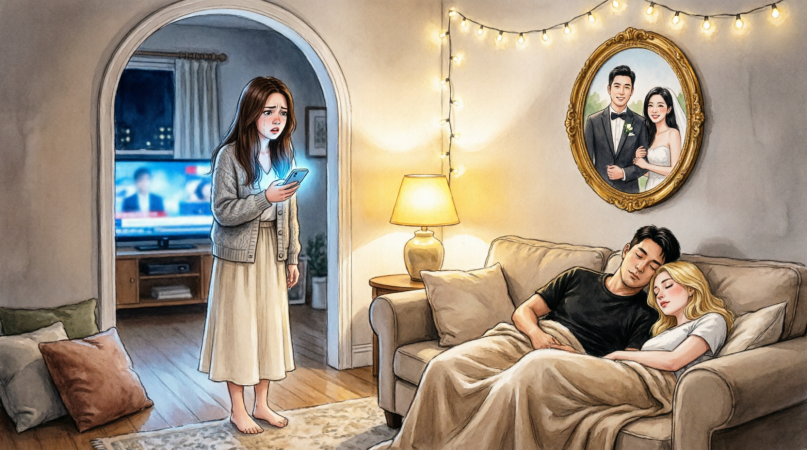
After my late shift, I slipped into my own house quietly, like I was trying not to wake up the lie.
That was the strange part I still think about now, the part that feels almost embarrassing in hindsight. I was the wife. I was the woman whose name was on the mortgage, whose paycheck paid half the bills, whose hands had scrubbed the baseboards before our first Thanksgiving dinner, whose grandmother’s wedding china sat boxed in the dining room cabinet because Caleb was afraid we would break it if we used it too often. I had a right to walk through that door as loudly as I wanted.
But that night, a little after midnight in a quiet suburb outside Columbus, Ohio, I parked at the curb instead of the driveway because gravel gives people away.
The driveway to our house on Marigold Lane was beautiful in daylight, curved and edged with low boxwoods, one of the features that had made Caleb say, “This feels grown-up, doesn’t it?” when the realtor first brought us there. But at night, when everything else slept, those pale stones crunched under tires like an announcement. Caleb had always claimed he slept heavily. That wasn’t true. Caleb slept lightly when he wanted to. He could sleep through my alarm at 5:10 in the morning, sleep through the dog barking at the mail carrier, sleep through the dryer thumping with towels, and yet wake instantly if I came home early, if I opened a drawer he thought I shouldn’t be opening, if I asked why his phone was facedown again.
So I parked down the block under the maple tree in front of the Sandersons’ house.
I sat for a moment with my hands still on the wheel, letting the engine tick softly as it cooled. The dashboard clock read 12:09 a.m. My scrubs smelled faintly of disinfectant and burnt coffee from the urgent care center where I worked twelve-hour shifts coordinating patient intake, insurance authorizations, and enough angry people to make any belief in human patience feel theoretical. I was exhausted, the kind of tired that settles behind your eyes and makes the world look smudged at the edges. My feet hurt. My lower back ached. All I wanted was to wash my face, take out my contacts, and crawl into bed beside my husband without having to talk about whose turn it was to run the dishwasher.
That was still the version of life I thought I was walking toward.
I got out, closed the car door with my hip, and held my keys tightly in my fist so they wouldn’t jingle. The neighborhood was still. December air moved cleanly through the bare trees. Porch lights glowed on automatic timers. A wreath hung on our front door, one I had bought from a school fundraiser because the little girl selling them reminded me of myself at ten, trying too hard to be useful. The wreath had a red bow that Caleb said was “a little much,” though he had never once bought a wreath himself.
I crossed the lawn instead of the driveway, my shoes dampening in the cold grass.
At the porch, I paused under the camera.
The little blue light blinked steadily.
Indifferent.
That camera had been Caleb’s idea. “For safety,” he said after a package went missing from the porch two years earlier. He installed it himself, made a show of linking it to both our phones, and then slowly, quietly, became the only one who checked it. I stopped getting notifications after an app update. He said he would fix it. He never did. I did not realize until later that technology in a marriage can become like furniture: familiar enough that you stop asking who controls it.
I unlocked the door with my key because the keypad made a beep, and I did not want a beep.
The lock turned. I eased the door open and stepped into the dark entryway.
The first thing I noticed was the television.
The living room TV was on low, not loud enough to be entertainment, just loud enough to wash the hallway in a watery blue light. Caleb liked falling asleep to documentaries, especially ones about disasters. Airplane investigations. Shipwrecks. Mountain rescues. He said the narrators relaxed him, all those calm voices explaining how other people’s lives had gone wrong. I used to tease him for it. “Nothing says bedtime like mechanical failure,” I would say, and he would laugh and pull me close.
The second thing I noticed was the perfume.
It was not mine.
It hit me before I reached the corner. Sweet, powdery, expensive in a way that tries to seem effortless. There was a faint floral note underneath it, something like peony, and then a warm vanilla finish that clung to the air. I knew that smell. I had smelled it on my gray knit throw blanket two weeks earlier and told myself it must have come from Tessa Riley hugging me in the kitchen after bringing over brownies. I had smelled it once on Caleb’s hoodie and accepted his explanation that Tessa had borrowed it when she got chilly on our back patio after the neighborhood chili cook-off. I had smelled it in my car once, too, though Caleb said I was imagining things.
Standing in my hallway, one hand on the wall, I let my brain bargain for a different explanation.
Maybe the candle.
Maybe the laundry detergent.
Maybe one of the patients at work had worn something similar and it had followed me home in my hair.
Maybe I was overtired.
Maybe I was becoming exactly what I had promised myself I would never become: suspicious, scanning, always waiting for betrayal because betrayal had been the weather of my childhood.
Then I heard breathing.
Not one rhythm.
Two.
One deeper, slow and open-mouthed. One softer, almost delicate, with a little catch on the exhale.
The human mind is strange in the seconds before it accepts a fact that will change everything. Mine became very quiet. Not peaceful. Not calm. Quiet the way a room goes quiet after glass breaks.
I stepped forward.
The living room opened to my left. The TV showed some nature documentary, a glacier calving silently because the volume was low and the captions were on. Blue light rolled across the couch, the coffee table, the woven rug I had saved for three months to buy, the framed wedding photo on the shelf where Caleb and I smiled under an arch of white roses in Cincinnati five years earlier.
And there they were.
Caleb Hartwell, my husband, slept on our couch with his head tipped back and his mouth slightly open. His dark hair was messy in the way I used to love because it made him look younger, less guarded. His right arm was curved across his chest like a cradle. Curled into that arm, cheek pressed to his shoulder, was Tessa Riley from next door.
Our neighbor.
My friend, or what passed for one.
She was tucked under my gray knit throw blanket as if she had been cold and someone had lovingly covered her. Her blonde hair spilled over Caleb’s shirt. One bare foot peeked out from beneath the blanket. Her left hand rested on his sternum, fingers loose and possessive, and the thin gold bracelet she always wore—a tiny green stone hanging from the chain—glinted when she shifted in her sleep.
I remember that bracelet with absurd clarity.
I remember thinking, That is peridot, not emerald.
As if identifying a gemstone mattered when my marriage was lying on the couch in front of me.
My stomach dropped so hard I tasted metal.
For a few seconds, my body became stupid with shock. I did not move toward them. I did not move away. I floated somewhere above myself, watching a woman who looked like me stand in a hallway and stare at the scene she had been trying not to imagine for months. My hands trembled. The tremor moved up my arms into my jaw. My pulse hammered in my teeth. I wanted to say Caleb’s name. I wanted to scream. I wanted to rip the blanket away, turn on every light, force the two of them out of sleep and into the fluorescent honesty of being caught.
But something in me went cold and clear.
Not numb.
Focused.
It had taken me thirty-three years to learn the difference.
My mother used to say I froze under pressure. She said it when I was nine and couldn’t answer fast enough during one of my parents’ kitchen fights. She said it when I was fourteen and cried silently instead of yelling back after my father moved into an apartment across town. She said it when I was twenty-two and Caleb first met my family and watched me become polite and small at the dinner table. “Lena doesn’t handle conflict,” my mother told him, passing the rolls. “She goes quiet and waits for other people to fix it.”
But my quiet had never meant I was not handling things.
It meant I was recording.
That night, in the blue light of my own living room, I backed up one step at a time until the doorway framed Caleb and Tessa like evidence.
The TV captions continued crawling across the screen. A narrator’s words appeared silently beneath images of ice and sea: THE CRACK FORMS LONG BEFORE THE BREAK.
It would have been funny if it had not felt cruel.
I took out my phone.
No flash.
No sudden movement.
No breath loud enough to wake them.
I held the phone steady with both hands and took the first picture wide enough to show the living room, the couch, the wedding photo, and the TV clock in the corner of the screen. 12:13 a.m. Then another. Then closer. Tessa’s bracelet. Her hand on his chest. Caleb’s arm around her. The blanket. The wineglass on the coffee table with a lipstick smudge along the rim, soft rose, not my shade. A second glass near Caleb’s side, half full. A small white plate with crumbs from the rosemary crackers I had bought for Christmas Eve, unopened when I left for work.
Proof first.
Emotion later.
I switched to video.
Ten seconds. Twenty. Thirty. The low television audio. The slow rise and fall of their breathing. Caleb shifting slightly and tightening his arm around Tessa without waking. Her cheek pressing closer into his shirt.
That hurt more than the stillness.
The ease of it.
The familiarity.
People do not sleep like that by accident.
I saved the video, then immediately created a new folder in my cloud storage. My hands were shaking again, but my mind stayed practical. Panic makes people forget passwords. Panic makes people misplace phones, delete files, confront liars without backup, and then wonder why the story changes by morning. I refused to let panic steal my leverage.
I uploaded everything.
Then I created a new email address on the spot, one with no shared recovery options, no saved password on the home computer, no trace Caleb could access. I uploaded the files there too. I emailed the folder link to myself and to Maya Chen from the new address because I wanted timestamps that lived somewhere outside my phone, outside my marriage, outside whatever Caleb would say when the sun came up.
Only then did I step backward into the hallway.
I closed the door to the guest room as I passed, though no one was in it. I closed the laundry room door too. It was irrational, but it felt like protecting the house from seeing itself. I kept moving until I reached the entryway. I opened the front door, stepped into the cold, and pulled it shut behind me without letting the latch click loudly.
Outside, the night air felt sharp and clean compared to the perfume inside.
I locked the door.
Then I tested it once.
That detail matters too. I locked them in the house together, not because I wanted to trap them, but because I was still the kind of woman who checked locks. Even betrayed, even shaking, some part of me cared that the house did not sit open to the street.
I walked back to my car at the end of the block.
The Sandersons’ maple branches scratched lightly against each other overhead. My breath came out in white clouds. Somewhere far away, a dog barked twice and stopped. I got behind the wheel and placed both hands on it as if it were the only solid thing left in the world.
12:17 a.m. glowed on my dashboard.
Before I called anyone, I sat there and let the facts line up like dominoes.
Caleb was not a stranger who had drifted into my life by accident. He had been the man who held my hand outside a courthouse in Dayton when my father’s second divorce became final and I admitted, shaking with humiliation, that I was terrified marriage was just a long con people played until they were tired of pretending. Caleb had squeezed my fingers and said, “Then we’ll build something honest. On purpose.”
On purpose.
That was our phrase.
We met in graduate school at Ohio State, both of us too old for campus bars and too young to know how little intelligence protects you from your own blind spots. I was studying healthcare administration. He was getting his MBA. He liked my color-coded notes and my habit of arriving early. I liked that he seemed steady without being boring, warm without being reckless. He was the kind of man who listened with his whole face when he wanted to charm you. He remembered small details. The name of my favorite coffee shop. The fact that I hated carnations. The song that played in my mother’s kitchen the night my parents finally told us they were separating.
Our first date was at a cheap Mexican restaurant with plastic tablecloths and margaritas too sweet to be dignified. I told him I wanted a calm life. Not rich. Not dramatic. Not impressive. Calm.
He raised his glass and said, “To boring in a good way.”
I believed him so completely that the belief itself felt like relief.
For years, we seemed to build exactly that. We rented a small apartment near German Village, worked too much, saved carefully, fought mostly about laundry and where to spend Thanksgiving. We got married in Cincinnati on a warm September afternoon, under a rented arch in a garden behind an old brick inn. Caleb cried when I walked down the aisle. He did. I have the pictures. His face crumpled in a way that looked so tender even my skeptical aunt whispered, “Well, he loves you, doesn’t he?”
I thought so.
We bought the house on Marigold Lane two years after the wedding.
The signing happened on a rainy Tuesday. Caleb wore a blue button-down. I wore the only blazer I owned that didn’t make me feel like a substitute teacher. The closing attorney slid papers across the table, and we signed our names until our wrists hurt. When we got the keys, Caleb twirled me in the empty living room while rain tapped against the windows.
“This is ours,” he said.
Ours.
A word I had wanted so badly I forgot to ask whether he meant it the way I did.
The last year had chipped at that belief slowly, which is how something enormous breaks without making a sound at first.
It did not start with lipstick or perfume or a neighbor asleep under my blanket. It started with restlessness.
Caleb started saying his job felt stagnant. He worked in operations for a logistics company in Dublin, good salary, predictable hours, decent benefits. The kind of job he used to call “responsible adult money.” Then he began coming home with complaints that had a new edge. His boss didn’t recognize his vision. His coworkers lacked energy. His life felt repetitive. He needed more. He never quite defined more, and I was too tired from my own shifts to keep asking.
Then came the late nights.
“Client call ran long.”
“Went out with the team.”
“Stopped by Dan’s to watch the second half.”
“Needed to clear my head.”
He came home with that loose smile people wear when they have already had the fun part of the day without you.
When I asked if he was unhappy, he frowned like I had insulted him.
“Why are you making problems?”
I learned to ask less.
Then Tessa moved in next door.
Tessa Riley arrived in the yellow house to our right on a bright April Saturday with a moving truck, two teenage nephews carrying boxes, and a laugh that crossed property lines before she did. She was thirty-one, recently divorced, a freelance interior stylist according to the introduction she gave everyone, though I never understood exactly what that meant. She wore linen pants, gold jewelry, and that powdery perfume. She had the kind of friendliness that made people feel selected. When she spoke to you, she tilted her head as if you were already close.
The first week, she knocked on our door with brownies.
“Hi, neighbors,” she sang, holding up the plate. “I’m Tessa, and I bribe people with sugar because I have no shame.”
Caleb laughed immediately.
I smiled because it was funny enough, and because I was trying to become the kind of woman who had neighbor friends. My childhood neighborhoods had never felt like communities. They were just places where families pretended not to hear each other breaking. Marigold Lane was different. People waved. They borrowed ladders. They posted lost cats on the neighborhood app. I wanted to belong to that ordinary softness.
Tessa learned us quickly.
Too quickly, I later thought.
She learned I worked late shifts twice a week and alternating Saturdays. She learned Caleb liked IPAs and documentaries and hated cilantro. She learned our dog, Mason, would do anything for freeze-dried chicken treats. She learned which side of the garage held the spare trash bags and that Caleb always forgot recycling day unless someone reminded him.
She told me I was “so lucky” to have such a devoted husband.
She said it while looking at him a second too long.
At first, it felt harmless. Maybe even flattering. Tessa was flirty with everyone, I told myself. Some women spoke with their eyes because it made life easier. It did not mean anything.
But then she kept showing up at the edges.
If I watered plants, she was suddenly outside watering hers. If Caleb grilled, she appeared with extra buns or corn or a bottle of wine she “could never finish alone.” If I left for work at three in the afternoon, she waved from her porch and asked how late I’d be gone.
Once, laughing, she said, “I just need to know when to stop blasting music and pretending I’m twenty-two.”
Her eyes stayed serious.
Caleb began mentioning her casually.
“Tessa said the HOA might start fining people for bins left out.”
“Tessa thinks our porch light is too dim.”
“Tessa invited us over for wine Friday.”
Us.
That was how the door opened. Not I’m going to Tessa’s. Not Tessa texted me. Us. A harmless little word that made me feel unreasonable if I questioned the frequency. If I said no because I was exhausted, Caleb accused me of never wanting fun.
“You work too much,” he said.
“As opposed to the mortgage fairy paying our bills?”
He rolled his eyes. “You know what I mean.”
Tessa laughed when he repeated that line in front of her. “Girl, you do deserve fun.”
Girl.
Always girl.
Always friendly. Always with a tiny undertone that made responsibility seem like a personal failing.
The small moments accumulated.
The night I came home early and found Tessa barefoot on my couch while Caleb opened a bottle of red wine.
“She was locked out,” Caleb said too fast. “I told her she could wait here while the locksmith came.”
Tessa waved a hand, laughing. “I’m such a disaster. Thank God for Caleb.”
The locksmith never came. She “found” her keys in a tote bag ten minutes later.
Then the throw blanket smelled like her perfume.
Then Caleb’s phone started living facedown.
Then he started stepping onto the porch to take calls he claimed were work-related, though logistics emergencies apparently made him smile now.
Then Tessa needed help carrying a mirror, then a bookshelf, then a rug, then a box of tile samples, then a patio umbrella. She never called a moving company. She called Caleb.
I told myself I was imagining patterns because I came from divorce. My parents had turned suspicion into a household religion. My mother checked my father’s jacket pockets. My father read my mother’s credit card statements. Their whole marriage became an investigation before it became paperwork. I swore I would not live that way. I would trust. I would ask directly. I would not become the woman who saw betrayal everywhere.
But choice without boundaries becomes blindness.
And I had been choosing blindness because it felt less humiliating than being right.
At 12:17 a.m., sitting in my car under the Sandersons’ maple tree, I stopped choosing it.
I thought about the spare key under the stone planter.
That stupid, suburban detail.
Caleb put it there because he said emergencies happened, and at the time I found it sweet. A hidden key meant we had a home stable enough to return to, a porch nice enough for a planter, a life ordinary enough to need contingency plans. Last fall, when Tessa made a show of locking herself out, I had lifted the stone planter and shown her.
“We keep one here,” I said. “Just in case. Don’t tell anyone.”
She laughed. “Your secret’s safe.”
Now I wondered how many times she had used our secret to enter my house before I got home from work.
The worst part was not even the physical closeness on the couch, though that image was already burned into me. It was the ease. The comfort. The blanket tucked up. The wineglasses. The TV left on low. That scene did not happen the first time someone crossed a line.
That scene happens after a line has been crossed enough times to become furniture.
I did not want details.
I wanted exits.
So I called Maya Chen.
Maya and I had been friends since graduate school, though friend never felt like the right word for what she was. We did not talk every week. We did not have matching brunch photos. We were not casual. We were emergency contacts in human form. She had become a family law attorney in Columbus after years of saying she would never “monetize other people’s heartbreak,” and then realizing heartbreak needed competent counsel more than inspirational quotes.
She answered on the second ring.
“Maya Chen.”
Her voice was sharp and awake. That was Maya. She could be asleep in a burning building and answer like a cross-examination had already begun.
“Maya,” I said.
My throat closed.
I heard sheets rustle. “Lena?”
“I just found Caleb asleep on our couch holding Tessa Riley.”
There was a pause, but it was not surprise.
It was recalibration.
“Where are you?”
“In my car. Down the block.”
“Are you safe?”
“Yes.”
“Do they know you saw?”
“No.”
“Do you have proof?”
I closed my eyes. That was why I called Maya. Not Oh my God. Not are you sure? Not maybe there’s an explanation.
Do you have proof?
“Yes,” I said. “Photos and video. Time stamp. TV clock in the shot.”
“Good. Listen to me carefully. Do not go back in there and create a scene. Tonight is for safety and documentation, not confrontation. You understand?”
My hand tightened on the steering wheel.
“I want him to feel it,” I admitted.
“Then do it the way that lasts,” she said. “Paper trails. Court orders. Consequences. You want clean? We do clean. You want ruthless? We do it legally.”
I let my head rest against the seat.
“What do I do?”
“Hotel first. Use your personal card, not the joint account. Send me the evidence from the burner email you used.”
I opened my eyes. “How did you know I used a burner?”
“Because you’re not stupid. Also because I know you.”
A laugh almost escaped me and turned into something like a sob.
Maya continued. “Tomorrow morning, we move fast. Passwords, documents, banking, direct deposit. I file for temporary orders—exclusive use of the house if you want it, financial restraints so he can’t drain accounts, and no harassment language if necessary. But you cannot talk to him tonight. You cannot send a paragraph. You cannot ask why. Liars love why. Why gives them a stage.”
“What about Tessa?”
“Not tonight.”
“She was in my house.”
“I know.”
“Under my blanket.”
“I know.”
“With his arm around her.”
“I know. And you will not give either of them the gift of your emotion before you secure your position.”
Her voice was firm enough to hold me upright.
“You’ll want to scream,” she said. “Don’t. You document, protect your accounts, secure your home, and let them discover the new rules by running into them.”
I looked toward my house. From the street, it looked peaceful. Dark upstairs windows. Wreath on the door. Blue porch camera light blinking.
“You make it sound simple.”
“It isn’t simple. It’s procedural.”
“I don’t know if I can do procedural right now.”
“You can,” Maya said. “You do procedural for a living. Tonight you treat your life like intake. Facts first. Emotional care after stabilization.”
That was the first thing that cut through the shock enough to make me breathe.
Facts first.
Stabilization.
Words I knew.
I drove to a hotel near the interstate, one of those business hotels with beige walls, silent carpets, and a lobby that smelled like lemon cleaner. The woman at the front desk asked for my ID and credit card. I handed over my personal card, the one Caleb always said we should cancel because joint points were better. She smiled politely and gave me a room key.
To her, I was just a tired woman checking in after midnight.
Maybe she saw the mascara under my eyes. Maybe she had seen too many women arrive alone with no luggage. Maybe hotel clerks know more about marriages than therapists do. She did not ask.
The room was on the third floor. King bed. Desk. Armchair. A framed print of a bridge that could have belonged to any city in America. I locked the door, latched the chain, checked the window, and sat at the desk without turning on the TV.
Sleep did not come.
Instead, I took the hotel notepad and cheap pen and started writing.
Maya had said temporary orders like they were ordinary. To her, they were. To me, the phrase sounded both terrifying and miraculous. A judge’s quick, blunt decision about who stayed where and who could touch what while the bigger divorce machine began to grind.
Caleb would expect a conversation. He would expect me to come home, cry, demand answers, and negotiate. He would expect to keep the house as neutral ground because Caleb always treated neutral ground like his stage. He would lower his voice, call me Laney the way he did when he wanted softness from me, insist it “wasn’t what it looked like,” maybe admit to one kiss, one mistake, one emotional confusion. He would count on my horror of public mess. He would count on my desire to be fair.
I was not giving him a stage.
I opened my banking app.
We had two joint accounts: checking for bills, savings for the future. The future fund. I used to love that name when it appeared in our budgeting app. Future. A baby maybe. A kitchen renovation. A trip to Maine. A cushion against disaster.
The future fund had barely grown in eight months.
I had noticed before, of course. I was the numbers person. I knew when Caleb’s “investing in quality” purchases got larger, when restaurant charges appeared on nights he said he was eating leftovers at home, when cash withdrawals happened after happy hours. But every time I asked him to slow down, he called me anxious. Every time I suggested we revisit spending, he said I was treating him like a child. I did not want another argument. So I let the numbers whisper while I shushed them.
Now I stared at the account and felt a strange gratitude toward my instincts.
They had been trying to help me.
I checked the credit cards next.
Two joint. One mine. I made sure the hotel was on my personal card. I removed the joint cards from my wallet app. I turned on alerts for every transaction over twenty dollars. I changed my banking password, then changed the email associated with it. It felt extreme for about three seconds. Then I remembered Tessa’s hand on Caleb’s chest, and the word extreme lost its meaning.
Mistrust is different when it has been earned.
At 1:03 a.m., I called Maya again.
“Okay,” I said when she answered. “Walk me through tomorrow like I’m five.”
She inhaled once, not impatient, just focused.
“Tomorrow is logistics. First, you secure your money. Move your direct deposit to your personal account. Do not empty joint accounts unless I advise it; judges hate that. Second, you change passwords and security questions. Email, phone carrier PIN, banking, cloud storage, utilities, smart home apps, anything he can access. Third, identity documents. Passport, Social Security card, birth certificate, marriage certificate, insurance, mortgage, car title. Originals if possible, scans if not. Fourth, evidence. Upload everything in multiple places. Export smart-lock logs. Screenshot texts. Save voicemails. Fifth, do not communicate except one line after filing.”
“What line?”
“We need to communicate through my attorney. Do not come to the house.”
“That sounds cold.”
“Good.”
I stared at the hotel wall.
“What if he shows up?”
“You don’t open the door. You call non-emergency. You document. If he texts, screenshot. If he calls, voicemail. If Tessa tries to talk, one line: counsel. Nothing else.”
“What if I need to go back before the order?”
“Then don’t go inside if they’re there. We’ll time it. If needed, I’ll send a process server or request police standby. You are done sharing air with them without boundaries.”
I swallowed. “What if he says he loves me?”
Maya was quiet for half a second.
“Then you remember love does not sneak the neighbor into your house while you work late.”
That sentence broke something open.
I cried then.
Not loudly. Not the dramatic sobbing I imagined betrayal deserved. Just a silent, steady leaking, tears falling onto the hotel notepad while Maya stayed on the line.
When I could speak again, I said, “I feel stupid.”
“You are not stupid.”
“I knew.”
“You suspected.”
“I ignored it.”
“You survived in the information you could tolerate.”
“That sounds like therapist language.”
“It’s lawyer language with better shoes.”
I laughed through my nose.
Maya continued, softer now. “Lena, listen. People think betrayal is one event. It usually isn’t. It’s a structure. Tonight you saw the roof cave in, but the beams were rotting before. That does not make the collapse your fault.”
After we hung up, I opened my notes app and built a checklist in the exact style I used at work.
Bank: move direct deposit.
Email: new account, two-factor.
Phone: carrier PIN.
Passwords: banking, utilities, cloud, smart lock, thermostat, streaming, grocery delivery, insurance, employer portal.
Documents: passport, Social Security card, birth certificate, marriage certificate, mortgage, deed, insurance, car title.
Locks: locksmith.
Evidence: upload media, export smart-lock logs, screenshot texts, save voicemails, photograph house condition.
Communication: one line only.
I kept writing until my brain stopped circling the image of the couch.
At 2:10 a.m., Caleb texted.
You home?
2:12 a.m.
Why aren’t you answering?
2:13 a.m.
Did something happen at work?
I stared at the messages.
There was the performance. Not Where are you, I’m worried. Not I woke up and you weren’t here. Not Are you safe?
It was framed like annoyance pretending to be concern.
I screenshot every message, saved them to the folder, and turned off read receipts.
At 3:40 a.m., I lay down fully clothed on top of the hotel comforter, shoes on the floor beside the bed, phone charging on the nightstand. Sleep did not come, but neither did the collapse I expected. I was not thinking about what they had done. I was thinking about what I would do next.
That shift—from pain toward action—felt like I was taking my body back.
By dawn, I had more texts.
Caleb: Are you serious right now?
Caleb: Lena answer me.
Caleb: I know you came home because the porch cam logged the door.
That one made my blood go cold.
He had checked.
Not because he was worried.
Because he wanted to know what I knew.
Then:
Caleb: If you saw something, you need to talk to me before you make it worse.
There it was.
Before you make it worse.
The betrayal was his, but the responsibility for containment had already been assigned to me.
I saved everything.
At 6:30 a.m., I walked into the bank the moment it opened.
The teller was young, cheerful, wearing a red sweater with tiny white snowflakes on it. She had no idea she was helping me extract oxygen from a burning room. I moved my direct deposit to my personal account and confirmed Caleb had no access to it. I did not touch the joint checking beyond downloading statements. I did not drain savings. Maya’s voice lived in my head: clean, legal, boring.
“All set,” the teller said.
Two words.
The first real breath of the morning.
At 7:05, I created a new primary email address with two-factor authentication linked to an authenticator app, not text messages. At 7:20, sitting in my car in the bank parking lot with coffee cooling in the cupholder, I changed passwords. Email. Cloud. Banking. Utilities. Streaming. Smart thermostat. Smart lock. Budgeting app. Grocery delivery. Phone carrier PIN. Employer portal. Social media. The dog’s vet account. Even the neighborhood app.
Every changed password felt like pulling a thread back into my own hands.
At 8:15, Maya texted photos of stamped documents.
Petition filed.
Temporary financial restraints requested.
Exclusive use requested.
Emergency hearing scheduled.
Then another message:
Do not speak to him without me.
I stared at it like scripture.
At 8:40, I logged into my employer portal and downloaded pay stubs, benefits information, and employment verification. Maya had warned me that spouses who lose control often try to paint the other as unstable, reckless, financially irresponsible, vindictive. Boring documents are armor against manufactured narratives.
At 9:00, I called a locksmith.
He answered on the third ring with the voice of a man who had heard everything.
“Residential?”
“Yes.”
“Emergency?”
I looked out at the gray morning, at people driving to work as if the world had not split open.
“Yes,” I said. “Marriage emergency.”
He paused. “I can be there in forty.”
Before going home, I opened the smart-lock activity log.
I had not checked it in months.
That was another thing I would later revisit. Not with blame, exactly, but with recognition. The information had been there. I had simply trusted the person interpreting the system.
We had created a guest code for Tessa after her dramatic lockout. “Temporary,” Caleb said. “We’ll delete it after.”
We never did.
The log showed Tessa’s guest code had been used repeatedly.
11:48 p.m. Tuesday.
10:16 p.m. Saturday.
12:03 a.m. Thursday.
9:42 p.m. another late-shift night.
Again and again, always when I was working or visiting my sister or taking Mason to the vet.
Not proof of sex.
Proof of access.
Access is the part people deny first.
I screenshot every entry.
Then I checked the porch camera archive. Caleb had disabled cloud storage for “bandwidth reasons” three months earlier. Of course he had. But there were still local event logs, enough to show door openings, late-night motion, deleted clips without video. Deletions are their own kind of evidence when placed beside other records.
I saved those too.
At 9:34, I sent Caleb the line.
We need to communicate through my attorney Do not come to the house
I hated the missing period. I had copied Maya’s exact wording and removed punctuation because she said the flatter the better.
His response arrived instantly.
What are you talking about
Then:
Attorney??? Are you insane?
Then:
Lena call me now.
I did not answer.
I forwarded the messages to Maya.
When I pulled into the driveway, Caleb’s car was not there.
That surprised me.
The blinds were half open. Porch light off. Wreath still on the door. Everything looked normal, which is what betrayal depends on: the world keeping its face.
The locksmith arrived five minutes after I did, driving a white van with no logo. He was in his late fifties, gray beard, quiet eyes, tool bag in hand.
“You have paperwork?” he asked gently.
“Orders are pending. I own the home jointly. My attorney advised changing access for safety until court review.”
He nodded like that was enough. “Happens.”
That single word, happens, nearly undid me.
Not because it minimized anything, but because it placed my private catastrophe into a category large enough to have service protocols. People had done this before. Women had stood on porches with shaking hands and locksmiths had come and changed the metal shape of their lives.
He changed the front lock, the back lock, the garage entry, and reprogrammed the keypad. I deleted Tessa’s guest code while he stood there, then deleted Caleb’s access temporarily through the app only after Maya confirmed by text that I could do so once the emergency filing was stamped and the exclusive-use motion was pending.
“New keys,” the locksmith said, placing them in my palm.
They felt heavier than metal.
They felt like permission.
Inside, the house smelled like stale wine and Tessa’s perfume.
I did not cry.
I walked through like an inspector, not a wife.
The couch still held the imprint of two bodies. The gray knit throw was twisted in a heap at one end. I picked it up with two fingers and immediately smelled her. Powder, vanilla, betrayal. I put it into a trash bag, tied it shut, and set it near the garage door because I could not stand the idea of washing it like it deserved care.
The wineglass remained on the coffee table.
The lipstick mark showed more clearly in morning light.
I lifted the glass with a paper towel, photographed it from several angles, then set it back. I was not collecting trophies. I was collecting options.
In the hallway closet, I pulled the important-documents binder. Caleb had always liked that binder. He said it made us feel like adults. He never maintained it; I did. Mortgage, insurance, car titles, marriage certificate, dog vaccination records, appliance warranties. I scanned everything with my phone and uploaded it to the new folder.
I took photos of the condition of each room. Living room. Kitchen. Office. Bedroom. Guest room. Basement. Garage. Furniture, floors, walls. Maya had warned me about sudden claims. Property damage. Missing items. Allegations that I “ransacked” the house. People who lie about love will lie about lamps.
Then I boxed my personal things.
Not marital furniture. Not shared property. Mine.
My grandmother’s pearl earrings. My diploma. My professional certificates. The thumb drive with work documents. The photo album of my father from before bitterness turned him into a stranger. My journals. The framed picture of my sister and me at Lake Erie when we were children. A silver bracelet Caleb gave me on our first anniversary, which I put in the box, then removed, then set on the dresser because I did not yet know whether memory counted as property or poison.
At 11:48 a.m., Maya texted again.
Judge signed temporary exclusive-use order pending hearing. Check email. Print. Tape inside front door. Photo with timestamp.
I did exactly that.
The order arrived as a PDF. I printed it from the home office printer that jammed twice because of course it did. I taped the order to the inside of the front door and photographed it with the date visible on my phone. Temporary exclusive use of residence. Financial restraint prohibiting either party from transferring, concealing, wasting, or disposing of marital assets outside ordinary expenses. Communication through counsel except emergencies.
Paper held the boundary now.
At 12:26 p.m., my phone buzzed with a neighborhood app notification.
Tessa Riley posted in Marigold Lane Community:
Does anyone know if Lena is okay? I saw police/legal people earlier and I’m worried. Caleb seems really upset.
The audacity almost made me laugh.
She wanted witnesses.
She wanted the first narrative.
Concerned neighbor. Confused friend. Soft voice. Big eyes.
I stared at the post for thirty seconds.
Then I typed one sentence.
I’m safe. Please respect privacy. Any contact goes through counsel.
No accusations. No details. No emotional opening she could crawl through.
Three neighbors liked it within minutes. One privately messaged me a heart. I did not answer yet.
Caleb began messaging mutual friends after that. I saw it because my phone lit up with screenshots.
From our friend Daniel:
Hey Lena, Caleb says you guys had a misunderstanding? He asked me to tell you to call him.
From Erica:
Are you okay? Caleb texted saying you locked him out?
From my sister Nora:
Tell me where you are and whether I need to bring a shovel.
That one made me laugh for the first time.
Maya told me not to argue publicly, but also not to let silence become his evidence. So I sent a factual note to four key people.
I am safe. I have legal counsel. Caleb and I are separating. I’m not discussing details right now. Please do not pass messages between us.
Then I stopped.
No gossip.
No spiral.
Caleb did not understand the damage he had done. Not yet. He thought the betrayal was physical, something he could apologize for, minimize, rename. He did not understand that the real betrayal was the assumption that I would help him manage the consequences.
That assumption was dying quietly with every screenshot I filed and every door I refused to open.
He arrived at 1:14 p.m.
I saw his car pull up through the front window. He parked crookedly in the driveway, half on the gravel, half on the grass. That alone would have annoyed me on any other day. He hated when I parked too close to the edge, but there he was, tires cutting into the lawn like damage belonged to whoever made it look urgent.
He got out wearing the sweatshirt he had slept in.
The one Tessa’s hair had been on.
He looked up at the house, then down at his phone, then at the door. His face was tight, pale, angry already, but there was fear under it. Not fear for me. Fear of losing control of the version of events.
He tried the keypad.
It rejected him.
He tried again.
Rejected.
Then he used his key.
The new lock held.
He pounded on the door.
“Lena!”
I stood in the living room, far enough back that he could not see me through the glass.
“Lena, open the door!”
I did not.
He called. I let it go to voicemail.
The pounding continued.
“What the hell is this? Open the door!”
My heart raced so hard I could feel it in my throat, but my body did not move toward him. That felt like a miracle. For years, Caleb’s anger had been a weather system inside our home. Not violent, not usually loud enough for neighbors, but heavy. Disappointed silence. Slammed cabinets. The cold withdrawal that made me apologize just to restore warmth. I knew every barometric shift of his mood.
Now his anger was outside.
That mattered.
I saved the voicemail as it arrived.
“Lena, what the hell is going on? You can’t just lock me out of my own house. Call me back. This is insane. Whatever you think you saw, you’re blowing it up. You need to talk to me like an adult.”
Whatever you think you saw.
I forwarded it to Maya.
Then Tessa appeared on her porch next door.
Of course she did.
She had brushed her hair. She wore leggings, a cream cardigan, and concern arranged carefully across her face. The role of worried neighbor, not the woman I had filmed asleep against my husband’s chest. She stepped off her porch and started across the lawn.
“Lena?” she called. “Can we just—”
I opened the living room window two inches.
“Don’t,” I said.
My voice surprised me. Flat. Strong. Loud enough to carry.
She stopped.
“Any contact goes through counsel.”
Her mouth tightened.
For a second, the mask slipped. Not guilt. Irritation.
Then it returned. “I just want to explain.”
I looked at her.
“No.”
I closed the window.
Then I called the non-emergency police line.
I gave my name, address, and explained that I had a temporary exclusive-use order, that the other party was attempting contact, and that I wanted the incident documented. I did not cry. I did not say mistress. I did not say cheating. I used the language Maya told me to use.
Restrained contact.
Temporary order.
Attempting entry.
Documentation.
A patrol car arrived fifteen minutes later.
The officer was younger than I expected, maybe late twenties, with reddish hair and a cautious expression. He spoke to Caleb on the porch while I watched from inside. Caleb gestured dramatically. The officer read the printed order through the glass after I held it up, then asked me through the door if I wanted to speak outside. I said no, I was comfortable providing the order from inside and would follow up through counsel.
The officer nodded.
Ink worked on him better than tears would have.
Caleb tried charm first. I could see it in his posture. The lowered shoulders, the reasonable hands. Then sadness. He wiped his face, though I saw no tears. Then anger. The officer’s stance shifted. Caleb backed down.
Finally, he walked down the steps.
Before getting into his car, he looked up at my window.
He expected me to flinch.
I didn’t.
After he left, the house became quiet in a way that felt dangerous at first. Silence had always been punishment in our marriage. Caleb could make a room silent until I apologized for things I had not done. But this silence was different. It belonged to me. It held.
I sat on the floor by the front door, back against the wall beneath the taped court order, and let myself shake.
Not cry.
Shake.
My body had been brave without asking my permission, and now it wanted payment.
Maya called at 2:05.
“You okay?”
“He came. Police made him leave.”
“Good. Incident number?”
I read it to her.
“Excellent. Eat something.”
“I’m not hungry.”
“I didn’t ask if you were hungry. Eat something.”
So I did. I made toast and stood at the counter eating it dry because butter felt like too much commitment.
That afternoon, Maya emailed the next moves.
Prepare for temporary hearing.
Inventory assets.
Document communication.
No meetings alone.
No phone calls.
No direct emotional engagement.
Then she wrote one line that stayed with me:
The revenge isn’t screaming. It’s removing his options.
I taped that to the inside of a kitchen cabinet where only I would see it.
The first night alone in the house was worse than the hotel.
I thought I would feel safer because the locks were changed. Instead, every room held evidence of what I knew. The couch looked guilty. The hallway smelled faintly of perfume no matter how many windows I opened. Caleb’s side of the closet hung full of his shirts. His toothbrush sat in the bathroom cup, blue and ordinary. The house was not empty enough to be mine and not occupied enough to be ours.
Mason, our golden retriever, came back from my sister Nora’s house that evening. I had sent him there before Caleb arrived because the thought of him barking, confused, while everything happened had been too much. When Nora brought him home, he bounded in, nails clicking on the floor, tail sweeping the air. He sniffed the living room, then looked at me with the pure concern of a dog who knows the pack has changed and no one explained why.
I sat on the floor and wrapped my arms around him.
“I know,” I whispered into his fur. “Me too.”
Nora stood in the doorway holding his leash.
My sister is two years older than me, a high school art teacher with red hair, blunt opinions, and a history of wanting to fight people who hurt me. She looked around the living room once and saw enough.
“I hate him,” she said.
“Efficient.”
“I can do more.”
“Maya says no shovels.”
“Maya ruins all my best plans.”
I laughed, then cried because laughter opened the door.
Nora sat beside me on the floor. Mason pressed his whole body into my lap.
“I feel humiliated,” I said.
Nora’s face changed. “You didn’t do anything humiliating.”
“He did it in our house.”
“That’s his shame.”
“With our neighbor.”
“Also his shame.”
“Under my blanket.”
Nora paused. “Okay, that part makes me want to commit a misdemeanor.”
I laughed again, harder this time, until crying took over. Nora held my hand through it, not trying to fix anything. That is the difference between comfort and control. Comfort sits beside pain. Control tries to redirect it before it becomes inconvenient.
Caleb did not know that difference.
Maybe he never had.
Over the next three days, his messages changed shape.
At first, outrage.
You can’t do this.
This is my house too.
You’re acting crazy.
Then apology.
I’m sorry.
Please just talk to me.
I messed up but it’s not what you think.
Then minimization.
Nothing happened.
We fell asleep.
You’re making it look worse than it was.
Then blame.
You’ve been distant for months.
You work nights and expect me to be alone.
Tessa listened when you wouldn’t.
Then romance.
Laney, please.
I love you.
I can’t lose us.
Then threats disguised as concern.
If you keep going like this, people are going to know everything.
You’re embarrassing yourself.
A judge won’t like how extreme you’re being.
Each phase arrived like weather I could forecast. I screenshot everything. I did not respond. Maya replied where necessary through counsel.
Tessa tried once more.
She left a handwritten note in my mailbox.
Lena,
I know this looks terrible, but please believe me when I say I never wanted to hurt you. Caleb and I became close during a time when we both felt lonely. Nothing physical happened the way you probably imagine. We fell asleep after talking. I care about you and would love to explain woman to woman.
Tessa
Woman to woman.
I photographed the note, scanned it, placed it in the folder, and dropped the original into a plastic sleeve. Then I texted Maya.
She replied:
She just admitted emotional involvement and access. Useful.
I stared at that message and felt a grim little spark.
Useful.
Not devastating.
Useful.
That became my word for the week.
Caleb’s voicemail? Useful.
Tessa’s note? Useful.
Smart-lock entries? Useful.
The neighbor app post? Useful.
A photo Erica sent me of Caleb and Tessa sitting too close at a summer block party while I was in the kitchen helping someone find ice? Useful.
I was learning to convert pain into record.
At mediation, five days after the discovery, Caleb arrived in what Nora later called his reasonable man costume.
Navy button-down. Sleeves rolled to the forearm. No wedding ring, which he probably thought I would not notice. Hair carefully messy. Face drawn enough to look wounded but not guilty. His attorney, Mark Feldman, was a silver-haired man with a pleasant courtroom smile and the dead eyes of someone billing hourly.
Maya and I sat across from them in a conference room with a long table and bad coffee.
I wore black trousers, a cream blouse, and the pearl earrings my grandmother left me. Not because Caleb deserved presentation, but because I needed to look like myself in a room where he would try to define me.
The mediator, a retired judge named Ellen Cross, opened with the usual language about cooperation, dignity, and the benefit of resolving matters without escalating conflict.
Maya listened politely.
Caleb stared at me like we were in a private tragedy rather than a legal process.
When it was his turn, he leaned forward.
“Lena, I know you’re hurt,” he said.
Maya lifted one finger slightly, a signal.
I said nothing.
Caleb swallowed.
“What happened with Tessa was a mistake,” he continued. “A lapse in judgment. It didn’t mean anything. We were talking, and we fell asleep. That’s all. I know it looked bad, but you know me. You know I would never—”
Maya slid the first packet across the table.
Photos.
Video stills.
Smart-lock logs.
Tessa’s note.
Texts.
Voicemails.
The lipstick glass.
Caleb stopped talking.
His attorney pulled the packet closer.
I watched Mark Feldman’s posture change page by page.
Less swagger.
More math.
That was the moment Caleb began to understand that the story had moved beyond his voice.
Maya spoke in a tone so calm it made the air colder.
“My client is not interested in litigating the emotional character of Mr. Hartwell’s relationship with Ms. Riley today. We are here to address exclusive use, asset preservation, communication boundaries, and eventual division. Mr. Hartwell’s repeated attempts to contact my client after being instructed to communicate through counsel are documented. The neighbor’s use of a guest code to enter the marital residence during my client’s late shifts is documented. The presence of Ms. Riley inside the residence at midnight is documented. We can spend money pretending facts are feelings, or we can proceed.”
Facts are not feelings.
I wanted to write it on the wall.
Caleb’s face reddened.
“That’s not fair,” he said.
Maya looked at him. “Which part?”
He looked at me then.
“You’re making me sound like some kind of monster.”
I almost answered.
Almost.
Maya’s shoe touched mine under the table.
I stayed silent.
That silence did more damage than anything I could have said.
Caleb expected tears. He expected accusation, pain, bargaining, something he could work with. My calm hollowed him out. I saw it in his eyes. Not because he understood my dignity. Because he understood he had lost access to the emotional version of me, the version that would have protected him from embarrassment by making the room about heartbreak instead of conduct.
The mediation did not resolve everything. Real life does not give clean movie punishments. Caleb did not lose every dollar, every friend, every illusion. But he lost the narrative in that room. He lost the ability to call me unstable without facing a stack of timestamps. He lost the house as a stage. He lost the assumption that my fairness would be a resource he could spend.
The temporary hearing happened three days later.
The courtroom was small, carpeted, and smelled like old coffee. Not dramatic. No jury. No packed gallery. Just a judge, clerks, attorneys, and the dull machinery of domestic collapse.
Caleb sat with Mark Feldman at one table. Maya and I sat at the other. Tessa was not there, which was convenient for the story Caleb wanted to tell. If the neighbor remained invisible, perhaps she could become a misunderstanding instead of a person with a guest code, a bracelet, a lipstick shade, and an apology note.
Judge Patricia Lowell took the bench at 9:03 a.m.
She looked like a woman who had heard every version of “it’s not what it looks like” and found most of them disappointing.
Maya presented first.
Temporary exclusive use. Financial restraint. Communication through counsel. Preservation of assets. No removal or destruction of property. No use of guest codes by third parties. No harassment. No direct contact except emergencies involving the dog or house safety.
She handed up the packet.
Judge Lowell read without expression.
Caleb tried to look remorseful. Then reasonable. Then confused. I watched him cycle through faces the way he cycled through explanations.
When his attorney spoke, the story became exactly what I expected.
“Your Honor, this is an unfortunate marital misunderstanding. Mr. Hartwell acknowledges that boundaries became blurred with a neighbor during a period of emotional strain. However, Ms. Hartwell’s response has been extreme. She changed locks on a jointly owned home, denied access, and escalated private marital issues into legal confrontation without meaningful discussion.”
Meaningful discussion.
That phrase nearly made me laugh.
Judge Lowell looked down at the papers.
“Mr. Feldman,” she said, “why was the neighbor using a guest code to enter the marital residence repeatedly on nights Ms. Hartwell worked late?”
Caleb’s mouth opened.
His attorney touched his elbow lightly.
Stop.
It was the smallest gesture, but I saw it.
Mark Feldman answered for him. “Your Honor, the guest code was provided after Ms. Riley was locked out of her home. Any subsequent use may have been with permission—”
“Whose permission?”
A pause.
“Mr. Hartwell’s, perhaps.”
Judge Lowell looked over her glasses. “At midnight?”
Mark’s smile thinned.
Maya added, “Without notice to my client, while my client was absent for scheduled late shifts.”
Judge Lowell turned a page.
“And the neighbor was found asleep in the marital residence with Mr. Hartwell?”
Mark cleared his throat. “The characterization—”
“I have photographs,” the judge said. “I can characterize well enough.”
Caleb stared at the table.
In the end, Judge Lowell extended the exclusive-use order and kept financial restraints in place. Caleb could retrieve personal belongings by appointment with counsel or police standby. He could not enter the residence without written agreement. All communication through attorneys unless specifically permitted. Neither party could harass, disparage, or dispose of property. Guest codes were to remain disabled.
No drama.
No lightning.
Just a woman in a black robe making consequences legible.
Outside the courtroom, Caleb tried one more time.
We were waiting near the elevators. Maya stood beside me, scrolling through an email. Caleb approached slowly, hands visible, voice low.
“Lena.”
I looked straight ahead.
“Please,” he said. “Can you just look at me?”
Maya raised her eyes.
“Mr. Hartwell,” she said, “you are represented.”
“I just want one minute with my wife.”
“Your wife requested no direct communication.”
His face twisted. “This is insane. We were together ten years.”
That almost got me.
Not the argument. The number.
Ten years.
Ten years of grocery lists and shared jokes, road trips, flu medicine, Christmas trees, mortgage payments, morning coffee, his hand on my back in crowded rooms. Ten years did not vanish because of one night. That was what made betrayal so violent. It did not erase history; it infected it retroactively, making you question which memories were real and which were simply earlier scenes in the same lie.
I wanted to turn to him and ask, When did you stop being careful with me?
Instead, I stared at the elevator doors.
They opened.
I walked in with Maya.
Caleb stayed outside.
As the doors closed, I saw his face change. Not to sorrow. To disbelief. He could not believe I was denying him the comfort of my pain.
In the parking garage, Maya said, “You did it right.”
“I don’t feel victorious.”
“You’re not supposed to.”
“What am I supposed to feel?”
“Clean, eventually.”
I leaned against the car and breathed.
Clean.
Not happy.
Not healed.
Clean.
Like a room after smoke clears. Still damaged, but breathable.
The next weeks became an education in how people choose sides while pretending not to.
Some friends disappeared quietly. They did not defend Caleb openly, but they stopped texting me. Maybe my situation frightened them. Maybe betrayal is contagious in social circles because it forces couples to ask what they themselves have ignored. Maybe they liked Caleb more. Maybe they liked comfort more than truth.
Erica stayed.
Daniel apologized for passing Caleb’s message and then stopped responding to him.
Nora became my unofficial food delivery service and rage translator. She brought soup, dog treats, legal pads, and once a tiny cactus with a note that said: THRIVE OUT OF SPITE.
My mother called after Nora told her.
Her first words were, “What did you expect me to do with this information?”
That was my mother. Not cruel exactly. Just emotionally underfunded.
“I’m not asking you to do anything,” I said.
“Well, I’m sorry, honey. That’s awful.” A pause. “Are you sure there’s no explanation?”
I closed my eyes.
“There is an explanation. It’s just not one that helps him.”
She sighed. “Marriage is complicated.”
“Not this complicated.”
Another pause.
“I just don’t want you to make a decision in anger.”
I thought of my mother staying with my father for five years after she found hotel receipts in his glove compartment because she did not want to make a decision in anger. By the time she left, anger was not a decision; it was the whole house.
“I’m making decisions with counsel,” I said.
“That sounds cold.”
“It is.”
She did not know what to do with that.
Caleb’s family reacted predictably.
His mother, Diane, texted me a paragraph about vows, forgiveness, and “moments of weakness.” She said she loved me like a daughter and hoped I would not “throw away a good man over pain that can heal.”
I wrote back one sentence.
Please direct communication through Maya Chen.
Diane sent three more paragraphs.
I did not answer.
Caleb’s father, Ron, called once and left a voicemail saying he was disappointed in both of us for “letting private things become legal.” I saved it under a folder labeled Hartwell Family.
Useful.
Tessa’s world shrank faster than Caleb’s.
That surprised me.
I had expected people to treat her gently because she was good at making herself seem fragile. But Marigold Lane was a neighborhood built on observation. The same people who posted about missing packages and recycling violations had seen her patterns. They had seen Caleb at her house, Tessa at mine, the late-night porch lights, the wine glasses, the way she asked about my schedule. Most had not known what to call it. Now they did.
She sold her house two months later for “unrelated reasons.”
Before that, she tried one final performance.
She came to my door on a Saturday afternoon while Nora was over helping me sort the garage. Tessa wore jeans, a white sweater, no makeup except mascara, as if simplicity could signal sincerity. She held a small box.
Nora saw her through the window and said, “Absolutely not.”
I surprised myself by opening the door with the chain latched.
“What?”
Tessa held up the box. “I found these. They’re yours.”
Inside were two serving spoons I had lent her in July.
I looked at them.
Then at her.
“Leave them on the porch.”
Her eyes filled.
“I never meant for it to happen,” she said.
Nora muttered behind me, “People always say that like gravity did it.”
Tessa heard but continued.
“I was lonely. Caleb was lonely. You were always working, and he seemed so sad. I know that doesn’t excuse it, but—”
“You’re right,” I said. “It doesn’t.”
She flinched.
“I cared about you,” she said.
That sentence was so offensive in its softness that I almost smiled.
“No,” I said. “You studied me.”
Her tears stopped.
There it was. The truth landing somewhere she did not expect.
“You learned my schedule. My kindness. My spare key. My trust. You didn’t care about me, Tessa. You used access and called it closeness.”
Her face hardened beneath the hurt.
“You don’t know everything,” she said.
“I know enough.”
I closed the door.
Nora stood in the hallway holding a box cutter.
“I know Maya said no crimes,” she said, “but I would like credit for restraint.”
“You get full credit.”
That evening, I threw away the gray blanket.
Not because fabric had sinned.
Because I did not want to be noble about everything.
Some things do not need cleansing. They need leaving.
The divorce itself was less cinematic than people imagine.
It was emails. Asset spreadsheets. Appraisals. Mortgage payoff calculations. Retirement account disclosures. Arguments about patio furniture. Caleb wanted the couch. Then he didn’t. Then he wanted half its value. Maya suggested he take the couch if it held sentimental meaning. He stopped asking.
That was Maya at her finest.
We sold the house.
I had thought that would destroy me. Instead, the day the realtor placed the sign in the yard, I felt a deep, unexpected relief. The house had been the container of the betrayal. I did not need to win it permanently. I needed to stop living inside a crime scene of intimacy.
The open house happened on a Sunday.
I took Mason to Nora’s and avoided the entire thing. Couples walked through admiring the kitchen, the built-ins, the backyard maple tree, never knowing that a marriage had ended on the couch they were told was “negotiable.” The house received two offers above asking. Marigold Lane remained desirable. Betrayal does not lower property values unless disclosed as structural damage.
At the final walkthrough, I stood in the empty living room alone for the last time.
No couch.
No wedding photo.
No throw blanket.
Just pale rectangles on the walls where frames had been and dust lines where furniture used to sit.
I expected memories to attack me.
They did, but not all cruelly.
Caleb twirling me the day we got keys. Mason as a puppy sliding across the hardwood. My sister painting the guest room and spilling blue paint on her socks. Thanksgiving laughter. Snow outside the windows. Caleb kissing me in the kitchen with flour on his cheek.
Those moments had existed.
That was one of the hardest truths.
The marriage was not fake from the beginning. Caleb had loved me in ways that were real until they were not enough to keep him honest. Or maybe he loved the version of himself he got to be with me: stable, adored, forgiven, centered. Maybe I would never know. Maybe knowing would not help.
I placed my hand on the mantel.
“This was ours,” he had said.
Now it was no one’s yet.
That felt right.
Six weeks after the agreement was signed, I moved into a one-bedroom apartment in Worthington above a bakery that made cinnamon rolls every morning at five. The first night, the air smelled like my shampoo and cardboard boxes and nothing else. No powdery perfume. No Caleb’s cologne. No old wine. No shared history pressing from the walls.
Mason walked from room to room, confused by the smaller space, then chose a spot by the balcony door and sighed dramatically.
“Same,” I told him.
I locked the door.
Set my phone facedown.
Sat on the floor because the couch had not been delivered yet.
For the first time in years, my body unclenched enough to sleep.
In the morning, sunlight hit bare walls, and I realized silence could be protection instead of punishment.
That was not the end of grief.
Grief is rude that way. It does not leave because the paperwork is signed.
It showed up in the grocery store when I reached for Caleb’s favorite coffee without thinking. It showed up when a documentary narrator’s voice came through a waiting-room TV and my stomach tightened. It showed up when Mason waited by the door at 6 p.m. because Caleb used to come home then, and I had to watch a dog process absence without being able to explain betrayal.
It showed up in anger too.
Hot, delayed, inconvenient anger.
At myself for showing Tessa the key.
At Caleb for letting me work late shifts while he turned our home into something I had to investigate.
At every person who said, “At least you found out now,” as if ten years were a small amount of time to bury.
At Diane for sending a Christmas card addressed to Mr. and Mrs. Hartwell because she “forgot.”
At my mother for asking six weeks later whether I was dating yet.
At the version of me who had smelled perfume and chosen trust because trust felt morally superior to suspicion.
Maya told me anger arriving late was normal.
“Your nervous system was busy with logistics,” she said over Thai food one night in my apartment. “Now it has time to invoice.”
“I hate that you’re funny about trauma.”
“I bill in six-minute increments. Humor is included.”
She had become more than my attorney again by then, though she never fully stopped being one. She sat cross-legged on my floor, eating pad see ew from the carton, while Mason placed his head in her lap like he knew she had helped change the locks.
“Do you ever get tired of seeing people at their worst?” I asked.
“Yes.”
“Then why do it?”
She considered that.
“Because sometimes worst is the moment they finally stop negotiating against themselves.”
I thought about that for a long time.
I had negotiated against myself for years.
Every time I explained away Caleb’s restlessness. Every time I told myself Tessa was harmless. Every time I accepted “you work too much” as if my labor was a marital defect. Every time I smelled her perfume and chose to feel guilty instead of curious.
Leaving was not just walking away from Caleb.
It was ending the internal courtroom where I had been both defendant and judge, always ruling against myself to keep the peace.
Therapy helped.
I resisted at first because I was tired of appointments. My life had become appointments: attorney, mediator, realtor, bank, doctor, veterinarian, therapist. But Nora found a therapist named Dr. Anita Rao who specialized in betrayal trauma, and after three sessions I understood why people paid strangers to ask the questions friends could not.
Dr. Rao did not care whether Caleb had slept with Tessa in the technical sense people like him used to bargain down harm.
“Your body understands betrayal through threat,” she said. “The details may matter legally or relationally, but your nervous system already knows the home became unsafe.”
That sentence relieved me.
The home became unsafe.
Not because Caleb might leave.
Not because marriage ended.
Because the place where I was supposed to rest had become a place where I had to gather evidence.
Dr. Rao asked me once what I missed.
I gave the acceptable answers first. Companionship. Routine. Shared jokes. Someone to call when the car made a sound. The future we planned.
Then I told the truth.
“I miss who I was before I knew.”
Dr. Rao nodded.
“Yes,” she said. “That version of you felt safer.”
“She was stupid.”
“She was trusting.”
“Trusting got her humiliated.”
“Trusting gave her a marriage for as long as trust was honored. His dishonesty ended that, not your trust.”
I hated how often therapy sounded like something embroidered on a pillow until it landed in the right wound.
Months passed.
The divorce finalized in spring.
I wore the same pearl earrings to the final hearing that I wore to the temporary one. Not out of superstition. Out of continuity. Caleb appeared thinner, less polished. He had grown a short beard that did not suit him. He looked at me only once, then away.
The judge reviewed the settlement, asked a few questions, and signed.
Just like that, I was no longer Lena Hartwell.
I kept my married name for three weeks because I was too tired to change paperwork. Then one Saturday morning, after coffee and a cinnamon roll from downstairs, I filled out the forms to return to my birth name.
Lena Brooks.
Seeing it printed again felt strange.
Not like going backward.
Like recovering a tool I had misplaced.
Caleb texted once after the divorce finalized.
I hope one day you understand I never meant to destroy us.
I stared at it for a long time.
Then I typed back, against Maya’s advice but with my therapist’s voice in my head: clarity can be a boundary too.
You meant to hide what you were doing. The destruction was part of the risk you accepted.
Then I blocked him.
I did not feel triumphant.
I felt finished.
Tessa moved away in June.
I learned from Erica, who heard it from the HOA president, who knew everything before God did. Tessa sold the yellow house to a retired couple from Indianapolis. The moving truck came on a Tuesday. Caleb was not there to help. That gave me a satisfaction I am not proud of and do not apologize for.
Caleb moved across town into an apartment near a golf simulator bar. Daniel saw him once and said he looked “like a guy trying to become fun in public.” I did not ask follow-up questions.
The urge to monitor him faded slowly.
At first, I wanted updates. Not because I wanted him back, but because I wanted proof that consequences continued when I wasn’t watching. That is another trap. You escape someone and then keep renting them space in your head as a surveillance project.
Dr. Rao called it “post-betrayal accounting.”
“You want the universe to produce a balance sheet,” she said.
“Yes.”
“It won’t.”
“That seems like poor management.”
“It is.”
Eventually, I stopped asking.
My life grew in unglamorous ways.
I bought a smaller couch, one no one had betrayed me on. I hung art that Caleb would have called too colorful. I adopted a rule that no object in my home had to justify itself to anyone’s taste but mine. I took Mason on long walks along the Olentangy Trail. I learned which nights the bakery downstairs made extra cinnamon rolls and sold them half-price after six. I let Nora paint one wall of my bedroom deep blue. I started sleeping diagonally across the bed.
I also learned that loneliness is not always a sign you made the wrong choice.
Sometimes it is just the echo left after noise leaves.
At work, I changed too.
Not dramatically. I did not become hard in the way people expected. I became clearer. I stopped apologizing for scheduling needs. I stopped covering shifts that would make me resentful. I stopped pretending exhaustion was virtue. When a coworker named Marcy complained that her boyfriend kept “accidentally” showing up at places she had not told him she would be, I did not laugh it off.
“That’s not romantic,” I said. “That’s surveillance.”
She blinked.
Two weeks later, she asked me for Maya’s number.
I gave it to her.
That became a pattern. Not because I advertised my story, but because women know when another woman has learned how to leave. They ask differently. Quietly. In parking lots, break rooms, bathrooms at weddings. They ask, “How did you know?” but they mean, “How do I trust myself when someone has trained me not to?”
I never tell them to blow up their lives.
I tell them to document.
Not because every relationship ends in court. Because documentation is how you speak to your future self when your present self is being talked out of reality.
Write down what happened.
Save the message.
Screenshot the log.
Tell one trusted person.
Make copies.
Not to become paranoid.
To become reliable to yourself.
A year after the night on the couch, I drove past Marigold Lane.
I did not plan to. I had an appointment nearby and missed my turn. Suddenly there it was: the entrance to the subdivision, the row of maples, the HOA sign with seasonal ribbons. My hands tightened on the wheel.
I almost kept driving.
Then I turned in.
The neighborhood looked smaller from the far side of survival. The same tidy lawns. Same mailboxes. Same wreath hooks on doors. Tessa’s former house had new curtains. The retired couple had planted mums along the walkway. Our old house—no, the house—had a child’s bicycle in the driveway and a basketball hoop near the garage.
I pulled over across the street.
For a moment, the old image overlaid the new one: Caleb’s car, Tessa on her porch, the police cruiser, the locksmith’s van, my own hands holding new keys.
Then the front door opened.
A little boy ran out wearing dinosaur pajamas and sneakers with no socks. A woman followed, laughing, carrying a lunchbox. A man stepped out behind her with a travel mug, kissed her cheek, and scooped up the child before he could reach the street.
An ordinary family.
Or what looked like one from the outside.
I realized then that houses are never as honest as they seem. They hold whatever people do inside them. Love. Lies. Recovery. Burnt toast. Affairs. Homework. Illness. Forgiveness. Silence. Dogs. Babies. Divorce papers. Birthday candles. Evidence folders. All of it behind siding and seasonal wreaths.
I did not own that house anymore.
I did not need it to confess.
I drove away before anyone noticed me.
That evening, I went home to my apartment above the bakery, where the hallway smelled like sugar and yeast. Mason greeted me like I had returned from war instead of errands. I changed into sweatpants, made tea, and sat on my blue couch with my dog’s head on my knee.
My phone buzzed.
Maya.
One year, she wrote.
I looked at the date.
December 12.
One year since the night I found them.
I had not realized.
Or maybe my body had known all day and kept it from me until I was home.
I replied:
I drove past the house today.
Maya:
On purpose?
Me:
Maybe.
Maya:
How are you?
I thought about lying in the socially acceptable way.
Fine.
Good.
Better.
Instead I wrote:
Breathable.
She sent back:
That counts.
It did.
The next month, I bought myself a gray throw blanket.
For a while, I had avoided them. Blankets felt contaminated by memory. But one cold January afternoon, I saw one in a shop window downtown—soft gray wool, heavier than the old one, with blue threads running through the weave. I stood outside looking at it long enough that the shop owner noticed and smiled at me through the glass.
I bought it.
At home, I washed it once, dried it, and draped it over my new couch.
Then I sat beneath it with Mason beside me and waited for grief to make some dramatic statement.
It didn’t.
It was just a blanket.
Warm.
Mine.
That was healing, I think. Not a grand forgiveness. Not forgetting. Not the universe balancing accounts. Just the slow return of ordinary objects to their proper size.
A couch becomes a couch.
A blanket becomes a blanket.
A lock becomes a lock, not a warning.
A silent room becomes rest.
Two years after the divorce, I saw Caleb in a grocery store.
It was late September, early evening, the kind of golden hour that makes even suburban parking lots look briefly tender. I was in the produce section holding a bunch of cilantro because I had started cooking with it after years of avoiding it for him. I turned toward the apples and there he was.
He looked older.
Not ruined. Not dramatically punished. Just older. He wore a gray quarter-zip and jeans, a basket over one arm. His hair had thinned slightly at the temples. He saw me at the same time I saw him.
For a second, we were back in the old physics of each other.
His face softened automatically. Mine probably closed.
“Lena,” he said.
I considered walking away.
Then I didn’t.
“Caleb.”
He looked at the cilantro in my hand and gave a faint, sad smile. “You always hated that.”
“No,” I said. “You did.”
The smile vanished.
A small correction. A small reclaiming.
He nodded. “Right.”
We stood there while people moved around us selecting avocados and bagged salads, ordinary life refusing to provide a dramatic soundtrack.
“How are you?” he asked.
“Well.”
“I’m glad.”
I said nothing.
He shifted the basket. “I’ve wanted to apologize better.”
“You apologized plenty.”
“No. I explained plenty.” He looked down. “I’m sorry for what I did. For making our home unsafe for you. For making you feel crazy when you were noticing the truth. For bringing her into your space.”
I held the cilantro tighter.
There are apologies that arrive too late to repair anything but still matter because they confirm the shape of the wound.
“Thank you,” I said.
He looked up, maybe hoping that thank you meant a door.
It did not.
“I don’t expect anything,” he said quickly.
“Good.”
A tiny, painful laugh escaped him. “Fair.”
I moved my cart slightly.
He understood.
“Take care of yourself, Lena.”
“I do now.”
I walked away.
In the car afterward, I shook for ten minutes. Not because I wanted him back. Because the body remembers the old importance of people long after the mind has revised the file. I texted Dr. Rao, then Maya, then Nora.
Nora replied first:
Proud of you. Also cilantro is victory.
She was right.
That night, I made tacos with too much cilantro and ate them under my gray blanket while Mason begged shamelessly.
Life did not become perfect.
I do not want to write that kind of lie.
I dated badly once, briefly, a man named Peter who seemed kind until he made a joke about how “organized women are terrifying” after seeing my calendar. The old Lena might have laughed and tried to become less. The newer me said, “Then you should date someone less terrifying,” and never saw him again.
I dated better later. A widowed architect named Miles who listened without prying and never once called my boundaries baggage. The first time he came to my apartment, he asked where to put his coat and did not wander. When he wanted to kiss me, he asked. It was both awkward and lovely. We moved slowly. Slow was good. Slow let truth keep up.
When I told him the outline of Caleb and Tessa, not every detail, just enough, Miles did not say, “I would never do that.” People think that is reassuring. It isn’t. Everyone thinks they would never be cruel until the opportunity arrives in a shape they can justify.
Miles said, “What helps you feel safe now?”
That question did more for me than any promise could have.
We did not rush.
I kept my apartment. He kept his house. We met for dinner, took walks, argued about movies, introduced our dogs to each other with more planning than some people give weddings. When he stayed over, he placed his phone screen-up on the nightstand without making a show of it. When I worked late, he did not ask for proof of where I was. When I asked for reassurance, he gave it without acting wounded that I needed it.
Trust returned differently the second time.
Less like falling.
More like building a bridge and inspecting it as you go.
On the third anniversary of the couch, I did not notice the date until Maya sent a calendar invite titled Annual Celebration of Not Committing Crimes.
I laughed so loudly Mason barked.
We went to dinner: Maya, Nora, Erica, and me. No speeches. No pity. Just food, wine, and stories that had nothing to do with Caleb. At the end, Maya lifted her glass.
“To clean exits,” she said.
Nora added, “And legal ruthlessness.”
Erica said, “And screenshots.”
I said, “And locks.”
We drank.
The truth is, I do not hate Caleb anymore.
That took longer than people wanted. People like clean emotional categories. Hate him, forgive him, forget him, pity him. But real recovery is less obedient. My feelings changed shape many times. Hate. Grief. Disgust. Longing. Indifference. Curiosity. Anger again. Then something quieter.
Now, when I think of him, I mostly feel distance.
He was a man I loved who became unsafe.
That is enough.
I do not need to make him a monster to justify leaving. I do not need to remember only the worst to validate my choice. The worst was enough. The proof was enough. My body’s relief was enough.
As for Tessa, I know less.
I heard she moved to Nashville for a while, then Charlotte. I heard she started a design page that used phrases like sacred spaces and intentional living. That almost made me laugh. Maybe she changed. Maybe she didn’t. She is not my lesson to monitor.
The last direct trace of her stayed in my evidence folder for years.
One day, after therapy, I opened the folder labeled HARTWELL TEMP and looked through it.
Photos. Video. Smart-lock logs. Texts. Voicemails. Tessa’s note. Court orders. Settlement documents. The photo of the front door with the order taped inside.
I expected pain.
Some came.
But what surprised me was pride.
Not because of what happened.
Because of what I did next.
I had built a bridge out of paper while my heart was breaking. I had listened to the cold, clear voice inside me that said proof first, emotion later. I had protected future Lena before present Lena knew how to stop shaking.
I did not delete the folder.
I moved it to an external drive and locked it in a small fireproof safe.
Not because I needed it daily.
Because records matter.
Then I made a new folder on my laptop.
LENA BROOKS — HOME.
Inside it, I saved photos from my actual life.
Mason asleep under the new blanket.
Nora painting my wall blue.
Maya holding the cactus.
My first solo Christmas tree, too tall and leaning slightly left.
A cinnamon roll from the bakery.
Cilantro tacos.
Miles’s dog wearing a ridiculous raincoat.
My keys on the counter of my apartment.
The proof of what happened mattered.
So did the proof of what came after.
Five years later, I bought a townhouse.
Not with a husband. Not with a future fund built on assumptions. With my own savings, my own credit, my own name. It was in Clintonville, brick-fronted, with a small fenced patio and enough sunlight in the kitchen for basil. The mortgage felt different this time. Not like a promise someone could betray. Like a responsibility I had chosen with my eyes open.
At closing, the attorney slid papers across the table.
I signed.
Lena Brooks.
Again and again.
When she handed me the keys, I thought I might cry. Instead, I laughed.
“What?” the attorney asked kindly.
“Nothing,” I said. “I just like keys.”
That first night, I carried my own boxes into my own home. Nora helped until she got bored and started arranging my bookshelf by emotional damage. Maya arrived with takeout and a bottle of champagne. Miles brought a drill and asked before hanging anything. Mason, older now, sniffed every room and chose a spot near the kitchen.
The townhouse was not silent. It creaked. Pipes knocked. The refrigerator hummed. Cars passed outside. A neighbor’s wind chimes rang lightly in the dark.
But no sound in it felt like warning.
Before bed, I checked the locks.
Not obsessively.
Normally.
Then I placed the keys in a bowl by the door and went upstairs.
On the wall of my bedroom, I hung one framed print: an abstract blue and gold piece Nora painted for me. At the bottom, in tiny letters only I could read if I stood close, she had written: Breathable.
That word had become a life.
Sometimes, people ask why I did not confront Caleb immediately.
They ask with curiosity, not accusation, but still. They imagine themselves in that doorway. They imagine righteous fury. Lights on. Screaming. Throwing wine. Demanding answers. Maybe that would have felt good for ten minutes.
But I know what would have happened.
He would have woken disoriented, then defensive. Tessa would have cried. Caleb would have sworn nothing happened. I would have been shaking, mascara running, voice breaking, and by morning the story would have become my instability instead of his conduct. A scene can be useful in movies. In life, scenes are often where liars gather material.
I do not regret staying quiet.
Quiet saved me.
Not the old quiet of swallowing pain to keep peace.
The new quiet of refusing to hand my reaction to people who had already misused my trust.
There is a difference between silence that erases you and silence that positions you.
That night, my silence had teeth.
If I could tell the woman in the hallway one thing now, as she stood with her phone trembling in her hands while her husband slept with another woman under her blanket, I would not tell her to be stronger. She was already strong. I would not tell her to leave. She was already beginning.
I would tell her this:
Your shock is not stupidity.
Your love was not foolish.
Your trust was not consent to be deceived.
Take the photo.
Save the file.
Call Maya.
Walk out.
The grief will come, but so will the clean air.
And someday, a blanket will just be a blanket again.
A couch will just be a couch.
A key will just be a key.
And silence, the thing you once feared, will become the sound of your own home finally telling the truth.
On the morning I realized that fully, I was standing in my townhouse kitchen with sunlight hitting the basil on the windowsill. Mason was asleep near the back door, gray around the muzzle now. Miles had left early after making coffee and writing a note on the counter: I locked the back door. See you tonight.
No drama.
No performance.
Just information, consideration, care.
I picked up the note and smiled.
Then my phone buzzed with a message from an unknown number.
For a second, my body prepared.
Old reflex.
I opened it.
It was from a woman named Marcy, the coworker I had once given Maya’s number to.
Lena, I signed my lease today. I’m out. Thank you for telling me to document. I didn’t think I could do it.
I stood in the kitchen for a long time, reading the message.
Then I typed back:
You did it. Breathe.
I set the phone down and looked around my kitchen.
The basil. The coffee. The dog. The note. The keys. The quiet.
For years, I thought betrayal was the story because betrayal was loud when it finally revealed itself. It took over the room, the marriage, the memories, the furniture. It demanded to be named, examined, documented, litigated, survived.
But betrayal was not the whole story.
The exit was.
The morning after was.
The locks were.
The friends who answered were.
The first night of real sleep was.
The new name, new couch, new bank account, new home, new love, new silence.
Those were not footnotes.
They were the life.
Caleb and Tessa had given me an ending I did not choose.
I gave myself everything after.
And that, more than any courtroom order or settlement check or neighbor’s whispered apology, became the consequence they never saw coming.
They thought I would break loudly enough to be managed.
Instead, I left quietly enough to win.

