He pulled out a screwdriver, pressed a metal plate I had never noticed before, and, with a sharp click, the passenger-side dashboard opened up from the inside like a mouth keeping a secret. I stood completely still. Not out of surprise. Out of fear.
Because in that instant, I understood that George hadn’t spent years talking about “his little blue Chevy” as if it were just the whim of a stubborn man. There was something else. Something hidden among the smell of oil, the old upholstery, and the parts he polished with an almost religious patience.
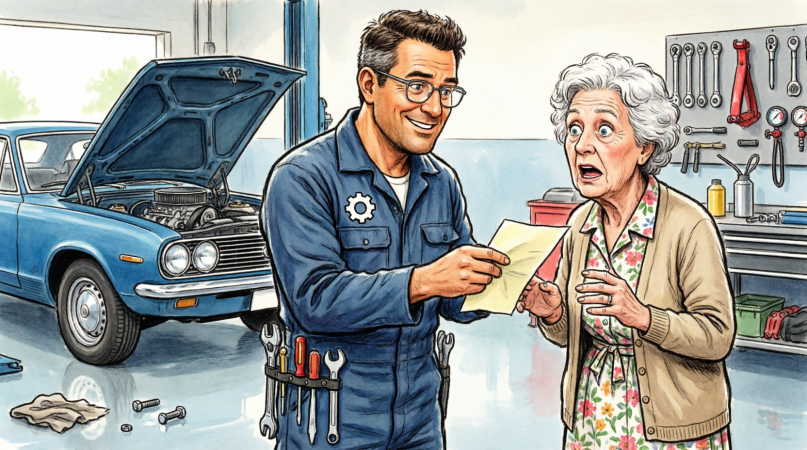
Frank reached deep into the compartment and pulled out a long envelope, wrapped in clear plastic, and a small metal box the size of a notebook. He placed them on the seat with a strange, reverent care, as if he weren’t touching papers but a piece of my husband’s body.
“What is that?” I asked, though my voice barely came out.
“What George asked me to keep until you came with the key,” he replied.
“And why didn’t you tell me sooner? Why did you hide it like this?”
Frank rubbed the back of his neck.
“Because your husband didn’t trust the people in his house anymore.”
That sentence hit me harder than the emptiness of the garage.
The people in his house.
My son.
Me.
Our table.
Our walls.
Our grief.
I approached the car with weak legs. I reached down my blouse and pulled out the black key I found in George’s nightstand. The old label scratched my fingers:
“For when Teresa knows the truth.”
I set it next to the little box.
“You open it,” I murmured.
Frank shook his head.
“No. This was between the two of you. I just kept my promise not to let it get lost.”
I looked at the small lock. The key slid right in. It turned without resistance. The lid opened.
Inside, there were three things.
A bundle of documents folded with old rubber bands.
A silver USB flash drive.
And a photo.
I picked that up first, because sometimes the body chooses which truth it can handle first on its own.
The image was a bit worn at the edges. George was in it, younger, with his beard still black and a smile I hardly ever saw on him after he got sick. But he wasn’t alone. Next to him was a man in a suit, dark-skinned, with a trimmed mustache, and between the two of them, they held the keys to the same blue Chevy, freshly painted, shining like a promise.
On the back, in George’s handwriting, was a single sentence:
“The car wasn’t the prize. It was the proof.”
I felt a punch to my chest.
“Proof of what?” I whispered.
Frank didn’t answer right away. He looked toward the gate, toward the street, toward nowhere and everywhere at once, like a man who fears even the walls are listening.
“Open the envelope, Mrs. Thompson.”
I did.
Inside were deeds, bank receipts, a life insurance policy I had never seen before, and copies of deposits made over nine years to an account I didn’t recognize. They all came from another account, in the name of a company: Gulf Coast Transport Inc.
George never owned a company with that name.
My husband was a mechanic, then a parts manager, then a driver for a small delivery line, and, when he could, he got into buying old cars to resell the parts. We never had extra. Never. I sewed dresses for other people to make ends meet for the electric bill, the gas, and David’s schooling. Where did that money come from, then?
I kept looking until I found a page folded in four with my name written on the outside.
Teresa.
Just that.
I recognized my husband’s handwriting instantly. My eyes filled with tears before reading a single word.
I opened the letter.
“Teresa:
If you are reading this, it’s because I didn’t have time to explain anything to you, and because someone in the house beat me to what I wanted to do. Don’t be scared right off the bat. Breathe. The first thing you need to know is that the car wasn’t sold by chance. David knew there was something inside, even if he didn’t know exactly what.”
My hands went numb.
“No…” I said out loud, but I was already reading the next line.
“Two years ago, I heard David talking to Chloe about ‘what the old man was hiding in his blue relic.’ I pretended not to hear. Later, I saw that he started checking the garage when he thought I was asleep. He never found the compartment, but he understood the car was worth more than it looked. That’s why I made you promise no one would sell it. It wasn’t just out of nostalgia.”
I had to sit in the passenger seat because my legs couldn’t hold me anymore.
Frank locked the door to the shop.
“Your son knew?” he asked.
I looked up, but I couldn’t answer immediately. Because it’s one thing to suspect that a son is selfish, lazy, ungrateful. It’s another to read, in his dead father’s handwriting, that maybe he was snooping around the corpse before it even got cold.
I kept reading.
“The second thing you should know is that I wasn’t as broke as I made you believe. I did work my whole life, we did struggle, we did go without. But eleven years ago, something happened that I never knew how to tell you without driving the house crazy: I witnessed a transport accident in Florida, I helped pull a man alive from the semi, and that man turned out to be the owner of the company whose deposits you see there. He wanted to reward me. I didn’t want to accept it at first. Then I thought about you. About our old age. About the fact that David lacked character and had too much hunger for money. About the fact that if I left that out in the open, they would ruin us. So I accepted it in secret.”
I felt a strange heat, as if someone had slapped me with one hand and caressed me with the other.
My husband.
Saving money for me.
Hiding it from me.
Protecting me.
Lying to me, too.
What an ugly mixture love can be when it comes dressed in silence.
“I won’t be mad if you hate me for not telling you. I hated myself too. But if I spoke up, David would find out. And ever since he met Chloe, he doesn’t look at me like a son anymore. He looks at me like an heir.”
I clutched the paper.
I didn’t want to keep going, but I had to.
“On the flash drive are the videos, the bank statements, and the recording where I heard David say that if I died before selling the Chevy, he was going to take it out ‘even if the old lady threw a fit.’ Forgive me for writing to you like this, but I need you to see the whole picture so his little repentant boy face doesn’t break your heart again.”
A small, humiliating whimper escaped me.
Every mother has a corner of her soul where she still keeps the four-year-old boy, even if he stands in front of her turned into something else. George was asking me not to look at that corner. To look at the man.
I went on.
“The third thing, Teresa, is the most important: the insurance policy does not have David as the beneficiary. You have it. The car, the account, and the policy are all part of the same private trust that Mr. Miller set up for me when I survived and saved him. Frank knows where the first copy is. The second one is on the flash drive. The third one, if it still exists, is with Miller’s accountant in Atlanta. Don’t go alone. Don’t trust David. And if the boy has already sold the car, it means he’s not coming alone.”
I looked up.
“He’s not coming alone?”
Frank clenched his jaw.
“Chloe wasn’t the one who convinced him. She just barely caught the scent of the money. The problem is something else.”
I wiped my face with the back of my hand.
“What problem?”
He pointed to the silver flash drive.
“That will be better understood in there.”
I didn’t want to understand better. I wanted reality to shrink. I wanted the car to be back in the garage, for David to be twenty again and still praise his father when he popped the hood. I wanted to return to yesterday’s miserable ignorance. I couldn’t.
I tucked the letter into my blouse and handed him the flash drive.
“Do you have a computer?”
Frank nodded and led me to a small office at the back of the shop. A metal desk. A fan that made more noise than air. An old calendar with a girl in a bikini next to a Michelin tire. A slow, but working, computer. He turned it on without saying a word.
It took an eternity.
I took the opportunity to open the policy. My hands were still shaking. The name was clear. Sole beneficiary: Teresa Thompson, widow of Sullivan. The amount made my body go numb.
One million dollars.
One million.
I had cried entire nights over not knowing if I could pay for insulin, property taxes, or David’s school uniforms. And George had that hidden for me, in the form of a car I thought was pure memory.
The computer finally opened the flash drive.
There were several folders.
ACCOUNT / POLICY / AUDIO / VIDEO / IF DAVID ALREADY SOLD THE CAR
That last one seemed to be staring at me.
I opened it.
There was only an audio file and a scanned note.
The note said:
“Frank: if Teresa comes for this, don’t let her go alone. And if David shows up first, call Warren. He’ll know.”
“Who is Warren?” I asked.
Frank didn’t move.
“Miller’s accountant. The one in Atlanta.”
I opened the audio file.
At first, there was the sound of plates, silverware, and very faint country music playing in the background. Then David’s voice.
My David.
Younger, drunker, clearer than I ever wanted to hear.
“My old man thinks that car is pure sentimentality, but he’s attached to it for a different reason,” he said, laughing. “He’s definitely hiding something. If I hit it right, as soon as the old man croaks, I’m taking that Chevy out and seeing what I find.”
Another voice, female.
Chloe.
“Your mom is going to throw a fit.”
David let out a laugh.
“My mom is good for crying, Chloe. Not for getting in the way.”
The audio kept playing, but I already felt the world breaking apart.
I didn’t stop it. I had to hear it all the way to the end.
“Besides, that notary who came by once didn’t go into the house; he went straight to the garage. There’s something in there. My old man wouldn’t guard it so much just out of love for the metal.”
Then Chloe said something that completely froze me:
“Well, hurry up, because if your dad gets ahead of you and leaves something to your mom, we’re screwed.”
The audio cut off with the sound of clinking glasses.
I stared at the screen as if they had just shown me an autopsy.
My son.
He wasn’t impulsive.
He wasn’t ignorant.
He wasn’t a fool who sold an old car to go on a trip.
He had been waiting for George to die so he could get his hands on what he thought was hidden.
Frank placed a glass of water in front of me. I didn’t take it.
“How long ago did you hear this?” I asked.
“Almost two years ago. George brought it to me. He told me he didn’t know anymore if he was raising a son or surviving next to a thief.”
Something broke inside me with that sentence.
Because George never spoke to me about David like that. Not even when he took money from his pants at seventeen. Not when he stood him up at the hospital. Not when he found out he failed out of his third major. He always excused him a little. He always found a crack to keep calling him a boy and not a lost man.
If he wrote that, it was because he truly reached his limit.
“Why didn’t you tell me anything?” I whispered.
Frank leaned against the desk.
“Because he was certain you wouldn’t want to see it. And he was right, if you’ll pardon me saying so. Women like you love first and doubt later. George thought that if he told you, you’d confront him, David would play the victim, and everything would be lost prematurely.”
I looked down.
How ugly it is to hear a truth you recognize immediately.
“What do I do now?”
Frank opened the policy folder and then another one with bank statements.
“First, don’t go back to your house alone. Second, don’t tell David you know this yet. Third, we need to make copies of everything and talk to Warren before your son tries to move anything else. If he sold the car that fast, he surely already talked to someone who promised to turn paper into money.”
I nodded, but barely.
My mind was elsewhere.
On George.
On his silence.
On that impossible mixture of care and distrust.
On the promise he wrung from me about the blue Chevy without ever telling me the true size of what he was protecting.
“Did my husband know he was going to die?” I asked.
Frank looked down.
“Yes. And he knew David wasn’t going to wait long.”
There was a long silence, broken only by the fan and the country music from the store next door.
I squeezed the flash drive in my hand.
“I want to see the car again.”
We went back out to the main shop.
The blue Chevy was still there, quiet, dignified, wounded in a taillight but whole. I put my hand on the hood and felt such a strong rush of tenderness it almost bent me in half.
“Forgive me,” I murmured.
I didn’t know if I was saying it to the car, to George, or to myself.
Frank cleared his throat behind me.
“There’s something else.”
I turned around.
“More?”
He pointed to the glove compartment.
“When I opened the compartment, I found this too. I didn’t show it to you until you heard the audio.”
He pulled out a small clear baggie. Inside was a larger, gold key, with a new label, not old like the one from the nightstand. It said:
“B-14 / Chase Bank.”
I looked at it, not understanding.
“What is that?”
Frank licked his lips.
“A safe deposit box. George told me that if David sold the car before you knew the truth, then it meant they weren’t just going after the policy anymore. They were going after something older.”
I felt the air change again.
“Something older?”
His look grew strange. Not sad. Cautious.
“Something that has to do with your husband’s death.”
I stared at him.
“George died of cancer.”
Frank paused for just a second, but it was long enough.
“Yes, Mrs. Thompson. But that doesn’t mean they let him die in peace.”
The phrase hit me like a bucket of dirty water.
Everything in me wanted to reject it.
George screamed in pain. George wasted away. George smelled of medicine, IVs, old sheets, and the end. What did Frank mean by that?
“Speak clearly,” I demanded.
He lowered his voice.
“Warren suspected someone rushed certain movements before George died. Changes in accounts. Inquiries about the policy. Calls to the shop asking about the car. All of that happened when your husband couldn’t even get out of bed anymore. Someone was waiting.”
I thought of David.
I thought of Chloe honking the horn without getting out.
I thought of the smile with which he said “we’ll talk later, Ma.”
I felt sick. But also something else.
Fear.
Because if David had managed to get his hands in before George died, then someone else was guiding him. My son never had the brains for that much. Hunger, yes. Cunning, no.
“Who taught him where to look?” I asked.
Frank opened his mouth to answer.
He didn’t get the chance.
Outside, on the street, a short honk sounded.
Then another.
Then footsteps.
Several.
They were approaching the gate.
We looked at each other at the same time.
Frank turned off the fan motor.
The shop fell into a silence of sheet metal and breathing.
The footsteps stopped right outside.
A woman’s voice, clear, sing-songy, impossible to mistake, said:
“Mother-in-law, we already know you’re in there. You better open up before this gets ugly.”
Chloe.
I felt the blood drain to my feet.
Frank looked at me.
“I didn’t tell anyone.”
I hadn’t said anything either.
Then the cell phone in my purse rang.
Unknown number.
I answered with an icy hand.
It wasn’t David talking.
It wasn’t Chloe talking.
It was a man’s voice, hoarse, unfamiliar, with the calmness of someone who has already decided you owe them obedience.
“Mrs. Thompson. Do not go out the front. Your son didn’t come alone… and box B-14 is no longer empty.”
PART 3:
My blood ran cold.
“Who is this?” I asked in a whisper.
On the other end, there was barely a breath, as if the man were measuring how much he could tell me before they reached him too.
“Someone who owes Mr. George a favor,” he replied. “Don’t argue. Don’t go out the front. Your son brought two men, and one of them didn’t come to talk. Leave through the back exit of the shop and do not let go of the gold key.”
“Who are you?”
“When you get to the St. Raphael building, look for me by the newspaper racks. Ask for Warren. And, Mrs. Thompson… don’t even trust David’s tears.”
The call dropped.
I stood there with the phone pressed to my ear, listening to nothing, while outside Chloe knocked on the gate with her knuckles.
“Mother-in-law!” she sang out again. “We don’t want to scare you, we just came to talk.”
Frank was already closing the metal blinds in the office, turning off another light, moving with a speed I didn’t know he had.
“Let’s go,” he said.
“And you?”
“I’m staying ten seconds longer. Just enough to make them think someone is still in here.”
I looked at him, terrified.
“No.”
He held my gaze with a strange patience, like an older brother.
“If you stay, everything George hid is lost. And I didn’t carry this for so many years just so David could come and take it with the face of an offended little boy.”
David again.
My son again, in the mouths of others, as if he were no longer a son, but a threat.
A louder bang echoed against the gate.
Then David’s voice, loud, feigning calmness:
“Ma, open up. We already know Frank is in there. Don’t make the problem bigger.”
That phrase cut something inside me.
“Don’t make the problem bigger.”
As if the problem were me hiding in a shop. As if the problem wasn’t that I had just heard his voice wishing his father dead so he could pick through his car like a vulture picking at ribs.
Frank practically pushed me down a narrow hallway behind the tire storage. It smelled of rubber, stale gasoline, and dampness. At the end was a sheet metal door leading to an alley. He opened it just a crack.
“Walk two blocks toward the avenue and call a cab at the pharmacy,” he told me. “Not on the corner. They’re watching there. When you get to the St. Raphael building, don’t go through the lobby. Go through the underground parking garage. Box B-14 is in basement level two.”
“How do you know?”
Frank clenched his jaw.
“Because George didn’t hide things. He hid routes.”
A crash sounded on the other side of the shop. Something metallic. Maybe the gate. Maybe a tool thrown against the floor. Chloe stopped playing sweet.
“Open the damn door! We don’t have time!”
I felt my legs give out.
Frank grabbed my arm.
“Mrs. Thompson, listen to me. If David already knows about the car, then someone told him where to look next. The box isn’t empty because someone got there before you… or because someone left something inside for him. Both options are bad. But one can still be beaten.”
I wanted to ask him how.
I couldn’t.
The noise at the front grew. Men’s voices. A kick. Another.
Frank gently pushed me toward the alley.
“Walk.”
I stepped out.
I didn’t run at first. At my age, you know that running draws more attention than walking with fear. I crossed the alley with my purse clutched to my chest and the gold key squeezed in my palm. Halfway down the block, I looked back.
I barely saw the blue reflection of the Chevy through the crack of a high window. It hurt to leave it there, as if I were abandoning George all over again. But I kept going.
At the pharmacy, I ducked between shelves of cheap shampoo and electrolytes. I pretended to look at some blood pressure pills while, through the window, I watched a black SUV drive slowly by. I couldn’t make out anyone inside. When it disappeared, I called a cab.
“Where to, ma’am?” the driver asked.
I thought for a second.
If I said “St. Raphael” and someone was listening…
“To Atlanta,” I blurted out.
The man turned around.
“Downtown Atlanta?”
I nodded.
“It’s gonna cost you.”
“It’ll cost me more to stay.”
I got in.
I don’t know at what point I started crying. I only realized it when the driver handed me a box of tissues without looking at me in the rearview mirror.
“Are you running from someone?” he asked.
“From my family.”
He let out a sad laugh.
“Those are the worst kind.”
I didn’t speak again for an hour.
The highway swallowed the afternoon. Gray houses, beer billboards, tire shops, bridges, fruit stands—the whole country carrying on as if my world hadn’t just shattered. I carried George’s letter against my chest, the policy in my purse, the B-14 key in my hand, and in my head, David’s voice saying I was only good for crying.
That phrase hurt me more than anything else.
Because it was true that I cried.
I cried when he fell off his bike at six and busted his eyebrow. I cried when he got typhoid fever at eleven. I cried when he failed out of high school and George pulled him out of the pool hall by his shirt. I cried when he married Chloe, thinking love would fix him. I cried when he let his father carry the oxygen tank alone. I always cried. He always learned that I forgave.
Maybe that’s why he dared to do this.
We arrived in Atlanta right around dusk. I asked the driver to drop me off two blocks before the St. Raphael building. It wasn’t a hospital, as I thought when I heard the name. It was an old office building with a beige facade, a slow elevator, and an underground parking garage that smelled of dampness and old paint.
I walked down the ramp, just as Frank had said.
There was a security guard watching videos on his phone. He didn’t even look up when I walked by. I went down a narrow staircase to basement level two. That’s when my stomach tied in knots. The place was cold, silent, with a row of numbered metal doors. It looked like the closed mouth of a poor man’s bank.
B-14 was at the very end.
I didn’t run toward it.
I walked slowly, hearing my own footsteps as if they weren’t mine. When I reached it, I inserted the gold key and turned it.
It opened.
It wasn’t empty.
There was a burgundy folder. A manila envelope. And an old-school black tape recorder. On top of it all, a handwritten note:
“If Teresa got here first, there is still a way. If David got here, it’s too late.”
My knees buckled.
I opened the burgundy folder.
The first thing I saw was a copy of George’s death certificate. Then another page. Then another. All with stamps. All with signatures. All dated from his final weeks. And then I found something that made me feel like the entire basement was tilting.
Lab results.
Two versions.
One said advanced cancer, metastasis, guarded prognosis.
The other, with the exact same date, spoke of controlled progression, favorable response, and still-viable treatment.
Both bore my husband’s name.
“No…” I murmured.
I kept looking through them with freezing hands. There were transfers to a private clinic. There was a policy adjustment contract dated six days before George died. There were consultation records made when he couldn’t even get out of bed.
And there was a signature.
David’s signature.
Not one.
Several.
As a representative.
As an authorized party.
As primary caregiver.
I couldn’t breathe.
I thought during those days David barely showed up. He’d arrive late, smell like cigarettes, kiss his forehead, and leave saying he “couldn’t bear to see his dad like that.” I thought he was a coward. I never imagined he was also signing things while I slept sitting up next to the bed.
I opened the manila envelope.
Inside was a photo of George in the hospital, asleep, with an IV in his arm. Behind him, almost out of frame, was David talking to a man in a lab coat. On the back, someone had written:
“Dr. Zimmerman — private oncology — friend of Chloe’s.”
I felt nauseous.
The tape recorder was the last thing.
I hesitated to press play.
I did.
First, there was a hum. Then George’s voice. Much weaker than in the letters. Much closer to death.
“Warren, if you’re listening to this with Teresa, it means I didn’t have time to tell her everything… or that David beat me to it.”
I covered my mouth.
The recording continued.
“I don’t know how much time I have left, but I don’t think I’m going this fast just from the cancer anymore. Ever since David started bringing me my night pills, I sleep weird. It’s hard to wake up. The insurance doctor said one thing. The private one said another. And then Chloe showed up recommending Zimmerman like she was doing us a favor. I don’t like how they look at me when they think I can’t hear.”
My eyes clouded over.
“I’m not accusing them out of anger,” George continued. “I’m accusing them because I saw David taking pictures of the policy when he thought I was asleep. I saw Chloe talking to Zimmerman in the hallway. And one day I heard the whole sentence: ‘If he fades out before the change, we collect everything.’ I don’t know if they were talking about me. But I don’t have enough innocence left to think otherwise.”
I doubled over the tape recorder as if the voice could come out and hold me.
David.
My son.
He wasn’t just a petty inheritance thief. He was close to something much worse.
The recording ended with George coughing and saying, almost in a sigh:
“Terry, if you made it this far, forgive me for leaving you alone with this. But I’d rather you hate me for keeping quiet than have them bury you for being too trusting.”
I sat motionless.
I don’t know for how long.
Until I heard footsteps behind me.
I spun around.
It wasn’t David.
It was a slender man, in his fifties, dark jacket, glasses, graying at the temples. He didn’t have the face of a mugger or a bureaucrat. He had the face of someone used to looking at numbers and funerals with the same calmness.
“I’m Warren Vance,” he said. “Frank warned me late. I already saw the SUV outside.”
I felt my entire body go on guard.
“What SUV?”
Warren looked toward the basement hallway.
“Your daughter-in-law’s. And another one. They arrived ten minutes ago. That’s why I came down the service stairs.”
My throat went dry.
“Did they follow us?”
“Or they guessed right. Doesn’t matter which. They’re already here.”
I clutched the key, the folder, my purse, everything.
“What do we do?”
Warren took the burgundy folder, flipped through it quickly, and nodded with a hardness that confirmed the worst.
“With this, we can block the policy, freeze the payout, report the doctor, and fight the probate. But there is something more delicate.”
“What?”
He looked right at me.
“George wasn’t the only hidden beneficiary of Miller’s trust.”
I felt that double blow again: fear and exhaustion.
“Then who else?”
Warren opened the last section of the folder and showed me a separate page, signed by the owner of the Florida company.
Two names.
George Thompson.
And…
David Thompson.
My heart sank into my shoes.
“I don’t understand.”
“Your husband put him in years ago,” Warren said. “As a protégé. As a way to educate him with monitored money. The problem is that David only discovered the money part. He never understood the conditions.”
“What conditions?”
Before he could answer, a metallic bang sounded upstairs, on the basement door.
Then another.
Then Chloe’s voice, filtering down the stairwell:
“Mother-in-law! We already know you opened the box! Don’t make this harder!”
Warren slammed the folder shut.
“The main condition is that David only collects if you sign while you’re alive.”
The world went completely still.
Then everything clicked into place with an ugly clarity that hurt.
That was why they hadn’t done anything to me yet.
That was why they were trying to talk to me.
That was why Chloe called me mother-in-law with a honeyed voice.
They didn’t just want the car.
Or just the policy.
They wanted me.
My signature.
My fear.
My habit of forgiving.
The basement door rattled again.
Warren grabbed my arm.
“There’s another exit through the dead archives. But if we leave, we can no longer think David is just coming out of necessity. He’s coming with authorization. And someone has been guiding him since long before George fell ill.”
“Who?” I asked.
Warren didn’t answer right away.
He reached into his inner suit pocket, pulled out a crumpled card, and placed it in my palm.
I read the name.
Attorney Alice Miller.
Underneath, a handwritten note:
“The first call about the policy came from Teresa’s house. But David wasn’t the one who made it.”
I looked up, freezing.
“Then who?”
Warren swallowed hard.
The door upstairs groaned with a loud crash.
The voices were getting closer.
And right when he opened his mouth to answer me, I recognized another voice mixed with Chloe’s and David’s.
A woman’s voice.
A voice I had known for thirty-two years.
My sister Julie’s.
And in that moment, I understood that betrayal hadn’t entered my house with Chloe.
It had been sitting at my table since long before that.