“Move!”
The command cracked through the Anchor’s Rest a split second before the impact came.
A heavy boot slammed into the leg of a wooden chair, and the chair flew sideways across the stained floor.
The woman sitting in it went down hard, shoulder striking first, one hand catching the edge of the table in time to keep her skull from smashing into the corner.
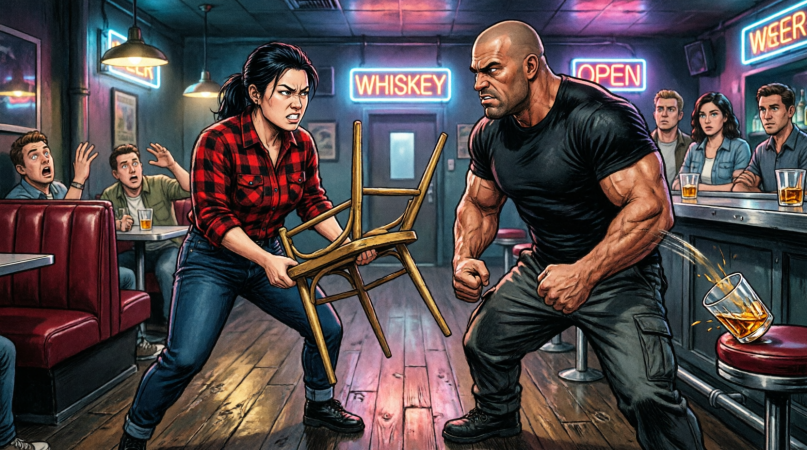
The bar stopped breathing.
Conversations broke off in pieces.
A man at the pool table froze with his cue in midair.
A server carrying two baskets of fries stopped so suddenly one of the paper liners fluttered onto the floor.
Even the jukebox seemed to dull under the colored neon, the song thinning into something far away and wrong.
Standing over the fallen chair was Gunnery Sergeant Marcus Crawford.
Most people called him Bull, and no one in Jacksonville had ever had to ask why.
He was six-foot-three, broad through the shoulders, thick in the jaw, thick in the neck, and thick with the kind of confidence that came from years of being the loudest man in every room he entered.
His face was flushed from whiskey and approval.
His grin was all appetite.
“Stay down, sweetheart,” he said, glinning at the room more than at the woman on the floor.
“This place is for real warriors.
Not little girls playing soldier.”
A few men at his table laughed because that was what they always did when Bull performed.
The woman on the ground did not answer right away.
She shifted once, tested her weight, and touched the split in her lip with the tip of her tongue.
The taste of blood spread bright and metallic through her mouth.
Not much.
Enough to notice.
Not enough to matter.
Then she stood.
It wasn’t dramatic.
That was the strange thing.
She rose with the kind of control that made the whole scene feel more dangerous, not less.
No shaky anger.
No wild rush.
No cursing.
She just came up in one smooth motion, brushed the dust from one sleeve of her dark jacket, and looked directly at the man who had kicked her to the floor.
Captain Alexis Kaine was not physically imposing the way Bull was.
She was lean where he was heavy, compact where he was oversized.
Her dark hair was pulled back cleanly, and there was a stillness in her face that read, at a distance, like composure.
Up close, it read like warning.
“You should leave,” she said.
Her tone was calm enough to make the words feel colder than a threat.
Bull laughed, loud enough to reclaim the room.
“Or what? You gonna cry to somebody? Run to your chain of command? Sweetheart, everyone in this place knows me.
Nobody knows you.”
Behind the bar, Pete Whitman stopped pretending to wipe glasses.
Pete was sixty-two, gray-bearded, and had spent enough years tending bars outside military bases to stop being impressed by rank, muscles, or cheap swagger.
He knew drunks.
He knew fighters.
He knew men who mistook noise for authority.
He also knew when a person had learned how to shut pain out of their face so completely it became part of them.
Alexis had that look.
Bull stepped in and shoved her shoulder with one open palm, rough and dismissive,
like he was moving furniture out of his path.
She let the force take her.
She went down again, controlled even in the fall, her body folding with practiced precision so her head missed the edge of the table by inches.
It looked, to anyone who didn’t know better, like weakness.
To Pete, it looked like choice.
Murmurs spread low and fast through the room.
“What the hell is she doing?”
“Why isn’t she fighting back?”
At Bull’s table, eight younger Marines watched with restless energy.
They were all close-cropped hair and fresh confidence, half-drunk on whiskey and the secondhand thrill of seeing their gunny dominate a room.
A couple of them were smiling.
One wasn’t.
Lance Corporal Diego Reyes had gone stiff in his seat, eyes flicking between Alexis and Bull with a growing confusion he couldn’t hide.
He knew faces.
That was part of how he survived.
Watch the room.
Read the room.
Remember the room.
And he had seen that woman before.
Not in person.
On screens.
In training packets that weren’t supposed to leave briefing rooms.
In stories told in quieter tones by men who had deployed enough times to stop bragging about deployments.
He leaned forward, his pulse kicking once, hard.
No, he thought.
No way.
But then Alexis turned her head slightly, and the overhead light caught the scar just behind her left ear, a pale slash half-hidden by hair.
Reyes’s stomach dropped.
He had seen that scar in a grainy photo attached to a profile package about inter-service command candidates.
The briefing had called her Captain Alexis Kaine, U.S.
Navy.
It had also used another phrase, one the instructor had spoken with obvious respect.
Task Group Blackwater actual.
Legend.
Retired Master Chief Owen Mercer stood from his stool in the corner like someone had jerked him upright by a wire.
Mercer had served thirty years, fourteen of them around Naval Special Warfare, and while he had never worked directly under Kaine, he had watched her walk into rooms full of hardened operators and silence them without raising her voice.
He had seen combat footage with her voice in the background, clipped and clear while everything else turned to chaos.
He had once heard a commander say, in complete seriousness, that Alexis Kaine could end a crisis faster with eye contact than some people could with a platoon.
Now she was bleeding in Pete’s bar while a drunk Marine puffed himself up in front of an audience.
“Marcus,” Mercer said.
Bull didn’t turn.
“Not now, old man.”
Mercer’s face hardened.
“You need to stop touching her.”
That got Bull’s attention.
He glanced back with contempt, then at Alexis, then back to Mercer.
“You know her?”
Mercer held his stare.
“Enough to tell you that you’re making a mistake.”
The room tightened.
A smart man might have read the shift.
The change in breathing.
The way the laughter had vanished.
The way Pete’s expression had gone from annoyance to concern.
The way one or two of the younger Marines had started looking anywhere but at Bull.
Bull was not in a smart mood.
He rolled his shoulders and gave Alexis a long, dismissive look.
“What, she your daughter? She can’t defend herself?”
Alexis finally spoke, still dusting off one sleeve as if the interruptions were
more inconvenient than upsetting.
“He’s trying,” she said.
A small, dangerous sound moved through the room.
Bull’s grin thinned.
“Excuse me?”
She met his eyes.
“You heard me.”
The challenge in her voice was so slight most people would have missed it.
Bull heard it perfectly.
Humiliation is gasoline to a certain kind of man.
Add witnesses, and it becomes an explosion.
He stepped closer until they were only inches apart.
“You think you’re funny?”
“No,” Alexis said.
“I think you’re drunk.”
Several Marines at Bull’s table winced.
That should have been the last chance.
Pete came out from behind the bar, slow and deliberate, palms visible.
“That’s enough,” he said.
“Crawford, you settle your tab and go home.”
Bull spread his hands without looking at Pete.
“I’m not the one causing a problem.”
“You kicked a customer out of a chair.”
“Then throw me out.”
Pete almost did.
But before he could take another step, Alexis lifted one hand slightly—not to Bull, to Pete.
Wait.
It was the barest motion, easy to miss, but Pete stopped.
So did Mercer.
She wanted this to continue.
Not because she enjoyed it.
Because she was measuring something.
Bull mistook the pause for fear.
That was his second fatal mistake.
His first had been putting his hands on her.
He leaned in until the smell of whiskey and aftershave wrapped around her.
“You Navy?” he asked.
“Admin? Public affairs? Some little office where they hand out medals to people who never earned them?”
Alexis said nothing.
Bull smirked, taking her silence as surrender.
“That’s what I thought.”
What he didn’t notice was what everyone else began to notice.
Her hands.
They were relaxed.
Not curled.
Not trembling.
Not hidden.
Just open at her sides, fingers loose, as if she were standing on a range waiting for the signal to begin.
There was no panic in her.
No scramble.
No uncertainty.
Only patience.
Mercer exhaled slowly through his nose.
He had seen that patience before.
It was the look men wore just before a door came off its hinges.
Reyes finally stood from Bull’s table.
He didn’t do it loudly.
He didn’t want attention.
But the scrape of his stool still cut through the room.
Bull glanced over in irritation.
“Sit down, Reyes.”
Reyes swallowed.
“Gunny…
maybe we should just go.”
That landed badly.
Bull stared at him as if he’d been slapped.
“You got something to say?”
Reyes’s face burned.
He looked at Alexis, then at Mercer, then back at Bull.
There were twenty ways to say it and every single one felt like a betrayal.
In the end he chose the one that sounded least impossible.
“I think you don’t know who that is.”
The bar went dead still again.
Bull turned back to Alexis with the slow disbelief of a man who thinks everyone around him has joined some private joke at his expense.
“Should I?”
Alexis’s expression didn’t move.
Mercer answered for her.
“Yeah.”
Bull barked a laugh, but it came out thinner now.
“What is this? Some kind of setup?”
Mercer took a step closer.
“No.
This is me trying to save you from yourself.”
Bull’s jaw flexed.
He could still have walked away.
He could have sneered, tossed cash on the table, and left with enough dignity to
salvage the night.
He could have listened to the warning in Mercer’s voice, or the fear in Reyes’s, or the fact that a woman he outweighed by nearly a hundred pounds had been dropped twice and still looked more in command of the room than he did.
Instead, he made the kind of choice men make when pride matters more than survival.
He reached for her again.
It happened too fast for most people to process.
Bull’s hand shot toward Alexis’s upper arm, aiming to jerk her closer.
She moved before contact fully landed.
One step offline.
One turn of her hips.
One hand trapping his wrist, the other guiding the momentum he had stupidly offered her.
Bull’s balance vanished.
His body kept going where his ego had sent it, but Alexis redirected every pound of him with a terrifying economy of motion.
He hit the floor chest-first with a force that shook nearby tables, his right arm folded up behind him in a restraint so exact he froze from the shock of it before the pain fully registered.
Then the pain arrived.
Bull roared.
Not in rage.
In disbelief.
Because she had not just taken him down.
She had pinned him so completely he could not move his shoulder, turn his head, or get a knee under himself without risking that something important would separate.
And she was doing it one-handed.
The entire bar recoiled in one collective inhale.
Alexis stood over him, one knee lightly against his back, her voice calm enough to hum.
“You’ve had enough,” she said.
Bull thrashed once and stopped the instant her grip tightened.
“Easy,” she said, almost conversationally.
“You’re closer to losing that elbow than you think.”
No one laughed now.
Pete stepped in, stunned but ready.
Reyes looked like his soul had left his body.
Mercer closed his eyes for half a second as if a thing he had expected for ten straight minutes had finally arrived.
Bull sucked in a ragged breath and tried to twist his head toward the room.
“Get her off me!”
No one moved.
Alexis looked at Pete.
“Call the MPs.
And someone from his command.”
Pete nodded at once and reached for the landline behind the bar.
Bull stared up from the floor, face red with pain and humiliation.
“You can’t do this to me.”
For the first time all night, a trace of something sharpened in Alexis’s eyes.
“I didn’t do this to you,” she said.
“You did.”
One of the younger Marines near the end of the table whispered, almost reverently, “Holy hell.”
Mercer answered without looking at him.
“That,” he said quietly, “is Captain Alexis Kaine.”
The name spread through the room like current.
Bull stopped fighting.
Not because he wanted to.
Because his mind had finally caught up.
He had heard the name.
Of course he had.
Anyone around serious operators long enough had heard it, usually attached to stories no one could fully verify because the details vanished into classified fog.
A raid salvaged by impossible improvisation.
A hostage extraction pulled off after another team had failed.
A command climate so brutal, disciplined, and respected that men with stacked combat tours still straightened when she entered.
Bull’s breathing changed.
Shame is a slower burn than pain, but deeper.
“No,” he
said hoarsely, as if saying it could make it untrue.
Alexis eased the pressure only enough to let him breathe normally, not enough to let him move.
“Yes.”
The MPs arrived nine minutes later, though to Bull it probably felt like an hour.
By then the room had settled into that unnerving quiet that follows public ruin.
No one needed to exaggerate what had happened.
Too many people had seen it.
Pete gave his statement.
Mercer gave his.
Three civilians at separate tables confirmed the shove, the kick, the slur, and the second assault.
Reyes, pale but steady, stepped forward and spoke with the clipped honesty of a man choosing his conscience over his comfort.
Bull said very little.
He was still trying to decide which part of the night had destroyed him: the assault, the witnesses, the name, or the fact that every bit of it had happened in front of his own Marines.
Alexis declined medical assistance until after the statements were taken.
Pete brought her ice in a clean towel.
She held it against her lip and sat in the same booth Bull had kicked her from, posture straight, expression unreadable.
Mercer approached carefully.
“You let him push twice.”
She nodded once.
“Why?”
Alexis looked toward the parking lot where the MPs were placing Bull in the vehicle.
“I wanted his men to see exactly who he was before I stopped him.”
Mercer studied her face, then gave a slow, grim nod.
He understood.
A private correction can be dismissed.
A witnessed character failure cannot.
Reyes lingered near the door as if unsure whether he had permission to exist in the room anymore.
Alexis noticed him and tipped her head toward the empty seat across from her.
“Sit down, Lance Corporal.”
He obeyed instantly.
Up close he looked younger than the uniform suggested.
“You stood up,” Alexis said.
He swallowed.
“Too late, ma’am.”
“Still stood up.”
His eyes dropped.
“He’s my gunny.”
“And?”
Reyes hesitated, then forced himself to meet her gaze.
“And he was wrong.”
Something in Alexis’s expression softened by a degree.
“Hold on to that.
There will be moments in your career when rank, reputation, and loyalty all point in one direction and integrity points in another.
Pick integrity early.
It gets more expensive later.”
Reyes nodded like he was receiving something heavier than advice.
By midnight the bar had emptied.
Pete locked the front door and flipped off two of the neon signs, leaving the room washed in softer amber light.
Mercer had gone.
The MPs had gone.
Bull was gone.
Only Alexis, Pete, and the smell of old beer remained.
Pete set a glass of water in front of her.
“You okay?”
She gave him the kind of smile people use when they are too tired for a real one.
“I’ve been worse.”
“You could’ve ended that in the first three seconds.”
“Yes.”
Pete leaned on the table.
“But you didn’t.”
Alexis looked at the melting ice in the towel.
“Men like him don’t usually get corrected by force.
They get protected by noise.
People call them difficult.
Strong personalities.
Hard chargers.
They get chance after chance until someone under them pays for it.”
Pete said nothing.
She continued, voice quieter now.
“Tonight his people saw the whole thing.
Not the version
he would tell later.
The whole thing.
Sometimes that matters more than knocking a man down fast.”
Pete let out a breath.
“You think it’ll stick?”
“For some of them,” she said.
“That’s enough.”
The next morning, the story moved through the base faster than official paperwork.
By noon, Crawford had been relieved pending investigation.
By evening, three additional complaints had surfaced from subordinates who had stayed silent for months.
One involved public humiliation.
One involved threats tied to evaluations.
One involved a shove in a motor pool that had been laughed off at the time and replayed very differently after the bar incident became impossible to ignore.
The commanding officer requested footage from the Anchor’s Rest security cameras.
The footage was crisp.
Too crisp.
Bull’s version of events died before he finished telling it.
He tried once to frame Alexis as the aggressor.
That lasted until someone in legal watched the tape where he kicked her chair, taunted her, shoved her twice, and reached for her again while multiple witnesses tried to intervene.
After that, the tone of everything changed.
For Alexis, the matter was simple.
She submitted her statement, answered the necessary calls, and refused every invitation to dramatize what had happened.
She had no interest in becoming a story.
She preferred ending them.
But stories have a way of spreading when people are hungry for proof that arrogance can still meet consequence.
A week later, Reyes received a message asking him to report to a conference room at 0700.
He arrived ten minutes early and found Alexis there in civilian clothes, standing by the window with a folder in her hand.
He snapped to attention before he could stop himself.
She almost smiled.
“Relax.
Sit down.”
He sat.
The folder in front of her contained transfer recommendations, counseling notes, and an offer she had quietly advocated for after speaking with his command.
Advanced leadership training.
Mentorship.
A path that would separate him from Crawford’s orbit before that orbit did permanent damage.
Reyes stared at the paperwork.
“Why me?”
Alexis folded her hands.
“Because you were afraid and told the truth anyway.
That’s rarer than confidence.
Easier to build on, too.”
He looked at her like he did not know what to do with that answer.
“Don’t waste it,” she said.
Across base, Crawford sat in an office under fluorescent lights, discovering the difference between being feared and being respected.
Men who had once laughed at his jokes no longer returned his calls.
The younger Marines who used to orbit him kept their distance.
Witness statements stacked.
Recommendations shifted.
The informal immunity he had mistaken for strength evaporated under formal scrutiny.
In the end, his career did not explode in one cinematic instant.
It collapsed the way most false structures do.
Piece by piece.
A reprimand.
Relief.
Investigation findings.
Removal from leadership.
The kind of official language that sounds bloodless until it lands on the life of the person who earned it.
The real punishment, though, came from memory.
Because everyone who had been in the Anchor’s Rest that night remembered the same image: Bull Crawford face-down on a bar floor, held in place by a woman he had called sweetheart, while the room realized all at once that the strongest person present had never needed to announce
it.
Two months later, Alexis stopped by the Anchor’s Rest on a Tuesday just after sunset.
Pete looked up from the register and gave a low whistle.
“You know, business picked up after that night.”
She took the same booth without asking.
“Because of the food?”
“Because people like drinking where justice happened.”
That pulled a real smile from her.
Pete set a club soda in front of her.
“On the house.”
The bar was quieter than it had been that first night.
A baseball game played on muted televisions.
Rain tapped softly against the windows.
For the first time, the place felt almost restful.
Mercer came in twenty minutes later and spotted her immediately.
He joined her booth without ceremony.
“Heard Crawford’s done,” he said.
“He is.”
“You satisfied?”
Alexis considered the question.
Outside, headlights moved through the rain and vanished.
Inside, someone laughed near the dartboard.
Pete clinked glasses into a rack behind the bar.
“I’m not interested in satisfaction,” she said.
“I’m interested in whether anybody learned something.”
Mercer snorted softly.
“That sounds exhausting.”
“It is.”
He studied her for a moment.
“You know half the base is telling that story wrong already.
In some versions you broke his wrist.
In some versions he came at you with a bottle.
In one version, absurdly, you made him cry.”
Alexis took a sip of soda.
“Did I?”
Mercer laughed.
“Not visibly.”
For a few seconds they sat in companionable silence.
Then Mercer said, “You ever think about how close it came to going differently? If no one had spoken.
If his Marines kept laughing.
If people just watched.”
Alexis looked toward the rain-streaked windows.
“That’s the part that stays with me,” she said.
“Not him.
The room.
A room decides what grows inside it.
Cruelty, cowardice, courage.
Most people think those decisions happen in huge moments.
They don’t.
They happen one silence at a time.”
Mercer nodded slowly.
That was the aftershock of the whole thing, the part that lingered longer than the takedown or the revelation of her name.
Bull Crawford had humiliated himself the moment he chose power over character.
But the room had been tested too.
Some had frozen.
Some had watched.
Some had warned.
One young Marine had finally stood up.
Maybe that was why the story kept spreading.
Not because a legendary commander had put an arrogant man on the floor.
But because everyone who heard it had to decide which person in that bar they would have been.