“Sold the family beach house for $5 million—thanks for being abroad,” my sister texted me just after midnight in Tokyo.
By sunset two days later, she was in handcuffs on the front steps of the house she had spent half her life insisting should have been hers.
The worst part was not the amount.
It was not even the little laugh at the end of the message, that lazy, poisonous confidence Christine always slipped into her words when she thought she had outmaneuvered someone.
It was the phrase closed on the beach house.
She did not write listed.
She did not write accepted an offer.
She wrote closed.
My hotel room was small and immaculate, all pale wood, precise corners, and rain-softened city light.
Outside the window, Tokyo glowed blue and red under a wet sky.
Inside, the air conditioner hummed while my phone lit my hand like a warning flare.
I read the message three times before my brain finally accepted what my body already knew.
Something impossible had happened.
The house in Kitty Hawk was not just real estate.
It was the closest thing our family had ever had to a permanent version of itself.
My father had taught me to skim stones there.
My mother had taught me to clean shrimp at the kitchen sink while pretending not to be annoyed when sand clogged the drain again.
Even the flaws belonged to us: the screen door that never quite shut, the salt-stiff curtains, the drawer full of bent spoons nobody could explain but nobody threw away.
Before resentment, before illness, before money turned every conversation into a scorecard, that house had been where Christine and I were simply sisters.
Seven years earlier, my father’s Alzheimer’s diagnosis changed the meaning of everything.
What had been a family home suddenly became an asset at risk.
My mother, who had always been calm in emergencies and frantic in ordinary life, marched us into James Patterson’s office with a legal pad full of questions.
She wanted the house protected from medical debt, probate confusion, and what she called the slow machinery of disaster.
James explained options.
My mother listened, asked sharp questions, and in the end said she wanted the deed transferred cleanly into one child’s name.
Mine.
I objected immediately.
I told her Christine would see it as betrayal.
I told her it would split something we might never repair.
My mother looked at me with the exhausted clarity of someone who had no energy left for family theater.
She said, “Nicole, you’re the one who handles things.
You always have.”
Christine heard every word.
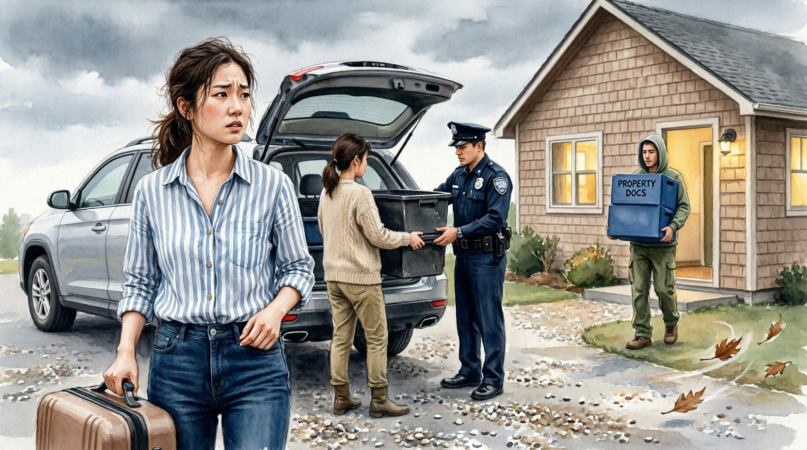
In the parking lot afterward, with heat bouncing off the asphalt in waves, she leaned close and said, “Must be nice being the good daughter.” It was almost casual.
Almost a joke.
But it was also the moment I should have recognized as a warning.
We had entered a season where nothing would ever be simple again, and Christine had already decided the story in her head: I had been chosen, and she had been denied.
That was never how it felt from my side.
Being on the deed did not feel like winning.
It felt like inheriting a second unpaid job.
I was the one who drove down after storms to check the roof.
I was the one who coordinated repairs, tracked taxes, answered insurance questions, and sat across from accountants explaining my father’s decline.
Christine loved to say I controlled everything.
What she meant was that I handled everything nobody else wanted.
The night she texted me from North Carolina, I called her immediately.
She sent me to voicemail.
That did not surprise me.
Christine preferred texts because texts let her perform power without absorbing reaction.
She could say something monstrous and then disappear into silence.
I called James Patterson’s office next.
The after-hours service took my message.
I paced my hotel room, called again, and reached a woman whose voice went guarded the moment I gave my name.
She said James had been trying to reach me.
That was the first moment real fear arrived.
Not anger.
Not disbelief.
Fear.
When James came on the line, he did not waste time.
Somebody, he said, had forced a closing through with forged documents.
A power of attorney carrying my name.
A transfer packet his office had never drafted.
A fake email account impersonating me.
He had already contacted the title insurer, the county register, and the sheriff’s office.
I asked him how any of it had gone through.
He said the first crack appeared when the buyer started renovation work less than twenty-four hours after closing.
It was a cash deal, rushed from offer to funding with the kind of speed that only happens when someone is paying more than asking and everyone in the room decides not to be difficult.
The buyer, a Raleigh businessman named Mark Hollis, had sent a foreman to the house to measure the kitchen and inspect plumbing before a full remodel.
While looking for the main shutoff, the foreman opened the locked owner’s closet.
At the top was a blue fireproof box my mother had kept for years.
Inside were copies of the recorded deed, flood insurance records, tax bills, vendor contracts, maintenance logs, and my father’s asset-protection file.
At the bottom was a letter from James’s office stating plainly that title to the property was vested solely in Nicole Brennan.
There were seven years of tax receipts paid from my account.
Insurance renewals in my name.
Permit records in my name.
Service contracts in my name.
Even a note from my mother reminding me where the hurricane shutters were stored was addressed to me.
The foreman thought he had discovered an ownership dispute.
He called the number on James’s letterhead before he touched another cabinet.
That was the moment the sale began to collapse.
I booked the first flight I could get out of Haneda.
I packed badly and too fast, shoving clothes and project folders into my suitcase with the blunt panic of someone trying to outrun a nightmare using zippers.
James told me not to respond to Christine.
He said every text mattered now.
He said I needed to get home, sign a statement, and let law enforcement do the rest.
Christine did not stay quiet.
While I crossed the Pacific, messages piled up on my phone.
At first she was still triumphant.
Then she became argumentative.
Then wounded.
Then vicious.
Mom agreed.
Dad wanted this.
You don’t even live here.
I’m the one who stayed.
You’ve been controlling this family for years.
Don’t
embarrass us now just because you lost control.
That last sentence told me more than everything before it.
In Christine’s mind, this was not theft.
It was correction.
She believed she was taking back something that had been unfairly placed in my hands.
At my layover, James called again with more detail.
The false closing packet included a scanned signature lifted from an old repair authorization I had signed years earlier.
The email account impersonating me differed from my real address by one character.
The mobile notary now claimed she had verified my identity remotely because I was overseas.
She sounded less convincing, James said, every time someone asked follow-up questions.
The title clerk who approved the file had already retained counsel.
There was also one devastating fact Christine had not accounted for.
At the exact time I was supposedly executing documents in North Carolina, I had been inside a restoration planning session in Tokyo.
My employer had badge scans.
The temple office had security footage.
Twelve colleagues had signed the session log.
My passport and travel records did the rest.
By the time I boarded my connection home, the fraud had a shape.
My mother’s voicemail reached me when I landed.
She was crying so hard I had to replay it twice.
She said Christine told her I had agreed to everything by email.
She said she thought the papers she signed were routine transfer acknowledgments and tax forms.
She said deputies were at the house because Christine had driven back there with empty bins and said she needed to collect family documents before lawyers got involved.
James met me before I even left the terminal.
He looked ten years older than he had a week earlier.
With him was Sheriff Dalton, broad-shouldered, careful-eyed, and calm in the way people get when they have seen too many family disasters to be surprised by one more.
We drove first to the county office so I could sign a sworn affidavit.
I remember the fluorescent lights, the stale coffee smell, and how strange it felt to watch my own name become evidence.
From there we drove to Kitty Hawk.
The sky was low and white when we crossed toward the island, the ocean on one side, sound waters on the other, everything looking exactly the same as it had looked a hundred times before and nothing feeling remotely familiar.
I kept expecting anger to hit me full force, but what I felt most was grief.
Not only for the fraud.
Not only for the risk.
For the fact that my sister had reached the point where she could sit in a closing, impersonate me, take millions, and still believe she was the wronged one.
Mark Hollis was waiting when we arrived.
So was his foreman, a square-handed man named Luis who kept apologizing as if he had done something wrong by opening a closet.
Through the front door I could see the kitchen half torn apart.
Cabinet doors leaned against the wall.
Protective paper covered part of the floor.
The house looked like a patient cut open before the surgeon realized it was the wrong body.
The blue fireproof box sat on the island.
I knew it instantly.
Dented corner.
Rusting hinge.
Sticky latch.
My mother had once painted a tiny
seashell inside the lid with white nail polish because she was afraid she would mix it up with an ordinary lockbox.
Luis had laid everything out neatly.
The deed copy.
The tax bills.
Insurance paperwork.
My father’s legal file.
James’s letter.
Every document that should have made Christine stop before she crossed the last line.
Mark looked sick.
He kept saying he had no idea.
He had dealt with Christine, the title company, and a broker who was now refusing to return calls.
He had assumed everything was clean because money at that level usually comes with competent paperwork.
James was kinder to him than I expected.
He told Mark the title insurer would have to make him whole.
Mark did not look relieved.
He looked ashamed to be standing in someone else’s family wreckage.
Sheriff Dalton stepped outside to take a call from one of his deputies.
When he came back in, his expression had changed.
“She’s on her way,” he said.
My first thought was that he meant my mother.
He did not.
Christine, apparently, had told someone she needed to retrieve personal items from the house before things got complicated.
A deputy had spotted her SUV at a convenience store a mile away, bins stacked in the back.
Dalton looked at me and asked quietly whether I was willing to make the complaint official now that I was physically present and had reviewed the documents.
I said yes.
He nodded once, stepped back onto the porch, and made a call.
A minute later, through the front window, I saw Christine’s SUV turn into the driveway.
She slowed when she noticed the sheriff’s vehicle.
For one sharp second I thought she might reverse and run.
Dalton raised a hand for the others to stay back, then spoke into his phone as it rang.
I could not hear Christine’s side, only his.
His voice was even, almost polite.
“Christine Brennan? This is Sheriff Dalton.
Ma’am, do not leave that vehicle.”
She must have said something frantic because his face hardened.
Then he said the sentence I had already heard in my head a hundred times since Tokyo.
“Ma’am, you’re under arrest for fraud.”
Christine stepped out anyway.
When she saw me standing in the doorway, jet-lagged, salt wind in my hair, one hand still resting on the frame of the house she had tried to sell out from under me, her whole body changed.
Not guilt.
Not shock.
Fury.
Pure, blinding fury.
“This is because you can’t stand not controlling everything,” she snapped, as deputies moved toward her.
“You stole that house first.”
I walked down the steps before anyone could stop me.
“I didn’t forge your name,” I said.
My voice surprised me by how steady it sounded.
“I didn’t pretend to be you.
I didn’t sell something that wasn’t mine.”
“Mom wanted the money,” she shot back.
“Dad needed care.
You were gone.
You’re always gone.”
The deputies turned her gently but firmly toward the vehicle.
She twisted once, looking for me over her shoulder.
“I was the one who stayed,” she said, and that was the line that broke something in me—not because it was entirely false, but because she had turned every sacrifice anyone had ever made into a weapon she felt entitled to use.
The investigation moved faster after the arrest.
Once Christine realized the evidence was overwhelming, details spilled out in layers.
She had been deep in debt from a failed boutique, unpaid taxes, and a boyfriend who had vanished after borrowing heavily in her name.
She had found one of my old signatures in a home-repair file, copied it, and built the rest around that theft.
She created a false email account, told the title company I was overseas and hard to reach, and convinced my mother that I had approved everything in advance because selling the house was the only practical solution.
My father, by then, was too impaired to understand what was happening.
The notary claimed she had participated in a remote verification she now could not properly document.
The title clerk admitted the closing had been rushed under pressure because it was an all-cash transaction.
The broker disappeared for a week before resurfacing through counsel.
None of that saved Christine.
Forgery was forgery.
Fraud was fraud.
Obtaining property by false pretenses was still theft even when the person committing it insisted it was family business.
The money became its own long ugly trail.
Some of it had gone into Christine’s account.
Some into a joint account my mother barely monitored.
Some had already been used to pay private debts Christine had hidden from everyone.
The title insurer refunded Mark Hollis and went after every possible party to recover losses.
James filed what needed filing.
The county voided the fraudulent transfer.
Legally, the house had never stopped being mine.
Months later, Christine pleaded guilty.
She avoided a trial, but not consequences.
She owed restitution.
She lost the fantasy that outrage could substitute for innocence.
The judge said something I still think about: family resentment did not convert fraud into fairness.
Christine cried when she heard the sentence.
I did not.
My mother apologized so many times the words began to sound bruised.
What hurt most was that she had believed Christine when Christine said I had approved the sale.
Not because she trusted Christine more than me, but because by then she was exhausted enough to believe almost anything that sounded like relief.
My father never really understood what had happened.
Some days he asked whether the beach house still had the blue crab mailbox.
Some days he thought we had sold it years earlier.
Some days he asked where Christine was and why nobody would answer clearly.
In the end, I did what I should have done sooner.
I moved the house into a tightly controlled trust with clear instructions, professional oversight, and no room for improvisation disguised as love.
My mother kept the right to use it.
No sale could happen without independent review.
No single family member could force anything through by charm, pressure, or guilt.
The kitchen had to be put back together after Mark’s aborted renovation.
I stood there a week later while contractors rehung cabinet doors and reconnected the sink, and I kept thinking about how close the place had come to being stripped down to studs before anyone noticed the ownership itself had been gutted first.
Luis returned the blue fireproof box to me.
I still keep it, though I changed the lock.
Sometimes people ask whether I ever forgave Christine.
I tell
them forgiveness is not the first question.
The first question is what exactly you are being asked to forgive.
A bad decision made in panic is one thing.
A forged identity, a fabricated closing, and a five-million-dollar lie built on years of resentment is another.
I can grieve my sister and still refuse to excuse what she did.
What unsettles me more is the red flag none of us treated like a red flag when it first appeared.
Not the forged signature.
Not the fake email.
Much earlier than that.
It was the parking lot after the deed transfer, when Christine said, “Must be nice being the chosen one,” and every adult involved decided hurt feelings would fade on their own.
They did not.
They hardened.
They waited.
And one night, while I was six thousand miles away trying to save a different old structure from collapse, they came for the house that had been holding our family together long after the family itself had started to crack.
I still go there.
I still open the kitchen drawer with the bent spoons.
I still stand on the porch at dusk and listen to the wind push through the screens.
But I do it knowing something I did not know as a child: a home can survive storms, salt, neglect, and time more easily than it can survive the quiet belief inside one person’s heart that love was unevenly handed out and theft is just another word for balance.