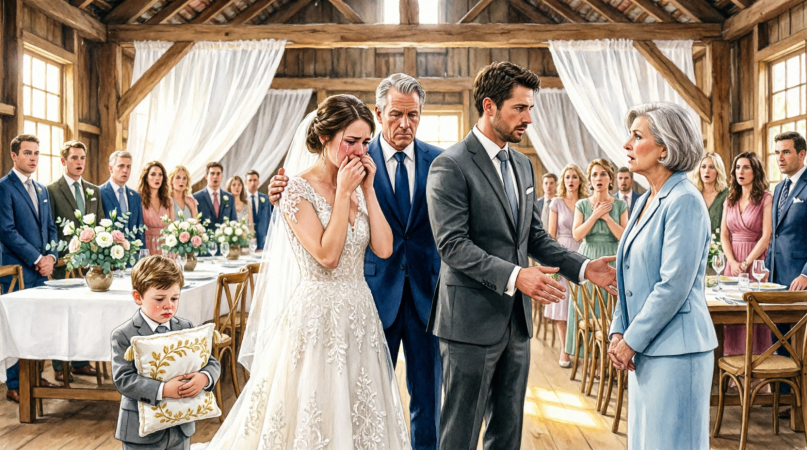
In front of 87 wedding guests, my parents turned to my four-year-old son and said, “You don’t belong here.
You’re a reminder of her failure.”
My siblings laughed.
My son shrank back.
But my fiancé didn’t hesitate.
He stood up, looked my parents in the eye, and said something that made the whole room freeze.
My name is Maris Holloway, and until the day I married Callum Voss, I thought I understood exactly who my family was.
Cruel, yes.
Proud, absolutely.
Judgmental in a way that made kindness seem almost suspicious.
But still predictable.
Still familiar.
I believed I knew the shape of the damage.
I was wrong.
The wedding was being held in a restored barn outside Asheville, North Carolina, the kind of place brides fall in love with because it makes everything look softer than it really is.
White linen drapes hung from exposed beams.
Long farmhouse tables waited for dinner under strings of lights.
The late afternoon sun spilled in through the high windows in warm gold sheets.
If you blurred your eyes, it looked like one of those days people spend the rest of their lives describing as perfect.
I had spent months trying to believe that maybe it could be.
Not because I trusted my parents to behave.
I didn’t.
But Callum had convinced me that this wedding should belong to us, not to old shame.
He said we could draw boundaries and still have joy.
He said Bennett deserved to see his mother loved openly, not hidden behind old mistakes and old voices.
Bennett was four.
He had my nose, his own stubborn chin, and a habit of taking every responsibility more seriously than most adults.
For three weeks he had practiced being our ring bearer in the hallway of our house, walking slowly while holding the pillow with both hands.
He would stop and ask, “Was that right?” even when it was perfect.
That afternoon he stood beside me in a tiny gray suit with a pale tie and hair I had smoothed three times because I couldn’t stop touching him.
He looked so proud I thought my heart might crack from it.
Then my mother walked over.
Helena Holloway had spent her whole life learning how to look beautiful while doing ugly things.
She wore pale blue silk, pearl earrings, and the same expression she wore at funerals, galas, and family arguments: polished concern stretched over contempt.
My father, Robert, followed beside her in a dark suit, stern and rigid.
My brother Keaton and sister Lianne moved behind them like satellites that had learned to orbit the strongest force in the room.
At first I thought my mother had come to say something performative and harmless.
Straighten Bennett’s tie.
Kiss my cheek for the audience.
Remind me not to cry too much during the vows because mascara was expensive.
Instead, she bent toward my son and said, “You don’t belong here.
You’re a reminder of her failure.”
Bennett stared at her.
His fingers tightened around the ring pillow.
His face changed in that small, terrible way children’s faces do when they realize an adult is not safe.
Lianne laughed.
It was quick and mean and reflexive, the kind of laugh people use when cruelty has become family shorthand.
Keaton shook his head
and smirked.
My father said nothing at all.
I froze.
People love to imagine they know what they would do in moments like that.
They imagine clean, cinematic courage.
A slap.
A scream.
A dramatic dismissal.
But freezing is not weakness when you have been trained into it since childhood.
My parents raised me on correction disguised as refinement.
Every room had rules that changed depending on my performance.
Smile, but not too much.
Speak, but never first.
Excel, but never in a way that threatened Keaton.
Be pretty, but never vain.
Be grateful, but never needy.
Their affection was measured, conditional, and often public, especially when it was being withheld.
When I got pregnant at twenty-three, that was the moment they had been waiting for.
The father, a man I had dated for less than a year, left before Bennett was born.
I will not dress that up.
He was weak, frightened, and eager to escape responsibility.
I was devastated for a while, then practical.
I built a life anyway.
I finished a certification program.
I worked.
I budgeted.
I raised Bennett.
I paid my bills.
When my parents loaned me money once during a rough stretch after Bennett got pneumonia and I lost work hours, I paid every dollar back with interest because I knew they would hold it over me forever if I didn’t.
It didn’t matter.
To them, I remained the moral cautionary tale at every holiday table.
So when my mother said those words to Bennett on my wedding day, the horror of it wasn’t only what she said.
It was that she said it with complete confidence that she would get away with it.
Then Callum stood.
I had met Callum two years earlier when my firm handled branding work for a nonprofit he advised.
He was quiet the first time I met him, the kind of quiet that makes you notice details later.
He listened fully.
He remembered things.
He never treated my son like an accessory to my life or a complication to be managed.
On our third date, Bennett fell asleep on his shoulder during a movie.
Callum sat there for forty-five minutes without moving because he didn’t want to wake him.
That was the night I started to love him.
Now he crossed the barn with a calm that seemed to split the air in front of him.
He put one hand on Bennett’s shoulder and gently moved him behind him.
Then he looked at my parents and said, “You do not get to speak to my son that way.
And before either of you says one more word, I think your guests deserve to know why you’re so desperate to punish a child for a history that doesn’t belong to him.”
The room went silent.
My mother lost color.
My father’s jaw locked.
For the first time in my life, I saw fear move through them before control caught up.
“This is not the time,” my mother whispered.
Callum’s expression did not change.
“That should have mattered to you before you humiliated a four-year-old.”
He reached into his jacket and pulled out a folded packet of documents.
My father stepped toward him.
“Put that away.”
The force in his voice was wrong.
It sounded frightened.
Guests were turning in
their chairs now.
Someone near the back stood to get a better view.
The violinist had lowered her instrument completely.
My wedding planner, who had spent the entire afternoon solving tiny crises with inhuman grace, looked like she was considering whether to call security or start praying.
I stared at the papers in Callum’s hand and felt a cold sensation spread through my chest.
“What is that?” I asked.
He looked at me then, and what I saw in his face made me unsteady.
Not triumph.
Not eagerness.
Regret.
“Asheville County archives,” he said softly.
“And a birth record your mother never wanted you to see.”
My mother took a step toward me.
“Maris, listen to me.
There are things you don’t understand.”
“I understand enough,” Callum said.
He opened the first page and read the line that changed everything.
“Date of birth: September 2, 1993.
Mother: Helena Mercer.
Father line blank at registration.
Marriage license to Robert Holloway filed March 14, 1994.”
At first, the words did not arrange themselves into meaning.
Then they did.
I looked at my mother.
Then my father.
Then back to the paper.
I had been born more than six months before their wedding.
More than six months before the date they had celebrated every year as the beginning of the respectable family they never stopped bragging about.
The barn erupted into whispers.
“No,” my father said sharply.
“That is incomplete.
That is private.”
But Callum kept going.
He explained that he had started digging only after our rehearsal dinner, when he overheard my father tell an uncle that marrying me at all was already generous of Callum because “some stains never fully come out.” Callum said he knew there was something obsessive, almost personal, in the way my parents talked about my pregnancy, something beyond judgment.
He had a friend who worked in county records.
One request led to a birth certificate.
The birth certificate led to a marriage license.
The marriage license led to older local church records and, finally, to something far worse.
A paternity filing.
Not for me.
For Keaton.
Callum held up another page.
“There is also a court document from 1997.
Robert Holloway petitioned to seal a paternity dispute naming Thomas Kessler as biological father of Keaton Holloway.”
It took a full second for the words to land.
Lianne made a strangled sound.
Keaton went white.
My father lunged, but two of his own friends stood up instinctively and caught his arm before he reached Callum.
“That is a lie,” my father barked.
“No,” Callum said.
“It’s sealed.
Not erased.”
The sound in the room changed after that.
It wasn’t just gossip anymore.
It was disbelief sharpening into fascination.
My mother closed her eyes for a moment, and in that moment I understood something I had never let myself see.
The rage they had poured onto me all these years had never been about principle.
It had been about history.
About exposure.
About protecting an image built on rot.
My mother had become pregnant with me before marriage.
My father had married her quickly.
Then, a few years later, she had an affair that resulted in Keaton.
My father had stayed, but not out of mercy.
Out of vanity.
Out of mutual destruction avoidance.
Their marriage had become
a private hostage negotiation dressed up as high society discipline.
And then I had gotten pregnant while unmarried.
I hadn’t just embarrassed them.
I had mirrored them.
I had dragged their secret shape into daylight without even knowing it existed.
That was why they hated it so much.
That was why Bennett, an innocent child, made them furious.
He wasn’t a reminder of my failure.
He was a reminder of theirs.
My mother finally spoke, but her voice had lost its steel.
“I was nineteen,” she said.
“My parents would have thrown me out.
Robert and I made choices to survive.”
I laughed, though it came out broken.
“And for that, you spent four years making my son feel dirty?”
She flinched.
My father tried a different angle.
“This is family business.”
Callum’s expression turned cold enough to cut glass.
“You made it public when you spoke to Bennett.”
Then Bennett, from behind Callum, asked in a tiny voice, “Mommy, did I do bad?”
That nearly destroyed me.
I dropped to my knees in front of him, took his face in both hands, and said, “No, baby.
No.
You did nothing bad.
Nothing.
None of this is because of you.”
He searched my face the way children do when they need truth more than comfort.
“Then why was Nana mean?”
There are questions adults spend years avoiding.
A child can ask one in five seconds and strip every excuse naked.
I looked up at my mother.
She was crying now, but not beautifully.
Not with restraint.
Her mascara had started to run.
Her mouth trembled.
For the first time, she looked less like a queen and more like a frightened woman who had spent decades mistaking control for absolution.
“Because I was cruel,” she said quietly.
It was the first honest sentence I had ever heard her say about herself.
Keaton stepped forward then, his face wrecked.
“What do you mean Thomas Kessler?” he asked my mother.
“Who is that?”
No one answered.
He looked at my father.
“Dad?”
My father said nothing.
In that silence, Keaton understood.
He staggered back a step like the floor had shifted under him.
Lianne burst into tears.
She had built her whole adult identity around being the favored polished daughter, the one who embodied family order.
You could see her realizing that the order had always been theater.
Then something happened I will never forget.
My maid of honor, Dani, walked straight to the front, took the microphone meant for the officiant, and said, “Anyone who is here for Maris and Callum, stay seated.
Anyone who thinks a child should be shamed for adult secrets can leave now.”
Several people clapped before they could stop themselves.
My father looked around, expecting support that didn’t come.
Men he had golfed with for twenty years would not meet his eyes.
Women who had admired my mother’s polished charity persona were staring at her with revulsion.
My parents had finally run out of room.
The officiant, an older woman with sensible shoes and a talent for moral clarity, stepped up beside Dani and said, “This ceremony may proceed when the bride is ready, but not with cruelty in the front row.”
That solved the part no one wanted to say aloud.
I stood and turned to
my parents.
All my life, I had imagined that if I ever confronted them, I would need the perfect speech.
Something devastating and articulate.
Something that would summarize the decades.
But the truth was simpler.
“You do not get to stay,” I said.
My father straightened, stunned.
“Maris.”
“No.” My voice didn’t shake.
“You do not get to sit there and watch me marry a man who loves my son after you tried to make him feel unwanted.
You do not get to use this day to protect your image.
You do not get to call me a failure again.
Leave.”
My mother took a half-step toward me.
“Please.”
I thought of Bennett’s face.
I thought of every dinner, every holiday, every carefully aimed insult designed to keep me apologizing for existing out loud.
Then I shook my head.
Keaton was crying now, furious and humiliated.
Lianne looked like she might be sick.
My father tried one last time to reassemble authority around himself, but it was gone.
The guests had seen too much.
So my parents left.
Not gracefully.
My father muttered something vicious under his breath.
My mother kept saying my name like repetition could reopen a door I had finally shut.
Keaton followed in a daze.
Lianne hurried after them, heels catching on the floorboards.
When the barn doors closed behind them, the silence felt entirely different.
Not frightened.
Released.
I stood there in my wedding dress, breathing like I had run miles.
Callum stepped toward me carefully, as though giving me room to decide what came next.
“I’m sorry,” he said.
“I should have told you before today.
Once I found out, I wanted to.
But I kept thinking maybe there was a way to protect the wedding first.”
I looked at him, at Bennett still pressed to his side, at the papers in his hand, at the man who had been willing to set fire to every false thing in that room because my son mattered more than decorum.
And I knew two things at once.
I was furious that the truth had reached me this way.
And I had never been more certain I was marrying the right man.
“Next time,” I said, my voice thick, “you tell me before you detonate my family.”
A shocked laugh broke through the room.
Then Callum, to his credit, actually looked ashamed.
“That’s fair.”
I nodded once.
“Good.”
And then, because Bennett was still watching me with huge solemn eyes, I crouched again and asked, “Do you still want to carry the rings?”
His chin lifted.
“I can do it.”
“Yeah,” I said, kissing his forehead.
“You can.”
So we got married.
Not in the clean way I had imagined.
Not untouched.
Not untouched at all.
But honestly.
The violinist began again.
Guests resettled, still buzzing, still processing.
Dani fixed my veil with shaking hands.
The officiant gave me a look that said she had seen stranger things and would still be done by dinner.
Bennett walked down the aisle clutching the ring pillow like treasure.
This time, every person watching him smiled with actual warmth.
I saw one older man wipe his eyes.
I saw my boss squeeze her husband’s hand.
I saw people looking at my son not like he was a symbol, but like
he was what he had always been: a child loved beyond measure.
When I reached Callum, he took my hands and held them so steadily I felt my own heartbeat slow.
The vows we had written suddenly meant more than they had an hour earlier.
Not because hardship had made them dramatic, but because exposure had made them real.
I promised to tell the truth even when it was messy.
He promised to stand between cruelty and the people we loved.
We both cried.
Bennett clapped at the kiss.
The room laughed.
And for the first time in my life, joy did not feel borrowed from someone else’s approval.
The aftermath was not neat.
My mother called twelve times over the next week.
I did not answer.
My father sent a single email accusing Callum of violating private family matters and humiliating innocent people.
I replied with one sentence: You humiliated a child on purpose.
We are done.
Keaton contacted me a month later, not to apologize at first, but to demand copies of the court records.
I sent them.
Two weeks after that, he wrote again.
The message was four lines long.
He said he had confronted our mother, confirmed the affair, and spent his whole life defending a family that treated all of us like props.
At the end he wrote, I laughed at Bennett.
I can’t undo that.
I’m sorry.
Lianne took longer.
Her apology came almost a year later, after her own divorce cracked something open in her.
She admitted she had learned from our mother that the safest place in the family was beside the person doing the hurting.
She said watching me throw them out had terrified her because she realized she had never once stood on the right side of anything that cost her comfort.
My mother eventually wrote me a letter.
Not a text.
A real letter, six pages long, in careful blue ink.
It contained excuses, context, shame, memory, fear, and finally, buried near the end, a sentence that mattered: I punished you for the life I was afraid people would remember in me.
That sentence was true.
It was not enough.
Forgiveness, I learned, is not the same thing as restored access.
I have forgiven some things because I did not want to carry acid forever.
But my parents are not part of Bennett’s life now.
They do not get holiday photos.
They do not get school updates.
They do not get to stand near the child they once tried to make small just to feel taller than their own history.
Callum adopted Bennett two years after the wedding.
The courthouse hearing was quiet, almost ordinary.
Bennett wore a button-down shirt and kicked his feet from the chair until the judge smiled.
When she asked him if he understood what adoption meant, he said, “It means he picks me forever.”
There are moments that heal with such precision they hurt on the way in.
That was one of them.
Sometimes people ask whether I wish Callum had exposed my parents in private instead of in front of everyone.
The honest answer is complicated.
Part of me still mourns that my wedding will always carry that bruise.
Part of me hates that Bennett’s first memory of weddings includes his grandmother’s cruelty.
Part of me wishes I had learned the truth in a quieter room.
But another part of me knows this: private is where my family’s damage survived for decades.
Private is where shame was cultivated, rehearsed, and handed down.
Private is where they expected me to keep swallowing it.
Public truth ended that.
Not gently.
Not elegantly.
But completely.
And if you ask me now what the biggest red flag was, it wasn’t the harsh comments or the polished judgment or even the way my mother spoke to my son.
It was the family rule underneath all of it: protect the image, no matter who gets hurt.
Once you see that rule clearly, you start noticing how many people confuse respectability with goodness.
They are not the same thing.
My parents taught me that by accident.
Callum, Bennett, and the life we built afterward taught me the rest.