We had only been married for three days when my mother-in-law walked into my own apartment and threw a pot of boiling food onto my legs.
That sentence still sounds impossible when I say it out loud, because there are things the mind wants to file under nightmare even after the body keeps the proof.
My name is Camila, and before Andrés Ramírez, I believed a home could protect you if your name was on the deed.
My parents bought the apartment in Colonia Del Valle before the wedding, not because I was spoiled, as Doña Teresa loved to imply, but because they had spent their lives working for the kind of safety they wanted their daughter to have.
It was modest and bright, with two bedrooms, an open kitchen, a balcony over jacaranda trees, and a digital lock I chose after comparing three models online.
I liked the sound it made when it closed.
It sounded final.
It sounded like mine.
Andrés used to say he loved that I was independent.
During the first months of dating, he admired the apartment plans, helped me choose curtains, and joked that one day we would drink coffee on the balcony while the city woke up below us.
For two years, I believed him.
I also believed that his mother’s interruptions were just the habits of a woman who loved her son too much.
Doña Teresa called him during dinners and asked what he had eaten.
She texted him reminders about ironing his shirts.
She once asked me, in front of him, whether my mother had ever taught me that a man’s plate should never be served after a woman’s.
Andrés laughed then, not because it was funny, but because he wanted me to understand I was not supposed to make it serious.
That was how he handled every warning sign.
He wrapped it in a smile and handed it to me like a joke.
The wedding was beautiful in photographs.
White flowers, a small reception, my father crying during the toast, my mother adjusting my veil as if she were trying to bless every thread with protection.
Doña Teresa wore beige lace and told three people that my dress was pretty, although modern girls confused pretty with expensive now.
I heard her.
I pretended not to.
Aphorisms are easy after the damage is done.
Before it happens, we call the same thing patience.
Three days after the wedding, I woke before six with a pressure in my chest I could not explain.
The apartment was quiet except for Andrés snoring facedown into the pillow.
The city outside still had that gray-blue hour before traffic becomes a living thing.
I stood barefoot on the kitchen tile and opened the message Andrés had shown me the night before.
“Son, tell Camila to make you chilaquiles with chicken tomorrow, the way your grandmother used to make them. In this family, a wife serves her husband first. She needs to start learning.”
I hated the message.
I hated the way Andrés had shown it to me as if he were delivering instructions, not asking a favor.
But I had been married for three days, and some childish part of me still thought peace was something a wife could cook into existence.
So I made green chilaquiles.
I made refried beans.
I fried sunny-side-up eggs and cut fruit into small careful pieces.
I brewed café de olla until cinnamon and piloncillo filled the kitchen.
I set the table with the new plates we had received as wedding gifts.
There were already documents in the story, although I did not yet understand they would matter.
The deed with my name.
The WhatsApp message with hers.
The digital lock record waiting silently in the app.
Proof often arrives before courage does.
I was about to wake Andrés when I heard the keypad at the door.
Beep, beep, beep.
The lock opened.
Doña Teresa walked in carrying grocery bags and wearing the expression of a woman who had never needed permission in her life.
For a second, I could not move.
I was in my pajamas in my own kitchen, and she was standing there as if the apartment had been built around her authority.
“What are you doing here?” I asked.
“I came to see whether my son is having a proper breakfast,” she said, without greeting me.
Then she looked at my hands.
“Because with those spoiled little girl hands of yours, who knows what you feed him.”
She did not ask where to put the bags.
She placed them on my counter.
She inspected my living room, touched the cushions, moved my decorations, opened drawers, and criticized the pans hanging near the stove.
She even looked at Andrés’s sneakers by the wall and said the toes were facing the wrong direction.
“To attract money, they face the door,” she said.
The absurdity of it almost made me laugh.
Almost.
Then she saw the table.
Her mouth curved.
“You call these chilaquiles?”
The café continued to steam between us.
“They’re soggy,” she said. “And those beans look canned. Oh, Camila, it’s obvious your mother never taught you how to be a woman of the house.”
Something hot moved up my neck, but I kept my voice steady.
“Doña Teresa, breakfast is ready. If you’d like to sit down…”
“Don’t give me orders in my son’s house.”
The words changed the air.
I felt them in my bare feet, in my ribs, in the hand I had pressed against the chair.
“This isn’t Andrés’s house,” I said. “It’s mine.”
She looked at me as if ownership were a little costume I had put on for fun.
“As long as my son sleeps here, this house belongs to him too,” she said. “And wherever my son lives, I enter.”
That was the first moment I understood the code had not been stolen.
It had been given.
Andrés came out of the bedroom rubbing his eyes.
My whole body waited for him.
There are moments in marriage that are not large in the calendar but enormous in the soul.
A husband either stands beside you, or he teaches everyone where you stand alone.
He smiled.
“Mom, you’re here.”
“Of course, my king,” she said. “I came to save you from this sad little breakfast.”
She unpacked shredded chicken, salsa, cream, cheese, sweet bread, and beans from her grocery bags.
She removed my plates.
She pushed my food aside.
Andrés sat down.
I watched him eat what she served.
“Now this tastes like real food,” he said with his mouth full. “Camila, you should learn from my mom.”
The kitchen went still.
Coffee steam rose.
The spoon near the beans trembled from the movement of the table and then settled.
A bead of salsa slid down the side of a ceramic bowl while my husband chewed.
Nobody moved.
Then Doña Teresa reached into her bag and took out a folded sheet of paper.
“These are the rules for this marriage to work,” she said.
Rules.
She said it in my kitchen.
She said it over my wedding plates.
I opened the paper.
I had to wake up at five thirty every day.
I had to wash Andrés’s shirts by hand.
I had to visit his parents every Sunday.
I had to ask permission before buying anything expensive.
I had to never talk back to my mother-in-law.
The words were printed neatly, not scribbled in anger.
That made them uglier.
Anger can be impulsive.
This had margins.
This had planning.
“I’m not going to follow this,” I said.
Doña Teresa’s smile disappeared.
“Excuse me?”
“I’m no one’s servant.”
Andrés set down his fork.
“Camila, don’t start.”
That sentence did something to me.
Not because it was loud.
Because it was familiar.
It was the voice he used when his mother had already won and he expected me to accept the loss quietly.
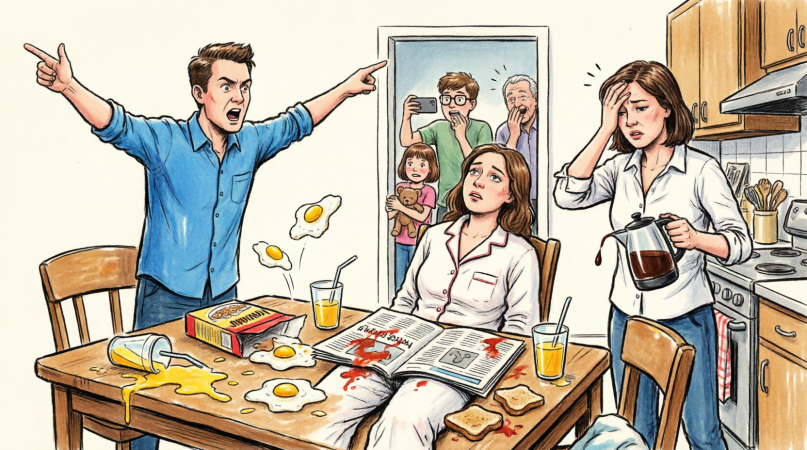
Doña Teresa picked up the steaming plate of chilaquiles she had served herself.
Her wrist moved fast.
Too fast.
Too clean.
The hot salsa hit my thighs through my pajama pants.
I screamed.
Pain erased the room for a second.
It came white and instant, like fire under fabric, and then it spread into a deep pulsing burn that made my knees fold.
The plate struck the tile and cracked.
“Look how clumsy you are!” she shouted. “You almost burned me.”
I grabbed the edge of the table so hard my knuckles went numb.
“You did that on purpose,” I whispered.
Andrés stood.
I thought he was going to help me.
I thought, even then, that some husband inside him would wake up at the sight of my legs blistering.
Instead, he slapped me.
My head snapped sideways.
Blood filled my mouth where my tooth cut the inside of my cheek.
“Apologize to my mother,” he said. “Right now.”
Then the digital lock chirped again.
Beep, beep, beep.
My father opened the door with the spare folder from the notary in his hand.
He had come to drop it off because I had left it in my parents’ car after the wedding.
For a moment, he did not understand what he was seeing.
His eyes moved from the cracked plate to my soaked pajama legs, then to the red mark blooming on my cheek, then to Andrés’s raised hand.
Doña Teresa spoke first.
“She slipped,” she said.
My father looked at the floor.
There was chilaquiles on the tile, a burn pattern on my pajama legs, and the empty plate near Doña Teresa’s shoe.
Then my phone lit up beside the coffee cup.
Digital lock access record.
Temporary code used.
My father picked it up carefully, the way a person touches evidence without yet calling it that.
The code had a label.
Andrés Family.
Created the night before.
Andrés went pale.
Doña Teresa said his name softly, but it was not comfort.
It was a warning.
My father did not shout.
That frightened them more than shouting would have.
He set the notary folder on the table, opened it to the deed, and placed one finger under my name.
“Whose apartment is this?” he asked.
No one answered.
He picked up the printed rules.
He read them once.
Then he took a photograph of the page with his phone.
He took a photograph of the floor.
He took a photograph of the access record.
Methodical things can look cold from the outside, but sometimes method is the only way a parent keeps from becoming violent.
My mother arrived fifteen minutes later.
She did not cry when she saw me.
She took scissors from a kitchen drawer and cut the pajama fabric away from my burned skin.
Then she cried.
We went to urgent care.
The doctor documented the burns.
The nurse asked whether I felt safe going home.
I looked at Andrés, who had followed us there with his mother, both of them suddenly soft-voiced in public.
“No,” I said.
It was the first honest thing I had said that day without trying to make it easier for someone else to hear.
A medical report was filed.
Then a police report.
Then my father sent the access record, the WhatsApp message, the rule sheet, and the deed copies to a lawyer he trusted.
Doña Teresa called my mother that night and said families should not destroy marriages over “a kitchen accident.”
My mother answered only once.
“My daughter’s skin is not your family’s reputation.”
Then she hung up.
Andrés sent seventeen messages before midnight.
Some were apologies.
Some were accusations.
Some said I had embarrassed him.
One said his mother was old and I should understand her ways.
That was the message that ended whatever hesitation I had left.
A man who can watch his wife burn and still worry about his mother being offended is not confused.
He is decided.
The legal process was not cinematic.
There was no grand speech under a spotlight.
There were forms, photographs, medical notes, screenshots, and a lawyer who told me not to answer any message directly.
There was the apartment administration confirming the temporary code had been created from Andrés’s user access.
There was the clinic report describing the burns on both thighs.
There was the photograph of the printed rule sheet, folded neatly beside the wedding plates.
Doña Teresa tried to say I had overreacted.
Andrés tried to say he had only slapped me because I had insulted his mother.
That sentence looked very different when written down in a statement.
The separation moved faster than anyone expected because the marriage was only three days old and the apartment had never belonged to him.
His belongings were boxed by my father, cataloged, and left with building security for pickup.
The digital lock was reset.
The secondary users were deleted.
I watched the app confirm it.
Access revoked.
That sound felt better than any apology.
For weeks, I could not drink café de olla without smelling hot salsa.
I slept at my parents’ house until the burns stopped waking me at night.
I wore loose pants and changed bandages and answered questions from people who wanted to know how such a thing could happen so quickly after a wedding.
The truth is that it had not happened quickly.
It had been introduced slowly.
In jokes.
In messages.
In instructions.
In every moment Andrés asked me to be smaller so his mother could feel large.
When I finally returned to the apartment, the jacaranda trees were blooming purple outside the balcony.
My mother replaced the cracked plate.
My father installed an extra camera at the entrance.
I threw away the rule sheet only after the lawyer said we had enough copies.
The first morning I made breakfast again, I made eggs only for myself.
I ate at the table with the balcony door open.
No one corrected the angle of the sneakers by the wall.
No one inspected the beans.
No one told me that being a woman meant serving pain with a smile.
Months later, Andrés asked through a relative whether we could meet and talk.
I said no.
Doña Teresa sent one message from a new number.
“You ruined my son’s life,” it said.
I blocked it.
I used to think the worst part was the burn.
Then I thought it was the slap.
Now I understand the worst part was the expectation that I would apologize for surviving both.
I had not married a man.
I had married his mother.
But I divorced the whole house they tried to build inside mine.
And this time, when the lock clicked shut behind them, it sounded exactly the way it had always been supposed to sound.
Mine.