“This seat’s for close family,” Brandon said, and the way he said it made the words feel like a palm across my chest.
Not a joke. Not a nudge. He actually shoved me—shoulder to shoulder, like we were back in my aunt’s backyard and he’d decided the lawn belonged to him. The chair legs scraped on polished wood. A few heads turned. Someone laughed too loudly, the kind of laugh that pretends it didn’t witness anything ugly.
I stood there with my hand still on the back of the chair, the air of the steakhouse thick with butter and pepper and expensive cologne, and something in me tightened—an old knot, familiar as bone. For a second I was twelve again, stuck in a doorway while Brandon and his friends blocked it, chanting my name like it was something gross.
Robert. Robot. Rrrrr-bert.
The knot had lived in me so long I’d started to think it was just part of my body. I had built whole years around it—years of keeping my mouth shut, of being the easiest person to ignore, the easiest person to tease, the easiest person to blame for making things “awkward.” I’d learned how to disappear in a room full of relatives. How to smile like a polite stranger. How to swallow humiliation and let it dissolve somewhere in my ribs.
But the shove—small as it was—rang like a bell.
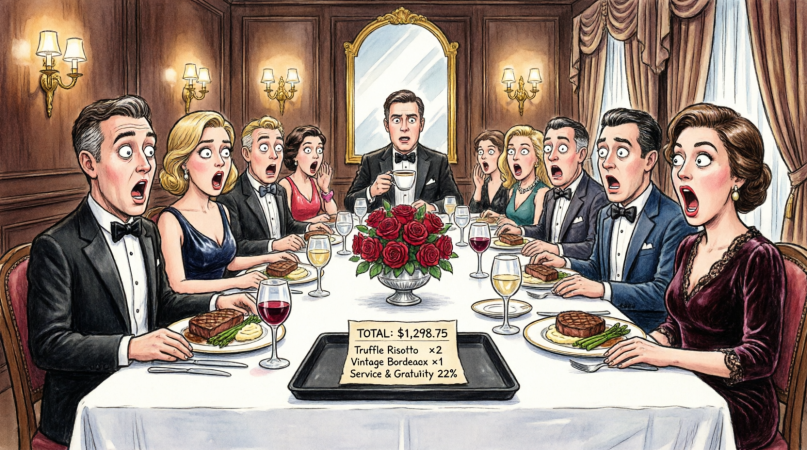
I looked down the length of the table. White tablecloth, heavy silverware, wine glasses lined like soldiers, the centerpiece a low arrangement of roses so dark they were almost black. Everyone had already settled in, leaning in close, laughing over each other like the room belonged to them. My aunt sat near Brandon, her hand resting on her purse as if she might be photographed at any moment. My uncle’s belly pressed against the table edge. Melissa, Brandon’s sister, was checking her phone with a bored expression, like she’d been dragged to a charity event and couldn’t wait to leave.
My mom sat a little apart from the loudest cluster, shoulders slightly hunched, smile strained. When her eyes met mine, there was a flicker of apology, quickly buried under the same old plea: please don’t make this harder.
No one stood up. No one said, “Brandon, knock it off.” Nobody even pretended I’d been invited to sit.
Brandon tilted his head, the grin on his face bright and cruel. “You can grab a seat somewhere else, Rob. This table’s for close family.”
Close family.
As if blood could be measured in inches. As if closeness was something he got to assign like seating at a wedding. As if the word family didn’t include me unless he allowed it.
I could have left right then. It would’ve been clean. It would’ve been wise. It would’ve saved me from the sour aftertaste I always got at these things, the kind that stuck around for days.
And I almost did—my feet even shifted, a reflex toward the exit. I pictured the quiet of my apartment, the steady hum of the fridge, the way my couch didn’t judge me. I pictured going home, taking off my shoes, letting the night drain away.
But then I remembered my mother’s voice on the phone earlier that week.
“Just one dinner,” she’d said, careful and soft, like she was trying not to startle a skittish animal. “It’s been years, Robert. Please. I’m not asking you to move back in with them. I’m just… I’m tired of pretending we’re not a family.”
Family.
That word again. The way it could mean obligation when they wanted something, and exclusion when I wanted basic respect.
I had said yes because my mother’s hope was a fragile thing and I had spent most of my life trying not to break it. I had said yes because a part of me—the part that still went silent in doorways—believed maybe, just maybe, time had sanded the sharp edges off all of us.
Walking into the steakhouse had shattered that illusion almost immediately.
They were already loud when I arrived, loud in the way people are when they want to be noticed. They’d chosen the kind of place with dark wood and low lighting and a hostess who smiled like her cheeks hurt. The menus were leather-bound. The water glasses were cut crystal. Even the napkins looked too expensive to touch with clean hands.
And yet my relatives had sprawled into it like they’d been born in velvet. Brandon at the center, naturally. Melissa draped beside him. My uncle gesturing with a cigar-smoker’s hand even though he wasn’t smoking. My aunt laughing like she was auditioning for a reality show.
When I stepped toward the far end of the table, hoping to slide into a corner and keep my presence small, Brandon spotted me and called out in a voice designed to carry.
“Well, look who crawled out of the library.”
A few people chuckled.
I forced a smile that didn’t reach my eyes. “Hey.”
“Didn’t think you remembered us,” Brandon continued, leaning back like he owned the chair, the room, the whole night. “Big man.”
Big man. It was the same tone he used when we were teenagers and he wanted to remind me that no matter how many books I read, I’d never be one of them.
Now, standing beside the chair he’d blocked with his body, I let my fingers loosen. I turned my head slightly, letting my gaze travel over the table settings, the half-empty wine bottles, the glint of a watch on Brandon’s wrist—flashy, too big for his arm, the kind of thing purchased on credit to impress strangers.
The knot in my ribs tightened once more.
Brandon watched me like he expected my silence. Like he expected the old script: I would shrug, I would laugh awkwardly, I would take whatever scraps of dignity they left on the floor.
I heard myself speak before I even fully decided to.
I leaned a fraction closer, lowered my voice just enough that the people at the far end couldn’t hear, and said, “Then let your real family pay the damn bill.”
His grin twitched.
I didn’t wait for him to respond. I didn’t give him time to turn it into a joke. I just stepped away from the blocked chair, walked to an empty two-top nearby, and dragged a chair back with a single, deliberate scrape across the floor.
The sound cut through the chatter. Heads turned again. The waiter’s eyes widened. My aunt’s smile tightened. Melissa looked up, annoyed. Brandon’s brows rose like he couldn’t believe I’d dared to move furniture in his kingdom.
I set the chair down at the very edge of their table—close enough that no one could pretend I wasn’t there, far enough that they couldn’t pretend they’d welcomed me.
“Is that okay?” I asked, tone neutral.
Brandon’s mouth opened, then closed. He gave a small laugh, too sharp. “Sure, Rob. Whatever makes you feel included.”
Included. As if inclusion was a gift. As if I should thank him for letting me breathe the same air.
The waiter approached with a polite smile that wavered. “Can I get you started with something to drink?”
I glanced at the menus they were already flipping through like catalogs. “Coffee,” I said. “Just coffee.”
Brandon smirked. “Still doing the whole monk thing?”
I ignored him. The waiter nodded and slipped away.
The table surged back into conversation, but now it had an edge. They weren’t just performing wealth; they were performing dominance. It was a game, and my presence had made them decide they needed to win louder.
As they ordered, I watched.
It started with Brandon. He slapped his menu shut with theatrical flair. “Wagyu,” he announced. “And lobster. Actually, make that two lobster tails. I’m celebrating.”
My uncle immediately followed. “I’ll do the ribeye, extra butter. And that bourbon flight. The good one.”
Melissa leaned over, lips pursed as if she was studying art. “Oh, I’ll have the scallops. And another glass of that red. The one that’s… what was it… from Napa?”
My aunt, who had once screamed at me for using too much ketchup at a barbecue because it was “wasteful,” waved her hand now. “Let’s do appetizers for the table. All of them. We deserve it.”
We deserve it.
Every time one of them said something like that, I felt the old knot pulse. Not because they were ordering expensive food—eat what you want, I didn’t care—but because I could see the shape of the night forming, as predictable as weather.
They weren’t ordering for themselves. They were ordering for an audience.
Me.
They wanted me to see. They wanted me to swallow it. They wanted me to feel small beside their confidence.
And beneath that, under the clink of glasses and the forced laughter, there was another hunger, quieter but sharper.
They expected me to pay.
I could see it in the way Brandon kept glancing at me, checking if I looked impressed. I could see it in Melissa’s sweetness when she asked, “So, Robert, you’re still doing… what is it… investing?”
I could see it in my uncle’s tone when he said, “Must be nice to have money working for you.”
It was never, How are you? It was always, What can we take?
Their eyes always found the same thing: the suit I wore, the calm way I carried myself, the fact that I didn’t flinch when prices rose. They didn’t know what my job actually involved, not really. They just knew, through the grapevine, that I had “done well.” They knew I had a condo. They knew I drove a car that wasn’t held together by duct tape. They knew my name had been in an article once, a small business spotlight, and my aunt had forwarded it to everyone with a caption that said, So proud of our Robert! as if she’d had anything to do with it.
They didn’t know the nights I’d spent eating ramen while I taught myself skills no one in my family cared about. They didn’t know the years I’d worked while they partied, the early mornings, the late nights, the constant pressure of building a life without a safety net. They didn’t know how many times I’d wanted to quit. They didn’t know the loneliness that came with leaving.
They didn’t know, and they didn’t want to.
Because knowing would mean admitting I wasn’t the quiet, strange kid anymore. And that admission would crack the story they’d built around me: Robert is the odd one, the nobody, the one who should be grateful for any seat at the table.
The waiter brought my coffee. The cup was small, expensive porcelain, the kind that made even coffee feel like a status symbol. I wrapped my hands around it and took a slow sip.
The bitterness grounded me.
As plates arrived, the table became a stage. They exclaimed over marbling and sauces, over the “chef’s special,” over how perfectly the steak was cooked. Brandon raised his glass often, making mini-toasts to himself. Melissa laughed at jokes that weren’t funny. My uncle talked too loudly about “business deals” that sounded suspiciously vague.
I let them perform.
And I waited.
Because I had learned something about bullies: they don’t change, they just get older. The tactics evolve, the language becomes more polite, but the core remains the same. They push until you fold, then they call it family. They take until you’re empty, then they call it love.
I was done folding.
When the last plates were cleared and the last glass drained, the waiter returned with the check on a little black tray and set it down—not in the center, not between the loudest people, but directly in front of me.
As if it had been decided long before the night started.
As if my place at the edge of the table was still close enough to hold their debt.
The number stared up at me.
Two thousand, one hundred eighty-five dollars and fifty cents.
Not even the final total yet, not really—because I’d seen them order extra bottles at the end, the kind that came with labels no one could pronounce. I’d seen Brandon wave for dessert menus, insisting, “We’re not leaving without the chocolate soufflé.” I’d seen my uncle order after-dinner drinks like the night was endless and consequences were for other people.
Brandon leaned back, stretching as if he’d just finished a workout. “You’ve got this, right, Robert?”
Melissa covered her mouth as she laughed. “Oh my God, yeah. Pocket change for him.”
The table went quiet in a way that made my skin hum. Even my mother fell silent, her fingers twisting together in her lap.
All eyes on me.
I picked up the check slowly, like I was considering it, like I was measuring the weight of it in my hands. The paper was thick, glossy. I scanned the items, the prices, the ridiculous add-ons.
Brandon watched my face, smug certainty settling into him like a crown.
I let a few seconds pass.
Then I laughed—quiet, calm, almost amused.
Brandon’s smile faltered. “What’s funny?”
I set the check back down, but not in front of me.
In front of him.
His eyes dropped to it, then lifted to me, confused. “Wait. What?”
I took another sip of coffee, unhurried, as if nothing about this moment mattered.
“Oh,” I said softly. “You really don’t know who’s handling the bill tonight.”
Melissa blinked like she couldn’t process the idea. My uncle leaned forward, irritation already forming. My aunt’s mouth pinched. Someone at the far end muttered something under their breath.
Brandon’s face hardened. “Come on, Rob. Don’t be weird. You’re doing great. This is nothing.”
Nothing.
That word always landed wrong with me. Because nothing, to them, was always something taken from someone else.
My mother shifted, voice gentle. “Robert, honey… it’s just dinner.”
Just dinner.
Just family.
Just the same pattern, repeated until I broke.
I set my coffee cup down with care, the porcelain clicking softly against the saucer. The sound felt loud.
I looked at each face around the table, one by one. I didn’t rush it. I let them feel the spotlight they’d aimed at me.
Then I smiled.
“Sure,” I said. “I’ll cover it.”
Relief rippled instantly, almost comically. My aunt’s shoulders loosened. My uncle grunted like he’d won. Brandon’s grin snapped back into place, brighter than before.
“See?” Brandon said, clapping his hands once. “That wasn’t so hard. Appreciate it, big shot.”
I held his gaze. Let the grin stay on my face a second longer.
Then I said, “Actually… I changed my mind.”
The relief evaporated so fast it was like someone had turned off a light.
“I’m not paying,” I continued, calm as water. “You all can.”
Silence dropped like a curtain.
Brandon’s mouth opened. No sound came out. Melissa’s eyes went wide. My uncle stared at me like I’d spoken another language. My aunt’s expression tightened into something sharp and offended, as if I’d insulted her personally instead of simply refusing to be robbed.
My mom whispered my name, barely audible. “Robert…”
I stood, smoothing my jacket like I was leaving a meeting. “If you don’t want to deal with a big total,” I said, voice low but clear, “maybe order like adults next time.”
Brandon pushed back from the table, chair scraping. “You can’t just—”
“I’ll be over there,” I cut in, pointing toward a lounge area near the bar where soft chairs sat under dim lamps. “Let me know when you’ve sorted it out.”
I walked away before he could decide whether to shout or beg.
Behind me, voices rose in quick, frantic bursts. I didn’t need to hear the words to understand the panic. They weren’t panicking because the bill was too high—they were panicking because the safety net had moved. Because for once, their assumptions were failing.
I sat in one of the lounge chairs, crossing one ankle over the other, and pulled out my phone like a man waiting for a ride. The bar’s low murmur surrounded me, glasses clinking, a bartender polishing a tumbler with a towel. The world continued as if nothing dramatic had happened. That steadiness was comforting.
From across the room, I watched my family.
Brandon stood, hands moving in sharp gestures as he talked to Melissa. Melissa’s face was pinched, lips moving fast. My mother sat rigid, eyes flicking between them and me. My uncle’s jaw worked like he was chewing anger. My aunt leaned close to the waiter, her voice likely sharp enough to cut.
Minutes passed.
I scrolled through my phone without reading anything, pretending to be absorbed, while my peripheral vision tracked every shift at the table. The waiter hovered, his polite mask strained. A manager appeared at one point, arms folded, posture firm.
My relatives didn’t know how to handle firm people. They were used to emotional people—people they could guilt, pressure, shame. They were used to my mother smoothing edges. They were used to me swallowing my discomfort.
They weren’t used to someone calmly refusing to play.
Eventually, Brandon broke away from the table and marched toward me, his stride stiff. Up close, his confidence looked thinner, more frantic. His face had a sheen of sweat at the hairline.
He stopped in front of me, breathing hard like he’d run a mile. “Robert,” he hissed, trying to keep his voice low. “This isn’t funny.”
I looked up at him, letting my expression stay neutral. “What’s the problem?”
“The bill,” he snapped, then caught himself and forced a calmer tone. “It’s… higher than we thought. Can you just help us out this one time?”
One time.
I almost laughed again. The number of “one times” I’d given them in my life could fill a calendar. One time to babysit because they were “overwhelmed.” One time to lend money because “payday was late.” One time to show up because my presence made my mother happy. One time to keep the peace. One time to be the bigger person.
One time, always.
“Family,” Brandon added quickly, like the word was a key that should unlock my wallet. “We’re family.”
I leaned back in the chair. “You shoved me away from the table.”
“That was—” He waved his hand like swatting a fly. “That was nothing. Come on.”
“It wasn’t nothing,” I said, voice steady. “And neither is this.”
His eyes narrowed. “So what, you’re doing this to punish us? Over a seat?”
I held his gaze. “I’m doing this because you all ordered like you had someone else’s bank account.”
His jaw tightened. “You can afford it.”
There it was. The real argument. Not that it was fair, not that it was right, not that it was family—just that I had money, therefore they deserved access to it.
I stood slowly, keeping my movements controlled. “You don’t get to spend my money because you think you can.”
Brandon’s face flushed. “After everything we’ve done for you—”
I cut him off gently, almost kindly. “Name one thing you’ve done for me that didn’t come with a joke at my expense.”
His mouth opened. Closed. Opened again. Nothing came out but breath.
Behind him, Melissa approached, heels clicking on the floor like punctuation. “Robert,” she said, voice trembling with forced sweetness. “This is ridiculous. It’s four—” She paused, eyes darting to Brandon. “It’s almost forty-seven hundred now. The manager added something because we couldn’t pay right away. You’re not really going to leave us with that, are you?”
Four thousand seven hundred.
The number didn’t scare me. What scared me, once upon a time, was the idea of them hating me. What scared me was my mother crying. What scared me was being labeled selfish. What scared me was the cold shoulder at holidays, the gossip, the way they could turn the word family into a weapon.
But that fear had been wearing thin for years, and tonight it finally tore.
I looked at Melissa. “Nobody’s leaving without paying,” I said. “You’re staying. You’re paying. I’m not cleaning up your mess.”
Melissa’s eyes flashed. “You can’t just abandon us.”
“I’m not abandoning anyone,” I replied. “I’m walking away from people who only remember I exist when there’s a bill.”
My mother appeared then, stepping into the space between us like she could physically soften the conflict. Her eyes were glossy. “Robert, please,” she whispered. “We can’t. We don’t have… it’s too much. Just this once, honey.”
The old knot in my ribs pulsed hard.
For a moment, I saw her younger, tired, working extra shifts, trying to keep a roof over us. I saw the way she’d defended me in small ways when I was little, the way she’d rubbed my back when I cried after family gatherings, the way she’d told me, “They don’t understand you, but they love you.”
I wanted to believe that. I had wanted it so badly I’d nearly built my whole life around the hope that it was true.
But love that only shows up when it wants something isn’t love. It’s convenience.
I softened my voice, not for Brandon or Melissa, but for my mom. “I know this is hard,” I said. “But you can’t keep asking me to carry what they drop.”
Her mouth trembled. “They’re your family.”
“So am I,” I said quietly.
That sentence hung in the air like a held breath.
Brandon scoffed, unable to resist. “Oh, come on. Don’t make it dramatic.”
I turned to him, and whatever calm I’d been holding sharpened. “You made it dramatic when you shoved me. You made it dramatic when you placed the check in front of me like I was your employee. You made it dramatic when you decided I wasn’t close family until the bill arrived.”
His eyes widened slightly. He wasn’t used to hearing his behavior named.
I took a step back, creating distance. “I’m done,” I said, voice firm. “Figure it out.”
Then I walked toward the exit.
Behind me, Brandon’s voice rose. “Robert—!”
I didn’t turn around.
The night air outside was cool, the kind that made your lungs feel clean. The parking lot lights cast pale pools over asphalt. My car sat near the edge, alone, quiet, solid. I walked toward it with my hands in my pockets, feeling the strange weightlessness that comes when you finally stop holding something you’ve carried too long.
Footsteps hurried behind me.
“Robert!” Melissa’s voice, sharp and frantic.
I stopped but didn’t face her immediately. I stared at my car for a second longer, the reflection of the restaurant’s lights gleaming on its surface. I heard her heels click closer, her breath uneven.
When I turned, she was a few feet away, arms crossed like she could hold herself together by force.
“You can’t do this,” she said. “This is serious.”
“You think I don’t know what serious is?” I replied, tone calm but hard. “I’ve been serious my whole life because no one else in this family was.”
Her eyes narrowed. “We were kids. Brandon was a jerk. Fine. But this is now.”
“This is now,” I agreed. “And now you still treat me like I exist to solve your problems.”
Her mouth twisted. “We said we’d pay you back.”
I almost smiled. “You’re not sorry. You’re scared.”
She flinched like I’d slapped her.
Brandon burst out of the restaurant then, shirt slightly untucked, his face tight with panic. My mother followed, slower, shoulders hunched, looking as if she might collapse from the stress of standing between us.
Brandon stopped near Melissa, jaw clenched. “Robert, don’t be like this,” he said, trying for control and failing. “We’re in trouble.”
I nodded once. “Yes.”
“That’s it?” He threw his hands up. “You’re just going to leave us? You’re going to let Mom get embarrassed? You’re going to let the restaurant call the cops or whatever?”
I held his gaze. The parking lot light made his eyes look paler, almost watery. “You should’ve thought about that before you ordered like you were starring in a show.”
He stared at me, breathing hard. “You’re doing this because you’re mad.”
“I’m doing this because I’m done,” I corrected. “Those are different.”
My mother stepped forward, voice cracking. “Robert… please.”
I looked at her, and pain tightened in my throat. I didn’t want her to hurt. I never had. But I also couldn’t keep living as the family’s emergency fund just because my mother wanted the illusion of peace.
“I love you,” I said softly, letting the words land where they belonged. “But I can’t keep doing this.”
Tears gathered in her eyes. “What are we supposed to do?”
Brandon answered for her, bitter and desperate. “We can’t pay. That’s what. We don’t have it.”
I waited. I let the night hold the silence.
Then I said, “Then you’ll have to figure out what happens when you spend money you don’t have.”
Brandon’s face twisted. “You’re cruel.”
I gave a small, humorless laugh. “Cruel was making me feel worthless my whole childhood. Cruel was laughing at me and calling it teasing. Cruel was treating me like a stranger until you wanted something.”
Melissa’s voice rose. “So what, you’re going to punish us forever?”
“I’m not punishing you,” I said, opening my car door. “I’m choosing myself.”
Brandon stepped forward as if he might grab the door, but he stopped short, as if something in my posture warned him. For the first time in my life, he looked unsure around me.
I slid into the driver’s seat and started the engine. The sound was steady, a quiet promise. I looked at them one last time through the windshield: Brandon rigid with disbelief, Melissa trembling with anger, my mother staring as if she didn’t recognize the world anymore.
Maybe she didn’t. Maybe, for the first time, she was seeing the family without the soft filter of hope.
I backed out and drove away.
The restaurant shrank in my mirror, its warm lights fading, its drama contained within glass and brick. As I turned onto the main road, my phone buzzed. And buzzed again. And again.
I didn’t answer.
The city lights blurred past, reflecting on the windshield like streaks of gold. My hands on the wheel felt steady. My heartbeat stayed calm. I expected guilt to crash into me the way it always had—like a wave I couldn’t outrun. I expected my stomach to knot, my thoughts to spiral.
But guilt didn’t come.
What came instead was something I hadn’t felt in relation to my family in a long time.
Relief.
When I got home, my apartment greeted me with silence. No forced laughter. No sharp remarks hidden under jokes. No eyes measuring me for what I could provide. Just the soft click of my lock, the familiar scent of my own space, the quiet hum of everything staying exactly as I left it.
I tossed my keys into the bowl by the door and shrugged off my jacket. My phone buzzed on the counter like an angry insect.
Six missed calls from Mom.
Four from Brandon.
A message from Melissa: We’re really sorry. Please come back. We’ll pay you back. Don’t leave us like this.
I stared at the screen for a long moment, thumb hovering above the reply button.
A part of me wanted to respond. Not because I wanted to rescue them, but because I wanted to soothe my mother, to stop her from crying, to rewind time to before tonight became a rupture.
But another part of me—the part that had worked in silence while they laughed, the part that had built a life brick by brick—held my thumb still.
Because I knew what would happen if I went back.
They’d say thank you with the same casual entitlement as always. They’d promise repayment with words they didn’t mean. They’d twist the story into one where I was dramatic, where I’d “caused a scene,” where they were the victims and I was the problem. And my mother, desperate for calm, would encourage me to let it go.
And the next time there was a bill—literal or emotional—they’d shove it in front of me again.
I put my phone face down on the counter.
I went to the fridge, grabbed a beer, and sat on my couch. The first sip tasted cold and clean. I let my shoulders drop, the tension of the night unwinding slowly like a rope sliding off my spine.
On the TV, some mindless show played—laugh tracks, bright colors, people pretending life was simple. I watched without seeing, my thoughts drifting backward.
I remembered the way Brandon used to take my notebooks and toss them into the pool at my aunt’s house. The way Melissa used to whisper, “Don’t be weird,” every time I tried to join a conversation. The way my uncle used to tell me, “You’ll never make it in the real world if you can’t toughen up.”
I remembered being fourteen, sitting on my bed with a flashlight, reading long after midnight because books were safer than people. I remembered making plans in my head—escape plans, future plans, the quiet vow I made to myself: I will leave. I will build something they can’t touch.
I did leave.
The leaving had been lonely, but it had been mine. I’d moved into a tiny apartment where the heater rattled and the neighbors argued through thin walls. I’d worked jobs that left my hands raw and my brain exhausted. I’d studied at night, learned skills no one taught me, made mistakes that cost money I didn’t have, clawed my way forward anyway.
There were nights I’d fallen asleep at my desk with my cheek pressed against a keyboard, waking to the imprint of letters on my skin. There were mornings I’d looked at myself in the mirror and wondered if the effort was worth it.
But every time I thought about giving up, I pictured my family’s laughter. I pictured Brandon’s grin. I pictured the seat at the table I was never allowed to claim.
And I kept going.
Success didn’t arrive like a movie moment. It came in small shifts—a better job, a raise, an opportunity I didn’t waste. It came in the form of stability, of choices. It came in the quiet satisfaction of paying my own bills without panic. It came in the freedom of knowing I could handle my life without anyone’s approval.
And when my relatives caught wind of it, their attitude changed just enough to be dangerous.
They didn’t apologize. They didn’t suddenly respect me. They simply started orbiting closer, like moths to a porch light.
At first it was subtle. A friendly text from Melissa after years of silence. Brandon inviting me to a barbecue, acting like we’d always been close. My aunt calling me “sweetheart” in a way that felt rehearsed.
Then it became requests. Loans. “Investments.” “Just a little help.” Always wrapped in family language, always delivered like I was selfish if I hesitated.
I had said no most of the time, but even my no’s came with politeness. With soft edges. With apologies.
Tonight had been the first time I said no without cushioning it.
My phone buzzed again.
I flipped it over. Another message from Melissa: We can’t pay the bill. It’s $4,700. Please help.
I stared at the number. The same number she’d thrown at me in the parking lot as if it should scare me into obedience.
It didn’t.
I took another sip of beer, let the cold settle in my chest.
A call came through—Brandon.
I let it ring twice, then answered, not because I wanted to fix anything, but because I wanted him to hear, unmistakably, that my boundary was real.
“Robert,” he said immediately, voice strained. “Okay. We get it. You’re mad. But this is bad. They’re threatening… I don’t know what they’re threatening. We need help.”
“You need to pay your bill,” I said.
“Don’t do that,” he snapped, then softened. “Come on, man. We didn’t think it would be that much.”
“Yes, you did,” I replied, calm. “You ordered like it didn’t matter because you assumed I’d handle it.”
Silence. Then Brandon exhaled hard. “We’re family.”
“You keep saying that,” I said. “But you only remember it when you want something.”
His voice rose, frustration bleeding through. “So you’re really going to abandon us after all we’ve… after everything?”
I almost asked him to define everything. Almost asked if he meant the years of insults, the laughter, the constant reminder that I was strange. Almost asked if he meant the way he’d shoved me, tonight, in public, like I was a nobody.
Instead I said, “Take care, Brandon.”
“Robert—”
I ended the call.
My hands didn’t shake. My chest didn’t tighten. I didn’t feel the old knot yanking me back into the role of peacemaker.
I felt… steady.
Later, another message came through. This time from my mother.
Robert, please. If you’re hurt, we’ll make it right. Just come back and take care of the check.
I read it once. Twice.
I didn’t reply.
Because making it right, in my mother’s language, often meant smoothing the surface while rot stayed underneath. It meant I paid and they stayed the same and everyone pretended the damage didn’t exist.
But the damage did exist.
And I wasn’t going to keep covering it with my money.
The next morning, I woke up to more missed calls and a silence in my apartment that felt even sweeter after the chaos of the night before. Sunlight spilled across my kitchen floor. I made coffee the way I liked it—strong, no sugar—and drank it slowly, letting the bitterness remind me of last night’s porcelain cup and the way my family had expected my wallet to open on command.
Around midday, I got a message from a distant cousin—one of the quieter ones, someone who usually stayed out of the drama.
They couldn’t pay, it read. They were calling everyone. Brandon’s freaking out. Aunt’s screaming at the manager. It’s a mess.
I pictured it easily.
My uncle trying to act tough, then panicking when his card declined. Melissa calling friends she hadn’t spoken to in years, voice bright with fake friendliness. My aunt complaining about “bad service” as if the problem was the restaurant, not her entitlement. Brandon pacing, sweating, bargaining with the manager like he could charm his way out of consequences.
And my mother… my mother sitting there with her hands twisted together, heart breaking in a way she’d always tried to avoid.
I didn’t feel happy about her pain.
But I also didn’t feel responsible for it.
Because responsibility has limits. Love has limits. And if you don’t set them, people like Brandon will keep shoving you aside, keep calling it nothing, keep placing the check in front of you with a grin.
That evening, when my phone finally rang again and my mother’s name lit up the screen, I answered—not because I was going back, not because I was paying, but because I wanted to speak to her with honesty I’d avoided for years.
“Hi, Mom,” I said.
Her breath hitched. “Robert…”
“I’m not paying,” I said gently, before she could build the request. “I need you to hear that.”
Silence. Then a small, broken sound. “They’re humiliating themselves,” she whispered. “They’re… they’re acting like you’re the villain. They’re saying you… you did this on purpose.”
I closed my eyes. “They’re saying that because it’s easier than admitting they used me.”
“You could fix it,” she murmured, voice shaking. “You could make it go away.”
“I could,” I agreed. “And then it would happen again.”
Her breathing trembled through the phone.
“I’m tired,” I said softly. “I’m tired of being treated like I’m only valuable when I can pay.”
“I never meant—”
“I know,” I cut in, not unkindly. “I know you didn’t mean to hurt me. But you’ve asked me to swallow hurt my whole life to keep them comfortable.”
More silence.
Then my mother said, barely audible, “I didn’t see it clearly.”
I opened my eyes, staring at the wall in my living room where a framed photo hung—just a landscape, nothing to do with family, something calm and distant.
“I think you did,” I said. “I think you just hoped it wasn’t true.”
She cried quietly, the sound small and exhausted. “What happens now?” she asked.
“Now they learn,” I replied. “Or they don’t. But it won’t be because I rescued them.”
After we hung up, I sat for a long time with the phone in my hand, feeling a mix of sadness and something brighter, something like air filling lungs that had been compressed for years.
Freedom isn’t always loud. Sometimes it’s a quiet room after you leave a place that never made space for you. Sometimes it’s a boundary held firmly, even when people scream at it. Sometimes it’s refusing to pay a bill that was never really about money in the first place.
It wasn’t the $4,700 that mattered.
It was the seat.
The way Brandon thought he could decide who belonged. The way my family thought my success was theirs to spend. The way they treated me like a shadow until they needed light.
And the way I finally stood up—calm, steady, unshakable—and chose to leave them with the consequences of their own appetite.
I didn’t know if they would ever understand. I didn’t know if my mother would ever fully stop trying to stitch us together. I didn’t know if Brandon would twist the story into one where he was wronged, where I was cruel, where family meant someone else should always pay.
But I knew this:
For the first time in my life, I wasn’t the quiet kid in the doorway.
I wasn’t waiting for permission to sit.
I wasn’t begging for a place at a table that only welcomed me when there was something to take.
I had walked out.
And when the door closed behind me, it didn’t feel like losing a family.
It felt like finally keeping myself.
THE END.