I still heard my mother’s voice after I closed the venue’s website tab, like the sound had soaked into the blue light of my laptop and followed me around the kitchen.
It wasn’t the kind of voice people imagine when they think of cruelty. There was no screaming, no tears, no dramatic slam of a door that a neighbor could hear through drywall. It was worse than that, in its own quiet way. It was flat. Announced. Delivered like a fact she’d read in the newspaper and decided to share.
We were at my sister Serena’s bridal brunch when she said it—an event that smelled like citrus mimosas, vanilla candles, and the expensive kind of perfume that always made my throat feel tight. Serena had chosen a restaurant with white tablecloths and gold-rimmed plates. Even the water glasses looked like they had trust funds.
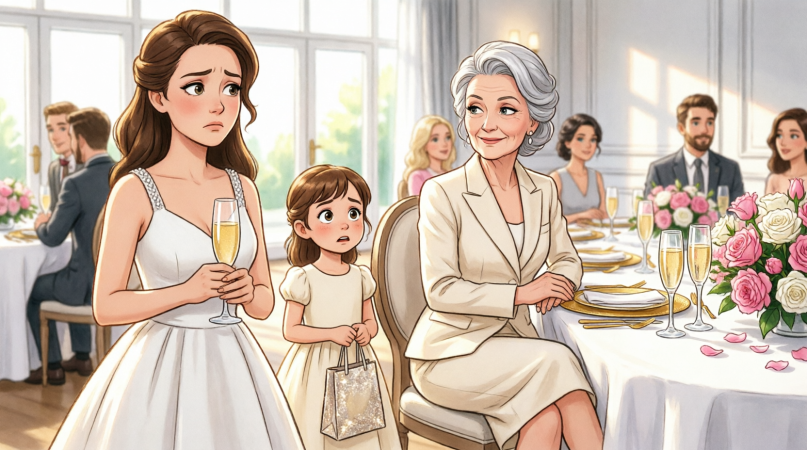
My mother sat at the head of the table as if the seat belonged to her by law. She had her hair perfectly smoothed back, lips glossy, a bracelet sparkling at her wrist that I recognized because I’d helped her pay for it last Christmas when she “just needed a little buffer until the end of the month.”
I sat on the side with my daughter Maya beside me. Maya was nine, quiet in crowds, the kind of kid who watched everything before she spoke. She wore a little cardigan I’d bought on sale and the shoes she insisted were “fancy” because they had tiny bows on them. In her lap was a gift bag she’d decorated herself with glitter glue and stickers. Inside were sparkly hair clips she’d picked out because, as she’d whispered to me in the pharmacy aisle, “Aunt Serena likes shiny things.”
The table was crowded with women who shared my mother’s smile, my mother’s laugh, my mother’s ability to say something sharp and make it sound like a compliment. An aunt. Two cousins. Serena’s friends, who all seemed to have the same caramel balayage and the same laugh that rose like a chorus whenever Serena spoke.
I’d been invited because I was family, but I’d been kept on the edge of everything like a decorative plant.
Serena scrolled through photos on her phone, holding the screen up to my mother like she was presenting royal artifacts. Centerpieces. Dress options. A florist’s proposal that looked like a mortgage payment. A cake tasting where each slice sat on a marble tray as if it were too good for plates.
My mother nodded along, pleased, her eyes bright. When Serena showed her something particularly extravagant—a towering floral arch, white roses spilling down like a waterfall—my mother made the same sound she made when she tried on a new coat and wanted everyone to notice.
Then, in that bright little atmosphere of praise and planning, my mother turned her head just enough to include me.
“Christina,” she said.
She always used my nickname, Chris, when she wanted to sound reasonable. When she wanted to claim the higher ground before she pushed.
“Your wedding budget is five thousand.”
The words landed like a napkin dropped on the table—light, casual, easy to ignore if you wanted to pretend it didn’t matter.
Around the table, a few eyebrows lifted. Someone chuckled like my mother had made a joke.
My mother’s smile widened, and she added, as if she were sharing a fun fact about the weather, “Your sister’s was ninety thousand.”
I felt my fingers tighten around my mimosa glass. Cold seeped into my skin. I stared at the orange slice perched on the rim like it was the only real thing in the room.
Serena didn’t even blink. She kept scrolling.
My mother’s eyes rested on me with that familiar look—half patience, half annoyance—like I was a child about to complain about something she considered silly.
“You’re just not as important to the family,” she said, still smiling.
There it was. The sentence that made the restaurant noise go distant. The chatter around us blurred into a hum. I remember the way the sunlight hit the tablecloth, bright enough to make my eyes water. I remember the little clink of someone’s spoon against a plate.
Then my mother did something that made my stomach drop even further. She looked past me.
Not at Serena. Not at the women who would nod and laugh to keep things comfortable.
She looked right at Maya.
“And Maya won’t be in the formal photos,” my mother said. “We’re keeping it traditional.”
My daughter’s body went still. Her hands tightened around her gift bag. I saw her swallow, saw her eyes widen slightly like she wasn’t sure she’d heard correctly.
Maya leaned into my side and whispered, so small I almost didn’t catch it, “Mom… did I do something wrong?”
My chest constricted. The urge to stand up, to spill the entire brunch onto the floor like a tipped table, surged through me. But my family had trained me. My whole life, they had trained me to be the one who swallowed things before they could be seen.
The person who reacted was always the problem. The person who made a scene was always “dramatic.” The person who cried, yelled, or demanded respect was always “too sensitive.”
So I smiled, because my face knew the routine before my heart could fight it.
“No, baby,” I said too quickly, voice too bright. “No. You didn’t.”
Maya stared at my mother as if she was trying to translate another language. Serena kept scrolling through her phone. My aunt chuckled—actually chuckled—and someone said, “Well, at least Christina is practical.”
Practical. Useful. Stable.
My mother took a sip of her drink and continued, calm and practiced, “We’re not doing another big wedding. It’s not necessary. You’re older. You already have a child, and honestly, you’re stable. You don’t need the help.”
Stable.
Like a cabinet you lean on. Like a shelf you load up until it bows and then slam shut and forget exists.
I rubbed Maya’s back with my thumb. She leaned into me like she was trying to make herself smaller, disappear into my side. She didn’t cry. She wasn’t the kind of kid who cried in public. She was the kind of kid who tried harder.
That’s what hurt most—watching her instinctively start to become like me.
I didn’t argue. I didn’t demand my mother apologize. I didn’t stand up and say, “What is wrong with you?” because no one at that table would have backed me up. They would have looked at me as if I’d ruined something beautiful and expensive with my emotions.
So I stayed still. I smiled like my face belonged to someone else. I let the brunch end without an explosion, because in my family, silence was a currency, and I had paid with it all my life.
On the walk to my car, the spring air felt too sharp, like it wanted to cut through my skin. Serena’s kids ran past us with sugar on their faces, shouting about cake tasting. My mother called after me, “Christina, don’t be dramatic,” as if my back walking away was already a tantrum.
I didn’t turn around.
Maya buckled herself into the passenger seat, moving carefully, as if any sudden motion might break something. She stared at her lap, fingers twisting the ribbon on her gift bag. Her voice was small when she finally spoke.
“If I’m not in the pictures,” she asked, “does that mean I’m not really family?”
My throat burned. I gripped the steering wheel until my knuckles went white.
I wanted to say, Of course you are. I wanted to say, Grandma is wrong. I wanted to say, I’ll make them love you.
But the truth sat between us like a stone.
In my mother’s version of family, Maya had always been an asterisk.
Not like Serena’s kids, the ones my mother bragged about to strangers at the grocery store. Not like the children she posted on Facebook with captions about how blessed she was.
Maya was “Christina’s little one.” A footnote. A reminder that I’d done life out of order, that I wasn’t the daughter who made my mother look impressive.
So I told Maya the only truth that mattered.
“You’re my family,” I said. “And that’s the only one that counts.”
Maya nodded slowly, but I saw the way her eyes got shiny and stubborn. Kids don’t just accept things like that. They carry them. They fold them into their bones.
By the time we got home—my two-bedroom townhouse outside Columbus, Ohio, with the tiny kitchen and the laundry closet that screamed every time it spun—I felt like I’d been hollowed out.
I was thirty-six then. A hairdresser, not the glamorous kind you see in commercials where everyone’s laughing and sipping champagne and tossing their hair like silk. The real kind. Ten hours on your feet. Hairspray in your lungs. Smiling through a client’s divorce confession while trying to get foils even. A job that left your wrists aching and your back stiff, but that somehow still demanded you be cheerful.
I was good at it. I had regulars who tipped in cash and brought me muffins at Christmas. I could tell what kind of day someone was having by the way they sat in my chair. I’d learned to make people feel beautiful even when I didn’t feel seen.
And in my family, I was the quiet little emergency fund.
The one who could “handle things.”
Handle meant money. Handle meant labor. Handle meant swallowing your own needs so everyone else’s could stay loud.
Maya’s dad had been in and out like bad Wi-Fi. Promises, apologies, disappearing acts. I stopped pretending I could build a stable home out of someone else’s excuses. Two years before that brunch, I met Ethan Cole.
Ethan wasn’t flashy. He didn’t walk into my life like a hero with a soundtrack. He was calm, quiet, a middle school teacher who wore worn sneakers and carried a thermos like it was part of him. The kind of man who didn’t fill silence with noise because he wasn’t afraid of it.
He didn’t come in and try to save me. He just showed up, again and again.
Picked Maya up from after-school care when my last client ran late. Sat on the living room floor and helped her build puzzles without checking his phone every thirty seconds. Let her talk about her drawings like they were museum exhibits. He listened to her the way I’d always wanted adults to listen to me—like my thoughts mattered.
The first time Maya fell asleep on the couch with her head on his shoulder, Ethan didn’t move. He just sat there, letting her weight settle against him, his hand resting gently on her back like he’d been doing it his whole life.
When he proposed, he did it in our kitchen, not at some fancy restaurant, not with a crowd to clap. It was a quiet Sunday afternoon. Maya was at the table coloring. I was washing dishes. Ethan came up behind me and slipped his arms around my waist and said my name like it was something precious.
Then he got down on one knee anyway, right there on the kitchen tile, and asked me.
Maya cried first. She dropped her marker and ran over, throwing her arms around him with such force he almost tipped over.
“Does this mean you’re really staying?” she asked, her voice breaking.
Ethan looked at her like the question mattered more than the ring.
“Yes,” he said. “It means I’m really staying.”
I thought a ring and a good man and a kid who just wanted to belong would finally make my mother treat me like I mattered.
I should have known better. The pattern was older than my engagement. It started so early I couldn’t even remember the beginning—only the feeling of it, like standing in a room where everyone else had warmer light.
When Serena got engaged five years earlier, my mother called me like it was an emergency.
“Chris, I need you,” she said.
Need. That word was always her hook, soft and urgent.
“You’re the only one who can handle the bridal party,” she added.
Handle meant doing everyone’s hair for free.
Serena wanted a luxury wedding. Ballroom. Live band. Floral arch. Ice sculpture that made everyone pull out their phones. Ninety thousand dollars went into that wedding, mostly from my parents.
They didn’t have ninety thousand dollars lying around. Not really. They had a comfortable life, sure. But not that kind of money.
So where did it come from?
Loans. Credit. Temporary borrowing. And me.
At the time, my mother started mentioning bills like they were accidents that kept happening to her.
“We’re struggling this month,” she’d sigh.
“Your dad’s truck needs repairs.”
“The roof might leak.”
“Your brother could really use help with daycare just for this month.”
So I sent money. Not huge amounts at first. Two hundred here. Three hundred there. It felt manageable. It felt like being a good daughter.
Then my mother started saying things like, “Just until we get through this month.”
Then, “You’re so good with money.”
Then, “You’re the only one we can count on.”
And they got comfortable.
It wasn’t just cash. It was my labor.
Every holiday, every event, every “special occasion,” my mother expected me to show up early with my kid and do hair in the upstairs bathroom like I was hired staff who happened to share DNA.
Serena’s blowout. Bridesmaids’ curls. My mother’s “just a few touch-ups.” Even my aunt’s hair because “you’re already doing everyone else.”
I once did twelve heads in one morning. Twelve.
By the time the wedding started, my arms were shaking and my stomach was empty because I’d been too busy to eat. At the reception, my mother hugged me and whispered into my ear, “See? You’re so useful.”
Useful.
Not loved. Not thanked.
Useful.
I laughed like it was a joke because that was what my mouth did when my heart didn’t know how to speak.
After Serena’s wedding, the requests didn’t stop. They just changed outfits.
When Serena bought her house, my parents helped with the down payment. That same week, my mother called me.
“We’re a little short,” she said softly. “Just a little. Can you spot us?”
I did.
When my dad wanted to redo the basement, my mother asked me to put the contractor’s deposit on my credit card “just for the points.”
I did.
When Maya had asthma flare-ups and I was juggling inhalers and co-pays, my mother still asked me to cover my brother’s tires because “he has a family.”
As if I didn’t.
Through all of it, they treated Maya like an add-on. A reminder of my “mistakes.” They never said grandbaby the way they did with Serena’s kids. They called her Christina’s little one.
They forgot her birthday twice.
One Christmas, my mother handed Maya a used coloring book—pages already scribbled in—and said, “You can share with the other kids.”
Maya smiled anyway. “Thank you,” she said, because that’s the kind of kid she was. She didn’t complain. She just tried harder.
She drew pictures for my parents—big happy houses with everyone holding hands. She carefully wrote grandma in bubble letters. She saved her allowance to buy my mother a vanilla candle because she once heard her say she liked the smell.
And every time, my mother watched like she was seeing a stranger’s child perform at a school play she didn’t want to attend.
Still, I kept showing up because I’d been trained to believe love was earned through usefulness. If I was helpful enough, quiet enough, flexible enough, maybe I’d finally belong.
So when Ethan proposed, I thought, Okay. Now we’re legitimate. Now we’re safe.
We planned a small wedding. Not courthouse small. Normal small. A garden venue. Fifty people. A simple dress. A budget around eighteen thousand, paid by Ethan and me. We weren’t asking my parents to fund it.
I just wanted my mother to stop acting like my life was a consolation prize.
I told her we’d cover most of it. I asked if she wanted to contribute in any way, knowing she’d insist on helping if she felt in control.
That brunch was her answer.
Not just the money. The ranking. The way she made it public. The way she involved my child like it was nothing.
That night, after Maya fell asleep with her stuffed rabbit under her chin, Ethan came over and found me at the kitchen table. Laptop open. Venue contract on the screen. My cursor hovering over the cancellation button like it was a cliff edge.
Maya’s drawings were spread out on the floor in the living room. One of them—a girl in a dress with a flower crown—stood alone. No one beside her. Just empty space.
Ethan didn’t ask if I was okay. He didn’t do that thing some people do where they pretend not to notice pain because it makes them uncomfortable.
He sat down across from me, looked at the screen, and asked quietly, “What did she say?”
So I told him.
I told him about the budget sentence. The ninety thousand. The five thousand. The words not as important. The part about Maya not being in photos.
I watched Ethan’s jaw tighten. He didn’t explode. His anger wasn’t loud. It was contained, like a fist held steady.
“Christina,” he said, “we don’t have to do this their way.”
“It’s not about the money,” I said, and the bitterness in my voice surprised even me. “It’s the statement.”
He nodded once. “Then we don’t reward it.”
My deposit for the venue was three thousand two hundred dollars. Non-refundable. It would sting.
But I thought about my mother’s smile over that mimosa, like she’d just handed down a verdict. I thought about Maya asking if she was family. I thought about twelve heads of hair, deposits on my credit card, late-night transfers, and used coloring books.
And something in me got tired.
Bone tired.
I moved the cursor. My hand shook as if my body understood what my mind had avoided for years.
Cancel booking.
The screen asked, Are you sure?
I clicked yes.
A confirmation email arrived almost immediately. Then another. Florist canceled. Rentals canceled. Bakery tasting canceled.
Each email felt like cutting a thin thread that had been wrapped around my wrist for years. It hurt, but it also loosened something. Like circulation returning to a limb you didn’t realize had been asleep.
Maya padded into the kitchen in her socks, rubbing her eyes.
“Are we still getting married?” she asked, voice thick with sleep.
“Yes,” I said, and my voice sounded steady in a way I didn’t expect. “Yes, we are. Just… not like that.”
Maya blinked at me. Then she asked the question that mattered most.
“Will I be in the pictures?”
I swallowed. “In all of them,” I promised.
Two days later, my phone started lighting up like it was possessed.
First Mom.
Then Serena.
Then my brother.
Then my aunt.
I let them ring.
Finally, my mother texted, and she didn’t even bother with a fake sweetness.
Are you trying to embarrass us? Everyone knows you booked that venue. You’re making this family look bad.
Not Are you okay?
Not I’m sorry.
Not I shouldn’t have said that about Maya.
Just reputation.
The familiar reflex surged in me: explain, smooth it over, apologize for reacting to my own humiliation.
Instead, I typed one sentence.
I’m not hosting a wedding where my daughter is treated like she doesn’t belong.
The reply came instantly.
Don’t use Maya as a weapon.
Weapon.
My child was a weapon, but my money had been a tool. My labor had been a resource. My silence had been a gift.
I didn’t respond.
That night, Ethan came over with something different in his eyes—not anger now, but a kind of quiet resolve.
“Do you remember my Uncle Alessandro?” he asked.
I frowned. “The one in Italy?”
He nodded. “He heard we were planning something small. I told him things changed. He asked why.”
My stomach tightened. “You told him?”
“I didn’t gossip,” Ethan said gently. “I explained why we might change plans.”
He slid a thin stack of printed emails across the table. No dramatic invitation. No gold lettering. Just simple, clear words.
A civil ceremony. Legally binding. Quiet. Intimate.
Hosted at his uncle’s villa outside Florence.
No speeches. No seating chart. No ranking. No performance.
Just us.
At the bottom, in a neat, formal hand, was a single line.
Family is not measured in budgets.
I stared at it for a long time, like my eyes were learning a new truth.
“Maya,” I called softly.
She came in, clutching her sketchbook.
“How would you feel about going to Italy?” I asked.
Her head snapped up like I’d said magic.
“Pizza Italy?” she whispered, and Ethan laughed under his breath.
“That Italy,” I said.
Maya crawled into my lap, warm and solid. She looked at the paper again, then at me.
“Would I be in the pictures?” she asked, serious.
“Yes,” I said. “In all of them.”
She nodded once, solemn as a judge. “Okay.”
We didn’t announce it. We didn’t fight for anyone’s blessing. We just went.
I used airline miles I’d been hoarding for years—miles I’d saved for a “real honeymoon someday,” like I’d been waiting for permission to live my own life. We packed light. Maya brought her sketchbook and her stuffed rabbit. Ethan carried the documents. I carried something I didn’t recognize yet.
Peace, maybe. Or the first seeds of it.
The night before we left, my mother called again.
This time, I answered.
She didn’t say hello.
“Have you calmed down?” she asked.
I stood in the kitchen, staring at the dish rack, at the ordinary plate with a chip in the edge that I’d been meaning to replace for months. My life was so normal. So small. And still she tried to own it.
“I canceled the venue,” I said evenly.
There was a sharp inhale on the other end.
“That was a family event,” she snapped.
“It was my wedding,” I said.
“You’re jealous of your sister,” she spat, like jealousy explained everything.
I almost laughed. “I’m done being treated like I’m less.”
“You’re being selfish,” she said, and the word selfish sounded like a curse in her mouth.
“You excluded my daughter,” I said.
There was a pause. Then a scoff.
“You’ll come crawling back,” my mother said, so certain, so smug.
Something inside me settled, like a door clicking shut.
“No,” I said quietly.
And I hung up.
Italy didn’t feel real at first. When we stepped out of the airport, the air was warm and soft, smelling faintly of sun on stone. The buildings looked like they’d been standing there long before anyone had decided which daughter mattered more.
We drove through rolling hills and vineyards that looked like paintings. Maya pressed her face to the window and made small amazed sounds every few minutes like she couldn’t help it. Ethan reached over and squeezed my hand whenever my breathing started to hitch—because my body still expected punishment for choosing myself.
Alessandro met us at the gate of his villa. He was tall, silver-haired, with calm eyes that didn’t dart around looking for status. He wore a simple linen shirt and held himself like someone who knew exactly who he was without needing anyone else to confirm it.
He didn’t ask for the drama. He didn’t demand explanations.
He walked straight to Maya, knelt down so he was eye level with her, and said in careful English, “I am very happy you are here.”
Maya blinked, then smiled shyly.
Alessandro stood and looked at me.
“Welcome,” he said.
That word hit me harder than I expected. Welcome. Not useful. Not stable. Not practical.
Welcome.
We were married three days later.
No grand ballroom. No ice sculpture. No staged perfection.
Just a small ceremony in a garden where lemon trees grew heavy with fruit. The sunlight filtered through leaves, turning everything soft and gold. There were a few people—Alessandro, a couple of his friends, a woman who served as the officiant in a crisp dress, and a photographer Alessandro hired who treated us like we were the most important thing he’d ever captured.
I wore a simple white dress that fell softly over my hips. Ethan wore a light gray suit that made his eyes look even calmer. Maya wore a yellow dress and a flower crown she insisted on placing herself, crooked and proud.
When the officiant asked if anyone objected, Maya raised her hand solemnly.
My heart jumped.
The officiant paused, eyebrows lifted, amused.
Maya cleared her throat like a tiny adult. “I don’t,” she said firmly.
Everyone laughed, the kind of laughter that warms instead of mocks. I cried, sudden and sharp, because for the first time my child was being included in something without conditions.
Afterward, the photographer took one photo that mattered more than a thousand formal portraits: Ethan and me, Maya between us, her hands in ours, her smile bright and unguarded.
No one told her to step aside.
No one looked at her like she ruined the aesthetic.
No one made her small.
That evening, we ate dinner under strings of warm lights. The table was simple—bread, olive oil, pasta that tasted like comfort made edible, a cake that wasn’t towering but was perfect. Alessandro raised a glass and said something in Italian that made everyone smile, then turned to us and said in English, “To people who choose each other.”
I felt my shoulders drop. I didn’t realize how high they’d been for years.
After dinner, Maya ran around the garden with her stuffed rabbit, pretending it was a tiny guest. Ethan laughed, really laughed, and I stared at him like I was seeing a version of us that could have existed all along if I’d stopped chasing my mother’s approval.
Later, in our room, Ethan asked me, “Do you want to tell them?”
My phone sat on the bedside table like a sleeping animal.
I thought about my mother’s voice. About the brunch. About Maya’s question in the car.
“I don’t want my wedding day to be about them,” I said.
Ethan nodded. “Then it won’t be.”
I posted the photo anyway—not because I wanted to provoke anyone, but because I was tired of hiding my life like it was a shameful secret. I didn’t write a caption. I didn’t explain. I just let the picture exist.
Then I turned my phone face down and went back outside, where Maya was showing Alessandro her sketches and Alessandro listened like each one was important.
The next morning, I checked my phone.
One hundred twenty-seven missed calls in six hours.
My stomach dropped even though I’d expected it.
Mom.
Serena.
My brother.
My aunt.
Cousins who hadn’t texted me on my birthday in years suddenly deeply invested in my marriage.
Serena’s first message was short.
What is this?
My mother’s was longer.
Answer your phone. You are humiliating this family. How could you do this without your mother present after everything we’ve done for you?
Everything we’ve done for you.
The phrase made me laugh out loud in the quiet villa room, and the sound startled me. It wasn’t a happy laugh. It was disbelief. Like hearing someone claim credit for a house they never built.
Then the comments started rolling in under the photo. Hearts. Congratulations. Friends from the salon telling me how beautiful Maya looked. Ethan’s coworkers leaving kind words. People who actually knew us, celebrating.
Then shocked emojis from my mother’s friends, the ones who liked Serena’s wedding photos with breathless admiration.
And then a new comment appeared.
Alessandro Bianchi.
Beautiful ceremony at my villa. Welcome to the family.
That was it. No defense. No drama. Just acknowledgment.
My body relaxed in a way I didn’t realize it had been braced for my entire adult life.
Because in my family, boundaries were only respected when someone higher enforced them. My mother had always acted like she was at the top of the hierarchy, like her approval was the ultimate prize.
Alessandro’s calm comment reminded everyone—quietly—that she wasn’t.
My mother replied publicly.
Please don’t encourage this. Christina is confused. This was not a real wedding. We will handle this privately.
Not a real wedding.
I stared at the screen, then looked up at Maya, who was humming as she colored a picture of a lemon tree.
Real enough, I thought.
Ethan gently took my phone from my hand. “We’re not giving her our day,” he said.
He was right.
That night, Alessandro hosted another dinner, smaller, calmer. Halfway through the meal, he said, speaking slowly so I’d catch every word, “In families, there are people who take and people who give. Takers become angry when giving stops.”
His eyes moved to Maya, who was twirling pasta around her fork.
“In my home,” Alessandro said quietly, “a child is never made to feel small.”
He didn’t need to say more.
I felt something inside me shift, like a heavy coat sliding off my shoulders.
The morning after that dinner, while sunlight spilled across the tiled floor and Maya sat at the table drawing us under a lemon tree, I sent exactly one message to my family.
I’m married. Maya is my family. If you can’t respect that, you won’t be part of our lives or our finances.
I stared at the screen for a full minute before hitting send. Not because I doubted it. Because my body was still learning that I was allowed to say no without dying from guilt.
Then I opened my banking app.
Monthly transfer to Mom: canceled.
Auto payment for my brother’s daycare loan: canceled.
Credit card authorized user: removed.
Salon appointments blocked out for “family events”: deleted.
Each confirmation felt strangely quiet. Not dramatic. Not explosive. Just final, like clearing broken glass barefoot and realizing you’re not bleeding anymore.
The fallout came within hours.
First Serena.
Mom is crying. What did you do?
Then my brother.
Dad is furious. He says you’re overreacting.
Then my aunt.
Is that really Ethan’s uncle? The one who owns the villa?
Not Are you happy?
Not How was the ceremony?
Just status.
I didn’t answer.
By the time we boarded the flight home, my phone had stopped buzzing—not because they were calm, but because they were regrouping.
Ohio felt colder when we landed. The airport lights looked harsher. The sky was the kind of gray that made everything feel heavy. But when we walked into our townhouse, it felt lighter than it had in years.
Maya taped an Italy postcard to the fridge. She drew a lemon tree beside it and wrote in bubble letters: OUR WEDDING HOUSE.
Ethan set our suitcases down and pulled me into the kitchen.
“You okay?” he asked.
I thought about it.
For years, my normal had been tension—anticipating the next request, the next emergency, the next guilt-laced favor.
Now there was silence.
“Yes,” I said slowly, surprised by the truth. “I think I am.”
Three days later, the panic shifted from emotional to practical.
My mother called from a different number. I let it go to voicemail.
Her message wasn’t angry this time. It was almost casual, like she was calling about groceries.
“Chris, we just need to talk about the basement payment. The contractor is expecting it.”
I deleted the voicemail.
An hour later, my brother texted.
The daycare deposit bounced. Did something happen with your account?
I stared at the message, my thumb hovering.
Yes, I thought. I stopped being your backup plan.
I didn’t type that. Not yet. I just didn’t respond.
Serena tried a softer angle.
Mom says you’re being influenced. That Ethan’s family is trying to isolate you.
I read that message longer than I expected. It would have been easy to defend Ethan, to argue, to list all the ways he’d shown up for me and for Maya. But I knew this tactic. My mother loved the idea that I couldn’t make a decision on my own. It made her feel powerful.
So I typed, calmly:
No one is isolating me. I just stopped funding you.
That was when the tone changed.
Serena replied.
You owe this family after everything Mom sacrificed.
Sacrificed.
I thought about twelve heads of hair before Serena’s wedding. About deposits on my credit card. About asthma inhalers and used coloring books. About my daughter being told she wasn’t traditional enough to be seen.
I set my phone down and walked into the living room where Maya was building a puzzle with Ethan. She was laughing at something he said, and the sound made my chest ache in a way that felt like healing.
A week later, my cousin Rachel showed up at my door holding a box of cannoli like an offering.
“I come in peace,” she said awkwardly.
Rachel and I weren’t close, not really. We’d grown up in the same orbit, but she’d always been more like Serena—more polished, more naturally included. Still, I opened the door wider.
Maya was in the living room showing Ethan how she’d drawn Alessandro’s villa from memory. Rachel watched them for a moment, her face softening.
“She looks happy,” Rachel said quietly.
“She is,” I replied.
Rachel shifted, uncomfortable. “Your mom’s telling everyone you were brainwashed. That this Italy thing was a stunt.”
I let out a short laugh. “That sounds about right.”
Rachel hesitated, then lowered her voice. “They’ve been using you, Chris. Everyone knows it. No one wanted to say it.”
The words hit harder than they should have, not because they were cruel, but because they were honest.
“Why say it now?” I asked.
Rachel shrugged helplessly. “Because you stopped.”
I stared at her, feeling something cold and clear settle in my chest.
Because when I was stable—useful—everything worked. The basement got renovated. The daycare got paid. The family looked good.
When I stopped, the illusion cracked.
After Rachel left, Ethan found me sitting at the kitchen table again. Not staring at contracts this time. Just breathing, fingers wrapped around a mug of tea I’d forgotten to drink.
“You’re quiet,” he said gently.
“I keep waiting for the guilt,” I admitted. “And it’s not there.”
Ethan smiled slightly. “Maybe because you didn’t do anything wrong.”
Across the room, Maya ran toward us holding another drawing.
This one had three stick figures under a lemon tree again, but this time she’d drawn a fourth figure off to the side—taller, with gray hair.
“That’s Alessandro,” she explained proudly. “He said I’m family.”
The word family settled deeper than it ever had before.
Not ranked. Not measured. Not budgeted.
Chosen.
A few days later, my mother sent one last message that week.
So this is it? You’re cutting us off?
I read it twice. My fingers didn’t shake this time.
No, I typed. I’m cutting off the part where you treat us like we don’t belong.
There was no reply.
Not that day. Not the next.
Silence used to scare me. In my family, silence meant punishment. It meant you’d done something unforgivable.
Now silence felt like space.
And in that space, I started to see my life more clearly, like fog lifting off a road.
I noticed how much lighter my shoulders felt when my phone didn’t buzz with requests. I noticed how my checking account stopped doing that sickening dip every month when my mother’s “emergency” came due. I noticed how Maya laughed more.
One Saturday morning, we went to the park. Ethan pushed Maya on the swings, and she screamed delightedly, hair flying. I sat on a bench with coffee and watched her, the sun warm on my face. The scene felt so ordinary it almost made me cry.
Ordinary meant safe.
A month passed, then two.
My father didn’t call. That hurt more than I wanted to admit, because my dad had always been quieter than my mother, more passive, the kind of man who let my mother’s decisions become family law. But I’d still held onto the hope that he might choose me when it mattered.
He didn’t.
Instead, my brother sent a message late one night.
Dad says you’re tearing the family apart.
I stared at the words until they blurred.
Then I typed back, the truth clean and simple.
I didn’t tear anything apart. I just stopped holding it together.
My brother didn’t reply.
In the salon, my life continued in its familiar rhythm—shampoo, cut, color, talk. Clients told me their secrets, their fears, their hopes. I listened the way I always did, but something in me had changed. I wasn’t carrying my family’s weight in my chest anymore, so there was room for other things.
One afternoon, an older woman named Marlene sat in my chair. She was a regular—short, sharp, with hair the color of silver coins.
“You look different,” she said as I sectioned her hair. “Lighter.”
I smiled faintly. “Yeah. I think I feel different.”
Marlene snorted. “Took you long enough.”
I paused, comb in hand. “Excuse me?”
She met my eyes in the mirror. “Your mother’s been coming in here for years, acting like she owns you. I’ve watched you run yourself ragged for her. And I’ve watched you pretend it doesn’t hurt.”
Heat crept into my face. “It’s complicated.”
“It’s not,” Marlene said bluntly. “It’s hard, but it’s not complicated. Some people love what you can do for them more than they love you.”
The words sat heavy. True.
Marlene softened slightly, her voice gentler. “I’m glad you chose your kid.”
I swallowed. “Me too.”
At home, Ethan and I started building little rituals that weren’t about anyone else. Friday night pizza and a movie. Sunday morning pancakes with Maya “helping” by dumping too many chocolate chips into the batter. Evening walks around the neighborhood where Ethan told me stories about his students and Maya pointed out every dog like she was cataloging them.
We started talking about the future like it belonged to us, not like it was a stage performance my family could grade.
Then, in late summer, Serena showed up.
It was a Wednesday evening. Maya was in the bathtub, bubbles piled high like clouds. Ethan was in the kitchen chopping vegetables for dinner. The doorbell rang, sharp and insistent.
My stomach tightened automatically, like my body recognized my family before my mind did.
When I opened the door, Serena stood on the porch in heels she didn’t need and a dress that looked too expensive for a Wednesday. Her hair was glossy. Her makeup perfect. Her eyes cold.
She didn’t say hello.
She stepped forward as if she planned to enter, and I held my ground.
“What do you want?” I asked, my voice quieter than I expected.
Serena blinked, as if she hadn’t considered that I might speak like that.
“You’ve made Mom sick,” she said immediately, like she’d been rehearsing. “She’s barely sleeping. She cries all the time. Everyone’s talking about you.”
I stared at her. “Is Maya okay?” I asked, because my mind still wanted to jump to the only thing that mattered.
Serena frowned. “What?”
“You showed up at my door,” I said, “and the first thing you said wasn’t about my daughter. So I’m asking—are you here to apologize for what Mom said about her?”
Serena’s face tightened. “Mom didn’t mean—”
“She meant it,” I cut in, and my voice sharpened. “She said it out loud. In public.”
Serena scoffed. “You’re always twisting things. You’ve always been dramatic, Chris.”
There it was. The old script.
I breathed in, slow. “You know what’s dramatic?” I said. “Telling a nine-year-old she doesn’t belong in family photos. Telling your sister she’s not important enough to be treated with basic kindness.”
Serena’s eyes flashed. “Mom paid for my wedding because it was a real wedding. It mattered. It was—”
“Expensive,” I finished. “It was expensive.”
Serena stepped closer, lowering her voice. “Do you have any idea how much stress you’ve caused? Dad’s credit cards—”
I stared at her. “Dad’s credit cards?” I repeated.
Serena’s mouth tightened. She looked away for a fraction of a second—enough to tell me she’d said something she hadn’t meant to.
My chest went cold. “They’re in debt,” I said, more statement than question.
Serena didn’t answer.
I felt a strange clarity. The ninety-thousand-dollar wedding. The down payment help. The basement renovation. All those “little emergencies” my mother used to call about.
Of course.
It wasn’t just favoritism. It was a system. A machine that ran on my compliance.
“So you’re here,” I said slowly, “because you need me to start paying again.”
Serena’s eyes snapped back to mine, offended. “That’s not—”
“It is,” I said, and my voice didn’t shake. “You don’t care that Mom hurt Maya. You care that Mom can’t keep up appearances without me.”
Serena’s face hardened. “You owe us.”
The old me would have flinched. The old me would have started listing everything I’d done, trying to prove my worth.
Instead, I said something I’d never said to my sister before.
“No,” I said simply. “I don’t.”
Serena stared at me, stunned, like I’d just spoken in another language.
Behind me, I heard Maya’s laughter from the bathroom, and the sound anchored me.
“Leave,” I said.
Serena’s mouth fell open. “Excuse me?”
“Leave,” I repeated, and my voice was firm. “And don’t come back unless you’re ready to treat my daughter like family. Real family.”
Serena’s eyes narrowed. “You think Ethan’s uncle makes you better than us,” she hissed. “You think you can just—”
“No,” I said. “I think I can stop begging.”
Serena’s face twisted. She looked like she wanted to slap me, but she was too careful for that. Too image-conscious.
So she leaned in and delivered her last weapon, the one she knew my mother always used.
“You’ll regret this,” she said softly.
Then she turned and walked down my front steps like she was leaving a bad restaurant.
I closed the door. My hands trembled, but not with fear. With adrenaline. With something like grief.
Ethan was standing in the kitchen doorway, knife paused mid-chop.
“You okay?” he asked, eyes searching my face.
I exhaled. “Yeah,” I said, and it surprised me because it was true. “I think I am.”
That night, after Maya went to bed, Ethan sat beside me on the couch and took my hand.
“I’m proud of you,” he said quietly.
I swallowed hard. Praise still felt unfamiliar, like wearing a new pair of shoes that hadn’t broken in yet. “I’m scared,” I admitted.
Ethan squeezed my hand. “Of what?”
I stared at the darkened TV screen, seeing my own reflection faintly. “That I’ll cave,” I whispered. “That something will happen—Dad will get sick, Mom will cry, Serena will—” I stopped. “That they’ll make me feel like a monster.”
Ethan’s voice was steady. “You’re not a monster,” he said. “You’re a mother choosing her child.”
A few days later, Maya came home from school quieter than usual. She sat at the kitchen table, pushing peas around her plate.
“Everything okay?” I asked, trying to keep my voice casual.
Maya shrugged, eyes down.
Ethan glanced at me, then busied himself with dishes so she wouldn’t feel cornered.
Finally, Maya said softly, “Emma said my grandma doesn’t like me.”
My heart dropped. “Who’s Emma?”
“My friend,” Maya said, still not looking up. “Her mom heard… something.”
The shame rose up, hot and familiar. The urge to fix it, to hide it, to make it not true.
I took a breath and moved my chair closer.
“Maya,” I said gently, “Grandma’s feelings aren’t about you. They’re about Grandma.”
Maya’s lip trembled. “But why?”
Because Grandma is broken, I wanted to say. Because she needs to feel powerful. Because she thinks love is a reward.
But Maya was nine. She didn’t need all my adult language. She needed something she could hold.
“Sometimes,” I said carefully, “grown-ups have rules in their heads that are wrong. Grandma has some wrong rules. She thinks people are important only if they do things her way.”
Maya stared at her peas. “Like… being traditional.”
“Yes,” I said softly. “Like that.”
Maya was quiet for a long moment. Then she said, “But you and Ethan have rules too.”
I blinked. “We do?”
Maya nodded solemnly. “Your rule is… everyone gets to be in the picture.”
My throat tightened.
“Yes,” I said, voice thick. “That’s our rule.”
Maya gave a small nod like she’d decided something. Then she reached for her fork and started eating again.
That night, after she went to bed, I stood in her doorway and watched her sleep. Her face looked peaceful, lashes resting on her cheeks. I thought about how easily children absorb messages about their worth. I thought about how my mother’s words could have planted something poisonous in my daughter if I’d let them.
I knew then—more clearly than ever—that I wasn’t just protecting myself. I was breaking a pattern so Maya wouldn’t grow up believing love was something you earned by being useful.
Autumn came with its crisp air and early sunsets. Leaves turned gold and red, then fell like secrets people couldn’t hold anymore.
Then, in early November, my father called.
His number flashed on my screen, and my heart thumped hard enough to make my hands sweat.
Ethan looked up from the couch, concerned.
I answered.
“Hi, Dad,” I said, and my voice sounded smaller than I wanted.
There was a pause, then my father’s voice, rougher than I remembered. “Christina,” he said.
He didn’t call me Chris. He never did. He said my full name like he was about to scold me.
“We need to talk,” he said.
My stomach tightened. “About what?”
He cleared his throat. “Your mother’s beside herself,” he said. “You can’t just cut her off like this.”
I swallowed. “Dad,” I said, “she told me I’m not important. She told Maya she wasn’t—”
“She didn’t mean it like that,” he interrupted quickly, like he needed to keep the truth from growing teeth.
“Yes, she did,” I said, and I forced my voice steady. “She said it out loud.”
Silence.
Then my father sighed, heavy. “Serena’s pregnant,” he said suddenly.
The words landed strange in the conversation, like a new card slapped onto the table.
“Okay,” I said carefully.
“And your mother—” his voice softened. “Your mother wants the family together. She wants to move past this.”
Move past.
My mother’s favorite phrase. It meant: pretend it didn’t happen so she wouldn’t have to apologize.
I took a breath. “Is she apologizing?” I asked.
My father hesitated.
“No,” I said quietly, because that hesitation was the answer.
My father’s voice tightened. “Christina, you’re punishing us.”
“I’m protecting my daughter,” I said.
“You’re making everything harder,” he snapped, and it startled me because my father rarely snapped. “We’re drowning over here.”
There it was again. The truth slipping out.
“Drowning?” I repeated. “In what?”
My father exhaled sharply, like he’d already said too much. “Bills,” he muttered. “Credit. Things got tight.”
“Because of Serena’s wedding,” I said, and my voice was calm in a way that surprised me. It wasn’t a guess. It was a conclusion.
My father didn’t answer.
I felt anger flare—hot, clean. Not the messy anger of being insulted. The sharp anger of being used.
“You let Mom take my money for years,” I said, and my voice shook now, not with fear but with rage. “You let her call it emergencies while she spent it on things that made Serena look good. You watched me struggle and you—”
“Christina,” my father said, sharp. “Don’t—”
“No,” I said, and my voice steadied again. “Don’t you tell me not to. You were supposed to protect me too.”
Silence again.
My father’s voice came back quieter, and for a moment I heard something vulnerable in it. “I didn’t know how to stop her,” he admitted.
The confession hit me like a gust of cold air. My father—the man I’d imagined as the calm one, the safer one—had been powerless in his own home.
But powerlessness didn’t erase harm.
“I’m sorry,” he added, and the words sounded awkward, like they didn’t fit his mouth.
I swallowed hard. “I need more than sorry,” I said softly. “I need you to stop asking me to accept mistreatment.”
My father exhaled. “What do you want, Christina?” he asked.
The question should have been simple. But it wasn’t. It was years of need packed into one sentence.
I thought about Maya. About the brunch. About the pictures. About my mother’s smile.
“I want Mom to apologize to Maya,” I said. “Not to me. To Maya. I want her to say she was wrong, and I want her to mean it. And I want her to understand that if she ever makes Maya feel small again, we leave. No debate.”
My father was quiet. Then he said, “She won’t do that.”
The honesty in his voice made my eyes sting.
“Then that’s your answer,” I said.
My father sighed, defeated. “You’re really done,” he said.
I stared at the wall, at the framed picture of Maya at the beach last summer, her grin wide, sand on her knees. “I’m done being used,” I said. “But you’re not dead to me, Dad. You can still be in our lives… if you can respect our boundaries.”
A pause.
“I’ll… think about it,” my father said, like boundaries were something optional.
“Okay,” I said, and my voice was gentle because I could still love him and not let him hurt me. “Goodnight.”
When I hung up, my hands were shaking.
Ethan was beside me instantly. “What happened?” he asked.
I sank onto the couch. “Serena’s pregnant,” I said, and the words tasted bitter.
Ethan’s brow furrowed. “And?”
“And they want everything to go back to normal,” I said.
Ethan’s eyes softened. “Normal for them,” he said quietly.
I nodded.
Ethan pulled me into his arms, and I let myself rest my forehead against his shoulder like my body needed to learn what support felt like.
Weeks passed. Serena didn’t call again. My mother didn’t apologize. My father didn’t visit. The silence stretched into a strange new normal.
Thanksgiving came.
For the first time, we didn’t go to my parents’ house. There was no long drive, no tense smiles, no Maya being subtly ignored while Serena’s kids were praised.
Instead, Ethan cooked a turkey in our tiny oven and somehow made it taste like a holiday. Maya made place cards with markers. We invited Marlene from the salon, who pretended she hated being included but showed up with a pie anyway. Ethan’s friend Dana came with her girlfriend and a casserole, and the table felt… easy.
At one point, Maya stood up and tapped her fork against her glass, copying what she’d seen in movies.
“I have an announcement,” she said solemnly.
We all turned to her, smiling.
Maya lifted her chin. “I’m thankful,” she said carefully, “that everyone here likes me.”
The room went silent for a breath, then Ethan’s eyes filled, and my throat tightened so hard I could barely breathe.
“I like you the most,” Ethan said, voice thick.
Maya grinned, relieved, and sat down like she’d checked something off her heart’s list.
After dinner, while everyone chatted in the living room, I slipped into the kitchen and cried quietly over the sink. Not because I was sad exactly—because something inside me was unclenching. Because my daughter was building a new template for what family could be.
After the guests left, Ethan found me wiping down the counter with too much intensity.
“You okay?” he asked softly.
I nodded, then shook my head. “I’m happy,” I whispered. “And I’m angry that I didn’t realize sooner that I could have this.”
Ethan kissed my temple. “You have it now,” he said.
In December, a letter arrived.
Actual paper. My mother’s handwriting on the envelope, neat and familiar.
My heart pounded as I held it. Old conditioning. Letters from my mother were never neutral.
Ethan watched me from the couch, concern in his eyes. “You don’t have to open it,” he said.
I knew that. And still, my fingers slid under the flap.
Inside was a card with a glossy picture of a snowy church on the front. On the inside, my mother had written:
Merry Christmas. I hope you’re happy. We all miss you. Maya can come by to open gifts if you’re ready to stop being stubborn. Love, Mom.
My eyes scanned it twice.
No apology. No acknowledgment. Just a condition.
Maya can come… if you’re ready…
Like my child was a treat my mother could offer as leverage.
I felt something in me go cold and clear again.
I folded the card, slid it back into the envelope, and set it on the counter like it was junk mail.
Ethan exhaled. “What did she say?”
“She tried to bargain for Maya,” I said, and my voice held more disgust than pain now.
Ethan’s jaw tightened. “No,” he said quietly.
“No,” I agreed.
We didn’t respond.
Christmas morning, Maya ran into the living room in pajamas with reindeer on them and tore open gifts that were simple and joyful. Ethan gave her a new sketchbook with thick paper. I gave her a set of colored pencils she’d been eyeing for weeks. Marlene sent her a small necklace with a charm shaped like a lemon.
Maya held it up, eyes wide. “Like Italy,” she whispered.
“Like Italy,” I said softly.
That evening, Maya sat at the kitchen table drawing again. This time, she drew a big house with strings of lights and people inside.
“Who’s that?” I asked, pointing at a figure with gray hair.
Maya grinned. “That’s you when you’re old,” she said.
I laughed. “Thanks.”
“And that’s Ethan,” she continued, pointing. “And that’s me.”
She paused, then added a small figure outside the house, near the edge of the page.
“And that’s Grandma,” Maya said quietly.
My heart tightened. “Do you want her inside?” I asked gently.
Maya stared at the drawing for a long time. Then she shook her head.
“No,” she said softly. “Not if she doesn’t like me.”
Her voice was calm. Not dramatic. Not angry.
Just honest.
I swallowed. “That’s a fair rule,” I said.
Maya nodded and colored the house brighter.
January came with snow and the slow drag of winter. Life continued. And then, one afternoon, my father showed up.
I opened the door and found him standing on the porch with his hands in his coat pockets, shoulders hunched against the cold. He looked older than I remembered, lines deeper around his mouth.
For a second, I almost saw him as a man instead of just my father.
He cleared his throat. “Can I come in?” he asked.
I hesitated. Then I stepped aside.
My father walked into the living room like he wasn’t sure he belonged there. His eyes landed on Maya’s drawings taped to the wall—lemon trees, stick figures, bright houses.
Maya peeked around the corner from the hallway, cautious.
“Hi, Grandpa,” she said softly.
My father’s face softened in a way I hadn’t seen in years. “Hi, sweetheart,” he said, and there was actual warmth in his voice.
Maya stepped into the room. She didn’t run to hug him. She stood near me, close enough that her shoulder brushed my hip.
My father swallowed, then looked at me. “Your mother doesn’t know I’m here,” he said.
I stared at him. “Why are you here?” I asked.
He looked down at his hands. “Because I keep thinking about what you said,” he murmured. “That I was supposed to protect you too.”
My chest tightened. I didn’t speak.
My father lifted his gaze. “I didn’t,” he admitted. “I didn’t protect you. I let your mother… I let her decide what you were worth.”
The words made my eyes sting.
Maya watched, quiet, her small hand reaching for mine.
My father’s voice cracked slightly. “I’m sorry,” he said again, and this time it sounded less like an awkward word and more like a confession.
I swallowed hard. “Dad,” I said softly.
He nodded, eyes wet. “And I’m sorry about Maya,” he added, and his gaze shifted to her. “That was wrong. She should never have been treated like that.”
Maya blinked, surprised. She hadn’t expected adults to admit wrongness. Kids rarely do.
My father took a slow step toward her, stopping a respectful distance away. “Maya,” he said gently, “you didn’t do anything wrong. Not ever.”
Maya’s lip trembled. She looked up at me like she needed permission to believe him.
I squeezed her hand. “It’s okay,” I whispered.
Maya looked back at my father. “Do you… like me?” she asked, the question so simple it felt like it could split the air.
My father’s face crumpled. “Yes,” he said quickly. “Yes, I do. I love you. I was… I was stupid. I was afraid of making your grandma mad.”
Maya’s brows knitted. “That’s a silly reason,” she said bluntly.
My father let out a broken laugh that sounded like a sob. “It is,” he admitted. “It really is.”
I stared at him, heart pounding. Part of me wanted to melt into forgiveness because I’d waited so long to hear words like that. Part of me wanted to hold the line because Maya deserved consistency, not speeches.
I took a breath. “Dad,” I said, voice steady, “this matters. You saying it matters. But it also matters what happens next.”
He nodded quickly. “I know.”
I studied him. “Can you respect our boundaries?” I asked. “Even if Mom doesn’t?”
My father hesitated, then nodded slowly. “I want to,” he said. “I’m trying.”
It wasn’t perfect. But it was something.
Maya stepped forward then, just one small step, and held out her hand.
My father stared, startled, then took her hand gently like it was fragile.
Maya looked up at him and said, very seriously, “You can be in the pictures.”
My father’s eyes filled. “Thank you,” he whispered.
After he left, I stood in the kitchen with Ethan, my hands wrapped around a mug of tea, my heart thudding.
“How do you feel?” Ethan asked.
I stared out the window at the snow-covered street. “Cautious,” I admitted. “Hopeful. Angry. All of it.”
Ethan nodded. “That makes sense,” he said.
A few days later, my mother called.
Her name flashed, and for a second my body went straight back to that brunch table—the bright restaurant, the mimosa, Maya’s whisper.
I didn’t answer.
She left a voicemail.
“Chris,” she said, voice sharp, “your father told me he went to your house. He has no right to go behind my back. You’re poisoning him against me. This has gone far enough.”
No apology. No concern. Just control.
I deleted the voicemail.
And that was when I realized something that changed the shape of everything.
My mother didn’t miss me.
She missed access.
Access to my money. Access to my labor. Access to the version of me who stayed quiet so she could look like a good mother without actually being one.
Once I saw that, the guilt lost its teeth.
Spring came again, slow and bright.
Maya’s tenth birthday approached, and for the first time I planned it without considering whether my mother would show up or forget. We rented a small art studio for kids. Maya invited classmates. Ethan and I set up easels and paints. Everyone made messy, joyful paintings that looked like freedom.
My father came, alone. He brought Maya a set of watercolor brushes and said, “I heard you like drawing.”
Maya smiled, shy but genuine. “I do,” she said.
My father looked at me, silent question in his eyes: Am I doing okay?
I nodded once.
Later, while kids ran around with paint on their hands, my father stood beside me and said quietly, “Your mother’s furious.”
I shrugged. “She can be.”
My father exhaled. “She says you’ve chosen Ethan’s family over yours.”
I laughed softly. “I chose my child,” I said. “And I chose peace.”
My father’s eyes got wet again. “I wish I’d chosen that sooner,” he murmured.
I didn’t answer because some wishes come too late to fix what they broke. But I let him stand beside me anyway, because he was trying now, and Maya was watching, and patterns can change slowly if someone finally decides to stop repeating them.
That night, after the party, Maya lay on the living room floor surrounded by cards and drawings from friends. She held up one card and grinned.
“It says I’m a good artist,” she announced.
“You are,” Ethan said immediately, sitting down beside her.
Maya beamed, then turned to me. “Mom,” she said, “can we go back to Italy someday?”
The question made my chest ache with happiness.
“Yes,” I said. “We can.”
Maya’s eyes sparkled. “And Alessandro will be there?”
“Probably,” I said, smiling. “He likes you.”
Maya nodded proudly. “Because I’m in the pictures,” she said.
I laughed, and this time it was real laughter, the kind that comes from a place that isn’t braced for impact.
Later, when Maya went to bed, Ethan and I stood in the kitchen washing dishes. The water ran warm over my hands, and the smell of dish soap filled the air.
“You know,” Ethan said quietly, “your mother might never change.”
I nodded. “I know.”
Ethan looked at me. “Does that break your heart?”
I paused, considering. “It used to,” I admitted. “It used to feel like… if she didn’t love me the way I wanted, then maybe I wasn’t worth loving.”
Ethan’s eyes softened. “And now?”
I stared at the bubbles in the sink, at the way light reflected off them like tiny rainbows.
“Now,” I said slowly, “I think she’s the one who isn’t worth following.”
Ethan’s hand found mine, squeezing gently.
I leaned into him, letting my head rest against his shoulder, and I thought about the sentence my mother had said at that brunch.
You’re just not as important to the family.
She’d meant it as a verdict. A ranking. A wound she could reopen whenever she needed leverage.
But she’d been wrong in a way she would never understand.
Because the moment I stopped begging to be important to her, I became important to myself.
And the moment I chose Maya’s belonging over my mother’s approval, I became the kind of mother I’d always needed but never had.
Some people think family is blood and money and pictures arranged just so. They think tradition means excluding whatever doesn’t fit their comfort.
I learned something different under a lemon tree in Italy, with sunlight on my skin and my daughter’s hand in mine.
Family is the people who make you bigger, not smaller.
Family is the ones who say welcome and mean it.
Family is the ones who don’t measure your worth in budgets.
And for the first time in thirty-six years, I wasn’t the useful daughter standing in the upstairs bathroom doing someone else’s hair while my own life waited downstairs.
I was Christina—wife, mother, and finally someone who didn’t have to earn a seat at her own table.
THE END.