My husband went pale so fast I thought he’d swallowed his tongue.
One second we were just another family on the highway—coffee in the cupholder, snack wrappers multiplying like rabbits, the back seat full of half-awake kids and the kind of petty arguments that only children can sustain for hours—and the next second he was staring straight ahead like the windshield had turned into a screen playing our funeral.
“Turn the car around,” he whispered.
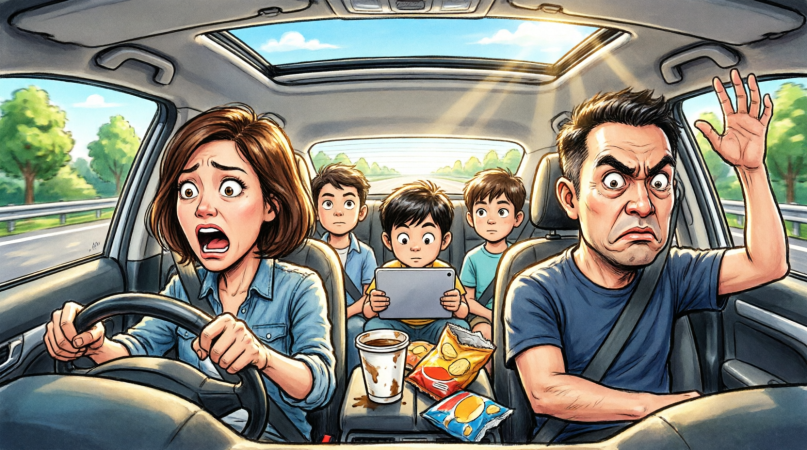
Not a suggestion. Not a question. A command so quiet it barely reached me over the hum of tires, which somehow made it worse. If he’d shouted, I could’ve dismissed it as panic. But my husband doesn’t do panic. He does calm. He does quiet competence. He does tightening a loose cabinet hinge while holding a baby on his hip. He does reading the fine print on our mortgage. He does checking the smoke detector batteries twice a year like his life depends on it.
So when he said it like that—low, urgent, almost pleading—my hands went cold on the steering wheel.
“What?” I asked, automatically smiling the way people do when they want the world to stay normal. “What are you talking about?”
He didn’t blink. His eyes were fixed on the road ahead, but I could feel him seeing something beyond it, something already in motion.
“Please,” he said, and there was a strain in his voice I rarely heard. “Just… turn around. Now.”
I stared at him for a beat too long. Then I looked back at the highway, the signs counting down the miles to the border like a harmless little countdown to potato salad and forced hugs and the reunion photos my mother would post with captions about family being everything.
We were a few minutes out. One last exit before the crossing. After that, it was funnels and lanes and questions and that weird, sterile quiet that settles over your car at a border checkpoint, when even the kids stop talking because something about uniforms makes them behave.
“Why?” I asked again, the word sharper this time. “What’s happening?”
His jaw flexed. He swallowed. “Just… trust me.”
My first instinct was to push. My second instinct was to be offended. I’m the driver because I’m the planner, because I’m the one who reads the hotel reviews and packs the backup socks and knows which kid hates which granola bar. I’m the one who doesn’t like being told to do something without a reason.
But my third instinct—deeper, quieter—was the one that mattered.
This man had held our newborn in an ER chair for six hours without complaining. He had once talked a stranger out of a road-rage fistfight with nothing but a calm voice and an apology that wasn’t even his. He had pulled our oldest out of a rip current like it was just another Tuesday and then thrown up behind the dunes because the adrenaline hit him late.
If he was asking me like this, it wasn’t about control.
It was about survival.
So I flicked on the turn signal and took the last exit before the border.
The ramp curved away from the highway gently, almost politely, as if the road itself was offering me an out. I half expected my husband to tell me I was overreacting, to laugh and say he’d just wanted to see if I’d do it. But he didn’t laugh. The moment we left the main road, his shoulders dropped a fraction. Not relaxed—never relaxed—but like someone had loosened a belt that had been digging into his ribs.
That tiny shift told me everything.
Whatever he thought was about to happen… we’d just dodged the first part of it.
“Okay,” I said, keeping my voice even because the kids were behind us and the last thing I needed was three tiny sirens of anxiety. “We’re off. Now tell me what’s going on.”
He shook his head once. “Just drive.”
“Drive where?”
“I don’t know,” he said, and there was something bleak in that, something almost exhausted. “Anywhere but there.”
In the back seat, our middle child’s cartoon paused, replaced by that suspicious silence kids get when they realize adults are lying.
“Mom?” my seven-year-old called. “Are we going the wrong way?”
“We forgot something,” I said automatically, because lying to your kids is sometimes just parenting triage. “It’s fine.”
“What did we forget?” my ten-year-old asked, already sensing weakness.
“I’ll tell you later.”
Our youngest, five, piped up with the hopeful voice of someone who still believes adults are mostly good. “Is it snacks?”
I didn’t answer.
My husband didn’t speak for a long time.
We drove in silence through a stretch of trees and roadside nothing, the kind of forgotten strip of land that sits between important places. Twenty minutes, maybe more. The kids drifted back into their cartoon. The highway noise faded. My brain, meanwhile, started filling in blanks the way it always does when something doesn’t make sense.
Had he gotten a text? Had he seen a road sign that triggered some memory? Had someone followed us? Was it something about the border itself? Did his passport expire and he was embarrassed? Was he about to confess he’d once committed a crime in Canada in college? My mind threw ridiculous possibilities at the wall because my mind would rather entertain absurdity than face a possibility that felt too heavy to hold.
Then he said, “Take the next turnoff.”
It wasn’t a proper exit. It was a narrow access road with no sign, just a break in the trees and a strip of gravel that looked like it led to nowhere. One of those roads you only notice when you’re lost, or when you’re about to become lost on purpose.
I pulled onto it, tires crunching, and felt like we’d stepped out of our normal life into a secret.
We rolled to a stop beneath a canopy of pines. No houses. No gas station. No other cars. Just trees and the faint sound of wind, and that suffocating awareness that we were alone enough for anything to happen.
My husband unbuckled. “Stay here,” he said.
He got out and walked to the back of the SUV.
“What are you doing?” I called, but my voice came out smaller than I meant it to.
He didn’t answer. He opened the trunk.
From where I sat, I couldn’t see what he saw. I could only hear the rustle of bags shifting, the soft thud of our cooler against the side, the zipper noise, quick and harsh, like tearing fabric.
My hands started sweating. My heartbeat did this weird stuttering thing, fast and heavy, like my body already knew what my brain refused to name.
After a minute, the trunk closed.
He came back to my window and tapped it lightly.
“Can you come out?” he asked.
“Why?”
“I need you to see it.”
He didn’t sound angry. He didn’t sound scared.
He sounded tired.
And very, very sure.
I got out.
The air smelled like sap and dust. The gravel crunched under my shoes in a way that made everything feel louder, more exposed. My husband led me to the back of the car and opened the trunk.
He didn’t speak. He just pointed.
At first, I didn’t understand what I was looking at.
A red duffel bag. The one my dad had handed me that morning with a casual, almost cheerful, “Won’t fit in ours.” It was wedged between our luggage and the kids’ backpacks, innocent-looking, the kind of bag you’d toss into a trunk without thinking.
My husband unzipped it.
Folded back a sweatshirt.
And then my entire body forgot how to breathe.
Inside—wedged between clothes, tucked into what looked like a child’s toiletry kit, sealed in plastic—were packets.
Not one packet.
Several.
Flat, rectangular, wrapped in clear plastic that caught the light in a way that made my stomach drop. There was no label. No prescription bottle. No plausible explanation that wouldn’t involve handcuffs.
It wasn’t fear at first. Fear takes time to arrive. Fear needs permission.
What I felt was something slower and heavier, like the floor of my life giving way in a quiet, unstoppable collapse. Like realizing, in one single instant, that we’d been driving toward a border checkpoint with three kids in the back seat and something illegal in the trunk, and my parents had waved goodbye like they were sending us off on a picnic.
I didn’t touch it. I didn’t need to.
I knew.
I took a step back, my throat tight. “They… put that in our car,” I said, like saying it out loud would make it less real.
My husband nodded once.
“With the kids,” I added, the words ripping out of me.
Another nod.
My eyes stung, but I couldn’t cry. Crying felt too small for what this was. This wasn’t a misunderstanding. This wasn’t family drama. This was criminal. This was our lives on the line.
I looked up at the sky for some reason.
It was still blue. Bright. Calm. Like a normal day.
I hated that. It felt like the universe was mocking me.
“How did you know?” I asked, turning back to him.
He stared at the bag like it could bite. “When they gave us the duffel,” he said slowly, like each word had weight. “Something in their eyes. The way they smiled.”
He shook his head once, almost as if he could shake off the memory. “Like it was already done. Like they were sure it would work.”
He exhaled hard. “I couldn’t stop thinking about it the whole drive. And then… just before the border, it hit me.”
He looked at me then, really looked at me, and there was something painful in his eyes.
“I didn’t know,” he said, “but I knew.”
And somehow that was worse.
Because it meant someone could see the truth in my family’s faces, and I—who’d spent my whole life being the responsible one—had trained myself not to see it. I’d trained myself to accept their smiles as normal, their requests as harmless, their pressure as love.
I walked back to the driver’s seat like I was moving underwater. I sat down and closed the door. My hands shook on the steering wheel, and I stared straight ahead while the heat soaked through the windshield.
The kids’ cartoon laughter floated from the back seat, oblivious.
A normal sound in a suddenly abnormal world.
My phone buzzed on the console, as if on cue.
Mom.
Then Dad.
Then Mom again.
I didn’t answer.
Neither did my husband.
We didn’t need to. We already knew the script.
Where are you? What happened? Are you okay? Where’s the bag?
My husband zipped the duffel closed again before getting back in, hands steady in a way mine weren’t. He didn’t say “Look what they did,” because we both already knew. He didn’t say “We’re calling the police,” because we both knew what that would mean too. He simply buckled his seatbelt and stared forward, as if anchoring us.
I started the car.
We drove for a while—highway, side roads, directionless. The phone kept lighting up every few minutes like a tiny alarm.
Eventually, without speaking it aloud, we turned toward my parents’ house.
It felt almost automatic, like our bodies knew what had to happen even if our minds were still trying to catch up.
The drive back was surreal. The landscape looked the same, but it didn’t feel the same. Trees became witnesses. Road signs became warnings. Every other car felt like a potential threat, not because anyone was following us, but because paranoia is what happens when trust snaps.
We pulled into my parents’ driveway in the middle of the afternoon.
Their porch light was still on from the night before, even though the sun was high. It was such a small detail, but it made me furious. That light was always on when they wanted the house to look welcoming, like a beacon. Like a promise.
My husband got out first and went to the trunk. I followed.
We didn’t talk. Speaking felt dangerous, like it might release something we weren’t ready to hold.
I reached for the fake rock by the porch—a stupid decorative thing my dad bought from a catalog that also sold deer whistles and solar-powered frogs—and flipped it over. The spare key was taped underneath, exactly where it had always been.
Of course it was.
Because my parents never changed. Not really.
We let ourselves in.
The house smelled like old coffee and carpet cleaner. A familiar smell I’d once associated with safety. Now it smelled like a trap.
We carried the red duffel inside and placed it just inside the hallway, like setting down a quiet bomb that didn’t need to explode to ruin everything. We didn’t open it. We didn’t adjust it. We didn’t leave a note. We just set it down where they would see it.
Then we left.
Locked the door behind us.
Got back in the car.
And drove home with our kids still chattering about cartoons and snacks and whether Canada had different candy than the U.S.
By the time we pulled into our own driveway, the adrenaline had started to drain. That’s when the shaking really hit. My hands trembled as I unbuckled my seatbelt. My throat felt sore, like I’d been screaming, even though I hadn’t raised my voice once.
We got the kids inside. We fed them. We smiled too much. We acted normal because our children deserved normal, and because we didn’t know how to explain betrayal without cracking their sense of safety in half.
That night, after they were asleep and the house was finally still, my phone rang again.
Mom.
I stared at it until it stopped.
Then it rang again.
Mom.
I answered on the third try because I wanted it over with, the way you pull off a bandage even when you know it’s stuck to skin.
Her voice was bright, fake, like she was calling to chat about muffins.
“Oh, honey,” she said. “We were so worried. We didn’t know what happened. You just disappeared.”
I didn’t speak.
“Is everything okay?” she asked, the concern perfectly placed, like a line in a play she’d rehearsed.
Still nothing from me.
Then she said it.
“Where’s the bag?”
I felt my entire body go still.
I let silence sit between us for a beat, just long enough for her to hear herself.
Then I said, “We dropped it off at your house.”
A pause.
If you’ve never heard a person’s mask slip over the phone, it’s subtle. It’s not dramatic. It’s a microscopic catch in their breath. A shift in tone that tells you the truth without words.
I heard it.
“If it was that important,” I added softly, “maybe you should’ve taken it yourself.”
Her voice didn’t change much. She was too practiced for that. But it tightened. “What do you mean?”
We both knew what I meant.
I didn’t say “drugs.” I didn’t say “smuggling.” I didn’t say “you tried to ruin my life with my kids in the back seat.”
I didn’t need to.
“Don’t call again,” I said, and my voice surprised me with how calm it was. “We’re not doing this.”
Her breath hitched. “Don’t be dramatic. You always—”
“I’m done,” I said.
And I hung up.
That should’ve been the end.
A line drawn. A door shut. A boundary finally enforced.
But people like my parents don’t respect boundaries. They treat them like dares.
They showed up on a Wednesday.
No warning. No text. Just the doorbell ringing like they were dropping off banana bread instead of guilt.
I knew it was them before I even checked the camera. There’s a certain pressure that comes through a front door when someone believes they’re entitled to you. It’s like static. Like a heaviness in the air.
I opened the door just enough to step outside and then shut it firmly behind me.
My parents stood there in their coats, my mother holding her purse with both hands like a shield, my father with his shoulders squared, trying to look calm. They looked like two people who’d convinced themselves they were reasonable.
My mother gave me a tight, practiced grin. The kind that’s supposed to look warm but doesn’t reach the eyes.
“We wanted to check in,” she said, as if I’d simply missed a brunch invite.
My dad added, “We thought maybe we could clear the air.”
I crossed my arms and waited.
My mother’s smile faltered for a second. She glanced at the closed door behind me, as if calculating whether the kids were within earshot.
Then she said, carefully, “We didn’t know how much you understood.”
 :
: