PART 2
“Silence,” the king said.
The word did not rise above a normal speaking voice, yet it struck the ballroom harder than any shout could have. Preston froze with one foot forward, his champagne flute trembling in his hand. The governor’s advisers stopped whispering. Cameras that had been pointed at Preston slowly turned toward me.
Toward the locket.
Toward the pale blue dress my husband had called homemade.
King Alistair continued walking until he stood before my table. Up close, he looked older than he had from across the room, not weak, but worn by some private storm that had never ended. Fine lines cut deeply around his eyes. His mouth trembled once before he forced it still.
“Where did you get that?” he asked.
My hand rose instinctively to my throat. The locket was small, oval, silver darkened with age. On its face was the same strange crest I had traced with my thumb since childhood: a crowned white stag holding a rose in its mouth.
“It was with me,” I said. My voice sounded too small for the room. “When I was found.”
The king closed his eyes.
A murmur moved through the guests like wind through dry leaves.
“When?” he asked.
“I don’t know the exact date. The sisters told me I was left outside Saint Agnes Church in Lancaster, Pennsylvania. In winter. I was wrapped in a gray blanket.”
His eyes opened sharply.
“A gray blanket,” he repeated.
“Yes.”
“With blue stitching along one edge?”
I stopped breathing.
No one had known that. Not even Preston. The blanket had burned in an orphanage fire when I was nine, but I remembered the stitching because I used to rub it between my fingers to fall asleep.
“Yes,” I whispered. “How do you know that?”
The king looked as if the floor had shifted beneath him. One of the royal guards stepped forward, but he lifted a hand to stop him.
“Because I bought that blanket myself,” he said. “In Vienna, three weeks before my daughter was taken from us.”
A sound broke from someone nearby. It might have been pity. It might have been shock.
Preston finally found his voice. “Your Majesty, surely this is some misunderstanding. My wife is from a charity home. There must be thousands of lockets—”
“There was one,” the king said.
He did not turn to look at Preston. That made the dismissal worse.
“One locket,” he continued, his gaze fixed on me. “Made for my daughter on the day she was born. Her mother placed a lock of hair inside it and insisted the clasp be engraved beneath the hinge. No one outside the palace knew.”
My fingers felt numb as I unclasped the chain. The locket had never opened easily. As a child, I had tried with pins and fingernails until a sister scolded me for damaging my only possession. Now, with the entire ballroom watching, I pressed my nail beneath the hinge.
It clicked.
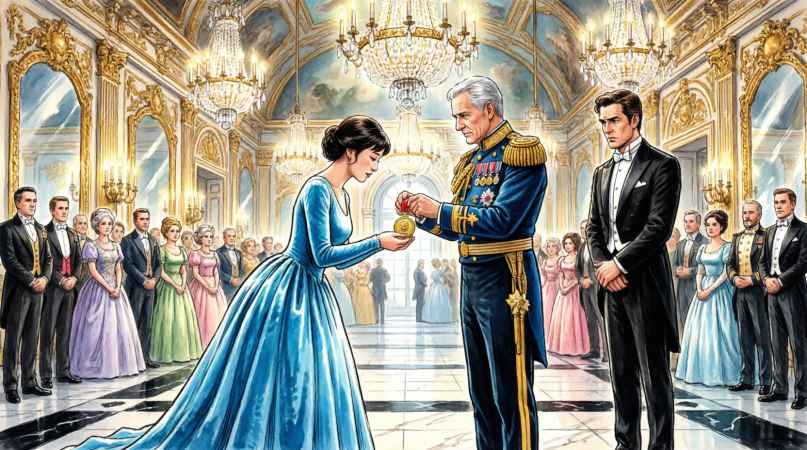
For the first time in my life, the locket opened.
Inside, beneath glass clouded by time, was a tiny curl of dark auburn hair.
And beneath the hinge, almost invisible, were three engraved words.
For Elara, always.
My chair scraped backward as I stood too fast.
Elara.
The name moved through me like a memory that had been sleeping beneath my bones.
The king reached out, then stopped himself before touching me. That hesitation undid me more than any embrace could have. Here was a man who had power enough to silence a ballroom, but not enough to claim me without permission.
“My daughter’s name,” he said softly, “was Princess Elara Rose of Ardenia.”
Was.
The word struck me.
“Was?” I asked.
His face tightened.
“We were told she died.”
The room seemed to tilt.
Preston made a faint choking sound. Lydia Ashcroft stood beside the stage with one hand pressed to the diamond necklace at her throat. Her father, Conrad, had gone very still.
The king noticed him.
For the first time since entering, King Alistair looked away from me. His gaze crossed the room and landed on Conrad Ashcroft with such cold recognition that even the guests nearest him stepped aside.
“Lord Ashcroft,” the king said.
Conrad’s polished smile appeared half a second too late. “Your Majesty. It has been many years.”
“Not enough.”
A silence followed, heavy and deliberate.
Preston looked from the king to Conrad, confusion spreading beneath his ambition like spilled ink. “You know each other?”
Conrad did not answer him.
The king’s jaw hardened. “My daughter disappeared during a private visit to New York twenty-seven years ago. We had been attending a diplomatic summit. Her nurse was found dead in the East River. Her carriage was burned. A child’s body, too damaged to identify, was presented to us as hers.”
My stomach turned.
“A body?” I whispered.
The king looked at me again, and grief softened his face. “We buried a coffin we were told held our child.”
I could not move. Could not speak.
I had spent my life with no story before the church steps. No mother’s voice. No father’s hands. No first birthday, no first home, no baby photograph yellowing in a frame. I had imagined many beginnings. Some cruel, some ordinary, some desperate.
I had never imagined a coffin.
Preston laughed suddenly.
It was a terrible laugh, too high and too brittle.
“This is absurd,” he said. “Claire cannot be a princess. She doesn’t even know which fork to use at diplomatic dinners.”
No one laughed.
His face flushed. “I only mean—Your Majesty, with respect, this woman has lived as my wife for six years. If she had any royal connection, surely it would have appeared before now. There must be tests. Procedures. Evidence.”
“There will be,” the king said. “But there is already evidence you do not understand.”
He turned back to me.
“May I?”
I realized he was asking to touch the locket. I nodded.
His fingers, though steady, treated the silver as if it were living flesh. He lifted the open locket and examined the inscription. His eyes filled, but he did not let the tears fall.
“My wife’s handwriting,” he said. “Copied exactly by the royal engraver. She wrote those words the night Elara was born.”
“Where is she?” I asked.
The king’s face changed.
Just a little.
But enough.
The answer was there before he spoke.
Queen Maribel of Ardenia was dead.
“She passed twelve years ago,” he said. “Still believing our daughter had died before her.”
A pain I had no right to feel pierced me anyway. A woman I had never met had mourned me into her grave. I had lived, and she had died not knowing.
“I’m sorry,” I said, though the apology made no sense.
The king shook his head. “No. I am.”
The cameras continued recording. Every whisper, every expression, every fracture in Preston’s carefully arranged life was being captured beneath the chandeliers.
Governor Halden moved forward, pale with political terror. “Perhaps we should continue this conversation privately.”
“Yes,” Preston said quickly. “Excellent idea. Claire, come with me.”
I looked at him.
For six years, I had turned at that tone. Come with me. Smile. Don’t embarrass me. Let me speak. Let me handle this. Tonight, those invisible strings lay cut at my feet.
“No,” I said.
The word was quiet, but it belonged to me.
Preston blinked. “Excuse me?”
“I said no.”
His eyes sharpened. The charming public mask slipped just enough for me to see the man who had practiced cruelty in private before daring it in public.
“You are overwhelmed,” he said. “You’re confused. This is a lot for someone like you.”
“For someone like me?” I repeated.
The king’s expression darkened.
Preston noticed too late. “I only mean she has no experience with this level of scrutiny.”
“No,” King Alistair said. “She has experience with abandonment, humiliation, survival, and betrayal. Scrutiny will be simple compared to what she appears to have endured.”
The ballroom went still again.
The king faced me fully. “Claire—if that is the name you choose to keep—I ask you to come with me tonight. Not as a command. Not as a claim. As a father who has been given one impossible hope and does not wish to lose it in a room full of strangers.”
My throat tightened around words that would not come.
A father.
The word had always felt like a foreign language. Other people had fathers. Men who attended graduations, threatened unsuitable boyfriends, fixed broken shelves, carried sleeping children from cars into warm houses.
I had had donation bins and caseworkers.
I looked at Preston.
He was staring at me now with a new calculation. The disgust was gone. In its place was fear.
Not fear of losing me.
Fear that he had discarded something valuable too publicly to retrieve it.
“Claire,” he said, softer now. “Darling. Let’s not make a spectacle.”
The old me might have folded at that word. Darling. He used to say it when rent was late and he needed me brave. He had said it when I sold my mother-of-pearl hair comb—the only gift I had ever bought myself—to pay for his certification course. He had said it when he promised everything he built would be ours.
Tonight, darling sounded like a hand reaching for a purse it had dropped.
“You made the spectacle,” I said.
His face tightened.
Lydia stepped forward, her silk dress shimmering like black water. “Preston, let her go. This is embarrassing.”
It was the wrong thing to say.
The king’s gaze shifted to her. “And you are?”
Lydia lifted her chin. “Lydia Ashcroft.”
“Daughter of Conrad Ashcroft?”
“Yes, Your Majesty.”
“Then embarrassment is a family inheritance.”
Her face drained.
Conrad moved at once. “Your Majesty, I must object to this tone.”
King Alistair did not raise his voice. “Object carefully.”
The warning in those two words was ancient, royal, and unmistakable.
Conrad fell silent.
A woman in a navy suit entered through the open ballroom doors carrying a leather case. She approached the king, bowed slightly, then turned to me.
“Your Majesty,” she said, “the preliminary team is ready.”
The king nodded. “Dr. Veyra, this is Claire Whitmore.”
The woman’s eyes softened when she looked at me. “I’m the royal family’s genetic archivist. We can begin verification with a cheek swab tonight, if you consent. Full confirmation will take longer, but certain markers may be assessed quickly against preserved samples from Queen Maribel.”
Preserved samples from a dead queen.
My mother.
Maybe.
The room swayed again, and I gripped the back of my chair.
King Alistair stepped closer, concern breaking through formality. “You do not have to decide anything here.”
But I did.
Not everything. Not who I was. Not whether I could become whatever the world would now demand of me.
But I could decide one thing.
I could decide not to leave with Preston.
“I’ll come with you,” I said.
Preston moved fast. He caught my wrist.
The touch was not violent enough to look like violence to anyone who did not know him. But I knew the pressure of his fingers. I knew how he used pain politely.
“Claire,” he murmured. “Think carefully. You walk out with him, and there is no going back.”
The king’s guards shifted.
I looked down at Preston’s hand on my wrist.
“Let go,” I said.
His grip tightened for half a second.
Then King Alistair spoke.
“Remove your hand from my daughter.”
My daughter.
The words rolled through the ballroom like thunder.
Preston released me.
Every camera caught it.
I walked away from my husband beneath the chandeliers, wearing the locket he had mocked, toward a king who looked at me as if I were both miracle and ghost.
Behind me, Preston called my name once.
Not Claire.
Not darling.
“Elara.”
I stopped.
The name did not belong in his mouth.
I turned back, and whatever he saw in my face made him step backward.
“You don’t get to use that,” I said.
Then I left the ballroom.
Outside, the hotel corridor was lined with royal guards and stunned staff. The noise of the gala faded behind the closing doors, replaced by the distant hum of elevators and the soft crackle of radios.
King Alistair walked beside me, not ahead of me. Dr. Veyra followed with her case. Two guards led the way toward a private suite.
I should have been asking questions. A thousand of them crowded my mind. Why was I taken? Who left me at the church? Why had no one found me? What did Conrad Ashcroft know?
Instead, the first thing I said was, “I’m not educated for this.”
The king looked at me.
The words poured out of me before I could stop them. “I went to community college for two semesters. I never finished. I worked in a bakery, then as a receptionist, then I helped Preston build his career. I don’t speak Ardenian. I don’t know palace rules. I don’t know anything about being—”
“A daughter?” he asked gently.
My eyes burned.
He stopped walking.
“You do not need training for that,” he said. “Only time, and truth, and perhaps forgiveness neither of us has earned yet.”
The corridor blurred.
“I don’t know you,” I whispered.
“No,” he said. “But I have known the absence of you every day for twenty-seven years.”
That was when I cried.
Not loudly. Not beautifully. Tears simply slipped down my face, hot and humiliating, and I turned away because I had learned early not to let strangers see what hurt.
The king did not touch me.
He only took a handkerchief from his breast pocket and offered it.
It smelled faintly of cedar and winter air.
In the private suite, the world became procedure. Dr. Veyra unpacked sterile tubes and explained each step. A cheek swab. A blood sample, only if I agreed. Photographs of the locket under magnification. Questions about childhood scars, allergies, memories.
I consented because facts felt safer than feelings.
When Dr. Veyra asked whether I had a small crescent-shaped birthmark beneath my left shoulder blade, I nearly dropped the glass of water in my hand.
“Yes.”
King Alistair turned away sharply, one hand covering his mouth.
Dr. Veyra’s expression changed. “Princess Elara had such a mark recorded at birth.”
Princess Elara.
Again and again, they placed the name near me, waiting to see if it would attach.
I was still Claire.
Claire who bought cheap coffee. Claire who knew which grocery stores marked down bread after eight. Claire who had spent three hours steaming Preston’s tuxedo shirt because he said wrinkles made men look poor.
But beneath that, something else had begun to stir.
A question with a crown.
Near midnight, the preliminary analysis returned.
Dr. Veyra came into the sitting room holding a tablet. Her professionalism remained, but her hands were trembling.
“Your Majesty,” she said.
The king stood.
She looked at me. “The rapid markers are consistent with a direct paternal relationship. We will require full sequencing for legal confirmation, but with the locket, the inscription, the birthmark, and the genetic markers…”
She swallowed.
“There is no reasonable doubt.”
The king closed his eyes.
For a moment, no one spoke.
Then he bowed his head to me.
Not as a monarch.
As a father overcome.
“My daughter,” he said.
I thought the words would frighten me.
Instead, they broke something open.
I rose from the sofa. He did not move toward me. He waited, as he had from the beginning, letting me choose the distance.
So I crossed it.
When he embraced me, his breath shuddered once near my hair. His arms were careful at first, then tightened as if some part of him feared I would vanish. I stood stiffly for a heartbeat, then folded against him with a grief that had no name.
I grieved the mother who never knew.
The father who buried an empty lie.
The child left in the cold.
The woman humiliated by a man too small to recognize what he had been given.
And somewhere far below all of that, I grieved the life I had mistaken for all I deserved.
By morning, the world knew.
“ORPHAN WIFE MAY BE LOST PRINCESS.”
“ROYAL SHOCK AT MANHATTAN GALA.”
“PRESTON WHITMORE MOCKED WIFE MINUTES BEFORE KING CLAIMED HER.”
The headlines multiplied faster than anyone could control. Clips of Preston’s speech flooded every platform. His words—“a woman found outside a church… no family… no history beyond a broken trinket”—played beside the image of King Alistair saying, “Remove your hand from my daughter.”
By noon, Preston’s new office issued a statement calling his remarks “deeply personal comments taken out of context during an emotional family transition.”
By one, the governor’s office announced Preston Whitmore would be placed on administrative review pending further consideration.
By two, Lydia Ashcroft had deleted every photograph of herself with him.
By three, Preston called me forty-six times.
I did not answer.
At four, a message arrived from an unknown number.
Claire, we need to talk. I was wrong. I was under pressure. You know how politics works. I never stopped caring about you.
A second message followed.
People are twisting this. Please don’t let them destroy me.
Then a third.
You owe me a conversation.
That one made me laugh.
It startled me, the sound. Small, dry, almost unfamiliar.
King Alistair looked up from across the suite, where he had been speaking quietly with his chief adviser.
“Good news?” he asked.
“No,” I said. “Just a man discovering consequences.”
The king’s mouth curved faintly.
But the smile faded when his adviser placed a folder on the table between us.
“Your Majesty,” the adviser said, “we have a problem.”
His name was Tomas Vale, a narrow, serious man with silver spectacles and the air of someone who had never misplaced a document in his life. He opened the folder and spread several photographs across the polished wood.
One showed Conrad Ashcroft at least twenty years younger, standing beside a black car outside a government building.
Another showed Preston shaking hands with Conrad at a private fundraiser.
A third showed a woman I did not recognize, her face half-turned from the camera as she entered Saint Agnes Church in Lancaster.
My skin prickled.
“Who is she?” I asked.
Tomas glanced at the king before answering.
“Margaret Vale,” he said. “My older sister.”
I looked at him in surprise.
“She served as an assistant nurse attached to the Ardenian delegation during the summit where Princess Elara disappeared,” he continued. “Officially, she resigned two days before the abduction. Unofficially, she vanished. We believed she had been killed.”
“And now?” I asked.
“This photograph was taken outside Saint Agnes Church the morning you were found.”
The room seemed to contract.
The woman in the photograph had been there.
At the beginning of my second life.
“Why would your sister leave me at a church?” I asked.
Tomas’s expression tightened. “To save you, perhaps.”
“From whom?”
No one answered quickly enough.
King Alistair picked up the photograph of Conrad. “Ashcroft was not merely a developer then. He was an intermediary. He arranged private investment channels between American businessmen and several European ministries. He wanted access to Ardenia’s northern ports.”
“That request was denied,” Tomas said. “By Queen Maribel.”
I turned to the king. “My mother?”
He nodded. “She believed Ashcroft’s partners were criminals hiding behind corporate names. She was correct.”
“And then her child was taken,” I said.
The king’s face hardened with a rage so old it had become disciplined. “Yes.”
The pieces lay between us, ugly and unfinished.
Conrad Ashcroft had known the king.
His daughter had stood beside Preston while Preston publicly discarded me.
Preston, newly appointed to a government role involving global partnerships.
Borrowed money. Private donors. Quiet meetings he never explained.
My stomach tightened.
“What does Preston have to do with this?” I asked.
Tomas hesitated.
The king’s eyes darkened. “We do not yet know.”
But by evening, we knew enough.
A royal security analyst recovered deleted messages from one of Preston’s old devices, a phone he had abandoned in our apartment months earlier when he upgraded. I had packed it into a drawer with tangled chargers and expired warranties. I remembered Preston telling me to throw it away. I had forgotten.
The analyst did not.
The messages were not explicit confessions. Men like Preston and Conrad rarely wrote crimes plainly. But they wrote around them.
C. is becoming a liability.
She asks too many questions about the foundation transfer.
Keep her contained until after the appointment.
Once you announce separation publicly, her credibility collapses.
No family. No leverage. No one to defend her.
My hands went cold as I read.
The messages were between Preston and Lydia.
Not Conrad.
Lydia.
Her delicate lowered eyes at the gala. Her smooth little comment: Let her go. This is embarrassing.
She had not been an ornament beside him. She had been helping arrange the knife.
Another message appeared, dated three weeks before the gala.
Father says the Ardenian file must never surface. Do not mention the locket again. If she still has it, remove it.
I touched my throat.
The locket was no longer around my neck. It had been placed in a secure evidence case.
I felt naked without it.
“Remove it,” I repeated.
The king’s expression had gone dangerously still. “Did Preston ever try to take your locket?”
I thought back.
To his sudden irritation when I wore it to fundraisers.
To the morning he suggested I sell it because antique silver was “wasted sentiment.”
To the night he kissed my shoulder and unclasped it, then claimed the chain had broken when I found it missing from my jewelry dish. I had discovered it two days later in the pocket of his suit jacket.
“Yes,” I said. “More than once.”
No one spoke.
The betrayal should have felt familiar by then, but it found fresh ground anyway.
I had believed Preston was ashamed of my past.
In truth, he may have been afraid of it.
That night, I asked to return to the apartment.
The king refused at first. Then he saw my face and changed the refusal into conditions: four guards, one adviser, no warning to Preston, and no more than thirty minutes inside.
I agreed.
The apartment was on the twenty-second floor of a glass building Preston had insisted we rent after his first major political contract. We could barely afford it, but he said perception was investment. I had clipped coupons in a kitchen with marble counters.
When I entered, the place looked exactly as I had left it before the gala. Preston’s cuff links on the dresser. My cardigan over the chair. Two coffee cups in the sink.
The ordinary cruelty of it nearly brought me to my knees.
A life could end while its dishes remained unwashed.
I went first to the bedroom closet. My clothes occupied one narrow side. Preston’s suits took the rest. I pulled out a small canvas bag and packed what belonged to me: two sweaters, my worn copy of Jane Eyre, the framed photo of Sister Agnes on my community college graduation day, the recipe notebook where I had written down every dish I taught myself to make.
At the back of the closet was a shoebox.
Not mine.
Preston’s.
It was tucked behind a stack of garment bags. I would not have noticed it if one bag had not slipped when I reached for my winter coat.
The royal guard nearest me stepped forward. “Mrs. Whitmore?”
“Wait,” I said.
I opened the box.
Inside were documents.
Old documents.
Photocopies of adoption records. Newspaper clippings about Ardenia’s lost princess. A printed photograph of the royal family from twenty-seven years ago: King Alistair, Queen Maribel, and a baby wrapped in a gray blanket with blue stitching.
Beneath them lay a small velvet pouch.
I opened it, and something fell into my palm.
A tiny gold ring.
A child’s ring.
Engraved inside with the letter E.
The room went quiet behind me.
Tomas, who had accompanied us, took one look and went pale. “That ring was listed among the items missing from the nursery after the abduction.”
My fingers closed around it.
Preston had known.
Maybe not from the beginning. Maybe not when he married the orphan woman with the broken locket. But at some point, he had learned enough to hide evidence in our closet while telling me I had no history.
The apartment door opened.
“Claire?”
Preston stood in the entryway, breathless, rain shining on his overcoat. He looked from me to the guards to the open shoebox in my hands.
For once, no speech came ready.
“What is this?” I asked.
His face shifted rapidly. Shock. Fear. Calculation. Then wounded innocence.
“I can explain.”
“You always can.”
He stepped into the room. A guard blocked him.
Preston looked offended, as if armed protection inside his own apartment were a social error. “Claire, listen to me. I found those things recently. I was trying to verify them before alarming you.”
“You hid them.”
“I was protecting you.”
That almost made me smile.
“From my father?” I asked.
His jaw flexed. “From chaos. From people who would use you. You have no idea what royalty does to normal lives.”
“You mean what it does to yours.”
His eyes sharpened.
There he was.
The real Preston, exposed beneath the silk.
“You think you’re safe with them?” he said. “You think a king appears out of nowhere and suddenly you have a family? You’re evidence, Claire. A political weapon. A symbol. At least with me, you had a life.”
“A life you ended onstage.”
“I made a mistake.”
“No. You made an announcement.”
His face reddened. “Because Lydia’s father required stability before backing the international development initiative. Because donors were asking questions. Because you kept embarrassing me with your insecurity and your cheap sentiment and that damned locket around your neck.”
The guard shifted again, but I raised a hand.
I wanted him to finish.
Preston did not realize he was bleeding truth now.
“I built everything,” he said. “Everything. And then suddenly I’m supposed to let my future collapse because my wife might be some lost royal scandal?”
“When did you know?”
He stopped.
“When?” I repeated.
His eyes flicked to the shoebox.
I understood before he answered.
“You knew before the gala.”
Silence.
“How long?”
He looked away.
“How long, Preston?”
“Six months,” he said.
The words landed like stones.
Six months.
For six months he had slept beside me, eaten meals I cooked, let me revise his speeches, kissed my forehead in public, and planned to erase me before anyone else could discover who I was.
“Conrad told you?” I asked.
“Lydia did.”
Of course.
“She said it was probably nothing,” Preston muttered. “Just an old rumor. Her father had files from decades ago. Then I saw the locket.”
“And instead of telling me—”
“I had a career to protect!”
His voice cracked through the apartment.
There it was.
The center of him.
Not love. Not fear. Not confusion.
Career.
Tomas spoke quietly. “Mr. Whitmore, these materials are now part of an active royal and federal investigation.”
Preston’s face changed again. “Federal?”
A voice answered from the hallway.
“Yes.”
Two agents entered behind him, badges visible.
Preston turned white.
The taller agent looked at me first. “Mrs. Whitmore, I’m Agent Calder with the FBI’s art theft and cultural property unit. We’ve been coordinating with Ardenian security since last night.”
“Art theft?” Preston said, forcing a laugh. “This is a domestic matter.”
Agent Calder glanced at the child’s ring in my hand. “Not anymore.”
They arrested him in the living room.
Not dramatically. No shouting, no struggle. Just metal cuffs around wrists that had held champagne the night before while their owner toasted his new beginning.
Preston looked at me as they led him toward the door.
“Claire,” he said. “Please. Don’t do this.”
I looked at the man who had called me nameless in front of the world.
“I’m not doing anything,” I said. “I’m finally letting the truth move without me holding it back.”
His eyes filled—not with remorse, I thought, but terror.
Then he was gone.
For a moment, the apartment was silent.
Rain tapped against the windows.
I looked down at the little gold ring in my palm.
E.
Elara.
A name stolen. A name buried. A name waiting.
Tomas received a call just after midnight as we were leaving the building. His expression changed while he listened.
“What is it?” King Alistair asked. He had insisted on coming upstairs once Preston was secured, though his guards hated the idea.
Tomas lowered the phone slowly.
“Conrad Ashcroft’s private jet departed Teterboro twenty minutes ago.”
The king’s face hardened. “Destination?”
“Filed for Geneva.”
“Filed?” I asked.
Tomas looked at me. “It changed course over the Atlantic.”
“To where?”
He hesitated.
“Ardenia.”
The king went very still.
Then Agent Calder’s phone rang.
He answered, listened, and turned toward us with the grim expression of a man about to make a bad night worse.
“Your Majesty,” he said, “there’s something else.”
The king did not blink.
Agent Calder looked at me. “A sealed diplomatic pouch was intercepted at the airport before Ashcroft’s departure. Inside was a handwritten letter addressed to you.”
“To me?”
He handed over a clear evidence sleeve.
Inside was a sheet of cream paper, folded once.
My name was written across it.
Not Claire.
Not Elara.
Both.
Claire Elara.
My hands trembled as I read the message.
The truth is not in New York. It is beneath the chapel where your mother prayed. Come home before the crown is placed on the wrong head.
There was no signature.
Only a symbol drawn at the bottom in dark red ink.
A crowned white stag.
But its rose had been replaced by a knife.
King Alistair stared at the mark, and for the first time since I had met him, I saw true fear enter his eyes.
“Father?” I said.
The word escaped before I could stop it.
He looked at me, shaken by it.
Then the little gold ring in my palm snapped open.
It had not been a ring at all.
It was a key.
Tiny, ancient, and made for a lock no one had mentioned.
Tomas whispered, “God help us.”
And somewhere across the ocean, in the country that might have been mine, a bell began ringing in the royal chapel where no bell had rung for twenty-seven years.
…If you want to know what happened next, please type “YES” and like for more.