The auditorium smelled like polished floors, coffee in paper cups, and the dry ink of hundreds of folded programs.
I sat in the front row with a white coat folded across my lap, my fingers resting on the embroidery I had turned carefully out of sight.
The dean was still reading names from a card at the podium.
Behind him, a small American flag stood beside the stage, barely moving in the air from the vents.
I had dreamed of this day so many times that I thought I would feel only relief when it finally came.
Instead, I felt the past sitting three rows behind me.
Karen Higgins was in the reserved family section.
Thomas Higgins sat beside her.
Megan was on the aisle with her phone balanced in her palm.
My biological family had arrived like guests at a celebration they had paid for, earned, and endured.
They smiled for strangers.
They accepted congratulations from people who did not know what they had done.
Karen leaned toward my father and whispered, just loudly enough for me to hear, “She owes us this moment after everything.”
I did not turn around.
There are some sentences that do not hurt because they are new.
They hurt because they prove nothing changed.
Fifteen years earlier, I had been thirteen years old in Room 314 at St. Jude’s Medical Center, sitting in a paper hospital gown that scratched my knees.
My legs were too short to reach the floor, so my heels tapped the metal base of the examination table.
I remember the smell first.
Antiseptic.
Plastic tubing.
Fake flowers from an air freshener plugged into the wall.
Dr. Robert Lawson sat across from my parents with a tablet in his hand and the careful face adults wear when they are about to say something that splits a childhood in half.
“It is acute lymphoblastic leukemia,” he said.
He looked at me first.
That mattered later.
At the time, I only knew that he had said leukemia, and that the room seemed to tilt.
“It is the most common type of childhood cancer,” he continued. “With aggressive chemotherapy, Emily’s survival rate is around eighty-five to ninety percent.”
I heard good odds.
I heard treatable.
I heard the possibility that somebody might still reach for my hand.
My mother sat near the window with her purse locked in both hands.
My father stood with his arms crossed.
Megan, sixteen years old and already treated like the family investment, tapped on her phone as if my diagnosis had made us late for something.
My father asked one question.
“How much?”
Dr. Lawson paused.
I was too young to understand every detail of insurance, but I understood that the air changed.
“The full treatment protocol usually lasts two to three years,” he said. “With your insurance, your out-of-pocket responsibility may fall somewhere between sixty and one hundred thousand dollars, though there are assistance programs and payment options.”
My father laughed once.
It was not a laugh that belonged in a hospital room.
“You’re telling me we have to pay a hundred grand because she got sick?”
“Thomas,” my mother whispered.
She sounded embarrassed.
Not afraid.
Not heartbroken.
Embarrassed.
Dr. Lawson leaned forward and said treatment needed to begin immediately.
My father looked past him.
“Megan is applying to colleges next year,” he said. “Stanford, Harvard, maybe Yale.”
Megan did not look up.
“We’ve saved since she was born,” he continued. “We have one hundred and eighty thousand dollars in her college fund, and we are not wiping out her future over this.”
I waited for somebody to correct him.
I waited for my mother to say I was also his daughter.
I waited for Megan to be annoyed with him, not with me.
No one did.
“There are resources,” Dr. Lawson said, and the calm in his voice had turned hard around the edges. “Emily is a child. She needs treatment, not a financial debate in front of her.”
My mother finally spoke clearly.
“We are not taking charity,” she said. “What would people in our neighborhood think if they found out we were on welfare?”
I remember staring at her purse.
It had a gold clasp shaped like a knot.
I stared at it because looking at her face hurt too much.
My father asked whether I could become a ward of the state.
He said Medicaid would cover everything that way.
He said it like he had found a coupon.
Dr. Lawson stood halfway out of his chair.
“You cannot be serious.”
“We have another daughter to think about,” my mother said.
Then my father looked at me.
Really looked at me.
“Megan has potential,” he said. “She is brilliant, focused, extraordinary. You have always been average, Emily, and we are not sacrificing a promising future for an average one.”
Cancer had frightened me.
Their math erased me.
I did not scream.
I did not throw anything.
I was a child, and I did what children do when the adults in the room decide their value out loud.
I tried to become smaller.
“I’m your daughter too,” I whispered.
My voice broke on daughter.
Dr. Lawson pushed his chair back so hard it scraped the floor.
“I am going to ask you to leave this room now while I speak to Emily privately.”
“We are her parents,” Karen snapped.
“Leave,” he said, “or I will call security and social services this second.”
Thomas looked offended.
Karen looked humiliated.
Megan looked bored.
They left without hugging me.
They left without touching my shoulder.
They left without saying they loved me.
The door closed behind them with a soft click.
That sound stayed with me longer than the word leukemia.
Within an hour, Susan Myers from social services came in with a clipboard and tired, kind eyes.
Within two hours, I had been admitted to pediatric oncology.
Within three hours, my parents had signed emergency custody papers giving the state temporary responsibility for me.
No goodbye.
No note.
No return to the room after they calmed down.
The first night after that was darker than any room with lights on should have been.
Machines beeped beside my bed.
Clear bags of fluid hung from hooks.
The hallway outside my door glowed with a soft hospital brightness that made loneliness feel official.
I was not thinking about dying by then.
I was thinking that if I died, maybe my parents would feel relieved that the bill had stopped growing.
Then Laura Davidson walked into my room.
She was thirty-four, with dark curly hair tied back, blue scrubs, worn sneakers, and a smile that did not ask me to perform happiness for her.
“Hey there, Emily,” she said gently. “I’m Laura. I’m going to be your night nurse.”
I turned my face toward the window.
“I feel terrible.”
She did not tell me to be brave.
She did not say everything happened for a reason.
She checked my monitors, pulled a chair beside my bed, and sat like she had decided I was not a task to finish.
“I heard what happened today,” she said. “And I am so sorry.”
I cried so hard my ribs hurt.
Laura handed me tissues and stayed.
That was the first thing she gave me.
She stayed.
Later that night, she came back with a deck of cards and crackers she called hospital treasure.
We played until nearly two in the morning.
She told me about her fat cat, Waffles, her small house fifteen minutes from the hospital, and the mystery podcasts she listened to while folding laundry.
She told me her little brother had survived leukemia years earlier.
She told me watching him suffer had made her want to become the kind of nurse who stayed when things got ugly.
My parents did not visit the next day.
Or the next week.
Or the week after that.
Chemotherapy stole my appetite first.
Then it stole my strength.
Then it took my hair in clumps that stuck to my pillow and shower drain.
Laura was there with clean blankets, bad jokes, a soft knit cap, and the kind of practical tenderness that did not need a speech to be real.
She learned that I hated grape gelatin.
She learned that I liked the door cracked at night.
She learned that I pretended not to be scared when new tubing came in, because I thought scared girls got left behind.
On the twenty-eighth day, Dr. Lawson told me I was responding beautifully.
He said outpatient care could begin soon.
Susan arrived with a folder and explained that they had found a foster placement.
Laura was supposed to be off duty.
She was still standing beside my bed.
“I want to take her,” she said.
Susan went still.
So did I.
“I want to foster Emily,” Laura repeated. “I’m already state-approved, and I know exactly what her medical needs are.”
Susan warned her about the commitment.
Medications.
Appointments.
School coordination.
Emergency plans.
County paperwork.
Laura did not flinch.
Then she turned to me.
“Only if you want to come home with me.”
For the first time since Room 314, I felt something rise inside me that was not fear.
“Yes,” I whispered. “Please.”
Laura’s house was small, with a front porch, a mailbox that leaned slightly to one side, and a little American flag stuck in a planter by the steps because her neighbor gave it to her every summer.
Waffles hated me for three days, then slept on my feet like I had always belonged there.
Laura set alarms for my medication.
She taped appointment cards to the refrigerator.
She drove me to treatment when snow iced the roads and to school when I was strong enough to return.
She never called me average.
She called me stubborn when I needed to drink water.
She called me brilliant when I passed algebra after missing half the semester.
She called me kiddo even when I rolled my eyes and pretended I was too old for it.
The adoption did not happen overnight.
Nothing official ever does.
There were hearings, home visits, signed reports, medical updates, school records, and the kind of waiting that makes a child afraid to unpack too much.
But Laura kept showing up.
Dr. Lawson wrote letters.
Susan filed what needed filing.
And eventually, the last name on my school forms changed.
Higgins became Davidson.
I did not think a name could feel like shelter until I had one that had been chosen for me with love.
Years passed in the ordinary hard way.
Remission.
Checkups.
College applications.
Scholarships.
Late nights with textbooks and cold coffee.
Laura worked extra shifts when I needed help with fees, and I worked whatever campus jobs I could find.
I became the person my father had declared I was not worth becoming.
Not to prove him wrong at first.
Survival came before revenge.
But eventually, the life I built became evidence.
Medical school was not glamorous.
It was exhaustion with a library card.
It was ramen, anatomy labs, aching feet, and calling Laura from stairwells when I thought I could not memorize one more pathway.
She always answered.
Sometimes she said, “Cry for ten minutes, then eat something.”
Sometimes she said, “You are allowed to be tired without quitting.”
Sometimes she just stayed on the phone while I breathed.
On graduation morning, she helped me steam my dress in the laundry room.
She fussed over my collar like I was still thirteen.
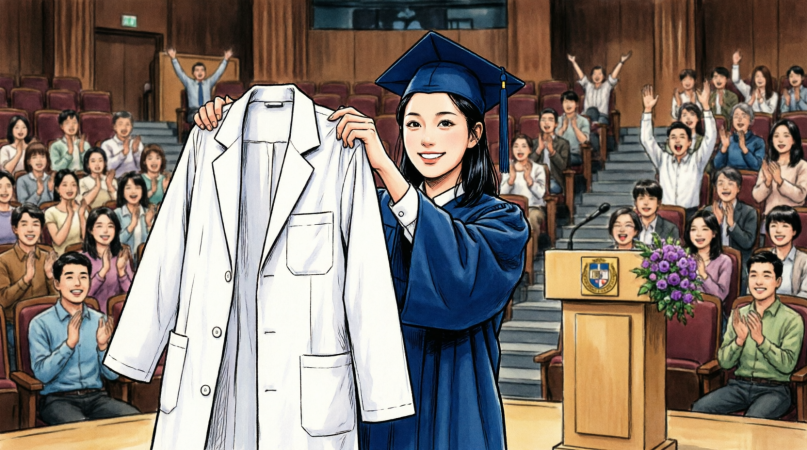
Then she lifted the white coat from its hanger.
Dr. Emily Davidson was stitched over the heart.
Laura touched the embroidery with two fingers.
She did not cry then.
Neither did I.
We both knew we needed all our makeup intact for later.
When we reached the auditorium, staff directed graduates one way and families another.
Laura squeezed my hand before leaving me.
“I’ll be right where you can see me,” she said.
I believed her because she had spent fifteen years proving it.
I did not know Karen, Thomas, and Megan would be there until I saw them taking seats in the reserved family section.
At first, I thought I had imagined them.
Then Karen smiled at a woman beside her and pointed toward me, proud and practiced.
Thomas accepted a program from an usher.
Megan crossed her legs and unlocked her phone.
My body remembered Room 314 before my mind caught up.
The soft door click.
The gold clasp on Karen’s purse.
The word average.
I looked for Laura and found her near the side of the stage.
She saw my face change.
She did not rush over.
She did not make the day about panic.
She pressed her hand to her chest once, a small signal only I understood.
I’m here.
So I stayed in my seat.
When Karen whispered that I owed them this moment, I almost laughed.
Not because it was funny.
Because some people will abandon the work and still arrive for the applause.
The dean stepped to the microphone.
He welcomed the families.
He praised the graduates.
He spoke about service, resilience, and the privilege of caring for others.
Then he lifted a separate card.
“And now,” he said, “it is my honor to recognize this year’s valedictorian.”
My fingers tightened on the white coat.
“Dr. Emily Davidson.”
The applause started before I moved.
Behind me, Karen made a small broken sound.
I stood.
The coat unfolded in my hands, and the embroidery became visible.
Davidson.
Not Higgins.
Thomas stared at the name like it was a verdict.
Megan’s phone lowered slowly into her lap.
Karen’s smile disappeared so completely that the woman beside her leaned away.
I walked to the stage.
Every step felt longer than it was.
The dean shook my hand and then turned back to the microphone.
“Dr. Davidson has asked that her first white coat be presented by the woman listed in her student file as her mother, emergency contact, medical advocate, and family.”
Laura stepped onto the stage.
She was wearing a navy dress and low heels, but I saw the nurse in her anyway.
I saw the woman who had brought cards to my hospital bed.
I saw the woman who sat through fevers, test results, school conferences, and bad nights without once making me feel expensive.
The applause changed when people understood.
It became softer first, then louder.
Karen covered her mouth.
Thomas leaned toward the aisle like he wanted to leave but could not bear being seen leaving.
Laura reached me and opened the coat.
Her hands trembled.
“Ready, Emily?” she whispered.
It was the same question she had asked before procedures, before court dates, before college drop-off, before the first day of medical school.
This time, I nodded.
She helped me into the coat.
The fabric settled over my shoulders.
For a moment, I was thirteen again and not thirteen at all.
I stepped to the microphone.
The auditorium quieted.
I had prepared a speech about medicine, resilience, and the people who make healing possible.
I had not prepared for my biological parents to sit in the reserved section like witnesses called by accident.
So I folded the paper once and looked up.
“When I was thirteen,” I said, “a doctor told me I had leukemia.”
The room went still.
“I was also told, that same day, that my life was not worth the cost of saving it.”
Karen’s face crumpled.
Thomas stared straight ahead.
“I survived because medicine mattered,” I continued. “But I became whole because someone stayed.”
I turned slightly toward Laura.
“This coat has my name on it because Laura Davidson gave me hers before I had anything to give back.”
Laura pressed her fingers to her mouth.
The dean looked down.
Dr. Lawson was in the audience too, seated near the aisle with Susan Myers beside him.
I had invited them both.
My first family saw them at the same time I did.
Dr. Lawson did not smile at Thomas.
Susan did not look away.
That was the part I had not planned to enjoy, but I would be lying if I said I felt nothing.
After the ceremony, Karen found me near the lobby doors.
Her makeup had settled into the lines under her eyes.
“Emily,” she said, and my old name in her mouth sounded borrowed.
Laura stood beside me.
Not in front of me.
Not speaking for me.
Beside me.
Thomas came up behind Karen with Megan hovering a few feet away.
“We didn’t know how to reach you,” Karen said.
I looked at her for a long second.
“You signed papers with a social worker before dinner that night,” I said. “You knew exactly where I was.”
Her mouth opened.
No words came.
Thomas cleared his throat.
“We made a difficult decision under pressure.”
Dr. Lawson’s voice came from behind them.
“No,” he said. “You made a financial decision in front of a child.”
Thomas turned red.
Susan stepped up beside Dr. Lawson with the same calm tired eyes I remembered from the worst day of my life.
Megan looked between them, then at me.
For the first time, she seemed less bored than frightened.
Karen started crying.
“I was your mother,” she said.
I looked at Laura.
Then I looked back at Karen.
“No,” I said. “You gave birth to me. My mother sat beside me when my hair fell out.”
The lobby was crowded, but that sentence made a small circle of silence around us.
Karen reached for me.
I stepped back.
Not dramatically.
Not cruelly.
Just enough.
There are boundaries that look small to everyone except the person who had to bleed to build them.
Thomas’s face hardened the way it had in Room 314.
“So that’s it?” he said. “You’re going to humiliate us in public after we came to support you?”
I almost smiled.
“You came to be seen supporting me,” I said. “There’s a difference.”
Megan finally spoke.
“Emily,” she whispered. “I was sixteen.”
“I know,” I said.
She flinched, maybe because forgiveness had not arrived in the shape she expected.
“You were a child,” I continued. “But you became an adult who never called.”
Her eyes filled.
I did not enjoy that.
Pain is not justice just because it lands on someone who once ignored yours.
But I also did not apologize for telling the truth.
Laura touched my elbow.
“Ready to go home?” she asked.
Home.
The word still had power after all those years.
I looked one last time at Karen, Thomas, and Megan.
They looked smaller than they had in my memories.
Not harmless.
Just human.
That almost made it worse.
Because monsters are easier to hate than ordinary people who choose cruelty when love gets expensive.
“Yes,” I said to Laura. “I’m ready.”
We walked out together into bright afternoon light.
The air smelled like cut grass and warm pavement.
A family nearby was taking pictures beside a school sign, and someone’s little brother was complaining that his dress shoes hurt.
Laura laughed through her tears when I handed her my diploma folder.
“Hold this,” I said. “You earned it too.”
She held it against her chest the way she had once held my discharge papers.
Then Dr. Lawson caught up to us and asked for a picture.
Susan stood on my other side.
Laura put her arm around my waist.
In the photo, my white coat is bright, my eyes are red, and the name over my heart is clear.
Davidson.
The name they did not give me.
The name that got me there.
For years, I thought the door closing in Room 314 was the sound of my life ending.
I was wrong.
It was the sound of the wrong people leaving before the right one walked in.
Cancer had frightened me.
Their math had erased me.
But love, the real kind, wrote my name back in.