The sound of champagne glasses touching should have belonged to celebration. It should have blended into soft music, pastel balloons, expensive cake, and polite family laughter beneath crystal chandeliers. Instead, that tiny metallic clink became the sound that still wakes me in the middle of the night, because it marked the exact second I realized my parents were capable of something monstrous.
My name is Emily Cooper, and that weekend was supposed to be simple.
My brother David’s daughter, Madison, was turning seven, and my parents invited the entire family to their estate in Connecticut for a birthday party that looked perfect from the outside. Pink decorations. Professional catering. Matching dresses. The kind of gathering people photograph for social media captions about family love and blessings.
I almost didn’t go.
I sat in my car ten minutes before leaving, watching my six-year-old daughter Lily buckle her stuffed rabbit into the seat beside her while something inside me whispered that the day would cost more than it was worth.
But Lily had never really been included in Madison’s birthday parties before. She’d seen photographs online, heard stories about grandparents and cousins, and finally asked me in that hopeful little voice children use before they learn adults can be cruel:
“Mommy, can we go this time?”
So I said yes.
I convinced myself I could survive my mother’s comments, my father’s disappointment, the endless comparisons between my life and David’s. I told myself Lily deserved the chance to know her family, even if I had spent most of my adult life emotionally surviving them.
My parents’ house looked exactly the same as always.
White columns.
Perfect hedges.
Tall windows polished like mirrors.
Everything about the place existed to impress strangers and quietly intimidate relatives.
My father, Robert Miller, answered the front door wearing a pressed blue shirt and the same expression he’d worn toward me since childhood: disappointment disguised as manners.
“Emily,” he said, hugging me briefly. “Still working at the library?”
“Yes.”
I refused to apologize for an honest job that paid my bills and gave my daughter peace.
My father made a faint sound in his throat before glancing toward my mother, Patricia, standing behind him already holding a champagne flute though it wasn’t even noon yet.
My mother’s eyes traveled over me first.
Then they dropped toward Lily.
My daughter wore a yellow unicorn dress she’d picked herself that morning, with glittery clips holding back her brown curls. She looked shy, sweet, and nervous, clutching her stuffed rabbit tightly against her chest.
“Oh, look at you,” my mother said in her sugary public voice. “You’ve gotten thinner.”
“She’s healthy, Mom,” I answered calmly.
Patricia tilted her head slightly.
“And you let her wear that to a party?”
The shame rose automatically.
It always did in that house.
But this time I swallowed it back down and placed my hand gently on Lily’s shoulder. I refused to let my daughter inherit the feeling that she was never enough.
Inside, the entire estate looked staged for a magazine photoshoot. Pink-and-gold balloons arched over the dining room entrance. A three-tier cake sat beneath soft lighting while flower arrangements surrounded trays of carefully labeled desserts.
David and his wife Karen adjusted decorations near the table while Madison twirled happily through the room in a sparkling pink dress.
“Hi, Aunt Emily!” Madison squealed before turning toward Lily. “You can sit next to me later, but don’t touch the cake before pictures.”
Lily nodded politely.
She’d always been gentle. The kind of child who whispered thank you to waiters and apologized when someone else bumped into her.
After the long drive, her eyelids started drooping.
“Mommy,” she whispered quietly, tugging my sleeve. “I’m sleepy.”
I glanced around at the adults, the alcohol, my mother’s thin smile, and decided letting Lily nap upstairs felt safer than forcing her through another hour of judgment disguised as conversation.
“Come on, sweetheart,” I said softly. “You can rest before the party starts.”
I took her upstairs to the guest bedroom, the same room where my parents used to send me whenever they were angry and wanted me out of sight. The lace curtains still hung beside the windows, stiff and pale, while the air smelled faintly of lemon polish and old perfume.
Lily climbed beneath the blankets holding her rabbit under one arm.
Her unicorn dress wrinkled slightly beneath the comforter, but she smiled up at me trustingly, completely unaware of anything except that she was attending a birthday party inside a giant house.
I kissed her forehead.
“Rest for a little while. I’ll come get you soon.”
“Don’t let them start without me,” she mumbled sleepily.
“I won’t.”
That promise still haunts me.
When I walked back downstairs, something felt wrong immediately.
Not empty.
Not silent.
Held.
Like the entire house was waiting for something.
I slowed near the kitchen doorway just as I heard the sharp clink of champagne glasses touching.
“Finally,” my father said calmly, “she’ll match her worth.”
Every muscle in my body locked instantly.
At first I thought I misunderstood him.
Maybe he meant decorations.
Maybe he made another cruel joke about me.
Anything except the horrifying possibility that slammed through my chest.
Then my mother laughed.
Not nervous laughter.
Not awkward laughter.
Pleased laughter.
Sharp and delighted.
“What do you mean?” I asked, stepping into the kitchen.
Both of them turned toward me standing beside the marble island with glasses raised in their hands. They didn’t look startled exactly.
They looked amused.
“Where’s Lily?” I demanded.
Neither answered.
And somehow that silence screamed louder than words.
Something ancient and animal exploded inside me then. The instinct every mother understands before proof, before explanation, before logic catches up.
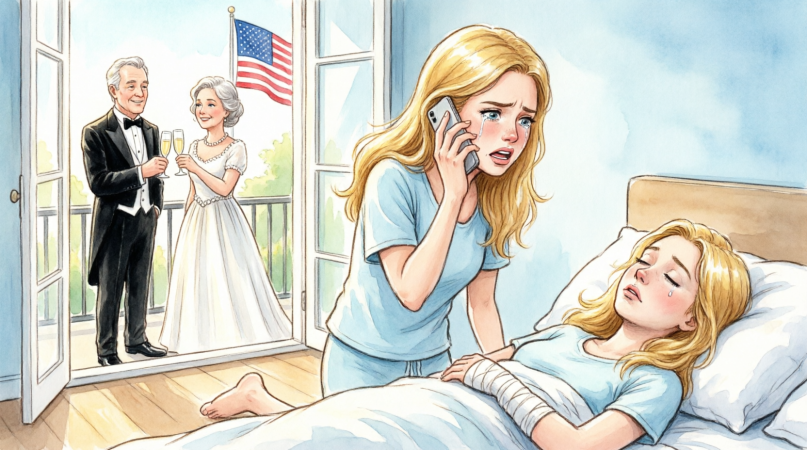
I ran.
My shoes slipped against the polished floor while I grabbed the staircase railing hard enough to hurt my palm and took the stairs two at a time.
“Lily!”
My voice cracked violently.
The guest room door was closed.
I knew I left it open.
My hand shook so badly I almost couldn’t turn the knob. When the door finally opened, the room looked normal for one impossible second.
Curtains.
Afternoon sunlight.
Small shape beneath blankets.
Then I saw the pillow.
Blood.
Not as much as my terrified brain expected at first, but enough to shrink the entire world down into the bed, the blanket, and my daughter’s stillness.
I rushed toward her.
Her face looked swollen and wrong, bruised in ways no child should ever experience.
“Lily!” I screamed, collapsing beside the bed. “Baby, wake up. Please wake up!”
She didn’t move.
Her stuffed rabbit remained trapped beneath one limp arm while one folded ear pressed against her cheek.
I touched her carefully and felt the faintest breath.
Barely there.
But there.
My hands shook violently while fumbling for my phone.
The screen blurred through tears as I dialed 911.
“What’s your emergency?”
“My daughter,” I sobbed. “She’s bleeding. She won’t wake up. Please hurry.”
“Is she breathing?”
“Yes, barely. She’s six years old. Please send someone.”
I barely remember lifting her.
One moment she lay motionless on the bed.
The next she was in my arms, too light, too still, blood soaking through my blouse while panic roared inside my skull.
I carried her downstairs while the operator kept speaking through the phone and my heart pounded hard enough to make me dizzy.
Everyone froze when they saw us.
David stepped into the hallway first, his face draining completely white. Karen followed behind him holding Madison’s shoulder tightly.
“What happened?” David shouted.
I turned toward my parents standing calmly near the kitchen entrance like spectators watching drama unfold inside someone else’s house.
My mother didn’t look frightened.
She looked irritated.
“They did this!” I screamed. “They hurt her while she was sleeping!”
“That’s absurd,” my father snapped immediately.
His voice stayed controlled, but not enough.
Something underneath it trembled.
“You probably left a window open,” he continued quickly. “Maybe she fell.”
“Fell?” I screamed. “Look at her!”
Karen already had her phone out calling 911 again while Madison started crying loudly behind her.
Then my mother sighed.
That’s the part I still struggle understanding years later.
Not the blood.
Not the lies.
The sigh.
Bored. Annoyed. Like I embarrassed her by ruining the party.
“You always make everything dramatic, Emily,” she muttered.
I stared at her in disbelief.
“She’s six years old,” I whispered. “You could’ve told me you didn’t want her here. I never would’ve brought her.”
My mother’s expression changed then.
For the first time that day, she stopped pretending.
“What fun would that be?” she said coldly. “I wanted everyone to see that only my real grandchild matters.”
Her eyes shifted toward Madison.
“That little girl you had with your useless ex-husband was never part of this family.”
Something inside me snapped so completely I barely felt David grabbing my shoulders while I lunged toward her.
Sirens exploded outside seconds later.
Red and blue lights flashed across the marble floors, the birthday balloons, the untouched cake, and my parents’ frozen faces.
That was the exact moment their house stopped feeling like my childhood home.
And the moment I realized I was no longer their daughter.
I was their enemy.
Part 2: What They Did To My Daughter
The ambulance doors slammed shut behind us, sealing Lily and me inside flashing lights, cold metal walls, and pure panic. Paramedics worked frantically around her small body while calling out numbers and medical instructions I could barely process through the terror flooding my head.
One medic touched my shoulder gently.
“Keep talking to her,” he said. “She may still hear your voice.”
So I leaned close to my daughter’s bruised face while tears blurred everything around me.
“Mommy’s here, baby,” I whispered shakily. “You’re safe now. Please stay with me.”
The hospital exploded into motion the second we arrived.
Doctors rushed Lily through emergency doors while nurses separated me from the stretcher despite my screams. I stood frozen in the hallway with blood drying across my blouse and my daughter’s stuffed rabbit still clutched tightly in my shaking hands.
That was when Officer Rachel Martinez approached me.
She had calm eyes and a steady voice that somehow kept me from collapsing completely.
“Emily Cooper?” she asked softly. “I need you to tell me exactly what happened tonight.”
So I did.
The champagne.
My father’s words.
My mother laughing.
The silence after I asked where Lily was.
The blood on the pillow.
Rachel’s pen paused when I repeated what Patricia said downstairs.
“I wanted everyone to see that only my real grandchild matters.”
The officer looked up immediately.
“Did anyone else hear that statement?”
“My brother and his wife.”
“Will they confirm it?”
I thought about David’s horrified face downstairs.
“Yes,” I whispered. “I think they will.”
Through the emergency room windows, I could see doctors surrounding Lily’s bed while machines beeped rapidly around her tiny body. Every time someone shouted instructions, my heart stopped completely.
David arrived twenty minutes later looking pale and sick.
“How is she?” he asked.
“I don’t know.”
My voice barely sounded human anymore.
Karen gave her statement to police while Madison cried quietly beside a vending machine clutching birthday balloons someone forgot to throw away.
Meanwhile my parents denied everything.
According to them, Lily fell.
According to them, I was hysterical.
According to them, I’d always exaggerated family conflict because I resented their success.
But hospitals don’t speak in family lies.
Dr. Sarah Williams stepped into the waiting room after surgery wearing blood-stained scrubs and exhaustion across her face.
“She’s alive,” she said gently.
Those two words became the only thing keeping me breathing for the next forty-eight hours.
“She’s alive.”
Dr. Williams explained that Lily suffered severe facial trauma, multiple fractures, swelling around the brain, and internal bleeding. They relieved the pressure surgically, but the next twenty-four hours would determine whether permanent damage remained.
I nearly collapsed hearing it.
“Can I see her?”
The doctor hesitated before nodding once.
“For a minute.”
Lily looked impossibly small beneath the hospital lights.
Bandages wrapped around her face while tubes and machines surrounded her bed. Her stuffed rabbit sat beside the pillow because one nurse noticed I couldn’t stop holding it.
I kissed her forehead carefully.
“Fight for me, baby,” I whispered. “Please.”
Then they wheeled me back outside and the waiting began.
Hours blurred together.
Machines.
Coffee.
Police interviews.
Hospital chairs.
Mark eventually arrived just before sunrise.
My ex-husband.
The man my parents spent years mocking because he worked as a mechanic instead of becoming wealthy enough for their standards.
The second he saw blood on my clothes, his face crumpled.
“Are they the ones who did this?”
I nodded silently.
Mark sat beside me and covered his face with both hands.
“They laughed,” I whispered. “They actually laughed.”
He looked up slowly then.
And I watched something dark settle permanently behind his eyes.
“They’ll pay for this,” he said quietly.
Officer Martinez returned later that afternoon with updates.
“Your parents are in custody,” she explained. “Given the severity of Lily’s injuries, prosecutors are considering aggravated assault and attempted murder charges.”
The words barely felt real.
Attempted murder.
Against my own parents.
I thought about childhood birthdays, expensive family portraits, my mother correcting my posture before guests arrived, my father teaching me how appearances mattered more than emotions.
Suddenly everything made horrifying sense.
Their love was always conditional.
Approval was currency.
And Lily represented failure to them because she came from my imperfect life instead of David’s polished one.
On the third night, Lily finally moved.
Just slightly.
A twitch of her fingers against mine.
“Lily?”
I leaned forward so quickly my chair nearly crashed backward.
Her swollen eyelids fluttered weakly.
“Mommy?”
The sound shattered me completely.
I sobbed so hard nurses rushed into the room thinking something went wrong.
But nothing was wrong.
My daughter was awake.
“You’re safe,” I kept whispering while holding her hand carefully. “You’re safe now.”
Lily blinked slowly, confused beneath the medication.
“It hurts.”
“I know, sweetheart.”
She looked around weakly.
“Where’s Grandma?”
The question hit harder than any courtroom testimony ever would.
I froze completely.
How do you explain evil to a six-year-old child?
“They did something very bad,” I whispered carefully.
Lily touched the bandages near her face with trembling fingers.
“Did they hit me?”
I couldn’t lie to her.
So I nodded once.
Tears slid quietly down her swollen cheeks.
“Why?”
That single word nearly destroyed me.
Why.
Why would grandparents beat a sleeping child badly enough to nearly kill her?
Why would they smile afterward?
Why would they celebrate?
Because cruelty without consequence eventually becomes identity.
That’s the only answer I’ve ever found.
Three months later, I stood inside a Connecticut courtroom beneath the words:
State of Connecticut vs. Robert and Patricia Miller.
My parents sat at the defense table dressed elegantly in expensive suits, looking more irritated than frightened. If someone walked in without context, they would’ve assumed they were wealthy donors attending a charity fundraiser instead of defendants accused of nearly murdering their granddaughter.
Their attorney attempted turning me into the villain immediately.
According to him, I was unstable after my divorce.
Resentful.
Financially bitter.
Emotionally dramatic.
“A woman projecting her failures onto successful parents,” he called me.
I sat silently gripping the edge of the table until my nails hurt.
Then Dr. Sarah Williams took the stand.
She spoke clearly while enlarged medical photographs appeared behind her.
“These injuries were caused by repeated blunt force trauma,” she explained steadily. “Not a fall. Not an accident. The victim suffered multiple impacts while likely unconscious.”
The courtroom went completely silent.
David testified next.
His hands visibly shook.
“I heard my mother say only her real grandchild mattered,” he admitted quietly. “She sounded proud.”
Karen confirmed every word.
For the first time during trial, my mother’s composure cracked visibly.
Then my father took the stand.
At first his performance almost worked.
Soft voice.
Controlled emotion.
Carefully rehearsed grief.
“We love our family,” Robert Miller told the jury solemnly.
Then prosecutor Rebecca Hayes asked one simple question.
“Did you tell your daughter, moments before she discovered Lily unconscious, ‘Finally, she’ll match her worth’?”
The courtroom froze.
His attorney whispered sharply:
“Don’t answer.”
But Robert looked directly at me.
And smirked.
“I said it,” he admitted calmly. “But people twist sarcasm into whatever they want these days.”
Gasps spread across the courtroom.
Rebecca stepped closer slowly.
“That wasn’t sarcasm,” she said quietly. “That was contempt.”
For the first time since the attack, I felt something unfamiliar rising inside me.
Not grief.
Not fear.
Power.
Because my parents spent my entire life controlling narratives, rewriting cruelty into discipline, humiliation into concern, emotional abuse into family values.
But now the truth existed publicly.
And everyone could finally see them clearly.
Part 3: The Last Time I Called Them Family
The verdict arrived six days later.
I remember every detail of that morning with terrifying clarity. The gray rain outside the courthouse windows. The smell of stale coffee drifting through the hallway. The way my hands shook while holding Lily’s tiny fingers as we waited for the jury to return.
She still wore soft bandages along one side of her face.
The bruising had faded from deep purple into yellow shadows, but some injuries linger longer than skin. Loud noises made her flinch now. Adults raising their voices caused instant panic in her eyes. She slept with lights on because darkness reminded her of waking up unable to breathe properly beneath a pillow soaked with blood.
Six years old.
And already carrying trauma heavy enough to change the shape of her childhood forever.
When the courtroom doors finally opened, everyone stood.
My parents entered wearing expensive clothes and expressions carefully designed for sympathy. Patricia dabbed fake tears from the corners of her eyes while Robert kept his chin lifted like a businessman enduring temporary inconvenience instead of a grandfather facing charges for nearly killing a child.
The jury filed in silently.
The foreman stood.
And then the words came.
“Guilty.”
Patricia stopped breathing for a second.
Robert’s expression froze completely.
The foreman continued reading every count while rain hammered softly against courthouse windows outside.
Aggravated assault.
Child abuse.
Attempted murder.
Conspiracy.
Each word felt surreal.
Heavy.
Permanent.
Lily squeezed my hand harder with every sentence.
When the judge asked whether either defendant wished to speak before sentencing, my mother rose slowly to her feet.
Even then, even after everything, part of me still hoped for humanity.
Regret.
Remorse.
Anything.
Instead Patricia looked directly at me and said:
“You always ruined this family.”
The courtroom went silent.
Not because people were shocked anymore.
Because everyone finally understood her completely.
The judge sentenced both of them to prison.
Robert received a longer sentence because prosecutors proved he physically assaulted Lily while Patricia encouraged him. Neither showed remorse. Neither apologized.
As deputies placed handcuffs around their wrists, my father turned toward me one final time.
“You’ll regret this,” he said coldly.
I stared back at him without blinking.
“No,” I answered quietly. “You just finally lost control.”
That was the last conversation we ever had.
Outside the courthouse, reporters crowded the sidewalk while cameras flashed endlessly through the rain. Questions exploded from every direction.
“Emily, do you forgive them?”
“Do you think prison is enough?”
“How does your daughter feel now?”
I ignored all of them.
Because none of those people cared about Lily the way they pretended to. To them, our pain was a headline. A tragic family scandal wrapped in wealth, violence, and courtroom drama.
But to me, it was my daughter waking up screaming at 2 a.m.
It was therapy appointments.
Nightmares.
Hospital bills.
And the horrifying realization that the people who should’ve protected Lily hated her simply because they hated what she represented.
Mark carried Lily to the car through the rain while I followed behind silently.
Once inside, Lily looked up from the backseat and asked softly:
“Are Grandma and Grandpa mad at me?”
The question nearly shattered me.
Children always search for ways to blame themselves for adult cruelty. They think if they behaved better, smiled more, stayed quieter, maybe the hurting would stop.
I turned around slowly.
“No, sweetheart,” I whispered. “They were broken long before you were born.”
She studied my face carefully.
“Then why didn’t they love me?”
I swallowed hard against the pressure building in my throat.
“Because some people only know how to love themselves.”
Lily looked down at her stuffed rabbit quietly after that.
Months passed.
Then a year.
Life slowly rebuilt itself around softer things.
Therapy helped Lily stop waking up screaming every night. The bruises disappeared completely. Her laughter returned in cautious pieces at first, then fully. Sometimes healing sounds like children singing badly in the backseat again after months of silence.
Mark and I grew unexpectedly close through everything.
Trauma stripped away years of bitterness left from our divorce. We stopped acting like opponents raising the same child separately and finally became what Lily needed most:
Parents standing on the same side.
One evening while helping Lily practice reading homework at our kitchen table, Mark looked up suddenly.
“You know what scares me most?”
“What?”
“If they hadn’t said those things downstairs… if you never overheard them…”
I finished the sentence silently in my head.
Lily might’ve died upstairs alone.
That realization still visits me some nights like cold air creeping beneath a locked door.
Because evil rarely announces itself dramatically at first.
Sometimes it sounds like champagne glasses clinking in a beautiful kitchen while wealthy people celebrate cruelty they believe they’ll never face consequences for.
David stopped speaking publicly after the trial ended.
The guilt destroyed him.
He spent years believing our parents were harsh but ultimately harmless. Accepting the truth meant confronting his own silence, his own willingness to overlook smaller cruelties because confronting them felt uncomfortable.
One afternoon he visited my apartment carrying an old cardboard box.
“What’s this?” I asked.
“Your childhood drawings,” he said quietly. “Mom kept them hidden in the attic.”
Inside were dozens of crayon drawings from elementary school.
Most showed the same thing repeatedly:
A little girl standing outside a house alone.
I stared at them for a long time without speaking.
David looked sick.
“I think part of you always knew,” he whispered.
Maybe he was right.
Children recognize conditional love long before they have words for it.
I just spent years pretending survival meant acceptance.
Patricia sent letters from prison at first.
Not apologies.
Accusations.
She blamed me for destroying the family name. Claimed Lily exaggerated injuries. Claimed therapy “filled her head with lies.”
I burned every letter without finishing them.
Some doors deserve to stay closed forever.
Last spring, Lily turned eight.
We celebrated in a small backyard behind our apartment with balloons, cupcakes, and a cheap inflatable unicorn sprinkler she absolutely adored. Nothing looked luxurious. No crystal chandeliers. No catered desserts. No magazine-perfect decorations.
Just safety.
Just love.
At one point she ran laughing through the sprinkler before suddenly stopping beside me.
“Mom?”
“Yeah?”
She hesitated.
“Are bad people always strangers?”
The question caught me off guard.
I looked toward Mark flipping burgers near the grill while sunlight warmed the yard around us.
“No,” I answered honestly. “Sometimes bad people are relatives. But the people who protect you are your real family.”
Lily smiled softly after that.
Then she grabbed my hand and pulled me toward the sprinkler while water exploded around us in sparkling sunlight.
Later that night, after everyone left and Lily fell asleep exhausted from sugar and excitement, I sat alone on the porch listening to summer insects hum through the dark.
And for the first time since the attack, I realized something important.
My parents didn’t lose me because I testified against them.
They lost me years earlier.
The moment they taught me love had to be earned.
The moment they treated my daughter like an embarrassment instead of a child.
The moment cruelty became more important to them than compassion.
That birthday party was never really about Madison.
Or cake.
Or family celebration.
It was about power.
About reminding me that in their world, some people mattered and others didn’t.
But they failed to understand one thing.
The second I carried my bleeding daughter down those stairs, their power over me died forever.
And honestly?
That was the only gift they ever gave me.