PART 2
Lauren Washington stood in the center of the ballroom with a silver flash drive trembling between her fingers.
For one suspended second, nobody moved.
Not the senators. Not the donors. Not the waiters holding silver trays of champagne. Not the string quartet, whose bows still hovered over their instruments as if the musicians were afraid even the smallest sound might set something off.
Howard stared at his wife.
The expression on his face changed so fast that only someone who had lived with fear could recognize it. First shock. Then calculation. Then rage hiding behind a polished society smile.
“Lauren,” he said quietly. “Put that away.”
She flinched.
That tiny movement told me everything.
For years, Lauren Washington had been the kind of woman people dismissed as decoration. Perfect hair, perfect posture, perfect charity luncheon smile. She stood beside Howard at every event like a beautiful marble statue, always silent, always agreeable, always wearing pearls that looked more like a collar than jewelry.
But now her hand was raised.
And the whole room saw it shaking.
Rachel Monroe stepped forward, her voice calm. “Mrs. Washington, what is on that drive?”
Lauren swallowed. Her eyes flicked to Howard, then to Eleanor, then finally to me.
“My husband’s private financial archive,” she whispered. “Copies of transfers. Internal emails. Audio recordings. A scanned version of Terrence’s real will before it disappeared.”
Howard’s face went flat.
Eleanor gasped. “Lauren, have you lost your mind?”
Lauren laughed once, but it sounded broken. “No, Eleanor. I think I finally found it.”
Chloe bent quickly to pick up her cracked phone, but one of the agents stepped in front of her.
“Leave it,” he said.
Chloe froze.
That was the first time I had ever seen my sister-in-law without a comeback.
Howard took one careful step toward Lauren. “You do not understand what you are doing.”
Lauren’s lips trembled. “I understand perfectly.”
“No,” Howard said, his voice lowering. “You are confused. You are emotional. This woman has manipulated you.”
He pointed at me.
Six months ago, that gesture would have made every head turn against me. Six months ago, they would have seen my simple black dress, my quiet voice, my lack of diamonds, and decided Howard must be right.
But tonight, I was not standing on their lawn in the rain.
Tonight, I was standing beneath a chandelier I had quietly paid to restore after the foundation claimed it could not afford maintenance. I was surrounded by donors who had received my anonymous seven-figure pledges, hospital administrators who had approved grants from shell philanthropies I controlled, and federal agents who already had enough evidence to stop smiling.
I looked at Howard’s outstretched finger and said, “Be careful. That is the same finger you used to sign the forged probate statement.”
His mouth shut.
A murmur moved through the ballroom.
Rachel held out her hand to Lauren. “May I?”
Lauren hesitated for one painful breath, then placed the flash drive in Rachel’s palm.
Howard lunged.
It was quick. Too quick for the room to understand at first. One moment he was composed in his tuxedo. The next, he crossed the marble floor with a snarl on his face, reaching for Rachel’s hand.
The lead agent intercepted him before he made it three steps.
Howard stumbled backward, his tuxedo jacket pulling tight at the shoulders.
“Do not touch my attorney,” I said.
He looked at me then, really looked at me, and the hatred in his eyes was so pure it almost felt honest.
“You stupid little nurse,” he said.
The room went silent again.
There it was.
The mask finally cracked.
Not Audrey Washington, grieving widow. Not Mrs. Terrence Washington. Not the rightful voting shareholder of the family foundation. Not the woman whose inheritance could buy every building he had ever posed in front of.
Just the thing he had always believed I was.
A stupid little nurse.
I smiled.
“You should have remembered that nurses know what fear looks like before men like you say a word.”
Howard’s jaw tightened.
The agent turned him gently but firmly toward the ballroom doors. “Howard Washington, you are being detained pending questioning regarding conspiracy to commit probate fraud, obstruction of justice, wire fraud, and misappropriation of charitable funds.”
“You cannot arrest me in my own event,” Howard snapped.
“It is not your event,” I said.
He stopped resisting just long enough to look back.
I reached into my clutch and removed a folded document. Rachel had made me carry it for exactly this moment.
“This gala was funded by an emergency donor guarantee,” I said. “Mine. The ballroom. The catering. The medical grants announced tonight. The foundation has been insolvent for three months because of you.”
Eleanor made a strangled sound.
Chloe looked around at the donors as if hoping someone would laugh and make it all go back to being entertainment.
No one laughed.
I looked at the head of the hospital board, a silver-haired woman named Dr. Anita Patel. She had been kind to me once, at Terrence’s memorial, before Eleanor pulled her away and whispered something ugly. Tonight, Dr. Patel stood near the stage, her face pale with comprehension.
“I am sorry,” I told her. “The fund was being used as a private account. That ends tonight.”
Dr. Patel’s eyes filled, but she nodded.
Howard twisted in the agent’s grip. “You think you won? You have no idea how deep this goes.”
I stepped closer, close enough that only the first few rows could hear me.
“I know exactly how deep it goes,” I said. “Terrence told me where to start digging.”
For the first time, Howard looked confused.
And that was the moment I knew he had never truly understood his own son.
Terrence had been gentle, but he had not been weak. He had laughed easily, loved quietly, and hated confrontation so much that Howard mistook decency for surrender. But my husband had spent the last three months of his life documenting everything.
The altered grants. The ghost vendors. The shell companies. The cancer fund money routed through consulting firms that existed only on paper.
And the will.
Especially the will.
Terrence had known someone in his own family would try to erase me.
He had prepared for it.
He had simply died before he could finish the fight.
Howard was led out through the ballroom doors in front of every person he had spent thirty years trying to impress.
Eleanor reached for the nearest chair as if her legs had gone hollow.
Chloe whispered, “Mom?”
Eleanor slapped her.
The sound cracked through the ballroom.
Chloe staggered, one hand pressed to her cheek, stunned less by the pain than by the fact that it had happened in public.
“You filmed her?” Eleanor hissed. “You posted that video? You stupid girl. You made the whole world remember her face.”
Chloe’s eyes widened. “You told me to.”
“I told you to scare her. Not make her famous.”
That sentence landed harder than any confession.
Rachel glanced at the second agent.
He was already taking notes.
I turned away from them because suddenly I could not breathe.
Not because I was afraid.
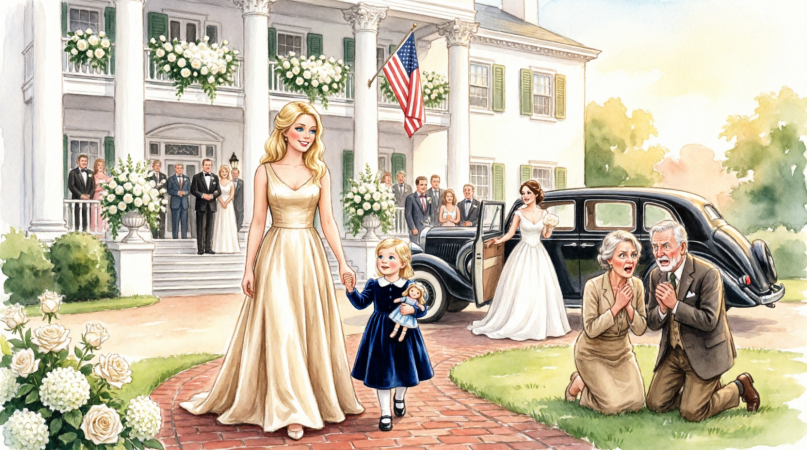
Because for six months, I had imagined this night. I had imagined Howard exposed, Eleanor humiliated, Chloe silenced. I had imagined walking into their world and making them feel one percent of what they made me feel when my wedding album landed open in the mud beside my broken suitcase.
But now that it was happening, I felt something sharper than satisfaction.
I felt grief.
Terrence should have been there.
He should have been standing beside me, making that nervous little half-smile he made when rooms got loud. He should have been squeezing my hand under the table, telling me, “Breathe, Aud. One crisis at a time.”
Instead, his name was on banners, programs, donation cards, and legal documents.
The dead are easy for guilty people to praise.
They cannot object.
Lauren moved toward me slowly. Her face was wet now, but she did not sob. She looked like a woman who had been drowning quietly for years and had only just realized the shore existed.
“Audrey,” she said, “I am so sorry.”
I did not answer right away.
Six months ago, Lauren had stood at the upstairs window while Eleanor dragged my suitcase across the lawn. She had not come down. She had not defended me. She had not even opened the door.
I remembered her silhouette behind the curtain.
Still. Silent. Watching.
“You saw everything,” I said.
She nodded. “Yes.”
“You watched them throw me out the day after I buried my husband.”
Her mouth trembled. “Yes.”
“You watched Chloe film me.”
“Yes.”
“And you did nothing.”
Lauren looked down at her hands. “I was afraid.”
“So was I.”
Her head snapped up.
I did not say it cruelly. That would have been easier for both of us. I said it plainly because truth did not need decoration.
Lauren nodded once, as if accepting a sentence. “You’re right.”
Rachel came to my side. “Audrey, the agents need to preserve the chain of custody. Lauren should give a formal statement tonight.”
“She will,” I said.
Lauren looked relieved, then terrified.
“But not here,” I added. “Not in front of them.”
I turned toward the stage.
The microphone still stood beside a tower of white roses beneath a banner that read: “Terrence Washington Children’s Medical Fund: A Legacy of Compassion.”
A legacy.
That word nearly broke me.
I walked to the stage.
Every eye followed me.
Six months ago, their eyes had been cameras, knives, and verdicts. Tonight, they were witnesses.
I stepped behind the microphone.
The ballroom remained perfectly still.
“My name is Audrey Hale Washington,” I said.
My voice echoed through the speakers, steadier than I felt.
“I was married to Terrence Washington for seven years. Most of you knew him as a board member, a donor, or Howard Washington’s son. I knew him as the man who sat beside children during chemotherapy because he remembered every name. I knew him as the man who kept granola bars in his coat pockets for exhausted parents. I knew him as the man who once missed a board dinner because a seven-year-old patient asked him to watch cartoons.”
Several people lowered their heads.
Dr. Patel covered her mouth.
“Terrence believed this foundation existed for children,” I continued. “Not for status. Not for tax games. Not for men in tuxedos to applaud themselves while money disappeared into private accounts.”
Eleanor tried to stand.
“Sit down,” Rachel said without raising her voice.
Eleanor sat.
“I will not discuss active legal matters,” I said. “But I will say this clearly. Every dollar stolen from this fund will be recovered. Every false vendor will be exposed. Every child denied support because of greed will be compensated. And tonight’s gala will not end in disgrace.”
I paused.
Then I looked directly at the hospital board.
“Tonight, through the Hale Family Trust, I am donating one hundred million dollars to fully endow the Terrence Washington Pediatric Treatment Center. The money will be placed under independent medical oversight. No Washington family member will control one cent.”
A sound moved through the room.
Not quite a gasp.
Not quite applause.
Disbelief.
I let them sit with it.
Then Dr. Patel began to clap.
Slowly.
One clap. Then another.
A father near the back stood next. I recognized him from a hospital photo Terrence had kept on his desk. His daughter had been one of the first children funded through the program before Howard turned compassion into a revenue stream.
Then a nurse stood.
Then a donor.
Then nearly the entire ballroom.
Eleanor remained seated, white-faced and shaking.
Chloe stared at me as if I had walked out of the mud and turned into something impossible.
I did not smile.
This was not revenge yet.
This was triage.
The first emergency was stopping the bleeding.
The second was finding out how Terrence died.
Because Howard had made one mistake.
When he whispered that I had no idea what I was touching, he had confirmed what I had feared since the morning my husband never woke up.
Terrence’s death had not been simple.
And Lauren knew more.
Two hours later, I sat in a private conference room on the fifth floor of the hotel with Rachel, two federal agents, Lauren, and a laptop that had never been connected to hotel Wi-Fi.
Outside, the gala continued under emergency management. Dr. Patel made the public announcement. The donors stayed. The hospital fund survived the night.
Inside, Lauren finally began to talk.
Howard had started stealing from the foundation eleven years earlier.
At first, it was small. A vendor overbilling here. A consulting fee there. Money moved through shell companies with names like Meridian Outreach Solutions and Capital Children’s Strategy Group. The amounts were large enough to enrich him but small enough to disappear inside charity bureaucracy.
Then Terrence joined the finance committee.
My husband noticed patterns.
Repeated invoice numbers. Vendors with identical mailing addresses. Pediatric equipment orders that were paid but never delivered.
Lauren said Howard laughed when Terrence first confronted him.
“He told him every foundation in America worked that way,” she said. “He said Terrence was naïve.”
I could hear Terrence’s voice in my memory.
“That cannot be normal, Audrey. Not when kids are waiting for treatment grants.”
Lauren folded her hands so tightly her knuckles turned white.
“Terrence kept digging. Howard got angry. Eleanor told him he was humiliating the family. Chloe called him dramatic. Everyone pressured him to drop it.”
“But he didn’t,” I said.
Lauren shook her head. “No. He started making copies.”
Rachel leaned forward. “Of what?”
“Everything. Emails. Vendor contracts. Bank transfer screenshots. Board minutes. And audio recordings.” Lauren looked at me. “He was afraid no one would believe him.”
My throat tightened.
Terrence had always hated being called dramatic. Howard used that word like a leash.
“And the will?” Rachel asked.
Lauren looked at the closed laptop. “Terrence changed it after he found out Howard planned to challenge Audrey’s inheritance rights.”
I frowned. “My inheritance was not from Terrence.”
“No,” Lauren said. “But Howard didn’t know that then. He only knew Terrence had left you something powerful.”
“His foundation shares,” Rachel said.
Lauren nodded. “Howard could tolerate you getting money. He could not tolerate you getting voting control.”
The lead agent, Marcus Reid, typed something into his notes. “Who altered the will submitted to probate?”
Lauren closed her eyes.
Then she said, “Howard ordered it. Eleanor arranged the notary. Chloe delivered the altered document to the attorney’s office.”
I stared at her.
Chloe.
Of course.
The girl who filmed me in the rain had also carried the paper that tried to erase me.
“She knew?” I asked.
Lauren’s face twisted. “She knew enough.”
That sentence was worse than yes.
Rachel inserted the flash drive into the laptop.
Folders appeared.
Terrence_Will_Final.
Foundation_Audit_Private.
Howard_Audio.
Emergency_If_Anything_Happens.
My hand went cold.
Rachel looked at me before clicking. “Audrey?”
I nodded.
She opened the emergency folder.
There was one video file.
The thumbnail showed Terrence sitting in his study at our house, wearing the blue sweater I had bought him for our anniversary.
For one terrible second, I could not speak.
Rachel reached for the trackpad.
The video began.
Terrence appeared on screen, tired but alive.
His hair was messy. His eyes were red. Behind him, our kitchen light glowed warm and golden, and for a moment I remembered that night with unbearable clarity. I had been at the hospital working a double shift. He had texted me at 11:18 p.m.
“Come home safe. I made soup. Do not argue with me about sodium.”
I had laughed in the medication room.
I did not know he was recording what might become his last message.
On the screen, Terrence took a breath.
“If you are watching this,” he said, “then something went wrong.”
Lauren began to cry silently.
I pressed one hand over my mouth.
Terrence looked directly into the camera.
“Audrey, I am sorry. I know you will be angry that I did not tell you everything right away. You always say secrets are just delayed explosions. You were right.”
A broken sound escaped me.
Rachel placed a steady hand on my arm.
Terrence continued.
“My father has been stealing from the foundation. I have documented enough to force a board investigation, but I believe the theft is larger than what I have found. I also believe he has people helping him inside the probate office, the bank, and possibly on the hospital board.”
Agent Reid stopped typing.
Terrence swallowed.
“I changed my will eight days ago. Audrey receives my voting shares, my personal research archive, and all rights to challenge foundation governance. I made that decision because she is the only person I trust to burn the rot out and still protect the children.”
I closed my eyes.
His voice filled the room.
“If my death looks convenient, it probably is.”
Lauren sobbed once.
The room went completely still.
Terrence leaned closer to the camera.
“My father asked me to meet him tomorrow at the old boathouse. He says he wants to settle this privately before I destroy the family. I am going because I need him to admit it on record. I will have a recorder in my watch. If I do not come back, look for the watch.”
The watch.
My breath stopped.
Terrence’s watch had been missing after he died.
The police said it must have fallen off during the accident.
The accident.
That was what they called it.
Terrence’s car had gone off a wet road near the Potomac at 2:14 a.m. His blood alcohol level was just high enough for everyone to whisper. I had screamed at the coroner that Terrence barely drank. Howard had put his arm around me in front of everyone and said grief made people deny obvious truths.
I remembered his hand on my shoulder.
I remembered wanting to crawl out of my own skin.
On the screen, Terrence’s face softened.
“Audrey, listen to me. Do not confront him alone. Do not trust my mother. Do not trust Chloe. Lauren may know more than she admits, but I think she is scared, not cruel. Rachel Monroe has the backup documents. The password is the place where you said yes.”
My eyes burned.
Rachel inhaled sharply.
The place where I said yes.
A tiny Italian restaurant in Baltimore with bad lighting, great bread, and a crooked sign outside.
Terrence smiled faintly at the camera.
“And Aud?”
I could barely see him through tears.
“If I am wrong, please forgive me for being paranoid. If I am right, do not let them turn you into what they are. Win clean. Win loud. Win so completely that no child ever has to pay for their greed again.”
The video ended.
For several seconds, the only sound in the room was Lauren crying.
I sat very still.
Something inside me had gone silent.
Not empty.
Focused.
Rachel wiped her eyes once, quickly, then straightened. “Agent Reid.”
“We need the watch,” he said.
Lauren looked up.
Her face had changed.
Fear was still there, but something else had entered it.
Resolve.
“I know where it is,” she whispered.
Everyone turned to her.
Howard had come home the night Terrence died soaked from the rain.
Lauren had been awake.
She said Howard walked straight to his study and locked the door. The next morning, a small velvet box appeared in the back of his gun safe. Lauren had seen it once when Howard forced her to retrieve passports before a trip to Geneva.
Inside was a watch.
Terrence’s watch.
“I did not know what it meant,” Lauren said. “Not then. But after the funeral, Howard kept opening the safe at night. He would just stare at it.”
Agent Reid leaned forward. “Can you access the safe?”
Lauren nodded slowly. “I know the code.”
“Then we move now,” he said.
Rachel looked at me. “Audrey, you do not have to go.”
I stood.
“Yes,” I said. “I do.”
The Washington estate looked smaller in the dark.
That surprised me.
For years, the mansion had seemed enormous. White columns, iron gates, long driveway, fountains lit from below. It was the kind of house built to make people feel grateful for being invited inside.
The night after Terrence’s funeral, it had felt like a fortress.
Eleanor had stood on the front steps in black silk, her face sharpened by rain and cruelty.
“This house belongs to blood,” she had said. “You were only ever temporary.”
Then she dragged my suitcase across the wet grass and let Chloe film.
Now, as two federal vehicles rolled silently through the gate behind Lauren’s car, the house looked exactly like what it was.
Wood. Stone. Glass.
A thing people built because they were terrified of being ordinary.
Lauren led us through a side entrance.
No staff stopped us. No family members appeared. Howard was still detained. Eleanor and Chloe were being questioned at the hotel.
The house smelled the same.
Polished floors. Expensive flowers. Old money pretending not to rot.
I had not stepped inside since the day they threw me out.
My body remembered before my mind did.
My shoulders tightened. My palms went damp. For half a second, I saw my suitcase splitting open again. White nursing shoes in mud. My wedding album face down in rainwater. Chloe laughing behind her phone.
Then Rachel touched my elbow.
“Breathe,” she said softly.
I did.
Lauren took us to Howard’s study.
The room was exactly as I remembered it. Dark wood shelves. Framed newspaper profiles. Photos of Howard shaking hands with presidents, governors, CEOs, bishops. A wall of achievements arranged like armor.
And on the desk, one photo of Terrence.
Not smiling.
I walked to it before I could stop myself.
It was from a foundation ceremony three years earlier. Howard stood beside him, hand clamped on Terrence’s shoulder. Terrence’s smile was polite but tired.
I touched the frame.
“You were so tired,” I whispered.
Behind me, Lauren moved a painting aside and revealed the safe.
Her fingers trembled as she entered the code.
The safe beeped.
Opened.
Agent Reid stepped forward with gloves.
Inside were stacks of documents, passports, cash bundles, jewelry cases, and a velvet box.
Black.
Small.
Familiar.
My knees nearly buckled.
Rachel caught me.
Agent Reid opened the box.
Terrence’s watch lay inside.
Silver face. Brown leather strap. Tiny scratch on the side from the time he tried to fix our kitchen cabinet himself and failed spectacularly.
I had teased him for a week.
He had said, “This scratch proves I am a man of action.”
I covered my mouth.
Agent Reid lifted the watch carefully. “This is evidence.”
“Can you recover the recording?” I asked.
“We will try.”
Lauren stared into the safe. “There are more folders.”
Rachel began photographing labels.
One folder read: “A.H.W. Pressure Strategy.”
My initials.
Rachel opened it.
Inside were printed screenshots of my work schedule, my bank history before my inheritance settled, private photos taken outside the hospital, notes about my relatives, and a typed strategy memo.
Objective: Isolate Audrey Hale Washington post-funeral. Prevent access to Washington family legal counsel. Establish public perception of financial desperation. Encourage social media humiliation to reduce credibility in future probate challenge.
Chloe’s name appeared beside a bullet point.
Digital amplification.
I did not feel shock.
Shock was for people who still believed cruelty happened by accident.
Rachel’s voice went cold. “This was premeditated.”
Lauren whispered, “I am sorry.”
I looked at the memo again.
There it was, in neat legal language.
My humiliation had been a strategy.
They had not thrown me out because grief made them reckless.
They had planned the rain.
They had planned the cameras.
They had planned my silence.
Agent Reid sealed the folder.
Then a sound came from the hallway.
A door slammed downstairs.
Lauren went rigid.
“Howard?” I whispered.
Agent Reid held up one hand.
Another agent stepped into the hall.
A woman’s voice rang from below.
“Where is she?”
Eleanor.
Rachel muttered, “Of course.”
Eleanor Washington appeared in the doorway two minutes later with mascara streaking down her face and fury burning through every crack in her composure.
Chloe stood behind her, pale, one cheek still red.
“You,” Eleanor breathed when she saw me.
No pearls. No perfect silk shawl. No audience to perform sorrow for.
Just a mother who had protected a criminal because the criminal carried her last name.
“You brought federal agents into my home?” she said.
I looked around Howard’s study. “Your home?”
Her mouth tightened.
That was when I knew.
She knew the estate was not hers either.
Terrence had once told me his grandfather put half the family properties into foundation-linked trusts. Howard controlled them only as long as he controlled the board.
And now he did not.
Eleanor stepped toward me. “You poisonous little opportunist. My son would be alive if he had never married you.”
The room went very quiet.
Rachel said, “Mrs. Washington, I would advise you to stop speaking.”
But Eleanor could not stop.
Women like her survived by controlling the room. Silence felt like death to them.
“You turned him against us,” she said. “Terrence was loyal before you. He understood family. Then you came in with your hospital hands and your cheap shoes and your saint act.”
I stepped closer.
“Terrence was loyal,” I said. “That is why your husband killed him.”
Chloe made a choking sound.
Eleanor’s eyes flashed.
“Do not you dare.”
“Did you know?” I asked.
She slapped me.
The sound echoed through Howard’s study.
Rachel shouted my name.
Agent Reid moved instantly, catching Eleanor’s wrist before she could raise her hand again.
My cheek stung.
I slowly turned back to Eleanor.
There was a time when that slap would have shattered me.
Tonight, it clarified everything.
“You always needed me small,” I said. “Poor Audrey. Grateful Audrey. Quiet Audrey. Audrey in muddy scrubs. Audrey with nowhere to go.”
Eleanor struggled against the agent’s grip.
“But I was never small,” I said. “I was just grieving.”
Chloe started crying.
Not pretty crying. Not social-media crying. Real, ugly panic.
“Mom,” she whispered. “Stop.”
Eleanor looked at her daughter with contempt. “This is your fault. If you had not posted that video—”
Chloe snapped.
“You told me to ruin her.”
Eleanor froze.
Chloe’s voice rose. “You told me she needed to look unstable. You said if people saw her screaming in the rain, no court would believe her later.”
Rachel turned sharply to the second agent. “Are you getting this?”
He nodded. “Body camera is active.”
Eleanor’s mouth opened.
For once, no sound came out.
Chloe looked at me then, and I saw the exact moment she understood that cruelty had not made her powerful. It had made her useful. Disposable.
“I did not change the will,” she said quickly. “I only delivered it. Dad said it was corrected paperwork. Mom said Terrence had signed the wrong copy. I knew it was bad, but I did not know—”
“You knew enough,” I said.
The words landed.
Chloe broke.
“I am sorry,” she sobbed. “I am so sorry.”
I wanted to feel something.
Pity. Anger. Satisfaction.
But all I saw was her phone pointed at me in the rain.
All I heard was her laugh when my wedding album fell open.
“You are not sorry because you hurt me,” I said. “You are sorry because the room changed.”
Chloe covered her face.
Agent Reid removed Eleanor from the study.
As she passed me, she leaned close enough that I could smell wine on her breath.
“You will never be one of us,” she whispered.
I looked at the safe, the evidence bags, the federal agents, the ruined empire around us.
“Thank God,” I said.
By dawn, Howard Washington’s world had begun to collapse.
Not publicly. Not yet.
Powerful families do not fall like trees. They fall like buildings with internal damage. First one crack, then another, then a groan behind the walls, then suddenly everyone insists they always knew the foundation was unsafe.
Rachel refused to let me go home alone, so I spent the morning in her office overlooking K Street, wrapped in a gray blanket, drinking coffee I never finished.
The watch had been taken to a federal lab.
The flash drive had been copied under evidence protocol.
Lauren gave a full statement before sunrise.
Chloe asked for an attorney.
Eleanor refused to speak after her slap became an assault charge.
Howard requested three phone calls and was denied two of them.
At 8:42 a.m., the first news alert appeared.
“Federal Investigation Disrupts Washington Charity Gala.”
By 9:10, it became:
“Prominent Philanthropist Howard Washington Questioned In Foundation Fraud Probe.”
By noon:
“Widow Of Terrence Washington Claims Late Husband’s Will Was Altered.”
Chloe’s old video resurfaced within hours.
The one of me in the rain.
Only this time, people did not laugh.
They watched Eleanor drag my suitcase across the lawn. They watched Chloe zoom in on my muddy wedding album. They heard Howard’s voice from somewhere off camera saying, “Let her learn what nothing feels like.”
And then they watched the new footage from the gala.
Me at the microphone.
My donation.
Howard being escorted out.
The internet is not justice, but it is a very fast mirror.
By evening, people were calling Chloe cruel, Eleanor monstrous, Howard corrupt.
I did not enjoy it.
That surprised me too.
Six months earlier, I had imagined their public humiliation as a kind of medicine. But now, watching strangers dissect their faces and invent details they did not know, I felt no healing.
I closed the laptop.
Rachel looked up from a stack of legal papers. “You do not have to watch.”
“I thought it would feel better.”
“It rarely does.”
“Then what does?”
She removed her glasses. “Building something they cannot touch.”
That became the plan.
Over the next three weeks, Rachel moved like a surgeon.
First, she filed an emergency petition to suspend Howard’s authority over the foundation.
Then she moved to validate Terrence’s original will.
Then she froze all foundation-linked accounts, vendor payments, property transfers, and board appointments.
Howard’s attorneys fought like cornered animals.
They called me unstable.
Rachel submitted the strategy memo.
They called Lauren unreliable.
Rachel submitted bank records matching her statement.
They said Terrence had been drinking the night he died.
Agent Reid called.
The watch had audio.
Rachel came to my house to tell me in person.
I knew the moment I opened the door.
She was standing on my porch with red eyes and a folder pressed to her chest.
“Is it bad?” I asked.
“Yes,” she said. “But it is useful.”
We sat at my kitchen table.
The same kitchen where Terrence had recorded his video.
Rachel placed a small speaker between us.
“You do not have to listen.”
“Yes,” I said. “I do.”
The recording began with wind.
Then footsteps on wood.
Then Howard’s voice.
“You are making a mistake, son.”
Terrence answered, calm but strained. “No. The mistake was thinking I could persuade you to stop.”
A door creaked.
The old boathouse.
I could picture it. The Washington property on the river. Rotten pier. Dark water. Rain.
Howard said, “You do not understand institutions. Money moves. People get paid. Good gets done anyway.”
“Children were denied treatment grants,” Terrence said. “Because your shell vendors drained the fund.”
“Do not be dramatic.”
“You stole from dying kids.”
A sharp sound.
Maybe a glass hitting wood.
Howard’s voice changed. “Careful.”
Terrence said, “I changed my will.”
Silence.
Then Howard, softer. “What did you say?”
“My shares go to Audrey if anything happens to me.”
“You left our family foundation to that nurse?”
“I left it to my wife.”
“She is nothing.”
“She is the best person I know.”
My breath caught.
Rachel reached across the table but did not touch me.
The recording continued.
Howard said, “You will reverse it.”
“No.”
“You think she will survive what comes after you? Your mother will eat her alive. Chloe will make her a joke before the funeral flowers wilt.”
Terrence’s voice hardened. “If you touch her, I will destroy you.”
Howard laughed.
It was the ugliest sound I had ever heard.
“My son,” he said, “finally becomes a man, and he uses it to defend a woman who married beneath him.”
Terrence said, “Goodbye, Dad.”
Footsteps.
Then a scuffle.
The recording distorted.
Terrence shouted, “Let go.”
Howard grunted. “Give me the watch.”
The sound of fabric tearing.
Then Terrence yelled in pain.
I gripped the table so hard my nails hurt.
Rachel stopped the recording.
“No,” I said. “Play it.”
Her face tightened. “Audrey—”
“Play it.”
She did.
The next sounds were chaos.
Rain. Struggle. Howard breathing hard. Terrence choking out, “You drugged me?”
Howard’s voice came close to the recorder.
“You should have stayed loyal.”
Then the recording cut to static.
For thirty seconds, there was only rain.
Then Howard’s voice again, distant now.
“Call Malcolm. Tell him to bring the car around.”
Another male voice answered. “Is he alive?”
Howard said, “Enough.”
The recording ended.
I sat in silence.
Rachel let me.
Grief came differently this time.
Not like the funeral, when it swallowed me whole. Not like the day on the lawn, when humiliation wrapped itself around loss until I could not separate them.
This grief was clean and terrible.
My husband had not died alone in a random accident.
He had died betrayed.
But he had also died fighting.
Terrence had walked into that boathouse afraid and still told the truth.
He had protected me with the last legal act of his life.
He had made sure his father’s own violence carried a witness.
The watch.
The scratch.
The man of action.
I stood so fast the chair scraped backward.
Rachel rose with me. “Audrey?”
“I need to go somewhere.”
“Where?”
“The hospital.”
The pediatric oncology floor smelled like antiseptic, crayons, and coffee.
Terrence had loved that floor.
He said adults lowered their voices too much around sick children, as if joy might disturb the illness. He would show up in bright socks, carry ridiculous sticker books, and ask kids for opinions about serious matters.
“Should I grow a mustache?”
“No,” one six-year-old had told him. “You have a friendly face. Do not ruin it.”
He quoted that child for months.
When I arrived, Dr. Patel was waiting near the nurses’ station.
She did not ask why I came.
She just hugged me.
I had spent my life being strong in public. That hug nearly undid me.
“I heard there may be audio,” she said carefully.
“There is.”
“I am sorry.”
I looked down the hall.
A little boy rolled past in a toy car pushed by his father. He wore a surgical mask covered in dinosaurs.
“Terrence said to win clean,” I said.
Dr. Patel nodded.
“So that is what we do.”
The next morning, we announced the independent oversight board.
No society names.
No political appointees.
No Washington cousins.
Doctors. Nurses. Patient advocates. Financial auditors. Parents who had actually sat beside hospital beds at 3 a.m.
I chaired the transition committee temporarily, but I refused permanent control.
Howard had taught me something valuable.
Any institution built around one person’s power is already sick.
The Washington Foundation became the Terrence Hale Pediatric Trust.
I changed the name deliberately.
Terrence Washington had been born into that family.
But Hale was my mother’s name, my grandfather’s name, and the name on the trust that made the gift possible. More importantly, Terrence had once told me that marrying me was the first time he felt he belonged to a family that did not treat love like a transaction.
So I gave him that name too.
Eleanor found out from the news.
She called me forty-three times.
I answered none.
Then one afternoon, she arrived at my gate.
Not the Washington estate gate.
Mine.
After Terrence died, I had moved into a modest brick house near the hospital. It was not small, but it was quiet. No columns. No fountains. No rooms designed for intimidation. Just sunlight, books, a kitchen we had painted blue, and a garden Terrence had planned but never finished planting.
Eleanor stood outside the gate wearing black, though nobody had died that day.
I watched her through the security camera.
She pressed the intercom.
“Audrey, open this gate.”
I said nothing.
She looked up, directly into the camera.
“You have made your point.”
Still, I said nothing.
Her voice cracked with frustration. “Do you think Terrence would want this?”
That made me press the button.
The speaker clicked on.
“No,” I said. “Terrence wanted you to be better. But you chose Howard.”
Eleanor’s face twisted. “I chose my family.”
“So did I.”
“He was my son.”
“He was my husband.”
“You had him for seven years.”
“And you had him his whole life,” I said. “Yet somehow, I knew him better.”
She recoiled.
Good.
Some truths are not cruel. They are just overdue.
Eleanor gripped the bars of the gate. “Howard is being charged because of you.”
“Howard is being charged because of Howard.”
“My life is destroyed.”
“No. Your image is destroyed. There is a difference.”
Her eyes filled with tears, but I did not trust them. Eleanor had weaponized tears too many times.
“I lost my son,” she whispered.
For the first time, I heard something real under her performance.
Pain.
Not repentance.
But pain.
I let the silence stretch.
Then I said, “Then tell the truth.”
She stared.
“Tell Agent Reid what you knew. Tell Rachel who arranged the false notary. Tell the court why Chloe delivered altered papers. Tell them who Malcolm is. Tell them what Howard did after the boathouse.”
Her lips parted.
There.
Malcolm.
She knew the name.
The recording had captured it, but not his full identity. Howard’s people were already claiming Malcolm could be anyone. A driver. A security contractor. A hallucinated word in distorted audio.
Eleanor looked over her shoulder, suddenly afraid.
“Who told you that name?” she whispered.
“Terrence did.”
Her face drained.
Not because Terrence had told me while alive.
Because for one second, Eleanor looked like she believed the dead had spoken.
I leaned closer to the intercom.
“You still have one chance to be his mother,” I said. “Do not waste it.”
Then I ended the call.
She stood at the gate for eight minutes.
Then she left.
Two days later, Eleanor Washington gave a statement.
Not because she became good.
Because fear finally outweighed pride.
Malcolm Price was Howard’s private security contractor. Former police. Paid through a shell vendor attached to the foundation’s “executive protection” budget. He had been at the boathouse the night Terrence died. He had driven Terrence’s car after Howard incapacitated him. He had staged the crash near the Potomac. He had removed the watch and given it to Howard, unaware that the device had already uploaded a damaged backup file to Terrence’s encrypted archive before the signal died.
Terrence had built redundancy into everything.
Even his own death.
When Malcolm was arrested, he turned in less than six hours.
Men like Malcolm are loyal until the sentence becomes personal.
He confirmed what the audio suggested.
Howard had confronted Terrence.
Howard had drugged him.
Howard had ordered the crash staged.
Malcolm claimed Terrence was still breathing when he left him in the car.
I did not let myself imagine that part for long.
Some doors inside the mind should stay closed unless opening them serves justice.
The indictment came on a Tuesday.
Howard Washington was charged with murder, conspiracy, fraud, obstruction, evidence tampering, and multiple financial crimes.
Eleanor was charged with conspiracy to commit probate fraud and obstruction.
Chloe received lesser charges for document delivery, false statements, and harassment tied to the planned humiliation campaign.
Lauren was granted conditional cooperation status.
The Washington name became a headline, then a scandal, then a cautionary tale.
But court moves slowly.
Pain does not.
While attorneys argued and reporters camped outside buildings, I went back to the house and opened the muddy wedding album for the first time since the day Chloe filmed it.
I had cleaned it weeks after the funeral.
At least, I tried.
Some pages were permanently warped. Mud had stained the corners. Rain had blurred the ink on the little cards where guests had written advice.
“Never go to sleep angry.”
“Laugh often.”
“Let him load the dishwasher wrong.”
I sat on the floor of my bedroom with the album in my lap and finally allowed myself to look at every picture.
Terrence dancing with my grandfather.
Terrence crying when I walked down the aisle.
Terrence feeding me cake and missing my mouth completely.
Terrence whispering something that made me laugh so hard the photographer caught me with my eyes closed.
The last page had stuck to the back cover.
I carefully separated it.
Something fell out.
A folded note.
My hands went still.
It was Terrence’s handwriting.
Audrey, if you find this years from now, I hope we are old and arguing about garden tomatoes. If you find it sooner, then I need you to remember something. You were never the lucky one because I married you. I was the lucky one because you chose me. Whatever my family says, whatever the world says, do not let anyone convince you love made you foolish. Loving you was the clearest thing I ever did.
I read it once.
Then again.
Then I bent over the album and cried until the sun went down.
That night, I slept without dreaming for the first time in six months.
The trial began eleven months later.
By then, my hair was longer. My house garden was alive with tomatoes, lavender, and stubborn wildflowers that grew wherever they pleased. The Terrence Hale Pediatric Trust had already funded treatments for 312 children, cleared emergency debt for 89 families, and opened a parent housing wing near the hospital.
I had learned how to live beside grief without letting it drive.
Howard entered the courthouse in a navy suit, thinner than before but still trying to look untouchable.
He did not look at the cameras.
He looked at me.
I wore a simple cream suit and Terrence’s scratched watch on my wrist.
Rachel had asked if I was sure.
I was.
The original watch remained evidence, but the lab had created an exact restored replica for me after the recording was secured. The scratch was there. The brown strap. The weight of it against my pulse.
A reminder.
Not of how he died.
Of what he protected.
Inside the courtroom, Eleanor sat behind Howard at first.
Then, on the third day, after prosecutors played Terrence’s video, she moved two rows away.
On the fifth day, after Malcolm testified, she stopped looking at her husband entirely.
Chloe testified on the seventh day.
She walked to the stand in a gray dress with no makeup and hands that would not stop shaking.
The prosecutor asked, “Did you participate in a plan to publicly humiliate Audrey Hale Washington after Terrence Washington’s funeral?”
Chloe closed her eyes.
“Yes.”
“Why?”
Chloe looked toward me, then down.
“Because my parents told me Audrey was dangerous. They said she wanted to steal the foundation. They said if she looked unstable, nobody would take her seriously. I wanted my father’s approval. I thought it was just family drama.”
“Did you believe that at the time?”
Chloe swallowed. “I think I chose to believe it because it made being cruel easier.”
That was the first honest thing I had ever heard her say.
The prosecutor played the video from the lawn.
The courtroom watched me kneel in the mud, gathering wet photographs.
I did not look away.
Chloe cried on the stand.
But this time, she did not ask me to comfort her with forgiveness.
That mattered.
Lauren testified next.
Howard’s attorney tried to destroy her.
He called her bitter.
She agreed.
He called her afraid.
She agreed.
He called her complicit.
She looked at the jury and said, “Yes. My silence helped him. That is why I am here telling the truth now.”
The jury listened.
But the hardest day was mine.
When I took the stand, Howard finally looked pleased.
He thought grief would make me messy.
He thought his attorney could turn my inheritance into motive, my silence into scheming, my donation into vanity.
For two hours, they tried.
“Mrs. Washington, is it true you inherited six hundred eighty million dollars shortly after your husband’s death?”
“Yes.”
“And you hid this from the Washington family?”
“Yes.”
“Why?”
“Because they had shown me who they were before they knew what I had.”
A few jurors looked up.
Howard’s attorney paced slowly.
“Did you enjoy shocking them at the gala?”
“No.”
“Really? You expect this jury to believe you took no satisfaction in humiliating the family that humiliated you?”
I looked at Howard.
Then back at the attorney.
“I did not want them humiliated. I wanted them unable to continue.”
He changed tactics.
“You claim to love Terrence Washington.”
“I do not claim it. I lived it.”
“Yet you benefited financially and institutionally from his death.”
Rachel rose. “Objection.”
“Sustained,” the judge said sharply.
But I answered anyway, softly.
“I would give all of it back for one more ordinary Tuesday with my husband.”
The courtroom went still.
Even Howard looked away.
Then the prosecutor played Terrence’s video.
I watched my husband speak to me from the screen in a room full of strangers.
This time, I did not break.
When the video ended, the prosecutor asked, “Mrs. Washington, what did you do after learning your husband believed his life was in danger?”
“I followed his instructions.”
“What were those instructions?”
“Win clean. Win loud. Protect the children.”
“And did you?”
I looked at the jury.
“I am trying.”
The trial lasted four weeks.
The jury deliberated for nine hours.
When they returned, the courtroom filled with a silence so dense it felt physical.
Howard stood.
His face gave nothing away.
The clerk read the verdicts.
Fraud.
Guilty.
Conspiracy.
Guilty.
Obstruction.
Guilty.
Evidence tampering.
Guilty.
Probate fraud.
Guilty.
Murder in the first degree.
The clerk paused.
I stopped breathing.
“Guilty.”
Howard’s knees bent slightly, as if the word had struck him in the chest.
Eleanor made a sound like an animal.
Chloe covered her face.
Lauren bowed her head.
Rachel gripped my hand under the table.
I looked at Howard Washington, the man who had called me nothing, the man who had planned my humiliation, the man who had taken Terrence from the world because his own son dared to become honest.
For one second, his eyes met mine.
I expected hatred.
Instead, I saw emptiness.
That was the final truth of him.
There had never been some grand villain beneath the tuxedo. No genius mastermind. No tragic patriarch. Just greed, cowardice, and a man so hollow he mistook control for legacy.
At sentencing, Terrence’s patients filled two rows.
Parents came. Nurses came. Doctors came. People Howard had used as charity décor came to remind the court that the money he stole had faces.
I read my statement last.
I had rewritten it twelve times.
In the end, I brought only one page.
“Your Honor,” I said, “Howard Washington did not only murder my husband. He tried to murder the truth about him. He tried to turn Terrence into a grieving headline, a tragic accident, a foundation logo, a son who would never contradict him.”
Howard stared at the table.
“But Terrence was not obedient. He was brave. He was not careless. He was careful enough to leave evidence. He was not weak. He stood alone in front of his father and refused to protect corruption.”
My voice shook once, then steadied.
“Howard wanted me homeless, silent, and ashamed. He wanted children’s money to become his money. He wanted love to lose to power. It did not.”
I touched the watch on my wrist.
“I do not ask this court for vengeance. Vengeance is too small for what he destroyed. I ask for a sentence that tells every powerful man in every polished room that family is not a shield for crime, charity is not a mask for theft, and a quiet woman in the rain may still be the person who brings the whole house down.”
The judge sentenced Howard to life in prison without parole.
Eleanor received prison time for conspiracy and obstruction.
Chloe received probation, community service, and a court order to issue a public apology and surrender profits from all monetized posts related to my humiliation. She also had to work, unpaid, under supervision, with a victims’ advocacy nonprofit. Not at my foundation. I would not let her perform redemption near Terrence’s name.
Lauren divorced Howard before sentencing and transferred every asset she could legally recover into a restitution fund for the children affected by the stolen grants.
People asked if I forgave her.
I said forgiveness was not a press release.
But one afternoon, months later, Lauren came to the hospital with three boxes of Howard’s private art collection documents. Hidden assets. More restitution.
She looked older. Freer.
“I found these,” she said. “I thought they belonged to the children.”
I accepted the boxes.
Then I said, “Terrence was right about you.”
She froze.
“He said you were scared, not cruel.”
Lauren’s eyes filled.
“I am trying not to be scared anymore,” she whispered.
“That is a good start.”
It was not forgiveness.
But it was a door left unlocked.
One year after the gala, the Terrence Hale Pediatric Treatment Center opened.
Not with a ballroom.
Not with champagne.
Not with senators giving speeches they did not write.
We opened it on a bright Saturday morning with paper butterflies taped to the windows, children drawing chalk stars on the sidewalk, nurses eating cupcakes before lunch, and parents crying quietly because hope can be overwhelming when you have gone too long without it.
The building stood beside the hospital, full of light.
At the entrance was a bronze plaque.
Terrence Hale Washington
Beloved Husband, Advocate, And Friend
“He Remembered Every Name.”
Below that, smaller letters:
Funded In Honor Of Every Child Whose Care Should Never Depend On Greed.
Dr. Patel cut the ribbon.
A little girl named Mia, who had once asked Terrence not to grow a mustache, rang a tiny silver bell to mark the first official treatment completed under the new trust.
The sound traveled through the lobby.
Clear.
Bright.
Unbroken.
I thought I would cry.
Instead, I laughed.
Because Terrence would have loved the bell. He would have made a terrible joke about dramatic symbolism. Then he would have pretended not to cry and failed.
After the ceremony, I walked alone to the garden behind the center.
We had planted tomatoes there.
Not because tomatoes belonged behind a pediatric treatment center, according to the landscaping committee. They had suggested sculptural grasses and low-maintenance shrubs.
I overruled them.
Terrence had wanted tomatoes.
So now there were tomatoes, lavender, wildflowers, and a bench beneath a young oak tree.
Rachel found me there near sunset.
“You disappeared,” she said.
“I am practicing peace.”
“How is it?”
“Strange.”
She sat beside me.
For a while, neither of us spoke.
Then she handed me an envelope.
“What is this?”
“Final probate order.”
I opened it.
Terrence’s will had been fully validated. The altered version was legally void. His shares, his archive, his personal letters, everything he intended for me, now belonged where he wanted it.
At the back was a copy of one last document.
A handwritten codicil.
Rachel said, “We found it in the attorney’s sealed storage. It was not legally necessary because the will already covered everything, but I thought you should have it.”
I unfolded the page.
Audrey, if anyone is reading this, then I have either become extremely dramatic or extremely right. My wife will know which. I leave her my foundation shares because she is allergic to corruption, my books because she pretends not to like my marginal notes, my watch because she says I am always late, and my faith in the world because hers is stronger than mine when she remembers to use it.
I laughed through sudden tears.
Rachel smiled.
There was more.
If my family contests this, remind them Audrey once worked a nineteen-hour shift, came home, fixed a leaking sink, yelled at a raccoon, and still made me soup. They should be afraid.
That broke me.
Not in the old way.
In the way sunlight breaks through weather.
I pressed the paper to my chest and let myself cry while the new center glowed behind me.
That evening, after everyone left, I walked through the empty lobby alone.
The floors shone. The walls smelled faintly of paint. The nurses’ station was stocked. The family rooms had blankets, real coffee, and chairs that folded into beds because no parent should have to sleep upright while their child is sick.
At the far wall hung a framed photograph.
Not of Howard.
Not of the Washington family.
Not of donors in tuxedos.
It was Terrence sitting cross-legged on a hospital floor, laughing while three children covered his shoes with stickers.
That was the legacy.
Not money.
Not buildings.
Not a name carved into stone.
A man who sat on the floor so sick children did not have to look up to feel seen.
I stood before the photo for a long time.
Then my phone buzzed.
A message from Chloe.
I expected another apology. Another attempt to be released from guilt.
Instead, it was a photo.
The original video of me on the lawn had been deleted from her public accounts by court order, but she had sent me one still image from it.
Not the humiliating part.
Not the suitcase.
Not the mud.
It was a frame I had never seen.
I was kneeling in the rain, holding my ruined wedding album.
Behind me, at the upstairs window, Lauren’s silhouette was visible.
And in the reflection of the glass, almost hidden by rain, Howard stood behind her.
Watching.
Chloe’s message read:
“I found this in the archive. I am not asking you to forgive me. I just thought you should know you were never as alone as we made you feel. We were all watching. You were the only one brave enough to stand back up.”
I stared at the image.
Then I deleted it.
Not because it hurt.
Because I no longer needed proof of that day.
I had lived it.
And I had survived it.
Before leaving, I went to the small dedication wall near the entrance. Families had already begun placing notes there.
“Thank you for giving our son a chance.”
“Thank you for helping us breathe.”
“Thank you for remembering us.”
At the center was a blank card.
I took a pen from the desk and wrote one sentence.
“Terrence, we won clean.”
I pinned it to the wall.
Then I stepped outside.
The evening air was warm. The sky over Washington, D.C., had turned soft gold, the kind of light Terrence used to call “movie ending weather.”
For six months after his death, I thought my story had ended on that lawn with mud on my hands and his family laughing behind me.
I had been wrong.
That was not the ending.
That was the moment the truth started gathering its strength.
Howard lost his empire.
Eleanor lost her throne.
Chloe lost her audience.
Lauren found her voice.
The children got their hospital.
Terrence got his name back.
And I got something I had not expected.
Not revenge.
Not even justice, though justice came as close as the law could carry it.
I got my life back.
Not the old one. That life was gone, and pretending otherwise would dishonor it.
This was a new life, built from evidence, grief, courage, and love that refused to be buried under a forged will.
I walked to my car with Terrence’s watch ticking softly against my wrist.
For the first time since the funeral, I did not feel him behind me like a ghost.
I felt him beside me like a promise.
At home, the garden was waiting.
The tomatoes had finally ripened.
I picked two, brought them inside, and made soup in the blue kitchen while rain began tapping gently against the windows.
Not storm rain.
Not funeral rain.
Just rain.
Clean and ordinary.
I set one bowl across from me at the table, the way grief sometimes asks you to do, and raised my spoon in a quiet toast.
“To ordinary Tuesdays,” I whispered.
Outside, the rain softened.
Inside, the house held.
And for the first time in a long time, so did I.