The first thing I remember about the Montgomery house is the smell: lemon polish on the table, butter warming in a silver dish, and Clara’s perfume settling over everything like a rule nobody had agreed to follow.
I married Mason because, in the beginning, he seemed gentle. He remembered my coffee order, carried grocery bags without being asked, and stood on my apartment porch in the rain when my old car would not start.
His mother called that sweetness “softness.” Clara said it like a diagnosis. The first time I met her, she corrected how I held a fork, then smiled at Mason as if I were a project she had purchased.
By our third year, I had learned that Clara did not need to raise her voice. Her house was quiet enough that a spoon touching china sounded like a verdict, and Mason mistook that silence for peace.
That Tuesday night, the dining room looked like a magazine picture nobody was supposed to disturb. Candles burned low, the good plates were out, and a framed map of the United States hung behind Clara’s chair.
“Ten degrees to the left, Ava,” she said, tapping my water glass with one pale fingernail. “Did your mother never teach you that precision matters?” Her voice was light, almost bored, which made it worse.
The glass was centered. I knew it the way you know your own shoes are tied. Mason knew it too, but he kept cutting his steak and refused to look at either one of us.
“Listen to Mother,” he said. “She’s only trying to polish you. You’ve been scatterbrained lately.” He used that word so smoothly it almost sounded like concern, but concern does not trap you in a room.
Scatterbrained became the word they used whenever reality made them uncomfortable. If Mason forgot to pay a bill, I had distracted him. If Clara moved my keys, I was careless. If I questioned money, I was emotional.
I had trusted them with ordinary things first: a spare key, my work schedule, my deposit routine, the passcode to my phone when Mason said married people should not keep walls between them.
Those little permissions became the bars of a room I had not noticed closing. That is how control works when it dresses itself as family. It asks for access first, then calls your boundaries an insult.
After dinner, Clara pushed back her chair and told me to come into the kitchen. “It’s time you learned my signature oil,” she said. “Perhaps heat will sharpen your dull mind.”
The kitchen floor was cold under my bare feet. The stainless steel counters reflected the gas flame, and the pot on the stove breathed smoke into the air, thick and sharp enough to sting my nose.
I remember the smell before the pain. I remember Mason’s fork clicking once in the other room. I remember Clara’s hand closing around the pot handle without hesitation, like she had rehearsed the movement.
She did not trip. She did not lose her balance. She looked directly at me, calm as a person choosing a tablecloth, and tilted the heavy pot toward both my arms.
The oil came down in a bright sheet across my forearms. For one second my mind could not name the pain because it was too large, too white, and too complete to be a normal sensation.
May you like
I fell against the lower cabinet and hit the tile hard. My arms were suddenly not arms anymore, just fire I could not put down, and every instinct in me screamed not to touch anything.
Clara stood over me with the empty pot hanging from her hand. “Now,” she whispered, “you finally have something to be clumsy about.” She said it quietly, as if the pain belonged only to us.
Mason came through the swinging door, and hope rose in me before I could stop it. I thought the sight of me on the floor would wake something human in him.
He looked at my arms. He looked at the oil spreading across the tile. He looked at his mother, who had not moved. Then he grabbed a towel and wiped the floor.
Not my skin. Not the stove. The floor. A person can learn the shape of a marriage in one second, and mine was a man cleaning marble while I burned beside him.
When he finally touched me, he grabbed my upper arms hard enough to make me gasp. “You tripped,” he said close to my face. “You reached for the pot and tripped. Say it.”
Clara watched from behind him. Her smile was small, private, and almost bored. Mason repeated the sentence until my shaking mouth formed the lie he wanted, because fear can make obedience look like agreement.
At 8:18 p.m., the hospital intake desk logged me as a cooking accident. Mason filled out the form because my hands shook too badly to hold the pen, and he wrote “fall near stove.”
The triage nurse wrote “patient tearful, spouse answering most questions.” I saw her pause when Mason corrected my sentence before I finished it, and that pause became the first mercy I had received all night.
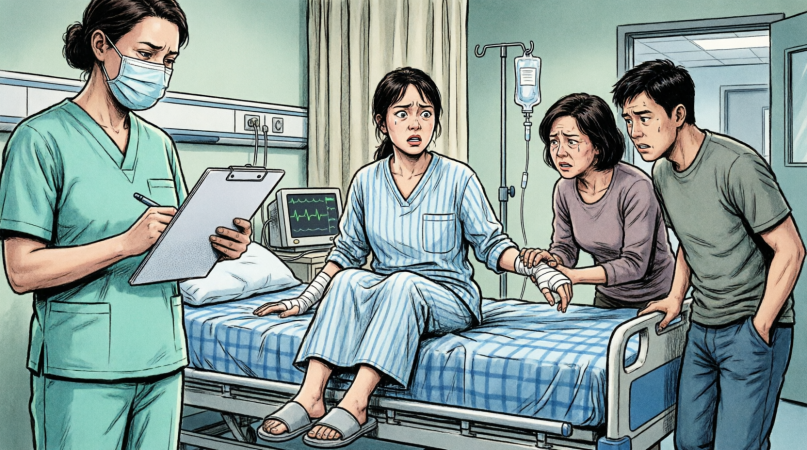
The charge nurse clipped a plastic bracelet around my wrist and led us behind a curtain. Mason turned into the kind of husband strangers praise, soft-voiced and wet-eyed, with one hand always too tight around mine.
He kissed the one safe patch near my knuckles. He told the nurse I rushed around when I cooked, that everyone who loved me worried about me, that I never slowed down long enough to think.
When the burn specialist came in, Mason squeezed my hand and said, “Doctor, please save her skin. She’s so scatterbrained. She tripped.” He sounded heartbroken, but his thumb pressed a warning into my palm.
The doctor did not look at him first. He looked at my arms, then at my shirt, then at my palms. His silence was different from Mason’s silence because it was working, measuring, and refusing to be charmed.
He examined the downward lines, the matching burns across both forearms, and the places near my elbows where the oil had run. The nurse stepped closer. Mason’s grip loosened. The monitor kept beeping.
“Mrs. Montgomery,” the doctor said, “don’t move.” He said it to Mason, and the room changed so quickly that even my pain seemed to hold its breath for one second.
Mason blinked. “Excuse me?” The doctor did not raise his voice. He said the burns were bilateral, downward, and patterned, inconsistent with a stumble, and consistent with my hands being raised defensively.
Clara arrived at the curtain then, still wearing her pearls and carrying her leather purse. She looked annoyed until she saw the doctor’s body planted between Mason and the door.
The charge nurse lifted a photo sheet from the rolling tray. The images had been taken at 8:23 p.m., close-ups of my arms and the bruises Mason’s fingers had left above them.
At the bottom of the page, in block handwriting, the nurse had written: SPOUSE COACHING PATIENT ANSWERS. Mason whispered, “That’s not what happened,” but the whisper sounded small against the paper.
The doctor told the nurse to start the domestic injury protocol. The nurse asked if I wanted police called. My mouth opened, but no sound came out, and Clara tried to answer before I could.
“This is ridiculous,” Clara said. “She is emotional. She has always been dramatic.” That was when the doctor turned his head slowly toward her and told her to step back from the patient.
There are moments when fear does not disappear, but it changes jobs. Mine stopped trying to keep me quiet and started keeping me alive. I looked at the nurse and said, “I didn’t trip.”
Mason shut his eyes. Clara’s purse creaked under her fingers. The security guard arrived first, then an officer came into the bay with a notebook and a calm voice.
The officer asked who poured the oil. I looked at Clara, who lifted her chin as if posture could erase physics. “She did,” I said. “And Mason told me to lie.”
The police report took hours. The nurse documented my words. The doctor added his assessment. Photographs were taken again, this time with a measurement strip beside each burn and the bruises on my arms.
They separated Mason and Clara from me before midnight. I did not see them leave, but I heard Clara arguing in the hallway until the elevator doors closed and the whole bay became quiet again.
The next morning, a hospital social worker helped me call my sister. I had not told her everything before, only pieces, because embarrassment makes people edit their own pain until even they barely recognize it.
My sister arrived with a hoodie, a phone charger, and the look of someone trying not to cry because I had already done enough crying for both of us. She never asked why I stayed.
Healing was not pretty. It smelled like ointment and gauze. It sounded like tape pulling from skin. It looked like my sister washing my hair in a hospital sink because lifting my arms was impossible.
Mason left voicemails after the first police interview. First he begged, then he blamed me, then he said I had misunderstood his mother. I saved every message and gave them to the officer.
Clara’s story changed three times. She said I slipped, then she said I startled her, then she said the pot was lighter than she thought and my movement caused the spill.
The burn specialist’s report did not change. Neither did the photographs, the intake notes, the triage time stamp, or the nurse’s sentence about Mason coaching my answers before anyone had accused him.
Weeks later, in a county courthouse hallway, Mason tried to speak to me through my sister. He looked smaller than I remembered, like the house had been holding him upright all along.
My sister stepped between us and did not raise her voice. She simply said, “She is not answering for you anymore.” Mason stared at her like he had never heard a door close from the outside.
The case did not fix everything. No court order can return skin to what it was before, and no apology can erase the sound of oil hitting tile beside your own body.
But the record mattered. The intake form mattered. The photographs mattered. The doctor’s words mattered because they gave my truth a place to stand when my voice was shaking.
Clara eventually faced consequences she could not decorate away, and Mason learned that crying in a hospital hallway is not the same as innocence. I filed for divorce before my bandages came off.
The day I signed the papers, my sister drove me home with the windows cracked. Spring air touched my arms like a warning and a promise, and I did not cover them.
I do not call myself clumsy anymore. For a long time, I thought survival would feel like victory, but it mostly felt like relearning how to make coffee without flinching at steam.
It felt like sleeping with the bedroom door unlocked. It felt like leaving my keys on the counter and knowing no one would move them to prove a point.
Sometimes I still see that kitchen when hot oil pops in a pan. Sometimes my arms remember before I do, and I have to stand very still until the room becomes mine again.
But I also remember the doctor standing between Mason and the door. I remember the nurse writing what she saw. I remember my own voice saying the sentence they trained me to swallow.
For the first time all night, Clara’s lesson had left evidence she could not polish away. And for the first time in three years, someone believed me before I had to beg.