Elena had learned long ago that family money can make people speak softly while doing brutal things. It starts with questions that sound polite, glances that last too long, and smiles that never reach the eyes.
Her daughter Sofía was twenty-three, educated, gentle, and more trusting than Elena had ever been. After Elena’s divorce from Alejandro, Sofía became the one clean thing neither parent wanted to damage further.
Alejandro had left Sofía an apartment in Polanco after the divorce. It was valued at 28,000,000 pesos, and it was meant to be her security, not a dowry, not bait, not a prize for another family.
The deed carried Sofía’s name. Elena kept copies in a folder at home, along with tax papers, property records, and every document a careful mother preserves when she has already seen love become leverage.
When Javier entered Sofía’s life, he appeared like the answer to every anxious prayer. He was a young lawyer, well dressed, soft spoken, and attentive in all the ways that impress relatives at first meetings.
He opened doors. He brought flowers. He addressed Elena as señora and never raised his voice. Sofía looked at him as if he had arrived to prove that not every marriage had to repeat her mother’s.
Elena wanted to believe it. Mothers are not immune to hope. They only learn to hold it with both hands and inspect it for cracks before giving it to their children.
Then Doña Carmen Robles came to Elena’s house.
Carmen wore gold jewelry, expensive perfume, and a calm, polished smile. She moved through Elena’s living room with the quiet attention of someone inspecting value, not visiting family.
At first, the conversation stayed pleasant. Wedding plans, guest lists, flowers, church details, hotel arrangements. Carmen praised Sofía’s manners and said Javier had chosen well.
Then her eyes moved to the furniture, the walls, the neighborhood, and finally back to Elena. “I heard Sofía’s father has strong properties, right?” she asked. “And that she has an apartment in Polanco.”
Elena answered immediately. “That apartment belongs to Sofía. It is not to be touched.”
Carmen smiled. “Of course, of course. Just asking to know what kind of family my son is marrying into.”
That was the first warning. The second came days later, when Carmen suggested a “wedding contribution” that sounded less like help and more like tribute. Money, jewelry, and “guarantees” were mentioned as if they were normal.
Elena refused. Sofía cried afterward, insisting Javier loved her and that his family was only traditional. She said Elena was suspicious because of what had happened with Alejandro.
There was truth in that, and that truth hurt. Elena had spent years inside a marriage where silence was mistaken for peace and interference was called family concern.
She did not want to become the bitter mother who poisoned her daughter’s happiness. So she agreed to a larger wedding than she wanted. She helped pay for things she considered unnecessary.
But one boundary stayed immovable. The apartment would not be transferred to Javier, Carmen, or anyone connected to the Robles family.
On the wedding morning, Elena styled Sofía’s hair herself. The room smelled of hairspray, flowers, and nervous coffee. Sofía kept laughing too quickly, smoothing the front of her dress again and again.
“You look beautiful,” Elena told her.
Sofía smiled in the mirror. “Are you happy for me, Mom?”
Elena put both hands on her daughter’s shoulders and chose love over fear. “I want you to be safe,” she said. “And yes, I want you to be happy.”
The ceremony passed without incident. Javier looked composed. Carmen cried at the proper moment. Guests clapped, cameras flashed, and Sofía walked through the evening glowing with the fragile hope of a bride who thinks the hard part is over.
At the reception, Elena noticed Carmen watching Sofía with an expression that did not match the music. It was not affection. It was calculation dressed as patience.
Still, nothing happened in public. Javier danced. Carmen greeted relatives. The six women around Carmen laughed at the right tables and whispered near the dessert display.
Near midnight, Javier took Sofía toward the hotel suite. Elena kissed her daughter’s cheek and told her to call in the morning. Sofía hugged her tightly, still smelling of perfume and champagne.
That was the last moment Elena saw her daughter untouched.
At 3:00 in the morning, someone knocked on Elena’s apartment door in the Del Valle neighborhood. Not rang. Knocked. A dull, desperate sound against the wood.
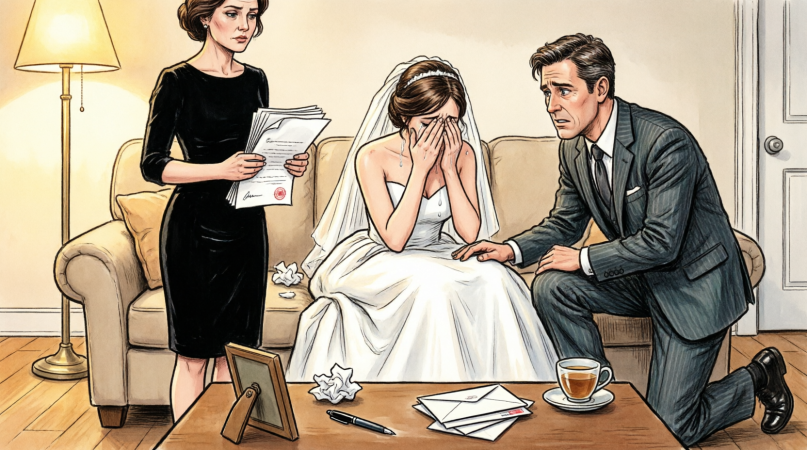
Elena opened it and found Sofía in her wedding dress, covered in blood.
The hallway light was bright enough to show everything. The torn back of the dress. The split lip. The swelling cheek. The purple marks on her arms. The way one shoe was missing.
Sofía tried to speak before her body gave out. “Mom, my mother-in-law slapped me 40 times because I refused to give her my apartment.”
Elena caught her as she fainted.
For several seconds, the building seemed to vanish around them. There was only the weight of Sofía, the smell of blood, the scratch of torn satin under Elena’s fingers, and the impossible fact that this had happened on her wedding night.
Inside the apartment, Elena laid Sofía on the sofa and reached for the phone. Sofía grabbed her wrist with surprising strength.
“Mom, don’t call the hospital,” she whispered. “They said that if I reported them, they would kill me.”
Elena felt the old terror rise, the kind she remembered from years of swallowing her own fear. But this time the fear did not make her quiet.
“Who told you that?” she asked.
Sofía closed her eyes. “Doña Carmen. Javier’s mother.”
Piece by piece, the story came out.
After the party, Javier took Sofía to the suite. She believed they were finally going to be alone. Instead, he left, saying he had something pending.
Twenty minutes later, Carmen entered with six women. They locked the door behind them. Sofía heard the click and understood too late that she had not been brought there as a wife.
She had been brought there as property under negotiation.
Carmen grabbed her by the hair and demanded to know when Sofía would put the Polanco apartment in her name. Sofía said never.
Then Carmen hit her.
Once. Again. Again. Sofía counted because counting was the only thing her mind could still control. By the time she reached 40, the room had blurred around the women’s laughter.
They told her a disobedient daughter-in-law had to be trained early. They said marriage meant obedience. They said good wives did not keep assets separate from the family they married into.
Elena asked the question that mattered most. “And Javier?”
Sofía’s face crumpled. “He was outside. He only said, ‘Mom, don’t hit her so much in the face because it will show tomorrow.’”
That sentence changed everything.
Not a misunderstanding. Not an argument. Not a mother-in-law losing control. A plan. A locked door. A witness outside who cared more about visible bruises than violence.
Elena wanted to scream. Instead, she moved carefully. She checked Sofía’s breathing. She placed clean cloth near the split lip. She photographed the visible injuries because instinct told her this night would become evidence.
She noted the time on the kitchen clock: 3:07 a.m. She saved the three missed calls from unknown numbers. She set aside the wedding envelope with the suite number written in gold ink.
Then she opened the cabinet and removed the folder containing Sofía’s deed and property records.
The apartment was still in Sofía’s name. That mattered. Paper can be cold, but sometimes cold paper is the only wall between a wounded woman and people who think fear transfers ownership.
Sofía saw the phone in Elena’s hand and shook her head. “Mom, Dad hasn’t spoken to us in years.”
Elena looked at her daughter’s bloodied dress. “But you are still his daughter.”
She dialed Alejandro’s number for the first time in almost ten years.
He answered in a hoarse voice. “Elena?”
She did not soften the truth. “Your daughter was left half-dead on her wedding night.”
There was silence on the line. Then Alejandro said, “Send me the address. I’m on my way.”
For the next 30 minutes, Elena held Sofía while the city outside continued as if nothing had happened. Cars passed. A dog barked somewhere below. The refrigerator hummed.
Sofía drifted in and out, waking each time with a small gasp, as though part of her was still in that locked hotel suite.
When the doorbell rang, Elena felt her whole body tighten. She looked through the peephole and saw Alejandro standing there, pale, disheveled, and stripped of every polished defense he had once carried.
When he saw Sofía, he knelt beside the sofa.
“Daughter…”
Sofía opened her swollen eyes. “Dad…”
The word broke him. He covered her legs with his jacket, careful not to touch her bruises. For a long moment, he could not speak.
Then the lawyer in him returned, but not the cold one Elena remembered. This was something sharper. A father finally understanding the cost of absence.
“Tell me exactly what they asked for,” he said.
Elena pointed to the deed folder, the wedding envelope, the phone, the missed calls, and the photographs she had already taken. Alejandro looked at each item as if building a case in his mind.
Then his phone rang.
The caller was Javier.
Alejandro answered and put the call on speaker without saying hello. Javier’s voice came through smooth, annoyed, and far too confident.
“Tell Sofía to calm down. My mother only wants the transfer papers signed before noon. If she makes this public, she knows what happens.”
No one moved.
Sofía stopped crying. Elena looked at Alejandro. Alejandro pressed record.
Javier continued, making the mistake arrogant men often make when they believe fear is the same as control. He mentioned the apartment. He mentioned Carmen. He mentioned the threat again.
Alejandro let him speak.
When Javier finally paused, Alejandro leaned toward the phone. His voice was quiet, but there was nothing weak in it.
“This is Alejandro,” he said. “Sofía’s father. You have just threatened my daughter on a recorded call after she arrived injured from your hotel suite.”
Javier went silent.
Alejandro continued. “Listen carefully. You will not contact her again. Your mother will not contact her again. The apartment will never be transferred. And by sunrise, every word you just said will be in the hands of people who know exactly what to do with it.”
Javier tried to laugh. It came out thin.
Carmen took the phone next. Her voice was colder than Javier’s. She called Sofía dramatic. She said newly married women sometimes exaggerate. She said families handled these matters privately.
That was when Elena spoke.
“No,” she said. “Families like yours depend on privacy. My daughter is done giving it to you.”
Carmen hung up.
They took Sofía to the hospital despite her fear. Alejandro drove. Elena sat in the back with Sofía’s head in her lap. At intake, the nurse’s expression changed the moment she saw the bruises.
The hospital record documented facial swelling, split lip, contusions on both arms, and trauma across her back. The physician asked whether Sofía felt safe returning to her husband.
Sofía looked at Elena, then Alejandro. “No,” she said.
It was small. It was shaking. But it was the first full truth she had spoken without apology.
Alejandro contacted a criminal attorney he trusted and a family lawyer before sunrise. Elena gave them the photos, the call recording, the suite number, the wedding timeline, and copies of the deed.
By the following morning, the Robles family was no longer dealing with a frightened bride and her mother. They were dealing with documentation.
Carmen tried to control the story first. She told relatives Sofía had become hysterical after drinking. She said Elena had always hated Javier. She said Alejandro was trying to punish his ex-wife through the marriage.
But lies have trouble surviving timestamps.
The hotel confirmed the suite booking. Staff remembered Carmen and six women entering the hallway after midnight. Security footage showed Sofía leaving alone, injured, and unsteady.
The call recording placed Javier’s threat after the assault. The property documents proved motive. The hospital report proved injury. Sofía’s statement gave the violence a voice.
Javier’s polished image began to crack. Carmen’s friends stopped speaking so confidently. The six women who had laughed in the suite discovered that laughter sounds different when described in a formal complaint.
The apartment remained untouched.
That became Elena’s anchor. In the days that followed, when Sofía woke crying, when fear made her ask whether she had ruined her own marriage, Elena would open the folder and remind her daughter what was true.
Her name was on the deed. Her body belonged to her. Her silence was not part of anyone’s tradition.
Alejandro stayed. Not perfectly, not magically, not as if ten years of absence could be repaired by one night of fury. But he stayed through statements, hospital visits, legal meetings, and the slow work of making Sofía feel believed.
One afternoon, Sofía asked Elena whether she should have seen it sooner.
Elena remembered Carmen’s perfume, Javier’s clean smile, the way greed had entered her living room speaking politely. She took Sofía’s hand.
“People like that train you to doubt the alarm before they ever touch the door,” she said. “You survived because some part of you still knew the apartment was yours.”
Sofía cried then, but differently. Not from terror. From the painful return of herself.
The case did not heal her overnight. Nothing real does. There were statements, legal consequences, family pressure, and long mornings when the wedding dress still existed in Elena’s mind like a white flag dragged through blood.
But Sofía did not go back to Javier.
The Polanco apartment stayed in her name. The deed stayed clean. The threats that had sounded powerful in a locked hotel suite became evidence once dragged into daylight.
Months later, Sofía stood in that apartment with sunlight across the floor and said she wanted to change the locks, repaint the bedroom, and start again.
Elena looked at her daughter and remembered the night she arrived at 3:00 in the morning, covered in blood, whispering that her mother-in-law had slapped her 40 times because she refused to give up her apartment.
That sentence had been a wound. Now it was also proof.
Proof that Sofía had said no. Proof that they had tried to break her for it. Proof that even terrified, even bleeding, even threatened, she had protected the one thing they wanted most.
For the first time since that wedding night, Elena saw hope in her daughter’s eyes without having to search for it.
Not a spark anymore.
A flame.